- Market Value (2025): USD 417.05 Mn
- Estimated Value (2026): USD 458.0 Mn
- Forecast Value (2036): USD 1155.9 Mn
- CAGR (2026-2036): 9.7%
What is the UV Cure Adhesive Gels Market forecast to be worth by 2036?
USD 1155.9 million by 2036 at 9.7% CAGR.
- The UV Cure Adhesive Gels Market reached USD 417.05 million in 2025.
- Demand is projected to increase from USD 458.0 million in 2026 to USD 1155.9 million by 2036.
- The market is forecast to record a 9.7% CAGR from 2026 to 2036.
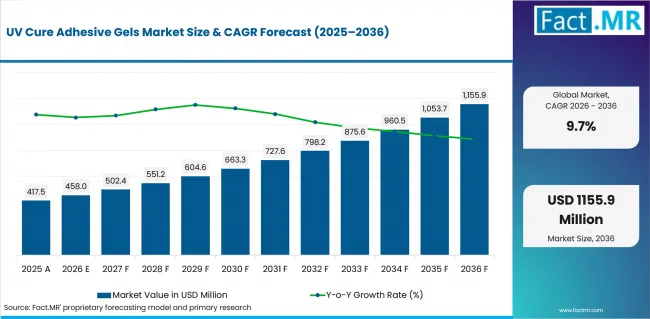
Uv Cure Adhesive Gels Market Value Analysis | Source: Fact.MR
What are the defining numbers behind UV Cure Adhesive Gels Market growth?
An absolute opportunity of USD 702.0 million is expected between 2026 and 2036.
- Demand Drivers in the Market
- Electronics assembly requires materials that cure within a defined station time while maintaining adhesion or protection on the finished assembly. Buyers therefore qualify the formulation and the exposure process together.
- Urethane-acrylate gel supports rapid light-initiated cure and can be adjusted for viscosity, flexibility or optical behaviour. This gives formulators a practical base for the applications listed in the stated taxonomy.
- UV plus heat leads its 2026 segment because installed equipment and package geometry favour its operating window. RadTech and IPC guidance show that spectral output, thickness and shadowing must be considered during qualification.
- Public semiconductor and electronics programmes in the USA and East Asia are adding assembly and packaging capacity. Each new line creates demand for qualified coatings, encapsulants or adhesive gels with local process support.
- Manufacturers are replacing manual cure judgements with controlled UV dose and inspection. Materials that support fluorescence, traceable recipes and a wider cure window reduce rework and improve repeatability.
- Key Segments Analyzed
- Urethane-acrylate gel accounts for 33.0% of Chemistry in 2026, supported by formulations that combine rapid light curing with the flexibility imparted by urethane segments.
- UV plus heat holds 28.0% of Cure Trigger in 2026 because UV exposure can secure the visible material first, while subsequent heating completes cure in shadowed or opaque areas.
- Electronics assembly represents 43.0% of Application in 2026 as non-sag gels can hold components, reinforce wires and remain precisely placed during automated dispensing and curing.
- Electronics manufacturers capture 39.0% of End User in 2026 because they define material specifications and control the production line where dispensing, curing and inspection are integrated.
- Analyst Opinion at Fact.MR
- Shambhu Nath Jha, Principal Consultant at Fact.MR, states, "Buyer decisions in the UV Cure Adhesive Gels Market will centre on non-sag bond lines, immediate light fixation and a secondary cure route for shaded joints. Buyers will compare the 2026 segment leaders with qualification evidence and the operating cost of the full process. Suppliers that support application trials and preserve formulation or equipment consistency can move more quickly into repeat production."
- Strategic Implications
- Suppliers should document the process conditions that allow Urethane-acrylate gel to deliver repeatable performance.
- Customer trials should use the intended substrate, fluid path or process stream before commercial qualification.
- Regional technical support is important in China and Japan because adoption depends on local production or infrastructure conditions.
- Commercial positioning should distinguish qualified application performance from general material or equipment capability.
How does the UV Cure Adhesive Gels Market break down by segment?
The market is segmented by Chemistry, Cure Trigger, Application and End User.
Why does Urethane-acrylate gel lead Chemistry?
Urethane-acrylate gel is projected to account for a 33.0% share in 2026.
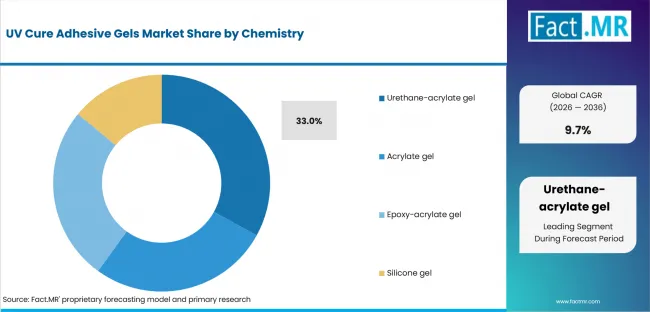
Uv Cure Adhesive Gels Market Analysis By Chemistry | Source: Fact.MR
Urethane-acrylate formulations combine the fast response of light-curable acrylates with the flexibility associated with urethane-modified networks. This makes them suitable for electronic assemblies that experience movement or thermal cycling after cure. Henkel markets acrylate-urethane light-cure adhesives for electronic and wearable assemblies, while Dymax also uses urethane-acrylate chemistry in electronics applications requiring resistance to heat and humidity.
The gel structure adds placement control. Non-flowing or thixotropic formulations can retain bead shape around components and mixed-material interfaces, helping manufacturers keep adhesive away from adjacent electrical features during dispensing.
Why does UV plus heat lead Cure Trigger?
UV plus heat is projected to account for a 28.1% share in 2026.
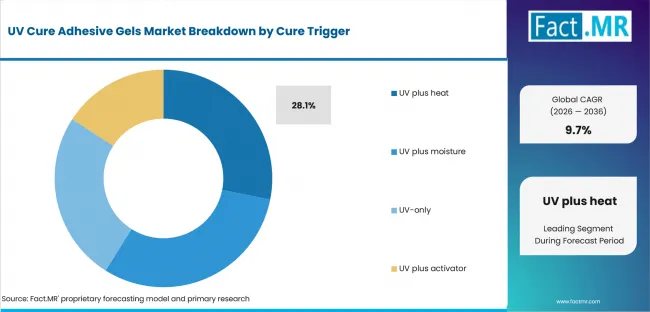
Uv Cure Adhesive Gels Market Analysis By Cure Trigger | Source: Fact.MR
UV plus heat addresses a practical limitation of light curing: portions of an assembly may be hidden beneath components or opaque housings. The exposed adhesive can be fixed quickly with UV light, while a secondary thermal step completes cure in areas the light cannot reach. Henkel's dual-cure electronics adhesives use this sequence, with UV exposure followed by low-temperature thermal cure for temperature-sensitive components.
The approach preserves handling speed while extending cure coverage across more complex geometries. Dymax similarly offers UV/heat systems in which exposed material cures within seconds and shadowed regions complete cure through heat exposure.
Why does Electronics assembly lead Application?
Electronics assembly is projected to account for a 43.1% share in 2026.
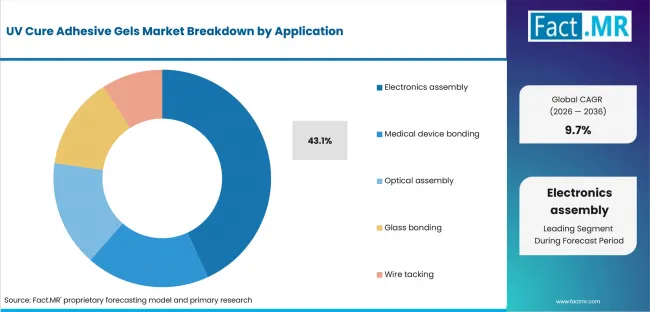
Uv Cure Adhesive Gels Market Analysis By Application | Source: Fact.MR
Electronics assembly creates several uses for controlled light-curable gels, including component tacking, wire reinforcement, encapsulation and protection around densely packed circuit-board features. Materials can be dispensed close to the component and cured within the same automated work cell, reducing the time between placement and subsequent assembly operations. Dymax specifically positions dual-cure materials for printed circuit boards and other electronic assemblies where shadow areas must also be addressed.
Process inspection is another reason for adoption. Fluorescent formulations allow deposited material to be checked under UV illumination, including through automated vision systems. This gives manufacturers a practical method for confirming coating or adhesive coverage before the assembly advances further down the line.
Why do Electronics manufacturers lead End User?
Electronics manufacturers are projected to account for a 39.2% share in 2026.
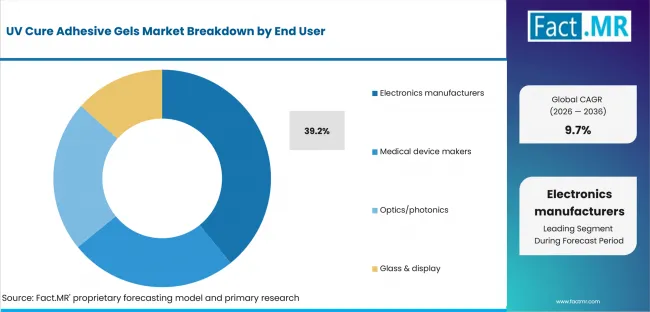
Uv Cure Adhesive Gels Market Analysis By End User | Source: Fact.MR
Electronics manufacturers typically control the production conditions that determine whether a gel formulation can be approved. Material viscosity must suit the dispensing equipment, while cure depth and secondary-cure behaviour must match component geometry and line speed. Suppliers therefore qualify materials against the actual assembly process rather than against chemistry specifications alone.
The cost of an unsuitable material also falls directly on the manufacturer through rework or interrupted production. This encourages plant-level trials covering dispensing behaviour, cure performance and inspection before a formulation is approved for volume use. The availability of electronics-specific dual-cure products from Henkel, Dymax and Panacol reflects this close connection between material selection and manufacturing-process qualification.
What is accelerating UV Cure Adhesive Gels Market adoption, and what is holding it back?
Drivers Impact Analysis
| Factor | (~) % Impact on CAGR | Geographic Relevance | Impact Timeline |
|---|---|---|---|
| Non-sag placement of urethane-acrylate gels in compact electronic assemblies | +2.6% | China, South Korea, Japan, USA and Europe | Short term (<= 2 years) |
| UV plus heat curing for shadowed and partially enclosed components | +2.1% | Japan, South Korea, Taiwan, USA and Germany | Medium term (2-4 years) |
| Automated dispensing and curing in electronics assembly | +1.6% | China, South Korea, Japan, USA and Europe | Long term (>= 4 years) |
Source: Fact.MR analysis. Updated Aug 12, 2026
Opportunity Impact Analysis
| Factor | (~) % Impact on CAGR | Geographic Relevance | Impact Timeline |
|---|---|---|---|
| Lower-stress dual-cure gels for temperature-sensitive components | +1.4% | China, Taiwan, Japan, South Korea and USA | Short term (<= 2 years) |
| UV-LED-compatible gels for lower-heat curing processes | +1.1% | Japan, South Korea, China, USA and Europe | Medium term (2-4 years) |
| Expansion into medical, optical and other precision-electronics applications | +0.8% | USA, Japan, Germany, South Korea and China | Long term (>= 4 years) |
Source: Fact.MR analysis. Updated Aug 12, 2026
Restraints Impact Analysis
| Factor | (~) % Impact on CAGR | Geographic Relevance | Impact Timeline |
|---|---|---|---|
| Incomplete cure in shadowed or inaccessible areas | -1.3% | Global | Short term (<= 2 years) |
| Adhesion variability across mixed substrates and surface conditions | -1.0% | Global | Medium term (2-4 years) |
| Added qualification requirements for dual-cure materials and processes | -0.7% | Global | Long term (>= 4 years) |
Source: Fact.MR analysis. Updated Aug 12, 2026
Which countries are scaling the UV Cure Adhesive Gels Market through 2036?
- Japan: Japan has established semiconductor, automotive and precision-electronics production with demanding reliability requirements.
- South Korea: South Korea combines memory, display and electronics manufacturing with automotive and battery investment.
- Taiwan: Taiwan has a concentrated semiconductor and advanced-packaging ecosystem where materials and dispensing processes are qualified close to foundry and OSAT lines.
- USA: The USA combines advanced packaging investment with aerospace, medical and power-electronics applications.
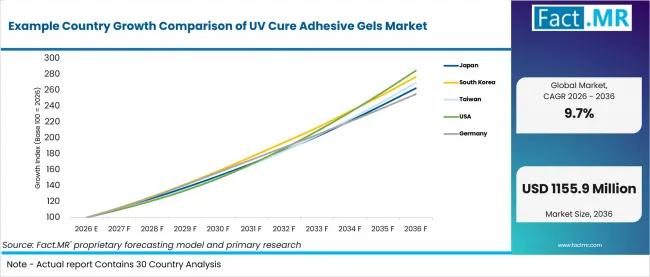
Example Country Growth Comparison Of Uv Cure Adhesive Gels Market | Source: Fact.MR
| Country | CAGR (2026-2036) |
|---|---|
| Japan | 10.3% |
| South Korea | 10.6% |
| Taiwan | 10.6% |
| USA | 10.6% |
Source: Fact.MR analysis. Updated Aug 12, 2026
What is driving Japan's growth through 2036?
Japan is forecast to expand at a 10.3% CAGR from 2026 to 2036.
Japan is expanding domestic semiconductor capability while retaining a substantial base in automotive and precision electronics. METI selected Rapidus for support under Japan’s next-generation semiconductor programme and intends to invest JPY 100 billion through the Information-technology Promotion Agency from the fiscal 2025 budget.
AIST is also establishing an open semiconductor R&D centre in Chitose alongside the emerging Rapidus cluster. More domestic development and pilot activity increases the number of assemblies where suppliers can qualify dual-cure gels for cure depth, adhesion and stress performance before volume production.
What is driving South Korea's growth through 2036?
South Korea is forecast to expand at a 10.6% CAGR from 2026 to 2036.
South Korea’s semiconductor ecosystem combines large-scale device manufacturing with dedicated support for materials, parts and equipment suppliers. The government’s semiconductor support package includes an KRW 18.1 trillion financial programme, while its ecosystem fund is directed toward materials, components, equipment and fabless companies.
This matters for dual-cure gels because material approval is closely tied to the production process. Local electronics and semiconductor manufacturers can work directly with suppliers on viscosity, UV exposure and secondary thermal cure, reducing the risk of incomplete cure around shadowed components.
What is driving Taiwan's growth through 2036?
Taiwan is forecast to expand at a 10.6% CAGR from 2026 to 2036.
Taiwan’s advanced-packaging sector is adding new production and testing capacity around its semiconductor manufacturing base. The Ministry of Economic Affairs reported that ASE-related companies and partners will invest NT$17.8 billion in advanced packaging and testing facilities at the Nanzih Technology Industrial Park.
Additional packaging lines create more qualification points for gels used around components and package interfaces. UV plus heat formulations are relevant where exposed material can be fixed rapidly while secondary thermal curing reaches regions shielded from direct light.
What is driving the USA's growth through 2036?
The USA is forecast to expand at a 10.6% CAGR from 2026 to 2036.
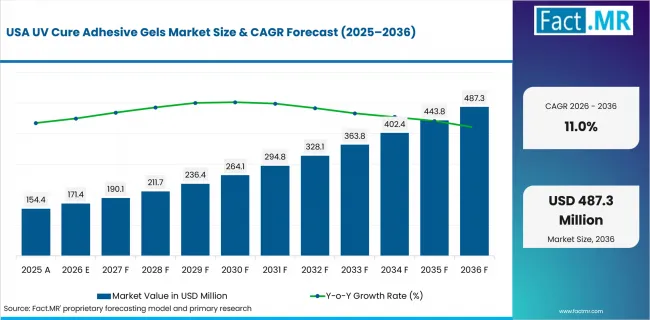
Uv Cure Adhesive Gels Market Country Value Analysis | Source: Fact.MR
The USA is expanding domestic advanced semiconductor packaging, creating new pilot and manufacturing environments for electronic materials. The U.S. Department of Commerce finalized USD 1.4 billion in awards under the CHIPS National Advanced Packaging Manufacturing Program to support technologies moving from development into scaled domestic production.
Separate CHIPS investments are also adding advanced packaging capability at commercial facilities. GlobalFoundries received additional support for advanced packaging at its Malta, New York site, while other programmes are building packaging and test infrastructure. These investments broaden the application base for dual-cure gels that must combine short handling times with reliable cure around complex electronic geometries.
Who leads the UV Cure Adhesive Gels Market?
Dymax is positioned as a leading supplier through electronics materials and application support. DELO Industrial Adhesives and Henkel compete through light-curable formulations and process-development capability.
Competition is determined by cure-window stability and adhesion on mixed substrates. Buyers also assess fluorescence, shelf life and support for lamp or UV-LED qualification.
Regional application laboratories matter because dispense geometry and cure equipment change the usable process window.
Which companies are the key providers?
Key companies include Dymax; DELO Industrial Adhesives; Henkel; Panacol-Elosol; Permabond; and Master Bond.
- Dymax
- DELO Industrial Adhesives
- Henkel
- Panacol-Elosol
- Permabond
- Master Bond
Bibliography
- U.S. Environmental Protection Agency. (2001). Ultraviolet and Electron Beam Cured Coatings, Inks and Adhesives. U.S. Government.
- IPC. (2018). IPC-CC-830C: Qualification and Performance of Electrical Insulating Compound for Printed Wiring Assemblies. IPC.
- IPC. (2013). IPC-HDBK-830: Guidelines for Design, Selection and Application of Conformal Coatings. IPC.
- RadTech International North America. (2013). The State of UV-LED Curing: An Investigation of Chemistry and Applications. RadTech.
- U.S. Department of Commerce. (2025). CHIPS for America Advanced Packaging Manufacturing Program. U.S. Government.
- Ministry of Industry and Information Technology, China. (2026). Development of the Electronic Information Manufacturing Industry in 2025. Government of China.
- Ministry of Economy, Trade and Industry, Japan. (2025). Strategy for Semiconductor and Digital Industry Revitalization. Government of Japan.
- Ministry of Trade, Industry and Energy, Republic of Korea. (2025). High-Tech Strategic Industry and Materials Development Measures. Government of the Republic of Korea.
- Ministry of Economic Affairs, Taiwan. (2026). Advanced Semiconductor Research and Development and Packaging Support. Government of Taiwan.
- Dymax. (2026). Light-Curable Adhesive Gels. Dymax.
- DELO Industrial Adhesives. (2026). Dual-Cure Adhesives for Electronics Assembly. DELO.
This Report Answers
- The report examines demand across Chemistry, Cure Trigger, Application, End User.
- Segment analysis explains the operating reason behind each leading category.
- Country analysis evaluates the listed markets and adoption conditions through 2036.
- Competitive analysis reviews the listed companies and clarifies ownership or research roles where relevant.
- The analysis considers qualification, process control and application fit that influence purchasing decisions.
What does the UV Cure Adhesive Gels Market cover?
UV-curable adhesive gels with high-viscosity, non-slump rheology for precise dispensing and rapid fixturing in electronics, medical device and optical assembly.
The assessment follows the stated segmentation by Chemistry, Cure Trigger, Application, End User. Revenue is counted only where the stated product or equipment is sold for the listed applications.
What is included in the scope?
The scope includes Acrylate gel, Urethane-acrylate gel, Epoxy-acrylate gel, Silicone gel.
It also covers UV-only, UV plus moisture, UV plus heat, UV plus activator.
Demand is assessed across Application: Electronics assembly, Medical device bonding, Optical assembly, Glass bonding, Wire tacking; End User: Electronics manufacturers, Medical device makers, Optics/photonics, Glass & display.
What is excluded from the scope?
Conventional solvent-borne or ambient-cure materials without a UV-curing function are excluded.
UV lamps, LED heads and dispensing equipment are excluded as standalone revenue.
General coatings or adhesives are outside the market when they are not qualified for the listed applications.
How Was the Analysis Built?
The analysis combines product scope, segment demand, country outlook and supplier coverage.
- Primary Research: Interviews focus on formulation suppliers, UV-equipment specialists, electronics manufacturers and application engineers.
- Desk Research: The review covers UV-curing guidance, electronics standards, semiconductor investment and supplier technical documents.
- Market Sizing and Forecasting: Estimates combine application production, material consumption per assembly, realized pricing, chemistry mix and cure-system penetration.
- Data Validation and Update Cycle: Findings are checked against public evidence and supplier portfolios. Updates review formulation changes, UV-LED conversion and electronics production capacity.
Segmentation
What is the report's scope and coverage?
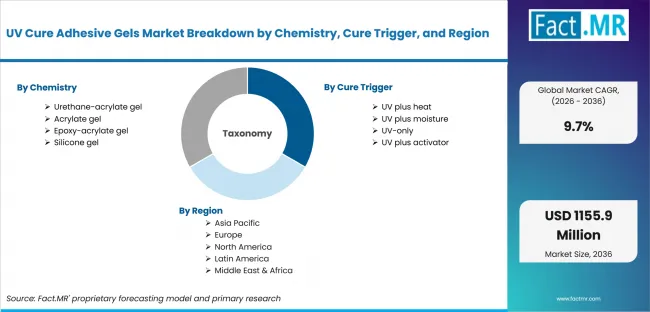
Uv Cure Adhesive Gels Market Breakdown By Chemistry, Cure Trigger, And Region | Source: Fact.MR
| Attribute | Details |
|---|---|
| Quantitative Units | USD Million |
| Market Definition | UV-curable adhesive gels with high-viscosity, non-slump rheology for precise dispensing and rapid fixturing in electronics, medical device and optical assembly. |
| Segments Covered | Chemistry; Cure Trigger; Application; End User |
| Regions Covered | North America; Latin America; Europe; East Asia; South Asia and Oceania; Middle East and Africa |
| Countries Covered | China; Japan; South Korea; Taiwan; USA |
| Key Companies Profiled | Dymax; DELO Industrial Adhesives; Henkel; Panacol-Elosol; Permabond; Master Bond |
| Forecast Period | 2026 to 2036 |
| Base Year | 2025 |
| Market Value, 2026 | USD 458.0 million |
| Market Value, 2036 | USD 1,160.0 million |
| CAGR, 2026-2036 | 9.7% |
| Absolute Opportunity | USD 702.0 million |
| Approach | Combines application production, material consumption per assembly, realized pricing, chemistry mix and cure-system penetration. |
Source: Fact.MR analysis. Updated Aug 12, 2026
How is the market segmented?
-
By Chemistry:
- Acrylate gel
- Urethane-acrylate gel
- Epoxy-acrylate gel
- Silicone gel
-
By Cure Trigger:
- UV-only
- UV plus moisture
- UV plus heat
- UV plus activator
-
By Application:
- Electronics assembly
- Medical device bonding
- Optical assembly
- Glass bonding
- Wire tacking
-
By End User:
- Electronics manufacturers
- Medical device makers
- Optics/photonics
- Glass & display
-
By Region:
- North America
- Latin America
- Western Europe
- Eastern Europe
- East Asia
- South Asia and Pacific
- Middle East & Africa
Frequently Asked Questions
What is the UV Cure Adhesive Gels Market value in 2026?
At what CAGR is the market projected to grow?
What is the projected market value by 2036?
Which Chemistry category leads the market?
Which Cure Trigger category leads the market?
Which Application category leads the market?
Which End User category leads the market?
What is the listed CAGR for China?
Which companies are assessed?
Who worked on this report


Preview the report firsthand - request a free sample
Free SampleGet the brochure for pricing and purchase details
Download PDF