- Base Value(2025): 250 Mn
- Estimated Value(2026): 257.75 Mn
- Forecast Value (2036): 349.77 Mn
- CAGR (2026 - 2036): 3.1%
Vernaldehyde Market Size, Market Forecast and Outlook By Fact.MR
In 2025, the vernaldehyde market was valued at USD 250 million. Based on Fact.MR analysis, demand for vernaldehyde is estimated to grow to USD 257.75 million in 2026 and USD 349.77 million by 2036. Fact.MR projects a CAGR of 3.1% during the forecast period from 2026 to 2036.
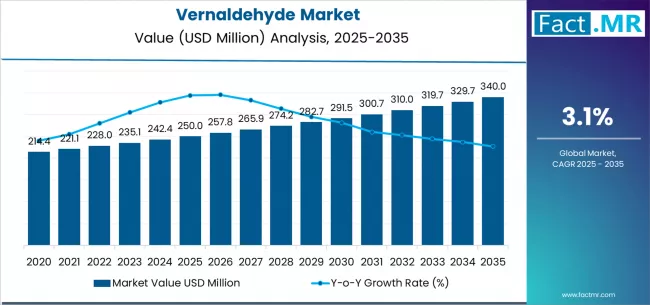
Vernaldehyde Market Market Value Analysis | Source: Fact.MR
Summary of Vernaldehyde Market
- Market Overview
- The market is valued at USD 250 million in 2025 and is projected to reach USD 349.77 million by 2036.
- The industry is expected to grow at a 3.1% CAGR from 2026 to 2036, creating an incremental opportunity of USD 92.02 million.
- The market is a fragrance-grade, purity-driven specialty aroma chemical category where olfactory profile consistency, IFRA compliance, and perfumer specification approval define supplier qualification.
- Demand and Growth Drivers
- Demand is sustained by fine fragrance and fabric care formulation cycles that require vernaldehyde as a green, ozone-type top note builder for fresh scent profiles in premium product lines.
- Personal care product penetration in India, China, and Southeast Asia is expanding the addressable base for aroma chemicals used in shampoos, body washes, and deodorant formulations.
- Pharmaceutical intermediate applications provide a secondary demand layer where vernaldehyde serves as a building block in specific active pharmaceutical ingredient synthesis pathways.
- Among key countries, India leads at 4.0% CAGR, followed by China at 3.6%, Germany at 3.0%, South Korea at 2.9%, USA at 2.8%, Japan at 2.6%, and France at 2.5%.
- Product and Segment View
- Vernaldehyde (2,4-dimethyl-3-cyclohexene-1-carboxaldehyde) is a synthetic aroma chemical delivering a characteristic green, ozone, fresh-cut grass olfactory profile used as a top note in fragrance compositions.
- Primary applications include fine fragrance formulation, fabric care and household product scenting, personal care product perfuming, and pharmaceutical intermediate synthesis.
- Purity 98% and above leads by Purity with 70.0% share in 2026, driven by fine fragrance and pharmaceutical applications requiring consistent olfactory and chemical specifications.
- Liquid Form dominates with 85.0% share in 2026, as fragrance compounding operations require pumpable, precisely doseable aroma chemical formats for blending line compatibility.
- Scope includes vernaldehyde in liquid and solid forms for fragrance, pharma intermediate, and industrial applications, excluding finished perfume products, essential oils, and natural aldehyde extracts.
- Geography and Competitive Outlook
- India and China are the fastest-growing markets, propelled by expanding personal care consumption, domestic fragrance compounding capacity, and aroma chemical production scale-up.
- Germany and France maintain high-value demand as the European fragrance compounding and luxury perfumery centres, with established perfumer specification approval pipelines.
- Competition centres on synthesis route efficiency, purity consistency at scale, IFRA compliance documentation, and long-term perfume house supply agreements, with key players including BASF SE, Lanxess AG, Symrise AG, International Flavors & Fragrances Inc., Takasago International Corporation, Firmenich SA, Mane SA, Zhejiang NHU Co. Ltd., Privi Speciality Chemicals Limited, Kao Chemicals, and Bedoukian Research Inc.
Vernaldehyde Market Key Takeaways
| Metric | Details |
|---|---|
| Industry Size (2026) | USD 257.75 million |
| Industry Value (2036) | USD 349.77 million |
| CAGR (2026 to 2036) | 3.1% |
Source: Fact.MR analysis. Updated Mar 27, 2026
Absolute dollar opportunity between 2026 and 2036 stands at approximately USD 92.02 million. Growth is steady and tied directly to premium fragrance formulation cycles, where vernaldehyde serves as a critical green, ozone-type note builder used across fine fragrance, fabric care, and personal care product lines. Demand correlates with consumer fragrance consumption patterns in developed markets and expanding personal care penetration in emerging economies. Raw material access to citral and linalool precursors introduces supply chain sensitivity, while competition from synthetic alternatives constrains pricing power for standard-grade material.
All major fragrance ingredient consuming markets reflect measured growth trajectories. India sets the pace at 4.0% CAGR as expanding personal care product penetration and domestic fragrance compounding capacity create sustained demand for aroma chemicals including vernaldehyde. China follows at 3.6%, supported by premium fragrance adoption among urban consumers and growing domestic aroma chemical production capability. Germany maintains 3.0% growth as the European fragrance compounding hub, serving luxury perfumery and household care product formulation. South Korea tracks at 2.9%. USA advances at 2.8%, sustained by fine fragrance reformulation cycles and fabric care innovation requiring fresh, ozone-type scent profiles. Japan expands at 2.6%, reflecting a mature personal care market with stable aroma chemical ingredient replacement demand. France registers 2.5% growth anchored by its position as the global luxury perfumery capital.
Why is the Vernaldehyde Market Growing?
Market expansion is being supported by the increasing demand for high-purity fragrance compounds and the corresponding need for high-efficiency chemical processing systems in vernaldehyde applications across global fragrance and pharmaceutical operations.
Modern chemical manufacturers are increasingly focused on advanced purification technologies that can improve product quality, reduce impurity levels, and enhance performance characteristics while meeting stringent regulatory requirements.
The proven efficacy of vernaldehyde in various industrial applications makes it an essential component of comprehensive fragrance formulation strategies and pharmaceutical intermediate programs.
The growing emphasis on chemical industry transformation and advanced quality optimization is driving demand for ultra-efficient vernaldehyde systems that meet stringent performance specifications and regulatory requirements for specialized applications.
Chemical manufacturers' preference for reliable, high-performance purification systems that can ensure consistent product quality is creating opportunities for innovative chemical technologies and customized industrial solutions.
The rising influence of regulatory compliance and quality control protocols is also contributing to increased adoption of premium-grade vernaldehyde systems across different industrial applications and chemical systems requiring advanced purification technology.
Opportunity Pathways - Vernaldehyde Market
The vernaldehyde market represents a specialized growth opportunity, expanding from USD 250.0 million in 2025 to USD 340.0 million by 2035 at a 3.1% CAGR. As manufacturers prioritize product quality, regulatory compliance, and performance optimization in complex chemical processes, vernaldehyde systems have evolved from a niche chemical technology to an essential component enabling quality enhancement, purity optimization, and multi-stage production across industrial operations and specialized chemical applications.
The convergence of industrial expansion, increasing chemical adoption, specialized manufacturing organization growth, and purity requirements creates momentum in demand. High-efficiency formulations offering superior performance characteristics, cost-effective liquid systems balancing purity with economics, and specialized solid variants for premium applications will capture market premiums, while geographic expansion into high-growth Asian chemical markets and emerging market penetration will drive volume leadership. Industrial emphasis on quality control and regulatory compliance provides structural support.
- Pathway A - ≥98% Purity Dominance: Leading with 70.0% market share, ≥98% purity applications drive primary demand through complex industrial workflows requiring comprehensive purification systems for specialized production. Advanced formulations enabling improved product quality, reduced impurity levels, and enhanced performance characteristics command premium pricing from manufacturers requiring stringent purity specifications and regulatory compliance. Expected revenue pool: USD 175.0-238.0 million.
- Pathway B - Fragrance Application Leadership: Dominating with 50.0% market share through optimal balance of performance and application versatility, fragrance applications serve most industrial processes while meeting quality requirements. This application addresses both performance standards and commercial considerations, making it the preferred choice for fragrance and chemical operations seeking reliable performance. Opportunity: USD 125.0-170.0 million.
- Pathway C - Asian Market Acceleration: India (4.0% CAGR) and China (3.6% CAGR) lead global growth through industrial infrastructure expansion, chemical production capabilities, and domestic vernaldehyde demand. Strategic partnerships with local manufacturers, regulatory compliance expertise, and supply chain localization enable the expansion of chemical technology in major industrial hubs. Geographic expansion upside: USD 60.0-85.0 million.
- Pathway D - Liquid Form Premium Segment: Liquid forms serve specialized applications requiring exceptional handling characteristics for critical chemical processing operations. Liquid formulations supporting complex processing requirements, industrial applications, and performance-sensitive processes command significant premiums from advanced chemical organizations and specialized manufacturing facilities. Revenue potential: USD 212.5-289.0 million.
- Pathway E - Advanced Purification & Processing Systems: Companies investing in sophisticated purification technologies, specialized processing systems, and automated quality control processes gain competitive advantages through consistent system performance and product quality reliability. Advanced capabilities enabling customized specifications and rapid deployment capture premium industrial partnerships. Technology premium: USD 50.0-75.0 million.
- Pathway F - Supply Chain Optimization & Quality Assurance: Specialized distribution networks, strategic inventory management, and reliable supply chain systems create competitive differentiation in industrial markets requiring consistent vernaldehyde availability. Companies offering guaranteed supply security, technical support, and regulatory documentation gain preferred supplier status with compliance-focused manufacturers. Supply chain value: USD 25.0-40.0 million.
- Pathway G - Emerging Applications & Market Development: Beyond traditional fragrance applications, vernaldehyde in specialty pharmaceuticals, novel chemical intermediates, and advanced processing systems represent growth opportunities. Companies developing new applications, supporting R&D initiatives, and expanding into adjacent industrial markets capture incremental demand while diversifying revenue streams. Emerging opportunity: USD 15.0-25.0 million.
Segmental Analysis
The market is segmented by purity, application, form, and region. By purity, the market is divided into ≥98% and <98%. Based on application, the market is categorized into fragrances, pharma intermediate, and others. By form, the market is divided into liquid and solid. Regionally, the market is divided into Asia Pacific, North America, Europe, Latin America, Middle East & Africa.
By Purity, ≥98% Segment Accounts for 70.0% Market Share
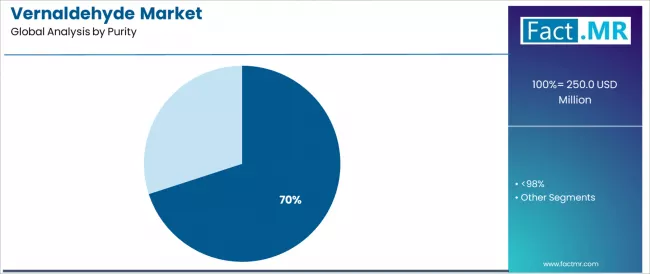
Vernaldehyde Market Analysis By Purity | Source: Fact.MR
The ≥98% purity segment is projected to account for 70.0% of the vernaldehyde market in 2025, reaffirming its position as the category's dominant purity grade. Manufacturers increasingly recognize the optimal balance of performance and quality assurance offered by ≥98% purity for most industrial applications, particularly in fragrance production and pharmaceutical processes. This purity grade addresses both performance requirements and regulatory considerations while providing reliable quality across diverse industrial applications.
This purity grade forms the foundation of most industrial protocols for chemical applications, as it represents the most widely accepted and commercially viable level of vernaldehyde purification technology in the industry.
Quality control standards and extensive industrial testing continue to strengthen confidence in ≥98% purity formulations among fragrance and pharmaceutical providers. With increasing recognition of the quality-performance optimization requirements in industrial operations, ≥98% purity systems align with both operational efficiency and product quality goals, making them the central growth driver of comprehensive industrial processing strategies.
By Application, Fragrances Segment Accounts for 50.0% Market Share
Fragrances is projected to represent 50.0% of vernaldehyde demand in 2025, underscoring its role as the primary application segment driving market adoption and growth. Manufacturers recognize that fragrance requirements, including complex formulation processes, specialized scent profiles, and multi-component systems, often require advanced vernaldehyde compounds that standard chemical technologies cannot adequately provide.
Vernaldehyde offers enhanced fragrance performance and regulatory compliance in specialized fragrance applications. The segment is supported by the growing nature of fragrance industry adoption, requiring sophisticated chemical systems, and the increasing recognition that advanced vernaldehyde technologies can improve fragrance performance and consumer outcomes.
Additionally, manufacturers are increasingly adopting evidence-based formulation guidelines that recommend specific vernaldehyde compounds for optimal fragrance development. As understanding of fragrance complexity advances and regulatory requirements become more stringent, vernaldehyde will continue to play a crucial role in comprehensive formulation strategies within the fragrance market.
By Form, Liquid Segment Accounts for 85.0% Market Share
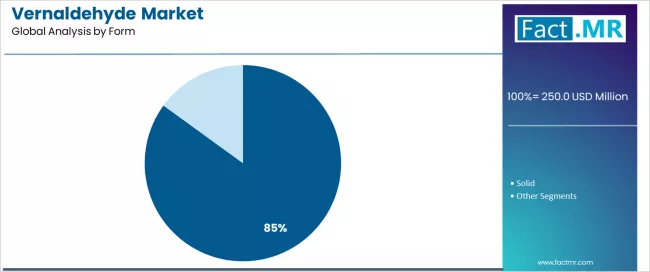
Vernaldehyde Market Analysis By Form | Source: Fact.MR
The liquid form segment is projected to dominate the vernaldehyde market with 85.0% market share in 2025, demonstrating its position as the preferred physical form for industrial applications.
Liquid vernaldehyde offers superior handling characteristics, processing efficiency, and integration capabilities compared to solid alternatives, making it the standard choice for most fragrance and pharmaceutical manufacturing operations. The liquid form enables easier incorporation into complex formulations and provides consistent performance across various processing conditions.
Industrial preference for liquid vernaldehyde stems from its compatibility with existing processing equipment, simplified handling procedures, and reduced processing complexity in large-scale manufacturing operations.
The segment benefits from established industrial infrastructure designed for liquid chemical processing and the operational advantages of liquid forms in automated manufacturing systems.
As industrial operations continue to prioritize efficiency and cost-effectiveness, liquid vernaldehyde maintains its dominant position through superior operational characteristics and processing advantages.
What are the Drivers, Restraints, and Key Trends of the Vernaldehyde Market?
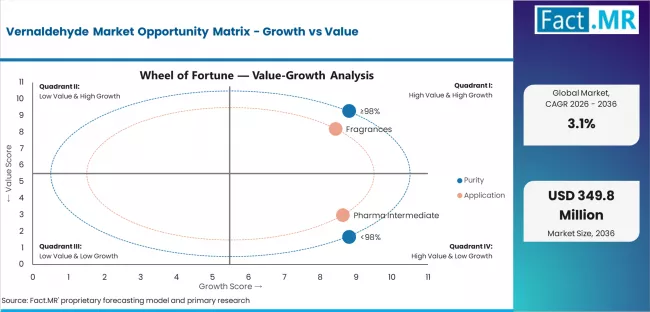
Vernaldehyde Market Opportunity Matrix Growth Vs Value | Source: Fact.MR
The vernaldehyde market is advancing steadily due to increasing recognition of specialty chemical technologies' importance and growing demand for high-efficiency purification systems across the fragrance and pharmaceutical sectors.
However, the market faces challenges, including complex synthesis processes, potential for quality variations during production and storage, and concerns about supply chain consistency for specialized chemical equipment. Innovation in chemical technologies and customized industrial protocols continues to influence product development and market expansion patterns.
Expansion of Advanced Chemical Facilities and Purification Technologies
The growing adoption of advanced chemical facilities is enabling the development of more sophisticated vernaldehyde production and quality control systems that can meet stringent industrial requirements.
Specialized chemical facilities offer comprehensive processing services, including advanced purification and quality assurance processes that are particularly important for achieving high-purity requirements in industrial applications. Advanced chemical facilities provide access to premium processing capabilities that can optimize product quality and reduce impurity levels while maintaining cost-effectiveness for large-scale chemical operations.
Integration of Digital Manufacturing Systems and Quality Management Systems
Modern chemical organizations are incorporating digital technologies such as real-time quality monitoring, automated purification systems, and supply chain integration to enhance vernaldehyde production and distribution processes.
These technologies improve product performance, enable continuous quality monitoring, and provide better coordination between producers and consumers throughout the supply cycle. Advanced digital platforms also enable customized purity specifications and early identification of potential quality deviations or supply disruptions, supporting reliable chemical production.
Analysis of the Vernaldehyde Market by Key Country
.webp "Top Country Growth Comparison Vernaldehyde Market Cagr (2026 2036)")
Top Country Growth Comparison Vernaldehyde Market Cagr (2026 2036) | Source: Fact.MR
| Country | CAGR (2026-2036) |
|---|---|
| India | 4.0% |
| China | 3.6% |
| Germany | 3.0% |
| South Korea | 2.9% |
| USA | 2.8% |
| Japan | 2.6% |
| France | 2.5% |
Source: Fact.MR analysis. Updated Mar 27, 2026
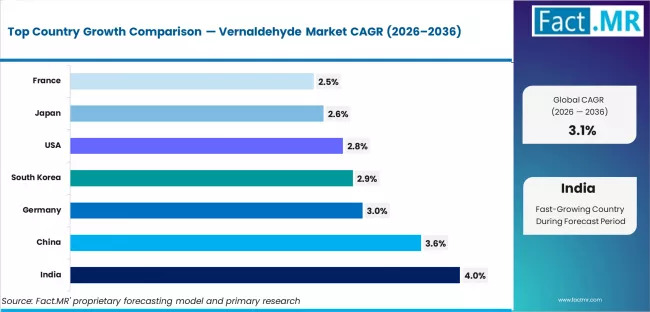
Vernaldehyde Market Cagr Analysis By Country | Source: Fact.MR
The vernaldehyde market is experiencing varied growth globally, with India leading at a 4.0% CAGR through 2036, driven by the expansion of chemical infrastructure development, increasing industrial production capabilities, and growing domestic demand for high-purity chemical systems.
China follows at 3.6%, supported by chemical expansion, growing recognition of advanced purification technology importance, and expanding manufacturing capacity. Germany records 3.0% growth, with a focus on developing the chemical technology and industrial processing industries.
USA shows 2.8% growth, representing a mature market with established industrial patterns and chemical frameworks. South Korea demonstrates 2.9% growth with focus on advanced chemical adoption.
Japan demonstrates 2.6% growth, emphasizing chemical infrastructure expansion and systematic industrial approaches. France demonstrates 2.5% growth, emphasizing chemical infrastructure expansion and systematic industrial approaches.
India Demonstrates Growing Market Potential with Chemical Infrastructure Development
Revenue from vernaldehyde in India is projected to exhibit robust growth with a CAGR of 4.0% through 2036, driven by ongoing chemical expansion and increasing recognition of high-purity chemical systems as essential industrial components for complex manufacturing processes.
The country's expanding chemical infrastructure and growing availability of specialized purification capabilities are creating significant opportunities for vernaldehyde adoption across both domestic and export-oriented manufacturing facilities.
Major international and domestic chemical companies are establishing comprehensive production and distribution networks to serve the growing population of manufacturers and chemical facilities requiring high-performance vernaldehyde systems across fragrance and pharmaceutical applications throughout India's major industrial hubs.
The Indian government's strategic emphasis on chemical industry modernization and industrial advancement is driving substantial investments in specialized purification capabilities.
This policy support, combined with the country's large domestic chemical market and expanding industrial requirements, creates a favorable environment for the vernaldehyde market development. Indian manufacturers are increasingly focusing on high-value chemical technologies to improve production capabilities, with vernaldehyde representing a key component in this industrial transformation.
- Government initiatives supporting chemical development and industrial modernization are driving demand for high-purity vernaldehyde systems throughout major chemical and manufacturing centers, including Mumbai, Delhi, and Bangalore regions.
- Production capacity expansion and purification system development are supporting appropriate utilization of vernaldehyde among manufacturers and chemical facilities nationwide, with particular growth in fragrance operations and pharmaceutical intermediate services.
China Demonstrates Exceptional Market Potential with Industrial Growth
Revenue from vernaldehyde in China is expanding at a CAGR of 3.6%, supported by increasing industrial accessibility, growing chemical awareness, and developing technology market presence across the country's major chemical clusters. The country's large chemical sector and increasing recognition of advanced purification systems are driving demand for effective high-purity chemical solutions in both fragrance and pharmaceutical applications. International chemical companies and domestic providers are establishing comprehensive distribution channels to serve the growing demand for quality vernaldehyde systems while supporting the country's position as an emerging chemical technology market.
China's chemical sector continues to benefit from favorable industrial policies, expanding manufacturing capabilities, and cost-competitive chemical infrastructure development. The country's focus on becoming a global chemical technology hub is driving investments in specialized purification technology and chemical processing infrastructure. This development is particularly important for vernaldehyde applications, as manufacturers seek reliable domestic sources for critical chemical technologies to reduce import dependency and improve supply chain security.
- Rising awareness about advanced chemical options and improving manufacturing capabilities are creating opportunities for specialized vernaldehyde systems across fragrance and pharmaceutical settings in major hubs like Beijing, Shanghai, and Guangzhou.
- Growing chemical infrastructure development and technology adoption are supporting increased access to high-purity vernaldehyde among organizations requiring comprehensive chemical capabilities, particularly in fragrance and pharmaceutical organizations.
USA Maintains Technology Leadership
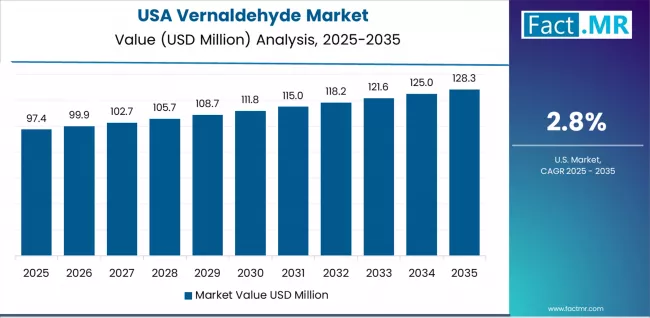
Vernaldehyde Market Country Value Analysis | Source: Fact.MR
USA's advanced chemical technology market demonstrates sophisticated industrial deployment with documented vernaldehyde effectiveness in chemical departments and manufacturing centers through integration with existing chemical systems and processing infrastructure. The country leverages industrial expertise in chemical technology and processing systems integration to maintain a 2.8% CAGR through 2036. Manufacturing centers, including major industrial areas, showcase premium installations where vernaldehyde systems integrate with comprehensive chemical information systems and processing platforms to optimize purification accuracy and operational workflow effectiveness.
American manufacturers prioritize system reliability and regulatory compliance in chemical development, creating demand for premium systems with advanced features, including quality validation and integration with US chemical standards. The market benefits from established chemical industry infrastructure and a willingness to invest in advanced vernaldehyde technologies that provide long-term operational benefits and compliance with regulatory requirements.
Germany Shows Strong Regional Leadership
Germany's market expansion benefits from diverse industrial demand, including chemical processing modernization in major industrial centers, purification development programs, and government chemical programs that increasingly incorporate vernaldehyde solutions for quality enhancement applications. The country maintains a 3.0% CAGR through 2036, driven by rising industrial awareness and increasing adoption of purification benefits, including superior chemical capabilities and reduced complexity.
Market dynamics focus on cost-effective vernaldehyde solutions that balance advanced chemical features with affordability considerations important to German industrial operators. Growing chemical infrastructure creates demand for modern purification systems in new manufacturing facilities and chemical equipment modernization projects.
Strategic Market Considerations:
- Chemical and fragrance segments leading growth with focus on quality enhancement and operational efficiency applications
- Regional industrial requirements are driving a diverse product portfolio from basic vernaldehyde systems to advanced purification platforms
- Import dependency challenges offset by potential local development partnerships with international chemical manufacturers
- Government chemical initiatives beginning to influence procurement standards and industrial requirements
South Korea Emphasizes Advanced Technology Integration
South Korea demonstrates strong market development with a 2.9% CAGR through 2036, distinguished by chemical operators' preference for high-quality vernaldehyde systems that integrate seamlessly with existing processing equipment and provide reliable long-term operation in specialized industrial applications. The market prioritizes advanced features, including precision purification algorithms, quality validation, and integration with comprehensive chemical platforms that reflect South Korean industrial expectations for technological advancement and operational excellence.
The South Korean government's strategic emphasis on chemical technology advancement and industrial innovation is driving substantial investments in specialized purification capabilities. This policy support, combined with the country's technology-focused industrial base and expanding chemical requirements, creates a favorable environment for the vernaldehyde market development. South Korean manufacturers are increasingly focusing on high-value chemical technologies to improve production capabilities, with vernaldehyde representing a key component in this industrial transformation.
- Government initiatives supporting chemical technology development and industrial modernization are driving demand for high-purity vernaldehyde systems throughout major chemical and manufacturing centers, including Seoul, Busan, and Incheon regions.
- Technology capacity expansion and advanced purification system development are supporting appropriate utilization of vernaldehyde among manufacturers and chemical facilities nationwide, with particular growth in high-tech operations and advanced chemical processing services.
Japan Emphasizes Precision and Quality Excellence
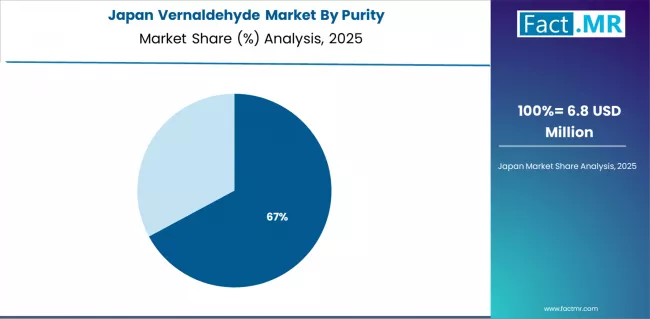
Vernaldehyde Market Japan Market Share Analysis By Purity | Source: Fact.MR
Japan demonstrates steady market development with a 2.6% CAGR through 2036, distinguished by chemical operators' preference for high-quality vernaldehyde systems that integrate seamlessly with existing processing equipment and provide reliable long-term operation in specialized industrial applications. The market prioritizes advanced features, including precision purification algorithms, quality validation, and integration with comprehensive chemical platforms that reflect Japanese industrial expectations for technological advancement and operational excellence.
Japanese manufacturers focus on system reliability and precision in chemical development, creating demand for premium systems with advanced features including automated quality monitoring and comprehensive technical support. The market benefits from established chemical research infrastructure and investment in purification technology that provides long-term industrial benefits.
Strategic Market Indicators:
- Premium focus on precision systems with advanced purification algorithms and high-reliability capabilities
- Integration requirements with existing chemical information systems and processing management platforms
- Emphasis on vernaldehyde reliability and long-term performance in industrial applications
France Shows Steady Development
France demonstrates consistent market development with a 2.5% CAGR through 2036, supported by established chemical industry presence and growing adoption of advanced purification technologies in fragrance and pharmaceutical applications. The country's strong fragrance industry heritage and established chemical processing capabilities create a stable foundation for vernaldehyde market growth, with particular emphasis on high-quality applications and premium chemical formulations.
French manufacturers focus on quality excellence and regulatory compliance in chemical development, creating demand for premium vernaldehyde systems with advanced purification capabilities and comprehensive documentation. The market benefits from established chemical industry infrastructure and strong research capabilities that support long-term market development.
Europe Market Split by Country
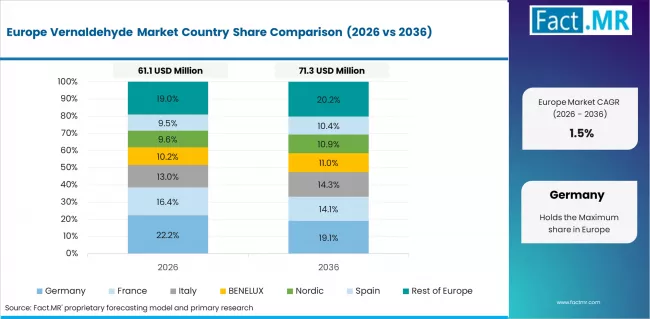
Vernaldehyde Market Europe Country Market Share Analysis, 2026 & 2036 | Source: Fact.MR
The vernaldehyde market in Europe is projected to represent a significant portion of global demand, with individual country performance varying across the region. Germany is expected to maintain its leadership position with a market value of USD 55.0 million in 2026, supported by its advanced chemical infrastructure, precision industrial processing capabilities, and strong manufacturing presence throughout major industrial regions.
UK follows with USD 40.0 million in 2026, driven by established chemical protocols, industrial innovation integration, and expanding specialty chemical networks serving both domestic and international markets.
France holds USD 35.0 million in 2026, supported by chemical infrastructure expansion and growing adoption of high purity vernaldehyde systems. Italy commands USD 30.0 million in 2026, while Spain accounts for USD 25.0 million in 2026. The Rest of Europe region, including Nordic countries, Eastern Europe, and smaller Western European markets, holds USD 65.0 million in 2026, representing diverse market opportunities with established chemical and industrial processing capabilities.
Competitive Landscape of the Vernaldehyde Market
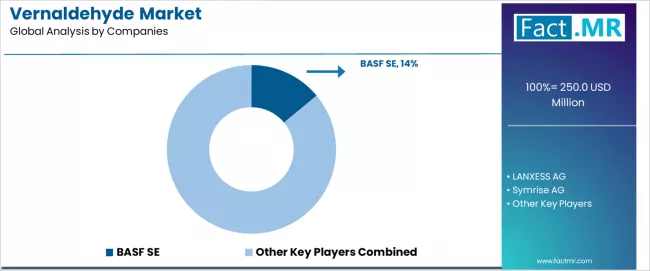
Vernaldehyde Market Analysis By Company | Source: Fact.MR
The vernaldehyde market is characterized by competition among established chemical companies, specialty purification companies, and industrial technology suppliers focused on delivering high-purity, consistent, and reliable vernaldehyde systems.
Companies are investing in purification technology advancement, quality control enhancement, strategic partnerships, and customer technical support to deliver effective, efficient, and reliable vernaldehyde solutions that meet stringent industrial and regulatory requirements. Quality optimization, performance validation protocols, and supply chain strategies are central to strengthening product portfolios and market presence.
BASF leads the market with 14.0% market share and comprehensive high purity vernaldehyde system offerings with a focus on quality consistency and purification reliability for industrial applications.
LANXESS provides specialized chemical systems with emphasis on industrial processing applications and comprehensive technical support services. Symrise focuses on advanced fragrance technologies and customized chemical solutions for purification systems serving global markets. IFF delivers established fragrance systems with strong quality control systems and customer service capabilities.
Takasago operates with a focus on bringing innovative chemical technologies to specialized industrial applications and emerging markets. Firmenich provides comprehensive chemical system portfolios, including advanced purification services, across multiple industrial applications and chemical processing operations.
Mane specializes in customized fragrance solutions and quality management systems for chemical systems with emphasis on regulatory compliance. Zhejiang NHU provides reliable supply chain solutions and technical expertise to enhance market accessibility and customer access to essential vernaldehyde systems.
Key Players in the Vernaldehyde Market
- BASF
- LANXESS
- Symrise
- IFF
- Takasago
- Firmenich
- Mane
- Zhejiang NHU
- Shinsei
- Privi
- Kao Chemicals
- Emerald Kalama
- Bedoukian
- PFW Aroma
- ACS Dobfar
Bibliography
- International Fragrance Association (IFRA). (2024). IFRA 51st Amendment: standards library update including use limits for cyclohexane carboxaldehyde derivatives. IFRA.
- European Chemicals Agency (ECHA). (2024). REACH registration dossier: 2,4-dimethyl-3-cyclohexene-1-carboxaldehyde (vernaldehyde) substance data. ECHA.
- Research Institute for Fragrance Materials (RIFM). (2024). RIFM safety assessment: vernaldehyde monograph update. RIFM.
- Euromonitor International. (2024). Global beauty and personal care industry: fragrance ingredient consumption trends 2023 to 2024. Euromonitor.
- United States Food and Drug Administration. (2024). Code of Federal Regulations Title 21, Part 172.515: synthetic flavoring substances and adjuvants. FDA.
- Indian Chemical Council. (2024). Annual review of Indian aroma chemicals and fragrance ingredients production: 2023 to 2024 statistics. ICC.
This bibliography is provided for reader reference. The full Fact.MR report contains the complete reference list with primary research documentation.
This Report Addresses
- Market sizing and quantitative forecast metrics detailing the precise ingredient expenditure dedicated to vernaldehyde procurement across fragrance, pharmaceutical, and industrial sectors through 2036.
- Segmentation analysis mapping the consumption patterns of high-purity and standard-grade vernaldehyde and evaluating the application-driven purity requirements across fine fragrance and pharma intermediate channels.
- Regional deployment intelligence comparing the expanding personal care and aroma chemical production bases in India and China against the established fragrance compounding centres in Germany and France.
- Regulatory compliance assessment analyzing how IFRA use limits, REACH substance registration, and RIFM safety assessments shape vernaldehyde sourcing specifications and market access.
- Competitive posture evaluation tracking synthesis route efficiency, purity consistency at scale, perfume house approval pipelines, and long-term fragrance ingredient supply agreements across leading aroma chemical producers.
- Supply chain vulnerability analysis identifying citral and linalool precursor pricing, synthesis capacity constraints, and logistics risks across major aroma chemical export corridors.
- Custom data delivery formats encompassing interactive dashboards, raw Excel datasets, and comprehensive PDF narrative reports.
Vernaldehyde Market Definition
Vernaldehyde, chemically known as 2,4-dimethyl-3-cyclohexene-1-carboxaldehyde, is a synthetic aroma chemical produced through Diels-Alder cycloaddition reactions using terpene-derived precursors. The compound delivers a characteristic green, ozone-like, fresh-cut grass olfactory profile that makes it a valued top note ingredient in fragrance compositions. Vernaldehyde is used by perfumers and fragrance compounders to construct fresh, natural-smelling accords in fine fragrances, fabric softeners, laundry detergents, shampoos, and body care products. Secondary applications include pharmaceutical intermediate synthesis where the aldehyde functionality serves as a building block for specific molecular targets. End buyers include fragrance houses, consumer goods companies, aroma chemical distributors, and pharmaceutical intermediate processors.
Vernaldehyde Market Inclusions
Market scope includes vernaldehyde in liquid and solid forms across fragrance-grade and pharmaceutical-grade purity levels. Coverage extends to global and regional market sizes, the 2026 to 2036 forecast period, and segment breakdowns by purity, application, and form. Pricing analysis for standard and high-purity grades and trade flow assessment across major aroma chemical supply corridors are incorporated.
Vernaldehyde Market Exclusions
The scope excludes finished fragrance compositions, consumer perfume products, and essential oils containing naturally derived aldehydes. Other cyclohexane-derived aroma chemicals not structurally identical to vernaldehyde fall outside the analytical boundary. Fragrance encapsulation technologies and delivery systems are explicitly omitted from the valuation.
Vernaldehyde Market Research Methodology
Primary Research: Analysts conducted structured consultations with aroma chemical production managers, fragrance house procurement leads, consumer goods scent development directors, and pharmaceutical intermediate buyers to map the decision triggers governing vernaldehyde grade selection and volume sourcing.
Desk Research: Data collection aggregated IFRA (International Fragrance Association) ingredient safety standards, REACH registration dossiers for vernaldehyde, fragrance industry association production statistics, and published aroma chemical company capacity disclosures.
Market-Sizing and Forecasting: Baseline values derive from a bottom-up aggregation of vernaldehyde shipment volumes by purity grade and application, applying fragrance consumption growth curves and personal care market penetration rates to project demand through 2036.
Data Validation and Update Cycle: Projections are cross-checked against publicly reported aroma chemical company revenue segments, fragrance house ingredient procurement patterns, and perfumery industry trade statistics.
Segmentation
Scope of the Report
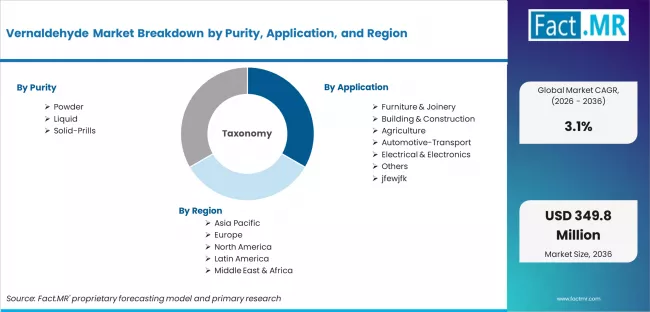
Vernaldehyde Market Breakdown By Purity, Application, And Region | Source: Fact.MR
| Metric | Value |
|---|---|
| Quantitative Units | USD 257.75 million to USD 349.77 million, at a CAGR of 3.1% |
| Market Definition | Vernaldehyde is a synthetic aroma chemical delivering a green, ozone-type olfactory profile, used as a top note in fragrance compositions for fine fragrances, fabric care, and personal care products. |
| Purity Segmentation | 98% and above, Below 98% |
| Application Segmentation | Fragrances, Pharma Intermediate, Others |
| Form Segmentation | Liquid, Solid |
| Regions Covered | North America, Latin America, Europe, East Asia, South Asia, Oceania, Middle East & Africa |
| Countries Covered | India, China, Germany, South Korea, USA, Japan, France, and 40 plus countries |
| Key Companies Profiled | BASF SE, Lanxess AG, Symrise AG, International Flavors & Fragrances Inc., Takasago International Corporation, Firmenich SA, Mane SA, Zhejiang NHU Co. Ltd., Privi Speciality Chemicals Limited, Kao Chemicals, Bedoukian Research Inc. |
| Forecast Period | 2026 to 2036 |
| Approach | Forecasting models apply a bottom-up methodology starting with global vernaldehyde shipment volumes by grade, applying fragrance consumption curves and personal care penetration rates, cross-validated against aroma chemical company revenue segments. |
Source: Fact.MR analysis. Updated Mar 27, 2026
Vernaldehyde Market by Segments
-
Purity :
- ≥98%
- <98%
-
Application :
- Fragrances
- Pharma Intermediate
- Others
-
Form :
- Liquid
- Solid
-
Region :
-
Asia Pacific
- China
- India
- Japan
- South Korea
- ASEAN
- Australia & New Zealand
- Rest of Asia Pacific
-
North America
- United States
- Canada
- Mexico
-
Europe
- Germany
- United Kingdom
- France
- Italy
- Spain
- Nordic
- BENELUX
- Rest of Europe
-
Latin America
- Brazil
- Argentina
- Chile
- Rest of Latin America
-
Middle East & Africa
- Kingdom of Saudi Arabia
- Other GCC Countries
- Turkey
- South Africa
- Other African Countries
- Rest of Middle East & Africa
-
Frequently Asked Questions
How large is the demand for vernaldehyde in the global market in 2026?
What will be the market size of vernaldehyde in the global market by 2036?
What is the expected demand growth for vernaldehyde in the global market between 2026 and 2036?
Which Purity level is poised to lead global sales by 2026?
How significant is the role of Fragrances in driving vernaldehyde adoption in 2026?
What is driving demand in India?
What is the India growth outlook in this report?
What is the main demand theme linked to France in its region coverage?
Who worked on this report


Preview the report firsthand - request a free sample
Free SampleGet the brochure for pricing and purchase details
Download PDF