- Base Value(2024): 242.4 Mn
- Forecast Value (2035): 1899 Mn
- CAGR (2035): 21.2%
Vertical Nanowires Market Outlook (2025 to 2035)
The global vertical nanowires market is expected to reach USD 1,899 Million by 2035, up from an estimated value of USD 296.7 Million in 2025. During the forecast period 2025 to 2035, the industry is projected to expand at a CAGR of 20.4%.
The vertical nanowires market is driven by rising demand for high-density memory and micro-LED displays, along with the push for energy-efficient nanoelectronics in computing and automotive systems. Rapid advancements in fabrication and packaging technologies are further accelerating adoption. In addition, the growing use of vertical nanowires in biosensing and healthcare applications is expanding their relevance, supporting global industries seeking enhanced performance, scalability, and sustainability.
2025-to-2035.webp "Us Vertical Nanowires Market Value(usd Million)2025 To 2035")
Us Vertical Nanowires Market Value(usd Million)2025 To 2035 | Source: Fact.MR
Quick Stats for Vertical Nanowires Market
- Industry Value (2025): USD 296.7 Million
- Projected Value (2035): USD 1,899 Million
- Forecast CAGR (2025 to 2035): 20.4%
- Leading Segment (2025): Semiconductor Nanowires (35% Market Share)
- Fastest Growing Country (2025-2035): China (23.2% CAGR)
- Top Key Players: NordAmps, Cambrios Technologies Corp., ACS Materials, LLC, Novarials Corporation, and Amprius Technologies.
What are the key factors driving growth in the Vertical Nanowires Market?
A key growth driver for the vertical nanowires market is the rapidly rising demand for high-density memory, advanced micro-LED displays, and next-generation processing technologies. These are of great interest to semiconductor and electronics developers since they can provide higher energy efficiency and performance, as well as higher performance in comparison with planar nanostructures.
The emergence of man-made intelligence, 5G/6G connectivity, and electric cars is introducing a high pull of sophisticated nanoscale materials. As well, the biosensing and medical diagnostics technology indicates the horizontal applicability of Vertical nanowires in healthcare industries. Sustainability initiatives that apply across the industry, targeting nanoelectronics that are long-life and recyclable, also increase adoption, which makes vertical nanowires a key enabler of higher-value electronic systems.
What are the key trends driving growth in the Vertical Nanowires market?
Another notable trend in the vertical nanowires market is the growing use of AI and digital twin simulations in device design, enabling faster innovation and accelerating product development cycles. Vertical nanowire systems using III-Vs, silicon, and hybrid materials are increasing the versatility of performance. Cross-industry attraction is demonstrated by increasing use in consumer electronics and micro-LEDs, biosensors, and renewable energy systems.
Co-development with research institutions is steered by OEM partnerships, and packs the latest with ultra-thin packaging, sustainable substrates, and eco-friendly shielding materials that align with the global sustainability vision. These trends demonstrate a good shift to scalability, reliability, and environmentally responsible nano-electronic devices.
What factors hinder the growth of the Vertical Nanowires market?
The vertical nanowires market faces notable limitations. Fabrication complexity and scale-up challenges remain significant barriers to consistent industrial outcomes, as achieving reliable performance requires highly advanced manufacturing infrastructure and precision engineering capabilities. Expensive manufacturing processes, and problems with ensuring homogeneity in material, and loss of control, can serve as factors that cap extensive use in the short future.
Also, long-term high-frequency operation and exposure to environmental conditions are manufacturing concerns. The commercialization might further be complicated by the regulatory trends related to e-waste, sustainability, and traceability of the supply chain. Lastly, horizontal planar semiconductor technologies also offer competitive threats and the vertical nanowires must prove their worth in terms of cost-performance benefits.
What are the key regional trends driving the Vertical Nanowires Market growth?
North America dominates the initiation of research and development and the initial commercialization of products, with Semiconductor foundries, startups and other innovation programs by the government. Vertical nanowire-based device investments are sustained by high demand in computing, healthcare and defense sectors.
Its most industrial segment is East Asia, where the consumer electronics, displays, and telecommunications industries of China, Japan, and South Korea incorporate vertical nanowires. Strong supply chains and the government reinforce the leadership.
The most developed are Western Europe, where sustainable nanoelectronics are in focus, and vertical nanowires are used in various automotive applications and in renewable energy and medical diagnostics. A research institution and OEM can undertake cooperative programs that can fast-track the transfer of technology to the marketplace.
Country-wise Outlook
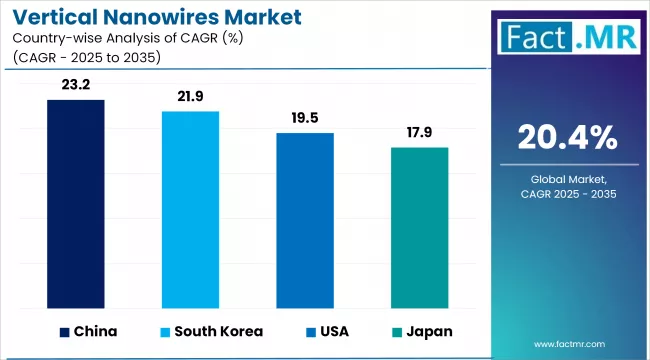
Vertical Nanowires Market By Country | Source: Fact.MR
Urban Tech Demand and Semiconductor Drive China’s Vertical Nanowires Market
The vertical nanowires market in China is expanding rapidly, fueled by substantial investments in the semiconductor sector, quantum computing initiatives, and renewable energy infrastructure. In its national plan to localize manufacture of high-tech applications, China is incorporating Vertical Nanowires within advanced logic chips, high-density memory and nanosensors. Such structures have increased surface area and electron mobility that facilitate next-gen electronics performance.
Commercialization is sped up by government support in the form of innovation zones and R&D funding, and the domestic fabs work with universities to promote scalable nanowire integration. Vertical Nanowires are another field that facilitates green technology, especially solar cells and high-efficiency batteries.
Precision Engineering and Clean Tech Drive Japan’s Vertical Nanowires Adoption
The vertical nanowires market in Japan benefits from the country’s expertise in precision nanofabrication and its strong legacy in microelectronics innovation and manufacturing. Its major growth areas are applications in high-performance sensors, neuromorphic computing and energy-efficient transistors. Japanese companies are exploiting vertical arrays of nanowires in microwatt logic circuits, photonic integration and in biosensing.
The academic and industrial research joint initiatives are geared toward the larger-scale tasks that can be productively realized through atomic-layer deposition and etching processes. Nano-enabled filtration and solar harvesting are driven by nano applications in the environment to create an eco-sustainable environment via the Japanese government's policy drive toward carbon neutrality.
Next-Gen Electronics and Foundry Expansion Fuel South Korea’s Market
The vertical nanowires market in South Korea is showing momentum as key players in the semiconductor and display industry consider nanoscale developments. Sub-2 nm monolithic transistors utilizing vertical nanowires are an essential component of next-generation FinFET scaling (such as Gate-All-Around (GAA)).
Tech giants are investing in pilot lines using nanowire-based FETs in sub-3nm nodes. Also, there are efforts to use Vertical Nanowires in optoelectronics, memory, and wearable devices, and in the development of both AI and IoT hardware, these are synergistic. R&D is being supported by governmental programs to promote semiconductor sovereignty and clean energy, and powerful international collaborations on material innovation.
Category-Wise Market Outlook
Semiconductor Nanowires Lead Growth Amid Rising Nanoelectronics Demand
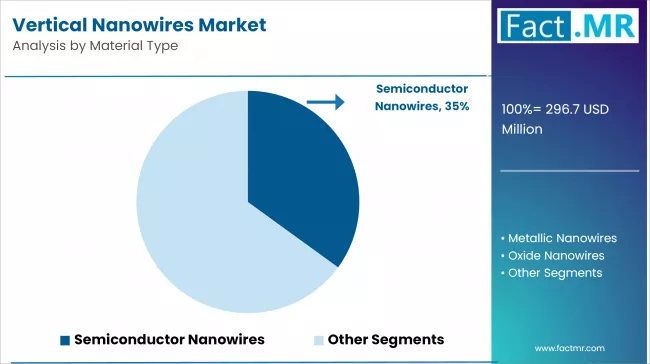
Vertical Nanowires Market By Material Type | Source: Fact.MR
Semiconductor nanowires are experiencing strong growth, driven by their crucial role in next-generation nanoelectronic devices and advancements in quantum computing. As they are most suited to logic and memory applications, they are semiconductors with tunable bandgap, high aspect ratio and also compatible with the CMOS platform. It enhances demand mainly because the amount of money invested in the research and commercialization of photodetectors, transistors, and photovoltaics is increasing, especially in the U.S., Europe and East Asia.
Vertical Nanowires (3D) Outpace Others as 3D Architectures Gain Favor
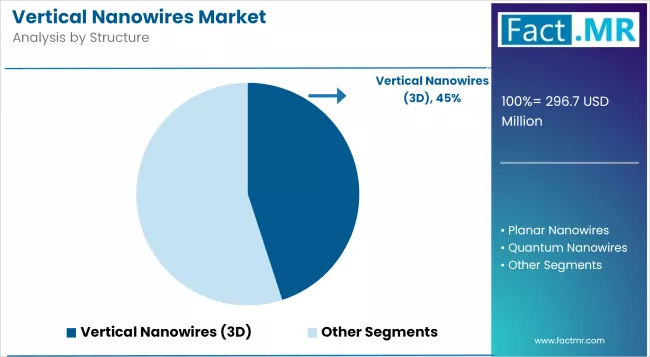
Vertical Nanowires Market By Structure | Source: Fact.MR
Vertical Nanowires (3D) are seeing rapid growth among structural types, supported by their high surface-to-volume ratio and strong scaling potential in 3D integrated circuits and neuromorphic computing applications. They allow dense assembly and vertical stacking, and overcome planar limits of miniaturization. The high demand for semiconductor fabs for advanced logic and memory chips is driving the advancement, particularly in South Korea and Taiwan.
Bottom-up Self-Assembly Booms with Low-Cost, High-Precision Fabrication
Momentum is building around Bottom-up Self-Assembly Techniques, which are becoming the preferred fabrication approach for vertical nanowires due to their scalability and cost efficiency. The methods can be used to make uniform nanostructures in which control on an atomic scale is critical, in photonic applications, sensing and energy storage. They are implemented in academic and industrial research and development, particularly in China, where nanotech funding is strong.
Competitive Analysis
Competitive Outlook: Vertical Nanowires Market
Innovators in the advanced materials, semiconductors, nanotechnology segments influence the Vertical Nanowires Market. NordAmps is advancing innovative nano-size transistors used in the next generation of electronics and Cambrios Technologies Corp. is busy developing a transparent conductive material that will result in flexible large displays. ACS Materials, LLC and Novarials Corporation are specialty nanomaterials producers of materials critical to the development of high-performance research and devices. Amprius Technologies uses vertical nanowires on silicon anodes to increase the efficiency of the lithium-ion battery. NanoTechLabs, Inc. and C3Nano, Inc. develop conductive nanostructures applicable to sensors and high-speed electronics.
Amerian Elements serves the industry with broad coverage of engineered nanomaterials. OneD Material, LLC is a company that specializes in the scalable injection of silicon nanowires in energetic storage systems. Alfa Chemistry adds materials to the range of experimental use, and Sisco Research Laboratories Pvt. Ltd. SRI provides quality nanomaterials to cater to research and commercial needs. Collectively, these businesses enhance material innovation, sensor design, energy applications and semiconductor scaleability and build upon the global vertical nanowire ecosystem.
Key players in the vertical nanowires industry are NordAmps, Cambrios Technologies Corp., ACS Materials, LLC, Novarials Corporation, Amprius Technologies, NanoTechLabs, Inc., C3Nano, Inc., American Elements, OneD Material, LLC, Alfa Chemistry, Sisco Research Laboratories Pvt. Ltd.
Recent Development:
- In July 2025, Aledia reported major progress toward commercialization of its silicon-based nanowire microLED architecture, highlighting readiness to translate R&D into products.
- In August 2025, NordAmps announced it will showcase high-frequency low-noise amplifiers built on InGaAs vertical nanowire transistors at Semicon Taiwan 2025, advancing RF front-end products.
Fact.MR has provided detailed information about the price points of key manufacturers of the Vertical Nanowires market positioned across regions, sales growth, production capacity, and speculative technological expansion, in the recently published report.
Methodology and Industry Tracking Approach
This report by Fact.MR is a global report on the Vertical Nanowires Market: The report gives a profound history of the product development journey, integration of materials, and commercialization tracks within the traversal of consumer electronics, automotive, medical, telecommunications, and industrial business tees, all enclosed in an innovation-driven ecosystem. The result of a survey in excess of 8,000 (a total of 38 countries) stakeholders, including 350+ tested contacts per country, the study provides unparalleled new insights into next-generation semiconductor engineering, AI-enabled nanowire design and modeling, sustainable manufacturing, and scale-up methodologies driving early adoption.
The maturing market trends noted include the development of vertical nanowire devices using AI / ML design, the rise in demand of recyclable and environmentally sustainable components, and the use of digital twin and advanced multiphysics simulation to enhance density, conductivity, and long-term reliability of vertical nanowires-based devices. The research provides a multidimensional outlook on the global shift to sustainable, high-performance nanoelectronics, based on 225 expert voices-IC designers, R&D managers, innovation leaders, supply chain architects, regulators, investors and policy advisors.
Based on a 2024-2025 benchmark time frame, the report records progress in substrate engineering (silicon, III-V semiconductors, and metal oxides), packaging developments and faster qualification testing (thermal cycling, electrical stress and fatigue analysis). Using 250+ validated data sets and in-depth modeling, the report determines the new paradigm of vertical nanowire innovation and commercial potential in the global markets.
Segmentation
Segmentation of Vertical Nanowires Market Research
-
By Material Type :
- Metallic Nanowires
- Semiconductor Nanowires
- Oxide Nanowires
- Composite / Hybrid Nanowires
-
By Structure :
- Planar Nanowires
- Vertical Nanowires (3D)
- Quantum Nanowires
- Multi-segmented / Core-shell Nanowires
-
By Fabrication Method :
- Chemical Vapor Deposition (CVD)
- Molecular Beam Epitaxy (MBE)
- Template-Assisted Growth (AAO templates, nanoimprint lithography)
- Electrochemical Deposition
- Laser Ablation & Thermal Evaporation
- Bottom-up Self-Assembly Techniques
-
By Application :
- Consumer Electronics
- Automotive Electronics
- Healthcare & Biomedical
- IT & Telecommunications
- Industrial & Energy
- Aerospace & Defense
-
By End Use :
- OEMs
- Foundries / Semiconductor Manufacturers
- Research Institutes & Universities
- Start-ups & Specialized Firms
-
By Region :
- North America
- Latin America
- Western Europe
- Eastern Europe
- East Asia
- South Asia & Pacific
- Middle East & Africa
Frequently Asked Questions
What was the Global Vertical Nanowires Market Size Reported by Fact.MR for 2024?
Who are the Major Players Operating in the Vertical Nanowires Market?
What is the Estimated Valuation of the Vertical Nanowires Market in 2035?
What Value CAGR did the Vertical Nanowires Market Exhibit Over the Last Five Years?
Who worked on this report


Preview the report firsthand - request a free sample
Free SampleGet the brochure for pricing and purchase details
Download PDF