- Base Value(2026): 0.51 Bn
- Estimated Value(2026): 0.5 Bn
- Forecast Value (2036): 1.2 Bn
- CAGR (2026 - 2036): 9.3%
DPP-Enabled Smart Labels and Inlays for FMCG Packaging Market Forecast and Outlook 2026 to 2036
The global DPP-enabled smart labels and inlays for FMCG packaging market is valued at USD 0.51 billion in 2026 and is projected to reach USD 1.24 billion by 2036, expanding at a CAGR of 9.3% over the decade. In 2026, FMCG & retail traceability applications will hold a 40% share, while smart barcode + RFID-enabled labels constitute 45% by product format and PET/paper label substrates leads material adoption with a 45% share.
Key Takeaways from the DPP-Enabled Smart Labels and Inlays for FMCG Packaging Market Report
- Market Value (2026):USD 0.51 Billion
- Market Forecast Value (2036):USD 1.24 Billion
- Forecast CAGR (2026-2036):9.3%
- Leading Application Segment:FMCG & Retail Traceability (40%)
- Leading Product Format/Type:Smart barcode + RFID-enabled labels (45%)
- Leading Material:PET/Paper label substrates (45%)
- Leading Technology:NFC/RFID Inlay Integration (50%)
- Key Growth Regions:North America, Latin America, Europe, Asia Pacific, MEA
- Key Players:Avery Dennison Corporation, Schreiner ProTech, Shenzhen RZX Technology Co. Ltd., UFLEX Limited, Toppan, Zebra Technologies Corporation, Smartrac N.V., Invengo Information Technology Co., Ltd.
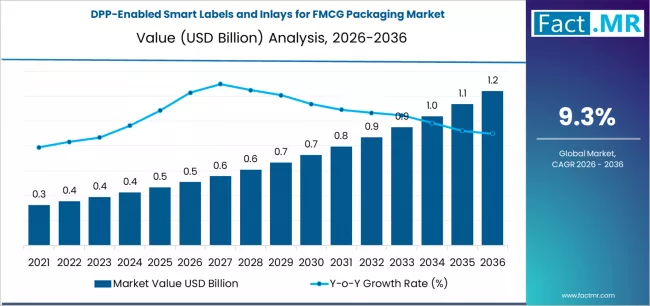
Dpp Enabled Smart Labels And Inlays For Fmcg Packaging Market Market Value Analysis | Source: Fact.MR
The global push for digital product passports (DPP) under circular economy regulations is the primary force propelling market growth. Mandates in Europe and similar initiatives worldwide require unique item-level identification and access to lifecycle data for products, creating a non-negotiable demand for smart packaging substrates.
DPP-enabled labels and inlays serve as the critical physical-digital bridge, allowing consumers, regulators, and supply chain actors to access information on origin, composition, recycling, and authenticity. This shift transforms packaging from a passive container to an active data carrier, fundamental to modern compliance and supply chain transparency.
Advancements in integration and printing technologies are critical to market expansion. Innovation focuses on seamlessly embedding NFC/RFID inlays into standard label formats and developing eco-friendly conductive inks that enable high-speed, cost-effective production. These technological enhancements are crucial for scaling smart label adoption across the high-volume, low-margin FMCG sector, moving beyond pilot projects to standard practice for brand protection, traceability, and consumer engagement.
DPP-Enabled Smart Labels and Inlays for FMCG Packaging Market
| Metric | Value |
|---|---|
| Estimated Value in (2026E) | USD 0.51 Billion |
| Forecast Value in (2036F) | USD 1.24 Billion |
| Forecast CAGR (2026 to 2036) | 9.3% |
Source: Fact.MR analysis. Updated Dec 20, 2025
Segmental Analysis
Why does FMCG & Retail Traceability comprise the Leading Application Segment?
FMCG & retail traceability will command a 40% share, as this sector faces the most immediate pressure from DPP regulations and has the most to gain from supply chain digitization. Smart labels enable end-to-end visibility from manufacturing to shelf, combating counterfeiting, optimizing inventory, and providing the data backbone for compliance with evolving ESG and circularity mandates. For retailers and brands, this technology is essential for operational efficiency, regulatory adherence, and building consumer trust through transparency.
- The ability to track products at item-level granularity allows for precise recall management, waste reduction in the supply chain, and dynamic fulfillment strategies.
- Smart labels facilitate automated checkouts and smart shelves in retail environments, merging compliance functionality with operational innovation.
What establishes Smart Barcode + RFID-enabled labels as the dominant Product Format?
Smart barcode + RFID-enabled labels hold a 45% share due to their hybrid functionality, which bridges current and future infrastructure. They combine the universal readability of optical barcodes with the secure, high-data-capacity, and non-line-of-sight scanning capability of RFID/NFC. This dual approach ensures compatibility with existing retail and logistics systems while future-proofing products for DPP requirements that demand richer, secure digital interactions.
- This format is favored for its ease of integration into standard packaging lines as a label applicator process, minimizing disruption to high-speed production.
- Innovation focuses on minimizing the size and cost of the embedded RFID inlay while maximizing read range and data integrity, making it viable for low-cost consumer goods.
What Cements PET/Paper Label Substrates as the Preferred Material Choice?

Dpp Enabled Smart Labels And Inlays For Fmcg Packaging Market Analysis By Material | Source: Fact.MR
PET/Paper label substrates lead with a 45% share, offering the optimal balance of durability, printability, and sustainability required for FMCG packaging. PET films provide moisture resistance, tear strength, and a smooth surface for high-quality graphics and reliable RFID performance. Paper substrates, particularly FSC-certified grades, offer a renewable, readily recyclable option that aligns with brand sustainability goals and circular packaging directives.
- The choice between PET and paper is often driven by the product's lifecycle such as wet vs. dry environment and end-of-life recycling stream considerations.
- Development of wash-off adhesives and thinner, high-performance facestocks is ongoing to ensure smart labels do not disrupt the recyclability of the primary packaging.
What are the Drivers, Restraints, and Key Trends in the DPP-Enabled Smart Labels and Inlays Market?
The market is y driven by binding regulatory timelines for DPP implementation, particularly in the EU, which create a compliance imperative for brands selling in regulated markets. The parallel need for supply chain resilience, anti-counterfeiting, and enhanced consumer engagement through digital experiences provides a strong commercial rationale beyond mere compliance.
A primary restraint is the incremental unit cost of smart labels compared to standard labels, requiring a clear ROI analysis based on supply chain savings, theft reduction, and compliance value. The complexity of integrating new scanning and data management infrastructure across global supply chains also presents a significant operational hurdle.
The market is trending towards ultra-low-cost RFID solutions using simpler chips and printed antennas to achieve the price points needed for mass-market FMCG items. Cloud-based data platform integration is critical, with labels acting as keys to centralized digital product passports, enabling seamless data access for all stakeholders.
Analysis of the Market by Key Countries
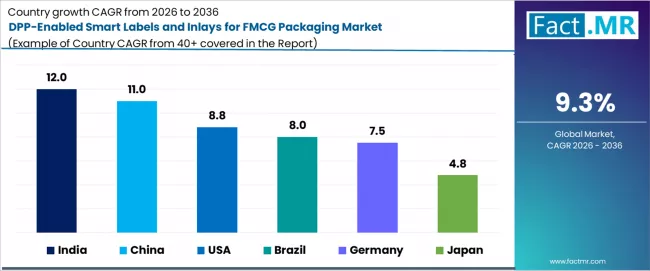
Dpp Enabled Smart Labels And Inlays For Fmcg Packaging Market Cagr Analysis By Country | Source: Fact.MR
| Country | CAGR (2026-2036) |
|---|---|
| USA | 8.80% |
| Germany | 7.50% |
| China | 11.00% |
| India | 12.00% |
| Brazil | 8.00% |
| Japan | 4.80% |
Source: Fact.MR analysis. Updated Dec 20, 2025
What underpins adoption of DPP-Enabled Smart Labels and Inlays for FMCG Packaging in the USA?
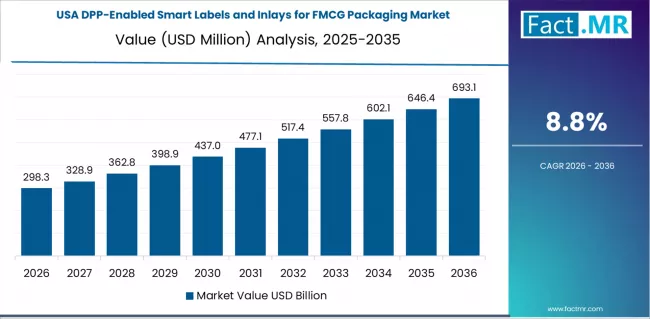
Dpp Enabled Smart Labels And Inlays For Fmcg Packaging Market Country Value Analysis | Source: Fact.MR
Growth in the USA at an 8.80% CAGR is driven by strong retailer mandates (e.g., Walmart, Amazon) for RFID tagging, the need for supply chain digitization, and voluntary brand initiatives for transparency. While federal DPP mandates are less advanced, commercial drivers and state-level sustainability reporting requirements fuel demand for smart labeling solutions.
How does Germany's regulatory framework shape its market?
Germany's 7.50% CAGR reflects its role as an EU frontrunner in implementing DPP regulations. The market is characterized by early, compliance-driven adoption, with a focus on high-reliability labels and inlays that meet stringent data security and durability standards for complex supply chains.
What factors propel China's rapid expansion?
China's 11.00% CAGR is fueled by its dual role as the world's FMCG manufacturing hub and a vast domestic market. National digitalization and anti-counterfeiting policies accelerate adoption. Domestic manufacturers are scaling low-cost, high-volume production of RFID inlays and smart labels for both export to regulated markets and internal traceability needs.
Why does India exhibit the highest growth trajectory?
India leads with a 12.00% CAGR, driven by the explosive growth of its organized retail and e-commerce sectors, which require advanced traceability and logistics efficiency. Government digital initiatives and the fight against counterfeit goods create a fertile ground for adoption, with demand focused on highly cost-optimized QR and RFID solutions.
How does Brazil's market develop?
Brazil's 8.00% CAGR is supported by the expansion of modern retail, food safety regulations, and the need for brand protection in a large market. Adoption is driven by retail distribution efficiency and the growing focus on product origin and authenticity from Brazilian consumers.
What Characterizes Japan's Mature Market Approach?
Japan's mature market grows at a measured 4.80% CAGR, prioritizing precision, miniaturization, and high-data-security applications. The focus is on integrating smart labels seamlessly into premium FMCG packaging for luxury goods and high-end foods, enabling sophisticated consumer engagement and stringent anti-counterfeiting measures.
Competitive Landscape
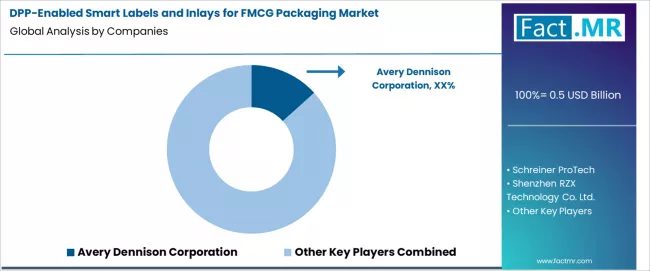
Dpp Enabled Smart Labels And Inlays For Fmcg Packaging Market Analysis By Company | Source: Fact.MR
The competitive landscape features convergence between traditional label manufacturers, specialized smart packaging solution providers, and RFID technology experts. Global leaders like Avery Dennison and Schreiner ProTech compete through integrated offerings combining label materials, inlay design, and software platforms.
Pure-play technology firms like Smartrac and Invengo compete on RFID chip and antenna innovation. Competition increasingly hinges on forming ecosystems that include secure data hosting services, achieving the lowest total cost of ownership for high-volume applications, and providing globally scalable solutions that meet regional regulatory variances.
Key Players Profiled in the DPP-Enabled Smart Labels and Inlays for FMCG Packaging Market
- Avery Dennison Corporation
- Schreiner ProTech
- Shenzhen RZX Technology Co. Ltd.
- UFLEX Limited
- Toppan
- Zebra Technologies Corporation
- Smartrac N.V.
- Invengo Information Technology Co., Ltd.
Segmentation
Market Segmentation
| Category | Segments |
|---|---|
| End-use/Application | FMCG & Retail Traceability, Food & Beverage Packaging, E-commerce & logistics, Retail & distribution, FMCG packaging, Others |
| Product Format/Type | Smart barcode + RFID-enabled labels, High-speed printable smart labels, RFID inlays & QR labels, QR-enabled labels, Others |
| Material | PET/Paper label substrates, FSC-certified paper substrates, PET inlay films, Paper & PET blends, Others |
| Technology | NFC/RFID Inlay Integration, Eco-friendly conductive inks, Low-cost RFID integration, Digital printing + embedded coding, Others |
| Region | North America, Europe, Asia Pacific, Latin America, MEA |
Source: Fact.MR analysis. Updated Dec 20, 2025
Scope of the Report
| Items | Values |
|---|---|
| Quantitative Units (2026) | USD 0.51 Billion |
| End-use/Application | FMCG & Retail Traceability, Food & Beverage Packaging, E-commerce & logistics, Retail & distribution, FMCG packaging, Others |
| Product Format/Type | Smart barcode + RFID-enabled labels, High-speed printable smart labels, RFID inlays & QR labels, QR-enabled labels, Others |
| Material | PET/Paper label substrates, FSC-certified paper substrates, PET inlay films, Paper & PET blends, Others |
| Technology | NFC/RFID Inlay Integration, Eco-friendly conductive inks, Low-cost RFID integration, Digital printing + embedded coding, Others |
| Regions Covered | North America, Europe, Asia Pacific, Latin America, Middle East & Africa |
| Key Companies Profiled | Avery Dennison Corporation, Schreiner ProTech, Shenzhen RZX Technology Co. Ltd., UFLEX Limited, Toppan, Zebra Technologies Corporation, Smartrac N.V., Invengo Information Technology Co., Ltd. |
| Additional Attributes | Cost analysis of smart label vs. standard label, data security and GS1 standards analysis, ROI models for supply chain applications, regulatory timeline mapping for DPP. |
Source: Fact.MR analysis. Updated Dec 20, 2025
DPP-Enabled Smart Labels and Inlays for FMCG Packaging Market by Segments
-
By End-use/Application :
- FMCG & Retail Traceability
- Food & Beverage Packaging
- E-Commerce & Logistics
- Retail & Distribution
- FMCG & Packaging
- Others
-
By Product Format/Type :
- Smart Barcode + RFID-enabled Labels
- High-speed Printable Smart Labels
- RFID Inlays & QR Labels
- QR-enabled Labels
- Others
-
By Material :
- PET/Paper Label Substrates
- FSC-certified Paper Substrates
- PET Inlay Films
- Paper & PET Blends
- Others
-
By Technology :
- NFC/RFID Inlay Integration
- Eco-friendly Conductive Inks
- Low-cost RFID Integration
- Digital Printing + Embedded Coding
- Others
-
By Region :
-
North America
- USA
- Canada
- Mexico
-
Europe
- Germany
- UK
- France
- Italy
- Spain
- Nordic Countries
- BENELUX
- Rest of Europe
-
Asia Pacific
- China
- India
- Japan
- South Korea
- Australia
- Rest of Asia Pacific
-
Latin America
- Brazil
- Argentina
- Rest of Latin America
-
Middle East & Africa
- Saudi Arabia
- UAE
- South Africa
- Rest of MEA
-
Frequently Asked Questions
How big is the DPP-enabled smart labels and inlays for FMCG packaging market in 2026?
What will be the size of DPP-enabled smart labels and inlays for FMCG packaging market in 2036?
How much will be the DPP-enabled smart labels and inlays for FMCG packaging market growth between 2026 and 2036?
What are the key product types in the DPP-enabled smart labels and inlays for FMCG packaging market?
Which product format/type segment to contribute significant share in the DPP-enabled smart labels and inlays for FMCG packaging market in 2026?
Who worked on this report


Preview the report firsthand - request a free sample
Free SampleGet the brochure for pricing and purchase details
Download PDF