- Market Value (2025): USD 14.1 Bn
- Estimated Value (2026): USD 14.7 Bn
- Forecast Value (2036): USD 22.7 Bn
- CAGR (2026-2036): 4.5%
What is the Walk-Behind Lawn Mowers Market forecast to be worth by 2036?
USD 14.7 billion in 2026 to USD 22.7 billion by 2036, at a 4.5% CAGR.
- The walk-behind lawn mowers market was valued at USD 14.1 billion in 2025.
- As per Fact.MR analysis, demand will increase from USD 14.7 billion in 2026 to USD 22.7 billion in 2036.
- The market is forecast to record a 4.5% CAGR for 2026 to 2036, reflecting household replacement purchases and recurring mowing work by grounds-maintenance crews.
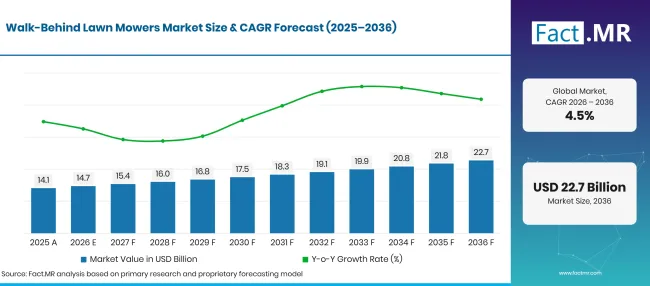
Factmr Walk Behind Lawn Mowers Market Forecast Global | Source: Fact.MR
| Year | Basis | Market Value (USD billion) |
|---|---|---|
| 2025 | Historical estimate | 14.1 |
| 2026 | Estimate | 14.7 |
| 2036 | Forecast | 22.7 |
| CAGR 2026 to 2036 | Forecast period | 4.5% |
Source: Fact.MR analysis. Updated Oct 19, 2026
What are the defining numbers behind Walk-Behind Lawn Mowers Market growth?
USD 8.0 billion absolute opportunity between 2026 and 2036, with residential users and self-propelled models shaping buying choices.
- Demand Drivers in the Market
- Battery-powered mower owners place more weight on usable runtime and access to spare batteries. Charging convenience becomes especially relevant when a mower shares a battery system with other garden tools.
- Professional grounds teams need machines that start reliably and can move between properties without a lengthy setup. Blade quality and service access affect daily output as much as rated engine power.
- Retailers and service dealers help customers compare models through demonstrations and clear information about spare parts. Local repair support also makes it easier to estimate how much a mower will cost to maintain over several seasons.
- Key Segments Analyzed
- By Fuel Types: Battery-powered mowers represent 38.5% share in 2026, as cordless starting and easier storage suit household lawn care.
- By End-users: Residential purchases account for 72.4% share in 2026, reflecting owners who cut lawns at home.
- By Operational Types: Self-propelled Mower represents 61.3% share in 2026, linked to less pushing effort on larger or sloped lawns.
- Analyst Opinion at Fact.MR
- Shambhu Nath Jha, Principal Consultant at Fact.MR, states, “Walk-behind mower buyers judge a machine by the mowing job it can finish rather than motor specifications alone. Battery models need enough runtime for the planned lawn, while petrol machines need dependable servicing and spare parts.”
- Strategic Implications
- Manufacturers should explain mowing-area suitability using clear run conditions, since grass height and cutting load can change battery life.
- Dealers need to keep frequently replaced blades and other service items available throughout the mowing season. Greenworks reported in December 2025 that its OPTIMUS walk-behind commercial mowers received AGZA Field-Tested Certification, making independent testing one useful comparison point for commercial customers [6].
- Fleet managers can compare the effort required to operate a mower with the length of their daily routes. These checks help them decide whether push or self-propelled models are a better fit for regular work.
- Battery-system suppliers should explain which chargers and packs work with each mower model. This information helps owners compare the cost of adding other compatible garden tools.
Brazil may grow at a 5.4% CAGR, followed by the United States at 5.0%. Germany posts a 4.3% outlook, while Japan reaches 4.0%. The United Kingdom is projected at 3.6%, as local lawn sizes and mowing practices shape the equipment chosen by households and grounds teams.
How does the Walk-Behind Lawn Mowers Market break down by segment?
Battery-powered leads with 38.5%; Residential accounts for 72.4% share in 2026.
Which Fuel Type leads walk-behind mower sales?
Battery-powered holds 38.5% share in 2026.
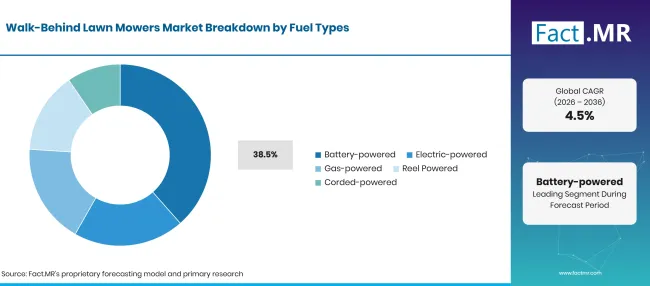
Factmr Walk Behind Lawn Mowers Market Breakdown Fuel Types | Source: Fact.MR
| Fuel Types | Share (2026) |
|---|---|
| Battery-powered (Leading segment) | 38.5% |
| Other segments combined | 61.5% |
| Total | 100.0% |
Source: Fact.MR analysis. Updated Oct 19, 2026
Battery-powered models appeal to households that prefer starting a mower without handling petrol. Cordless operation also lets people work around garden edges without managing a trailing cable. Petrol models still matter when owners need longer continuous cutting sessions or have limited charging access. Corded electric models suit smaller plots where an outdoor power socket is convenient. Reel-powered equipment offers a manual option for suitable lawns and owners who accept a slower cutting routine.
How does End-user purchasing shape sales?
Residential accounts for 72.4% share in 2026.
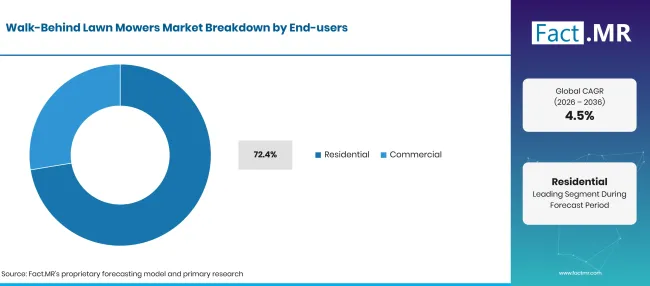
Factmr Walk Behind Lawn Mowers Market Breakdown End Users | Source: Fact.MR
| End-users | Share (2026) |
|---|---|
| Residential (Leading segment) | 72.4% |
| Other segments combined | 27.6% |
| Total | 100.0% |
Source: Fact.MR analysis. Updated Oct 19, 2026
Residential owners typically choose a mower around their own lawn area and storage space. Replacing a worn machine can be more attractive than paying for extensive repair work on an entry-level model. Commercial users instead weigh daily hours and how easily a machine moves between sites. They often favor designs that simplify blade changes and routine cleaning, since downtime affects scheduled jobs and crew time.
Which Operational Type holds the larger share?
Self-propelled Mower leads with 61.3% share in 2026.
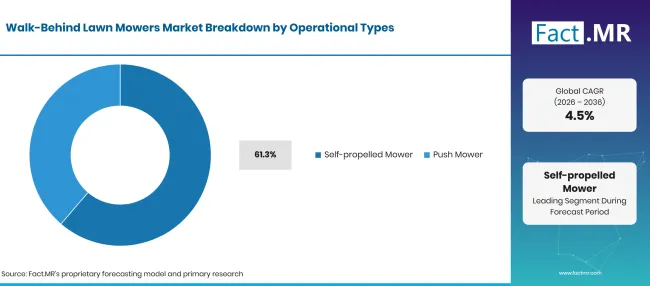
Factmr Walk Behind Lawn Mowers Market Breakdown Operational Types | Source: Fact.MR
| Operational Types | Share (2026) |
|---|---|
| Self-propelled Mower (Leading segment) | 61.3% |
| Other segments combined | 38.7% |
| Total | 100.0% |
Source: Fact.MR analysis. Updated Oct 19, 2026
Self-propelled models reduce the force needed to move the mower forward, especially when a lawn has slopes. Buyers still need to consider machine weight because turning and storing the mower take effort. Push mowers appeal to people with smaller lawns who want a simpler drive system and a manageable initial price. Professionals can select drive speed to match the grass and working pace across different grounds.
What is accelerating Walk-Behind Lawn Mowers Market adoption, and what is holding it back?
Replacement purchases and easier mowing support sales, while battery runtime, upfront prices and seasonal buying patterns influence when customers choose new equipment.
Drivers Impact Analysis
| DRIVER | (~) % IMPACT ON CAGR | GEOGRAPHIC RELEVANCE | IMPACT TIMELINE |
|---|---|---|---|
| Household replacement cycle | +1.0% | Global | Medium term (2–4 years) |
| Cordless convenience | +0.8% | North America, Europe | Medium term (2–4 years) |
| Self-propelled comfort | +0.7% | Global | Short term (<= 2 years) |
| Grounds-care services | +0.5% | Global | Medium term (2–4 years) |
| Retail and service access | +0.4% | Global | Long term (>= 4 years) |
Source: Fact.MR analysis. Updated Oct 19, 2026
Opportunity Impact Analysis
| OPPORTUNITY | (~) % IMPACT ON CAGR | GEOGRAPHIC RELEVANCE | IMPACT TIMELINE |
|---|---|---|---|
| Shared battery platforms | +0.8% | Europe, North America | Medium term (2–4 years) |
| Commercial walk-behind upgrades | +0.6% | United States, Japan | Medium term (2–4 years) |
| Compact storage designs | +0.5% | Urban households | Short term (<= 2 years) |
| Repair-parts availability | +0.4% | Global | Long term (>= 4 years) |
Source: Fact.MR analysis. Updated Oct 19, 2026
Restraints Impact Analysis
| RESTRAINT | (~) % IMPACT ON CAGR | GEOGRAPHIC RELEVANCE | IMPACT TIMELINE |
|---|---|---|---|
| Battery runtime concerns | -0.8% | Global | Short term (<= 2 years) |
| Upfront equipment expense | -0.6% | Global | Medium term (2–4 years) |
| Seasonal retail swings | -0.5% | Temperate markets | Short term (<= 2 years) |
| Service network gaps | -0.4% | Selected regions | Medium term (2–4 years) |
Source: Fact.MR analysis. Updated Oct 19, 2026
Which countries are scaling the Walk-Behind Lawn Mowers Market through 2036?
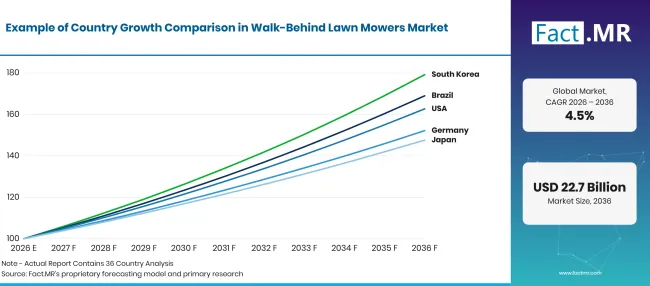
Factmr Walk Behind Lawn Mowers Market Growth Index | Source: Fact.MR
| Country | CAGR (2026–2036) |
|---|---|
| Brazil | 5.4% |
| United States | 5.0% |
| Germany | 4.3% |
| Japan | 4.0% |
| United Kingdom | 3.6% |
Source: Fact.MR analysis. Updated Oct 19, 2026
How is Brazil expanding walk-behind mower purchases?
5.4% CAGR, shaped by household budgets and access to local mower servicing.
Garden equipment sales in Brazil depend on the type of property being maintained and whether owners have access to local repair services. In April 2026, IBGE reported 79.3 million permanent private housing units for 2025 [2]. This housing measure describes the wider customer setting, while lawns and maintained grass areas form the direct market for walk-behind mowers.
What supports walk-behind mower sales in the United States?
5.0% CAGR, linked to household replacements and professional grounds care.
Household equipment replacement is a familiar part of lawn care in the United States, where retail stores and specialist dealers serve different price ranges. Walk-behind mowers still matter for gardens and narrow areas that are less convenient for riding machines. The Toro Company reported in October 2025 that its Exmark Turf Tracer with XiQ Technology received updates to path planning and remote stopping [1].
Why is Germany a steady market for walk-behind mowers?
4.3% CAGR, influenced by compact gardens and cordless equipment choices.
Mower selection in Germany is closely linked to garden size and the space available to store equipment after use. In its 2025 household statistics, Destatis recorded 41.126 million private households [3]. Compact cordless models attract interest when owners want straightforward starting and less equipment to store.
How is Japan shaping mower selection?
4.0% CAGR, connected to small plots and space-conscious equipment selection.
Japanese mower purchases depend heavily on the shape of the area being cut and whether equipment can be stored conveniently between uses. The Statistics Bureau of Japan's 2026 Statistical Yearbook contains housing and land tables that distinguish residential property types [4]. Detached properties with maintained grass are a more relevant setting for personal walk-behind mower use than dense apartment blocks.
What influences walk-behind mower adoption in the United Kingdom?
3.6% CAGR, reflecting private garden upkeep and seasonal mowing conditions.
Private gardens shape the main household use of walk-behind lawn mowers in the United Kingdom, while grounds contractors purchase machines for repeated outdoor work. In December 2025, the Ministry of Housing, Communities and Local Government reported that owner-occupied homes represented 65% of English households in 2024–25 [5]. Home ownership describes the housing setting and does not measure the number of lawns, so product choices still depend on the outdoor space at each property.
Who leads the Walk-Behind Lawn Mowers Market?
Deere & Company, Husqvarna Group and The Toro Company serve lawn-care equipment users through distinct product ranges.
Deere & Company offers commercial walk-behind mowing equipment alongside its wider turf business. Husqvarna Group supplies walk-behind machines for homeowners and professional work. The Toro Company addresses commercial lawn care through the Toro and Exmark portfolios, where product performance and service reach influence fleet purchases.
Globe Group (Greenworks) and Chervon Holdings Limited (EGO) offer cordless outdoor equipment. Positec Tool Corporation (WORX) serves household lawn care with electric designs.
Which companies are the key providers?
Key companies include Deere & Company; Husqvarna Group; The Toro Company; Honda Motor Co., Ltd.; Globe Group (Greenworks); Chervon Holdings Limited (EGO); Positec Tool Corporation (WORX).
- Deere & Company
- Husqvarna Group
- The Toro Company
- Honda Motor Co., Ltd.
- Globe Group (Greenworks)
- Chervon Holdings Limited (EGO)
- Positec Tool Corporation (WORX)
Bibliography
- [1] The Toro Company. (2025, October 22). Exmark updates autonomous Turf Tracer® with XiQ Technology.
- [2] Instituto Brasileiro de Geografia e Estatística. (2026, April 17). Rented housing units grew more than 50% since 2016.
- [3] Statistisches Bundesamt (Destatis). (n.d.). Households, by type of household.
- [4] Statistics Bureau of Japan. (2026). Japan statistical yearbook 2026: Chapter 21, housing and land.
- [5] Ministry of Housing, Communities and Local Government. (2025, December 4). English Housing Survey 2024 to 2025: Headline findings on demographics and household resilience.
- [6] Greenworks. (2025, December). Greenworks expands OPTIMUS lineup with handhelds + walk-behind mowers.
This Report Answers
- The forecast explains the value of the global walk-behind mower market from 2026 to 2036.
- Fuel analysis compares cordless equipment with petrol and mains-powered mower choices.
- End-user analysis covers homeowners and commercial grounds-maintenance operations.
- Country coverage compares Brazil, the United States, Germany, Japan and the United Kingdom.
- The competitive section identifies manufacturers and product platforms relevant to walk-behind mowing.
What does the Walk-Behind Lawn Mowers Market cover?
The market covers mowers controlled by a walking operator who guides the machine across managed grass. Equipment can use battery power or petrol engines, while corded electric and manual reel designs serve specific needs. Mower sales are considered separately from stand-on, ride-on and fully robotic equipment.
The analysis also considers adjacent electric lawn mower products where walk-behind designs share battery technology with other cutting equipment. The adjacent category includes lawn mowers category with a different product boundary.
What is included in the scope?
Equipment includes push mowers and self-propelled walk-behind units sold for home or commercial grass maintenance.
The focus is on complete mowing machines and the functions that guide buying decisions, including cutting width and storage requirements. Product service networks are reviewed as a competitive factor, but service charges are not counted as complete mower sales.
What is excluded from the scope?
Ride-on units and lawn tractors fall outside the walk-behind boundary.
Stand-on models are excluded where the operator rides a platform instead of walking behind the mower. Fully autonomous robotic mowers are treated as a separate product category, along with handheld string trimmers and agricultural cutting machinery.
Related buying patterns appear in commercial lawnmowers research but are not identical to the pedestrian-operated equipment boundary. The adjacent category includes zero-turn mower segment with a different product boundary.
How Was the Analysis Built?
The analysis draws on 120+ sources, 35+ company portfolios, 25+ countries, and more than 20 industry interviews.
- Primary Research: Primary research includes discussions with manufacturers, service providers, technology developers, distributors, end users, and subject-matter experts. These conversations examine purchasing priorities, product adoption, operational challenges, approval requirements, competitive positioning, and the factors that influence wider market acceptance.
- Desk Research: Desk research covers government statistics, regulatory publications, company filings, trade data, technical studies, industry associations, standards, public policy, and other authoritative sources. Every source used in the analysis is documented in the bibliography.
- Market Sizing and Forecasting: Market estimates combine historical performance, demand indicators, pricing and volume trends, segment shares, company participation, country-level growth, adoption patterns, investment activity, and barriers to market expansion.
- Data Validation and Update Cycle: Findings are validated by comparing primary interviews with public data, company activity, regulatory changes, trade patterns, and industry developments. Regular updates review new product launches, capacity changes, partnerships, approvals, and shifts in commercial adoption.
Segmentation
What is the report’s scope and coverage?
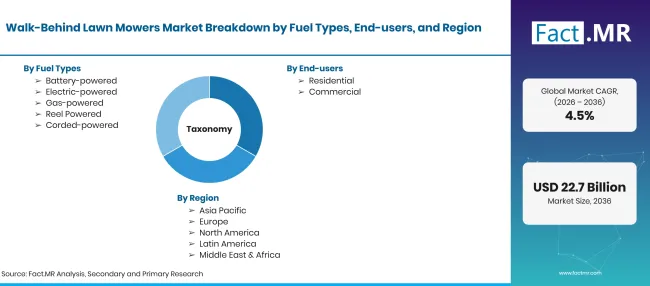
Factmr Walk Behind Lawn Mowers Market Taxonomy | Source: Fact.MR
| Attribute | Details |
|---|---|
| Quantitative Units | USD billion; forecast 2026 to 2036 |
| Market Definition | Pedestrian-operated lawn mowers used to cut managed grass areas |
| Fuel Types | Battery-powered; Electric-powered; Gas-powered; Reel Powered; Corded-powered |
| End-users | Residential; Commercial |
| Operational Types | Self-propelled Mower; Push Mower |
| Regions Covered | North America; Latin America; Western Europe; Eastern Europe; East Asia; South Asia & Pacific; Middle East & Africa |
| Countries Covered | Germany; Brazil; United States; United Kingdom; Japan |
| Companies Profiled | Deere & Company; Husqvarna Group; The Toro Company; Honda Motor Co., Ltd.; Globe Group (Greenworks); Chervon Holdings Limited (EGO); Positec Tool Corporation (WORX). |
| Forecast Period | 2026 to 2036 |
| Approach | Market sizing with segment and country assessment; supported official contextual statistics |
Source: Fact.MR analysis. Updated Oct 19, 2026
How is the market segmented?
-
By Fuel Types
- Battery-powered
- Electric-powered
- Gas-powered
- Reel Powered
- Corded-powered
-
By End-users
- Residential
- Commercial
-
By Operational Types
- Self-propelled Mower
- Push Mower
-
By Region
- North America
- Latin America
- Western Europe
- Eastern Europe
- East Asia
- South Asia & Pacific
- Middle East & Africa
Frequently Asked Questions
How big is the walk-behind lawn mowers market in 2026?
What is the CAGR from 2026 to 2036?
Which fuel type leads?
Who accounts for most end-user sales?
Who are the main companies in the walk behind lawn mowers market?
Who worked on this report


Preview the report firsthand - request a free sample
Free SampleGet the brochure for pricing and purchase details
Download PDF