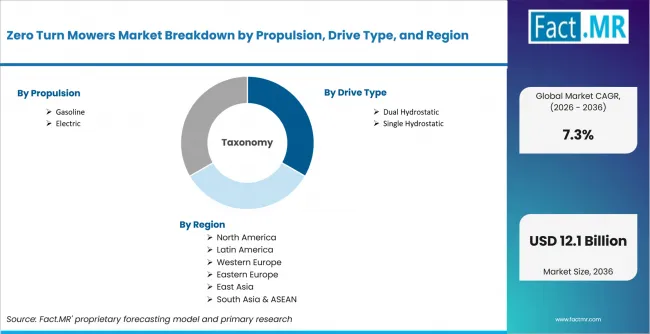
Zero Turn Mowers Market Size, Share, Growth and Forecast (2026 - 2036)

The Zero Turn Mowers Market is segmented by Propulsion (Gasoline and Electric), Cutting Width (Less than 50 Inches, 50 to 60 Inches, and More than 60 Inches), Application (Residential and Commercial), End User (Landscaping Services, Golf Courses, Public Agencies, and Residential Owners), Drive Type (Dual Hydrostatic, Single Hydrostatic, and Electric Wheel Motor), Sales Channel (Dealers, Online, and Rental), and Region. Forecast for 2026 to 2036.

Zero Turn Mowers Market Forecast and Outlook by FACT.MR

  • The zero turn mowers market was valued at USD 5.6 billion in 2025.
  • Based on Fact.MR analysis, revenue is estimated at USD 6.0 billion in 2026 and USD 12.1 billion by 2036.
  • Fact.MR projects a 7.3% CAGR during the forecast period.
  • The market is set to create an incremental revenue opportunity of USD 6.1 billion between 2026 and 2036.
  • Growth is linked to contractor labor pressure and municipal turf maintenance needs.
  • Electric models are gaining share in regulated urban work.
  • High upfront cost and battery charging time slow adoption among price-sensitive residential users.
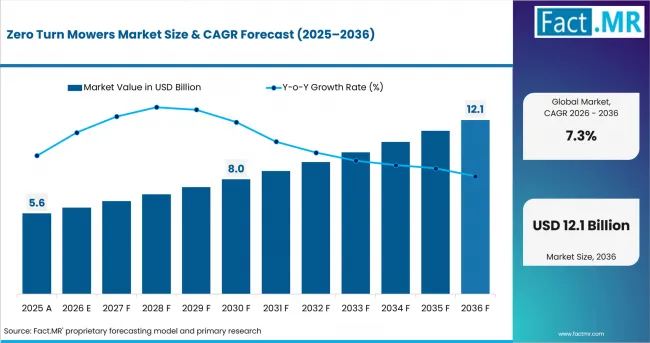
Zero Turn Mowers Market Value Analysis

Summary of zero turn mowers market

  • Demand Drivers
    • Labor pressure supports zero turn mower renewal, as the United States Bureau of Labor Statistics projects 171,600 annual openings for grounds maintenance workers over 2024 to 2034. This pushes contractors toward faster mowing machines. [1]
    • Golf course upkeep supports commercial fleet replacement, as the National Golf Foundation counted 15,963 courses at the end of 2023. The same source counted 13,963 U.S. golf facilities. [2]
    • Emission rules support battery-powered zero turn mower adoption after the United States Environmental Protection Agency granted California authorization for small-off-road engine rules in January 2025. This supports electric mower demand in regulated urban work. [3]
  • Key Segments Analyzed
    • By Propulsion: Gasoline is forecast to account for 71.3% share in 2026. Long operating time and established repair networks keep gasoline models preferred in contractor fleets.
    • By Drive Type: Dual hydrostatic drive is forecast to hold 68.4% share in 2026. Separate wheel control helps operators manage tight turns on large lawns.
    • By Application: Commercial use is forecast to account for 61.8% share in 2026. Contractors and campuses need machines that reduce mowing hours across routine turf work.
    • By Sales Channel: Dealers are forecast to capture 57.2% share in 2026. Local service support and parts access continue to influence riding mower selection.
    • By Cutting Width: The 50 to 60 inches segment is forecast to account for 54.9% share in 2026. This deck range balances mowing productivity with access through common property gates.
    • By End User: Landscaping services are forecast to hold 44.6% share in 2026. Outsourced lawn contracts create regular replacement demand for commercial zero turn mowers.
  • Analyst Opinion at Fact.MR
    • Shambhu Nath Jha, Principal Consultant at Fact.MR, opines, “Zero turn mower suppliers will gain most from strong dealer service and proven battery performance. Contractors are choosing machines that reduce labor hours without adding service risk.”
  • Strategic Implications
    • Manufacturers should protect gasoline mower supply for commercial crews because service networks and fuel access still guide fleet replacement decisions.
    • Companies should expand electric zero turn training for dealers because battery warranty clarity and charge planning affect first-time fleet trials.
    • Suppliers should keep mid-deck machines in stock because the 50 to 60 inches range serves residential acreage and light commercial mowing.
Metric Value
Estimated Value in 2026 USD 6.0 billion
Forecast Value in 2036 USD 12.1 billion
Forecast CAGR (2026 to 2036) 7.3%

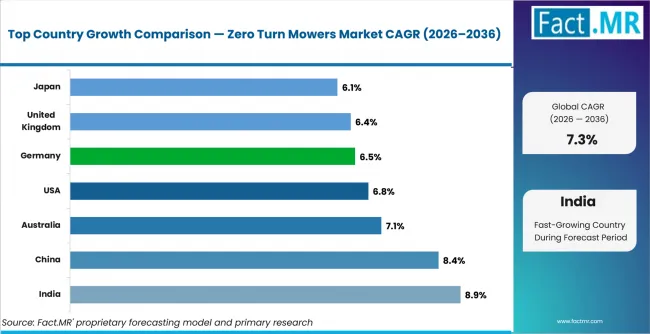
India is projected to record the highest CAGR at 8.9% through 2036 as gated housing and campus maintenance contracts expand professional mower orders. China follows at 8.4% through 2036 as municipal park expansion raises demand for larger deck equipment. Australia advances at 7.1% as sports turf and acreage homes support dealer sales. The United States records 6.8% as large lawns and golf course maintenance keep replacement orders steady. Germany is forecast at 6.5% through 2036 as low-noise equipment demand grows near residential zones. The United Kingdom reaches 6.4% as public open space upkeep supports commercial fleet orders. Japan expands at 6.1% through 2036 as aging property owners prefer riding equipment that reduces manual work.

Segmental Analysis

Zero Turn Mowers Market Analysis by Propulsion
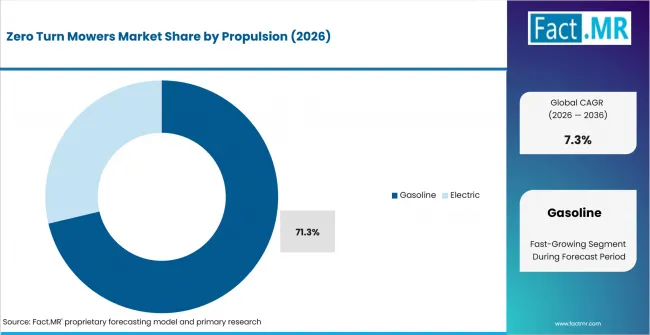
Zero Turn Mowers Market Analysis By Propulsion

Gasoline propulsion is set to hold 71.3% share in 2026 as contractors need long work time without charging breaks. Battery models are gaining attention in regulated municipal work after California received federal authorization for small engine rules. This shift connects zero turn mower demand with the electric lawn mower transition in outdoor power equipment. John Deere introduced the Z380R Electric ZTrak in October 2024 with mowing capacity up to 3.5 acres per charge. [6]

  • Gasoline fleet retention: Commercial crews keep gasoline units in fleet rotation because fuel access and service parts are easier on rural mowing routes.
  • Electric product shift: Dealer education is becoming important as battery zero turn models need charging guidance and clear warranty terms for professional crews.
  • Service economics: Repair shops earn steady revenue from belts and blades, so gasoline units protect dealer aftermarket value.

Zero Turn Mowers Market Analysis by Drive Type
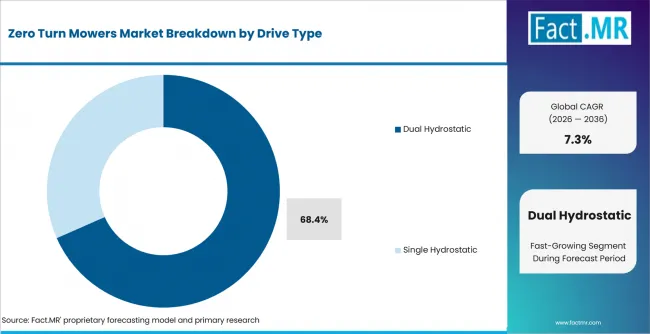
Zero Turn Mowers Market Analysis By Drive Type

Dual hydrostatic drive is set to hold 68.4% share in 2026 as independent wheel control defines zero turn performance. This design reduces turn time and supports accurate trimming near property borders. Manufacturers use this drive format across residential and commercial machines because dealers can service pumps and wheel motors through existing workshop systems.

  • Core drive preference: Contractors favor dual hydrostatic layouts because they support quick turns and steady control during long mowing shifts.
  • Entry unit pricing: Single hydrostatic formats remain limited because users often move to full zero turn control for larger lawns.
  • Dealer repair value: Hydrostatic service and fluid checks create repeat workshop visits that strengthen dealer relationships after the sale.

Zero Turn Mowers Market Analysis by Application
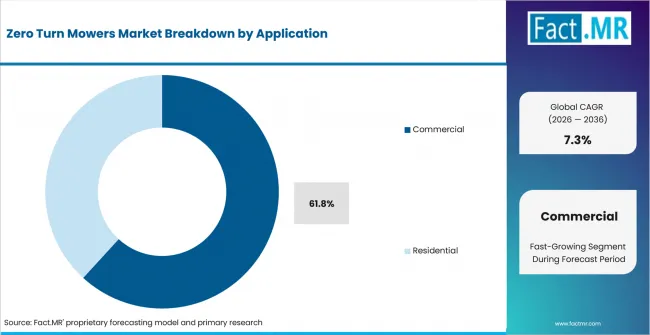
Zero Turn Mowers Market Analysis By Application

Commercial use is expected to hold 61.8% share in 2026 as contracted lawn care and public grounds upkeep need machines with high daily output. The National Recreation and Park Association states that the typical agency has one park for every 2,437 residents. The agency manages 10 acres of parkland per 1,000 residents. [4] Municipal and institutional workloads support larger fleets and more frequent replacement. These needs connect zero turn demand with adjacent lawn mowers used by park crews and contractors.

  • Contractor fleet demand: Commercial operators replace machines sooner because daily mowing hours increase wear on belts and cutting decks.
  • Residential acreage demand: Homeowners with larger lawns choose zero turn models to reduce mowing time around trees and property edges.
  • Public grounds demand: Schools and park agencies need machines with dealer-backed service to keep grass maintenance schedules on track.

Zero Turn Mowers Market Analysis by Sales Channel
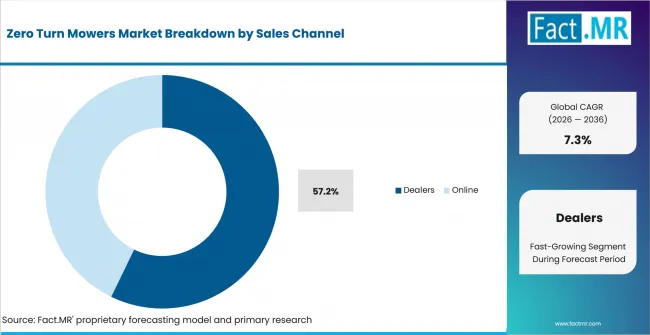
Zero Turn Mowers Market Analysis By Sales Channel

Dealers are expected to capture 57.2% share in 2026 as users value local service and test drives before buying riding equipment. The channel keeps an advantage through parts stock and seasonal maintenance packages. Online sales expand for smaller residential units but stay weaker for commercial fleets that need fast service support.

  • Dealer channel strength: Local dealers retain commercial users by providing setup help and parts support during peak mowing months.
  • Online channel expansion: Homeowners compare prices online but often look for nearby service support before final purchase.
  • Rental channel pressure: Smaller contractors use short-term machines for irregular jobs instead of buying extra units.

Zero Turn Mowers Market Analysis by Cutting Width
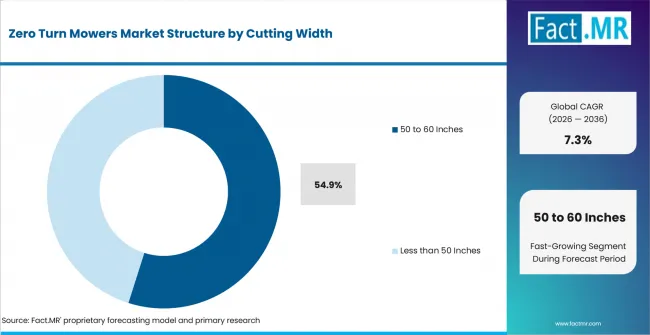
Zero Turn Mowers Market Analysis By Cutting Width

The 50 to 60 Inches segment is expected to hold 54.9% share in 2026 as this deck size balances mowing speed with access through common property gates. Wider units suit sports fields and golf facilities. Smaller decks serve compact residential lawns. Field managers compare zero turn deck width with turf removal tools such as fraise mowers during renovation planning.

  • Mid deck preference: The 50 to 60 Inches range suits residential acreage and contractor jobs needing faster coverage without oversized trailers.
  • Large deck demand: More than 60 Inches decks serve golf courses and campuses needing fewer passes across large grass areas.
  • Compact deck retention: Less than 50 Inches units serve homeowners with narrow gates and storage limits in suburban areas.

Zero Turn Mowers Market Analysis by End User
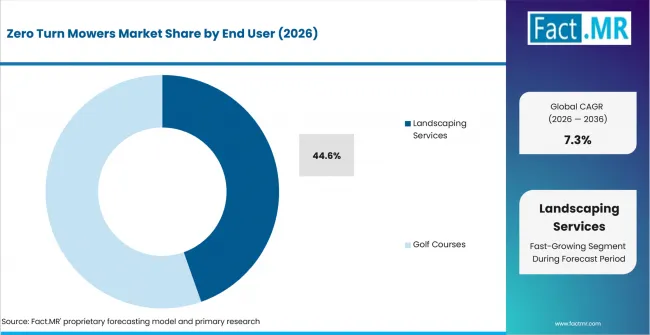
Zero Turn Mowers Market Analysis By End User

Landscaping services are set to hold 44.6% share in 2026 as outsourced lawn care contracts support regular machine replacement. Golf courses and public agencies form another user group with heavier duty cycles. Residential owners add volume at the entry level, though professional users shape feature demand through comfort and deck durability needs.

  • Landscape service purchasing: Contractors need machines that reduce operator fatigue and keep daily route schedules stable during peak grass season.
  • Golf course upkeep: Course managers select wider decks and high-power engines for fairway edges and facility grounds.
  • Residential acreage use: Rural homeowners buy zero turn mowers as larger lawns make weekend mowing time a clear pain point.

Drivers Restraints and Opportunities
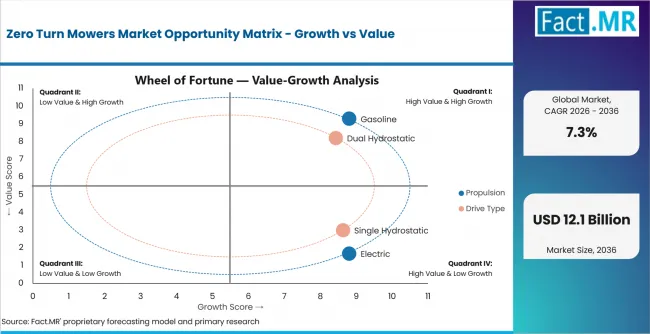
Zero Turn Mowers Market Opportunity Matrix Growth Vs Value

Zero turn mower demand expands as lawn care work faces tighter labor supply. Contractors need machines that reduce turns and repeated passes. The same ordering behavior supports adjacent turf tools such as lawn edge trimmer products used for finish work after mowing.

The shift to battery equipment creates an opportunity, though it is not a full replacement path. Honda said in October 2025 that ProZision models will include manual and autonomous battery-powered riding mowers scheduled for U.S. sale before the end of 2026. [7] This supports electric fleet trials in commercial mowing and municipal work linked with zero-emission equipment planning.

Pricing remains the main restraint. Commercial zero turn mowers require higher upfront spending than walk-behind units. Dealers report that smaller contractors often keep older gasoline units longer if repair costs stay predictable.

  • Replacement Demand Stability: Contractor fleets create steady replacement demand as high mowing hours wear blades and decks faster than residential use.
  • Battery Trial Opportunity: Municipal and campus users test electric zero turn mowers as low-noise operation improves acceptance near public buildings.
  • Rental Pressure: Seasonal land clearing and irregular acreage jobs can move toward brush hog rental services instead of owned zero turn units.

Regional Analysis

The zero turn mowers market is assessed across North America, Europe, Asia Pacific, Latin America, and the Middle East and Africa. The full report covers 40+ countries by propulsion, cutting width, application, end user, drive type, and sales channel.

Top Country Growth Comparison Zero Turn Mowers Market Cagr (2026 2036)

Country CAGR (2026 to 2036)
India 8.9%
China 8.4%
Australia 7.1%
United States 6.8%
Germany 6.5%
United Kingdom 6.4%
Japan 6.1%

Source: Fact.MR analysis, based on proprietary forecasting model and primary research
Zero Turn Mowers Market Cagr Analysis By Country

Asia Pacific Zero Turn Mowers Market Analysis
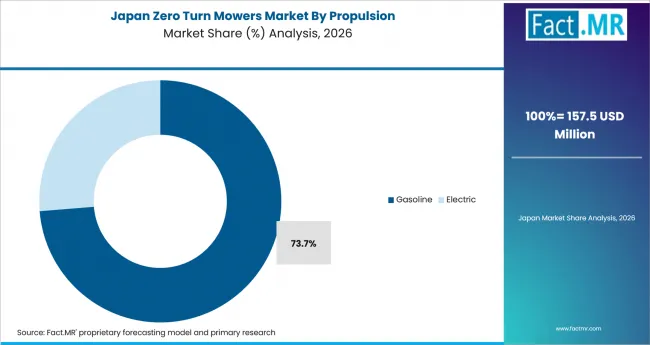
Zero Turn Mowers Market Japan Market Share Analysis By Propulsion

Asia Pacific is the fastest-growing regional market for zero turn mowers. Urban lawns and large housing communities are increasing the need for professional turf care. Gated housing and campus upkeep support higher orders in India. Municipal landscaping adds demand across China and Japan.

  • India: India is projected to record 8.9% CAGR through 2036. Gated housing communities and education campuses are increasing outsourced lawn care contracts. Turf service providers need compact riding mowers that reduce manual cutting time. Dealer support will influence adoption as operators compare service access and deck durability.
  • China: China is expected to expand at 8.4% CAGR by 2036. Public landscaping budgets and local equipment assembly are making commercial zero turn mowers easier to access. Municipal park expansion raises demand for wider deck equipment. Domestic supply can reduce order delays for city maintenance contractors during seasonal mowing work.
  • Japan: Japan advances at 6.1% CAGR from 2026 to 2036. Aging property owners and golf operators prefer riding equipment that reduces manual mowing effort. Compact zero turn formats suit property upkeep with limited labor availability. Dealers can gain from service packages that help older users operate riding mower controls safely.

North America Zero Turn Mowers Market Analysis
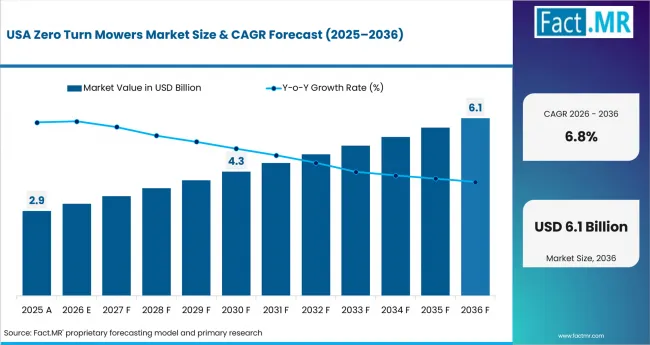
Zero Turn Mowers Market Country Value Analysis

North America is the largest regional market for zero turn mowers. Large residential lawns and contractor fleets support regular mower replacement. Commercial landscaping keeps dealer replacement demand stable across the United States. Canada grows steadily through suburban lawn care and municipal grounds upkeep.

  • United States: The United States is projected to record 6.8% CAGR through 2036. Large residential lawns and contractor fleets support regular zero turn mower replacement. Golf course upkeep and labor pressure in landscaping sustain commercial mower orders. Dealer service is important because contractors need quick parts access during mowing seasons.

Europe Zero Turn Mowers Market Analysis
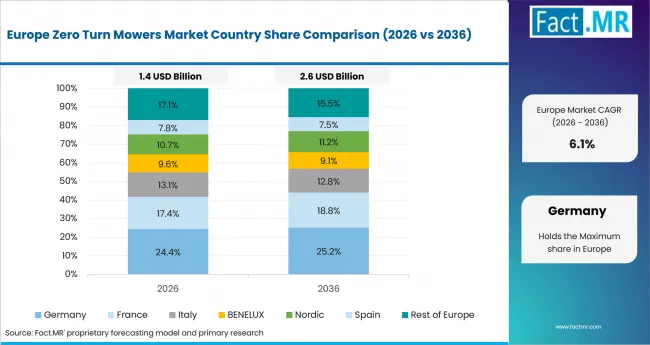
Zero Turn Mowers Market Europe Country Market Share Analysis, 2026 & 2036

Europe shows steady growth for zero turn mowers. Noise rules and public space upkeep are raising interest in battery powered riding equipment. Germany and the United Kingdom continue to see dealer replacement demand from municipal contractors and park maintenance users.

  • Germany: Germany is forecast to grow at 6.5% CAGR by 2036. Municipal contractors are moving toward quieter riding equipment near residential areas. Battery-powered decks are gaining attention because noise limits affect daily mowing hours. Dealer service support is important because commercial users need parts access during short mowing seasons.
  • United Kingdom: The United Kingdom reaches 6.4% CAGR from 2026 to 2036. Public open space upkeep supports fleet replacement after Keep Britain Tidy reported 2,250 accredited United Kingdom public sites in 2025. [5] Contractors and councils need reliable zero turn mowers for park grass cutting. Local dealer support is central for seasonal equipment service planning.

Oceania Zero Turn Mowers Market Analysis

Oceania is an established market for zero turn mowers. Acreage homes and sports turf upkeep support demand for larger deck machines. Australian users value durable decks because service points can be far from major cities.

  • Australia: Australia is projected to expand at 7.1% CAGR by 2036. Acreage homes and sports turf upkeep create demand for larger deck zero turn mowers. Regional dealers are important because service distances are long outside major cities. Durable decks and quick parts access influence repeat mower selection during long mowing seasons.

Competitive Aligners for Market Players
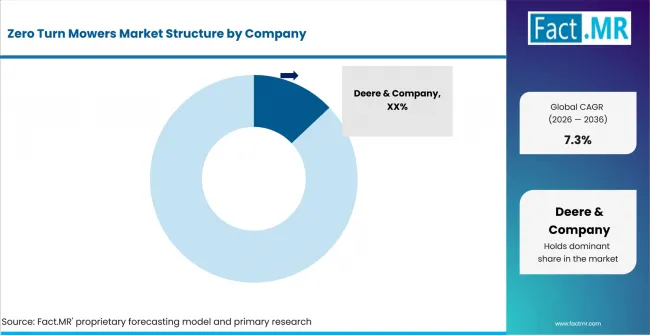
Zero Turn Mowers Market Analysis By Company

Zero turn mower competition centers on dealer reach and deck durability. Deere and Toro compete through established turf equipment portfolios. Kubota and Husqvarna compete through dealer networks and compact property equipment lines. Stanley Black & Decker uses Cub Cadet to reach residential owners who want branded home lawn equipment.

Battery-powered riding equipment is changing product comparison. Kubota displayed an autonomous mower at CES 2025 with GNSS and LiDAR for movement and coordination across multiple vehicles. [8] This shows supplier investment in automation for commercial mowing crews facing labor shortages.

Commercial users compare mower packages based on parts supply and service response. Contractors often select a brand after checking deck steel and hydrostatic service access. Companies with good dealer training can protect share as electric units need more guidance during early order cycles.

Key Players

  • Deere & Company
  • The Toro Company
  • Husqvarna Group
  • Kubota Corporation
  • AriensCo
  • Stanley Black & Decker Inc.
  • Bobcat Company
  • Altoz Inc.

Bibliography

  • [1] U.S. Bureau of Labor Statistics. (2025, August 28). Grounds maintenance workers. In Occupational Outlook Handbook.
  • [2] National Golf Foundation. (2024, February 29). New Golf Facilities in the U.S. Report now available.
  • [3] Environmental Protection Agency. (2025, January 6). California State Nonroad Engine Pollution Control Standards, Small Off-Road Engines Regulations, Notice of Decision. Federal Register, 90, 640-642.
  • [4] National Recreation and Park Association. (2026). 2026 NRPA Agency Performance Review.
  • [5] Green Flag Award. (2025, July 15). 2,250 of the UK’s best parks and green spaces are announced as 2025 Green Flag Award winners.
  • [6] Deere & Company. (2024, October 1). John Deere unveils new Z380R Electric ZTrak™ zero-turn mower for residential customers.
  • [7] Honda Motor Co., Ltd. (2025, October 15). Honda to present world premiere of ProZision Autonomous at Equip Exposition 2025.
  • [8] Kubota Corporation. (2025, February 7). Kubota Group exhibits latest technologies at CES® 2025.

This Report Addresses

  • Strategic demand analysis for zero turn mowers across residential lawns and commercial turf maintenance applications globally.
  • Market forecast from USD 6.0 billion in 2026 to USD 12.1 billion by 2036 at 7.3% CAGR with segment-level analysis.
  • Opportunity mapping across India, China, Australia, the United States, Germany, the United Kingdom, and Japan based on turf maintenance intensity.
  • Segment analysis by propulsion, cutting width, application, end user, drive type, and sales channel with regional forecasts through 2036.
  • Competitive analysis of Deere & Company, The Toro Company, Husqvarna Group, Kubota Corporation, AriensCo, Stanley Black & Decker Inc., Bobcat Company, and Altoz Inc.
  • Regulatory impact analysis covering small off-road engine rules and low-noise equipment needs in urban turf maintenance.
  • Report delivery in PDF, Excel, and presentation formats supported by dealer interviews and official source review.

Zero Turn Mowers Market Definition

The zero turn mowers market covers riding lawn mowers with independent wheel control and near zero turning radius used for residential and commercial turf cutting. These machines support faster maneuvering across residential lawns and commercial grounds where tight turns reduce mowing time. They are sold as gasoline or electric units through dealer networks and online channels. Rental channels also serve turf maintenance users with seasonal or irregular mowing needs.

Zero Turn Mowers Market Inclusions

Covers global and regional market forecasts from 2026 to 2036 by propulsion, cutting width, application, end user, drive type, and sales channel. Includes gasoline and electric zero turn mowers across compact, mid-deck, and large-deck formats. Covers residential owners, landscaping services, golf courses, and public agencies using zero turn equipment for regular turf maintenance. Includes dual hydrostatic, single hydrostatic, and electric wheel motor drive formats sold through dealers, online platforms, and rental channels.

Zero Turn Mowers Market Exclusions

Excludes walk-behind lawn mowers, robotic lawn mowers, lawn tractors, brush cutters, and general turf equipment that does not provide zero turn operation. Omits standalone mower attachments, replacement blades, belts, batteries, and aftermarket service parts unless sold as part of the original mower unit. Excludes golf course turf renovation tools, fraise mowers, brush hogs, and lawn edge trimmers outside zero turn mowing applications.

Zero Turn Mowers Market Research Methodology

  • Primary Research
    • Interviews with landscaping contractors, dealer sales managers, municipal grounds supervisors, golf course maintenance heads, and residential equipment distributors across the United States, Germany, India, China, Australia, the United Kingdom, and Japan.
  • Desk Research
    • Analysis of Deere & Company, Toro, Husqvarna Group, Kubota, AriensCo, Stanley Black & Decker, Bobcat, and Altoz product portfolios and public announcements. Supplemented by labor data, golf facility references, public park maintenance records, small engine regulation updates, and outdoor power equipment product releases.
  • Market-Sizing and Forecasting
    • Hybrid model combining top-down outdoor power equipment revenue estimates with bottom-up mower shipment projections by propulsion, cutting width, application, end user, drive type, and sales channel. Average selling prices by deck size, drive format, and propulsion type are modeled independently and aggregated across all covered regions.
  • Data Validation and Update Cycle
    • Validated through OEM product catalogs, dealer feedback, public agency maintenance references, product launch announcements, and distributor channel checks. Updated annually with regulatory changes, electric mower launch activity, dealer inventory signals, and commercial turf maintenance demand trends.

Scope of the Report

Zero Turn Mowers Market Breakdown By Propulsion, Drive Type, And Region

Attribute Details
Quantitative Units USD 6.0 billion in 2026 to USD 12.1 billion in 2036 at 7.3% CAGR
Market Definition Riding lawn mowers with independent wheel control and near zero turning radius used for residential and commercial turf cutting globally.
Propulsion Segmentation Gasoline, Electric
Cutting Width Segmentation Less than 50 Inches, 50 to 60 Inches, More than 60 Inches
Application Segmentation Residential, Commercial
End User Segmentation Landscaping Services, Golf Courses, Public Agencies, Residential Owners
Drive Type Segmentation Dual Hydrostatic, Single Hydrostatic, Electric Wheel Motor
Sales Channel Segmentation Dealers, Online, Rental
Regions Covered North America, Europe, Asia Pacific, Latin America, Middle East and Africa
Countries Covered United States, China, India, Germany, United Kingdom, Japan, Australia
Key Companies Profiled Deere & Company, The Toro Company, Husqvarna Group, Kubota Corporation, AriensCo, Stanley Black & Decker Inc., Bobcat Company, Altoz Inc.
Forecast Period 2026 to 2036
Approach Hybrid top-down and bottom-up model using outdoor power equipment revenue estimates. Mower shipment projections are validated through OEM product catalogs, dealer feedback, public agency maintenance references, product launch announcements, and distributor channel checks.

Zero Turn Mowers Market by Segment

  • By Propulsion

    • Gasoline
    • Electric
  • By Cutting Width

    • Less than 50 Inches
    • 50 to 60 Inches
    • More than 60 Inches
  • By Application

    • Residential
    • Commercial
  • By End User

    • Landscaping Services
    • Golf Courses
    • Public Agencies
    • Residential Owners
  • By Drive Type

    • Dual Hydrostatic
    • Single Hydrostatic
    • Electric Wheel Motor
  • By Sales Channel

    • Dealers
    • Online
    • Rental
  • By Region

    • North America
    • Latin America
    • Europe
    • East Asia
    • South Asia and Pacific
    • Middle East and Africa

- Frequently Asked Questions -

How large is the global zero turn mowers market in 2025?

The global zero turn mowers market was valued at USD 5.6 billion in 2025.

What will the zero turn mowers market size be in 2026?

Demand for zero turn mowers is estimated to reach USD 6.0 billion in 2026.

What is the projected zero turn mowers market size by 2036?

The zero turn mowers market is projected to reach USD 12.1 billion by 2036.

What is the expected CAGR for the zero turn mowers market?

Fact.MR projects the zero turn mowers market to expand at 7.3% CAGR from 2026 to 2036.

Which propulsion segment leads the zero turn mowers market?

Gasoline propulsion leads with 71.3% share in 2026 because fuel access and repair networks support contractor fleet use.

Which cutting width segment leads the zero turn mowers market?

The 50 to 60 Inches segment leads with 54.9% share in 2026 because it balances productivity and property access.

Which country shows the fastest growth in the zero turn mowers market?

India leads at 8.9% CAGR through 2036 as gated housing and campus maintenance contracts expand professional mower orders.

Table of Content

  1. Executive Summary
    • Global Market Outlook
    • Demand to side Trends
    • Supply to side Trends
    • Technology Roadmap Analysis
    • Analysis and Recommendations
  2. Market Overview
    • Market Coverage / Taxonomy
    • Market Definition / Scope / Limitations
  3. Research Methodology
    • Chapter Orientation
    • Analytical Lens and Working Hypotheses
      • Market Structure, Signals, and Trend Drivers
      • Benchmarking and Cross-market Comparability
      • Market Sizing, Forecasting, and Opportunity Mapping
    • Research Design and Evidence Framework
      • Desk Research Programme (Secondary Evidence)
        • Company Annual and Sustainability Reports
        • Peer-reviewed Journals and Academic Literature
        • Corporate Websites, Product Literature, and Technical Notes
        • Earnings Decks and Investor Briefings
        • Statutory Filings and Regulatory Disclosures
        • Technical White Papers and Standards Notes
        • Trade Journals, Industry Magazines, and Analyst Briefs
        • Conference Proceedings, Webinars, and Seminar Materials
        • Government Statistics Portals and Public Data Releases
        • Press Releases and Reputable Media Coverage
        • Specialist Newsletters and Curated Briefings
        • Sector Databases and Reference Repositories
        • Fact.MR Internal Proprietary Databases and Historical Market Datasets
        • Subscription Datasets and Paid Sources
        • Social Channels, Communities, and Digital Listening Inputs
        • Additional Desk Sources
      • Expert Input and Fieldwork (Primary Evidence)
        • Primary Modes
          • Qualitative Interviews and Expert Elicitation
          • Quantitative Surveys and Structured Data Capture
          • Blended Approach
        • Why Primary Evidence is Used
        • Field Techniques
          • Interviews
          • Surveys
          • Focus Groups
          • Observational and In-context Research
          • Social and Community Interactions
        • Stakeholder Universe Engaged
          • C-suite Leaders
          • Board Members
          • Presidents and Vice Presidents
          • R&D and Innovation Heads
          • Technical Specialists
          • Domain Subject-matter Experts
          • Scientists
          • Physicians and Other Healthcare Professionals
        • Governance, Ethics, and Data Stewardship
          • Research Ethics
          • Data Integrity and Handling
      • Tooling, Models, and Reference Databases
    • Data Engineering and Model Build
      • Data Acquisition and Ingestion
      • Cleaning, Normalisation, and Verification
      • Synthesis, Triangulation, and Analysis
    • Quality Assurance and Audit Trail
  4. Market Background
    • Market Dynamics
      • Drivers
      • Restraints
      • Opportunity
      • Trends
    • Scenario Forecast
      • Demand in Optimistic Scenario
      • Demand in Likely Scenario
      • Demand in Conservative Scenario
    • Opportunity Map Analysis
    • Product Life Cycle Analysis
    • Supply Chain Analysis
    • Investment Feasibility Matrix
    • Value Chain Analysis
    • PESTLE and Porter’s Analysis
    • Regulatory Landscape
    • Regional Parent Market Outlook
    • Production and Consumption Statistics
    • Import and Export Statistics
  5. Global Market Analysis 2021 to 2025 and Forecast, 2026 to 2036
    • Historical Market Size Value (USD Million) Analysis, 2021 to 2025
    • Current and Future Market Size Value (USD Million) Projections, 2026 to 2036
      • Y to o to Y Growth Trend Analysis
      • Absolute $ Opportunity Analysis
  6. Global Market Pricing Analysis 2021 to 2025 and Forecast 2026 to 2036
  7. Global Market Analysis 2021 to 2025 and Forecast 2026 to 2036, By Actuation
    • Introduction / Key Findings
    • Historical Market Size Value (USD Million) Analysis By Actuation , 2021 to 2025
    • Current and Future Market Size Value (USD Million) Analysis and Forecast By Actuation , 2026 to 2036
      • Electric
      • Hydraulic
      • Pneumatic
    • Y to o to Y Growth Trend Analysis By Actuation , 2021 to 2025
    • Absolute $ Opportunity Analysis By Actuation , 2026 to 2036
  8. Global Market Analysis 2021 to 2025 and Forecast 2026 to 2036, By Application
    • Introduction / Key Findings
    • Historical Market Size Value (USD Million) Analysis By Application, 2021 to 2025
    • Current and Future Market Size Value (USD Million) Analysis and Forecast By Application, 2026 to 2036
      • Industrial Automation
      • Vehicle Equipment
    • Y to o to Y Growth Trend Analysis By Application, 2021 to 2025
    • Absolute $ Opportunity Analysis By Application, 2026 to 2036
  9. Global Market Analysis 2021 to 2025 and Forecast 2026 to 2036, By Type
    • Introduction / Key Findings
    • Historical Market Size Value (USD Million) Analysis By Type, 2021 to 2025
    • Current and Future Market Size Value (USD Million) Analysis and Forecast By Type, 2026 to 2036
      • Linear Actuators
      • Rotary Actuators
    • Y to o to Y Growth Trend Analysis By Type, 2021 to 2025
    • Absolute $ Opportunity Analysis By Type, 2026 to 2036
  10. Global Market Analysis 2021 to 2025 and Forecast 2026 to 2036, By Vertical
    • Introduction / Key Findings
    • Historical Market Size Value (USD Million) Analysis By Vertical, 2021 to 2025
    • Current and Future Market Size Value (USD Million) Analysis and Forecast By Vertical, 2026 to 2036
      • Food & Beverages
      • Oil & Gas
      • Metals
    • Y to o to Y Growth Trend Analysis By Vertical, 2021 to 2025
    • Absolute $ Opportunity Analysis By Vertical, 2026 to 2036
  11. Global Market Analysis 2021 to 2025 and Forecast 2026 to 2036, By End Use Industry
    • Introduction / Key Findings
    • Historical Market Size Value (USD Million) Analysis By End Use Industry, 2021 to 2025
    • Current and Future Market Size Value (USD Million) Analysis and Forecast By End Use Industry, 2026 to 2036
      • Manufacturing
      • Automotive
      • Aerospace & Defense
    • Y to o to Y Growth Trend Analysis By End Use Industry, 2021 to 2025
    • Absolute $ Opportunity Analysis By End Use Industry, 2026 to 2036
  12. Global Market Analysis 2021 to 2025 and Forecast 2026 to 2036, By Region
    • Introduction
    • Historical Market Size Value (USD Million) Analysis By Region, 2021 to 2025
    • Current Market Size Value (USD Million) Analysis and Forecast By Region, 2026 to 2036
      • North America
      • Latin America
      • Western Europe
      • Eastern Europe
      • East Asia
      • South Asia and Pacific
      • Middle East & Africa
    • Market Attractiveness Analysis By Region
  13. North America Market Analysis 2021 to 2025 and Forecast 2026 to 2036, By Country
    • Historical Market Size Value (USD Million) Trend Analysis By Market Taxonomy, 2021 to 2025
    • Market Size Value (USD Million) Forecast By Market Taxonomy, 2026 to 2036
      • By Country
        • USA
        • Canada
        • Mexico
      • By Actuation
      • By Application
      • By Type
      • By Vertical
      • By End Use Industry
    • Market Attractiveness Analysis
      • By Country
      • By Actuation
      • By Application
      • By Type
      • By Vertical
      • By End Use Industry
    • Key Takeaways
  14. Latin America Market Analysis 2021 to 2025 and Forecast 2026 to 2036, By Country
    • Historical Market Size Value (USD Million) Trend Analysis By Market Taxonomy, 2021 to 2025
    • Market Size Value (USD Million) Forecast By Market Taxonomy, 2026 to 2036
      • By Country
        • Brazil
        • Chile
        • Rest of Latin America
      • By Actuation
      • By Application
      • By Type
      • By Vertical
      • By End Use Industry
    • Market Attractiveness Analysis
      • By Country
      • By Actuation
      • By Application
      • By Type
      • By Vertical
      • By End Use Industry
    • Key Takeaways
  15. Western Europe Market Analysis 2021 to 2025 and Forecast 2026 to 2036, By Country
    • Historical Market Size Value (USD Million) Trend Analysis By Market Taxonomy, 2021 to 2025
    • Market Size Value (USD Million) Forecast By Market Taxonomy, 2026 to 2036
      • By Country
        • Germany
        • UK
        • Italy
        • Spain
        • France
        • Nordic
        • BENELUX
        • Rest of Western Europe
      • By Actuation
      • By Application
      • By Type
      • By Vertical
      • By End Use Industry
    • Market Attractiveness Analysis
      • By Country
      • By Actuation
      • By Application
      • By Type
      • By Vertical
      • By End Use Industry
    • Key Takeaways
  16. Eastern Europe Market Analysis 2021 to 2025 and Forecast 2026 to 2036, By Country
    • Historical Market Size Value (USD Million) Trend Analysis By Market Taxonomy, 2021 to 2025
    • Market Size Value (USD Million) Forecast By Market Taxonomy, 2026 to 2036
      • By Country
        • Russia
        • Poland
        • Hungary
        • Balkan & Baltic
        • Rest of Eastern Europe
      • By Actuation
      • By Application
      • By Type
      • By Vertical
      • By End Use Industry
    • Market Attractiveness Analysis
      • By Country
      • By Actuation
      • By Application
      • By Type
      • By Vertical
      • By End Use Industry
    • Key Takeaways
  17. East Asia Market Analysis 2021 to 2025 and Forecast 2026 to 2036, By Country
    • Historical Market Size Value (USD Million) Trend Analysis By Market Taxonomy, 2021 to 2025
    • Market Size Value (USD Million) Forecast By Market Taxonomy, 2026 to 2036
      • By Country
        • China
        • Japan
        • South Korea
      • By Actuation
      • By Application
      • By Type
      • By Vertical
      • By End Use Industry
    • Market Attractiveness Analysis
      • By Country
      • By Actuation
      • By Application
      • By Type
      • By Vertical
      • By End Use Industry
    • Key Takeaways
  18. South Asia and Pacific Market Analysis 2021 to 2025 and Forecast 2026 to 2036, By Country
    • Historical Market Size Value (USD Million) Trend Analysis By Market Taxonomy, 2021 to 2025
    • Market Size Value (USD Million) Forecast By Market Taxonomy, 2026 to 2036
      • By Country
        • India
        • ASEAN
        • Australia & New Zealand
        • Rest of South Asia and Pacific
      • By Actuation
      • By Application
      • By Type
      • By Vertical
      • By End Use Industry
    • Market Attractiveness Analysis
      • By Country
      • By Actuation
      • By Application
      • By Type
      • By Vertical
      • By End Use Industry
    • Key Takeaways
  19. Middle East & Africa Market Analysis 2021 to 2025 and Forecast 2026 to 2036, By Country
    • Historical Market Size Value (USD Million) Trend Analysis By Market Taxonomy, 2021 to 2025
    • Market Size Value (USD Million) Forecast By Market Taxonomy, 2026 to 2036
      • By Country
        • Kingdom of Saudi Arabia
        • Other GCC Countries
        • Turkiye
        • South Africa
        • Other African Union
        • Rest of Middle East & Africa
      • By Actuation
      • By Application
      • By Type
      • By Vertical
      • By End Use Industry
    • Market Attractiveness Analysis
      • By Country
      • By Actuation
      • By Application
      • By Type
      • By Vertical
      • By End Use Industry
    • Key Takeaways
  20. Key Countries Market Analysis
    • USA
      • Pricing Analysis
      • Market Share Analysis, 2025
        • By Actuation
        • By Application
        • By Type
        • By Vertical
        • By End Use Industry
    • Canada
      • Pricing Analysis
      • Market Share Analysis, 2025
        • By Actuation
        • By Application
        • By Type
        • By Vertical
        • By End Use Industry
    • Mexico
      • Pricing Analysis
      • Market Share Analysis, 2025
        • By Actuation
        • By Application
        • By Type
        • By Vertical
        • By End Use Industry
    • Brazil
      • Pricing Analysis
      • Market Share Analysis, 2025
        • By Actuation
        • By Application
        • By Type
        • By Vertical
        • By End Use Industry
    • Chile
      • Pricing Analysis
      • Market Share Analysis, 2025
        • By Actuation
        • By Application
        • By Type
        • By Vertical
        • By End Use Industry
    • Germany
      • Pricing Analysis
      • Market Share Analysis, 2025
        • By Actuation
        • By Application
        • By Type
        • By Vertical
        • By End Use Industry
    • UK
      • Pricing Analysis
      • Market Share Analysis, 2025
        • By Actuation
        • By Application
        • By Type
        • By Vertical
        • By End Use Industry
    • Italy
      • Pricing Analysis
      • Market Share Analysis, 2025
        • By Actuation
        • By Application
        • By Type
        • By Vertical
        • By End Use Industry
    • Spain
      • Pricing Analysis
      • Market Share Analysis, 2025
        • By Actuation
        • By Application
        • By Type
        • By Vertical
        • By End Use Industry
    • France
      • Pricing Analysis
      • Market Share Analysis, 2025
        • By Actuation
        • By Application
        • By Type
        • By Vertical
        • By End Use Industry
    • India
      • Pricing Analysis
      • Market Share Analysis, 2025
        • By Actuation
        • By Application
        • By Type
        • By Vertical
        • By End Use Industry
    • ASEAN
      • Pricing Analysis
      • Market Share Analysis, 2025
        • By Actuation
        • By Application
        • By Type
        • By Vertical
        • By End Use Industry
    • Australia & New Zealand
      • Pricing Analysis
      • Market Share Analysis, 2025
        • By Actuation
        • By Application
        • By Type
        • By Vertical
        • By End Use Industry
    • China
      • Pricing Analysis
      • Market Share Analysis, 2025
        • By Actuation
        • By Application
        • By Type
        • By Vertical
        • By End Use Industry
    • Japan
      • Pricing Analysis
      • Market Share Analysis, 2025
        • By Actuation
        • By Application
        • By Type
        • By Vertical
        • By End Use Industry
    • South Korea
      • Pricing Analysis
      • Market Share Analysis, 2025
        • By Actuation
        • By Application
        • By Type
        • By Vertical
        • By End Use Industry
    • Russia
      • Pricing Analysis
      • Market Share Analysis, 2025
        • By Actuation
        • By Application
        • By Type
        • By Vertical
        • By End Use Industry
    • Poland
      • Pricing Analysis
      • Market Share Analysis, 2025
        • By Actuation
        • By Application
        • By Type
        • By Vertical
        • By End Use Industry
    • Hungary
      • Pricing Analysis
      • Market Share Analysis, 2025
        • By Actuation
        • By Application
        • By Type
        • By Vertical
        • By End Use Industry
    • Kingdom of Saudi Arabia
      • Pricing Analysis
      • Market Share Analysis, 2025
        • By Actuation
        • By Application
        • By Type
        • By Vertical
        • By End Use Industry
    • Turkiye
      • Pricing Analysis
      • Market Share Analysis, 2025
        • By Actuation
        • By Application
        • By Type
        • By Vertical
        • By End Use Industry
    • South Africa
      • Pricing Analysis
      • Market Share Analysis, 2025
        • By Actuation
        • By Application
        • By Type
        • By Vertical
        • By End Use Industry
  21. Market Structure Analysis
    • Competition Dashboard
    • Competition Benchmarking
    • Market Share Analysis of Top Players
      • By Regional
      • By Actuation
      • By Application
      • By Type
      • By Vertical
      • By End Use Industry
  22. Competition Analysis
    • Competition Deep Dive
      • Siemens AG
        • Overview
        • Product Portfolio
        • Profitability by Market Segments (Product/Age /Sales Channel/Region)
        • Sales Footprint
        • Strategy Overview
          • Marketing Strategy
          • Product Strategy
          • Channel Strategy
      • ABB Ltd.
      • Emerson Electric Co.
      • Rockwell Automation, Inc.
      • Schneider Electric SE
      • SMC Corporation
  23. Assumptions & Acronyms Used

List Of Table

  • Table 1: Global Market Value (USD Million) Forecast by Region, 2021 to 2036
  • Table 2: Global Market Value (USD Million) Forecast by Actuation , 2021 to 2036
  • Table 3: Global Market Value (USD Million) Forecast by Application, 2021 to 2036
  • Table 4: Global Market Value (USD Million) Forecast by Type, 2021 to 2036
  • Table 5: Global Market Value (USD Million) Forecast by Vertical, 2021 to 2036
  • Table 6: Global Market Value (USD Million) Forecast by End Use Industry, 2021 to 2036
  • Table 7: North America Market Value (USD Million) Forecast by Country, 2021 to 2036
  • Table 8: North America Market Value (USD Million) Forecast by Actuation , 2021 to 2036
  • Table 9: North America Market Value (USD Million) Forecast by Application, 2021 to 2036
  • Table 10: North America Market Value (USD Million) Forecast by Type, 2021 to 2036
  • Table 11: North America Market Value (USD Million) Forecast by Vertical, 2021 to 2036
  • Table 12: North America Market Value (USD Million) Forecast by End Use Industry, 2021 to 2036
  • Table 13: Latin America Market Value (USD Million) Forecast by Country, 2021 to 2036
  • Table 14: Latin America Market Value (USD Million) Forecast by Actuation , 2021 to 2036
  • Table 15: Latin America Market Value (USD Million) Forecast by Application, 2021 to 2036
  • Table 16: Latin America Market Value (USD Million) Forecast by Type, 2021 to 2036
  • Table 17: Latin America Market Value (USD Million) Forecast by Vertical, 2021 to 2036
  • Table 18: Latin America Market Value (USD Million) Forecast by End Use Industry, 2021 to 2036
  • Table 19: Western Europe Market Value (USD Million) Forecast by Country, 2021 to 2036
  • Table 20: Western Europe Market Value (USD Million) Forecast by Actuation , 2021 to 2036
  • Table 21: Western Europe Market Value (USD Million) Forecast by Application, 2021 to 2036
  • Table 22: Western Europe Market Value (USD Million) Forecast by Type, 2021 to 2036
  • Table 23: Western Europe Market Value (USD Million) Forecast by Vertical, 2021 to 2036
  • Table 24: Western Europe Market Value (USD Million) Forecast by End Use Industry, 2021 to 2036
  • Table 25: Eastern Europe Market Value (USD Million) Forecast by Country, 2021 to 2036
  • Table 26: Eastern Europe Market Value (USD Million) Forecast by Actuation , 2021 to 2036
  • Table 27: Eastern Europe Market Value (USD Million) Forecast by Application, 2021 to 2036
  • Table 28: Eastern Europe Market Value (USD Million) Forecast by Type, 2021 to 2036
  • Table 29: Eastern Europe Market Value (USD Million) Forecast by Vertical, 2021 to 2036
  • Table 30: Eastern Europe Market Value (USD Million) Forecast by End Use Industry, 2021 to 2036
  • Table 31: East Asia Market Value (USD Million) Forecast by Country, 2021 to 2036
  • Table 32: East Asia Market Value (USD Million) Forecast by Actuation , 2021 to 2036
  • Table 33: East Asia Market Value (USD Million) Forecast by Application, 2021 to 2036
  • Table 34: East Asia Market Value (USD Million) Forecast by Type, 2021 to 2036
  • Table 35: East Asia Market Value (USD Million) Forecast by Vertical, 2021 to 2036
  • Table 36: East Asia Market Value (USD Million) Forecast by End Use Industry, 2021 to 2036
  • Table 37: South Asia and Pacific Market Value (USD Million) Forecast by Country, 2021 to 2036
  • Table 38: South Asia and Pacific Market Value (USD Million) Forecast by Actuation , 2021 to 2036
  • Table 39: South Asia and Pacific Market Value (USD Million) Forecast by Application, 2021 to 2036
  • Table 40: South Asia and Pacific Market Value (USD Million) Forecast by Type, 2021 to 2036
  • Table 41: South Asia and Pacific Market Value (USD Million) Forecast by Vertical, 2021 to 2036
  • Table 42: South Asia and Pacific Market Value (USD Million) Forecast by End Use Industry, 2021 to 2036
  • Table 43: Middle East & Africa Market Value (USD Million) Forecast by Country, 2021 to 2036
  • Table 44: Middle East & Africa Market Value (USD Million) Forecast by Actuation , 2021 to 2036
  • Table 45: Middle East & Africa Market Value (USD Million) Forecast by Application, 2021 to 2036
  • Table 46: Middle East & Africa Market Value (USD Million) Forecast by Type, 2021 to 2036
  • Table 47: Middle East & Africa Market Value (USD Million) Forecast by Vertical, 2021 to 2036
  • Table 48: Middle East & Africa Market Value (USD Million) Forecast by End Use Industry, 2021 to 2036

List Of Figures

  • Figure 1: Global Market Pricing Analysis
  • Figure 2: Global Market Value (USD Million) Forecast 2021-2036
  • Figure 3: Global Market Value Share and BPS Analysis by Actuation , 2026 and 2036
  • Figure 4: Global Market Y-o-Y Growth Comparison by Actuation , 2026-2036
  • Figure 5: Global Market Attractiveness Analysis by Actuation
  • Figure 6: Global Market Value Share and BPS Analysis by Application, 2026 and 2036
  • Figure 7: Global Market Y-o-Y Growth Comparison by Application, 2026-2036
  • Figure 8: Global Market Attractiveness Analysis by Application
  • Figure 9: Global Market Value Share and BPS Analysis by Type, 2026 and 2036
  • Figure 10: Global Market Y-o-Y Growth Comparison by Type, 2026-2036
  • Figure 11: Global Market Attractiveness Analysis by Type
  • Figure 12: Global Market Value Share and BPS Analysis by Vertical, 2026 and 2036
  • Figure 13: Global Market Y-o-Y Growth Comparison by Vertical, 2026-2036
  • Figure 14: Global Market Attractiveness Analysis by Vertical
  • Figure 15: Global Market Value Share and BPS Analysis by End Use Industry, 2026 and 2036
  • Figure 16: Global Market Y-o-Y Growth Comparison by End Use Industry, 2026-2036
  • Figure 17: Global Market Attractiveness Analysis by End Use Industry
  • Figure 18: Global Market Value (USD Million) Share and BPS Analysis by Region, 2026 and 2036
  • Figure 19: Global Market Y-o-Y Growth Comparison by Region, 2026-2036
  • Figure 20: Global Market Attractiveness Analysis by Region
  • Figure 21: North America Market Incremental Dollar Opportunity, 2026-2036
  • Figure 22: Latin America Market Incremental Dollar Opportunity, 2026-2036
  • Figure 23: Western Europe Market Incremental Dollar Opportunity, 2026-2036
  • Figure 24: Eastern Europe Market Incremental Dollar Opportunity, 2026-2036
  • Figure 25: East Asia Market Incremental Dollar Opportunity, 2026-2036
  • Figure 26: South Asia and Pacific Market Incremental Dollar Opportunity, 2026-2036
  • Figure 27: Middle East & Africa Market Incremental Dollar Opportunity, 2026-2036
  • Figure 28: North America Market Value Share and BPS Analysis by Country, 2026 and 2036
  • Figure 29: North America Market Value Share and BPS Analysis by Actuation , 2026 and 2036
  • Figure 30: North America Market Y-o-Y Growth Comparison by Actuation , 2026-2036
  • Figure 31: North America Market Attractiveness Analysis by Actuation
  • Figure 32: North America Market Value Share and BPS Analysis by Application, 2026 and 2036
  • Figure 33: North America Market Y-o-Y Growth Comparison by Application, 2026-2036
  • Figure 34: North America Market Attractiveness Analysis by Application
  • Figure 35: North America Market Value Share and BPS Analysis by Type, 2026 and 2036
  • Figure 36: North America Market Y-o-Y Growth Comparison by Type, 2026-2036
  • Figure 37: North America Market Attractiveness Analysis by Type
  • Figure 38: North America Market Value Share and BPS Analysis by Vertical, 2026 and 2036
  • Figure 39: North America Market Y-o-Y Growth Comparison by Vertical, 2026-2036
  • Figure 40: North America Market Attractiveness Analysis by Vertical
  • Figure 41: North America Market Value Share and BPS Analysis by End Use Industry, 2026 and 2036
  • Figure 42: North America Market Y-o-Y Growth Comparison by End Use Industry, 2026-2036
  • Figure 43: North America Market Attractiveness Analysis by End Use Industry
  • Figure 44: Latin America Market Value Share and BPS Analysis by Country, 2026 and 2036
  • Figure 45: Latin America Market Value Share and BPS Analysis by Actuation , 2026 and 2036
  • Figure 46: Latin America Market Y-o-Y Growth Comparison by Actuation , 2026-2036
  • Figure 47: Latin America Market Attractiveness Analysis by Actuation
  • Figure 48: Latin America Market Value Share and BPS Analysis by Application, 2026 and 2036
  • Figure 49: Latin America Market Y-o-Y Growth Comparison by Application, 2026-2036
  • Figure 50: Latin America Market Attractiveness Analysis by Application
  • Figure 51: Latin America Market Value Share and BPS Analysis by Type, 2026 and 2036
  • Figure 52: Latin America Market Y-o-Y Growth Comparison by Type, 2026-2036
  • Figure 53: Latin America Market Attractiveness Analysis by Type
  • Figure 54: Latin America Market Value Share and BPS Analysis by Vertical, 2026 and 2036
  • Figure 55: Latin America Market Y-o-Y Growth Comparison by Vertical, 2026-2036
  • Figure 56: Latin America Market Attractiveness Analysis by Vertical
  • Figure 57: Latin America Market Value Share and BPS Analysis by End Use Industry, 2026 and 2036
  • Figure 58: Latin America Market Y-o-Y Growth Comparison by End Use Industry, 2026-2036
  • Figure 59: Latin America Market Attractiveness Analysis by End Use Industry
  • Figure 60: Western Europe Market Value Share and BPS Analysis by Country, 2026 and 2036
  • Figure 61: Western Europe Market Value Share and BPS Analysis by Actuation , 2026 and 2036
  • Figure 62: Western Europe Market Y-o-Y Growth Comparison by Actuation , 2026-2036
  • Figure 63: Western Europe Market Attractiveness Analysis by Actuation
  • Figure 64: Western Europe Market Value Share and BPS Analysis by Application, 2026 and 2036
  • Figure 65: Western Europe Market Y-o-Y Growth Comparison by Application, 2026-2036
  • Figure 66: Western Europe Market Attractiveness Analysis by Application
  • Figure 67: Western Europe Market Value Share and BPS Analysis by Type, 2026 and 2036
  • Figure 68: Western Europe Market Y-o-Y Growth Comparison by Type, 2026-2036
  • Figure 69: Western Europe Market Attractiveness Analysis by Type
  • Figure 70: Western Europe Market Value Share and BPS Analysis by Vertical, 2026 and 2036
  • Figure 71: Western Europe Market Y-o-Y Growth Comparison by Vertical, 2026-2036
  • Figure 72: Western Europe Market Attractiveness Analysis by Vertical
  • Figure 73: Western Europe Market Value Share and BPS Analysis by End Use Industry, 2026 and 2036
  • Figure 74: Western Europe Market Y-o-Y Growth Comparison by End Use Industry, 2026-2036
  • Figure 75: Western Europe Market Attractiveness Analysis by End Use Industry
  • Figure 76: Eastern Europe Market Value Share and BPS Analysis by Country, 2026 and 2036
  • Figure 77: Eastern Europe Market Value Share and BPS Analysis by Actuation , 2026 and 2036
  • Figure 78: Eastern Europe Market Y-o-Y Growth Comparison by Actuation , 2026-2036
  • Figure 79: Eastern Europe Market Attractiveness Analysis by Actuation
  • Figure 80: Eastern Europe Market Value Share and BPS Analysis by Application, 2026 and 2036
  • Figure 81: Eastern Europe Market Y-o-Y Growth Comparison by Application, 2026-2036
  • Figure 82: Eastern Europe Market Attractiveness Analysis by Application
  • Figure 83: Eastern Europe Market Value Share and BPS Analysis by Type, 2026 and 2036
  • Figure 84: Eastern Europe Market Y-o-Y Growth Comparison by Type, 2026-2036
  • Figure 85: Eastern Europe Market Attractiveness Analysis by Type
  • Figure 86: Eastern Europe Market Value Share and BPS Analysis by Vertical, 2026 and 2036
  • Figure 87: Eastern Europe Market Y-o-Y Growth Comparison by Vertical, 2026-2036
  • Figure 88: Eastern Europe Market Attractiveness Analysis by Vertical
  • Figure 89: Eastern Europe Market Value Share and BPS Analysis by End Use Industry, 2026 and 2036
  • Figure 90: Eastern Europe Market Y-o-Y Growth Comparison by End Use Industry, 2026-2036
  • Figure 91: Eastern Europe Market Attractiveness Analysis by End Use Industry
  • Figure 92: East Asia Market Value Share and BPS Analysis by Country, 2026 and 2036
  • Figure 93: East Asia Market Value Share and BPS Analysis by Actuation , 2026 and 2036
  • Figure 94: East Asia Market Y-o-Y Growth Comparison by Actuation , 2026-2036
  • Figure 95: East Asia Market Attractiveness Analysis by Actuation
  • Figure 96: East Asia Market Value Share and BPS Analysis by Application, 2026 and 2036
  • Figure 97: East Asia Market Y-o-Y Growth Comparison by Application, 2026-2036
  • Figure 98: East Asia Market Attractiveness Analysis by Application
  • Figure 99: East Asia Market Value Share and BPS Analysis by Type, 2026 and 2036
  • Figure 100: East Asia Market Y-o-Y Growth Comparison by Type, 2026-2036
  • Figure 101: East Asia Market Attractiveness Analysis by Type
  • Figure 102: East Asia Market Value Share and BPS Analysis by Vertical, 2026 and 2036
  • Figure 103: East Asia Market Y-o-Y Growth Comparison by Vertical, 2026-2036
  • Figure 104: East Asia Market Attractiveness Analysis by Vertical
  • Figure 105: East Asia Market Value Share and BPS Analysis by End Use Industry, 2026 and 2036
  • Figure 106: East Asia Market Y-o-Y Growth Comparison by End Use Industry, 2026-2036
  • Figure 107: East Asia Market Attractiveness Analysis by End Use Industry
  • Figure 108: South Asia and Pacific Market Value Share and BPS Analysis by Country, 2026 and 2036
  • Figure 109: South Asia and Pacific Market Value Share and BPS Analysis by Actuation , 2026 and 2036
  • Figure 110: South Asia and Pacific Market Y-o-Y Growth Comparison by Actuation , 2026-2036
  • Figure 111: South Asia and Pacific Market Attractiveness Analysis by Actuation
  • Figure 112: South Asia and Pacific Market Value Share and BPS Analysis by Application, 2026 and 2036
  • Figure 113: South Asia and Pacific Market Y-o-Y Growth Comparison by Application, 2026-2036
  • Figure 114: South Asia and Pacific Market Attractiveness Analysis by Application
  • Figure 115: South Asia and Pacific Market Value Share and BPS Analysis by Type, 2026 and 2036
  • Figure 116: South Asia and Pacific Market Y-o-Y Growth Comparison by Type, 2026-2036
  • Figure 117: South Asia and Pacific Market Attractiveness Analysis by Type
  • Figure 118: South Asia and Pacific Market Value Share and BPS Analysis by Vertical, 2026 and 2036
  • Figure 119: South Asia and Pacific Market Y-o-Y Growth Comparison by Vertical, 2026-2036
  • Figure 120: South Asia and Pacific Market Attractiveness Analysis by Vertical
  • Figure 121: South Asia and Pacific Market Value Share and BPS Analysis by End Use Industry, 2026 and 2036
  • Figure 122: South Asia and Pacific Market Y-o-Y Growth Comparison by End Use Industry, 2026-2036
  • Figure 123: South Asia and Pacific Market Attractiveness Analysis by End Use Industry
  • Figure 124: Middle East & Africa Market Value Share and BPS Analysis by Country, 2026 and 2036
  • Figure 125: Middle East & Africa Market Value Share and BPS Analysis by Actuation , 2026 and 2036
  • Figure 126: Middle East & Africa Market Y-o-Y Growth Comparison by Actuation , 2026-2036
  • Figure 127: Middle East & Africa Market Attractiveness Analysis by Actuation
  • Figure 128: Middle East & Africa Market Value Share and BPS Analysis by Application, 2026 and 2036
  • Figure 129: Middle East & Africa Market Y-o-Y Growth Comparison by Application, 2026-2036
  • Figure 130: Middle East & Africa Market Attractiveness Analysis by Application
  • Figure 131: Middle East & Africa Market Value Share and BPS Analysis by Type, 2026 and 2036
  • Figure 132: Middle East & Africa Market Y-o-Y Growth Comparison by Type, 2026-2036
  • Figure 133: Middle East & Africa Market Attractiveness Analysis by Type
  • Figure 134: Middle East & Africa Market Value Share and BPS Analysis by Vertical, 2026 and 2036
  • Figure 135: Middle East & Africa Market Y-o-Y Growth Comparison by Vertical, 2026-2036
  • Figure 136: Middle East & Africa Market Attractiveness Analysis by Vertical
  • Figure 137: Middle East & Africa Market Value Share and BPS Analysis by End Use Industry, 2026 and 2036
  • Figure 138: Middle East & Africa Market Y-o-Y Growth Comparison by End Use Industry, 2026-2036
  • Figure 139: Middle East & Africa Market Attractiveness Analysis by End Use Industry
  • Figure 140: Global Market - Tier Structure Analysis
  • Figure 141: Global Market - Company Share Analysis

Zero Turn Mowers Market

Buy Report Now