- Market Value (2025): USD 2.8 Bn
- Estimated Value (2026): USD 3.0 Bn
- Forecast Value (2036): USD 6.2 Bn
- CAGR (2026-2036): 7.7%
What is the Waterproof Polyurethane Dispersions Market forecast to be worth by 2036?
USD 3.0 billion in 2026 to USD 6.2 billion by 2036 at a 7.7% CAGR.
- The Waterproof Polyurethane Dispersions Market reached USD 2.7 billion in 2025.
- Demand is projected to increase from USD 3.0 billion in 2026 to USD 6.2 billion by 2036.
- The market is forecast to record 7.7% CAGR from 2026 to 2036 as textile coaters, footwear material producers and membrane formulators shift toward low-solvent waterproof systems.
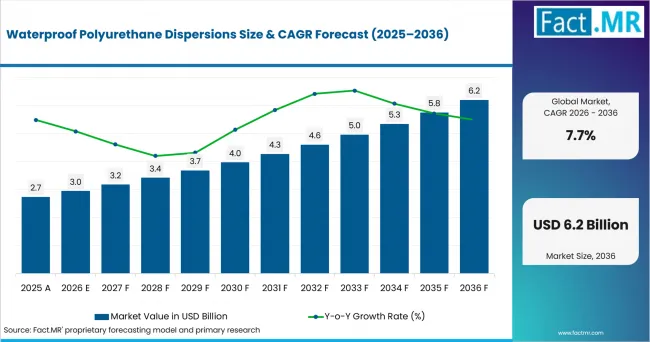
Waterproof Polyurethane Dispersions Value Analysis | Source: Fact.MR
What are the defining numbers behind Waterproof Polyurethane Dispersions Market growth?
USD 3.2 billion absolute opportunity by 2036, led by anionic PUD, textile / footwear coatings and the USA.
- Demand Drivers in the Market
- Textile coaters need flexible water barriers that preserve hand feel, so PUD selection is expected to focus on elongation and breathable film behavior.
- Footwear material suppliers need coatings that withstand flexing and wet abrasion, supported by polyurethane films that bond to synthetic and leather substrates.
- Construction membrane formulators need waterborne binders with low water absorption and hydrolysis resistance as liquid-applied systems expand into roofs and bathrooms.
- Wood finish producers need clear films that resist wear and moisture, reinforced by self-crosslinking PUD grades for floors and furniture.
- The U.S. Census Bureau’s December 2025 M3 full report, released February 23, 2026, recorded 2025 shipments for paints, coatings and adhesives at USD 50,038 million.
- Key Segments Analyzed
- By PUD Type: Anionic PUD is expected to hold 42.0% share in 2026 since charge stability helps formulators manage dispersion quality in high-volume coatings.
- By Waterproofing Use: Textile / footwear coatings are projected to account for 27.0% share in 2026 where coated fabrics and synthetic uppers require soft waterproof films.
- By Film Property: Hydrophobic barrier is anticipated to capture 31.0% share in 2026 due to its direct role in blocking water ingress on coated surfaces.
- By Crosslinking: Self-crosslinking is estimated to represent 35.0% share in 2026 owing to simpler handling and fewer mixing steps during coating application.
- Analyst Opinion at Fact.MR
- Shambhu Nath Jha, Principal Consultant at Fact.MR, states, "Waterproof PUD purchasing has become a film-performance decision. Formulators compare water uptake, hydrolysis resistance and crosslinking choices against solvent limits and plant handling needs. Suppliers are expected to combine waterborne chemistry, application data and crosslinker guidance so customers can qualify coatings with shorter reformulation cycles."
- Strategic Implications
- Resin producers should publish water uptake and flex-test data for each waterproofing application, giving formulators clear evidence for coated textiles and membranes.
- Textile coating houses should qualify PUDs by hand feel and wash resistance before moving commercial programs from solvent-heavy systems.
- Construction chemical brands should match PUD grades with membrane thickness and substrate moisture limits to reduce jobsite failure risk.
- Flexible-material developers should watch water-based PU substrate technologies. Stahl launched PermUCell on March 3, 2026 as a fully water-based, DMF-free coagulation technology for producing polyurethane substrates.
The USA is projected to record 8.6% CAGR through 2036 due to construction waterproofing use and coatings production depth. The UK is anticipated to post 8.3% CAGR as construction output and coated textile applications support reformulation. Italy is forecast to advance at 8.0% CAGR, supported by construction recovery and footwear material know-how. Germany is estimated to hold 7.7% CAGR because VOC pressure and construction orders shape waterborne binder selection. France is expected to record 6.0% CAGR as renovation activity and textile finishing needs support selective PUD use.
How does the Waterproof Polyurethane Dispersions Market break down by segment?
Anionic PUD leads at 42.0%; self-crosslinking leads at 35.0%.
Which PUD Type dominates?
Anionic PUD holds 42.0% share in 2026.
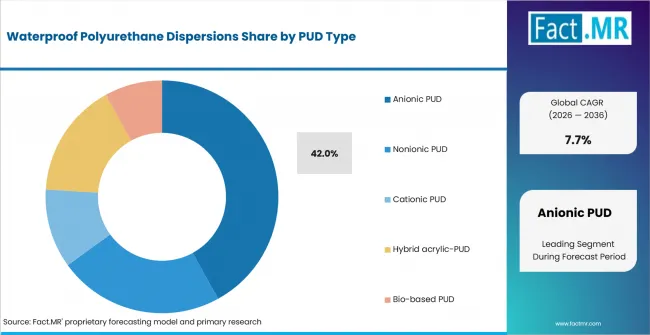
Waterproof Polyurethane Dispersions Analysis By Pud Type | Source: Fact.MR
Anionic PUD leads since ionic stability supports consistent particle dispersion in waterborne coating systems. Formulators use these grades where batch stability, substrate wetting and film clarity need to remain predictable across large production runs.
The chemistry fits waterproof textile and construction coating workflows that need stable viscosity during mixing. Wanhua Chemical presented water-borne waterproofing membranes at CHINACOAT 2025 using Archsol 8355 and Archsol 8357 PUDs for mechanical strength and low-temperature flexibility.
What leads the Waterproofing Use segment?
Textile / footwear coatings hold 27.0% share in 2026.
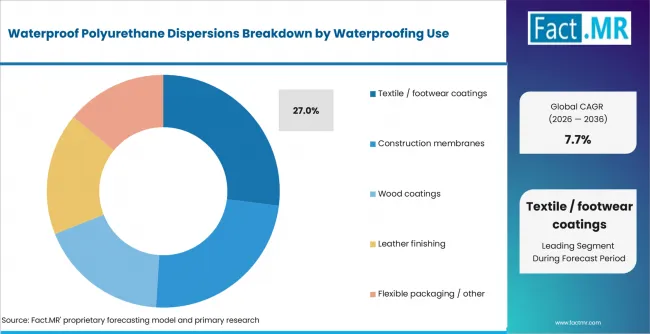
Waterproof Polyurethane Dispersions Analysis By Waterproofing Use | Source: Fact.MR
Textile and footwear coatings lead the use mix as fabrics and upper materials need water resistance with a soft touch. PUD films are suited to repeated folding and wear, which makes them useful in coated synthetic uppers and technical fabrics.
Covestro and Heraeus reported in September 2025 that AGXX technology is fully compatible with Impranil PU dispersions in Covestro waterborne INSQIN textile coating technology. The finding supports coated textile programs where durability, hygiene and lower-solvent processing are evaluated together.
How does Film Property shape demand?
Hydrophobic barrier holds 31.0% share in 2026.
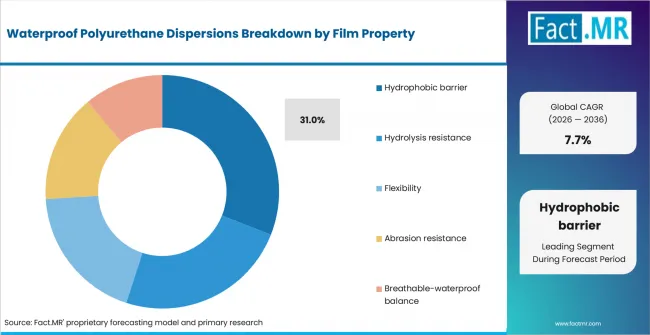
Waterproof Polyurethane Dispersions Analysis By Film Property | Source: Fact.MR
Hydrophobic barrier properties shape buying decisions as the coating must prevent water ingress while staying attached to moving or porous substrates. Construction membranes and outdoor fabrics need films that resist ponding water and repeated wetting.
Barrier performance is expected to carry more weight in liquid-applied membranes than in basic decorative coatings. PUD grades that combine low water absorption with flexible film formation are therefore better aligned with waterproofing applications.
What supports Crosslinking demand?
Self-crosslinking holds 35.0% share in 2026.
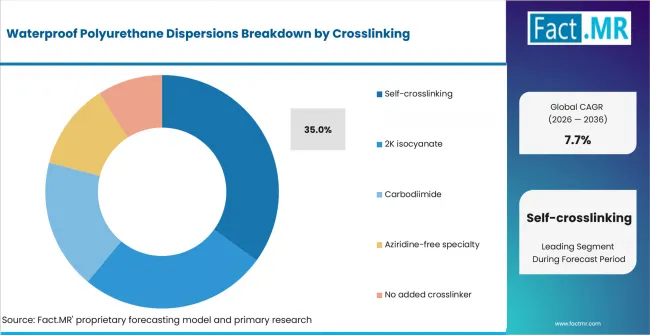
Waterproof Polyurethane Dispersions Analysis By Crosslinking | Source: Fact.MR
Self-crosslinking grades hold the main share since they reduce the handling burden of two-component systems. Coating plants simplify pot-life control and lower mixing-error risk when a film forms the required resistance after drying.
BASF identifies Joncryl U 4500 as a self-crosslinking aliphatic polyurethane dispersion for demanding wood coating applications. Lubrizol’s current Sancure™ 20025F product data sheet, published March 18, 2026, describes it as a soft elastic aliphatic polyester urethane polymer dispersion designed for textile and nonwoven coating formulations.
What is accelerating Waterproof Polyurethane Dispersions Market adoption, and what is holding it back?
Adoption is expected to rise through waterborne waterproofing, while cost and qualification needs shape switching pace.
Drivers Impact Analysis
| DRIVER | (~) % IMPACT ON CAGR | GEOGRAPHIC RELEVANCE | IMPACT TIMELINE |
|---|---|---|---|
| Waterborne substitution in waterproof textile and footwear coatings | +1.5% | North America, Europe | Short term (<= 2 years) |
| Liquid-applied construction membrane reformulation | +1.2% | USA, Italy, Germany | Medium term (2-4 years) |
| Hydrophobic barrier performance in flexible substrates | +0.9% | Global | Medium term (2-4 years) |
| Self-crosslinking processing advantages in wood and leather finishing | +0.7% | Europe, North America | Long term (>= 4 years) |
Opportunity Impact Analysis
| OPPORTUNITY | (~) % IMPACT ON CAGR | GEOGRAPHIC RELEVANCE | IMPACT TIMELINE |
|---|---|---|---|
| Bio-based and mass-balanced PUD grades for brand programs | +0.8% | Europe, North America | Medium term (2-4 years) |
| Aziridine-free and carbodiimide crosslinker packages | +0.6% | Europe, USA | Short term (<= 2 years) |
| Waterproof breathable coatings for outdoor textiles | +0.5% | USA, UK, Italy | Long term (>= 4 years) |
Restraints Impact Analysis
| RESTRAINT | (~) % IMPACT ON CAGR | GEOGRAPHIC RELEVANCE | IMPACT TIMELINE |
|---|---|---|---|
| Performance testing extends conversion cycles from qualified solvent systems | -0.6% | Global | Short term (<= 2 years) |
| Raw material and producer-price pressure | -0.4% | Europe, USA | Medium term (2-4 years) |
| Regulatory documentation burden for coatings chemistry | -0.3% | North America, Europe | Long term (>= 4 years) |
Which countries are scaling the Waterproof Polyurethane Dispersions Market through 2036?
- The country comparison spans 2.6 percentage points and forms three practical growth bands across the forecast period.
- The USA remains 0.3 percentage point above the UK as construction waterproofing and coatings output create a broad application base.
- The UK remains 0.3 percentage point above Italy as construction output and coated textile demand support reformulation.
- Italy remains 0.3 percentage point above Germany through construction recovery and specialist footwear material demand.
- Germany remains 1.7 percentage points above France where VOC pressure and industrial coating depth favor waterborne binders.
- France closes the displayed range as renovation activity and textile finishing needs support selective PUD conversion.
Comparable CAGRs create different entry conditions due to construction demand, coating qualification needs and textile finishing depth. Full report coverage includes North America, Latin America, Western Europe, Eastern Europe, East Asia, South Asia & Pacific, Middle East & Africa.
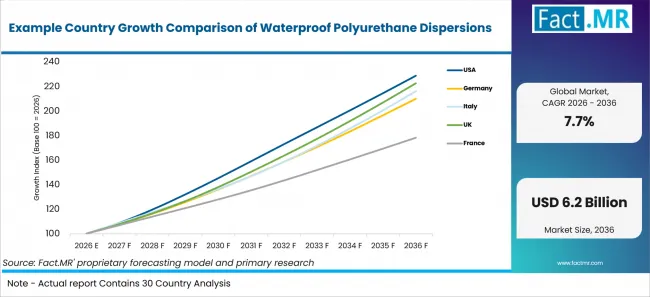
Example Country Growth Comparison Of Waterproof Polyurethane Dispersions | Source: Fact.MR
| Country | CAGR |
|---|---|
| USA | 8.6% |
| UK | 8.3% |
| Italy | 8.0% |
| Germany | 7.7% |
| France | 6.0% |
What supports USA adoption?
8.6% CAGR, supported by construction waterproofing demand and coatings production depth.
U.S. coating formulators benefit from a large construction base that uses waterproofing in roofs, bathrooms and building envelopes. The U.S. Census Bureau later revised June 2025 construction spending to a seasonally adjusted annual rate of USD 2,140.5 billion. The scale of U.S. construction activity as supportive of liquid-applied membrane demand and PUD opportunities in construction chemicals and industrial coating programs.
What supports the United Kingdom’s growth?
8.3% CAGR, backed by construction output and specialty coated fabric demand.
UK demand is linked to repair work, waterproofing membranes and technical textile finishing. The Office for National Statistics reported in February 2026 that annual construction output in Great Britain increased by 1.8% in 2025 compared with 2024. The 2025 construction output base as supportive of PUD use in moisture-resistant coating systems, with coated fabrics providing an additional route for breathable waterproof films.
How is Italy scaling demand?
8.0% CAGR, led by construction recovery and footwear coating specialization.
Italy combines construction demand with footwear and leather finishing expertise. Istat reported in February 2026 that Italy’s calendar-adjusted construction production index rose by 4.8% on average in 2025. Waterproof PUD suppliers to benefit where construction membranes require elastic films and footwear materials need water resistance with a softer hand feel.
What is supporting Germany’s adoption?
7.7% CAGR, supported by VOC pressure and construction-order recovery.
German formulators evaluate waterborne binders closely since performance records are central in industrial coatings. Destatis reported in February 2026 that real incoming orders in Germany’s main construction industry rose by 6.8% in 2025. This construction-order recovery as supportive of waterproofing demand and continued interest in lower-solvent PUD systems.
How does France perform?
6.0% CAGR, shaped by renovation demand and selective textile finishing.
French demand is tied to renovation, liquid membrane use and coated textiles. The SDES reported that, in December 2025, seasonally and working-day adjusted housing authorizations increased by 6.9% from November to 32,381 units. This housing-authorization activity as supportive of a construction channel for waterproof PUDs, alongside textile applications that balance comfort and water resistance.
Who leads the Waterproof Polyurethane Dispersions Market?
Covestro supports waterborne polyurethane applications through Bayhydrol, Impranil and INSQIN technologies. Impranil and INSQIN are used in textile coating applications, while selected Bayhydrol polyurethane dispersions, including Bayhydrol UH 2897, are designed for liquid waterproofing membranes and elastomeric construction coatings. These technologies provide properties including flexibility, durability, water resistance and hydrolysis resistance for coated-textile and construction-coating applications.
BASF participates through Joncryl polyurethane dispersions and polyurethane-acrylic systems for wood, flooring and other coating applications. Joncryl U 4500 is a self-crosslinking polyurethane dispersion that provides high chemical, abrasion and scratch resistance and is recommended for applications including wood and sports flooring. Lubrizol supports the market through Sancure polyurethane dispersions for coating applications, including textile, nonwoven, building and construction coatings.
Wanhua Chemical offers waterborne polyurethane dispersions for waterproofing applications, including Archsol 8355 and Archsol 8357 for liquid waterproofing systems for buildings. Alberdingk Boley offers polyurethane dispersions such as ALBERDINGK U 228 VP for flat-roof coatings and flexible coating systems for leather, textiles and plastics. Stahl provides water-based polyurethane coating technologies through its Permutex portfolio for synthetics, fabrics and other flexible materials.
Which companies are the key providers?
Key companies include Covestro; BASF; Lubrizol; Wanhua Chemical; Alberdingk Boley; and Stahl.
- Covestro
- BASF
- Lubrizol
- Wanhua Chemical
- Alberdingk Boley
- Stahl
Bibliography
- Covestro. (2025, September 30). Covestro and Heraeus Precious Metals collaborate to enable safer, more sustainable antimicrobial textile coatings.
- Covestro. (2025, November 18). Covestro launches new coatings solutions and lab automation in Asia Pacific.
- Statistisches Bundesamt (Destatis). (2026, February 25). Auftragseingang im Bauhauptgewerbe 2025 um 6,8 % höher als im Vorjahr.
- Istat. (2026, February 20). Production in the construction sector – December 2025.
- The Lubrizol Corporation. (2026, March 18). Sancure™ 20025F: Aliphatic polyurethane dispersion [Product data sheet].
- Office for National Statistics. (2026, February 12). Construction output in Great Britain: December 2025, new orders and Construction Output Price Indices, October to December 2025.
- Service des données et études statistiques. (2026, January 30). Construction de logements : résultats à fin décembre 2025 (France entière).
- Stahl. (2026, March 3). Stahl introduces market-ready PermUCell™ technology to accelerate sustainable PU material production.
- U.S. Census Bureau. (2025, August 1). Monthly construction spending, June 2025.
- U.S. Census Bureau. (2026, February 23). Monthly full report on manufacturers’ shipments, inventories and orders: December 2025.
- Wanhua Chemical. (2025, November 26). Wanhua Chemical debuts at CHINACOAT 2025, setting new benchmarks for eco-friendly high-performance coatings.
This Report Answers
- The report explains where waterproof polyurethane dispersions are used across PUD type, waterproofing use, film property and crosslinking approach.
- Segment analysis identifies the leading subsegments and the application reasons coating formulators prioritize them.
- Country analysis examines the listed markets and the construction, textile or regulatory mechanisms supporting PUD conversion.
- Competitive analysis reviews current providers across waterborne polyurethane dispersions, crosslinkers and flexible-material coating systems.
- Application analysis assesses how water resistance, hydrolysis behavior and coating flexibility influence supplier selection.
What does the Waterproof Polyurethane Dispersions Market cover?
The Waterproof Polyurethane Dispersions Market covers waterborne polyurethane dispersions used to form waterproof films on textiles, footwear materials, construction membranes, wood surfaces and leather substrates. Related demand touches waterborne polyurethane dispersions, waterproofing membranes and specialty coating binders.
The assessment covers anionic, nonionic, cationic, acrylic-hybrid and bio-based PUD types. It also reviews hydrophobic barrier properties within paints and coatings, hydrolysis resistance, flexibility and abrasion behavior across commercial coating uses.
What is included in the scope?
The scope includes commercial PUD grades used as primary binders or performance modifiers in waterproof coatings. It includes systems for coated fabrics, construction membranes and waterproofing chemicals where water resistance is the main buying reason.
It includes self-crosslinking grades, 2K isocyanate systems, carbodiimide-enabled systems and aziridine-free specialty packages. Adjacent comparisons include urethane surface coatings, hydrophobic coatings and commercial roofing membranes when PUD chemistry is used for waterproof performance.
What is excluded from the scope?
The scope excludes solvent-borne polyurethane coatings sold outside a waterborne PUD system. Raw isocyanates, generic acrylic emulsions, thermoplastic polyurethane pellets and finished membranes sold with limited resin-system visibility are outside the core boundary.
General inks and additives are treated as context where waterproof PUD chemistry is only a secondary ingredient. Related categories such as waterborne heat-seal coatings and wetting and dispersing agents are covered only when they help explain adjacent coating formulation choices.
How Was the Analysis Built?
The analysis draws on 120+ sources, 35+ company portfolios, 25+ countries, and more than 20 industry interviews.
- Primary Research: Primary research includes discussions with manufacturers, service providers, technology developers, distributors, end users, and subject-matter experts. These conversations examine purchasing priorities, product adoption, operational challenges, approval requirements, competitive positioning, and the factors that influence wider market acceptance.
- Desk Research: Desk research covers government statistics, regulatory publications, company filings, trade data, technical studies, industry associations, standards, public policy, and other authoritative sources. Every source used in the analysis is documented in the bibliography.
- Market Sizing and Forecasting: Market estimates combine historical performance, demand indicators, pricing and volume trends, segment shares, company participation, country-level growth, adoption patterns, investment activity, and barriers to market expansion.
- Data Validation and Update Cycle: Findings are validated by comparing primary interviews with public data, company activity, regulatory changes, trade patterns, and industry developments. Regular updates review new product launches, capacity changes, partnerships, approvals, and shifts in commercial adoption.
What is the report’s scope and coverage?
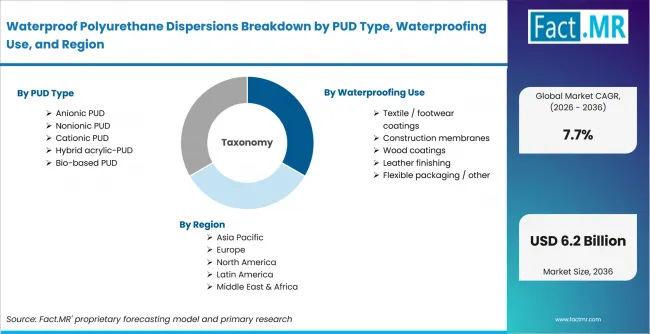
Waterproof Polyurethane Dispersions Breakdown By Pud Type, Waterproofing Use, And Region | Source: Fact.MR
| Attribute | Details |
|---|---|
| Quantitative Units | USD billion |
| Market Definition | Waterproof polyurethane dispersions are waterborne polyurethane polymer dispersions used to form flexible films that resist water ingress across textiles, footwear materials, construction membranes, wood coatings, leather finishing and other specialty coating applications. |
| PUD Type | Anionic PUD; Nonionic PUD; Cationic PUD; Hybrid acrylic-PUD; Bio-based PUD |
| Waterproofing Use | Textile / footwear coatings; Construction membranes; Wood coatings; Leather finishing; Flexible packaging / other |
| Film Property | Hydrophobic barrier; Hydrolysis resistance; Flexibility; Abrasion resistance; Breathable-waterproof balance |
| Crosslinking | Self-crosslinking; 2K isocyanate; Carbodiimide; Aziridine-free specialty; Crosslinker-free |
| Regions Covered | North America; Latin America; Western Europe; Eastern Europe; East Asia; South Asia & Pacific; Middle East & Africa |
| Countries Covered | USA; UK; Italy; Germany; France |
| Key Companies Profiled | Covestro; BASF; Lubrizol; Wanhua Chemical; Alberdingk Boley; Stahl |
| Forecast Period | 2026 to 2036 |
| Approach | Hybrid top-down and bottom-up approach using coating application demand; PUD chemistry mix; waterproofing use cases; film-performance requirements; crosslinking choices; country adoption; and provider portfolio review. |
How is the market segmented?
-
By PUD Type
- Anionic PUD
- Nonionic PUD
- Cationic PUD
- Hybrid acrylic-PUD
- Bio-based PUD
-
By Waterproofing Use
- Textile / footwear coatings
- Construction membranes
- Wood coatings
- Leather finishing
- Flexible packaging / other
-
By Film Property
- Hydrophobic barrier
- Hydrolysis resistance
- Flexibility
- Abrasion resistance
- Breathable-waterproof balance
-
By Crosslinking
- Self-crosslinking
- 2K isocyanate
- Carbodiimide
- Aziridine-free specialty
- Crosslinker-free
-
By Region
- North America
- Latin America
- Western Europe
- Eastern Europe
- East Asia
- South Asia & Pacific
- Middle East & Africa