Food Additives Market Size, Share, Growth and Forecast (2026 - 2036)

Food Additives Market is segmented by Product (Preservatives, Antioxidants, Emulsifiers, Hydrocolloids, Sweeteners, Flavor Enhancers, Colorants, Acidulants, Phosphates, Anti Caking Agents, Stabilizers), Source (Natural Additives, Animal Derived Ingredients, Synthetic Additives), Application (Bakery and Confectionery, Beverages, Dairy Products, Processed Foods, Meat and Seafood Products, Frozen Foods), and Region, with forecasts covering the period from 2026 to 2036.

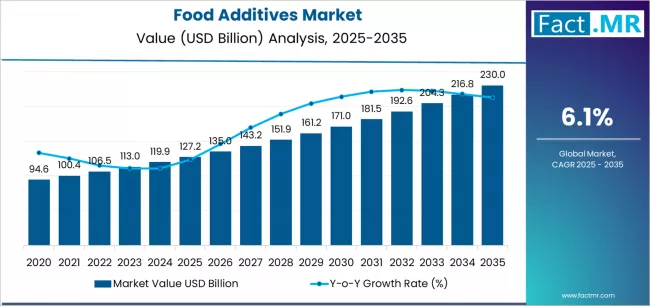
According to Fact.MR estimates, the global food additives market market was valued at USD 127.2 billion in 2025. The market is projected to reach USD 135.0 billion in 2026 and is expected to grow to USD 244.0 billion by 2036, expanding at a CAGR of 6.1%. Preservatives is anticipated to account for 18.0% of the product segment in 2026, while Natural Additives is expected to remain the leading application with around 48.0% share.

Food Additives Market Analysis and Forecast by Fact.MR

The global market for food additives is estimated to be around USD 127.2 billion in 2025 and has been forecast to expand at a CAGR of 6.1% to end up at USD 244.0 billion by 2036. Food additives encompass preservatives, emulsifiers, sweeteners, colorants, flavor enhancers, texturizers, and functional compounds used to improve safety, taste, appearance, texture, and shelf life in processed food manufacturing. Growth is shaped by clean-label reformulation demand, natural additive adoption, expanding processed food consumption in emerging markets, and regulatory evolution in food safety standards.
Food Additives Market Market Value Analysis

Summary of Food Additives Market

  • Market Snapshot
    • In 2025, the global Food Additives Market was valued at approximately USD 127.2 billion.
    • The market is estimated to reach USD 135.0 billion in 2026 and is projected to attain USD 244.0 billion by 2036.
    • The food additives market is likely to expand at a CAGR of 6.1% during the forecast period.
    • The market is anticipated to create an absolute dollar opportunity of USD 109.0 billion between 2026 and 2036.
    • Preservatives account for 18% of the product segment in 2026.
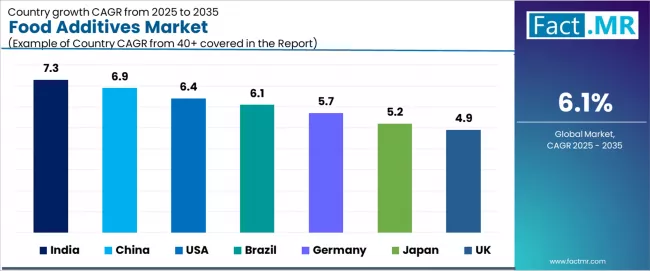
    • India (7.3%) and China (6.9%) are the key growth markets during the forecast period.
  • Demand and Growth Drivers
    • Clean-label reformulation trends are accelerating adoption of natural preservatives, colorants, and flavor enhancers across processed food manufacturing.
    • Expanding processed food consumption in emerging markets is creating volume demand for functional additives that support product quality and shelf stability.
    • Regulatory tightening of synthetic additive use is favoring natural alternatives with verified safety profiles.
    • Growth in convenience food and ready-to-eat categories is increasing demand for preservation, texture, and flavor enhancement additives.
    • Rising consumer demand for clean-label products with recognizable ingredients is reshaping additive sourcing from synthetic to plant and fermentation-derived alternatives.
  • Product and Segment View
    • Preservatives account for 18% of market value in 2026, supported by demand for shelf-life extension across packaged food manufacturing.
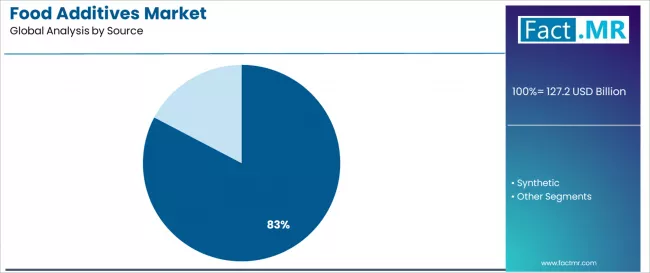
    • Natural additives hold 48% of the source segment, reflecting the accelerating shift from synthetic to plant and fermentation-derived alternatives.
    • Key segmentation includes:
      • Product Type: Preservatives, Emulsifiers, Sweeteners, Colorants, Flavor Enhancers, Texturizers, Others
      • Source: Natural Additives, Synthetic Additives, Bio-Fermented Additives
      • Application: Bakery and Confectionery, Dairy, Beverages, Meat Processing, Snacks, Others
    • These systems enable:
      • Shelf-life extension and food safety preservation in packaged products
      • Texture, flavor, and appearance optimization in processed food manufacturing
      • Clean-label ingredient positioning through natural and fermentation-derived alternatives
  • Geography and Competitive Outlook
    • North America and Europe together represent the largest food additive markets, supported by established processed food manufacturing and strong regulatory frameworks.
    • Asia Pacific is the fastest-growing region, with India (7.3%) and China (6.9%) leading through expanding food manufacturing and rising processed food consumption.
    • India (7.3%) and China (6.9%) are the key growth markets, with USA (6.4%), Brazil (6.1%), and Germany (5.7%) also recording steady growth.
    • Some of the major players are ADM, Ingredion Incorporated, Tate and Lyle plc, dsm-firmenich AG, Ajinomoto Co., Cargill Incorporated, BASF SE, Givaudan S.A., IFF, and Kerry Group plc.
  • Analyst Opinion
    • The food additives market is being reshaped by the clean-label movement, which is fundamentally altering ingredient sourcing decisions across the processed food industry. Growth is no longer about adding more additives but about replacing synthetic compounds with natural alternatives that deliver equivalent performance. Companies that combine natural ingredient sourcing with application-specific technical support for food manufacturers hold structural advantages. The next phase will be defined by fermentation-based additive development, regulatory harmonization across markets, and the ability to deliver natural performance at competitive cost.

Key Growth Drivers, Constraints, and Opportunities
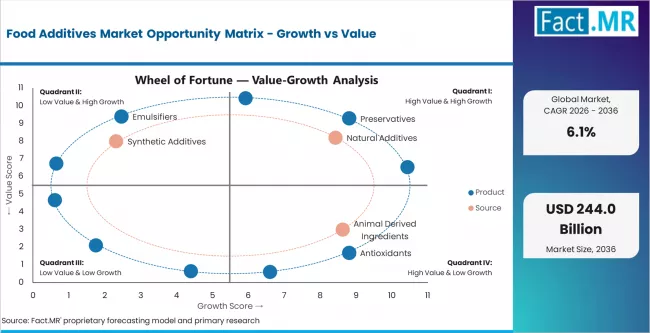
Food Additives Market Opportunity Matrix Growth Vs Value

Key Factors Driving Growth

  • Clean-label reformulation is driving systematic migration from synthetic to natural food additives across the processed food industry.
  • Processed food consumption growth in emerging markets is creating volume demand for functional additives.
  • Regulatory tightening of synthetic additive approvals favors natural alternatives with established safety profiles.

Key Market Constraints

  • Higher cost of natural additives compared to synthetic alternatives limits adoption in price-sensitive food manufacturing.
  • Performance gaps between natural and synthetic additives in some functionality categories create formulation challenges.
  • Regulatory fragmentation across markets in additive classification and approval creates compliance complexity for global suppliers.

Key Opportunity Areas

  • Fermentation-based additive production enables natural-equivalent performance at improving cost economics.
  • Clean-label preservation technology development addresses growing demand for natural shelf-life extension.
  • Emerging market food manufacturing expansion creates new volume demand as processed food consumption increases.

Segment-wise Analysis of the Food Additives Market

  • Preservatives hold 18% of the product segment in 2026, supported by shelf-life extension requirements across packaged food manufacturing.
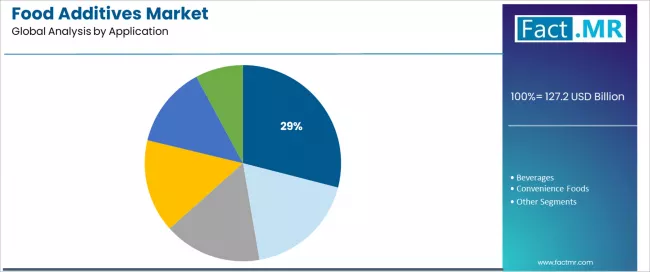
  • Bakery and confectionery accounts for 22% of the application segment, representing the highest-volume food category for additive consumption.
  • Food manufacturers represent 42% of the end-use segment, reflecting the concentration of additive demand in industrial-scale food processing.

The food additives market is segmented by product type, source, application, functionality, end use, and region. By product type, the market covers preservatives, emulsifiers, sweeteners, colorants, flavor enhancers, texturizers, and others. By source, coverage includes natural, synthetic, and bio-fermented additives. Preservatives lead by share, while natural additive alternatives drive the fastest growth across all categories.

Which Product Type Dominates the Food Additives Market?
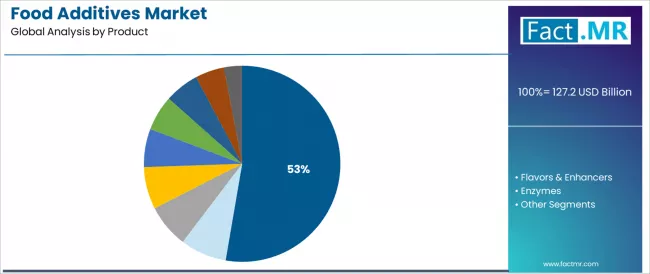
Food Additives Market Analysis By Product

Preservatives account for 18% of the product segment in 2026, serving as the most critical functional additive category for packaged food safety and shelf-life management. Natural preservatives including rosemary extract, citric acid, and fermentation-derived compounds are gaining share against synthetic alternatives.

The preservative segment is being reshaped by clean-label demand, with food manufacturers actively seeking natural preservation systems that deliver equivalent antimicrobial and antioxidant performance without synthetic ingredient declarations.

Which Application Dominates the Food Additives Market?
Food Additives Market Analysis By Application

Bakery and confectionery accounts for 22% of the application segment in 2026, representing the highest-volume food category for additive use. Emulsifiers, leavening agents, preservatives, colorants, and sweeteners all serve critical functions in bakery and confectionery production.

Dairy and beverages represent the second and third-largest applications, with emulsification, stabilization, flavor enhancement, and preservation needs driving consistent additive consumption across these categories.

Which Source Dominates the Food Additives Market?
Food Additives Market Analysis By Source

Natural additives hold 48% of the source segment in 2026, reflecting the accelerating shift toward plant-derived, fermentation-based, and mineral-sourced alternatives. Consumer demand for clean-label products with recognizable ingredients is the primary driver of natural additive adoption.

Synthetic additives continue to serve applications where natural alternatives cannot yet match performance or cost-effectiveness, particularly in high-volume preservation and coloring applications. Bio-fermented additives represent the fastest-growing source category.

Which Product Trend is Shaping the Next Phase of Growth in the Food Additives Market?

Bio-fermented food additives are not yet the largest source category, but they are emerging as the fastest-growing part of the market. Their share is projected to rise as food manufacturers seek natural-classified additives produced through controlled fermentation processes that deliver consistent quality, scalable supply, and clean-label compliance. This is especially relevant for preservatives, flavor enhancers, and colorants where fermentation enables natural-equivalent performance.

The shift toward fermentation-derived additives reflects a broader change in food ingredient sourcing. Manufacturers increasingly want natural-classified ingredients that combine regulatory compliance, supply security, and cost competitiveness. As a result, bio-fermented additives are moving from specialty ingredient status into mainstream food manufacturing procurement.

Regional Outlook Across Key Markets

Top Country Growth Comparison Food Additives Market Cagr (2026 2036)

  • India leads growth at 7.3%, supported by expanding processed food manufacturing, growing clean-label awareness, and rising demand for functional food additives.
  • China records growth at 6.9%, supported by large-scale food manufacturing, growing regulatory attention to food safety, and increasing adoption of natural additive alternatives.
  • North America shows steady growth, with the USA at 6.4% supported by clean-label reformulation demand and strong regulatory frameworks.

CAGR Table

Country CAGR (%)
India 7.3%
China 6.9%
USA 6.4%
Brazil 6.1%
Germany 5.7%
Japan 5.2%
UK 4.9%

Source: Fact.MR (FMR) analysis, based on proprietary forecasting model and primary research.
Food Additives Market Cagr Analysis By Country

India Food Additives Market Opportunity Outlook

The India Food Additives market is projected to grow at a CAGR of 7.3% through 2036. Demand is shaped by expanding processed food manufacturing, growing clean-label awareness, and rising demand for natural preservatives and flavor enhancers.

  • Processed food manufacturing expansion creates high-volume additive demand.
  • Clean-label awareness supports natural additive adoption.
  • Rising food safety regulatory attention shapes ingredient sourcing.

China Food Additives Market Growth Assessment

The China Food Additives market is projected to grow at a CAGR of 6.9% through 2036. Growth is supported by the world's largest food manufacturing sector, growing regulatory framework for food safety, and increasing adoption of natural alternatives.

  • Large-scale food manufacturing sustains high-volume additive demand.
  • Food safety regulations are tightening and shaping additive selection.
  • Natural additive adoption is increasing across food categories.

USA Food Additives Market Growth Outlook

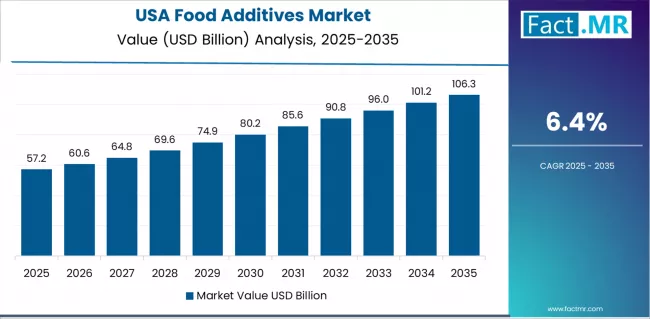
The USA Food Additives market is projected to grow at a CAGR of 6.4% through 2036. Demand is sustained by clean-label reformulation trends, strong regulatory frameworks, and growing consumer demand for natural, recognizable ingredients.
Food Additives Market Country Value Analysis

  • Clean-label reformulation drives migration to natural additives.
  • Strong regulatory frameworks support ingredient safety and transparency.
  • Consumer demand for recognizable ingredients shapes manufacturer sourcing.

Brazil Food Additives Market Demand Analysis

The Brazil Food Additives market is projected to grow at a CAGR of 6.1% through 2036. Demand is shaped by expanding processed food consumption, growing food manufacturing capacity, and increasing regulatory attention to additive safety.

  • Processed food consumption growth creates volume additive demand.
  • Food manufacturing expansion supports ingredient market growth.
  • Regulatory development shapes additive approval and sourcing.

Germany Food Additives Market Demand Trends

The Germany Food Additives market is projected to grow at a CAGR of 5.7% through 2036. Demand is supported by established food manufacturing, strong clean-label regulatory requirements, and growing consumer preference for natural ingredients.

  • Established food manufacturing sustains consistent additive demand.
  • Clean-label regulations shape ingredient selection priorities.
  • Natural ingredient preferences support premium additive positioning.

Competitive Benchmarking and Company Positioning
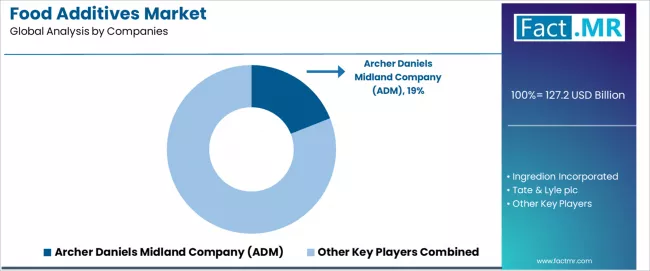
Food Additives Market Analysis By Company

Food Additives Market Analysis By Company

  • ADM, Ingredion Incorporated, and Cargill hold strong positions through broad additive portfolios, global distribution, and deep technical support for food manufacturing customers.
  • dsm-firmenich, Ajinomoto, and Kerry Group participate meaningfully through technology specialization, fermentation-based production, and application-specific expertise.
  • Technical application capability, natural ingredient sourcing, and regulatory compliance across multiple markets create significant competitive advantages.

The competitive landscape is moderately concentrated, with ADM holding a leading position at approximately 19% market share. ADM's advantage is built on broad ingredient portfolio, global sourcing and production infrastructure, and established relationships with major food manufacturers.

Ingredion, Tate and Lyle, and Cargill maintain strong positions through starch-based additives, sweetener systems, and natural ingredient supply. dsm-firmenich and Ajinomoto compete through fermentation technology and amino acid-based flavor enhancement.

BASF, Givaudan, IFF, and Kerry Group serve specific additive categories through technology specialization, natural ingredient innovation, and application support services.

Strategic priorities include expanding fermentation-based natural additive production, investing in clean-label preservation technology, building regulatory compliance capability across emerging markets, and strengthening technical support for food manufacturer reformulation programs.

Key Companies in the Food Additives Market

ADM, Ingredion Incorporated, and Cargill Incorporated are among the leading global players.

dsm-firmenich AG, Ajinomoto Co., and Tate and Lyle plc hold established positions through technology specialization.

BASF SE, Givaudan S.A., IFF, Kerry Group plc, and other specialist suppliers compete through category expertise.

Recent Industry Developments

  • ADM - Portfolio Expansion / Natural Additive Growth (2025)
    • ADM expanded its natural food additive portfolio with new plant-derived preservative and colorant systems, targeting food manufacturers seeking clean-label reformulation solutions. The expansion supports growing demand for natural alternatives across processed food categories.
  • dsm-firmenich - Technology Launch / Fermentation Additive Innovation (2025)
    • dsm-firmenich launched new fermentation-derived food additive ingredients targeting natural preservation and flavor enhancement applications, supporting the clean-label transition in processed food manufacturing.
  • Kerry Group - Distribution Expansion / Emerging Market Growth (2026)
    • Kerry Group expanded its food additive distribution and technical support capability into emerging Asian and Latin American markets, targeting growing food manufacturing demand for functional and clean-label ingredient solutions.

Leading Companies Shaping the Food Additives Market

  • Global Players

    • Archer Daniels Midland Company (ADM)
    • Ingredion Incorporated
    • Cargill, Incorporated
    • dsm-firmenich AG
    • Ajinomoto Co., Inc.
  • Regional Players

    • Tate & Lyle plc
    • BASF SE
    • Kerry Group plc
  • Emerging / Start-up Players

    • Givaudan S.A.
    • International Flavors & Fragrances Inc. (IFF)
    • Corbion N.V.

Sources and Research References

  • European Food Safety Authority (EFSA). Food additive safety assessments and regulatory updates.
  • U.S. Food and Drug Administration (FDA). GRAS and food additive regulations.
  • Codex Alimentarius Commission. International food additive standards.
  • Food and Agriculture Organization of the United Nations (FAO). Food production and additive trade data.
  • Primary interviews with additive suppliers, food manufacturers, regulatory specialists, and distributors.

This bibliography is provided for reader reference and is not exhaustive. The full report contains the complete reference list and detailed citations.

Key Questions This Report Addresses

  • What is the current and future size of the Food Additives market?
  • How fast is the market expected to grow between 2026 and 2036?
  • Which product type leads?
  • Which application holds the largest share?
  • What factors are fueling demand?
  • How is clean-label reformulation shaping growth?
  • Why are India and China the fastest-growing markets?
  • How are fermentation-derived additives influencing the market?
  • Which countries show the fastest growth through 2036?
  • Who are the key companies?
  • How does Fact.MR validate the market forecast?

Food Additives Market Definition

The food additives market covers commercially produced functional compounds used in processed food manufacturing to improve safety, taste, appearance, texture, and shelf life, including preservatives, emulsifiers, sweeteners, colorants, flavor enhancers, and texturizers.

Food Additives Market Inclusions

  • The scope covers global and regional market size and forecasts for 2026 to 2036 across product type, source, application, functionality, end use, and region.
  • It includes pricing analysis, regulatory compliance assessment, and natural vs. synthetic sourcing evaluation.
  • The report includes demand analysis across bakery, dairy, beverage, meat, and snack applications.
  • It covers ingredient innovation trends, market drivers and constraints, and competitive benchmarking.

Food Additives Market Exclusions

  • The scope excludes basic food ingredients such as flour, sugar, salt, and water.
  • It excludes dietary supplements, pharmaceutical excipients, and feed additives.
  • The report excludes food processing equipment and technology.
  • It also excludes flavors and fragrances classified separately from food additives.

Food Additives Market Research Methodology

  • The methodology combines secondary research, primary interviews, and forecast modelling.
  • It draws on 150+ secondary sources and benchmarks 70+ company profiles.
  • Market sizing covers 30+ countries through a demand-side model, supported by top-down validation.
  • Key inputs include processed food production volumes, additive consumption rates, regulatory approval data, and natural ingredient pricing.
  • The model cross-checks demand with production capacity, trade flows, and ingredient distribution data.
  • Primary validation includes 25+ interviews across additive suppliers, food manufacturers, regulatory specialists, and distributors.
  • Final estimates go through trade-flow checks, sales-pattern review, and sensitivity testing.

Scope of Analysis

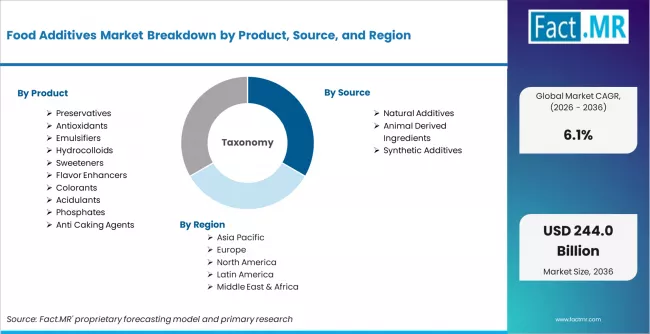
Food Additives Market Breakdown By Product, Source, And Region

Parameter Details
Quantitative Units USD 135.0 billion to USD 244.0 billion, at a CAGR of 6.1%
Market Definition The Food Additives market covers functional compounds for processed food manufacturing including preservatives, emulsifiers, sweeteners, colorants, flavor enhancers, and texturizers.
Regions Covered North America, Latin America, Europe, East Asia, South Asia and Pacific, Middle East and Africa
Countries Covered India, China, USA, Brazil, Germany, Japan, UK, 30 plus countries
Key Companies ADM, Ingredion, Tate and Lyle, dsm-firmenich, Ajinomoto, Cargill, BASF, Givaudan, IFF, Kerry Group
Forecast Period 2026 to 2036
Approach Hybrid demand-side and top-down methodology built on processed food production, additive consumption, regulatory data, and primary interviews across suppliers, food manufacturers, and regulatory specialists

Market Segmentation Analysis

  • Food Additives Market Market Segmented by Product:

    • Preservatives
      • Natural Preservatives
      • Synthetic Preservatives
    • Antioxidants
      • Natural Antioxidants
      • Synthetic Antioxidants
    • Emulsifiers
      • Lecithin
      • Mono and Diglycerides
    • Hydrocolloids
      • Xanthan Gum
      • Carrageenan
      • Guar Gum
    • Sweeteners
      • High Intensity Sweeteners
      • Natural Sweeteners
    • Flavor Enhancers
      • Monosodium Glutamate
      • Natural Flavor Enhancers
    • Colorants
      • Natural Food Colors
      • Synthetic Food Colors
    • Acidulants
      • Citric Acid
      • Malic Acid
    • Phosphates
      • Sodium Phosphates
      • Potassium Phosphates
    • Anti Caking Agents
      • Silicon Dioxide
      • Calcium Compounds
    • Stabilizers
      • Texture Stabilizing Systems
      • Shelf Stability Systems
  • Food Additives Market Market Segmented by Source:

    • Natural Additives
      • Plant Derived Ingredients
      • Microbial Derived Ingredients
    • Animal Derived Ingredients
      • Mineral Based Ingredients
    • Synthetic Additives
      • Chemically Synthesized Additives
      • Functional Chemical Blends
  • Food Additives Market Market Segmented by Application:

    • Bakery and Confectionery
      • Bread Products
      • Cakes and Pastries
    • Beverages
      • Soft Drinks
      • Functional Beverages
    • Dairy Products
      • Milk Based Products
      • Yogurt and Cheese
    • Processed Foods
      • Ready Meals
      • Snack Foods
    • Meat and Seafood Products
      • Processed Meat
      • Seafood Processing
    • Frozen Foods
      • Frozen Ready Meals
      • Frozen Snacks
  • Food Additives Market Market Segmented by Functionality:

    • Preservation
      • Shelf Life Extension Systems
      • Microbial Growth Inhibition
    • Texture Enhancement
      • Viscosity Control Agents
      • Mouthfeel Improvement Systems
    • Flavor Enhancement
      • Taste Optimization Systems
      • Salt and Umami Enhancement
    • Color Stability
      • Color Retention Systems
      • Food Appearance Enhancement
    • Nutritional Fortification
      • Vitamin Enrichment Systems
      • Mineral Enrichment Systems
  • Food Additives Market Market Segmented by End Use:

    • Food Manufacturers
      • Packaged Food Companies
      • Beverage Manufacturers
    • Food Service Industry
      • Restaurants
      • Catering Services
    • Retail Consumers
      • Processed Food Buyers
      • Convenience Food Consumers
    • Industrial Users
      • Food Processing Companies
      • Ingredient Blenders
  • Food Additives Market Market by Region:

    • North America
      • USA
      • Canada
      • Mexico
    • Latin America
      • Brazil
      • Chile
      • Rest of Latin America
    • Western Europe
      • Germany
      • UK
      • Italy
      • Spain
      • France
      • Nordic
      • BENELUX
      • Rest of Western Europe
    • Eastern Europe
      • Russia
      • Poland
      • Hungary
      • Balkan & Baltic
      • Rest of Eastern Europe
    • East Asia
      • China
      • Japan
      • South Korea
    • South Asia and Pacific
      • India
      • ASEAN
      • Australia & New Zealand
      • Rest of South Asia and Pacific
    • Middle East & Africa
      • Kingdom of Saudi Arabia
      • Other GCC Countries
      • Turkiye
      • South Africa
      • Other African Union
      • Rest of Middle East & Africa

- Frequently Asked Questions -

How big is the food additives market in 2025?

The global market is estimated at USD 127.2 billion in 2025.

What will be the size in 2036?

The market is projected to reach USD 244.0 billion by 2036.

How much will it grow between 2026 and 2036?

The market is expected to grow at a 6.1% CAGR.

Which product type leads?

Preservatives lead with 18% share in 2026.

Which application is most significant?

Bakery and confectionery accounts for 22% of the application segment in 2026.

Table of Content

  1. Executive Summary
    • Global Market Outlook
    • Demand to side Trends
    • Supply to side Trends
    • Technology Roadmap Analysis
    • Analysis and Recommendations
  2. Market Overview
    • Market Coverage / Taxonomy
    • Market Definition / Scope / Limitations
  3. Research Methodology
    • Chapter Orientation
    • Analytical Lens and Working Hypotheses
      • Market Structure, Signals, and Trend Drivers
      • Benchmarking and Cross-market Comparability
      • Market Sizing, Forecasting, and Opportunity Mapping
    • Research Design and Evidence Framework
      • Desk Research Programme (Secondary Evidence)
        • Company Annual and Sustainability Reports
        • Peer-reviewed Journals and Academic Literature
        • Corporate Websites, Product Literature, and Technical Notes
        • Earnings Decks and Investor Briefings
        • Statutory Filings and Regulatory Disclosures
        • Technical White Papers and Standards Notes
        • Trade Journals, Industry Magazines, and Analyst Briefs
        • Conference Proceedings, Webinars, and Seminar Materials
        • Government Statistics Portals and Public Data Releases
        • Press Releases and Reputable Media Coverage
        • Specialist Newsletters and Curated Briefings
        • Sector Databases and Reference Repositories
        • Fact.MR Internal Proprietary Databases and Historical Market Datasets
        • Subscription Datasets and Paid Sources
        • Social Channels, Communities, and Digital Listening Inputs
        • Additional Desk Sources
      • Expert Input and Fieldwork (Primary Evidence)
        • Primary Modes
          • Qualitative Interviews and Expert Elicitation
          • Quantitative Surveys and Structured Data Capture
          • Blended Approach
        • Why Primary Evidence is Used
        • Field Techniques
          • Interviews
          • Surveys
          • Focus Groups
          • Observational and In-context Research
          • Social and Community Interactions
        • Stakeholder Universe Engaged
          • C-suite Leaders
          • Board Members
          • Presidents and Vice Presidents
          • R&D and Innovation Heads
          • Technical Specialists
          • Domain Subject-matter Experts
          • Scientists
          • Physicians and Other Healthcare Professionals
        • Governance, Ethics, and Data Stewardship
          • Research Ethics
          • Data Integrity and Handling
      • Tooling, Models, and Reference Databases
    • Data Engineering and Model Build
      • Data Acquisition and Ingestion
      • Cleaning, Normalisation, and Verification
      • Synthesis, Triangulation, and Analysis
    • Quality Assurance and Audit Trail
  4. Market Background
    • Market Dynamics
      • Drivers
      • Restraints
      • Opportunity
      • Trends
    • Scenario Forecast
      • Demand in Optimistic Scenario
      • Demand in Likely Scenario
      • Demand in Conservative Scenario
    • Opportunity Map Analysis
    • Product Life Cycle Analysis
    • Supply Chain Analysis
    • Investment Feasibility Matrix
    • Value Chain Analysis
    • PESTLE and Porter’s Analysis
    • Regulatory Landscape
    • Regional Parent Market Outlook
    • Production and Consumption Statistics
    • Import and Export Statistics
  5. Global Market Analysis 2021 to 2025 and Forecast, 2026 to 2036
    • Historical Market Size Value (USD Million) Analysis, 2021 to 2025
    • Current and Future Market Size Value (USD Million) Projections, 2026 to 2036
      • Y to o to Y Growth Trend Analysis
      • Absolute $ Opportunity Analysis
  6. Global Market Pricing Analysis 2021 to 2025 and Forecast 2026 to 2036
  7. Global Market Analysis 2021 to 2025 and Forecast 2026 to 2036, By Product
    • Introduction / Key Findings
    • Historical Market Size Value (USD Million) Analysis By Product , 2021 to 2025
    • Current and Future Market Size Value (USD Million) Analysis and Forecast By Product , 2026 to 2036
      • Preservatives
        • Natural Preservatives
        • Synthetic Preservatives
      • Antioxidants
        • Natural Antioxidants
        • Synthetic Antioxidants
      • Emulsifiers
        • Lecithin
        • Mono and Diglycerides
      • Hydrocolloids
        • Xanthan Gum
        • Carrageenan
        • Guar Gum
      • Sweeteners
        • High Intensity Sweeteners
        • Natural Sweeteners
      • Flavor Enhancers
        • Monosodium Glutamate
        • Natural Flavor Enhancers
      • Colorants
        • Natural Food Colors
        • Synthetic Food Colors
      • Acidulants
        • Citric Acid
        • Malic Acid
      • Phosphates
        • Sodium Phosphates
        • Potassium Phosphates
      • Anti Caking Agents
        • Silicon Dioxide
        • Calcium Compounds
      • Stabilizers
      • Texture Stabilizing Systems
      • Shelf Stability Systems
    • Y to o to Y Growth Trend Analysis By Product , 2021 to 2025
    • Absolute $ Opportunity Analysis By Product , 2026 to 2036
  8. Global Market Analysis 2021 to 2025 and Forecast 2026 to 2036, By Source
    • Introduction / Key Findings
    • Historical Market Size Value (USD Million) Analysis By Source, 2021 to 2025
    • Current and Future Market Size Value (USD Million) Analysis and Forecast By Source, 2026 to 2036
      • Natural Additives
        • Plant Derived Ingredients
        • Microbial Derived Ingredients
      • Animal Derived Ingredients
        • Mineral Based Ingredients
      • Synthetic Additives
        • Chemically Synthesized Additives
        • Functional Chemical Blends
    • Y to o to Y Growth Trend Analysis By Source, 2021 to 2025
    • Absolute $ Opportunity Analysis By Source, 2026 to 2036
  9. Global Market Analysis 2021 to 2025 and Forecast 2026 to 2036, By Application
    • Introduction / Key Findings
    • Historical Market Size Value (USD Million) Analysis By Application, 2021 to 2025
    • Current and Future Market Size Value (USD Million) Analysis and Forecast By Application, 2026 to 2036
      • Bakery and Confectionery
        • Bread Products
        • Cakes and Pastries
      • Beverages
        • Soft Drinks
        • Functional Beverages
      • Dairy Products
        • Milk Based Products
        • Yogurt and Cheese
      • Processed Foods
        • Ready Meals
        • Snack Foods
      • Meat and Seafood Products
        • Processed Meat
        • Seafood Processing
      • Frozen Foods
        • Frozen Ready Meals
        • Frozen Snacks
    • Y to o to Y Growth Trend Analysis By Application, 2021 to 2025
    • Absolute $ Opportunity Analysis By Application, 2026 to 2036
  10. Global Market Analysis 2021 to 2025 and Forecast 2026 to 2036, By Functionality
    • Introduction / Key Findings
    • Historical Market Size Value (USD Million) Analysis By Functionality, 2021 to 2025
    • Current and Future Market Size Value (USD Million) Analysis and Forecast By Functionality, 2026 to 2036
      • Preservation
        • Shelf Life Extension Systems
        • Microbial Growth Inhibition
      • Texture Enhancement
        • Viscosity Control Agents
        • Mouthfeel Improvement Systems
      • Flavor Enhancement
        • Taste Optimization Systems
        • Salt and Umami Enhancement
      • Color Stability
        • Color Retention Systems
        • Food Appearance Enhancement
      • Nutritional Fortification
        • Vitamin Enrichment Systems
        • Mineral Enrichment Systems
    • Y to o to Y Growth Trend Analysis By Functionality, 2021 to 2025
    • Absolute $ Opportunity Analysis By Functionality, 2026 to 2036
  11. Global Market Analysis 2021 to 2025 and Forecast 2026 to 2036, By End Use
    • Introduction / Key Findings
    • Historical Market Size Value (USD Million) Analysis By End Use, 2021 to 2025
    • Current and Future Market Size Value (USD Million) Analysis and Forecast By End Use, 2026 to 2036
      • Food Manufacturers
        • Packaged Food Companies
        • Beverage Manufacturers
      • Food Service Industry
        • Restaurants
        • Catering Services
      • Retail Consumers
        • Processed Food Buyers
        • Convenience Food Consumers
      • Industrial Users
        • Food Processing Companies
        • Ingredient Blenders
    • Y to o to Y Growth Trend Analysis By End Use, 2021 to 2025
    • Absolute $ Opportunity Analysis By End Use, 2026 to 2036
  12. Global Market Analysis 2021 to 2025 and Forecast 2026 to 2036, By Region
    • Introduction
    • Historical Market Size Value (USD Million) Analysis By Region, 2021 to 2025
    • Current Market Size Value (USD Million) Analysis and Forecast By Region, 2026 to 2036
      • North America
      • Latin America
      • Western Europe
      • Eastern Europe
      • East Asia
      • South Asia and Pacific
      • Middle East & Africa
    • Market Attractiveness Analysis By Region
  13. North America Market Analysis 2021 to 2025 and Forecast 2026 to 2036, By Country
    • Historical Market Size Value (USD Million) Trend Analysis By Market Taxonomy, 2021 to 2025
    • Market Size Value (USD Million) Forecast By Market Taxonomy, 2026 to 2036
      • By Country
        • USA
        • Canada
        • Mexico
      • By Product
      • By Source
      • By Application
      • By Functionality
      • By End Use
    • Market Attractiveness Analysis
      • By Country
      • By Product
      • By Source
      • By Application
      • By Functionality
      • By End Use
    • Key Takeaways
  14. Latin America Market Analysis 2021 to 2025 and Forecast 2026 to 2036, By Country
    • Historical Market Size Value (USD Million) Trend Analysis By Market Taxonomy, 2021 to 2025
    • Market Size Value (USD Million) Forecast By Market Taxonomy, 2026 to 2036
      • By Country
        • Brazil
        • Chile
        • Rest of Latin America
      • By Product
      • By Source
      • By Application
      • By Functionality
      • By End Use
    • Market Attractiveness Analysis
      • By Country
      • By Product
      • By Source
      • By Application
      • By Functionality
      • By End Use
    • Key Takeaways
  15. Western Europe Market Analysis 2021 to 2025 and Forecast 2026 to 2036, By Country
    • Historical Market Size Value (USD Million) Trend Analysis By Market Taxonomy, 2021 to 2025
    • Market Size Value (USD Million) Forecast By Market Taxonomy, 2026 to 2036
      • By Country
        • Germany
        • UK
        • Italy
        • Spain
        • France
        • Nordic
        • BENELUX
        • Rest of Western Europe
      • By Product
      • By Source
      • By Application
      • By Functionality
      • By End Use
    • Market Attractiveness Analysis
      • By Country
      • By Product
      • By Source
      • By Application
      • By Functionality
      • By End Use
    • Key Takeaways
  16. Eastern Europe Market Analysis 2021 to 2025 and Forecast 2026 to 2036, By Country
    • Historical Market Size Value (USD Million) Trend Analysis By Market Taxonomy, 2021 to 2025
    • Market Size Value (USD Million) Forecast By Market Taxonomy, 2026 to 2036
      • By Country
        • Russia
        • Poland
        • Hungary
        • Balkan & Baltic
        • Rest of Eastern Europe
      • By Product
      • By Source
      • By Application
      • By Functionality
      • By End Use
    • Market Attractiveness Analysis
      • By Country
      • By Product
      • By Source
      • By Application
      • By Functionality
      • By End Use
    • Key Takeaways
  17. East Asia Market Analysis 2021 to 2025 and Forecast 2026 to 2036, By Country
    • Historical Market Size Value (USD Million) Trend Analysis By Market Taxonomy, 2021 to 2025
    • Market Size Value (USD Million) Forecast By Market Taxonomy, 2026 to 2036
      • By Country
        • China
        • Japan
        • South Korea
      • By Product
      • By Source
      • By Application
      • By Functionality
      • By End Use
    • Market Attractiveness Analysis
      • By Country
      • By Product
      • By Source
      • By Application
      • By Functionality
      • By End Use
    • Key Takeaways
  18. South Asia and Pacific Market Analysis 2021 to 2025 and Forecast 2026 to 2036, By Country
    • Historical Market Size Value (USD Million) Trend Analysis By Market Taxonomy, 2021 to 2025
    • Market Size Value (USD Million) Forecast By Market Taxonomy, 2026 to 2036
      • By Country
        • India
        • ASEAN
        • Australia & New Zealand
        • Rest of South Asia and Pacific
      • By Product
      • By Source
      • By Application
      • By Functionality
      • By End Use
    • Market Attractiveness Analysis
      • By Country
      • By Product
      • By Source
      • By Application
      • By Functionality
      • By End Use
    • Key Takeaways
  19. Middle East & Africa Market Analysis 2021 to 2025 and Forecast 2026 to 2036, By Country
    • Historical Market Size Value (USD Million) Trend Analysis By Market Taxonomy, 2021 to 2025
    • Market Size Value (USD Million) Forecast By Market Taxonomy, 2026 to 2036
      • By Country
        • Kingdom of Saudi Arabia
        • Other GCC Countries
        • Turkiye
        • South Africa
        • Other African Union
        • Rest of Middle East & Africa
      • By Product
      • By Source
      • By Application
      • By Functionality
      • By End Use
    • Market Attractiveness Analysis
      • By Country
      • By Product
      • By Source
      • By Application
      • By Functionality
      • By End Use
    • Key Takeaways
  20. Key Countries Market Analysis
    • USA
      • Pricing Analysis
      • Market Share Analysis, 2025
        • By Product
        • By Source
        • By Application
        • By Functionality
        • By End Use
    • Canada
      • Pricing Analysis
      • Market Share Analysis, 2025
        • By Product
        • By Source
        • By Application
        • By Functionality
        • By End Use
    • Mexico
      • Pricing Analysis
      • Market Share Analysis, 2025
        • By Product
        • By Source
        • By Application
        • By Functionality
        • By End Use
    • Brazil
      • Pricing Analysis
      • Market Share Analysis, 2025
        • By Product
        • By Source
        • By Application
        • By Functionality
        • By End Use
    • Chile
      • Pricing Analysis
      • Market Share Analysis, 2025
        • By Product
        • By Source
        • By Application
        • By Functionality
        • By End Use
    • Germany
      • Pricing Analysis
      • Market Share Analysis, 2025
        • By Product
        • By Source
        • By Application
        • By Functionality
        • By End Use
    • UK
      • Pricing Analysis
      • Market Share Analysis, 2025
        • By Product
        • By Source
        • By Application
        • By Functionality
        • By End Use
    • Italy
      • Pricing Analysis
      • Market Share Analysis, 2025
        • By Product
        • By Source
        • By Application
        • By Functionality
        • By End Use
    • Spain
      • Pricing Analysis
      • Market Share Analysis, 2025
        • By Product
        • By Source
        • By Application
        • By Functionality
        • By End Use
    • France
      • Pricing Analysis
      • Market Share Analysis, 2025
        • By Product
        • By Source
        • By Application
        • By Functionality
        • By End Use
    • India
      • Pricing Analysis
      • Market Share Analysis, 2025
        • By Product
        • By Source
        • By Application
        • By Functionality
        • By End Use
    • ASEAN
      • Pricing Analysis
      • Market Share Analysis, 2025
        • By Product
        • By Source
        • By Application
        • By Functionality
        • By End Use
    • Australia & New Zealand
      • Pricing Analysis
      • Market Share Analysis, 2025
        • By Product
        • By Source
        • By Application
        • By Functionality
        • By End Use
    • China
      • Pricing Analysis
      • Market Share Analysis, 2025
        • By Product
        • By Source
        • By Application
        • By Functionality
        • By End Use
    • Japan
      • Pricing Analysis
      • Market Share Analysis, 2025
        • By Product
        • By Source
        • By Application
        • By Functionality
        • By End Use
    • South Korea
      • Pricing Analysis
      • Market Share Analysis, 2025
        • By Product
        • By Source
        • By Application
        • By Functionality
        • By End Use
    • Russia
      • Pricing Analysis
      • Market Share Analysis, 2025
        • By Product
        • By Source
        • By Application
        • By Functionality
        • By End Use
    • Poland
      • Pricing Analysis
      • Market Share Analysis, 2025
        • By Product
        • By Source
        • By Application
        • By Functionality
        • By End Use
    • Hungary
      • Pricing Analysis
      • Market Share Analysis, 2025
        • By Product
        • By Source
        • By Application
        • By Functionality
        • By End Use
    • Kingdom of Saudi Arabia
      • Pricing Analysis
      • Market Share Analysis, 2025
        • By Product
        • By Source
        • By Application
        • By Functionality
        • By End Use
    • Turkiye
      • Pricing Analysis
      • Market Share Analysis, 2025
        • By Product
        • By Source
        • By Application
        • By Functionality
        • By End Use
    • South Africa
      • Pricing Analysis
      • Market Share Analysis, 2025
        • By Product
        • By Source
        • By Application
        • By Functionality
        • By End Use
  21. Market Structure Analysis
    • Competition Dashboard
    • Competition Benchmarking
    • Market Share Analysis of Top Players
      • By Regional
      • By Product
      • By Source
      • By Application
      • By Functionality
      • By End Use
  22. Competition Analysis
    • Competition Deep Dive
      • Archer Daniels Midland Company (ADM)
        • Overview
        • Product Portfolio
        • Profitability by Market Segments (Product/Age /Sales Channel/Region)
        • Sales Footprint
        • Strategy Overview
          • Marketing Strategy
          • Product Strategy
          • Channel Strategy
      • Ingredion Incorporated
      • Tate & Lyle plc
      • dsm-firmenich AG
      • Ajinomoto Co., Inc.
      • Cargill, Incorporated
      • BASF SE
      • Givaudan S.A.
      • International Flavors & Fragrances Inc. (IFF)
      • Kerry Group plc
  23. Assumptions & Acronyms Used

List Of Table

  • Table 1: Global Market Value (USD Million) Forecast by Region, 2021 to 2036
  • Table 2: Global Market Value (USD Million) Forecast by Product, 2021 to 2036
  • Table 3: Global Market Value (USD Million) Forecast by Source, 2021 to 2036
  • Table 4: Global Market Value (USD Million) Forecast by Application, 2021 to 2036
  • Table 5: Global Market Value (USD Million) Forecast by Functionality, 2021 to 2036
  • Table 6: Global Market Value (USD Million) Forecast by End Use, 2021 to 2036
  • Table 7: North America Market Value (USD Million) Forecast by Country, 2021 to 2036
  • Table 8: North America Market Value (USD Million) Forecast by Product, 2021 to 2036
  • Table 9: North America Market Value (USD Million) Forecast by Source, 2021 to 2036
  • Table 10: North America Market Value (USD Million) Forecast by Application, 2021 to 2036
  • Table 11: North America Market Value (USD Million) Forecast by Functionality, 2021 to 2036
  • Table 12: North America Market Value (USD Million) Forecast by End Use, 2021 to 2036
  • Table 13: Latin America Market Value (USD Million) Forecast by Country, 2021 to 2036
  • Table 14: Latin America Market Value (USD Million) Forecast by Product, 2021 to 2036
  • Table 15: Latin America Market Value (USD Million) Forecast by Source, 2021 to 2036
  • Table 16: Latin America Market Value (USD Million) Forecast by Application, 2021 to 2036
  • Table 17: Latin America Market Value (USD Million) Forecast by Functionality, 2021 to 2036
  • Table 18: Latin America Market Value (USD Million) Forecast by End Use, 2021 to 2036
  • Table 19: Western Europe Market Value (USD Million) Forecast by Country, 2021 to 2036
  • Table 20: Western Europe Market Value (USD Million) Forecast by Product, 2021 to 2036
  • Table 21: Western Europe Market Value (USD Million) Forecast by Source, 2021 to 2036
  • Table 22: Western Europe Market Value (USD Million) Forecast by Application, 2021 to 2036
  • Table 23: Western Europe Market Value (USD Million) Forecast by Functionality, 2021 to 2036
  • Table 24: Western Europe Market Value (USD Million) Forecast by End Use, 2021 to 2036
  • Table 25: Eastern Europe Market Value (USD Million) Forecast by Country, 2021 to 2036
  • Table 26: Eastern Europe Market Value (USD Million) Forecast by Product, 2021 to 2036
  • Table 27: Eastern Europe Market Value (USD Million) Forecast by Source, 2021 to 2036
  • Table 28: Eastern Europe Market Value (USD Million) Forecast by Application, 2021 to 2036
  • Table 29: Eastern Europe Market Value (USD Million) Forecast by Functionality, 2021 to 2036
  • Table 30: Eastern Europe Market Value (USD Million) Forecast by End Use, 2021 to 2036
  • Table 31: East Asia Market Value (USD Million) Forecast by Country, 2021 to 2036
  • Table 32: East Asia Market Value (USD Million) Forecast by Product, 2021 to 2036
  • Table 33: East Asia Market Value (USD Million) Forecast by Source, 2021 to 2036
  • Table 34: East Asia Market Value (USD Million) Forecast by Application, 2021 to 2036
  • Table 35: East Asia Market Value (USD Million) Forecast by Functionality, 2021 to 2036
  • Table 36: East Asia Market Value (USD Million) Forecast by End Use, 2021 to 2036
  • Table 37: South Asia and Pacific Market Value (USD Million) Forecast by Country, 2021 to 2036
  • Table 38: South Asia and Pacific Market Value (USD Million) Forecast by Product, 2021 to 2036
  • Table 39: South Asia and Pacific Market Value (USD Million) Forecast by Source, 2021 to 2036
  • Table 40: South Asia and Pacific Market Value (USD Million) Forecast by Application, 2021 to 2036
  • Table 41: South Asia and Pacific Market Value (USD Million) Forecast by Functionality, 2021 to 2036
  • Table 42: South Asia and Pacific Market Value (USD Million) Forecast by End Use, 2021 to 2036
  • Table 43: Middle East & Africa Market Value (USD Million) Forecast by Country, 2021 to 2036
  • Table 44: Middle East & Africa Market Value (USD Million) Forecast by Product, 2021 to 2036
  • Table 45: Middle East & Africa Market Value (USD Million) Forecast by Source, 2021 to 2036
  • Table 46: Middle East & Africa Market Value (USD Million) Forecast by Application, 2021 to 2036
  • Table 47: Middle East & Africa Market Value (USD Million) Forecast by Functionality, 2021 to 2036
  • Table 48: Middle East & Africa Market Value (USD Million) Forecast by End Use, 2021 to 2036

List Of Figures

  • Figure 1: Global Market Pricing Analysis
  • Figure 2: Global Market Value (USD Million) Forecast 2021-2036
  • Figure 3: Global Market Value Share and BPS Analysis by Product, 2026 and 2036
  • Figure 4: Global Market Y-o-Y Growth Comparison by Product, 2026 to 2036
  • Figure 5: Global Market Attractiveness Analysis by Product
  • Figure 6: Global Market Value Share and BPS Analysis by Source, 2026 and 2036
  • Figure 7: Global Market Y-o-Y Growth Comparison by Source, 2026 to 2036
  • Figure 8: Global Market Attractiveness Analysis by Source
  • Figure 9: Global Market Value Share and BPS Analysis by Application, 2026 and 2036
  • Figure 10: Global Market Y-o-Y Growth Comparison by Application, 2026 to 2036
  • Figure 11: Global Market Attractiveness Analysis by Application
  • Figure 12: Global Market Value Share and BPS Analysis by Functionality, 2026 and 2036
  • Figure 13: Global Market Y-o-Y Growth Comparison by Functionality, 2026 to 2036
  • Figure 14: Global Market Attractiveness Analysis by Functionality
  • Figure 15: Global Market Value Share and BPS Analysis by End Use, 2026 and 2036
  • Figure 16: Global Market Y-o-Y Growth Comparison by End Use, 2026 to 2036
  • Figure 17: Global Market Attractiveness Analysis by End Use
  • Figure 18: Global Market Value (USD Million) Share and BPS Analysis by Region, 2026 and 2036
  • Figure 19: Global Market Y-o-Y Growth Comparison by Region, 2026 to 2036
  • Figure 20: Global Market Attractiveness Analysis by Region
  • Figure 21: North America Market Incremental Dollar Opportunity, 2026 to 2036
  • Figure 22: Latin America Market Incremental Dollar Opportunity, 2026 to 2036
  • Figure 23: Western Europe Market Incremental Dollar Opportunity, 2026 to 2036
  • Figure 24: Eastern Europe Market Incremental Dollar Opportunity, 2026 to 2036
  • Figure 25: East Asia Market Incremental Dollar Opportunity, 2026 to 2036
  • Figure 26: South Asia and Pacific Market Incremental Dollar Opportunity, 2026 to 2036
  • Figure 27: Middle East & Africa Market Incremental Dollar Opportunity, 2026 to 2036
  • Figure 28: North America Market Value Share and BPS Analysis by Country, 2026 and 2036
  • Figure 29: North America Market Value Share and BPS Analysis by Product, 2026 and 2036
  • Figure 30: North America Market Y-o-Y Growth Comparison by Product, 2026 to 2036
  • Figure 31: North America Market Attractiveness Analysis by Product
  • Figure 32: North America Market Value Share and BPS Analysis by Source, 2026 and 2036
  • Figure 33: North America Market Y-o-Y Growth Comparison by Source, 2026 to 2036
  • Figure 34: North America Market Attractiveness Analysis by Source
  • Figure 35: North America Market Value Share and BPS Analysis by Application, 2026 and 2036
  • Figure 36: North America Market Y-o-Y Growth Comparison by Application, 2026 to 2036
  • Figure 37: North America Market Attractiveness Analysis by Application
  • Figure 38: North America Market Value Share and BPS Analysis by Functionality, 2026 and 2036
  • Figure 39: North America Market Y-o-Y Growth Comparison by Functionality, 2026 to 2036
  • Figure 40: North America Market Attractiveness Analysis by Functionality
  • Figure 41: North America Market Value Share and BPS Analysis by End Use, 2026 and 2036
  • Figure 42: North America Market Y-o-Y Growth Comparison by End Use, 2026 to 2036
  • Figure 43: North America Market Attractiveness Analysis by End Use
  • Figure 44: Latin America Market Value Share and BPS Analysis by Country, 2026 and 2036
  • Figure 45: Latin America Market Value Share and BPS Analysis by Product, 2026 and 2036
  • Figure 46: Latin America Market Y-o-Y Growth Comparison by Product, 2026 to 2036
  • Figure 47: Latin America Market Attractiveness Analysis by Product
  • Figure 48: Latin America Market Value Share and BPS Analysis by Source, 2026 and 2036
  • Figure 49: Latin America Market Y-o-Y Growth Comparison by Source, 2026 to 2036
  • Figure 50: Latin America Market Attractiveness Analysis by Source
  • Figure 51: Latin America Market Value Share and BPS Analysis by Application, 2026 and 2036
  • Figure 52: Latin America Market Y-o-Y Growth Comparison by Application, 2026 to 2036
  • Figure 53: Latin America Market Attractiveness Analysis by Application
  • Figure 54: Latin America Market Value Share and BPS Analysis by Functionality, 2026 and 2036
  • Figure 55: Latin America Market Y-o-Y Growth Comparison by Functionality, 2026 to 2036
  • Figure 56: Latin America Market Attractiveness Analysis by Functionality
  • Figure 57: Latin America Market Value Share and BPS Analysis by End Use, 2026 and 2036
  • Figure 58: Latin America Market Y-o-Y Growth Comparison by End Use, 2026 to 2036
  • Figure 59: Latin America Market Attractiveness Analysis by End Use
  • Figure 60: Western Europe Market Value Share and BPS Analysis by Country, 2026 and 2036
  • Figure 61: Western Europe Market Value Share and BPS Analysis by Product, 2026 and 2036
  • Figure 62: Western Europe Market Y-o-Y Growth Comparison by Product, 2026 to 2036
  • Figure 63: Western Europe Market Attractiveness Analysis by Product
  • Figure 64: Western Europe Market Value Share and BPS Analysis by Source, 2026 and 2036
  • Figure 65: Western Europe Market Y-o-Y Growth Comparison by Source, 2026 to 2036
  • Figure 66: Western Europe Market Attractiveness Analysis by Source
  • Figure 67: Western Europe Market Value Share and BPS Analysis by Application, 2026 and 2036
  • Figure 68: Western Europe Market Y-o-Y Growth Comparison by Application, 2026 to 2036
  • Figure 69: Western Europe Market Attractiveness Analysis by Application
  • Figure 70: Western Europe Market Value Share and BPS Analysis by Functionality, 2026 and 2036
  • Figure 71: Western Europe Market Y-o-Y Growth Comparison by Functionality, 2026 to 2036
  • Figure 72: Western Europe Market Attractiveness Analysis by Functionality
  • Figure 73: Western Europe Market Value Share and BPS Analysis by End Use, 2026 and 2036
  • Figure 74: Western Europe Market Y-o-Y Growth Comparison by End Use, 2026 to 2036
  • Figure 75: Western Europe Market Attractiveness Analysis by End Use
  • Figure 76: Eastern Europe Market Value Share and BPS Analysis by Country, 2026 and 2036
  • Figure 77: Eastern Europe Market Value Share and BPS Analysis by Product, 2026 and 2036
  • Figure 78: Eastern Europe Market Y-o-Y Growth Comparison by Product, 2026 to 2036
  • Figure 79: Eastern Europe Market Attractiveness Analysis by Product
  • Figure 80: Eastern Europe Market Value Share and BPS Analysis by Source, 2026 and 2036
  • Figure 81: Eastern Europe Market Y-o-Y Growth Comparison by Source, 2026 to 2036
  • Figure 82: Eastern Europe Market Attractiveness Analysis by Source
  • Figure 83: Eastern Europe Market Value Share and BPS Analysis by Application, 2026 and 2036
  • Figure 84: Eastern Europe Market Y-o-Y Growth Comparison by Application, 2026 to 2036
  • Figure 85: Eastern Europe Market Attractiveness Analysis by Application
  • Figure 86: Eastern Europe Market Value Share and BPS Analysis by Functionality, 2026 and 2036
  • Figure 87: Eastern Europe Market Y-o-Y Growth Comparison by Functionality, 2026 to 2036
  • Figure 88: Eastern Europe Market Attractiveness Analysis by Functionality
  • Figure 89: Eastern Europe Market Value Share and BPS Analysis by End Use, 2026 and 2036
  • Figure 90: Eastern Europe Market Y-o-Y Growth Comparison by End Use, 2026 to 2036
  • Figure 91: Eastern Europe Market Attractiveness Analysis by End Use
  • Figure 92: East Asia Market Value Share and BPS Analysis by Country, 2026 and 2036
  • Figure 93: East Asia Market Value Share and BPS Analysis by Product, 2026 and 2036
  • Figure 94: East Asia Market Y-o-Y Growth Comparison by Product, 2026 to 2036
  • Figure 95: East Asia Market Attractiveness Analysis by Product
  • Figure 96: East Asia Market Value Share and BPS Analysis by Source, 2026 and 2036
  • Figure 97: East Asia Market Y-o-Y Growth Comparison by Source, 2026 to 2036
  • Figure 98: East Asia Market Attractiveness Analysis by Source
  • Figure 99: East Asia Market Value Share and BPS Analysis by Application, 2026 and 2036
  • Figure 100: East Asia Market Y-o-Y Growth Comparison by Application, 2026 to 2036
  • Figure 101: East Asia Market Attractiveness Analysis by Application
  • Figure 102: East Asia Market Value Share and BPS Analysis by Functionality, 2026 and 2036
  • Figure 103: East Asia Market Y-o-Y Growth Comparison by Functionality, 2026 to 2036
  • Figure 104: East Asia Market Attractiveness Analysis by Functionality
  • Figure 105: East Asia Market Value Share and BPS Analysis by End Use, 2026 and 2036
  • Figure 106: East Asia Market Y-o-Y Growth Comparison by End Use, 2026 to 2036
  • Figure 107: East Asia Market Attractiveness Analysis by End Use
  • Figure 108: South Asia and Pacific Market Value Share and BPS Analysis by Country, 2026 and 2036
  • Figure 109: South Asia and Pacific Market Value Share and BPS Analysis by Product, 2026 and 2036
  • Figure 110: South Asia and Pacific Market Y-o-Y Growth Comparison by Product, 2026 to 2036
  • Figure 111: South Asia and Pacific Market Attractiveness Analysis by Product
  • Figure 112: South Asia and Pacific Market Value Share and BPS Analysis by Source, 2026 and 2036
  • Figure 113: South Asia and Pacific Market Y-o-Y Growth Comparison by Source, 2026 to 2036
  • Figure 114: South Asia and Pacific Market Attractiveness Analysis by Source
  • Figure 115: South Asia and Pacific Market Value Share and BPS Analysis by Application, 2026 and 2036
  • Figure 116: South Asia and Pacific Market Y-o-Y Growth Comparison by Application, 2026 to 2036
  • Figure 117: South Asia and Pacific Market Attractiveness Analysis by Application
  • Figure 118: South Asia and Pacific Market Value Share and BPS Analysis by Functionality, 2026 and 2036
  • Figure 119: South Asia and Pacific Market Y-o-Y Growth Comparison by Functionality, 2026 to 2036
  • Figure 120: South Asia and Pacific Market Attractiveness Analysis by Functionality
  • Figure 121: South Asia and Pacific Market Value Share and BPS Analysis by End Use, 2026 and 2036
  • Figure 122: South Asia and Pacific Market Y-o-Y Growth Comparison by End Use, 2026 to 2036
  • Figure 123: South Asia and Pacific Market Attractiveness Analysis by End Use
  • Figure 124: Middle East & Africa Market Value Share and BPS Analysis by Country, 2026 and 2036
  • Figure 125: Middle East & Africa Market Value Share and BPS Analysis by Product, 2026 and 2036
  • Figure 126: Middle East & Africa Market Y-o-Y Growth Comparison by Product, 2026 to 2036
  • Figure 127: Middle East & Africa Market Attractiveness Analysis by Product
  • Figure 128: Middle East & Africa Market Value Share and BPS Analysis by Source, 2026 and 2036
  • Figure 129: Middle East & Africa Market Y-o-Y Growth Comparison by Source, 2026 to 2036
  • Figure 130: Middle East & Africa Market Attractiveness Analysis by Source
  • Figure 131: Middle East & Africa Market Value Share and BPS Analysis by Application, 2026 and 2036
  • Figure 132: Middle East & Africa Market Y-o-Y Growth Comparison by Application, 2026 to 2036
  • Figure 133: Middle East & Africa Market Attractiveness Analysis by Application
  • Figure 134: Middle East & Africa Market Value Share and BPS Analysis by Functionality, 2026 and 2036
  • Figure 135: Middle East & Africa Market Y-o-Y Growth Comparison by Functionality, 2026 to 2036
  • Figure 136: Middle East & Africa Market Attractiveness Analysis by Functionality
  • Figure 137: Middle East & Africa Market Value Share and BPS Analysis by End Use, 2026 and 2036
  • Figure 138: Middle East & Africa Market Y-o-Y Growth Comparison by End Use, 2026 to 2036
  • Figure 139: Middle East & Africa Market Attractiveness Analysis by End Use
  • Figure 140: Global Market - Tier Structure Analysis
  • Figure 141: Global Market - Company Share Analysis

Food Additives Market