- Base Value(2025): 651.2 Mn
- Estimated Value(2026): 676.0 Mn
- Forecast Value (2036): 981.4 Mn
- CAGR (2026 - 2036): 3.8%
High Purity Quartz Sand Market Outlook (2025 to 2035)
The global high purity quartz sand market is projected to increase from USD 651.2 million in 2025 to USD 945.6 million by 2035, with a CAGR of 3.8% during the forecast period. Growth is driven by the growing demand for high-performance materials in advanced applications, such as semiconductors and solar panels.
The use of quartz sand in these high-tech applications is contingent upon its purity, and the demand for ultra-pure quartz sand is being driven by the stringent quality requirements.
Quick Stats for High Purity Quartz Sand Market
- Industry Value(2025):USD 651.2 Million
- Projected Value (2035):USD 945.6 Million
- Forecast CAGR(2025 to 2035):3.8%
- Leading Segment(2025):Wafer Processing (40% Market Share)
- Fastest Growing Country (2025-35):China (3.6% CAGR)
- Top Key Players:American Elements, Nordic Mining ASA, Creswick Quartz, Sibelco, and Sung Rim
2025-to-2035.webp "Us High Purity Quartz Sand Market Market Value(usd Million)2025 To 2035")
Us High Purity Quartz Sand Market Market Value(usd Million)2025 To 2035 | Source: Fact.MR
What are the drivers of High Purity Quartz Sand Market?
The expanding semiconductor industry is one of the primary growth drivers for this market. Semiconductors are the foundation of contemporary electronic devices, such as smartphones, computers, and a variety of IoT devices. The demand for hyper-high purity quartz sand is driven by the necessity of ultrapure materials in semiconductor manufacturing, which is essential for enhancing performance and minimizing defects.
Furthermore, the market is being further stimulated by technological advancements and the increasing investment in semiconductor fabrication facilities. The renewable energy sector, particularly solar energy, is another substantial growth driver for the market.
In order to fabricate photovoltaic cells, solar panels necessitate high-purity quartz grit. The hyper high purity quartz sand market is directly impacted by the increasing demand for high-efficiency solar panels as the world transitions to sustainable energy sources. The development of this market is also significantly influenced by government policies and incentives that encourage the adoption of renewable energy.
The market's expansion is also significantly influenced by the optical fiber industry. The demand for optical fibers is on the rise due to the ongoing expansion of the telecommunications sector and the growing demand for high-speed internet. The cladding of optical fibers necessitates high-purity quartz sand to guarantee high transmission quality and minimal signal loss. The hyper high purity quartz sand market is anticipated to experience significant growth as the world becomes more interconnected.
What are the Regional Trends of the High Purity Quartz Sand Market?
Asia Pacific is the dominant region, driven by rapid industrialization, construction, and expanding electronics and semiconductor manufacturing in countries like China, India, and Japan.
In South Asia & Oceania, countries like India, Australia, and Thailand are seeing rising demand due to expanding solar energy projects and increased manufacturing activity, with solar cell applications accounting for a significant portion of regional consumption.
Investments in infrastructure, fiber-optic production, and smart city projects further fuel demand in this region. North America is also experiencing growth, particularly due to rising demand in lighting and advanced manufacturing sectors. Europe is seeing increased adoption of high purity quartz sand in solar energetics, with the U.K. and Germany leading in this application.
In the Middle East & Africa, growth is linked to the use of medium grade quartz in fiber optics, while Latin America benefits from expanding construction and industrial activities. Across all regions, trends such as technological advancements in processing, market consolidation, and a focus on sustainable practices are shaping the industry’s evolution.
What are the Challenges and Restraining Factors of High Purity Quartz Sand Market?
The high purity quartz sand market faces several key challenges and restraining factors. Volatility in raw material prices and the high cost of quartz are major concerns, as the supply of high-purity feedstock is limited and subject to fluctuations due to weather, regulatory issues, and political influences. This irregular supply can cause sudden price changes and impact the profitability of companies, especially those operating on narrow margins such as refiners and semiconductor or solar panel manufacturers.
Stringent environmental and regulatory compliance adds another layer of complexity; mining and processing operations must invest significantly in eco-friendly practices to meet these standards, increasing operational costs. The limited availability of high-quality quartz deposits further restricts market growth, as high-purity quartz is rare and geographically concentrated.
Additionally, the high production and processing costs associated with achieving the required purity levels, along with the need for advanced purification technologies, act as barriers to entry for new players and limit scalability for smaller companies. The presence of impurities in quartz can render it unsuitable for high-end applications, leading to further costs for reprocessing or forcing companies to seek alternatives.
Thus, the combination of raw material scarcity, high costs, environmental regulations, and supply chain vulnerabilities are the primary restraining factors for the market.
Country-Wise Outlook
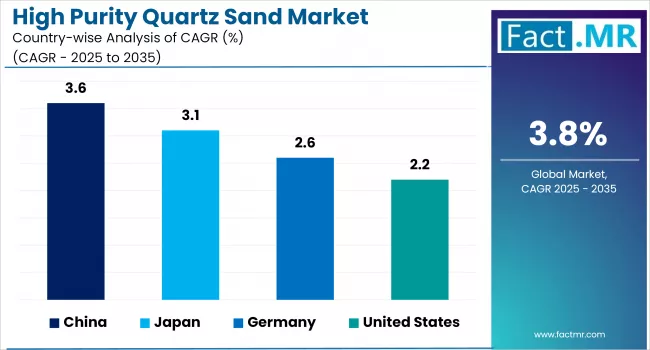
High Purity Quartz Sand Market By Country | Source: Fact.MR
U.S. high purity quartz sand market sees increased need for high-performance optical fibers and components in telecommunications
The market is witnessing growth primarily driven by increased demand from the electronics industry, the rapid expansion of solar energy systems, and the growing use of advanced optical technologies. The surge in 5G network infrastructure and higher investments in renewable energy projects are also significant contributors to this trend.
Additionally, innovations in purification technologies are enabling manufacturers to achieve higher purity levels more efficiently, further supporting market expansion. However, the industry faces challenges such as high production costs due to complex and energy-intensive refining processes, and stringent environmental regulations that increase operational costs and can delay production.
2025-to-2035.webp "Us High Purity Quartz Sand Market Country Value(usd Million)2025 To 2035")
Us High Purity Quartz Sand Market Country Value(usd Million)2025 To 2035 | Source: Fact.MR
Both global and regional players focusing on technological advancements, cost management, and strategic partnerships to secure long-term contracts with key sectors like semiconductors and renewable energy mark the competitive landscape.
Additionally, the market is seeing continuous innovation in purification technologies, enabling manufacturers to achieve higher purity levels more efficiently and cater to the stringent requirements of electronics and photovoltaic applications. These advancements, along with ongoing investments in production capacity, are the most significant new product launches and initiatives shaping the market in 2025.
April 2023, Sibelco announced an investment of approximately USD 200 million to double its high purity quartz (HPQ) production capacity at the Spruce Pine facility in North Carolina. This expansion is designed to meet growing demand from the semiconductor and solar energy sectors, as well as to support the increasing requirements for advanced optical technologies.
China Witnesses Rapid Market Growth Backed by Ongoing Investments in High-Tech Manufacturing
High purity quartz sand is essential in manufacturing semiconductors and other electronic components, sectors that are rapidly expanding in China due to the country's large digital ecosystem and government-led industrial policies. The push for renewable energy, especially solar photovoltaics, is significantly increasing the need for ultra-pure quartz sand, as it is a critical material for solar panel production.
China is seeing a wave of new investments in high purity quartz sand, driven by strategic national priorities and the rapid expansion of high-tech industries. In 2025, the Chinese government officially recognized high-purity quartz ore as a new mineral species and placed it on the list of strategic mineral resources.
This move has triggered a series of major investments in exploration, resource evaluation, and industrial-scale purification projects, particularly in regions such as Henan (Qinling Mountains) and Xinjiang (Altay), where large deposits have been discovered. Internationally, companies such as SandCo are also targeting the Chinese market, with plans to increase output and supply high-purity quartz sand for China’s expanding digital economy and renewable energy sectors. These investments are expected to significantly enhance China’s domestic resource security and reduce reliance on imports, supporting the high-quality development of strategic emerging industries.
Similarly, in March 2024, Hunan Dongting and Jiangsu Fujinyan partnered to build a large silica sand plant in China, aimed at serving the photovoltaic sector. These developments highlight a clear trend: leading companies are actively acquiring assets and forming partnerships to secure supply chains, expand product offerings, and meet the growing demand from sectors such as solar energy and semiconductors.
Germany’s Industrial Development and Renewable Push Driving Quartz Sand Demand
The Germany market is experiencing steady growth, driven by Germany’s strong industrial base and the increasing demand for high purity quartz in sectors such as electronics, semiconductors, and renewable energy. The market is also supported by Europe’s broader focus on renewable energy and advanced electronics manufacturing, as well as strict environmental regulations and incentives for clean energy technologies.
High purity grades of quartz sand are especially important for the production of ultra-efficient photovoltaic cells and high-performance optical fibers, which are essential for Germany’s renewable energy goals and advanced telecommunications infrastructure.
Germany has recently introduced new processing technologies, including chemical leaching, high-temperature processing, and advanced filtration systems. These innovations are designed to achieve higher purity levels, meeting the stringent requirements of the semiconductor and solar panel industries.
The country is witnessing significant new investments in its high purity quartz sand sector, driven by rising demand from the semiconductor, solar energy, and advanced glass manufacturing industries. The country is channeling over USD 2.34 billion into research and development for advanced materials by 2025, which is expected to attract further investments into high-purity quartz sand production and processing facilities.
These investments are reinforcing Germany’s position as a key supplier of high-purity quartz sand in Europe, supporting both domestic and global supply chains for critical industries.
Category-wise Analysis
4N to Exhibit Leading by Grade
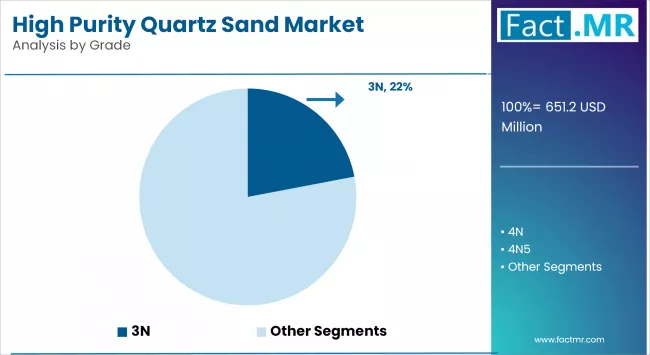
High Purity Quartz Sand Market By Grade | Source: Fact.MR
The 4N grade segment dominates the high purity quartz market, as these are widely used in semiconductor and lighting applications. With a purity level of 99.99%, 4N quartz meets the critical performance requirements of wafer processing, optical products, and certain specialty glass types. Its cost-effectiveness compared to higher grades and suitability for mass-production processes in electronics and solar cell manufacturing make it a reliable and in-demand grade across global industries.
The 5N grade is the fastest-growing segment, driven by the increasing demand for ultra-pure quartz in advanced semiconductor manufacturing and high-end optical applications. With a 99.999% purity level, 5N quartz is essential for leading-edge wafer production and precision components in 5G and quantum computing technologies. As chip design becomes smaller and more complex, the need for extremely pure raw materials rises, fueling demand for 5N quartz, especially in South Korea, Taiwan, and the U.S.
Water Processing to Exhibit Leading by Application
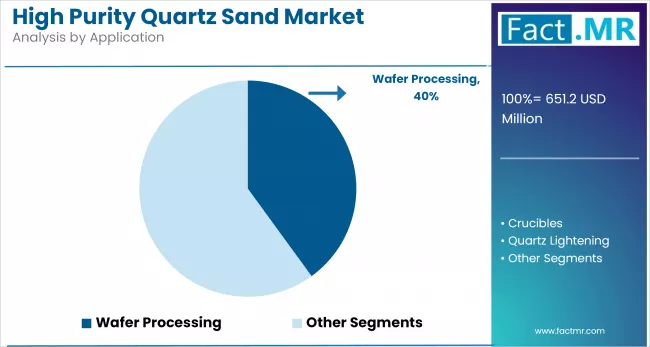
High Purity Quartz Sand Market By Application | Source: Fact.MR
Wafer processing dominates the high purity quartz sand market, as high purity quartz is indispensable for producing semiconductor wafers. The material’s low thermal expansion, chemical purity, and resistance to high temperatures make it ideal for use in reactors, tubes, and other semiconductor processing equipment. With the global electronics sector expanding rapidly, especially in Asia-Pacific, wafer processing continues to drive the bulk of high purity quartz consumption.
Solar cells are the fastest-growing application segment due to the increasing adoption of renewable energy sources and the rapid expansion of photovoltaic manufacturing capacity. High purity quartz is vital in producing crucibles for silicon ingot formation and other solar-grade components. As countries push toward decarbonization and solar energy becomes more economically viable, quartz demand for solar applications is surging, especially in China, India, and the EU solar supply chain.
Semiconductor to Exhibit Leading by End-Use
Semiconductor manufacturing segment dominates the high purity quartz sand market, as high purity quartz being essential in etching, deposition, and wafer fabrication processes. It ensures contamination-free environments and is used in quartz tubes, bell jars, and process chambers. The sector’s demand for increasingly precise, high-performance materials ensures a steady market for quartz. With rising global chip demand, this end-use segment continues to dominate the market, especially in advanced economies and major chip-producing regions.
Optical product manufacturing is the fastest-growing end-use segment, fueled by rising demand for precision lenses, fiber optics, and specialty glass. High purity quartz enables superior optical clarity and UV resistance, crucial for applications in telecommunications, high-end cameras, and laser systems. As global bandwidth demand increases and optical systems become more integral to data transmission, medical imaging, and defense, this segment is expected to register rapid growth in the coming years.
Competitive Analysis
The high purity quartz sand market is becoming increasingly competitive, driven by key players leveraging technological innovation, quality control, and sustainability initiatives. Unimin Corporation stands out as a market leader due to its extensive product range and strong emphasis on advanced purification technologies, enabling it to meet the rising demand from semiconductor and renewable energy sectors. Similarly, Sibelco maintains a significant market share with its global presence, diversified portfolio, and commitment to environmentally responsible production processes, aligning with the market’s growing focus on sustainability.
These companies serve highly regulated industries requiring strict performance specifications and global compliance, allowing them to maintain competitive advantages through proprietary refining processes, strategic partnerships, and vertical integration of supply chains. The market also sees robust participation from regional players, particularly in Asia-Pacific, where growing industrial activity and cost-sensitive applications create opportunities for local manufacturers.
Key players in the market include American Elements, Nordic Mining ASA, Creswick Quartz, Sibelco, Sung Rim, Jiangsu Pacific Quartz Co. Ltd., The Quartz Corp., High purity quartz sand Pty Ltd, I-Minerals Inc., Australian Silica Quartz Pty Ltd., Covia Holdings Corporation, Mineracao Santa Rosa, Russian Quartz LLC, and other players.
Recent Development
- In May 2024, Covia, a leading supplier of high-purity silica sand, completed the acquisition of R.W. Sidley’s silica sand mining operation in Thompson, Ohio. This deal included the quarry, reserves, and all associated operational assets, expanding Covia’s product portfolio and regional presence in North America.
- In February 2024, Sibelco North America entered a USD 350 million partnership with Ojing Technology to supply high-purity quartz sand for advanced industrial applications, further consolidating Sibelco’s market position.
Segmentation
Segmentation of High Purity Quartz Sand Market
-
By Grade :
- 3N
- 4N
- 4N5
- 4N6
- 4N7
- 4N8
- 5N
-
By Application :
- Wafer Processing
- Crucibles
- Quartz Lightening
- Xenon for Automotive
- Halogen Lamps
- Ultra-high-Performance Lamps
- High-intensity Discharge Lamps
- Others
- Solar Cells
- Optical Lenses
- Quartz Fibres
- Specialty Glass
- LCD Glass
- Lenses
- Ceramics
- Epoxy Molding Compounds
- Others
-
By End-Use :
- Semiconductor Manufacturing
- Solar Energy
- Lighting Equipment
- Telecommunication Equipment Production
- Optical Product Manufacturing
- Polymer Modification
- Glass Manufacturing
- Others
-
By Region :
- North America
- Latin America
- Western Europe
- Eastern Europe
- East Asia
- South Asia & Pacific
- Middle East & Africa
Frequently Asked Questions
What is the Global High Purity Quartz Sand Mrket size in 2025?
Who are the Major Players Operating in the High Purity Quartz Sand Market?
What is the Estimated Valuation of the High Purity Quartz sand market by 2035?
What Value CAGR Did the high purity quartz sand market Exhibit ove rthe Last Five Years?
Who worked on this report


Preview the report firsthand - request a free sample
Free SampleGet the brochure for pricing and purchase details
Download PDF