- Base Value(2025): 720 Mn
- Estimated Value(2026): 746.64 Mn
- Forecast Value (2036): 1073.74 Mn
- CAGR (2026 - 2036): 3.7%
Methacrylate Butadiene Styrene Market Size, Market Forecast and Outlook By Fact.MR
The methacrylate butadiene styrene market was valued at USD 720 million in 2025, projected to reach USD 746.64 million in 2026, and is forecast to expand to USD 1073.74 million by 2036 at a 3.7% CAGR. Expanding automotive exterior trim component demand and growing consumer electronics housing specifications are accelerating procurement of methacrylate butadiene styrene (MBS) resin across global engineering plastics supply chains. Injection moulding engineers specifying MBS for automotive instrument panel and pillar trim applications face tightening surface quality requirements as OEMs mandate class-A finish consistency across multi-cavity mould production runs.
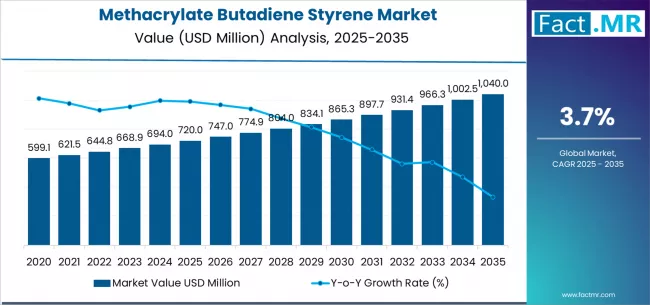
Methacrylate Butadiene Styrene Market Market Value Analysis | Source: Fact.MR
Summary of Methacrylate Butadiene Styrene Market
- Methacrylate Butadiene Styrene Market Definition
- Methacrylate butadiene styrene is a specialty thermoplastic terpolymer that delivers superior gloss, transparency, and UV resistance, used in automotive trim components, consumer electronics housings, and industrial applications.
- Demand Drivers in the Market
- Automotive OEMs specifying MBS for exterior mirror housings, grille inserts, and pillar trim where UV weathering resistance and class-A surface gloss must be maintained without painting, reducing per-part finishing costs.
- Consumer electronics manufacturers sourcing MBS for laptop, tablet, and monitor housings where surface scratch resistance, colour consistency, and dimensional stability requirements exceed standard ABS performance capabilities.
- Appliance producers selecting MBS for refrigerator door liners and washing machine control panel fascias where chemical resistance to household cleaning agents and sustained surface gloss drive material specification above commodity alternatives.
- Key Segments Analyzed in the Fact.MR Report
- Automotive Parts application: 46.0% share in 2026.
- Extrusion grade: 58.0% share in 2026.
- Industrial end use: 61.0% share in 2026.
- USA: 4.0% compound growth during 2026 to 2036.
- Analyst Opinion at Fact.MR
- The MBS market is operating under concentrated supply conditions where a limited number of polymerisation facilities control global production capacity, creating structural pricing discipline and allocation management during demand peaks. Automotive OEMs relying on single-source MBS resin specifications face production vulnerability during polymer supply disruptions. Electronics product designers that delay MBS qualification risk surface quality compromises when falling back to standard ABS grades during material shortages. Maintaining multi-grade and multi-source MBS qualification programmes represents the clearest supply continuity pathway for automotive and electronics moulding operations over the forecast decade.
- Strategic Implications / Executive Takeaways
- MBS producers must invest in polymerisation capacity to meet the growing automotive and electronics demand for high-gloss, UV-stable engineering thermoplastic grades.
- Automotive material engineers should qualify MBS resin from at least two suppliers per component programme to mitigate allocation risk during polymer supply tightening periods.
- Electronics housing designers must benchmark MBS scratch resistance and colour stability performance against competitive transparent engineering plastics before finalising material selections for high-volume product platforms.
Methacrylate Butadiene Styrene Market Key Takeaways
| Metric | Details |
|---|---|
| Industry Size (2026) | USD 746.64 million |
| Industry Value (2036) | USD 1073.74 million |
| CAGR (2026 to 2036) | 3.7% |
Source: Fact.MR analysis. Updated Mar 30, 2026
The absolute dollar opportunity between 2026 and 2036 amounts to approximately USD 327.1 million. This expansion captures the structural position of MBS as a specialty impact modifier and transparent engineering thermoplastic that delivers superior surface gloss, weathering resistance, and impact performance compared to standard ABS grades. Methacrylate monomer cost volatility and the limited number of MBS polymerisation facilities are constraining supply expansion while supporting pricing premiums over commodity ABS resin.
All major consuming regions reflect accelerated deployment parameters. USA sets the pace with a 4.0% CAGR, followed by Mexico at 3.6%. Germany registers a 3.3% rate. France registers a 3.2% rate. UK registers a 3.1% rate. South Korea registers a 3.0% rate. Japan expands at a 2.9% trajectory.
Why is the Methacrylate Butadiene Styrene Market Growing?
Market expansion is being supported by the increasing global demand for lightweight and high-performance automotive components driven by electric vehicle adoption trends and fuel efficiency regulations, alongside the corresponding need for advanced thermoplastic materials that can enhance product durability, enable innovative designs, and maintain operational efficiency across various automotive, electronics, and industrial applications. Modern automotive manufacturers and electronics producers are increasingly focused on implementing MBS solutions that can improve impact resistance, enhance processing characteristics, and provide consistent performance in demanding operating conditions.
The growing emphasis on sustainability and circular economy principles is driving demand for MBS that can support recyclable product design, enable bio-based formulations, and ensure comprehensive environmental performance. Industrial manufacturers' preference for thermoplastic materials that combine mechanical excellence with processing efficiency and design flexibility is creating opportunities for innovative MBS implementations. The rising influence of electric vehicle adoption and miniaturized electronics manufacturing is also contributing to increased adoption of MBS that can provide superior performance characteristics without compromising functionality or processing requirements.
Segmental Analysis
The market is segmented by application, grade, and end use. By application, the market is divided into automotive parts, consumer electronics, and others. Based on grade, the market is categorized into extrusion and injection molding grades. By end use, the market is split between industrial and consumer applications.
By Application, the Automotive Parts Segment Leads the Market
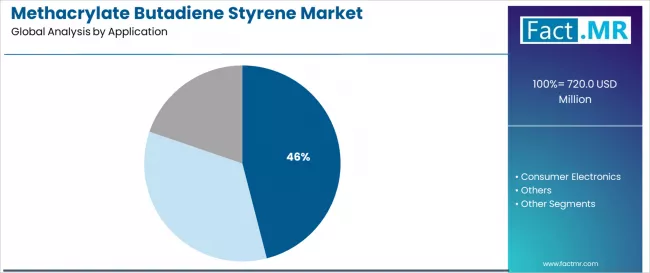
Methacrylate Butadiene Styrene Market Analysis By Application | Source: Fact.MR
The automotive parts segment is projected to maintain its leading position in the methacrylate butadiene styrene market in 2026 with a 46.0% market share, reaffirming its role as the preferred application category for impact modification and component manufacturing applications.
Automotive manufacturers increasingly utilize MBS for its superior impact resistance properties, excellent processing characteristics, and proven effectiveness in enhancing component durability while maintaining dimensional stability.
MBS technology's proven effectiveness and application versatility directly address the industry requirements for lightweight vehicle production and sustainable mobility solutions across diverse automotive platforms and component categories. This application segment forms the foundation of modern automotive component manufacturing, as it represents the material with the greatest contribution to weight reduction improvements and established performance record across multiple automotive applications and vehicle segments.
Automotive industry investments in lightweight technologies continue to strengthen adoption among component manufacturers and automotive suppliers. With regulatory pressures requiring reduced vehicle weight and improved fuel economy, MBS aligns with both environmental objectives and performance requirements, making it the central component of comprehensive lightweight automotive strategies.
By Grade, the Extrusion Segment Dominates Market Demand
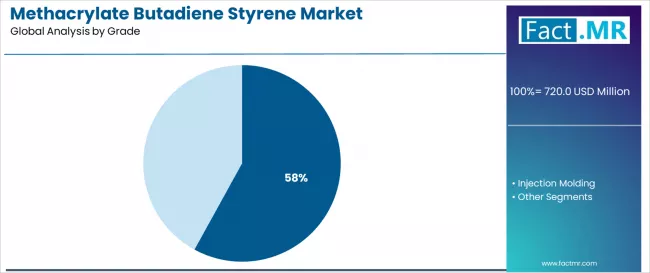
Methacrylate Butadiene Styrene Market Analysis By Grade | Source: Fact.MR
The extrusion grade segment is projected to represent the largest share of methacrylate butadiene styrene demand in 2026 with a 58.0% market share, underscoring its critical role as the primary processing method for MBS across sheet manufacturing, profile production, and film applications. Manufacturers prefer extrusion grade MBS for processing due to its exceptional melt flow characteristics, thermal stability benefits, and ability to maintain consistent quality while supporting high-volume production and cost-effectiveness. Positioned as essential materials for modern thermoplastic processing, extrusion grade MBS offers both performance advantages and processing benefits.
The segment is supported by continuous innovation in polymer processing technology and the growing availability of specialized MBS grades that enable superior processing performance with enhanced quality and reduced production costs. Additionally, manufacturers are investing in comprehensive extrusion optimization programs to support increasingly demanding processing requirements and market demand for high-performance thermoplastic solutions. As industrial processing advances and quality standards increase, the extrusion grade application will continue to dominate the market while supporting advanced MBS utilization and processing optimization strategies.
By End Use, the Industrial Segment Commands Market Leadership
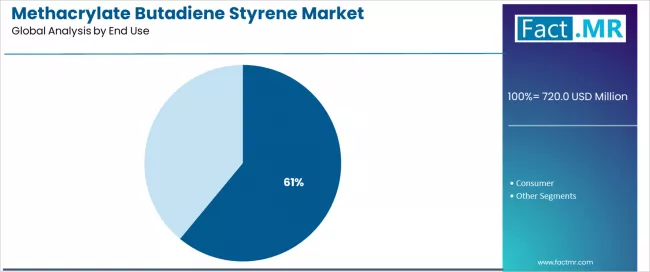
Methacrylate Butadiene Styrene Market Analysis By End Use | Source: Fact.MR
The industrial end use segment is projected to maintain the largest share of methacrylate butadiene styrene consumption in 2026 with a 61.0% market share, highlighting its fundamental role in automotive manufacturing, electronics production, and industrial component applications. Industrial manufacturers prefer MBS for its comprehensive performance characteristics, processing reliability, and proven effectiveness in demanding applications requiring superior mechanical properties and consistent quality. This segment represents the backbone of MBS consumption across multiple industrial sectors and manufacturing processes.
The industrial segment benefits from ongoing technological advancement in manufacturing processes and the expanding adoption of high-performance thermoplastics in critical applications. Industrial demand continues to grow due to increasing automation in manufacturing, rising quality standards, and the need for materials that can withstand challenging operating conditions while maintaining cost-effectiveness. As industrial applications become more sophisticated and performance requirements increase, the industrial end use segment will continue to drive market growth while supporting advanced material utilization strategies.
What are the Drivers, Restraints, and Key Trends of the Methacrylate Butadiene Styrene Market?
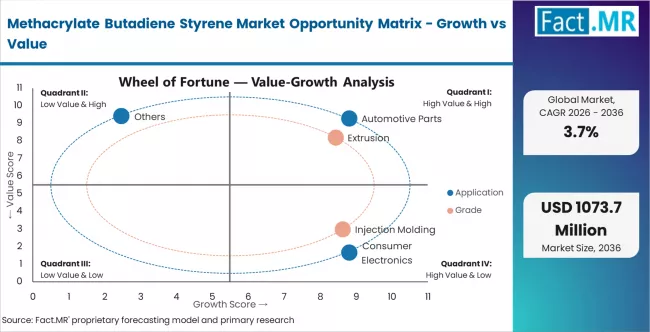
Methacrylate Butadiene Styrene Market Opportunity Matrix Growth Vs Value | Source: Fact.MR
The methacrylate butadiene styrene market is advancing steadily due to increasing demand for lightweight automotive components driven by fuel efficiency regulations and growing adoption of electric vehicles that require specialized thermoplastic materials providing enhanced mechanical properties and processing characteristics across diverse automotive, electronics, and industrial applications.
However, the market faces challenges, including high raw material costs and price volatility, competition from alternative impact modifier materials and engineering plastics, and supply chain constraints related to petrochemical feedstock availability and processing capacity limitations. Innovation in sustainable production technologies and advanced polymer engineering continues to influence product development and market expansion patterns.
Expansion of Electric Vehicle Adoption and Lightweight Components
The growing adoption of electric vehicles is driving demand for specialized lightweight components that address unique performance requirements including enhanced structural integrity, reduced weight for improved range, and superior impact resistance for battery protection systems.
Electric vehicle components require advanced MBS formulations that deliver superior mechanical properties across multiple parameters while maintaining processing efficiency and cost-effectiveness.
Automotive manufacturers are increasingly recognizing the competitive advantages of MBS integration for electric vehicle component development and market differentiation, creating opportunities for innovative grades specifically designed for next-generation mobility applications.
Integration of Sustainable Production and Circular Economy Methods
Modern MBS manufacturers are incorporating circular economy principles and sustainable production technologies to enhance environmental performance, reduce carbon footprint, and support comprehensive sustainability objectives through optimized manufacturing processes and recyclable product design.
Leading companies are developing bio-based feedstock sourcing strategies, implementing circular raw material utilization, and advancing production technologies that minimize energy consumption and environmental impact.
These technologies improve ecological credentials while enabling new market opportunities, including sustainable automotive components, recyclable electronics housings, and environmentally conscious industrial applications.
Development of High-Performance Grades for Advanced Applications
The expansion of precision manufacturing, advanced automotive systems, and high-performance electronics is driving demand for specialized MBS grades with enhanced mechanical properties and superior processing characteristics.
These advanced applications require specialized polymer formulations with stringent performance specifications that exceed traditional industrial requirements, creating premium market segments with differentiated value propositions.
Manufacturers are investing in advanced compounding capabilities and quality control systems to serve emerging high-performance applications while supporting innovation in automotive, electronics, and industrial sectors.
Analysis of the Methacrylate Butadiene Styrene Market by Key Countries
.webp "Top Country Growth Comparison Methacrylate Butadiene Styrene Market Cagr (2026 2036)")
Top Country Growth Comparison Methacrylate Butadiene Styrene Market Cagr (2026 2036) | Source: Fact.MR
| Country | CAGR (2026-2036) |
|---|---|
| USA | 4.0% |
| Mexico | 3.6% |
| Germany | 3.3% |
| France | 3.2% |
| UK | 3.1% |
| South Korea | 3.0% |
| Japan | 2.9% |
Source: Fact.MR analysis. Updated Mar 30, 2026
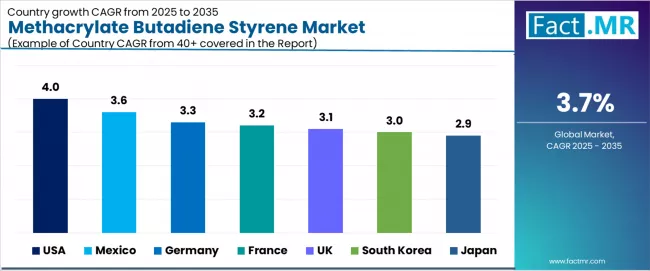
Methacrylate Butadiene Styrene Market Cagr Analysis By Country | Source: Fact.MR
The methacrylate butadiene styrene market is experiencing solid growth globally, with the USA leading at a 4.0% CAGR through 2036, driven by expanding automotive production and growing electronics manufacturing, alongside increasing adoption of advanced thermoplastic materials in industrial applications. Mexico follows at 3.6%, supported by automotive manufacturing growth, expanding industrial production, and growing demand for impact-resistant materials in consumer goods.
Germany shows growth at 3.3%, emphasizing automotive engineering excellence, precision manufacturing, and advanced polymer processing technologies. France demonstrates 3.2% growth, supported by automotive component production and industrial applications.
The UK records 3.1%, focusing on automotive manufacturing and industrial material applications. South Korea exhibits 3.0% growth, emphasizing electronics manufacturing and automotive component production. Japan shows 2.9% growth, emphasizing precision manufacturing and high-performance automotive applications.
The report covers an in-depth analysis of 40+ countries; seven top-performing countries are highlighted below.
USA Leads Global Market Growth with Automotive and Electronics Expansion
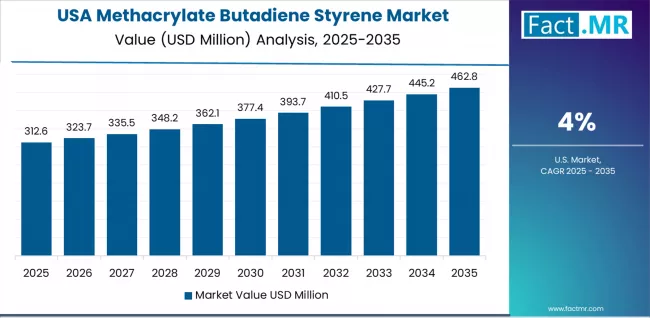
Methacrylate Butadiene Styrene Market Country Value Analysis | Source: Fact.MR
Revenue from methacrylate butadiene styrene in the USA is projected to exhibit strong growth with a CAGR of 4.0% through 2036, driven by expanding automotive production and rapidly growing electronics manufacturing supported by reshoring initiatives and industrial modernization programs.
The country's substantial automotive sector expansion and increasing investment in advanced manufacturing technologies are creating substantial demand for MBS solutions. Major automotive manufacturers and electronics companies are establishing comprehensive MBS utilization capabilities to serve both domestic markets and export opportunities.
- Government support for advanced manufacturing and automotive production is driving demand for MBS throughout major industrial regions including Michigan, Ohio, and the Southeast automotive corridor, supporting both domestic consumption and export-oriented manufacturing facilities.
- Strong automotive sector growth and expanding electronics production are supporting the rapid adoption of high-performance MBS technologies among manufacturers seeking enhanced component durability and processing efficiency in competitive global markets.
Mexico Demonstrates Strong Manufacturing Growth with NAFTA Advantages
Revenue from methacrylate butadiene styrene in Mexico is expanding at a CAGR of 3.6%, supported by the country's growing automotive manufacturing sector, expanding industrial production capabilities, and strategic position as a manufacturing hub for North American markets. Mexico's comprehensive automotive infrastructure and cost-competitive manufacturing are driving sophisticated MBS capabilities throughout industrial sectors. Leading automotive manufacturers and industrial companies are establishing extensive production facilities to address growing domestic and export demand.
- Rising automotive production and expanding manufacturing base are creating opportunities for MBS adoption across automotive components, industrial applications, and consumer goods manufacturing in major industrial regions including Bajío, Northern Mexico, and Central Mexico clusters.
- Strong trade relationships and strategic geographic position are supporting the adoption of advanced MBS technologies among manufacturers seeking to serve both domestic and international markets while maintaining cost competitiveness and quality excellence.
Germany Demonstrates Engineering Excellence with Premium Applications
Revenue from methacrylate butadiene styrene in Germany is expanding at a CAGR of 3.3%, driven by the country's premium automotive sector, advanced manufacturing capabilities, and precision engineering excellence supporting high-performance MBS applications. Germany's automotive leadership and industrial sophistication are driving demand for specialized MBS solutions throughout technology sectors. Leading automotive manufacturers and chemical companies are establishing comprehensive innovation programs for next-generation MBS technologies.
- Advanced automotive engineering and precision manufacturing requirements are creating demand for specialized MBS grades among automotive suppliers and industrial manufacturers seeking enhanced material performance and innovation differentiation in global markets.
- Strong chemical industry expertise and engineering excellence are supporting the adoption of advanced MBS formulations and processing optimization technologies across manufacturing facilities throughout major industrial regions.
France Shows Automotive Innovation and Industrial Applications Focus
Revenue from methacrylate butadiene styrene in France is expanding at a CAGR of 3.2%, supported by the country's automotive manufacturing excellence, industrial production capabilities, and strong emphasis on advanced materials for automotive and industrial applications. France's automotive expertise and industrial infrastructure are driving demand for high-performance MBS products. Leading automotive manufacturers and industrial companies are investing in specialized capabilities for advanced MBS applications.
- Advanced automotive production and industrial manufacturing are creating opportunities for MBS adoption throughout automotive component production, industrial equipment manufacturing, and consumer goods production facilities across major industrial regions.
- Strong industrial base and automotive sector excellence are driving the adoption of innovative MBS grades and processing technologies supporting enhanced product performance and manufacturing efficiency in competitive global markets.
UK Focuses on Automotive Manufacturing and Industrial Applications
Revenue from methacrylate butadiene styrene in the UK is growing at a CAGR of 3.1%, driven by the country's automotive manufacturing sector, industrial production capabilities, and emphasis on advanced materials for automotive and industrial applications. The UK's manufacturing expertise and technological capabilities are supporting investment in advanced MBS technologies. Major automotive manufacturers and industrial companies are establishing comprehensive programs incorporating advanced material solutions.
- Automotive manufacturing and industrial production are creating demand for high-performance MBS grades supporting component manufacturing, industrial applications, and advanced material solutions throughout major manufacturing regions including the Midlands and Northern England.
- Strong manufacturing base and technological expertise are driving the adoption of advanced MBS processing technologies and formulation optimization supporting enhanced product quality and manufacturing competitiveness.
South Korea Demonstrates Technology Leadership with Electronics Focus
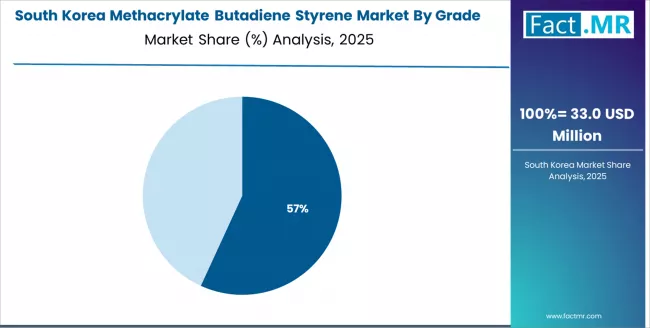
Methacrylate Butadiene Styrene Market South Korea Market Share Analysis By Grade | Source: Fact.MR
Revenue from methacrylate butadiene styrene in South Korea is expanding at a CAGR of 3.0%, supported by the country's leadership in electronics manufacturing, automotive component production, and strong emphasis on advanced materials for high-technology applications. South Korea's technological sophistication and manufacturing excellence are driving sophisticated MBS capabilities throughout technology sectors. Leading electronics manufacturers and automotive suppliers are investing extensively in advanced MBS technologies.
- Advanced electronics manufacturing and automotive component production are creating demand for specialized MBS products throughout semiconductor applications, consumer electronics manufacturing, and automotive component production facilities in major industrial regions.
- Strong technology industry and manufacturing expertise are supporting the adoption of innovative MBS formulations and processing optimization technologies for next-generation applications requiring superior material performance and reliability.
Japan Shows Advanced Technology Focus with Precision Applications
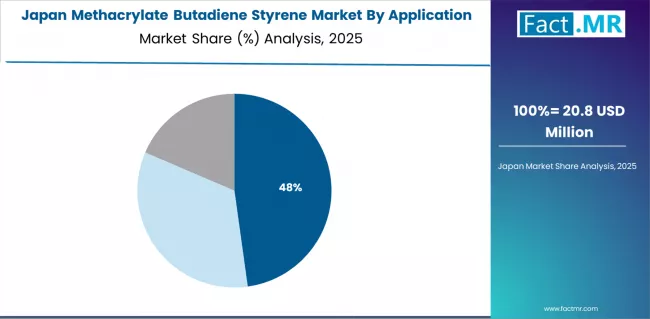
Methacrylate Butadiene Styrene Market Japan Market Share Analysis By Application | Source: Fact.MR
Revenue from methacrylate butadiene styrene in Japan is expanding at a CAGR of 2.9%, supported by the country's leadership in precision manufacturing, automotive engineering excellence, and strong emphasis on high-specification materials for advanced technology sectors. Japan's technological sophistication and quality excellence are driving demand for premium MBS products. Leading automotive manufacturers and precision manufacturers are investing in specialized capabilities for advanced MBS applications.
- Advanced automotive manufacturing and precision engineering requirements are creating opportunities for high-performance MBS products throughout automotive component production, precision manufacturing, and advanced industrial applications meeting stringent quality and performance standards.
- Strong manufacturing industry and technological excellence are driving adoption of specialized MBS grades and advanced processing technologies supporting innovation in automotive, electronics, and precision manufacturing sectors requiring superior material performance and consistency.
Europe Market Split by Country
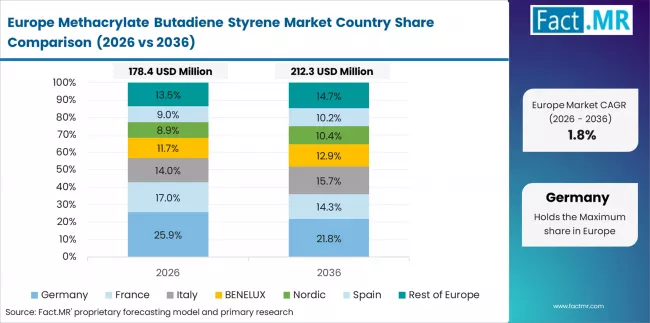
Methacrylate Butadiene Styrene Market Europe Country Market Share Analysis, 2026 & 2036 | Source: Fact.MR
The methacrylate butadiene styrene market in Europe is projected to grow from USD 180.0 million in 2026 to USD 260.0 million by 2036, registering a CAGR of 3.7% over the forecast period. Germany is expected to maintain its leadership position with a 28.5% market share in 2026, declining slightly to 27.8% by 2036, supported by its advanced automotive manufacturing and engineering plastics industry.
France follows with a 19.2% share in 2026, projected to reach 19.5% by 2036, driven by comprehensive automotive component production and electronics manufacturing. The United Kingdom holds a 16.8% share in 2026, expected to decrease to 16.3% by 2036 due to market maturation. Italy commands a 13.7% share, while Spain accounts for 9.8% in 2026. The Rest of Europe region is anticipated to gain momentum, expanding its collective share from 12.0% to 12.6% by 2036, attributed to increasing MBS adoption in Nordic countries and emerging Eastern European automotive manufacturing implementing advanced polymer technologies.
Competitive Landscape of the Methacrylate Butadiene Styrene Market
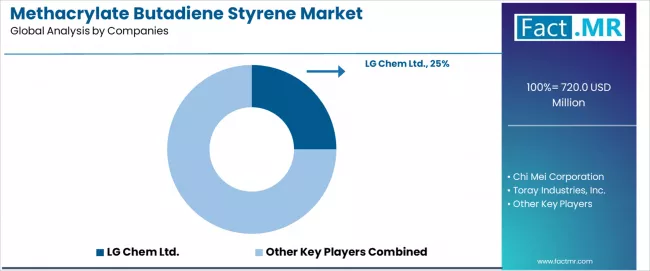
Methacrylate Butadiene Styrene Market Analysis By Company | Source: Fact.MR
The methacrylate butadiene styrene market is characterized by competition among established polymer manufacturers, diversified chemical companies, and specialized thermoplastic producers. Companies are investing in sustainable production technology development, advanced polymer engineering, product portfolio expansion, and application-specific grade development to deliver high-performance, cost-effective, and environmentally responsible MBS solutions. Innovation in bio-based feedstock utilization, enhanced impact modification technologies, and advanced processing optimization is central to strengthening market position and competitive advantage.
LG Chem leads the market with a 12.0% share, offering comprehensive MBS solutions with a focus on automotive applications, advanced processing technologies, and high-performance grades across diverse industrial and consumer applications. The company has announced major capacity expansion initiatives and investments in sustainable production technologies to support growing global demand for lightweight automotive components and electronics applications.
Chi Mei provides innovative polymer solutions with emphasis on processing optimization and quality excellence, while Toray delivers high-performance thermoplastic materials with focus on automotive and electronics applications. BASF offers advanced chemical solutions with comprehensive MBS offerings for industrial applications, and Dow provides innovative materials with emphasis on performance optimization and sustainability. Ineos Styrolution specializes in styrenic materials with advanced MBS technologies, while Trinseo focuses on engineered materials for demanding applications. Other key players including Techno-UMG, Denka, and LOTTE Chemical contribute to market competition through specialized product offerings and regional market presence.
Methacrylate Butadiene Styrene Market - Stakeholder Contribution Framework
Methacrylate butadiene styrene represents a specialized thermoplastic segment within industrial and consumer applications, projected to grow from USD 720.0 million in 2025 to USD 1,040.0 million by 2035 at a 3.7% CAGR.
These high-performance polymer materials—primarily impact modifier and processing aid configurations for multiple applications—serve as critical functional materials in automotive manufacturing, electronics production, consumer goods, and industrial applications where enhanced mechanical properties, processing efficiency, and cost-effectiveness are essential.
Market expansion is driven by increasing automotive lightweighting requirements, growing electronics miniaturization trends, expanding industrial manufacturing capabilities, and rising demand for high-performance thermoplastic solutions across diverse automotive, electronics, and industrial sectors.
How Industrial Regulators Could Strengthen Product Standards and Performance Guidelines?
- Material Performance Standards: Establish comprehensive technical specifications for MBS products, including impact strength requirements, thermal stability characteristics, processing parameter guidelines, and mechanical property standards that ensure consistent quality across automotive, electronics, industrial, and consumer applications.
- Sustainable Production Integration: Develop regulatory frameworks that incentivize circular economy implementation, requiring manufacturers to reduce energy consumption, minimize waste generation, incorporate bio-based feedstocks, and achieve measurable carbon footprint reductions in MBS production processes.
- Quality Assurance Requirements: Implement mandatory quality control standards for MBS manufacturing, including batch testing protocols, contamination prevention measures, and traceability systems that ensure product consistency and application reliability across diverse end-use sectors.
- Automotive Grade Certification: Create specialized guidelines for automotive-grade MBS used in critical components, addressing stringent performance specifications, durability requirements, and safety validation specific to automotive applications requiring enhanced reliability and performance consistency.
- Innovation Support Programs: Provide regulatory facilitation and financial incentives for research and development of next-generation MBS technologies that improve mechanical performance, reduce environmental impact, and enable emerging applications in sustainable transportation and advanced manufacturing.
How Industry Associations Could Advance Technology Standards and Market Development?
- Application Best Practices: Develop comprehensive technical guidelines for MBS selection, formulation optimization, and processing techniques that maximize performance benefits, ensure product quality, and maintain cost-effectiveness across automotive manufacturing, electronics production, and industrial applications.
- Sustainability Benchmarking: Establish industry-wide metrics for environmental performance, including production energy intensity, carbon footprint, waste generation, and recyclable content that enable comparative analysis and drive continuous improvement toward sustainability objectives.
- Technical Training Programs: Create specialized education initiatives for application engineers, processing specialists, and production personnel covering MBS characteristics, processing requirements, performance optimization, and troubleshooting techniques across diverse industrial applications.
- Performance Standardization: Develop standardized testing methodologies for MBS performance evaluation, including impact strength measurement, processing behavior assessment, thermal performance analysis, and application-specific performance metrics that facilitate objective product comparison.
- Cross-Industry Collaboration: Facilitate partnerships between MBS manufacturers, end-user industries, research institutions, and equipment suppliers to advance technology development, address emerging application challenges, and accelerate innovation in sustainable thermoplastic materials.
How MBS Manufacturers Could Drive Innovation and Market Leadership?
- Sustainable Production Technologies: Invest in renewable energy integration, bio-based feedstock development, circular raw material sourcing, and process efficiency improvements that reduce environmental impact while maintaining product quality and cost competitiveness in global markets.
- Advanced Product Development: Develop next-generation MBS grades with enhanced mechanical characteristics, including optimized impact modification, improved processing properties, enhanced thermal stability, and application-specific performance attributes for emerging market segments.
- Digital Manufacturing Integration: Implement intelligent production systems with real-time quality monitoring, predictive maintenance capabilities, automated process control, and data analytics that optimize manufacturing efficiency, ensure consistent product quality, and reduce production costs.
- Application Technical Support: Establish comprehensive customer service capabilities providing formulation assistance, processing troubleshooting, performance optimization guidance, and technical expertise that strengthen customer relationships and enable successful product implementation.
- Global Supply Chain Excellence: Develop regional production facilities, strategic inventory management, reliable logistics networks, and responsive customer service that ensure consistent product availability, minimize delivery times, and support customer operational requirements worldwide.
How End-User Industries Could Optimize Material Performance and Cost-Effectiveness?
- Strategic Material Selection: Conduct comprehensive assessments of performance requirements, cost constraints, processing capabilities, and quality specifications to optimize MBS grade selection and achieve desired product characteristics while managing total system costs.
- Processing Optimization: Implement advanced development methodologies utilizing design of experiments, processing parameter optimization, and systematic testing to maximize MBS performance benefits, minimize material usage, and optimize overall production cost-effectiveness.
- Quality Management: Develop optimized processing protocols, quality control procedures, and performance validation that ensure effective MBS integration, maximize functional benefits, and maintain consistent product quality throughout production operations.
- Sustainability Integration: Incorporate life cycle assessment methodologies, circular economy principles, and environmental impact considerations into material selection and product development processes that support comprehensive sustainability objectives and stakeholder expectations.
- Collaborative Innovation: Establish strategic partnerships with MBS suppliers for joint development programs, technical exchange initiatives, and co-innovation projects that address specific application challenges and accelerate new product commercialization.
How Research Institutions Could Enable Technology Advancement?
- Fundamental Research: Conduct scientific investigations into polymer structure-property relationships, impact modification mechanisms, processing-performance interactions, and mechanical property development that advance fundamental understanding and enable breakthrough innovations.
- Process Technology Development: Develop novel production methods, including bio-based synthesis routes, energy-efficient manufacturing processes, and circular material recovery technologies that improve sustainability performance while maintaining product quality and economic viability.
- Application Innovation: Investigate emerging applications for MBS in advanced automotive components, next-generation electronics housings, sustainable consumer products, and high-performance industrial materials that create new market opportunities and expand application potential.
- Analytical Capabilities: Provide advanced characterization services utilizing mechanical testing, thermal analysis, rheological evaluation, and processing assessment methodologies that enable detailed understanding of MBS properties and application behavior.
- Industry Knowledge Transfer: Facilitate technology commercialization through licensing agreements, startup incubation programs, technical publications, and collaborative research projects that accelerate innovation adoption and strengthen industry-academia partnerships.
How Investors and Financial Enablers Could Support Market Growth and Innovation?
- Production Capacity Investment: Provide capital for MBS manufacturing facility construction, production line expansion, and technology upgrade projects that address growing market demand while improving operational efficiency and environmental performance.
- Innovation Financing: Fund research and development of breakthrough MBS technologies, including sustainable production methods, advanced performance grades, and novel application developments that address current market limitations and create competitive advantages.
- Sustainability Project Support: Finance circular economy initiatives, renewable energy integration, bio-based feedstock development, and carbon reduction programs that enhance environmental credentials and position manufacturers for long-term regulatory compliance and market acceptance.
- Market Expansion Enablement: Support strategic acquisitions, market entry initiatives, distribution network development, and customer technical service capabilities that accelerate geographic expansion and strengthen competitive positions in high-growth markets.
- Emerging Market Development: Provide financing and technical assistance for MBS production facilities in developing economies, creating new supply capabilities, supporting local industrial development, and expanding global market access for sustainable thermoplastic solutions.
Key Players in the Methacrylate Butadiene Styrene Market
- LG Chem Ltd.
- Chi Mei Corporation
- Toray Industries, Inc.
- BASF SE
- The Dow Chemical Company
- INEOS Styrolution Group GmbH
- Trinseo S.A.
- Techno-UMG Co., Ltd.
- Denka Company Limited
- LOTTE Chemical Corporation
Bibliography
- 1. Society of Automotive Engineers. (2024). SAE J1960: Accelerated exposure of automotive exterior materials using a xenon-arc apparatus. SAE.
- 2. International Organization for Standardization. (2024). ISO 4892: Plastics, methods of exposure to laboratory light sources. ISO.
- 3. LG Chem Ltd. (2024). Annual report 2023: Advanced materials segment review. LG Chem.
- 4. Organisation for Economic Co-operation and Development. (2024). Engineering plastics production and trade statistics. OECD.
- 5. ASTM International. (2024). ASTM D4226: Standard test method for impact resistance of rigid poly(vinyl chloride) building products. ASTM.
- 6. INEOS Styrolution. (2024). Annual report 2023: Specialty styrenics segment review. INEOS Styrolution.
This bibliography is provided for reader reference. The full Fact.MR report contains the complete reference list with primary research documentation.
This Report Addresses
- Market sizing and quantitative forecast metrics detailing methacrylate butadiene styrene consumption across major end-use industries through 2036.
- Segmentation analysis mapping adoption velocity across application, grade, end use categories and evaluating structural demand shifts.
- Regional deployment intelligence comparing consumption patterns across Asia Pacific, Europe, North America, and other regions.
- Regulatory compliance assessment analysing how material safety directives and environmental standards influence procurement specifications.
- Competitive positioning evaluation tracking market share distribution, vertical integration advantages, and buyer leverage dynamics among leading producers.
- Capital project strategic guidance defining procurement specifications and supply qualification requirements for major industrial consumers.
- Supply chain risk analysis identifying feedstock concentration, logistics constraints, and capacity utilisation bottlenecks.
- Custom data delivery formats encompassing interactive dashboards, raw Excel datasets, and comprehensive PDF narrative reports.
Methacrylate Butadiene Styrene Market Definition
Methacrylate butadiene styrene (MBS) is a thermoplastic terpolymer produced through the emulsion or bulk polymerisation of methyl methacrylate, butadiene, and styrene monomers. This material delivers superior surface gloss, transparency, UV resistance, and low-temperature impact performance compared to standard ABS. Core grades include extrusion grades for sheet and profile applications and injection moulding grades for automotive and electronics components. Primary end uses span automotive exterior and interior trim parts, consumer electronics housings, and appliance components.
Methacrylate Butadiene Styrene Market Inclusions
Market scope covers global and regional MBS consumption volumes, forecast from 2026 to 2036. Segment breakdowns include application (automotive parts, consumer electronics), grade (extrusion, injection moulding), and end use (industrial, consumer). Regional pricing trends and production capacity analysis are incorporated.
Methacrylate Butadiene Styrene Market Exclusions
The scope excludes standard ABS resin, polymethyl methacrylate (PMMA), and other styrenic copolymers classified under separate polymer categories. Finished automotive components, assembled electronics devices, and appliance products fall outside analytical parameters. Methyl methacrylate monomer production is not included unless directly linked to MBS manufacturing cost metrics.
Methacrylate Butadiene Styrene Market Research Methodology
- Primary Research: Analysts conducted structured interviews with procurement directors, production managers, and specification engineers across major methacrylate butadiene styrene consuming industries in 30 countries to validate adoption timelines and volume commitments.
- Desk Research: Data collection aggregated regulatory filings, trade association production statistics, company annual reports, and published pricing indices relevant to the methacrylate butadiene styrene supply chain.
- Market-Sizing and Forecasting: Baseline values derive from a bottom-up aggregation of production capacity data and consumption volumes, applying region-specific demand curves to project future adoption trajectories.
- Data Validation and Update Cycle: Projections undergo cross-validation against publicly reported financial guidance from leading producers and quarterly trade data published by national statistical agencies.
Segmentation
Scope of the Report
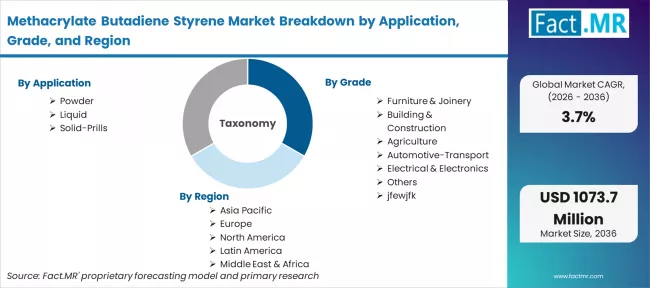
Methacrylate Butadiene Styrene Market Breakdown By Application, Grade, And Region | Source: Fact.MR
| Quantitative Units | USD 746.64 million to USD 1073.74 million, at a CAGR of 3.7% |
|---|---|
| Market Definition | Methacrylate butadiene styrene is a specialty thermoplastic terpolymer that delivers superior gloss, transparency, and UV resistance, used in automotive trim components, consumer electronics housings, and industrial applications. |
| Segmentation | Application: Automotive Parts, Consumer Electronics, Others; Grade: Extrusion, Injection Molding; End Use: Industrial, Consumer |
| Regions Covered | North America, Latin America, Europe, East Asia, South Asia, Oceania, Middle East & Africa |
| Countries Covered | USA, Mexico, Germany, France, UK, South Korea, Japan, and 40 plus countries |
| Key Companies Profiled | LG Chem Ltd., Chi Mei Corporation, Toray Industries, Inc., BASF SE, The Dow Chemical Company, INEOS Styrolution Group GmbH, Trinseo S.A., Techno-UMG Co., Ltd., Denka Company Limited, LOTTE Chemical Corporation |
| Forecast Period | 2026 to 2036 |
| Approach | Hybrid modelling combining bottom-up production capacity analysis with top-down demand consumption patterns, cross-validated against primary research and public financial disclosures. |
Source: Fact.MR analysis. Updated Mar 30, 2026
Methacrylate Butadiene Styrene Market by Segments
-
Application :
- Automotive Parts
- Consumer Electronics
- Others
-
Grade :
- Extrusion
- Injection Molding
-
End Use :
- Industrial
- Consumer
-
Region :
-
East Asia
- China
- Japan
- South Korea
- Taiwan
- Rest of East Asia
-
Europe
- Germany
- United Kingdom
- France
- Italy
- Spain
- Netherlands
- Nordic
- BENELUX
- Rest of Europe
-
North America
- United States
- Canada
- Mexico
-
South Asia
- India
- Pakistan
- Bangladesh
- Rest of South Asia
-
Latin America
- Brazil
- Argentina
- Chile
- Rest of Latin America
-
Middle East & Africa
- Kingdom of Saudi Arabia
- Other GCC Countries
- Turkey
- South Africa
- Other African Union
- Rest of Middle East & Africa
-
Eastern Europe
- Russia
- Poland
- Czech Republic
- Rest of Eastern Europe
-
Frequently Asked Questions
How large is the demand for Methacrylate Butadiene Styrene Market globally in 2026?
What will be the market size of Methacrylate Butadiene Styrene Market by 2036?
What is the expected demand growth for Methacrylate Butadiene Styrene Market between 2026 and 2036?
Which Application is poised to lead global sales by 2026?
What is the USA growth outlook in this report?
How significant is the role of Extrusion in the grade category?
What is Methacrylate Butadiene Styrene and what is it mainly used for?
How does Fact.MR build and validate the Methacrylate Butadiene Styrene Market forecast?
Who worked on this report


Preview the report firsthand - request a free sample
Free SampleGet the brochure for pricing and purchase details
Download PDF