- Base Value(2025): 1.85 Bn
- Estimated Value(2026): 1.89 Bn
- Forecast Value (2036): 2.35 Bn
- CAGR (2026 - 2036): 2.2%
Expanded Polystyrene Industry Analysis in the USA Market Size, Market Forecast and Outlook By Fact.MR
The expanded polystyrene industry in the USA was valued at USD 1.85 billion in 2025, projected to reach USD 1.89 billion in 2026, and is forecast to expand to USD 2.35 billion by 2036 at a 2.2% CAGR. Persistent demand from residential and commercial building insulation applications sustains core consumption volumes, while packaging applications face headwinds from municipal single-use foam bans in multiple state jurisdictions. Construction code updates mandating higher thermal resistance values in wall and roof assemblies create specification-driven pull for EPS insulation board products.
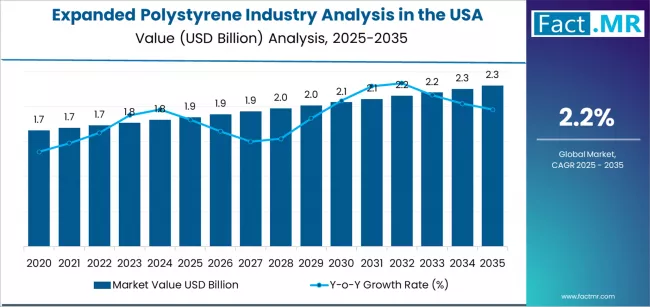
Expanded Polystyrene Industry Analysis In The Usa Market Value Analysis | Source: Fact.MR
Summary of Expanded Polystyrene Industry Analysis in the USA
- Market Overview
- The expanded polystyrene industry in the USA is valued at USD 1.85 billion in 2025 and is projected to reach USD 2.35 billion by 2036.
- The industry is expected to grow at a 2.2% CAGR from 2026 to 2036, creating an incremental opportunity of USD 0.46 billion.
- The market is a mature, construction-cycle dependent polymer processing category where energy code compliance, raw material cost management, and recycling infrastructure define competitive positioning.
- Demand and Growth Drivers
- Demand is sustained by residential and commercial building insulation requirements as updated energy codes mandate higher thermal resistance values in wall and roof assemblies.
- Protective packaging consumption faces contraction pressures from municipal and state-level single-use expanded polystyrene bans across multiple US jurisdictions.
- Retrofit insulation demand in existing building stock generates replacement volume as property owners upgrade thermal envelopes to meet energy efficiency standards.
- The Southern region leads at 2.5% CAGR, driven by sustained Sun Belt residential construction activity and building code adoption requiring upgraded insulation specifications.
- Product and Segment View
- The market covers expanded polystyrene products manufactured by pre-expanding polystyrene beads with pentane blowing agents and molding or cutting them into application-specific shapes.
- Building & Insulation leads by Application with 48.0% share in 2026, anchored by energy code mandated thermal insulation requirements in residential and commercial construction.
- Blocks & Sheets leads by Form with 63.0% share in 2026, serving flat-board insulation applications in wall cavities, roof decks, and below-grade foundation systems.
- Low-density EPS leads by Density with 59.0% share in 2026, used across standard insulation and protective packaging where lightweight performance is prioritized.
- Scope includes insulation boards, molded packaging shapes, and geofoam products, while excluding extruded polystyrene foam boards, expanded polypropylene, and raw polystyrene resin.
- Geography and Competitive Outlook
- The Southern USA is the fastest-growing sub-region due to sustained residential construction in Sun Belt metros, while the Northeast and Midwest generate stable retrofit and replacement insulation demand.
- Western states face packaging volume contraction from EPS foam bans, partially offset by continued insulation-grade product demand.
- Competition is shaped by styrene monomer sourcing, regional manufacturing footprint, and building material distribution network coverage, with key players including BASF SE, Dow Inc., TotalEnergies SE, Braskem S.A., Knauf Insulation GmbH, ACH Foam Technologies LLC, JSP Corporation, Sealed Air Corporation, Alpek S.A.B. de C.V., Flint Hills Resources, and Nova Chemicals Corporation.
- Analyst Opinion at Fact.MR
- Shambhu Nath Jha , Principal Consultant for Polymers & Plastics, opines: 'In my analysis, I have observed that the margin structure of US EPS producers is migrating from volume-dependent packaging economics to specification-driven insulation economics. Manufacturers maintaining legacy foodservice foam capacity in jurisdictions with active ban legislation face stranded asset exposure that compresses return on invested capital. Producers redirecting capacity toward higher-density insulation grades aligned with updated IECC energy code requirements position themselves for stable, code-mandated demand that is less exposed to municipal packaging restrictions.'
- Strategic Implications / Executive Takeaways
- EPS producers must accelerate capacity rebalancing from packaging-grade to insulation-grade production to align with evolving regulatory and demand dynamics across US jurisdictions.
- Building material distributors should secure multi-year EPS insulation supply agreements to guarantee availability during peak residential construction seasons in high-growth Sun Belt markets.
- Insulation specifiers must track IECC energy code update cycles to ensure EPS board specifications meet or exceed the thermal resistance requirements adopted by local building authorities.
Expanded Polystyrene Industry Analysis in the USA Market Key Takeaways
| Metric | Details |
|---|---|
| Industry Size (2026) | USD 1.89 billion |
| Industry Value (2036) | USD 2.35 billion |
| CAGR (2026 to 2036) | 2.2% |
Source: Fact.MR analysis. Updated Apr 6, 2026
Source: Fact.MR, 2026
The USD 0.46 billion incremental opportunity over the forecast period reflects a mature market operating within defined regulatory boundaries. EPS producers balancing insulation grade production with shrinking protective packaging volumes manage capacity utilization through grade-mix optimization. Styrene monomer price volatility introduces quarterly margin fluctuations that manufacturers absorb through contract pricing mechanisms with building material distributors and insulation installers.
Within the USA, the Southern region sets the pace at a 2.5% CAGR, propelled by sustained residential construction activity across Sun Belt metropolitan areas where building energy code adoption drives insulation specification upgrades. The broader national market progresses at a measured rate as established Northeast and Midwest construction markets generate steady replacement and retrofit insulation demand. Western states maintain consumption levels despite aggressive EPS packaging restrictions, with insulation-grade products offsetting volume losses from banned foodservice foam applications.
Opportunity Pathways - Expanded Polystyrene Industry
Demand expansion is being supported by the accelerating emphasis on energy efficiency and sustainable construction nationwide, with the USA maintaining its position as a building innovation and insulation technology leadership region, and the corresponding need for effective thermal solutions for construction applications, building performance optimization, and insulation integration. Modern construction manufacturers and building developers rely on expanded polystyrene technologies to ensure thermal performance, cost efficiency, and optimal pathway achievement toward comprehensive energy-efficient building environments.
Advanced construction requirements necessitate comprehensive insulation solutions including specialized thermal capabilities, precision-engineered high-performance varieties, and performance-validated application infrastructure to address diverse building needs and regulatory specifications.
The growing emphasis on green building and increasing federal and industry-level energy standards, particularly building efficiency programs across the USA, are driving demand for expanded polystyrene from proven material suppliers with appropriate technical expertise and quality management capabilities. Manufacturing facilities and construction companies are increasingly investing in expanded polystyrene sourcing and integrated building solutions to enhance project performance profiles, access energy optimization trends, and demonstrate innovation leadership in competitive construction environments.
Industry standards and regulatory compliance requirements are establishing standardized building pathways that require expanded polystyrene enhancement and thermal assurance, with USA operations often pioneering large-scale implementation of advanced insulation technologies.
Opportunity Pathways - Demand for Expanded Polystyrene in the USA
The expanded polystyrene demand in the USA is positioned for steady expansion, growing from USD 1.85 billion in 2025 to USD 2.30 billion by 2035, reflecting a 2.2% CAGR. Rising adoption of energy-efficient materials in construction operations, manufacturing facilities, and packaging applications is driving growth as manufacturers seek insulation solutions that maximize thermal performance and comply with stringent building standards. Additionally, demand from specialized packaging applications and advanced manufacturing implementations strengthens opportunities for both sophisticated insulation platforms and integrated construction solutions.
Operators focusing on premium implementations, sustainable material integration, and advanced manufacturing capabilities stand to gain from evolving construction standards and manufacturer expectations for material performance, reliability, and thermal optimization.
- Pathway A - Building & Insulation Implementations and Construction Applications Construction manufacturers face increasing demands for insulation solutions in modern building projects. Premium expanded polystyrene enables enhanced thermal performance and comprehensive energy efficiency capabilities without compromising structural integrity. Solutions targeting commercial construction firms, residential developers, and industrial building projects can achieve strong adoption rates through thermal optimization and cost efficiency improvements. Estimated revenue opportunity: USD 216-270 million.
- Pathway B - Sustainable Material Technology and Green Building Systems The growth in green construction, environmental positioning, and sustainability certification demands creates robust demand for recyclable EPS ensuring environmental compliance in building processes. Operators offering certified sustainable solutions for green building applications can build relationships with premium developers and construction partners. Estimated revenue opportunity: USD 162-216 million.
- Pathway C - Packaging & Protective Applications Packaging manufacturers are increasingly adopting high-performance systems for consistent protection in demanding conditions. Collaborations with packaging providers for integrated protective solutions can unlock large-volume supply contracts and long-term partnerships in logistics applications. Estimated revenue opportunity: USD 135-189 million.
- Pathway D - Low-density EPS and Premium Insulation Applications Thermal performance requirements and energy efficiency demands are driving preference for low-density platforms with superior insulation capabilities. Suppliers offering comprehensive insulation solutions with exceptional thermal characteristics can differentiate offerings and attract high-end construction manufacturers. Estimated revenue opportunity: USD 108-162 million.
- Pathway E - Consumer Goods and Specialty Applications Specialty product applications require specialized EPS configurations with optimized protective features and enhanced durability. Operators investing in consumer-grade development can secure advantages in serving product-critical consumer applications. Estimated revenue opportunity: USD 81-135 million.
- Pathway F - Technical Service and Recycling Networks Comprehensive recycling networks offering material guidance, performance assurance, and ongoing application support create recurring value opportunities. Companies building strong technical support capabilities can capture ongoing relationships and enhance manufacturer satisfaction across construction facilities. Estimated revenue opportunity: USD 54-108 million.
Segment Analysis
The industry is segmented by application, density, form, and region. By application, the industry is divided into building & insulation, packaging & protective, and consumer goods categories. In terms of density, the industry is segmented into low-density EPS and high-density EPS. By form, the industry is divided into blocks & sheets and molded shapes, with building & insulation applications representing a key growth and innovation hub for expanded polystyrene technologies. Regionally, the industry is divided into West, South, Northeast, and Midwest.
By Application, Building & Insulation Segment Accounts for 48.0% Share
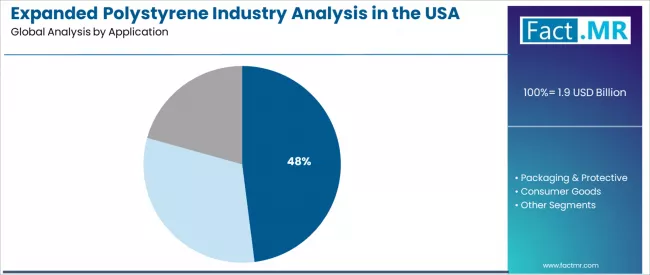
Expanded Polystyrene Industry Analysis In The Usa Analysis By Application | Source: Fact.MR
The building & insulation application segment is projected to account for 48.0% of USA expanded polystyrene demand in 2025, making it the leading application category across the sector. This dominance reflects the thermal performance requirements and energy efficiency needs of construction-grade expanded polystyrene for modern building applications and comprehensive insulation solutions where building performance is optimized through superior insulating capabilities and integrated construction architecture.
In the USA, where substantial construction and building infrastructure requires material integration without complete project redesign, building and insulation platforms provide practical pathways for energy enhancement while maintaining construction continuity. Continuous innovations are improving thermal performance, insulation response characteristics, and construction integration parameters, enabling builders to achieve high efficiency standards while maximizing project efficiency.
The segment's strong position is reinforced by the extensive existing construction infrastructure requiring material feature adoption and growing availability of building-grade suppliers with proven application experience.
- Construction compatibility and existing building integration make building and insulation platforms the preferred choice for enhancing construction projects and building performance installations.
- Reliability and thermal performance demonstration track records are enhancing builder confidence and material viability across large-scale adoption initiatives.
By Density, Low-density EPS Segment Accounts for 59.0% Share
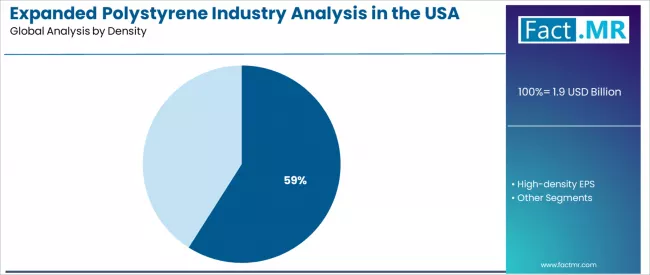
Expanded Polystyrene Industry Analysis In The Usa Analysis By Density | Source: Fact.MR
Low-density EPS applications are expected to represent 59.0% of USA expanded polystyrene demand in 2025, highlighting the critical importance of thermal efficiency requiring comprehensive insulation solutions for mass-market construction. Material manufacturers including construction firms, insulation contractors, and building product distributors generate consistent demand for low-density EPS that is technically and economically favorable for high-volume applications.
The segment benefits from material characteristics that often provide superior insulation efficiency compared to high-density alternatives, enabling energy savings and performance optimization. Low-density applications also access enhanced supply chain reliability through proven manufacturing that improves project planning and market competitiveness.
In the USA, where large-scale construction operations represent substantial portions of building development, construction excellence requires material integration across diverse project platforms. In Texas and Florida regions, where residential and commercial construction concentrations are significant, expanded polystyrene demand is elevated by emphasis on maintaining construction scale while achieving energy-efficiency targets.
- Thermal performance optimization and favorable application economics make this the largest density segment for expanded polystyrene technologies.
- Construction versatility and reliability demands drive consistent demand across major building contractors, insulation specialists, and construction product distributors.
What are the Drivers, Restraints, and Key Trends of the Expanded Polystyrene Industry?
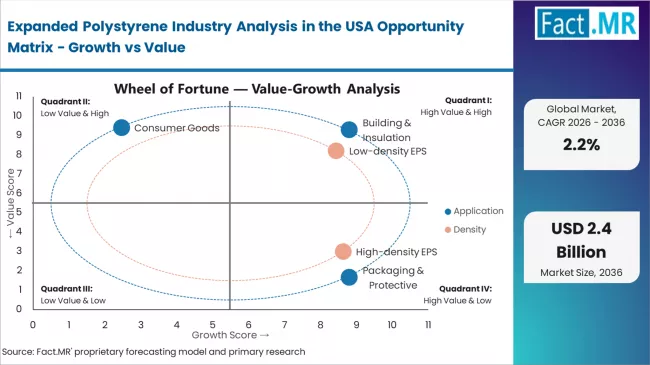
Expanded Polystyrene Industry Analysis In The Usa Opportunity Matrix Growth Vs Value | Source: Fact.MR
Regulatory compliance requirements and building efficiency standards initiatives, particularly energy code mandates and sustainability programs in South and Midwest regions, continue to influence expanded polystyrene selection and deployment timelines.
Expansion of Energy Efficiency Requirements and Green Building Standards
The enhancement of building performance standards, gaining particular significance through energy conservation regulations and sustainable construction adoption campaigns, is enabling expanded polystyrene suppliers to achieve differentiation without prohibitive material costs, providing predictable demand patterns through construction requirements and regulatory preferences. Enhanced building efficiency standards offering substantial opportunities for advanced expanded polystyrene systems and integrated applications provide foundational dynamics while allowing suppliers to secure construction contracts and development partnerships.
These trends are particularly valuable for first-mover suppliers and premium insulation development that require substantial innovation investments without immediate cost advantages.
Deployment of Advanced Manufacturing Technologies and Supply Chain Systems
Modern expanded polystyrene suppliers and construction manufacturers are establishing advanced distribution networks and centralized production facilities that improve manufacturing efficiency through material standardization and economies of scale. Integration of recycling systems, high-precision molding technology, and coordinated supply chain management enables more efficient production across multiple manufacturing locations.
Advanced manufacturing concepts also support next-generation construction applications including specialized building integration, industrial cluster optimization, and regional distribution networks that optimize system-level economics while enabling comprehensive quality monitoring across construction regions, with USA developments increasingly adopting collaborative production models to reduce individual operator costs and accelerate market adoption.
Region
.webp "Top Country Growth Comparison Expanded Polystyrene Industry Analysis In The Usa Cagr (2026 2036)")
Top Country Growth Comparison Expanded Polystyrene Industry Analysis In The Usa Cagr (2026 2036) | Source: Fact.MR
| Region | CAGR (2026-2036) |
|---|---|
| South | 2.50% |
| West | 2.30% |
| Midwest | 2.10% |
| Northeast | 1.90% |
Source: Fact.MR analysis. Updated Apr 6, 2026
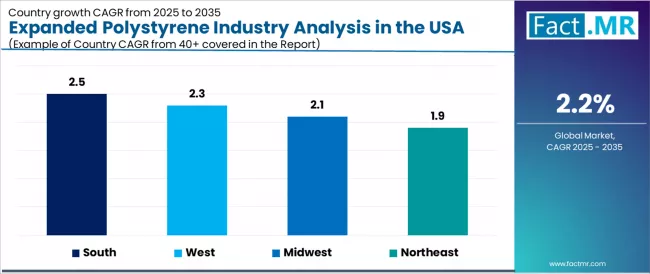
Expanded Polystyrene Industry Analysis In The Usa Cagr Analysis By Country | Source: Fact.MR
The USA expanded polystyrene demand is witnessing steady growth, supported by rising construction activity, expanding energy efficiency initiatives, and the deployment of advanced insulation technologies across regions. South leads the nation with a 2.5% CAGR, reflecting established construction infrastructure, substantial industrial development, and concentration of manufacturing facilities.
West follows with a 2.3% CAGR, driven by extensive green building programs, favorable regulatory environment, and concentration of innovative construction projects that enhance material application development. Midwest grows at 2.1%, as manufacturing expansion and packaging industry opportunities increasingly drive expanded polystyrene deployment. Northeast demonstrates growth at 1.9%, supported by specialized construction projects and regional building renovation initiatives.
South Leads National Growth with Construction and Industrial Excellence
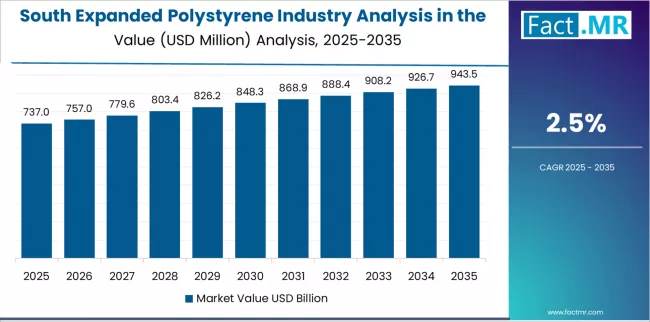
Expanded Polystyrene Industry Analysis In The Usa Country Value Analysis | Source: Fact.MR
Demand for expanded polystyrene in South is projected to exhibit solid growth with a CAGR of 2.5% through 2036, driven by established construction industry base, substantial manufacturing capabilities, and concentration of industrial expertise across Texas, Florida and surrounding states.
As the dominant region with extensive industrial infrastructure and growth-focused development policies, South's emphasis on comprehensive construction excellence and manufacturing leadership is creating significant demand for expanded polystyrene with proven performance and consistent quality potential. Major construction firms and packaging manufacturers are establishing comprehensive material programs to support project advancement and volume deployment across diverse building applications.
- Construction industry expansion and infrastructure development requirements are requiring comprehensive material strategies and insulation solutions, driving demand for expanded polystyrene with demonstrated thermal capabilities and permanent performance assurance throughout diverse construction operations.
- Industrial ecosystem strength and development capital availability are supporting deployment of next-generation manufacturing technologies and application pathways that enhance production viability, reduce material costs, and maintain market opportunities across commercial and residential applications, positioning South as a national construction and manufacturing leadership region.
West Demonstrates Strong Potential with Green Building Development
Demand for expanded polystyrene in West is expanding at a CAGR of 2.3%, supported by extensive environmental initiatives including energy efficiency programs, sustainable construction applications, and green building companies generating concentrated demand favorable for advanced material systems. The region's regulatory characteristics, featuring progressive building codes and sustainability requirements ideal for insulation positioning, provide market advantages.
Environmental expertise concentrated in California, Washington, and regional metropolitan corridors facilitates product innovation and performance differentiation. Expanded polystyrene suppliers and construction companies are implementing comprehensive sustainability strategies to serve expanding environmental requirements throughout West.
- Green building concentration and favorable regulatory environment are creating opportunities for specialized expanded polystyrene suppliers that can integrate material systems with existing construction operations.
- Sustainability positioning and performance standards are building regional competitive advantages in environmental applications, enabling comprehensive value development and green building cluster enhancement that meets regulatory targets while accessing premium pricing opportunities.
Midwest Shows Manufacturing Strength with Industrial Focus
Demand for expanded polystyrene in Midwest is growing at a CAGR of 2.1%, driven by substantial manufacturing operations from packaging production, industrial development, and regional construction companies requiring reliable material pathways.
The region's industrial base, supporting critical manufacturing operations, is increasingly adopting advanced material applications to maintain competitiveness while meeting cost expectations. Manufacturers and expanded polystyrene suppliers are investing in distribution systems and regional supply infrastructure to address growing production management requirements.
- Manufacturing imperatives and cost competitiveness concerns are facilitating adoption of expanded polystyrene technologies that enable continued operations while achieving performance enhancement across packaging production, industrial applications, and construction facilities.
- Supply optimization opportunities including regional distribution development and efficiency utilization for enhanced manufacturing operations are creating unique regional advantages and diversified application types throughout Midwest industrial operations.
Northeast Maintains Specialized Markets with Quality Focus
Demand for expanded polystyrene in Northeast is advancing at a CAGR of 1.9%, supported by specialized construction markets, regional building renovation development including premium residential and commercial applications, and growing emphasis on quality solutions across the region.
Construction quality standards and specialized building operations are driving consideration of expanded polystyrene as performance enhancement pathways. Construction firms and premium developers are developing regional capabilities to support emerging specialized deployment requirements.
- Specialized construction infrastructure and project diversification are creating economic drivers for quality technologies and expanded polystyrene deployment across premium and renovation facilities seeking competitive differentiation pathways.
- Regional construction cooperation and coordinated industry development are establishing consistent quality environments and shared innovation infrastructure that support multi-state quality projects throughout Northeast building operations.
Competitive Landscape of the Expanded Polystyrene Industry
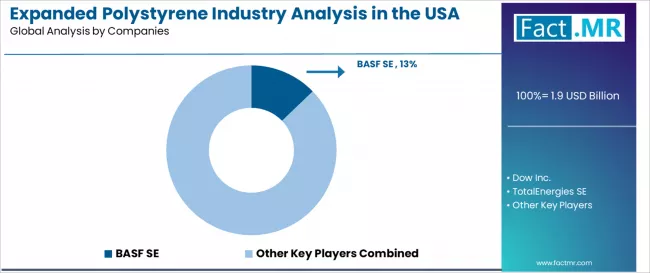
Expanded Polystyrene Industry Analysis In The Usa Analysis By Company | Source: Fact.MR
USA expanded polystyrene demand is defined by competition among specialized chemical manufacturers, material companies, and integrated solution providers, with major construction and industrial suppliers maintaining significant influence through production resources and application development capabilities. Companies are investing in expanded polystyrene advancement, manufacturing infrastructure optimization, quality assurance network structures, and comprehensive technical services to deliver effective, reliable, and scalable insulation solutions across USA construction, packaging, and industrial applications.
Strategic partnerships, production infrastructure development, and first-mover application execution are central to strengthening competitive positioning and presence across building-grade, packaging-grade, and specialty industrial applications.
BASF SE leads with 12.8% share, offering comprehensive expanded polystyrene solutions including manufacturing, technical support, and distribution services with focus on building and insulation applications, quality reliability, and thermal performance optimization across USA operations. Dow Inc., operating with extensive USA presence, provides integrated polystyrene solutions leveraging chemical expertise, application development, and construction management capabilities.
TotalEnergies SE delivers full-service expanded polystyrene production including technological development, performance optimization, and system integration serving USA and international construction markets. Braskem S.A. emphasizes comprehensive material solutions with integrated production capabilities, high-performance standards, and reliability features leveraging industrial sector expertise. Knauf Insulation GmbH offers expanded polystyrene application development and construction integration operations for building insulation and specialty applications across USA operations.
Key Players
- BASF SE
- Dow Inc.
- TotalEnergies SE
- Braskem S.A.
- Knauf Insulation GmbH
- ACH Foam Technologies, LLC
- JSP Corporation
- Sealed Air Corporation
- Alpek S.A.B. de C.V.
- Flint Hills Resources
- Nova Chemicals Corporation
Bibliography
- International Code Council. (2024). 2024 International Energy Conservation Code (IECC). ICC.
- EPS Industry Alliance. (2024). EPS production and recycling data report. EPS-IA.
- United States Census Bureau. (2024). Annual construction spending survey: Residential and commercial. U.S. Census Bureau.
- National Association of Home Builders. (2024). Housing starts and building permit trends. NAHB.
- California Department of Resources Recycling and Recovery. (2024). Polystyrene food packaging prohibition compliance report. CalRecycle.
This bibliography is provided for reader reference. The full Fact.MR report contains the complete reference list with primary research documentation.
This Report Addresses
- Market sizing and quantitative forecast metrics detailing expanded polystyrene expenditure across insulation, packaging, and civil engineering applications in the USA through 2036.
- Segmentation analysis mapping consumption patterns across application types, density grades, and product forms with sub-regional granularity.
- Sub-regional deployment intelligence comparing Sun Belt construction-driven growth against mature Northeast and Midwest replacement demand patterns.
- Regulatory impact assessment analyzing how state-level EPS foam bans and updated energy code thermal resistance requirements reshape product mix and capacity allocation.
- Competitive posture evaluation tracking styrene monomer sourcing strategies, regional manufacturing footprint optimization, and building material distribution network coverage.
- Capital project strategic guidance defining the grade-mix optimization and capacity rebalancing specifications required for EPS producers navigating a shifting demand profile.
- Custom data delivery formats encompassing interactive dashboards, raw Excel datasets, and comprehensive PDF narrative reports.
Expanded Polystyrene Industry Analysis in the USA Market Definition
Expanded polystyrene in the USA refers to the rigid cellular plastic manufactured by pre-expanding polystyrene beads with a pentane blowing agent and fusing them into blocks, sheets, or custom-molded shapes inside steam-heated molds. These products serve as thermal insulation in building construction, protective packaging for goods in transit, and structural fill in civil engineering applications. Primary purchasers include building material distributors, insulation contractors, packaging converters, and civil engineering firms.
Expanded Polystyrene Industry Analysis in the USA Market Inclusions
Market scope includes EPS insulation boards, molded protective packaging shapes, geofoam blocks for civil engineering, and decorative architectural molding profiles. Coverage extends to low-density and high-density product grades across blocks, sheets, and custom-molded forms. National and sub-regional market sizing is provided across the 2026 to 2036 forecast period.
Expanded Polystyrene Industry Analysis in the USA Market Exclusions
Extruded polystyrene foam board products manufactured through a continuous extrusion process are excluded. Expanded polypropylene packaging, raw polystyrene resin, and general-purpose polystyrene sheet are not covered. EPS recycling and regrind processing operations fall outside the analytical scope.
Expanded Polystyrene Industry Analysis in the USA Market Research Methodology
- Primary Research: Analysts engaged with EPS block molder operations managers, insulation contractor procurement leads, and building material distribution executives to map production volumes and specification upgrade cycles.
- Desk Research: Data collection phases aggregated residential and commercial construction permit databases, state-level EPS ban legislation trackers, and styrene monomer pricing indices from commodity reporting services.
- Market-Sizing and Forecasting: Baseline values derive from a bottom-up aggregation of EPS production shipment data and building insulation specification volumes, applying regional construction growth rates to project future demand.
- Data Validation and Update Cycle: Projections are tested against publicly reported polymer division revenues from leading chemical companies and cross-referenced with building permit and construction spending databases.
Segmentation
Scope of the Report
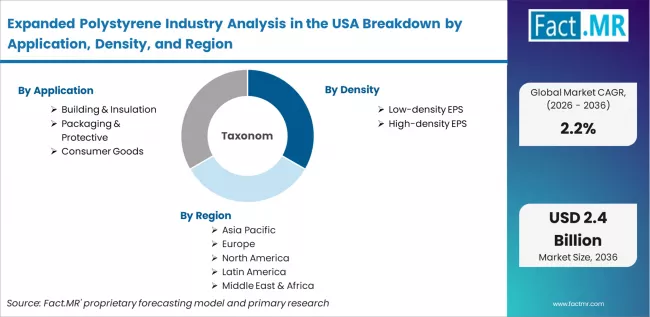
Expanded Polystyrene Industry Analysis In The Usa Breakdown By Application, Density, And Region | Source: Fact.MR
| Metric | Value |
|---|---|
| Quantitative Units | USD 1.89 billion to USD 2.35 billion, at a CAGR of 2.2% |
| Market Definition | Expanded Polystyrene Industry in the USA encompasses rigid cellular foam products manufactured by pre-expanding and molding polystyrene beads for thermal insulation, protective packaging, and civil engineering applications across the United States. |
| Application Segmentation | Building & Insulation, Packaging & Protective, Consumer Goods |
| Density Segmentation | Low-density EPS, High-density EPS |
| Form Segmentation | Blocks & Sheets, Molded Shapes |
| Regions Covered | South, Northeast, Midwest, West (USA sub-regions) |
| Countries Covered | United States (sub-regional analysis: South, Northeast, Midwest, West) |
| Key Companies Profiled | BASF SE, Dow Inc., TotalEnergies SE, Braskem S.A., Knauf Insulation GmbH, ACH Foam Technologies LLC, JSP Corporation, Sealed Air Corporation, Alpek S.A.B. de C.V., Flint Hills Resources, Nova Chemicals Corporation |
| Forecast Period | 2026 to 2036 |
| Approach | Forecasting models apply a bottom-up methodology starting with US EPS production shipment data and construction insulation specification volumes, projecting demand by application and density grade. |
Source: Fact.MR analysis. Updated Apr 6, 2026
Expanded Polystyrene Industry by Segments
Application:
- Building & Insulation
- Packaging & Protective
- Consumer Goods
Density:
- Low-density EPS
- High-density EPS
Form:
- Blocks & Sheets
- Molded Shapes
Region:
- West
- South
- Midwest
- Northeast
Frequently Asked Questions
How large is the demand for Expanded Polystyrene in the USA in 2026?
What will be the market size of Expanded Polystyrene in the USA by 2036?
What is the expected demand growth for Expanded Polystyrene in the USA between 2026 and 2036?
Which Application is poised to lead sales by 2026?
How significant is the role of Blocks & Sheets in Expanded Polystyrene consumption in 2026?
What is driving demand in the Southern USA?
What is Expanded Polystyrene and what is it mainly used for?
What is included in the scope of this report?
What is excluded from the scope of this report?
How does Fact.MR build and validate the Expanded Polystyrene forecast?
What does zero reliance on speculative third-party market research mean here?
Who worked on this report


Preview the report firsthand - request a free sample
Free SampleGet the brochure for pricing and purchase details
Download PDF