The Video Game Market is analyzed by platform, including mobile, console and PC, along with monetization, including free-to-play, premium and subscriptions, genre, and region, forecast 2026 to 2036.
By Fact.MR Consumer Goods DeskLead analyst:
Ayush RajPublished :
Updated :
15 min read
Fact-checked under the Fact.MR editorial process
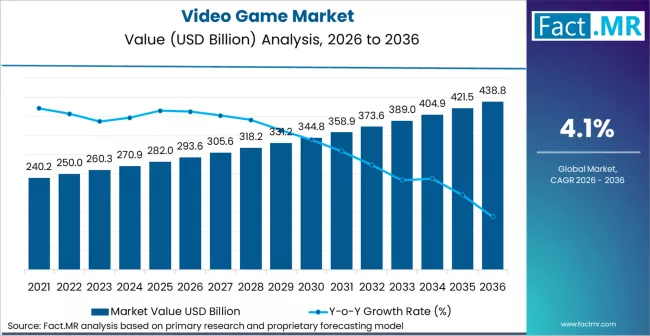
In 2025, the video game market was valued at USD 282 billion. Based on Fact MR's analysis, demand for video games is estimated to grow to USD 293.6 billion in 2026 and USD 437.3 billion by 2036. FMR projects a CAGR of 4.1% during the forecast period.
The absolute dollar growth from 2026 to 2036 is USD 143.7 billion. This growth is driven by the increasing popularity of gaming across various platforms, the rise of eSports, and the growing adoption of cloud gaming services. As the industry continues to innovate with advancements in gaming technology, including virtual reality (VR) and augmented reality (AR), the market is expected to see significant expansion. However, challenges such as market saturation in some regions and the increasing cost of game development may impact growth in certain areas.
As Ilkka Paananen, Chief Executive Officer of Supercell, noted regarding the video game market’s future and innovation, ‘I think it’s going to be a massive opportunity for everybody in the industry, both for incumbents like ourselves but also for start-ups.’
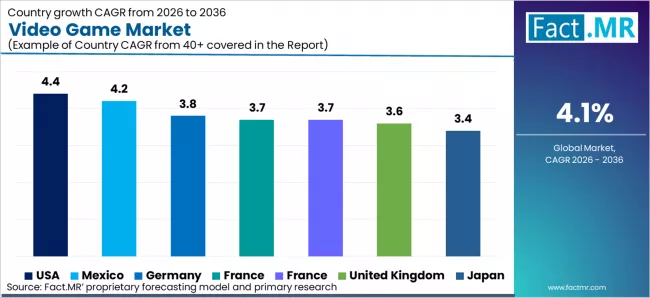
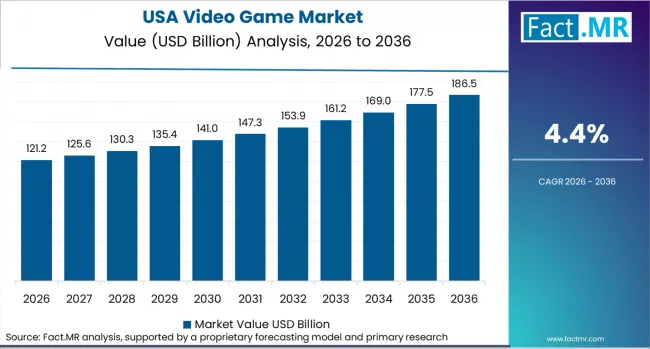
The USA leads with a CAGR of 4.4%, driven by a strong gaming community and steady demand for both console and PC gaming. Mexico follows with a 4.2% CAGR, fueled by expanding gaming infrastructure and increasing digital adoption. Germany grows at 3.8%, supported by strong gaming culture and eSports adoption in Europe. France grows at 3.7%, benefiting from a vibrant gaming industry and strong consumer interest in gaming content. South Korea shows a 3.7% growth rate, reflecting its dominance in the global gaming market, particularly in eSports. The UK grows at 3.6%, driven by a growing gaming culture and digital gaming platforms. Japan experiences slower growth at 3.4%, reflecting a mature market but ongoing demand for innovative gaming solutions.
Video Game Market Market Value Analysis | Source: Fact.MR
Video Game Market
Metric
Value
Estimated Value in (2026E)
USD 293.6 billion
Forecast Value in (2036F)
USD 437.3 billion
Forecast CAGR (2026 to 2036)
4.1%
Source: Fact.MR analysis. Updated Mar 5, 2026
Summary of the Video Game Market
Market Definition
The Video Game Market encompasses the development, publishing, and sale of video games and related services across various platforms such as mobile, console, and PC. This market is driven by growing consumer demand for interactive entertainment, advancements in gaming technology, and the increasing use of digital distribution and subscription models.
Demand Drivers
Proliferation of Mobile Gaming: Mobile gaming continues to dominate the market, driven by the widespread adoption of smartphones, accessibility of casual games, and the growth of in-app purchases.
Rising Popularity of eSports: The growth of eSports, with its increasing viewership and participation, is boosting the demand for competitive gaming and related content.
Adoption of Cloud Gaming: The rise of cloud gaming services, like Google Stadia and Microsoft’s Xbox Cloud Gaming, is changing the way players access and consume games, reducing the need for expensive hardware.
Innovation in Gaming Technology: Advancements in virtual reality (VR), augmented reality (AR), and next-generation consoles are enhancing the gaming experience, leading to stronger demand for new gaming experiences.
Key Segments Analyzed
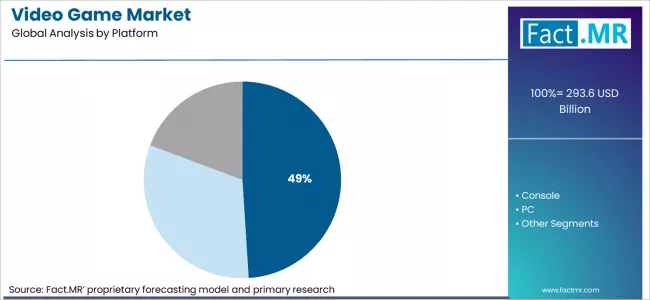
Platform: Mobile is expected to capture 49% of the market by 2026, driven by its convenience, accessibility, and the massive growth in mobile gaming.
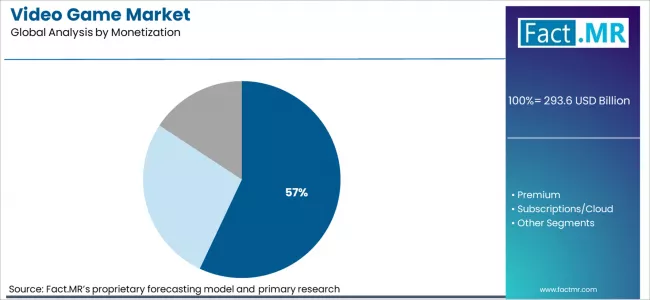
Monetization: F2P/IAP (Free-to-Play/In-App Purchases) is projected to dominate the monetization model with 57% of the market share in 2026.
Geography: The USA leads with a CAGR of 4.4%, followed by Mexico (4.2%) and Germany (3.8%).
Analyst Opinion at FMR
Shambhu Nath Jha, Principal Consultant at Fact MR, notes, "The video game market is in a strong growth phase, driven by technological innovations, the rise of mobile gaming, and the growing appeal of online multiplayer ecosystems. As the industry diversifies and new monetization strategies emerge, video games will continue to shape the entertainment landscape."
Strategic Implications/Executive Takeaways
Focus on Digital and Cloud Platforms: As cloud gaming becomes more prominent, companies should invest in cloud infrastructure and digital distribution channels to stay competitive.
Leverage Emerging Technologies: Explore opportunities in VR, AR, and immersive gaming experiences to appeal to tech-savvy gamers and remain at the forefront of industry trends.
Engage with eSports and Live Services: Expanding into the eSports and live service model can help capture the growing interest in competitive gaming and extend the longevity of gaming titles.
Methodology
Primary research through interviews with game developers, publishers, platform operators, and industry analysts.
Data sourced from industry reports, platform usage statistics, and trade association publications.
Market sizing and forecasting using a hybrid model combining top-down industry demand with bottom-up game-specific revenue data.
Video Game Market Definition
The Video Game Market involves the development, publishing, and sale of video games and related services across platforms such as consoles, PCs, and mobile devices, driven by consumer demand for interactive digital entertainment.
Market Inclusions
This report covers global and regional market sizes for the video game market over a defined forecast period, including segments by platform (console, PC, mobile), game type (AAA, indie, esports titles), distribution model (digital, physical), and revenue streams (sell‑through, subscriptions, in‑game purchases).
Market Exclusions
The scope excludes unrelated entertainment sectors (film, music) and consumer hardware sales not specific to video game use (general‑purpose PCs, unrelated electronics). It also omits non‑game software and services outside gaming ecosystems.
Research Methodology
Primary Research: Interviews were conducted with game developers, publishers, platform operators, and industry analysts.
Desk Research: Data was sourced from industry reports, platform usage statistics, and trade association publications.
Market‑Sizing and Forecasting: A hybrid model combining top‑down entertainment market forecasts with bottom‑up game‑specific revenue data was used.
Data Validation and Update Cycle: Findings were validated through expert review and aligned with recent production, adoption, and revenue figures.
Segmental Analysis
Video Game Market Analysis by Platform
Video Game Market Analysis By Platform | Source: Fact.MR
Market Overview: Mobile is expected to capture 49% of the video game market by 2026. Mobile gaming continues to grow rapidly due to the increasing adoption of smartphones, the development of more engaging games, and the ease of access that mobile platforms provide to a wide range of players.
Demand Drivers:
Accessibility and Convenience: Mobile gaming offers unmatched accessibility, as smartphones are ubiquitous. This has led to an explosion in casual gaming, with players able to enjoy games anytime and anywhere, which is a key factor driving the mobile gaming sector.
Frequent Game Updates and Multiplayer Features: Mobile games often feature regular updates, multiplayer modes, and social integration, keeping players engaged. This frequent interaction drives long-term player retention and revenue generation through in-app purchases (IAP) and other monetization strategies.
Growing Casual Gaming Audience: The rise of mobile gaming has brought in a broader, more casual gaming audience, expanding the market beyond traditional gamers. This demographic shift has contributed to the dominance of mobile as a key platform in the industry.
Video Game Market Analysis by Monetization
Video Game Market Analysis By Monetization | Source: Fact.MR
Market Overview: F2P/IAP (Free-to-Play/In-App Purchases) is projected to hold 57% of the market share by 2026. The F2P model, in which the game is free to download and play but generates revenue through in-app purchases, has become the dominant monetization strategy, especially on mobile and online platforms.
Demand Drivers:
Wide Appeal of Free-to-Play Model: The F2P model attracts a larger audience, as players can download and start playing without any initial cost. This low barrier to entry encourages more players to try the game, which increases the potential for revenue through in-app purchases.
Microtransactions and Player Customization: In-app purchases, such as cosmetic items, upgrades, or premium content, allow developers to monetize their games effectively without requiring players to make large upfront payments. This model has proven successful in driving recurring revenue from players.
Increased Mobile Gaming and Microtransactions: The rise of mobile gaming, where F2P games dominate, has significantly boosted the use of IAP as the primary monetization model. Popular games like Fortnite and PUBG Mobile have set benchmarks for successful F2P models that incorporate in-game purchases and season passes.
Video Game Market Drivers, Restraints, and Opportunities
FMR analysts observe that the video game market is a growth‑aligned, entertainment‑centric segment propelled by the proliferation of connected devices, expanding gamer demographics, and increasing integration of immersive technologies. Historically rooted in console and PC gaming, the industry has structurally expanded as mobile gaming, cloud streaming, and cross‑platform play lowered barriers to entry and broadened consumer participation across age groups and global regions. The 2026 valuation reflects this shift, with ongoing monetization strategies such as in‑game purchases, subscriptions, and live service models anchoring revenue growth even as hardware sales fluctuate with generational cycles.
While demand for traditional boxed console titles remains substantial, growth is increasingly driven by digital distribution, free‑to‑play mobile games, and online multiplayer ecosystems that generate recurring engagement and revenue. These digital and service‑oriented models often command higher lifetime value per user, contributing to net market value growth even where unit sales of hardware or packaged games grow modestly. The market exists at its current size because video games serve both entertainment and social engagement needs and continue to intersect with broader media and technology trends.
Digital & Live Services Growth: Expansion of downloadable content, in‑game purchases, subscriptions, and live service models increases monetization beyond one‑time game sales.
Technology & Immersion Trends: Adoption of cloud streaming, AR/VR, and high‑fidelity graphics drives demand for new game experiences that replace basic, linear titles.
Regional Market Dynamics: Asia‑Pacific leads in user base and mobile gaming revenue, while North America and Europe show strong engagement in premium and console segments.
Regional Analysis
The market analysis covers key global regions, including North America, Western Europe, East Asia, and Latin America. It is segmented geographically, with specific market dynamics for each region. The full report provides a detailed market attractiveness analysis.
Video Game Market Cagr Analysis By Country | Source: Fact.MR
Video Games Market CAGR Table
Country
CAGR (2026-2036)
USA
4.4%
Mexico
4.2%
Germany
3.8%
France
3.7%
South Korea
3.7%
United Kingdom
3.6%
Japan
3.4%
Source: Fact.MR analysis. Updated Mar 5, 2026
Source: Fact MR (FMR) analysis, based on proprietary forecasting model and primary research.
North America:
Video Game Market Country Value Analysis | Source: Fact.MR
In North America, the USA leads the demand for video games, supported by the growing gaming community, increasing investments in gaming content, and technological advancements in gaming hardware and software.
USA: Demand for video games in the U.S. is projected to rise at 4.4% CAGR through 2036. The USA’s large gaming market, rapid advancements in gaming technology, and growing popularity of mobile and cloud gaming continue to drive the market's expansion.
Mexico: Demand for video games in Mexico is projected to rise at 4.2% CAGR through 2036. Mexico’s rising gaming population and increased access to gaming consoles and mobile platforms contribute to steady market growth.
Western Europe:
In Western Europe, Germany and France are key markets for video games, driven by a strong gaming culture, high digital adoption, and increasing investments in the gaming ecosystem.
Germany: Demand for video games in Germany is projected to rise at 3.8% CAGR through 2036. Germany’s strong gaming industry, growing mobile gaming sector, and focus on eSports continue to fuel the market’s growth.
France: Demand for video games in France is projected to rise at 3.7% CAGR through 2036. France’s expanding gaming community and increased demand for gaming hardware and digital content continue to contribute to market expansion.
United Kingdom: Demand for video games in the UK is projected to rise at 3.6% CAGR through 2036. The UK’s strong gaming culture and growing interest in online gaming and eSports continue to support steady demand for video games.
East Asia:
In East Asia, South Korea and Japan are leading markets for video games, driven by high gaming penetration, technological advancements in gaming platforms, and a strong gaming culture.
South Korea: Demand for video games in South Korea is projected to rise at 3.7% CAGR through 2036. South Korea’s advanced gaming industry, growing popularity of eSports, and high gaming device adoption continue to support market growth.
Japan: Demand for video games in Japan is projected to rise at 3.4% CAGR through 2036. Japan’s leading role in gaming innovation and expanding mobile gaming market continue to contribute to steady market expansion.
Fact MR's analysis of the Video Game Market in North America, Western Europe, East Asia, and Latin America consists of country-wise assessments that include the USA, Mexico, Germany, France, South Korea, the United Kingdom, and Japan. Readers can find detailed trends, regulatory updates, and company-specific investments shaping the market’s growth in these countries.
Competitive Landscape
Video Game Market Analysis By Company | Source: Fact.MR
How Are Key Players Competing in the Video Game Market?
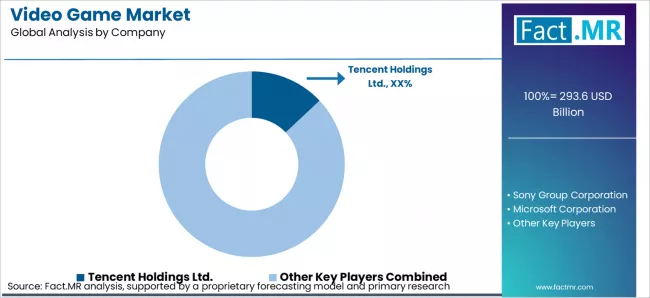
In the highly competitive video game market, major companies like Tencent, Sony, and Microsoft are engaged in a fierce battle for dominance through game development, distribution, and gaming platforms. Tencent leads in China, with a significant stake in major game studios like Riot Games (League of Legends) and Epic Games (Fortnite), while Sony and Microsoft focus on their flagship consoles, PlayStation and Xbox, respectively. Both companies are expanding into digital gaming services, with Sony offering PlayStation Now and Microsoft investing in Xbox Game Pass for subscription-based gaming. Nintendo continues to thrive with its innovative gaming consoles, such as the Switch. Activision Blizzard and Electronic Arts (EA) lead in game development, producing hit franchises like Call of Duty and FIFA, while Ubisoft stays competitive with a diverse game portfolio. Additionally, NetEase and Take-Two Interactive continue to carve niches in online gaming and sports games, respectively. With the rise of cloud gaming, Microsoft and Sony are investing in new technologies to stay ahead. Companies also strive for market share by acquiring smaller studios and developing exclusive content, further intensifying the competition in the video game industry.
Recent Industry Developments
Nintendo Switch 2 Early 2026 Lineup
Following its mid-2025 launch, the Nintendo Switch 2 enters March 2026 with a robust software calendar featuring Pokémon Pokopia (March 5) and Monster Hunter Stories 3: Twisted Reflection (March 13). The month concludes with a major "Switch 2 Edition" of Super Mario Bros. Wonder on March 26, featuring a new playable area called Bellabel Park.
Sony PlayStation 5 Hardware Milestone
Sony reported in February 2026 that the PlayStation 5 has reached 92.2 million units sold globally, officially surpassing the lifetime sales of the PlayStation 3. Despite a moderate decline in year-over-year hardware units, Sony achieved record third-quarter operating income of 510 billion yen, driven by record-high software revenue and network services.
Microsoft Xbox Strategy Pivot
Microsoft’s Q2 FY2026 earnings revealed a 32% drop in Xbox hardware revenue, prompting a strategic shift toward cloud and digital subscriptions. While console sales have slowed, Microsoft CFO Amy Hood noted that Game Pass revenue is expected to grow in Q3, helping to offset the hardware decline as the brand leans further into its multi-platform "content-first" model.
Key Players of the Video Game Market
Tencent Holdings Ltd.
Sony Group Corporation
Microsoft Corporation
Nintendo Co., Ltd.
Activision Blizzard, Inc.
NetEase, Inc.
Electronic Arts Inc.
Take-Two Interactive Software, Inc.
Ubisoft Entertainment SA
Sea Limited (Garena)
Report Scope
Metric
Value
Quantitative Units
USD 293.6 billion (2026) to USD 437.3 billion (2036), at a CAGR of 4.1%
Market Definition
The Video Game Market includes the development, distribution, and monetization of video games across various platforms including mobile, console, and PC, with a variety of monetization strategies.
North America, Latin America, Europe, East Asia, South Asia, Oceania, Middle East and Africa
Countries Covered
United States, Canada, Mexico, Brazil, Argentina, Germany, France, United Kingdom, Italy, Spain, China, India, Japan, South Korea, Indonesia, Australia, and 40+ countries
Key Companies Profiled
Tencent Holdings Ltd., Sony Group Corporation, Microsoft Corporation, Nintendo Co., Ltd., Activision Blizzard, Inc., NetEase, Inc., Electronic Arts Inc., Take-Two Interactive Software, Inc., Ubisoft Entertainment SA, Sea Limited (Garena)
Forecast Period
2026 to 2036
Approach
Hybrid top-down and bottom-up market modeling validated through primary interviews with manufacturers and supported by trade data benchmarking and market research.
Source: Fact.MR analysis. Updated Mar 5, 2026
Bibliographies
Activision Blizzard, Inc. (2025). Game development portfolio including major franchises and live-service titles. Activision Blizzard, Inc.
Microsoft Corporation. (2025). Xbox platform, cloud gaming services, and subscription ecosystem developments. Microsoft Corporation.
Nintendo Co., Ltd. (2025). Nintendo Switch platform and first-party game development strategy. Nintendo Co., Ltd.
Sony Group Corporation. (2025). PlayStation platform and digital gaming services expansion. Sony Group Corporation.
Tencent Holdings Ltd. (2025). Global gaming investments and online game publishing operations. Tencent Holdings Ltd.
Nintendo Life. (2026, March). Upcoming Nintendo Switch 2 game lineup and accessory releases for early 2026 [Industry coverage]. Nintendo Life.
Windows Central. (2026, January/February). Xbox revenue trends and strategic positioning amid first-party release cycle changes [Industry analysis]. Windows Central.
This report addresses:
Market Intelligence enabling comprehensive assessment of leading countries and service segments across the Video Game Market globally.
Market Volume (Sales Units) estimates and 10-year revenue forecasts from 2026 to 2036, validated through platform operator surveys, game publisher reports, and country-level demand modeling.
Growth Opportunity Mapping across platform categories (Mobile, Console, PC), monetization models (F2P/IAP, Premium, Subscriptions/Cloud), and regions.
Segment and Regional Revenue Forecasts by platform, monetization model, genre, and geography across 40+ countries.
Competition Strategy Analysis covering game developers, platform operators, recent developments, product portfolio, USPs, and market share analysis.
Monetization Model and Regulatory Compliance Tracking aligned with gaming industry standards, platform requirements, and regional regulations.
Regulatory Impact Analysis addressing global market compliance, technological advancements in gaming platforms, and evolving monetization strategies.
Report Delivery in PDF, Excel, PowerPoint, and interactive dashboard formats for executive, procurement, and operational planning use.
Market Breakdown
Segmentation
Video Game Market Key Segments
Platform :
Mobile
Console
PC
Monetization :
F2P/IAP
Premium
Subscriptions/Cloud
Genre :
Action/Adventure
Casual/Puzzle
Shooter/MMO
Sports/Others
Region :
North America
USA
Canada
Mexico
Europe
Germany
UK
France
Italy
Spain
Nordic Countries
BENELUX
Rest of Europe
Asia Pacific
China
Japan
South Korea
India
Australia
Rest of Asia Pacific
Latin America
Brazil
Argentina
Rest of Latin America
Middle East and Africa
Kingdom of Saudi Arabia
United Arab Emirates
South Africa
Rest of Middle East and Africa
Other Regions
Oceania
Central Asia
Other Markets
Questions Answered
Frequently Asked Questions
How large is the demand for Video Games in the global market in 2026?
Demand for Video Games in the global market is estimated to be valued at USD 293.6 billion in 2026.
What will be the market size of Video Games in the global market by 2036?
The market size for Video Games is projected to reach USD 437.3 billion by 2036.
What is the expected demand growth for Video Games in the global market between 2026 and 2036?
Demand for Video Games in the global market is expected to grow at a CAGR of 4.1% between 2026 and 2036.
Which monetization model is expected to dominate the market?
F2P (Free-to-Play)/IAP (In-App Purchases) is expected to dominate the market, accounting for 57% of the market share in 2026, due to the increasing popularity of mobile and online games that allow players to play for free and generate revenue through in-game purchases.
Which region is expected to show the highest growth rate for Video Games?
Mexico is projected to show the highest regional CAGR at 4.2% during the forecast period, driven by the expanding gaming market, increasing internet penetration, and rising disposable incomes.
How significant is the growth outlook for the USA in this market?
The United States is expected to grow at a CAGR of 4.4%, supported by its large gaming market, continued demand for gaming consoles, mobile games, and digital gaming content, as well as advancements in gaming technology.
What is the growth outlook for Germany in the Video Game market?
Germany is expected to grow at a CAGR of 3.8%, driven by increasing demand for online and mobile games, a growing esports community, and an expanding gaming industry.
What is the growth forecast for France in the Video Game market?
France is expected to grow at a CAGR of 3.7%, reflecting strong consumer demand for video games, an expanding gaming culture, and the growth of esports and mobile gaming.
What is the growth forecast for South Korea in the Video Game market?
South Korea is expected to grow at a CAGR of 3.7%, fueled by its strong gaming industry, a leading esports culture, and the increasing popularity of online and mobile gaming.
What is the growth forecast for the United Kingdom in the Video Game market?
The United Kingdom is expected to grow at a CAGR of 3.6%, driven by the demand for interactive and online gaming experiences, along with rising interest in esports and mobile games.
What is the growth forecast for Japan in the Video Game market?
Japan is expected to grow at a CAGR of 3.4%, with a strong legacy of console gaming and mobile game development, alongside an expanding gaming culture and increasing global influence.
Which company is identified as a leading player in the Video Game market?
Tencent Holdings Ltd. is recognized as a leading player in this market, dominating the gaming sector through a combination of game development, publishing, and strategic investments in various game studios worldwide.
What is the F2P/IAP model used in video games?
The F2P (Free-to-Play)/IAP (In-App Purchases) model allows players to download and play a game for free, while monetizing through optional in-game purchases, such as virtual goods, upgrades, and other content. This model is widely used in mobile gaming and online multiplayer games.
What does the Video Game market include in this report?
The market scope includes video games across all platforms (mobile, console, PC) and monetization models, with a primary focus on F2P/IAP games, which make up a significant portion of the market share, especially in mobile and online gaming.
How is the market forecast developed in this report?
The forecast is developed using historical data on gaming trends, the growing adoption of mobile gaming, shifts in monetization models, consumer behavior, and insights from key industry players in game development and publishing.
What is meant by the Video Game market in this report?
The market refers to the global production, trade, and consumption of video games, focusing on F2P/IAP monetization models and the growing popularity of mobile, console, and online gaming across various regions and demographics.