- Market Value (2025): USD 771.1 Mn
- Estimated Value (2026): USD 815.0 Mn
- Forecast Value (2036): USD 1418.8 Mn
- CAGR (2026-2036): 5.7%
What is the Pneumatic Rollers Market forecast to be worth by 2036?
USD 1,418.8 million by 2036 at a CAGR of 5.7%.
- The market reached USD 771.1 million in 2025.
- Market value is forecast to rise from USD 815.0 million in 2026 to USD 1,418.8 million in 2036.
- Demand is forecast to expand at a 5.7% CAGR from 2026 to 2036.
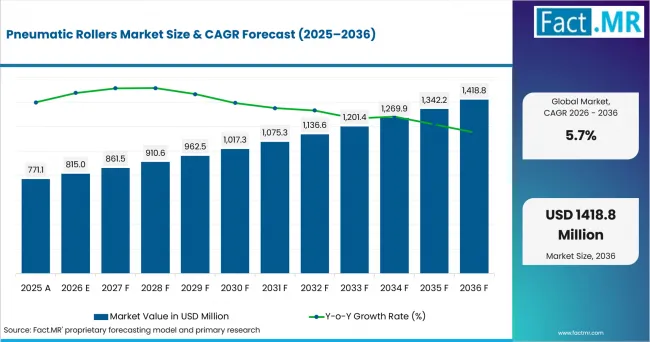
Pneumatic Rollers Market Value Analysis | Source: Fact.MR
What are the defining numbers behind Pneumatic Rollers Market growth?
The market is expected to generate an absolute opportunity of USD 603.8 million between 2026 and 2036.
- Demand Drivers in the Market
- Highway rehabilitation and resurfacing programs create recurring demand for compaction after asphalt placement. FHWA construction guidance places pneumatic-tired rollers within the rolling sequence used to build density, while sustained road renewal expands work for asphalt pavers and the compactors that follow them.
- Density, surface sealing and smoothness requirements support pneumatic rolling on suitable asphalt mixtures. AASHTO operator training treats pneumatic rollers as a distinct compaction option, and Asphalt Institute guidance notes that rubber-tired rolling can provide kneading and sealing action where specifications and mix design permit it.
- Adjustable ballast and tire pressure make one machine usable across a wider range of layer thicknesses and compaction targets. Caterpillar and HAMM product documentation shows that operating weight, wheel load and tire pressure can be varied to tune compaction force, increasing the utility of pneumatic units within the wider road rollers fleet.
- Replacement demand is also influenced by non-road diesel emissions rules. U.S. EPA Tier 4 requirements and the European Union Stage V framework push fleets toward compliant engines and aftertreatment systems, affecting replacement decisions across construction equipment.
- Project-based fleet planning supports rental as well as ownership. Contractors can align machine weight and width with project duration rather than carrying underutilized capacity between jobs, supporting demand for compactor rental on short-cycle paving and civil works.
- Key Segments Analyzed
- Engine Capacity: Up to 100 HP is projected to hold 56.8% of the segment in 2026, supported by its fit with municipal roads, maintenance works and civil projects where transportability, maneuverability and economical fleet use matter.
- Operating Capacity: Up to 8000 KG is projected to hold 28.7% in 2026, reflecting demand for light-duty machines that are easier to mobilize and practical for confined road, shoulder and repair assignments.
- Drum Width: Up to 1800 mm is projected to hold 39.0% in 2026. Narrower compaction widths fit urban streets, lane edges and patching work where operators need close control beside curbs and adjacent structures.
- End Use: Construction Contractors are projected to hold 47.6% in 2026 because contractors directly manage paver and roller sequencing, density targets, mobilization schedules and equipment utilization across projects.
- Analyst Opinion at Fact.MR
- - Shambhu Nath Jha, Principal Consultant, Fact.MR ~ “Pneumatic roller demand is becoming more closely tied to the quality and economics of the rolling window. Buyers are looking beyond nominal machine weight to tire-pressure control, ballast flexibility, temperature management, pass consistency and fleet utilization. Suppliers that make those variables easier to control on mixed road-maintenance workloads will be better positioned as rehabilitation activity increases.”
- Strategic Implications
- Manufacturers should prioritize adjustable ballast, practical tire-pressure control and broad operating-weight windows so one platform can cover more mix and layer conditions without forcing contractors into oversized fleets.
- Contractors should size pneumatic rollers against paver output, lane geometry, lift thickness and the available rolling window. Matching width and wheel load to the job can reduce excess passes and lower the risk of uneven density.
- Pass-count, temperature, location and machine-utilization data can strengthen quality control when integrated into fleet management, particularly on large resurfacing programs that require repeatable rolling patterns.
- Dealer support, parts availability and project-based access remain commercially important because paving stoppages are costly. This creates room for suppliers and fleet owners to connect uptime services with equipment rental programs rather than relying only on outright machine sales.
How does the Pneumatic Rollers Market break down by segment?
The market is segmented by Engine Capacity, Operating Capacity, Drum Width and End Use.
Why does Up to 100 HP lead Engine Capacity?
Up to 100 HP is projected to account for a 56.8% share of Engine Capacity in 2026.
This class aligns with the recurring workload of local-road resurfacing, parking areas, shoulders and general civil construction, where contractors need compaction force without the transport and operating burden of higher-power machines. Lower-power units are also easier to place in mixed fleets that move frequently between short-duration sites.
The commercial advantage is utilization rather than maximum output. Contractors can assign these rollers to more maintenance and urban jobs, where lane length is shorter and maneuverability has greater value than peak engine power.
Why does Up to 8000 KG lead Operating Capacity?
Up to 8000 KG is projected to account for a 28.7% share of Operating Capacity in 2026.
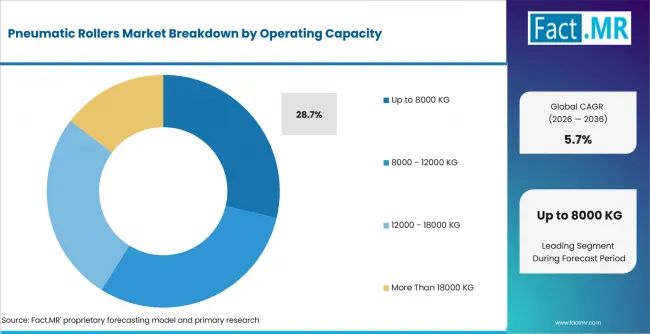
Pneumatic Rollers Market Analysis By Operating Capacity | Source: Fact.MR
Light-duty pneumatic rollers fit maintenance, patching, shoulder work and smaller civil projects where frequent machine transport and tight working areas are common. The lower base weight also gives contractors room to use ballast selectively instead of mobilizing a heavier machine for every assignment.
Caterpillar lists the CW16 with a base operating weight of about 5.2 tonnes and adjustable ballast, illustrating how a lighter pneumatic platform can be configured for different compaction requirements while remaining practical for smaller sites.
Why does Up to 1800 mm lead Drum Width?
Up to 1800 mm is projected to account for a 39.0% share of Drum Width in 2026.
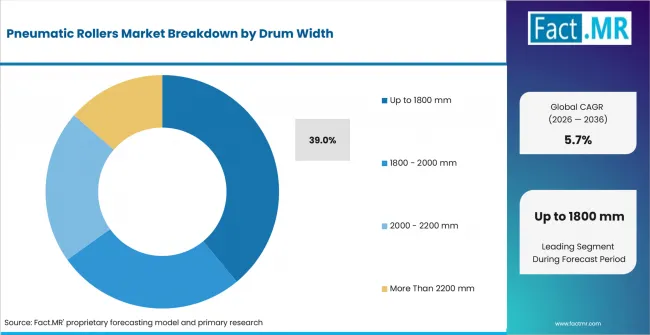
Pneumatic Rollers Market Analysis By Drum Width | Source: Fact.MR
Narrower working widths are useful on urban streets, shoulders, access roads and patch repairs because operators can compact close to curbs, joints and lane edges with less overlap. They also suit project layouts where full-width highway rollers are difficult to maneuver.
The Caterpillar CW16 is offered with a standard compaction width of 1,754 mm, providing a practical example of the sub-1800 mm configuration used for controlled coverage on confined paving jobs.
Why do Construction Contractors lead End Use?
Construction Contractors are projected to account for a 28.0% share of End Use in 2026.
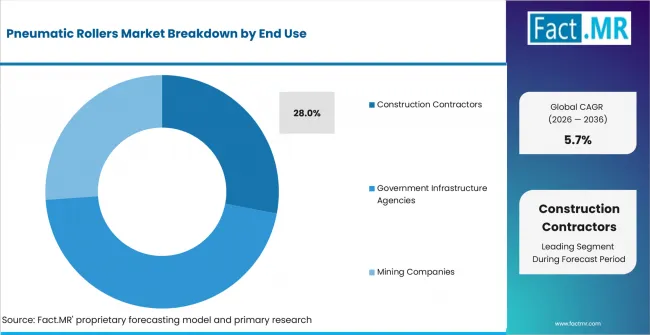
Pneumatic Rollers Market Analysis By End Use | Source: Fact.MR
Contractors control day-to-day paving productivity and are accountable for matching roller patterns to mix temperature, density targets and paver speed. That operational responsibility makes pneumatic rollers a direct fleet decision rather than an incidental purchase tied only to public-agency ownership.
The segment also benefits from contractors working across road rehabilitation, civil engineering and private construction. A roller that can be reballasted or adjusted for tire pressure can move between these workloads, improving annual utilization and supporting both ownership and rental procurement.
What is accelerating Pneumatic Rollers Market adoption, and what is holding it back?Adoption is being accelerated by recurring road rehabilitation, asphalt quality requirements, adjustable compaction systems and the need to replace older non-road diesel fleets. Growth is moderated by high capital cost, uneven utilization between projects, tire pickup or mix-compatibility limits on selected asphalt formulations, and the added cost of emissions-compliant powertrains and aftertreatment. Drivers Impact Analysis Factor (~) % Impact on CAGR Geographic Relevance Impact Timeline Highway rehabilitation and resurfacing programs +1.3% USA, Germany, Japan and France Short term (2 years or less) Asphalt density and surface-quality requirements +0.9% Global Short term (2 years or less) Flexible ballast and tire-pressure control +0.6% Global Medium term (2-4 years) Replacement of older diesel construction fleets +0.4% USA and Europe Medium term (2-4 years) Contractor demand for versatile compaction fleets +0.3% Global Long term (4 years or more) Opportunity Impact Analysis Factor (~) % Impact on CAGR Geographic Relevance Impact Timeline Preventive maintenance of aging road assets +0.8% Germany, Japan, France and USA Medium term (2-4 years) Pass-count, temperature and location monitoring +0.6% North America, Europe and East Asia Medium term (2-4 years) Expressway expansion and urban road upgrades +0.5% South Korea and selected global markets Short term (2 years or less) Rental and project-based fleet deployment +0.4% Global Long term (4 years or more) Restraints Impact Analysis Factor (~) % Impact on CAGR Geographic Relevance Impact Timeline High capital cost and uneven contractor utilization -0.7% Global Short term (2 years or less) Tire pickup or mix-compatibility limits -0.5% Global Short term (2 years or less) Diesel engine emissions compliance and aftertreatment cost -0.4% USA and Europe Medium term (2-4 years) Steel, rubber and hydraulic component cost pressure -0.3% Global Medium term (2-4 years)
Adoption is being accelerated by recurring road rehabilitation, asphalt quality requirements, adjustable compaction systems and the need to replace older non-road diesel fleets. Growth is moderated by high capital cost, uneven utilization between projects, tire pickup or mix-compatibility limits on selected asphalt formulations, and the added cost of emissions-compliant powertrains and aftertreatment.
Drivers Impact Analysis
| Factor | (~) % Impact on CAGR | Geographic Relevance | Impact Timeline |
|---|---|---|---|
| Highway rehabilitation and resurfacing programs | +1.3% | USA, Germany, Japan and France | Short term (2 years or less) |
| Asphalt density and surface-quality requirements | +0.9% | Global | Short term (2 years or less) |
| Flexible ballast and tire-pressure control | +0.6% | Global | Medium term (2-4 years) |
| Replacement of older diesel construction fleets | +0.4% | USA and Europe | Medium term (2-4 years) |
| Contractor demand for versatile compaction fleets | +0.3% | Global | Long term (4 years or more) |
Source: Fact.MR analysis. Updated Aug 26, 2026
Opportunity Impact Analysis
| Factor | (~) % Impact on CAGR | Geographic Relevance | Impact Timeline |
|---|---|---|---|
| Preventive maintenance of aging road assets | +0.8% | Germany, Japan, France and USA | Medium term (2-4 years) |
| Pass-count, temperature and location monitoring | +0.6% | North America, Europe and East Asia | Medium term (2-4 years) |
| Expressway expansion and urban road upgrades | +0.5% | South Korea and selected global markets | Short term (2 years or less) |
| Rental and project-based fleet deployment | +0.4% | Global | Long term (4 years or more) |
Source: Fact.MR analysis. Updated Aug 26, 2026
Restraints Impact Analysis
| Factor | (~) % Impact on CAGR | Geographic Relevance | Impact Timeline |
|---|---|---|---|
| High capital cost and uneven contractor utilization | -0.7% | Global | Short term (2 years or less) |
| Tire pickup or mix-compatibility limits | -0.5% | Global | Short term (2 years or less) |
| Diesel engine emissions compliance and aftertreatment cost | -0.4% | USA and Europe | Medium term (2-4 years) |
| Steel, rubber and hydraulic component cost pressure | -0.3% | Global | Medium term (2-4 years) |
Source: Fact.MR analysis. Updated Aug 26, 2026
Which countries are scaling the Pneumatic Rollers Market through 2036?
- USA: Bridge and highway rehabilitation programs keep resurfacing and pavement renewal active, sustaining contractor use of compaction equipment across federal, state and local road work.
- Germany: Federal transport planning gives substantial weight to road preservation, while Autobahn rehabilitation continues across bridge, tunnel and pavement assets that require recurring civil and paving work.
- South Korea: Expressway construction and expansion create multi-year paving requirements, with Korea Expressway Corporation listing 17 routes under construction or expansion totaling 430.6 km.
- Japan: Aging road assets and a preventive-maintenance approach support recurring pavement and structural rehabilitation, creating steady demand for controllable compaction equipment on maintenance projects.
- France: National transport planning continues to emphasize maintenance, regeneration and modernization of the road network, supporting resurfacing and renewal work rather than relying only on new-road construction.
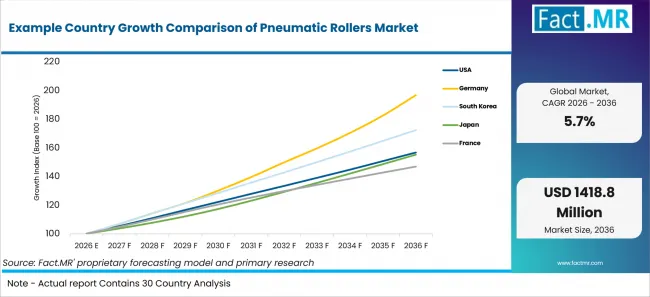
Example Country Growth Comparison Of Pneumatic Rollers Market | Source: Fact.MR
Country CAGR (2026-2036)
| Country | CAGR (2026-2036) |
|---|---|
| USA | 4.6% |
| Germany | 7.0% |
| South Korea | 5.6% |
| Japan | 4.5% |
| France | 3.9% |
Source: Fact.MR analysis. Updated Aug 26, 2026
What is driving USA's growth through 2036?
The USA is forecast to expand at a 4.6% CAGR from 2026 to 2036.
FHWA budget estimates for fiscal 2026 include continued Bridge Formula Program funding for bridge replacement, rehabilitation, preservation and construction. Bridge work commonly brings approach-road, deck and connecting-pavement activity that keeps asphalt placement and compaction equipment in contractor fleets.
The U.S. Department of Transportation also continues to track Infrastructure Investment and Jobs Act obligations and outlays, showing that multi-year federal transport funding remains in execution. For pneumatic rollers, the purchase mechanism is recurring resurfacing and rehabilitation work rather than a single project cycle.
What is driving Germany's growth through 2036?
Germany is forecast to expand at a 7.0% CAGR from 2026 to 2036.
Germany’s Federal Ministry of Transport places road preservation at the center of its 2025-2029 investment framework. Preservation-heavy spending translates into repeated pavement renewal, bridge approaches and corridor rehabilitation, all of which require compacted asphalt or granular layers.
Autobahn GmbH has also highlighted additional resources for urgent rehabilitation of bridges, tunnels and road surfaces. This favors pneumatic rollers with flexible operating weight because contractors can move the same platform across maintenance packages with different layer conditions.
What is driving South Korea's growth through 2036?
South Korea is forecast to expand at a 5.6% CAGR from 2026 to 2036.
Korea Expressway Corporation lists 17 expressway routes under construction or expansion totaling 430.6 km, with several project schedules extending beyond 2026. New lanes, junction works and corridor expansion create direct paving and compaction requirements over multiple construction seasons.
The Republic of Korea’s 2026 budget proposal also increases planned spending for social overhead capital by 7.9%. The combination of active expressway packages and continued transport investment supports demand for rollers that can be shifted between new-build sections and rehabilitation work.
What is driving Japan's growth through 2036?
Japan is forecast to expand at a 4.5% CAGR from 2026 to 2036.
Japan’s Ministry of Land, Infrastructure, Transport and Tourism has documented the aging profile of road assets, including a projection that the share of bridges more than 50 years old rises from 34% in 2022 to 59% by 2032. That aging curve increases the need for preventive maintenance, rehabilitation and associated pavement renewal.
The ministry’s Roads in Japan 2026 material continues to emphasize asset management, disaster resilience and advanced road technologies. These programs favor compact, controllable equipment that can deliver repeatable density on maintenance projects where work zones and access are constrained.
What is driving France's growth through 2036?
France is forecast to expand at a 3.9% CAGR from 2026 to 2036.
The 2025 Ambition France Transports work emphasizes the need to maintain and regenerate national transport infrastructure and the cost of deferring road maintenance. For pneumatic rollers, this supports recurring resurfacing and renewal rather than demand being dependent on major new-road projects.
The Conseil d’orientation des infrastructures also calls for stronger maintenance, regeneration and modernization of the non-concession national road network. A steady rehabilitation program supports contractor demand for rollers that can be transported between projects and adjusted for different pavement conditions.
Who Leads the Pneumatic Rollers Market?
Key players in the Pneumatic Rollers Market include Caterpillar Inc, Volvo Construction Equipment Corporation, Dynapac AB, Ammann Group, Bomag GmbH, Hamm AG, XCMG Construction Machinery Co. Ltd, Case Construction Equipment Inc., Sany Group Co Ltd and VT LeeBoy Inc.
Competition is shaped by operating-weight flexibility, compaction width, tire-pressure control, pickup prevention, operator visibility, emissions compliance and service coverage. These attributes influence whether a machine can move efficiently between highway, municipal and general civil assignments without excessive reconfiguration.
Caterpillar’s current CW34 specification illustrates the breadth suppliers pursue: modular ballast, a wide operating-weight range, optional air-on-the-run tire-pressure adjustment and jobsite data functions such as pass count, temperature and positioning. HAMM’s pneumatic series similarly emphasizes adjustable ballasting and control of wheel load, tire pressure and speed as key compaction variables.
Regional parts availability, tire support, trained service and dealer response also affect fleet decisions because paving operations are sensitive to downtime. Suppliers that combine machine adaptability with dependable field support can improve contractor utilization across seasonal roadwork.
Which companies are the key providers?
Key providers include Caterpillar Inc, Volvo Construction Equipment Corporation, Dynapac AB, Ammann Group, Bomag GmbH, Hamm AG, XCMG Construction Machinery Co. Ltd, Case Construction Equipment Inc., Sany Group Co Ltd and VT LeeBoy Inc.
- Caterpillar Inc.
- Volvo Construction Equipment Corporation
- Dynapac AB
- Ammann Group
- Bomag GmbH
- Hamm AG
- XCMG Construction Machinery Co. Ltd.
- Case Construction Equipment Inc.
- Sany Group Co. Ltd.
- VT LeeBoy Inc
Bibliography
- American Association of State Highway and Transportation Officials. (2024). Asphalt Compaction Basics for Roller Operators. AASHTO.
- Asphalt Institute. (n.d.). Engineering FAQs. Asphalt Institute.
- Autobahn GmbH des Bundes. (2025). 1,1 Milliarden Euro sind ein klares Signal für mehr Tempo bei der Sanierung. Autobahn GmbH des Bundes.
- Caterpillar Inc. (n.d.). CW16 Pneumatic Rollers. Caterpillar Inc.
- Caterpillar Inc. (n.d.). CW34 Pneumatic Rollers. Caterpillar Inc.
- Conseil d’orientation des infrastructures. (2026). Grands projets: le temps des choix. Ministry for Ecological Transition, France.
- European Commission. (n.d.). Emissions from Non-Road Mobile Machinery. Directorate-General for Internal Market, Industry, Entrepreneurship and SMEs.
- Federal Highway Administration. (1998). Principles of Construction of Quality Hot-Mix Asphalt Pavements: Inspectors’ Training Course Manual. U.S. Department of Transportation.
- Federal Highway Administration. (2025). Budget Estimates Fiscal Year 2026. U.S. Department of Transportation.
- Federal Ministry of Transport, Germany. (2026). Investment Framework Plan 2025-2029 for Federal Transport Infrastructure. Federal Ministry of Transport.
- HAMM AG. (n.d.). Intelligent Ballasting: Optimum Compaction Quality through Even Weight Distribution. Wirtgen Group.
- Korea Expressway Corporation. (2026). Routes Under Construction. Korea Expressway Corporation.
- Ministry of Finance and Economy, Republic of Korea. (2025). 2026 Budget Proposal. Government of the Republic of Korea.
- Ministry of Land, Infrastructure, Transport and Tourism, Japan. (2023). Roads in Japan 2023. Government of Japan.
- Ministry of Land, Infrastructure, Transport and Tourism, Japan. (2026). Roads in Japan 2026. Government of Japan.
- Ministry for Ecological Transition, France. (2025). Ambition France Transports. Government of France.
- U.S. Department of Transportation. (2026). Infrastructure Investment and Jobs Act Funding Status. U.S. Department of Transportation.
- U.S. Environmental Protection Agency. (2026). Regulations for Emissions from Heavy Equipment with Compression-Ignition Engines. U.S. Environmental Protection Agency.
This Report Answers
- How large is the Pneumatic Rollers Market in 2026 and what value is forecast for 2036?
- Which engine-capacity, operating-capacity, drum-width and end-use categories account for the leading 2026 shares?
- Which road-investment, compaction-quality and fleet-replacement factors are shaping demand through 2036?
- How are USA, Germany, South Korea, Japan and France expected to develop over the forecast period?
- Which companies are active in pneumatic rollers and which product capabilities are influencing competition?
What does the Pneumatic Rollers Market cover?
The market covers complete self-propelled pneumatic-tire rollers and compactors supplied for asphalt, aggregate and stabilized-soil compaction across the specified engine-capacity, operating-capacity, drum-width and end-use categories. It includes machines purchased or deployed by construction contractors, government infrastructure agencies and mining companies for road, civil and heavy-earthwork assignments.
What is included in the scope?
Included revenue covers complete pneumatic roller machines, including integral tire systems, ballast systems and onboard machine-control functions sold as part of the equipment.
The scope includes new-machine demand across all supplied engine, operating-capacity, drum-width and end-use classifications.
What is excluded from the scope?
The scope excludes vibratory tandem rollers, single-drum soil compactors, plate compactors, rammers, roller attachments and standalone aftermarket revenue from tires, telematics subscriptions, spare parts or maintenance services when these are sold separately from a complete pneumatic roller.
How Was the Analysis Built?
The analysis combines primary research with structured desk research to assess complete-machine demand across manufacturers, dealers, rental operators, road contractors, civil engineering firms, public works and transport agencies, and mining or heavy-earthwork users.
- Primary Research: Interviews and market checks focus on equipment managers, paving and compaction supervisors, procurement teams, dealer and rental personnel, service specialists and infrastructure buyers. Discussion areas include replacement timing, roller utilization, preferred operating weight, tire-pressure practices, width selection and procurement routes.
- Desk Research: The assessment reviews government road and bridge programs, expressway project pipelines, asphalt compaction guidance, non-road emissions regulations and manufacturer product portfolios. These inputs are used to test whether demand mechanisms are consistent with observed roadwork and fleet behavior.
- Market Sizing and Forecasting: Sizing considers machine shipments and pricing, engine and operating-weight mix, compaction-width mix, replacement cycles, road construction and resurfacing activity, rental utilization and the timing of country-level infrastructure programs.
- Data Validation and Updates: Findings are checked against product specifications, emissions rules, public infrastructure plans, rehabilitation schedules and changes in contractor fleet requirements. The forecast is updated when these inputs materially alter equipment demand or the mix of machines deployed.
Segmentation
What is the report's scope and coverage?
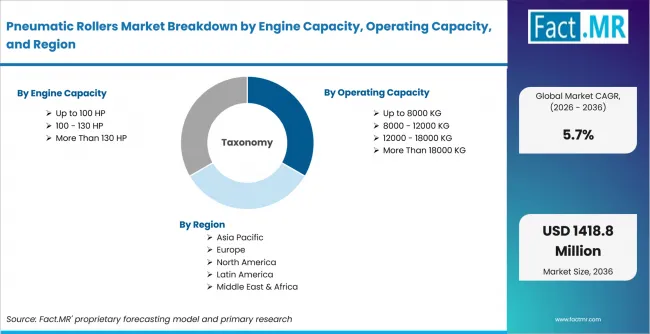
Pneumatic Rollers Market Breakdown By Engine Capacity, Operating Capacity, And Region | Source: Fact.MR
| Parameter | Coverage |
|---|---|
| Quantitative Units | USD million |
| Market Definition | Self-propelled pneumatic-tire rollers and compactors supplied for asphalt, aggregate and stabilized-soil compaction across the specified categories and end uses |
| Segments Covered | Engine Capacity; Operating Capacity; Drum Width; End Use |
| Regions Covered | North America; Europe; East Asia |
| Countries Covered | USA; Germany; South Korea; Japan; France |
| Key Companies Profiled | Caterpillar Inc; Volvo Construction Equipment Corporation; Dynapac AB; Ammann Group; Bomag GmbH; Hamm AG; XCMG Construction Machinery Co. Ltd; Case Construction Equipment Inc.; Sany Group Co Ltd; VT LeeBoy Inc. |
| Forecast Period | 2026 to 2036 |
| Base Year | 2025 |
| Market Value, 2026 | USD 815.0 million |
| Market Value, 2036 | USD 1,418.8 million |
| CAGR, 2026-2036 | 5.7% |
| Absolute Opportunity | USD 603.8 million |
| Approach | Hybrid top-down and bottom-up approach using equipment shipments and pricing, road construction and maintenance activity, product mix, replacement cycles, end-user procurement and country-level infrastructure pipelines |
Source: Fact.MR analysis. Updated Aug 26, 2026
How is the market segmented?
-
By Engine Capacity
- Up to 100 HP
- Compact Pneumatic Rollers
- 100 - 130 HP
- Mid Capacity Pneumatic Rollers
- More Than 130 HP
- High Capacity Pneumatic Rollers
- Up to 100 HP
-
By Operating Capacity
- Up to 8000 KG
- Light Duty Rollers
- 8000 - 12000 KG
- Medium Duty Rollers
- 12000 - 18000 KG
- Heavy Duty Rollers
- More Than 18000 KG
- Extra Heavy Duty Rollers
- Up to 8000 KG
-
By Drum Width
- Up to 1800 mm
- Narrow Drum Rollers
- 1800 - 2000 mm
- Standard Drum Rollers
- 2000 - 2200 mm
- Wide Drum Rollers
- More Than 2200 mm
- Extra Wide Drum Rollers
- Up to 1800 mm
-
By End Use
- Construction Contractors
- Civil Engineering Firms
- Private Construction Companies
- Government Infrastructure Agencies
- Transport Departments
- Public Works Departments
- Mining Companies
- Surface Mining Operators
- Heavy Earthwork Contractors
- Construction Contractors
-
By Region:
- North America
- Latin America
- Western Europe
- Eastern Europe
- East Asia
- South Asia and Pacific
- Middle East & Africa
Frequently Asked Questions
What is the Pneumatic Rollers Market value in 2026?
At what CAGR is the Pneumatic Rollers Market forecast to grow from 2026 to 2036?
What value is the Pneumatic Rollers Market projected to reach by 2036?
Which Engine Capacity category leads the market in 2026?
Which Operating Capacity category leads the market in 2026?
Which Drum Width category leads the market in 2026?
Which End Use category leads the market in 2026?
What CAGR is forecast for Germany from 2026 to 2036?
Which companies are included in the competitive landscape?
Who worked on this report


Preview the report firsthand - request a free sample
Free SampleGet the brochure for pricing and purchase details
Download PDF