- Base Value(2024): Bn
- Estimated Value(2025): 3.4 Bn
- Forecast Value (2035): 5.6 Bn
- CAGR (2025 - 2035): 5.2%
Soccer Goalkeeper Gloves Market Outlook 2025 to 2035
The global soccer goalkeeper gloves market is on track for significant growth, forecast to reach USD 5.6 billion by 2035, up from USD 3.4 billion in 2025, at a CAGR of 5.2%.
Soccer’s position as the world’s most popular sport ensures a massive and constantly renewing pool of goalkeepers at both the amateur and professional levels each requiring high-quality gloves tailored to their role, environment and budget.
This enduring appeal is supported by expanding grassroots programs rising youth and women’s participation increased televised coverage and the global proliferation of club and academy systems.
As clubs and retailers innovate and invest in technology, sustainability, training and digital sales, the goalkeeper gloves market stands out as a robust, value-driven segment in sporting goods.
Quick Stats on Soccer Goalkeeper Gloves Market
- Soccer Goalkeeper Gloves Market Size (2025): USD 3.4 billion
- Projected Soccer Goalkeeper Gloves Market Size (2035): USD 5.6 billion
- Forecast CAGR of Soccer Goalkeeper Gloves Market (2025 to 2035): 5.2%
- Leading Glove Type Segment of Soccer Goalkeeper Gloves Market: Match Gloves
- Leading End User Segment of Soccer Goalkeeper Gloves Market: Professional Players
- Key Growth Regions of Soccer Goalkeeper Gloves Market: United States, China, Germany
- Prominent Players in the Soccer Goalkeeper Gloves Market: Adidas, Nike, Puma, Uhlsport, Reusch and Select
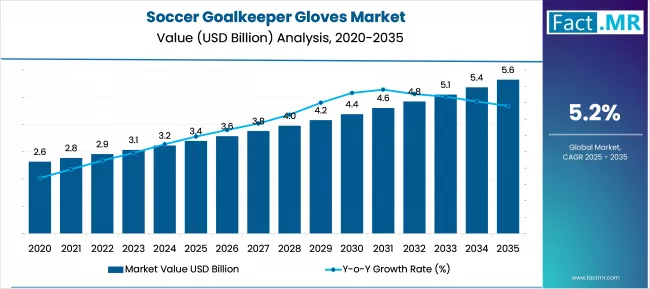
Soccer Goalkeeper Gloves Market Market Value Analysis | Source: Fact.MR
| Metric | Value |
|---|---|
| Industry Size (2025E) | USD 3.4 billion |
| Industry Size (2035F) | USD 5.6 billion |
| CAGR (2025-2035) | 5.2% |
Source: Fact.MR analysis. Updated Sep 17, 2025
The global soccer goalkeeper gloves market is positioned for steady expansion, with industry size projected to grow from USD 3.4 billion in 2025 to USD 5.6 billion by 2035, reflecting a CAGR of 5.2%. This trajectory highlights a blend of cultural, structural, and technological factors that make goalkeeper gloves a resilient niche within the wider sports equipment industry.
One of the major forces driving this growth is the rising global participation in soccer, especially at the grassroots and youth academy levels. Regions such as North America, China, and India are witnessing accelerated adoption of the sport, supported by government programs, club culture, and professional leagues. This creates consistent demand for entry-level gloves for training and academy use, as well as premium, high-performance gloves for competitive and professional play.
Technological innovations in glove design are enhancing product appeal. Manufacturers are integrating advanced latex blends, hybrid cuts, moisture-control fabrics, and finger protection technologies that cater to both performance and safety. The willingness of consumers to invest in premium match gloves reinforces the market’s growth momentum.
Additionally, sustainability trends are shaping glove development, with leading brands experimenting with eco-friendly materials and biodegradable components to appeal to environmentally conscious buyers.
E-commerce is another structural growth pillar, enabling wide availability and consumer access. Direct-to-consumer (DTC) brands and sports-specific platforms are reshaping purchasing behavior, with personalization, app-based sizing, and limited-edition pro-endorsed gloves gaining popularity.
The soccer goalkeeper gloves market is expected to expand steadily over the next decade, supported by the convergence of increasing soccer participation, innovation-led product development, and evolving consumer preferences. The balance between performance, personalization, and sustainability will define competitive differentiation in this growing segment.
Analyzing Key Dynamics of the Soccer Goalkeeper Gloves Market
The global soccer goalkeeper gloves market is driven by rising soccer participation, technological innovations, and evolving consumer preferences for performance, safety, and personalization. Growth is propelled by grassroots programs, urban mini-pitch developments, and increased female and youth participation worldwide.
Advanced glove designs, incorporating grip compounds, moisture-wicking fabrics, ergonomic fits, and protective features, are reshaping the buying landscape. Digital marketing, e-commerce, and international tournaments further accelerate demand and create seasonal sales surges.
However, the market faces several challenges, including balancing affordability with profitability amid competitive and fast-fashion trends, supply chain instability, regulatory compliance costs, limited affordability in developing regions, the proliferation of counterfeit products, and the need for consumer education on sizing, cuts, and maintenance. Addressing these challenges while leveraging innovation and digital platforms is crucial for sustained market growth and profitability.
Expanding Global Soccer Ecosystem as a Catalyst for Goalkeeper Glove Demand
Soccer is a unique global phenomenon, with passionate followings in nearly every country and a steady wave of institutional support whether in the form of international federations, national associations, school and youth leagues, or private club and academy investments.
The goalkeeping position, with its high visibility, specialized requirements, and make-or-break impact on game outcomes, demands advanced, protective, and confidence-boosting gloves.
The increase in grassroots programming and urban mini-pitch development is rapidly introducing the game to new demographics, from underprivileged urban youth in Latin America and North America to female and school-age players worldwide.
Technological Advancements and Personalization Driving Consumer Choices
Glove makers continually introduce improved grip compounds, moisture-wick and antibacterial linings, breathable mesh panels, and tailored fits for every hand shape and age. The desire for personalization, comfort, durability, and branded or professional-endorsed options, sometimes now offered even in small batches through online portals, is reshaping the buying landscape.
Parental and coaching concern around hand and finger protection especially in young or developmental leagues remains a strong driver for adoption of gloves with spines, extra padding, and certified materials.
Tournament-Driven Consumption and Digital Market Expansion
Evolution of football as an entertainment product has intensified competition and driven sales during international tournaments. Kit launches and fresh glove models often coincide with the World Cup, Euro, Asian Cup, Copa America, or major domestic leagues, creating regular sales surges and brand moments. E-commerce and digital marketing allow brands to launch, promote, and distribute new lines worldwide in real time, directly to players.
Balancing Affordability with Profitability Amid Intense Competition and Fast Fashion Trends
Producers who want to make money while keeping prices low for the mass market face constant challenges from high-stakes competition, counterfeit duplication, and rising material costs.
Even though demand is always strong, rapidly changing style cycles make it hard to keep prices in check and profit margins high. This is especially true when digital sales platforms make discounting and fast glove trends more popular.
Supply Chain Instability and Regulatory Compliance Impacting Production Costs
When premium latex production is unstable, polymer materials get stuck, or shipping routes aren't reliable, it can cause stock-outs or higher landed costs, which cuts into the profits of both brands and distributors.
Certification and compliance with safety regulations (toxins, seams, padding) are always changing, and brands need to spend money on research, development, and regulatory teams to ensure institutional and school customers can easily access their products, especially in areas where compliance is strict.
Limited Affordability in Developing Markets and Threat of Counterfeit Products
In developing markets, even aggressive price points can remain out of reach for many, limiting the total addressable market until local wages or discretionary income catch up.
Meanwhile, counterfeits sold via online marketplaces or informal channels, which often use low-quality materials and lack protection certifications, threaten both brand reputation and consumer safety.
Consumer Education Gaps and Challenges in E-Commerce Fitting Experiences
Educating new buyers, especially about hand sizing, cut differences such as negative, roll, hybrid, flat, and the care and maintenance required for latex gloves, remains a challenge amid the e-commerce boom, where trial and in-person fitting experiences are less common. Niche competitors investing in digital content, AR fitting apps, and glove wizard chatbots are addressing this, but coverage is still uneven.
Country-Wise Outlook
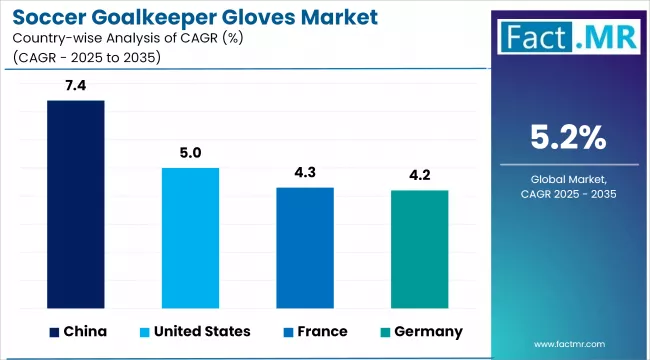
Soccer Goalkeeper Gloves Market Cagr Analysis By Country | Source: Fact.MR
| Countries | CAGR (2025-2035) |
|---|---|
| United States | 5.0% |
| China | 7.4% |
| Germany | 4.2% |
Source: Fact.MR analysis. Updated Sep 17, 2025
United States Soccer Goalkeeper Gloves Market Shows Sustained Momentum with Deep Club Culture and Homegrown Innovation
The United States, spurred by a unique blend of club, high school, collegiate, and professional soccer, is now a global top five soccer economy. The fast-growing landscape of youth academies, pay-to-play leagues, and rising female participation (including the world’s most successful women’s national team) underpin strong, consistent demand. U.S. consumers are early adopters of premium goods, branded match gloves, custom fits, or pro-endorsed limited releases, often spending significantly above the global average on kit and personalization.
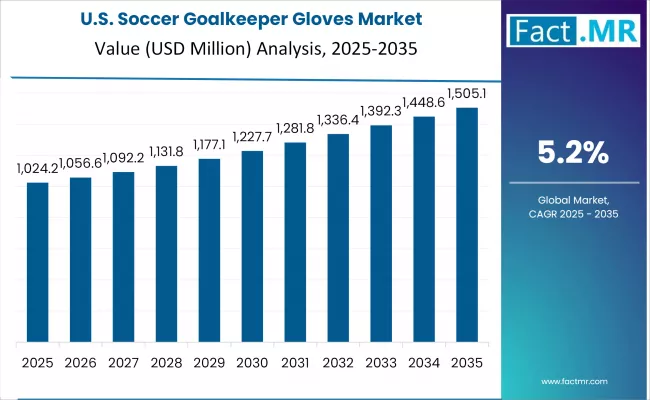
Soccer Goalkeeper Gloves Market Country Value Analysis | Source: Fact.MR
American innovation is shaping the market: several glove DTC startups have emerged offering home try-on kits, app-based sizing, and personalized grip tracking. Traditional big-box retailers (Dick’s Sporting Goods, Soccer.com) are joined by boutique outlets and regional chains, all stocking everything from $20 youth multipacks for beginners to $180 pro match series. Many clubs and schools are buying in bulk online, with contracts for suppliers that are timed to the school year and tournament cycles.
More focus on concussion protocols and player safety makes finger protection and shock-absorbing features even more important, especially for youth and high school programs. Bold colors, school/team branding, and "match the shoe" aesthetics are all design trends in the U.S. that show how much people want to be creative and unique on the field. Brand ambassadors, who are usually college or USL-level goalkeepers, use TikTok, Instagram and YouTube clinics to promote new products.
- U.S. market growth is anchored in its diverse soccer ecosystem spanning clubs, schools, and professional leagues
- Innovation through DTC startups and personalized glove technologies differentiates the U.S. landscape
- High consumer willingness to spend on customization and safety features fuels sustained demand
China Soccer Goalkeeper Gloves Market Advances Rapidly with State-Led Football Investment and Aspirational Consumer Growth
Government-driven investment in football infrastructure, massive school outreach, and a stated goal to become a world soccer superpower put China on a uniquely rapid growth trajectory. Chinese clubs, municipal leagues, and national training centers purchase goalkeeper gloves in massive lots, supporting domestic manufacturing in cities such as Qingdao and Guangzhou.
The national appetite for soccer, propelled by improvements in professional leagues (including foreign player recruitment), has created a vibrant middle class of players buying specialty gloves online and offline. Leading domestic brands compete aggressively with Adidas, Nike, and PUMA in both entry and elite price points, while club merchandising includes signature gloves for fans. National and TV-endorsed campaigns around fitness, safety, and “healthy children” drive institutional demand, especially in first- and second-tier city schools. Urban professionals increasingly buy premium gloves for their children, eager for overseas design and certification.
China’s policy focus on green manufacturing means recycled materials and traceable latex certifications are highlighted by the most successful domestic exporters, anticipating Western buyer standards and EU market regulations. Digital commerce, live-stream shopping, and influencer tie-ins further accelerate the speed of market penetration.
- State-backed investment and nationwide school programs underpin China’s rapid market growth
- A rising middle class and urban professionals drive aspirational purchases of premium gloves
- Green manufacturing and digital-first retail strategies position China strongly in both domestic and export markets
Germany Soccer Goalkeeper Gloves Market Delivers Reliability and Premium Experience via Heritage Engineering and Club Alliances
German soccer culture centers goalkeepers as both club icons and development priorities, driving a stable demand for well-crafted, durable, and eco-aware products. More than 25,000 registered clubs and a robust youth system consistently upgrade and replace gear seasonally, typically via regional club buying groups or local pro shops. Partnerships and co-branded glove deals are common, Bundesliga and Bundesliga 2 clubs offer “junior” versions of pro-endorsed gloves as part of academy welcome kits. German consumers at all ages are well-educated about cuts, fits, and the importance of latex/palm care.
Leading brands invest heavily in R&D with local universities (Darmstadt, Munich, Berlin) collaborating on palm durability, grip, and hand biomechanics. Germany’s green ethos is visible in leading brands’ certifications (Blue Angel, FSC, Oeko-Tex), use of non-toxic dyes, and “plastic-off” strategies for both gloves and packaging. Digital transformation is underway: while many players still prefer in-store fitting and traditional advice, AR fitting mirrors and smart sizing apps are being piloted in metropolitan sporting goods chains.
The national DFB’s close collaboration with equipment providers ensures regular laboratory testing for new cut and padding technologies, making Germany both a steady home base and R&D hub for global leader brands. This makes the country an innovation driver while retaining its heritage of quality and reliability.
- Strong club culture and structured youth programs sustain long-term glove demand in Germany
- Heavy R&D investment and collaborations with universities position Germany as an innovation hub
- Sustainability certifications and eco-friendly production align with consumer and regulatory priorities
Competitive Analysis
Adidas, Nike, Puma, Uhlsport, Reusch and Select are the biggest companies in the world market. They all have their own grip technologies, patented palm designs, exclusive pro contracts, and aggressive digital marketing. Uhlsport's long history in the Bundesliga, Reusch's legacy in Serie A, and Adidas/Nike's visibility in the Champions League set global trends for style, color, and function every season.
Challenger brands like Sells, Rinat, One Glove and HO Soccer are growing thanks to partnerships with influencers, selling directly to players, tech-forward designs (like palms with chips and AR fit guides) and messages about being eco-friendly. These disruptors often offer value runners gloves that are close to pro quality but much cheaper than well-known brands and made to be personalized.
Asian manufacturers, especially in China, Pakistan, and Vietnam, power both branded and white-label production for local and global players. European hand-made, boutique runs remain the choice for bespoke pro and collector lines but represent a small slice of the market.
Distribution is becoming “phygital”: brands leverage club deals for mega-orders, while also offering rapid e-commerce deliveries and subscription packs for individuals. Seasonal product launches, influencer challenge contests, and digitally driven limited drops (NFT or blockchain authenticated) round out marketing innovation. Innovation ecosystems are fostered by exclusive R&D partnerships and high-velocity copycatting ensures that even niche tech migrates quickly across brands.
Segmentation
Analyzing Key Segments of the Soccer Goalkeeper Gloves Market
The global soccer goalkeeper gloves market is primarily shaped by player preferences for performance, material quality, and professional influence. Among glove types, match gloves dominate due to their superior grip and reliability in competitive play. In terms of materials, latex gloves hold the lead, driven by their unmatched ball control and continuous improvements in durability.
From an end-user perspective, professional players drive demand, as their needs dictate innovation and influence purchasing behavior across other player segments. Together, these factors establish the market’s direction, with performance and professional endorsement acting as key growth catalysts.
Match Gloves Dominate Owing to Their High Preference Among Professional and Amateur Players
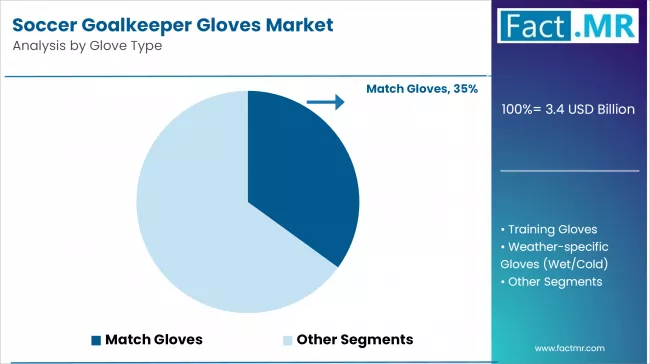
Soccer Goalkeeper Gloves Market Analysis By Glove Type | Source: Fact.MR
Match gloves remain the most widely used type, as they are specifically designed for actual gameplay and provide the highest level of grip, comfort, and control. Professional players and serious amateurs consistently choose match gloves over training or hybrid options due to their advanced latex palms and superior fit.
Their demand is further driven by technological innovations, such as moisture-resistant materials and enhanced shock absorption, which make them reliable across competitive environments.
- Match gloves are the first choice for both professional and semi-professional players due to grip and performance
- Continuous innovations in palm latex and glove ergonomics strengthen their dominance
- Rising player participation in organized tournaments and leagues boosts their demand
Latex Gloves Lead the Market Because of Their Superior Grip and Performance Features
Latex gloves are the most dominant material category as they provide unmatched ball control, grip, and responsiveness, making them the preferred choice in competitive matches. Despite higher wear-and-tear compared to synthetics, players continue to favor latex for its performance benefits during professional play.
Premium variations, such as German contact latex and aqua latex, have further enhanced durability and maintained latex’s leading position in the goalkeeper glove segment.
- Latex gloves dominate as they offer superior grip and ball-handling benefits
- New latex blends are improving durability, addressing one of latex’s biggest drawbacks
- Professional endorsements and brand marketing campaigns heavily feature latex gloves, reinforcing demand
Professional Players Drive the Market as They Prioritize High-Performance Gloves Over Other Segments
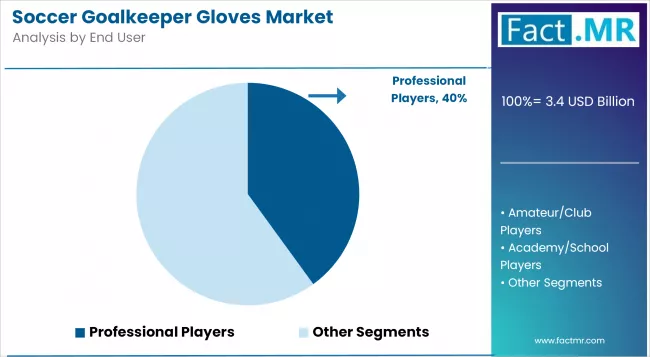
Soccer Goalkeeper Gloves Market Analysis By End User | Source: Fact.MR
Professional players represent the most influential end-user segment, as their demand sets industry standards and directly impacts glove design and innovation. They consistently seek high-performance gloves with advanced grip, ergonomic fits, and durability to withstand intensive match play.
Their influence also extends through sponsorships and endorsements, where brands showcase professional athletes using top-tier gloves, which strongly shapes consumer preferences across amateur and youth levels.
- Professional players significantly shape market demand through brand endorsements and performance requirements
- High investment in R&D is primarily focused on meeting professional-level standards
- Professional-grade gloves set trends that trickle down to amateurs, clubs, and youth players
Segmentation for Soccer Goalkeeper Gloves Market
-
By Glove Type :
- Match Gloves
- Training Gloves
- Weather-specific Gloves (Wet/Cold)
- Hybrid Performance Gloves
-
By Cut :
- Flat Cut
- Roll Finger
- Negative Cut
- Hybrid Cut
-
By Material :
- Latex
- Synthetic/PU
- Hybrid (Latex + Synthetic)
- Biodegradable/Eco-friendly
-
By End User :
- Professional Players
- Amateur/Club Players
- Academy/School Players
- Women’s & Youth Segments
- Institutional/Promotional
-
By Distribution Channel :
- Specialty Sports Stores
- Online/E-commerce
- Team/Academy Bulk Sales
- General Sporting Goods
-
By Region :
- North America
- Latin America
- Western Europe
- Eastern Europe
- East Asia
- South Asia & Pacific
- Middle East & Africa
Frequently Asked Questions
What is the value of the Soccer Goalkeeper Gloves Market in 2025?
What is the growth rate of the Soccer Goalkeeper Gloves Market until 2035?
Which are the prominent players in the Soccer Goalkeeper Gloves Market?
Who worked on this report


Preview the report firsthand - request a free sample
Free SampleGet the brochure for pricing and purchase details
Download PDF