- Market Value (2025): USD 287.6 Mn
- Estimated Value (2026): USD 319.0 Mn
- Forecast Value (2036): USD 896.0 Mn
- CAGR (2026-2036): 10.9%
What is the 24/7 Mega-Spa Complexes Market forecast to be worth by 2036?
USD 319.0 million in 2026 to USD 896.0 million by 2036 at a 10.9% CAGR.
- As per Fact.MR analysis, the 24/7 mega-spa complexes market was valued at USD 287.6 million in 2025.
- Demand will grow from USD 319.0 million in 2026 to USD 896.0 million by 2036 as operators expand integrated wellness, hydrotherapy, and destination-based services.
- The forecast records a 10.9% CAGR from 2026 to 2036, supported by interest in immersive wellness experiences and flexible access models.
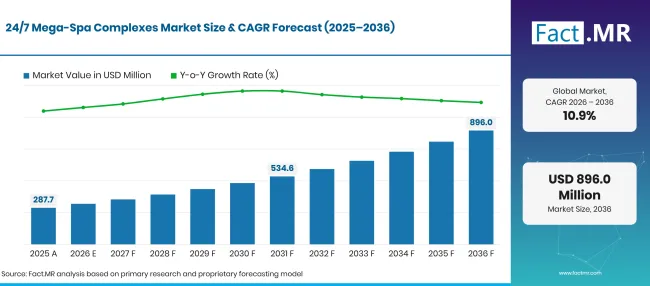
24 7 Mega Spa Complexes Market Forecast Global | Source: Fact.MR
| Year | Basis | Market Value (USD million) |
|---|---|---|
| 2025 | Actual | 287.6 |
| 2026 | Estimate | 319.0 |
| 2036 | Forecast | 896.0 |
| CAGR 2026 to 2036 | Forecast period | 10.9% |
Source: Fact.MR analysis. Updated Nov 6, 2026
What are the defining numbers behind 24/7 Mega-Spa Complexes Market growth?
USD 577.0 million absolute opportunity between 2026 and 2036.
- Demand Drivers in the Market
- Growing interest in wellness-led travel has driven the market growth. Wellness tourism is becoming a more significant part of the travel economy. The Global Wellness Institute reported approximately 1.24 billion domestic and international wellness tourism trips worldwide in 2024, accounting for 8.3% of all tourism trips and 17.6% of tourism expenditure [1].nterest in wellness-led travel has driven the market growth. Wellness tourism is becoming a more significant part of the travel economy. The Global Wellness Institute reported that wellness travelers made approximately 1.24 billion international and domestic trips in 2024. These trips represented 8.3% of all tourism trips and 17.6% of tourism spending [1].
- Demand for integrated wellness experiences has increased the demand for the 24/7 mega spa complexes. Visitors increasingly seek facilities that combine physical activity with recovery and relaxation. According to the Global Wellness Institute, global spa sector revenue increased by 14.6% from 2023 to 2024, while the thermal and mineral springs sector expanded by 11.1% over the same period [2].integrated wellness experiences has increased the demand for the 24/7 mega spa complexes. Visitors increasingly seek facilities that combine physical activity with recovery and relaxation. The Global Wellness Institute reported that the global spa sector grew 14.6% between 2023 and 2024, while thermal and mineral springs grew 11.1% [2].
- Expansion of medical and preventive wellness supports the market growth. Operators are adding health assessments, personalized programs, nutrition guidance, and recovery services to conventional spa offerings. Canyon Ranch and SHA Wellness, for example, present programs that combine wellness services with expert-led health and lifestyle guidance [3] [4].
- Investment in thermal and hydrotherapy facilities has created lucrative opportunity for the growth of the market. Thermal bathing and water-based wellness experiences can support repeat visits and longer stays. The Global Wellness Institute estimated that 31,386 thermal and mineral springs establishments generated USD 72 billion in revenue worldwide in 2024 [5].
- Key Segments Analyzed
- By Mega-Spa Facility Model: Fitness / Recovery Complexes are projected to account for 26.3% of the market in 2026, reflecting demand for facilities that combine exercise, recovery, and wellness services.
- By Access / Commercial Model: Multi-Day Packages lead with a 31.6% share in 2026 as destination wellness experiences encourage visitors to book structured programs rather than individual treatments.
- By Operating Setting: Destination Properties are set to represent 23.2% of the market in 2026, supported by resort-based wellness programs and multi-service facilities.
- By Core Visitor Group: Corporate Groups are projected to hold 27.6% of the market in 2026, reflecting demand for organized wellness retreats and group bookings.
- Analyst Opinion at Fact.MR
- Shambhu Nath Jha, Principal Consultant at Fact.MR, states, “Mega-spa operators can strengthen their position by bringing fitness, hydrotherapy, recovery, and personalized wellness services into a coordinated facility. The commercial opportunity will depend on how effectively operators manage access, staffing, and service quality across different visitor groups.”
- Strategic Implications
- Mega-spa operators should establish clear access schedules that distinguish continuously available amenities from services requiring appointments or specialist staff. Transparent scheduling can improve visitor convenience, support efficient staff allocation and help maintain consistent service quality across different wellness, fitness and recovery facilities.
- Destination properties need to integrate accommodation packages with wellness activities, fitness programs and recovery services to encourage longer visitor stays. Combining hospitality and wellness offerings can improve the overall guest experience, increase facility utilization and create additional revenue opportunities through bundled services and extended-stay packages.
- Fitness and recovery complexes must invest in facilities that encourage repeat visits, including structured exercise areas, dedicated recovery spaces and hydrotherapy services. Maintaining diverse wellness offerings can attract different customer groups, support regular facility utilization and strengthen customer retention through comprehensive fitness and recovery experiences.
- Operators targeting corporate groups can develop bookable wellness programs with clearly defined schedules, dedicated group facilities and measurable service inclusions. Offering structured packages for corporate retreats, employee wellness activities and team-building sessions can simplify group bookings, improve operational planning and generate recurring business opportunities.
- Investors should assess occupancy rates, visitor frequency, staffing requirements and utility expenses before committing to round-the-clock operations. Evaluating these operational factors can help determine financial feasibility, identify potential cost pressures and establish sustainable pricing strategies while maintaining service availability and facility performance throughout extended operating hours.
Germany is projected to record a 10.6% CAGR through 2036. Thailand is set to post 12.1%, followed by the UAE at 13.4%. Japan is forecast to advance at 9.3%, while the USA is expected to register 10.6%.
How does the 24/7 Mega-Spa Complexes Market break down by segment?
Fact.MR finds that Fitness / Recovery Complexes lead the Mega-Spa Facility Model segment at 26.3%; Multi-Day Packages lead the Access / Commercial Model segment at 31.6%; Destination Properties lead the Operating Setting segment at 23.2%; and Corporate Groups lead the Core Visitor Group segment at 27.6%.
Which Mega-Spa Facility Model dominates?
Fitness / Recovery Complexes are set to hold a 26.3% share in 2026.
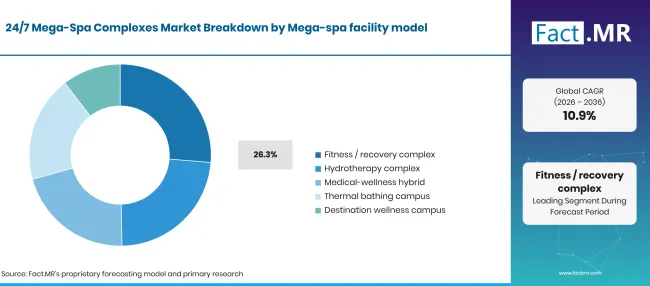
24 7 Mega Spa Complexes Market Breakdown Mega Spa Facility Model 1 | Source: Fact.MR
| Mega-Spa Facility Model | Share (2026) |
|---|---|
| Fitness / Recovery Complex (Leading segment) | 26.3% |
| Other segments combined | 73.7%* |
| Total | 100.0% |
Source: Fact.MR analysis. Updated Nov 6, 2026
Fitness and recovery complexes bring exercise, conditioning, and post-workout recovery services into one facility. Visitors can use these centers for planned workouts as well as relaxation and recovery activities. Their service mix can include fitness studios, pools, recovery areas, and selected spa treatments. Hydrotherapy complexes and thermal bathing campuses serve visitors with a stronger preference for water-based treatments, while destination wellness campuses focus on longer stays and structured wellness programs.
What leads the Access / Commercial Model segment?
Multi-Day Packages are set to represent 31.6% share in 2026.
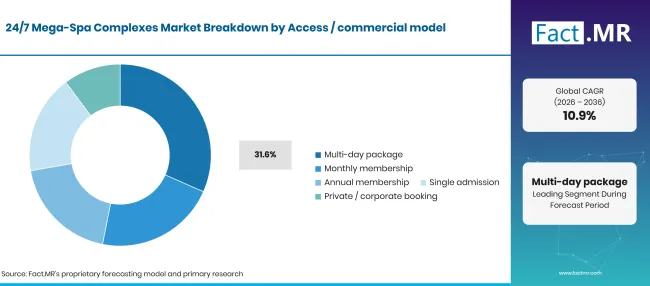
24 7 Mega Spa Complexes Market Breakdown Access Commercial Model | Source: Fact.MR
| Access / Commercial Model | Share (2026) |
|---|---|
| Multi-Day Package (Leading segment) | 31.6% |
| Other segments combined | 68.4%* |
| Total | 100.0% |
Source: Fact.MR analysis. Updated Nov 6, 2026
Multi-day packages provide a structured way to combine accommodation, treatments, fitness activities, and wellness consultations. They can also give operators greater visibility into visitor schedules and service demand. Monthly and annual memberships serve repeat users who prefer regular access, while single admissions attract visitors seeking individual treatments or shorter visits. Private and corporate bookings allow facilities to serve groups with customized programs and dedicated schedules.
How does Operating Setting shape demand?
Destination Properties are likely to account for 23.2% share in 2026.
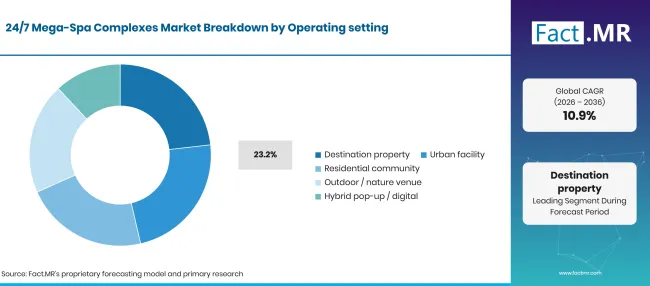
24 7 Mega Spa Complexes Market Breakdown Operating Setting | Source: Fact.MR
| Operating Setting | Share (2026) |
|---|---|
| Destination Property (Leading segment) | 23.2% |
| Other segments combined | 76.8%* |
| Total | 100.0% |
Source: Fact.MR analysis. Updated Nov 6, 2026
Destination properties combine wellness facilities with accommodation and a broader travel experience. Their appeal rests on the ability to provide multiple services within one location and encourage visitors to stay for several days. Outdoor and nature venues attract guests seeking relaxation in natural surroundings, while urban facilities can serve local residents and working professionals. Residential community facilities are positioned around recurring access and proximity to users. Hybrid pop-up and digital models may extend customer engagement, although they do not necessarily represent a full-scale physical mega-spa complex.
Which Core Visitor Group accounts for the largest share?
Corporate Groups are expected to hold 27.6% share in 2026.
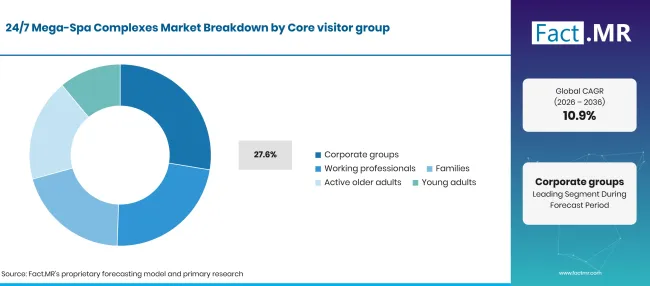
24 7 Mega Spa Complexes Market Breakdown Core Visitor Group | Source: Fact.MR
| Core Visitor Group | Share (2026) |
|---|---|
| Corporate Groups (Leading segment) | 27.6% |
| Other segments combined | 72.4%* |
| Total | 100.0% |
Source: Fact.MR analysis. Updated Nov 6, 2026
Corporate groups can book wellness facilities for team retreats, employee well-being activities, and organized recovery programs. Group bookings can support advance scheduling and coordinated service delivery. Working professionals may use urban facilities for stress management and fitness, while families are more likely to value facilities that offer activities across age groups. Active older adults can seek mobility and recovery services, whereas younger adults may be drawn to fitness, social wellness, and recreational experiences.
What is accelerating 24/7 Mega-Spa Complexes Market adoption, and what is holding it back?
Demand for integrated wellness experiences and destination-based programs supports expansion, while high operating costs and continuous staffing requirements can constrain adoption.
Drivers Impact Analysis
| DRIVER | (~) % IMPACT ON CAGR | GEOGRAPHIC RELEVANCE | IMPACT TIMELINE |
|---|---|---|---|
| Rising demand for wellness tourism | +1.1% | Global, Thailand, UAE | Medium term (2–4 years) |
| Growth of integrated fitness and recovery services | +0.9% | USA, Germany, Japan | Medium term (2–4 years) |
| Expansion of multi-day wellness packages | +0.8% | Thailand, UAE, Europe | Short term (≤ 2 years) |
| Greater interest in thermal and hydrotherapy facilities | +0.7% | Japan, Germany, Thailand | Medium term (2–4 years) |
| Corporate wellness retreats and group bookings | +0.5% | USA, Germany, UAE | Long term (≥ 4 years) |
Source: Fact.MR analysis. Updated Nov 6, 2026
Opportunity Impact Analysis
| OPPORTUNITY | (~) % IMPACT ON CAGR | GEOGRAPHIC RELEVANCE | IMPACT TIMELINE |
|---|---|---|---|
| Development of destination-scale wellness campuses | +0.9% | Thailand, UAE, Asia-Pacific | Long term (≥ 4 years) |
| Personalized health and recovery programs | +0.8% | USA, Germany, Japan | Medium term (2–4 years) |
| Membership-based access and recurring revenue | +0.6% | USA, Germany, UK | Medium term (2–4 years) |
| Corporate wellness packages | +0.5% | USA, UAE, Germany | Short term (≤ 2 years) |
| Integration of digital wellness services | +0.4% | Global | Long term (≥ 4 years) |
Source: Fact.MR analysis. Updated Nov 6, 2026
Restraints Impact Analysis
| RESTRAINT | (~) % IMPACT ON CAGR | GEOGRAPHIC RELEVANCE | IMPACT TIMELINE |
|---|---|---|---|
| High capital investment and maintenance costs | -0.9% | Global | Long term (≥ 4 years) |
| Continuous staffing and security requirements | -0.8% | Global | Short term (≤ 2 years) |
| High energy and water consumption | -0.7% | Germany, UAE, USA | Medium term (2–4 years) |
| Seasonal demand at destination properties | -0.5% | Thailand, Japan, Europe | Medium term (2–4 years) |
| Regulatory and licensing requirements for medical wellness | -0.4% | USA, Germany, Japan | Long term (≥ 4 years) |
Source: Fact.MR analysis. Updated Nov 6, 2026
Which countries are scaling the 24/7 Mega-Spa Complexes Market through 2036?
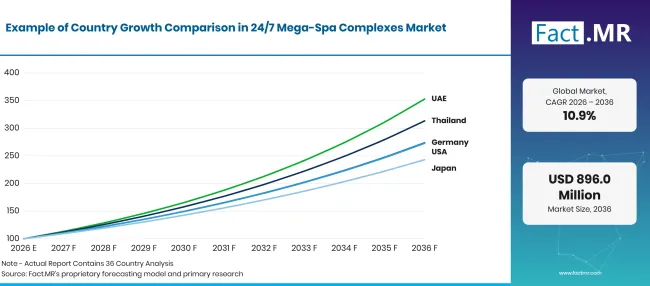
24 7 Mega Spa Complexes Market Growth Index 1 | Source: Fact.MR
| Country | CAGR (2026–2036) |
|---|---|
| Germany | 10.6% |
| Thailand | 12.1% |
| UAE | 13.4% |
| Japan | 9.3% |
| USA | 10.6% |
Source: Fact.MR analysis. Updated Nov 6, 2026
What factors are supporting market growth in Germany?
10.6% CAGR, supported by an established tourism sector and demand for thermal and wellness facilities.
Germany has a substantial accommodation and tourism base that can support destination wellness properties and large spa facilities. Destatis reported 497.5 million guest overnight stays in 2025, a new annual record [6]. The country also has established thermal bathing and rehabilitation traditions. Mega-spa operators can build on these foundations by combining bathing facilities with fitness, recovery, and longer-stay wellness services.
How is the market developing in the Thailand?
12.1% CAGR, driven by wellness tourism positioning and investment in professional wellness services.
Thailand is strengthening its position as a destination for wellness-led travel. In July 2026, the Ministry of Public Health announced a collaboration involving the Department of Thai Traditional and Alternative Medicine, BDMS Wellness, Chiva-Som, and other organizations to develop qualified wellness therapists and improve professional standards. The government also reported that Thailand's wellness economy reached USD 42.7 billion in 2024 [7]. This ecosystem can support destination wellness campuses and facilities combining traditional therapies with modern fitness and recovery services.
What supports UAE adoption?
13.4% CAGR, supported by international tourism and premium hospitality investment.
The UAE, particularly Dubai, offers a strong base for premium hospitality and destination wellness facilities. Dubai welcomed 19.59 million international overnight visitors in 2025, representing a 5% increase from 2024, according to the Dubai Department of Economy and Tourism [8]. This visitor base can create opportunities for hotel-linked mega-spas, private wellness programs, and premium recovery facilities. Operators can differentiate their services through personalized treatments, extended access, and packages designed for international visitors.
What is driving demand in Japan?
9.3% CAGR, led by established bathing traditions and demand for integrated wellness experiences.
Japan's onsen culture provides a foundation for thermal bathing and destination wellness facilities. Domestic travel spending also remains relevant to the sector. Japan's Tourism Agency reported domestic travel expenditure of approximately JPY 7.47 trillion for April to June 2026, up 10.7% year over year [9]. Mega-spa operators can combine traditional bathing experiences with modern fitness, recovery, and hospitality services. Facilities need to maintain clear distinctions between conventional bathing establishments and large integrated wellness complexes.
What supports United States adoption?
10.6% CAGR, backed by a large wellness economy and established premium wellness operators.
The United States has a substantial consumer wellness market and an established base of destination wellness operators. The Global Wellness Institute identified the USA as the world's largest national wellness economy in 2024, valued at approximately USD 2.1 trillion [10]. The country also has established operators offering integrated services across spa treatments, health assessments, fitness, and nutrition. Canyon Ranch, for example, combines spa and beauty services with health and performance programs, fitness, and nutrition support. These capabilities can support further development of large wellness complexes and structured visitor programs.
Who leads the 24/7 Mega-Spa Complexes Market?
Fact.MR profiles Six Senses, Canyon Ranch, SHA Wellness, Aman, COMO Shambhala, and Chiva-Som across the luxury wellness, destination spa, and integrated wellness services landscape. These brands demonstrate relevant operating models, although their individual properties should be assessed separately when confirming mega-spa scale and continuous operating hours.
Six Senses integrates spa treatments with sleep, nutrition, movement, and mindfulness programs. Its wellness offerings include personalized experiences and multi-day retreats at selected properties [11].
Canyon Ranch combines spa and beauty services with health and performance programs, fitness, nutrition, and mind-body services. Its destination retreats include expert guidance and structured daily activities. SHA Wellness positions itself around medically guided health optimization, longevity, and personalized wellness programs. Its service model combines clinical guidance with a luxury destination experience.
Aman offers wellness retreats and spa experiences across its properties, with programs covering physical optimization, mental balance, and traditional wellness practices. Its offering includes multi-night retreats and personalized wellness experiences [12].
COMO Shambhala provides integrated wellness experiences through yoga, physical training, nutrition, Ayurveda, and multi-night retreats. The concept operates across COMO Hotels and Resorts in several countries [13]. Chiva-Som is a relevant Thai wellness destination and participates in the country's wider professional wellness ecosystem. Its involvement in Thailand's 2026 wellness therapist initiative provides evidence of its engagement with the development of wellness services and professional standards.
Which companies are the key providers?
Key companies profiled include Six Senses; Canyon Ranch; SHA Wellness; Aman; COMO Shambhala; and Chiva-Som.
- Six Senses
- Canyon Ranch
- SHA Wellness
- Aman
- COMO Shambhala
- Chiva-Som
Bibliography
- [1] Global Wellness Institute. (2025, November). 2025 Global Wellness Economy Monitor.
- [2] Global Wellness Institute. (2025, November). 2025 Global Wellness Economy Monitor: Global spa and thermal/mineral springs sectors.
- [3] Canyon Ranch. (n.d.). Luxury Health & Wellness Retreats.
- [4] SHA Wellness. (n.d.). Luxury Wellness Destination for Health Transformation.
- [5] Global Wellness Institute. (2025, November). Thermal/Mineral Springs: 2024 global establishments and revenue.
- [6] Statistisches Bundesamt (Destatis). (2026, February 11). Tourismus in Deutschland im Jahr 2025: Erneut Rekordwert bei Gästeübernachtungen.
- [7] Government Public Relations Department, Thailand. (2026, July 6). Driving Thailand to Become Sustainable Global Wellness Hub.
- [8] Dubai Department of Economy and Tourism. (2026, January 7). Tourism Performance Report January–December 2025.
- [9] Japan Tourism Agency. (2026, October 30). [Travel and Tourism Consumption Trend Survey: April–June 2026, Second Preliminary Report].
- [10] Japan Tourism Agency. (2026, October 21) [Inbound Consumption Trend Survey: July–September 2026, First Preliminary Report].
- [11] Six Senses. (n.d.). Wellness & Spa.
- [12] Aman. (n.d.). Aman Wellness: Sanctuaries of Longevity.
- [13] COMO Group. (n.d.). COMO Shambhala.
This Report Answers
- The report describes the major facility models used across the 24/7 mega-spa complexes market.
- Segment analysis compares fitness and recovery complexes, hydrotherapy complexes, medical-wellness hybrids, thermal bathing campuses, and destination wellness campuses.
- Commercial analysis examines multi-day packages, memberships, single admissions, and private or corporate bookings.
- Country analysis discusses Germany, Thailand, UAE, Japan, and USA alongside relevant tourism and wellness industry indicators.
- The competitive overview profiles Six Senses, Canyon Ranch, SHA Wellness, Aman, COMO Shambhala, and Chiva-Som.
- Operating-setting analysis distinguishes destination properties from urban facilities, residential communities, outdoor venues, and hybrid models.
What does the 24/7 Mega-Spa Complexes Market cover?
The market covers large-scale facilities that combine multiple wellness services within a coordinated operating environment. These services may include spa treatments, fitness programs, hydrotherapy, thermal bathing, recovery services, wellness consultations, and destination-based programs. Commercial activity includes admissions, memberships, multi-day packages, and private or corporate bookings.
The 24/7 designation applies to facilities or service areas with verified continuous access or operating schedules. A resort with a spa that operates only during scheduled daytime hours should not automatically be classified as a 24/7 mega-spa complex.
What is included in the scope?
Included facilities offer multiple integrated wellness services and operate at a scale consistent with the mega-spa complex definition
. The market includes fitness and recovery complexes, hydrotherapy facilities, thermal bathing campuses, medical-wellness hybrids, and destination wellness campuses. Revenue coverage follows the facility, access, operating-setting, and visitor-group classifications.
What is excluded from the scope?
The analysis excludes conventional standalone day spas that do not meet the mega-spa scale and service-integration criteria.
It also excludes standard gyms without integrated spa or recovery facilities, individual massage studios, and hotels offering only a limited spa service. Wellness products, supplements, standalone medical clinics, and sales of fitness equipment are excluded unless they form part of the defined complex's operating revenue. Facilities without verified continuous or extended access should not be represented as 24/7 operators.
How Was the Analysis Built?
The analysis draws on 120+ sources, 35+ company portfolios, 25+ countries, and more than 20 industry interviews.
- Primary Research: Primary research includes discussions with manufacturers, service providers, technology developers, distributors, end users, and subject-matter experts. These conversations examine purchasing priorities, product adoption, operational challenges, approval requirements, competitive positioning, and the factors that influence wider market acceptance.
- Desk Research: Desk research covers government statistics, regulatory publications, company filings, trade data, technical studies, industry associations, standards, public policy, and other authoritative sources. Every source used in the analysis is documented in the bibliography.
- Market Sizing and Forecasting: Market estimates combine historical performance, demand indicators, pricing and volume trends, segment shares, company participation, country-level growth, adoption patterns, investment activity, and barriers to market expansion.
- Data Validation and Update Cycle: Findings are validated by comparing primary interviews with public data, company activity, regulatory changes, trade patterns, and industry developments. Regular updates review new product launches, capacity changes, partnerships, approvals, and shifts in commercial adoption.
Segmentation
What is the report’s scope and coverage?
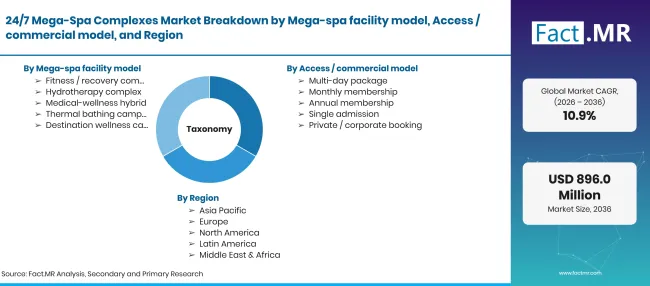
24 7 Mega Spa Complexes Market Taxonomy | Source: Fact.MR
| Attribute | Details |
|---|---|
| Quantitative Units | USD million |
| Market Definition | The 24-Hour Spa and Wellness Centers Market comprises large-scale wellness facilities offering integrated spa treatments, fitness programs, hydrotherapy, thermal bathing, relaxation therapies and physical recovery services. |
| Mega-Spa Facility Model | Fitness / Recovery Complex; Hydrotherapy Complex; Medical-Wellness Hybrid; Thermal Bathing Campus; Destination Wellness Campus |
| Access / Commercial Model | Multi-Day Package; Monthly Membership; Annual Membership; Single Admission; Private / Corporate Booking |
| Operating Setting | Destination Property; Urban Facility; Residential Community; Outdoor / Nature Venue; Hybrid Pop-Up / Digital |
| Core Visitor Group | Corporate Groups; Working Professionals; Families; Active Older Adults; Young Adults |
| Regions Covered | North America; Latin America; Western Europe; Eastern Europe; East Asia; South Asia & Pacific; Middle East & Africa |
| Countries Covered | Germany; Thailand; UAE; Japan; USA |
| Companies Profiled | Six Senses; Canyon Ranch; SHA Wellness; Aman; COMO Shambhala; Chiva-Som |
| Forecast Period | 2026 to 2036 |
| Approach | Market segmentation and scenario-based analysis supported by wellness tourism, hospitality, and company-level operating evidence |
Source: Fact.MR analysis. Updated Nov 6, 2026
How is the market segmented?
-
By Mega-Spa Facility Model
- Fitness / Recovery Complex
- Hydrotherapy Complex
- Medical-Wellness Hybrid
- Thermal Bathing Campus
- Destination Wellness Campus
-
By Access / Commercial Model
- Multi-Day Package
- Monthly Membership
- Annual Membership
- Single Admission
- Private / Corporate Booking
-
By Operating Setting
- Destination Property
- Urban Facility
- Residential Community
- Outdoor / Nature Venue
- Hybrid Pop-Up / Digital
-
By Core Visitor Group
- Corporate Groups
- Working Professionals
- Families
- Active Older Adults
- Young Adults
-
By Region
- North America
- Latin America
- Western Europe
- Eastern Europe
- East Asia
- South Asia & Pacific
- Middle East & Africa
Frequently Asked Questions
How big is the 24/7 Mega-Spa Complexes Market in 2026?
What is the CAGR from 2026 to 2036?
Which Mega-Spa Facility Model has the largest share?
Which Access / Commercial Model leads?
Which Operating Setting has the largest share?
Which Core Visitor Group leads?
Which country is expected to grow fastest?
Which companies are covered?
Who worked on this report


Preview the report firsthand - request a free sample
Free SampleGet the brochure for pricing and purchase details
Download PDF