- Market Value (2025): USD 4.66 Bn
- Estimated Value (2026): USD 4.88 Bn
- Forecast Value (2036): USD 7.72 Bn
- CAGR (2026-2036): 4.7%
What is the Digital Keyboard Market forecast to be worth by 2036?
USD 4.9 billion in 2026 to USD 7.7 billion by 2036 at a 4.7% CAGR.
- As per Fact.MR analysis, digital keyboard market revenue stood at USD 4.66 billion in 2025.
- The market is projected to advance from USD 4.88 billion in 2026 to USD 7.72 billion by 2036.
- The market is forecast to grow at a 4.7% CAGR from 2026 to 2036 as learners and performing musicians select instruments suited to different playing settings.
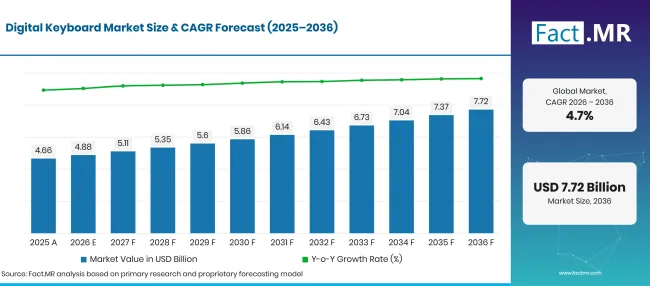
Digital Keyboard Market Forecast Global | Source: Fact.MR
| Year | Basis | Market Value (USD billion) |
|---|---|---|
| 2025 | Actual | 4.66 |
| 2026 | Estimate | 4.88 |
| 2036 | Forecast | 7.72 |
| CAGR 2026 to 2036 | Forecast period | 4.7% |
Source: Fact.MR analysis. Updated Nov 4, 2026
What are the defining numbers behind Digital Keyboard Market growth?
The market is projected to gain USD 2.8 billion in annual value by 2036.
- Demand Drivers in the Market
- Home piano learners increasingly compare key resistance and playing feel before buying. Digital pianos provide volume control and headphone practice while reducing the space needs of an acoustic instrument.
- Performers assess instrument weight alongside access to sounds and stage connections. Keyboard workstations support performance setups where musicians switch patches or combine sounds during a set. Portable arrangers address another need through automatic accompaniment.
- Trying an instrument in a store helps buyers judge the action of weighted keys and the sound from its speakers. NAMM reported that 19,005 people expressed interest in keyboards and synthesizers at its 2025 trade show [2].
- Online stores make it easier to compare key counts, dimensions and connection options before visiting a dealer. Eurostat reported in 2026 that 78% of EU internet users had purchased goods or services online during 2025 [3].
- Key Segments Analyzed
- By Product Type: Digital Pianos represent 35.2% of 2026 sales as buyers look for weighted keys and piano-focused sound.
- By Application: Professional use accounts for 42.3% in 2026, reflecting stage and recording requirements for reliable controls and sound selection.
- By Distribution Channel: Offline Stores lead with 58.0% in 2026 because physical trials remain central to instrument selection.
- By End-User: Musicians capture 45.2% in 2026 as stage performers and practicing players select keyboards for repeated use.
- Analyst Opinion at Fact.MR
- Shambhu Nath Jha, Principal Consultant at Fact.MR, states, “Purchase decisions differ between an affordable first keyboard and an instrument designed for regular professional playing. Buyers compare key feel and available sounds before trading up. The market analysis suggests that better playing action and clear product demonstrations have greater influence on spending than feature count alone.”
- Strategic Implications
- Manufacturers should distinguish beginner models from performance keyboards through clear descriptions of key action and sound controls.
- Specialist dealers should keep popular weighted-key models available for trials and explain delivery arrangements for larger cabinet instruments.
- Online retailers should include accurate sound demonstrations and accessible comparisons between portable and furniture-style models.
- Music schools should compare instrument durability and headphone connections when replacing shared classroom equipment. Students may use spatial audio earwear for playback, a separate product category.
Germany is forecast to record 6.0% CAGR through 2036, followed by Brazil at 5.5%. The United States is forecast at 4.9%, the United Kingdom at 4.4%, and Japan at 3.9%. The sequence reflects different education channels, retail conditions and product replacement needs; it does not establish the relative market size of these countries.
How does the Digital Keyboard Market break down by segment?
Digital Pianos account for 35.2% of Product Type; Professional use holds 42.3% of Application; Offline Stores hold 58.0% of Distribution Channel; and Musicians represent 45.2% of End-User.
Which Product Type dominates?
Digital Pianos account for 35.2% of 2026 value.
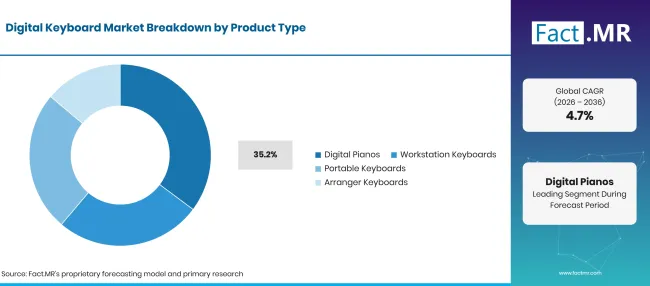
Digital Keyboard Market Breakdown Product Type | Source: Fact.MR
| Product Type | Share (2026) |
|---|---|
| Digital Pianos (Leading segment) | 35.2% |
| Other segments combined | 64.8% |
| Total | 100.0% |
Source: Fact.MR analysis. Updated Nov 4, 2026
Digital pianos appeal to players who want familiar piano keys without the weight and maintenance of an acoustic instrument. Weighted action and pedal support help with regular practice. Workstation keyboards suit musicians who edit and layer sounds, while portable keyboards and arrangers offer lighter formats and accompaniment features. Roland's March 2025 GO:PIANO88 launch is one example of a portable model with full-size keys [4].
What leads the Application segment?
Professional applications represent 42.3% in 2026.
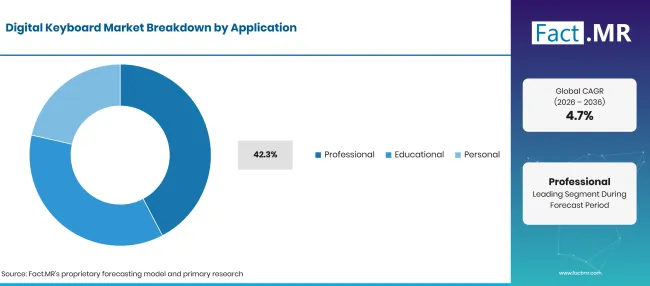
Digital Keyboard Market Breakdown Application | Source: Fact.MR
| Application | Share (2026) |
|---|---|
| Professional (Leading segment) | 42.3% |
| Other segments combined | 57.7% |
| Total | 100.0% |
Source: Fact.MR analysis. Updated Nov 4, 2026
Professional use includes keyboard players working in concert settings and musicians using instruments for recording. These customers often compare sound libraries and connection options before purchase. Educational use requires predictable key response and enough durability for repeated lessons. Personal use is shaped by available space and practice convenience, especially headphone listening.
How does Distribution Channel affect sales?
Offline Stores lead with 58.0% in 2026.
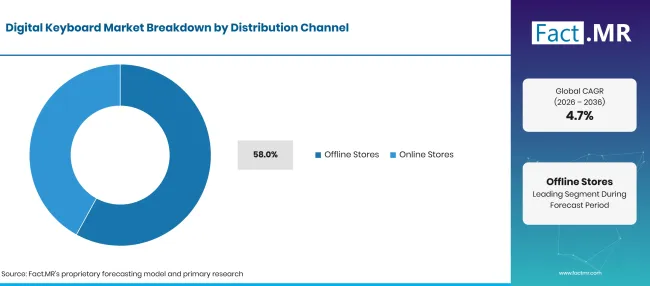
Digital Keyboard Market Breakdown Distribution Channel | Source: Fact.MR
| Distribution Channel | Share (2026) |
|---|---|
| Offline Stores (Leading segment) | 58.0% |
| Other segments combined | 42.0% |
| Total | 100.0% |
Source: Fact.MR analysis. Updated Nov 4, 2026
Musical instrument shops let shoppers compare the touch of semi-weighted and hammer-action keys. Staff can also explain stands and pedal compatibility before a sale is finalized. Online stores attract people who know the model they want or have viewed detailed product demonstrations. Large keyboard deliveries and returns can be more complicated than shipping small accessories.
Which End-User group leads?
Musicians capture 45.2% of 2026 spending.
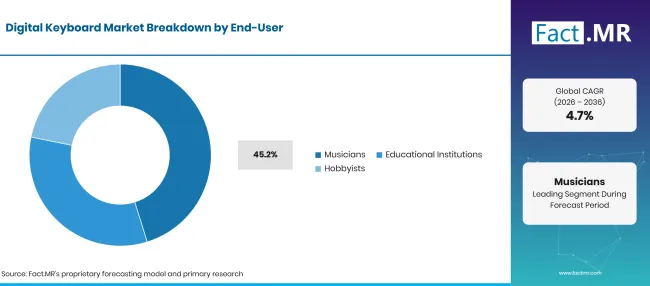
Digital Keyboard Market Breakdown End User | Source: Fact.MR
| End-User | Share (2026) |
|---|---|
| Musicians (Leading segment) | 45.2% |
| Other segments combined | 54.8% |
| Total | 100.0% |
Source: Fact.MR analysis. Updated Nov 4, 2026
Musicians include people who practice regularly and players who use keyboards in paid performances. They compare long-term usability because a change in touch or sound can alter an established playing routine. Hobbyists often begin with portable instruments that fit on an adjustable stand. Educational institutions look for manageable maintenance and consistent units across classrooms. Germany’s public music schools recorded 738,835 enrolments in instrumental and vocal subjects during 2024, according to figures published by the German Music Information Centre in September 2026 [7].
What is accelerating Digital Keyboard Market adoption, and what is holding it back?
Home practice features and stage performance needs are expected to encourage purchases. Premium instrument prices and limited opportunities to test key action remotely are expected to slow some decisions.
| DRIVER | (~) % IMPACT ON CAGR | GEOGRAPHIC RELEVANCE | IMPACT TIMELINE |
|---|---|---|---|
| Home practice and headphone use | +0.9 pp | Global | Short term (up to 2 years) |
| Music education replacement purchases | +0.7 pp | Europe, North America | Medium term (2–4 years) |
| Performing musician equipment needs | +0.6 pp | Global | Medium term (2–4 years) |
| Portable models and learning applications | +0.5 pp | East Asia, North America | Short term (up to 2 years) |
| Online product discovery | +0.4 pp | Global | Long term (4+ years) |
Source: Fact.MR analysis. Updated Nov 4, 2026
Opportunity Impact Analysis
| OPPORTUNITY | (~) % IMPACT ON CAGR | GEOGRAPHIC RELEVANCE | IMPACT TIMELINE |
|---|---|---|---|
| Compact weighted-key pianos | +0.6 pp | Urban markets | Medium term (2–4 years) |
| Learning software integration | +0.4 pp | Global | Medium term (2–4 years) |
| Institutional instrument upgrades | +0.3 pp | Europe, Americas | Long term (4+ years) |
Source: Fact.MR analysis. Updated Nov 4, 2026
Restraint Impact Analysis
| RESTRAINT | (~) % IMPACT ON CAGR | GEOGRAPHIC RELEVANCE | IMPACT TIMELINE |
|---|---|---|---|
| Price sensitivity for better key action | −0.6 pp | Global | Short term (up to 2 years) |
| Limited ability to test instruments online | −0.4 pp | Global | Medium term (2–4 years) |
| Freight and after-sales costs | −0.3 pp | Import-oriented markets | Long term (4+ years) |
Source: Fact.MR analysis. Updated Nov 4, 2026
Which countries are scaling the Digital Keyboard Market through 2036?
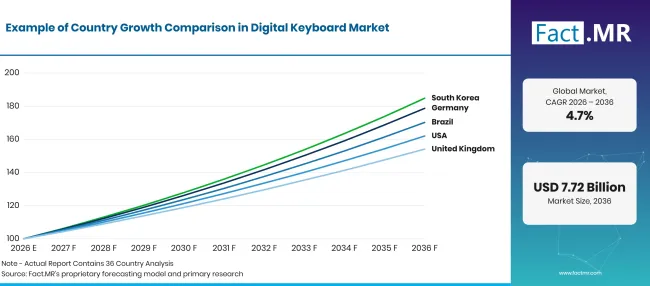
Digital Keyboard Market Growth Index | Source: Fact.MR
| Country | CAGR (2026 to 2036) |
|---|---|
| Germany | 6.0% |
| Brazil | 5.5% |
| United States | 4.9% |
| United Kingdom | 4.4% |
| Japan | 3.9% |
Source: Fact.MR analysis. Updated Nov 4, 2026
What supports Germany’s digital keyboard demand?
6.0% CAGR, shaped by formal lessons and specialist retail.
German digital keyboard sales draw on a broad network of public music schools and specialist instrument shops. The German Music Information Centre reported in September 2026 that public music schools served 1.55 million students in 2024 [1]. Teachers and families can compare weighted key action in stores before deciding whether a portable keyboard or digital piano suits the lessons ahead.
How is Brazil developing its digital keyboard market?
5.5% CAGR, supported by access to online product information.
Brazil's digital keyboard market serves first-time learners and performing players looking for different levels of sound control. The Brazilian Institute of Geography and Statistics reported in July 2026 that 95.0% of households had internet access in 2025 [9]. This broad connection gives households a practical way to compare portable keyboard functions before visiting stores or ordering online.
What shapes United States digital keyboard sales?
4.9% CAGR, linked to musician upgrades and varied price points.
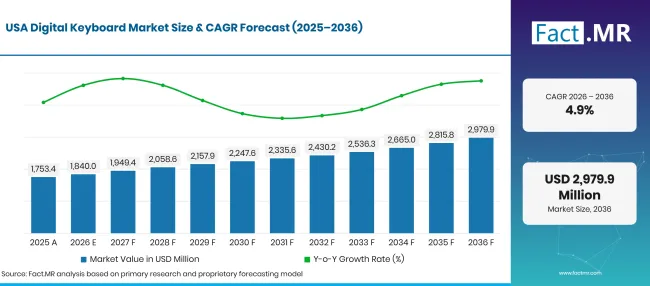
Digital Keyboard Market Forecast Usa | Source: Fact.MR
American digital keyboard sales span home practice, music teaching and stage performance. NAMM's September 2025 Global Report recorded 112,000 keyboard synthesizer units in the United States during 2024, an increase of 14.3% [5]. Synthesizers are an adjacent product group, and the result provides a useful view of electronic instrument retail activity.
How does the United Kingdom compare?
4.4% CAGR, influenced by music teaching and online retail.
UK digital keyboard shoppers can compare instrument specifications online before visiting a music shop to test the keys. The Office for National Statistics reported in August 2026 that online sales represented 27.4% of all UK retail sales in 2025 [6]. Home practice benefits from headphone connections and compact models, while music teachers place value on reliable key response.
What supports Japan’s digital keyboard business?
3.9% CAGR, underpinned by established instrument manufacturers.
Japanese digital keyboard manufacturers combine established piano design knowledge with compact electronic formats for household practice. Yamaha announced in February 2025 that its Japan-only TORCH T01 digital piano would be limited to 20 units and use selected unused African Blackwood in its keys [10].
Who leads the Digital Keyboard Market?
Yamaha Corporation and Casio Computer Co., Ltd. cover portable beginner keyboards and piano-focused instruments. Roland Corporation sells stage-oriented instruments and digital pianos, while Korg Inc. serves musicians needing performance sound options.
Kawai Musical Instruments Manufacturing Co., Ltd. is associated with piano-oriented playing action. Casio published a September 2025 update discussing new colors in its Privia digital piano range [11]. Roland’s 2026 FP-40 launch added Wi-Fi alongside its Piano Sphere learning service [8].
Which companies are the key providers?
Key companies include Yamaha Corporation; Casio Computer Co., Ltd.; Roland Corporation; Korg Inc.; Kawai Musical Instruments Manufacturing Co., Ltd.; Nord Keyboards; Kurzweil Music Systems; Alesis; Arturia.
- Yamaha Corporation
- Casio Computer Co., Ltd.
- Roland Corporation
- Korg Inc.
- Kawai Musical Instruments Manufacturing Co., Ltd.
- Nord Keyboards
- Kurzweil Music Systems
- Alesis
- Arturia
Bibliography
- [1] German Music Information Centre. (2026, September). Schülerzahlen und Altersverteilung an öffentlichen Musikschulen.
- [2] NAMM. (2025, March). What we learned from the 2025 NAMM Show.
- [3] Eurostat. (2026, April 23). Digitalisation in Europe – 2026 edition.
- [4] Roland Corporation. (2025, March 18). Roland announces GO digital piano.
- [5] NAMM. (2025, September). 2025 NAMM Global Report.
- [6] Office for National Statistics. (2026, August 21). Internet sales as a percentage of total retail sales (ratio) (%).
- [7] German Music Information Centre. (2026, September). Schülerzahlen in den Unterrichtsfächern öffentlicher Musikschulen.
- [8] Roland Corporation. (2026, September 1). Roland unveils FP-40 digital piano and Piano Sphere app.
- [9] Sousa, M. F., & Brito, R. (2026, July 2). Internet chega a 95% de domicílios do país em 2025. Instituto Brasileiro de Geografia e Estatística.
- [10] Yamaha Corporation. (2025, February 18). Yamaha releases TORCH T01 digital piano with keys made from unutilized materials.
- [11] Casio Computer Co., Ltd. (2025, September 19). I want to spend healing time in my favorite space! Introducing digital pianos with stylish nuance colors.
This Report Answers
- The product analysis explains differences between weighted-key digital pianos and portable or performance keyboards. Spatial sound reproduction belongs to the adjacent 3D audio systems category.
- The application assessment compares professional stage use with lessons and personal practice.
- The channel discussion examines why an in-store playing trial remains useful alongside online comparison. Online lessons and streaming media services are related to usage but separate from hardware sales.
- The country sections describe education channels and purchase conditions in Germany, Brazil, the United States, the United Kingdom and Japan.
- The supplier review compares manufacturers’ instrument focus and the practical differences between beginner and performance instruments.
What does the Digital Keyboard Market cover?
This market covers electronic keyboards that generate playable musical sounds and are sold as instruments for learning, performance or personal practice. It includes digital pianos with weighted or semi-weighted keys as well as portable keyboard models with built-in sound generation. Streaming media services may deliver lesson or music content but fall outside hardware sales.
What is included in the scope?
Digital pianos, workstation keyboards, portable keyboards and arranger keyboards are included when sold as musical instruments.
Cabinet models and portable instruments both fall within this boundary. Sales to musicians, learners and institutions are covered, including replacement purchases of self-contained keyboards.
What is excluded from the scope?
Acoustic upright and grand pianos sit outside the revenue scope.
The definition also excludes software-only digital audio workstations, stand-alone music production services and music distribution platforms. These are separate product and service categories from playable electronic keyboard instruments.
How Was the Analysis Built?
The analysis draws on 120+ sources, 35+ company portfolios, 25+ countries, and more than 20 industry interviews.
- Primary Research: Primary research includes discussions with manufacturers, service providers, technology developers, distributors, end users, and subject-matter experts. These conversations examine purchasing priorities, product adoption, operational challenges, approval requirements, competitive positioning, and the factors that influence wider market acceptance.
- Desk Research: Desk research covers government statistics, regulatory publications, company filings, trade data, technical studies, industry associations, standards, public policy, and other authoritative sources. Every source used in the analysis is documented in the bibliography.
- Market Sizing and Forecasting: Market estimates combine historical performance, demand indicators, pricing and volume trends, segment shares, company participation, country-level growth, adoption patterns, investment activity, and barriers to market expansion.
- Data Validation and Update Cycle: Findings are validated by comparing primary interviews with public data, company activity, regulatory changes, trade patterns, and industry developments. Regular updates review new product launches, capacity changes, partnerships, approvals, and shifts in commercial adoption.
Segmentation
What is the report’s scope and coverage?
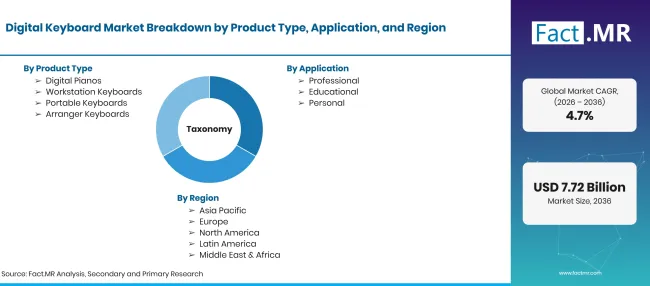
Digital Keyboard Market Taxonomy | Source: Fact.MR
| Attribute | Details |
|---|---|
| Quantitative Units | USD billion |
| Market Definition | Self-contained electronic keyboard instruments including digital pianos, workstation keyboards, portable keyboards and arranger keyboards. |
| Product Type | Digital Pianos; Workstation Keyboards; Portable Keyboards; Arranger Keyboards |
| Application | Professional; Educational; Personal |
| Distribution Channel | Offline Stores; Online Stores |
| End-User | Musicians; Educational Institutions; Hobbyists |
| Regions Covered | North America; Latin America; Western Europe; Eastern Europe; East Asia; South Asia & Pacific; Middle East & Africa |
| Countries Covered | Germany; Brazil; United States; United Kingdom; Japan |
| Companies Profiled | Yamaha Corporation; Casio Computer Co., Ltd.; Roland Corporation; Korg Inc.; Kawai Musical Instruments Manufacturing Co., Ltd.; Nord Keyboards; Kurzweil Music Systems; Alesis; Arturia. |
| Forecast Period | 2026 to 2036 |
| Approach | Segment-level product assessment informed by manufacturers’ portfolios, teaching channels and trade evidence. |
Source: Fact.MR analysis. Updated Nov 4, 2026
How is the market segmented?
-
By Product Type
- Digital Pianos
- Workstation Keyboards
- Portable Keyboards
- Arranger Keyboards
-
By Application
- Professional
- Educational
- Personal
-
By Distribution Channel
- Offline Stores
- Online Stores
-
By End-User
- Musicians
- Educational Institutions
- Hobbyists
-
By Region
- North America
- Latin America
- Western Europe
- Eastern Europe
- East Asia
- South Asia & Pacific
- Middle East & Africa
Frequently Asked Questions
How big is the digital keyboard market in 2026?
What is the forecast CAGR through 2036?
Which product type has the largest share?
Which application accounts for the most spending?
Which companies sell digital keyboards?
Who worked on this report


Preview the report firsthand - request a free sample
Free SampleGet the brochure for pricing and purchase details
Download PDF