- Base Value(2025): 948.1 Mn
- Forecast Value (2035): 1430.6 Mn
- CAGR (2035): 4.2%
Fine Blanking Tools Market Size and Share Forecast Outlook 2025 to 2035
The global fine blanking tools market is projected to increase from USD 948.1 million in 2025 to USD 1,430.6 million by 2035, with a CAGR of 4.2% during the forecast period.
Rising demand for high-precision components in automotive, aerospace, and electronics industries. Technological advancements and automation adoption improving tool efficiency and integration in production lines.
Quick Stats of Fine Blanking Tools Market
- Fine Blanking Tools Market Size (2025): USD 948.1 million.
- Projected Fine Blanking Tools Market Size (2035): USD 1,430.6 million
- Forecast CAGR of Fine Blanking Tools Market (2025 to 2035): 4.2%
- Leading Industry Segment of Fine Blanking Tools Market: Automotive
- Leading Type Segment of Fine Blanking Tools Market: Sliding-Punch
- Key Growth Regions of Fine Blanking Tools Market: U.S., Japan, Germany
- Prominent Players in the Fine Blanking Tools Market: TIDC India, IFB industries, Petford Group, ART Group, Ferrari & Carena s.r.l, Quantum Manufacturing Limited, Kenmode Precision Metal Stamping, Menear Engineering, Others.
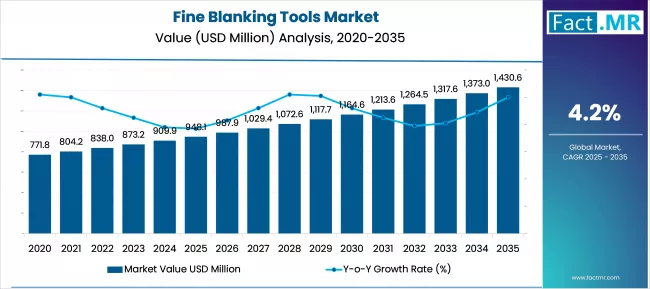
Fine Blanking Tools Market Market Value Analysis | Source: Fact.MR
| Metric | Value |
|---|---|
| Industry Size (2025E) | USD 948.1 million |
| Industry Size (2035F) | USD 1,430.6 million |
| CAGR (2025-2035) | 4.2% |
Source: Fact.MR analysis. Updated Sep 29, 2025
The global fine blanking tools market is forecast to expand from USD 948.1 million in 2025 to USD 1,430.6 million by 2035 at a CAGR of 4.2 percent. Growth begins with relatively modest value creation in 2025 and 2026.
The Fine Blanking Tools market has been witnessing steady growth, driven primarily by the rising demand for high-precision components across various industries. Automotive, aerospace, electronics, and medical device manufacturers increasingly require parts with complex geometries and tight tolerances. Fine blanking tools are uniquely capable of producing such components efficiently, making them indispensable in modern manufacturing. This demand is further reinforced by the need for reliable, durable parts in high-performance applications, which has created a consistent upward trajectory for the market.
The growth of electric vehicles (EVs) has also opened new opportunities for the fine blanking tools market. EVs require intricate components for motors, battery systems, and other electronic parts, creating additional demand for high-precision tooling solutions. Alongside this, industries are increasingly focused on cost-effective production methods. Fine blanking tools reduce post-processing requirements, minimize waste, and improve overall production efficiency, making them an attractive choice for high-volume manufacturing sectors like automotive and electronics.
Regionally, Asia-Pacific is emerging as a key growth hub due to rapid industrialization in countries such as China and India. Europe, led by Germany’s advanced manufacturing sector, and North America, with its technology-driven industries, are also contributing to the market’s expansion. Overall, the Fine Blanking Tools market is expected to continue on a growth trajectory, driven by the combination of rising demand for precision parts, technological innovations, and increasing adoption of automated manufacturing processes.
Key Fine Blanking Tools Market Dynamics
Rising Demand for High-Precision Components
The demand for high-precision components is one of the primary drivers of the Fine Blanking Tools market. Industries like automotive, aerospace, electronics, and medical devices increasingly require components with complex geometries, tight tolerances, and smooth edges. Fine blanking tools allow manufacturers to meet these stringent specifications, which is essential for high-performance applications.
In the automotive sector, fine blanking tools are widely used to manufacture gears, transmission parts, and housings that demand both precision and durability. Similarly, aerospace components require intricate manufacturing with minimal defects, which fine blanking tools can provide.
Medical devices, including surgical instruments and implants, also rely on fine blanking tools due to their ability to produce clean, precise, and reliable parts. This consistent demand for high-quality, accurate components across industries ensures a steady growth trajectory for the market.
Technological Advancements and Automation Integration
Technological innovations have significantly enhanced the efficiency and durability of fine blanking tools. Advanced materials such as high-strength steel, carbides, and specialized coatings allow these tools to handle complex part geometries while extending tool life and performance.
Integration with automated manufacturing systems and Industry 4.0 technologies further boosts their adoption. Smart monitoring systems, automated presses, and robotic handling allow fine blanking tools to operate seamlessly in high-volume production lines, reducing manual intervention and errors.
Automation also helps maintain consistent quality across components, which is critical in industries like automotive and electronics. Manufacturers can achieve higher precision at faster speeds, improving productivity and reducing overall production costs.
Growth in Electric Vehicle (EV) Production
The rise of electric vehicles is creating new opportunities for fine blanking tools. EVs require specialized components for motors, batteries, power electronics, and other systems, all of which demand precise manufacturing to meet performance and safety standards.
Fine blanking tools can produce intricate EV components efficiently, ensuring consistent quality and minimal post-processing. For instance, high-precision motor parts and battery casings can be manufactured to tight tolerances using these tools, which is crucial for the reliability and efficiency of EVs.
As global EV adoption increases, particularly in Europe, North America, and Asia-Pacific, the demand for fine blanking tools in this sector is expected to rise sharply. Manufacturers are increasingly investing in these tools to support EV production, which in turn drives the overall growth of the market.
High Initial Tooling Costs
The high initial investment required for fine blanking tools can act as a barrier to market growth, especially for small and medium-sized enterprises (SMEs). Advanced materials, precision engineering, and specialized designs make these tools expensive compared to conventional stamping or machining alternatives.
This cost factor can limit adoption in regions where capital expenditure is tightly controlled. Companies must weigh the long-term benefits of precision and durability against the upfront expenditure, which may slow market penetration.
Additionally, organizations may require multiple tool sets for different component specifications, further increasing the initial financial burden. This is particularly relevant for industries producing varied product lines with frequent design changes.
Complex Maintenance Requirements
Fine blanking tools require regular maintenance and skilled operators to ensure optimal performance. The precision and durability of the tools depend on proper calibration, handling, and servicing, which adds to operational complexity.
Companies without access to trained personnel may face challenges in maintaining tool efficiency, leading to reduced productivity or increased downtime. In industries where production schedules are tight, this can directly affect output and profitability.
Hence, the requirement for skilled labor and consistent maintenance practices remains a notable restraint, limiting the market’s adoption rate, particularly among SMEs or emerging manufacturers.
Competition from Alternative Manufacturing Techniques
Alternative manufacturing techniques, such as laser cutting, stamping, and CNC machining, pose a challenge to the fine blanking tools market. These methods can sometimes offer faster production speeds, lower costs, or easier adaptability for certain components, making them attractive alternatives.
For components that do not require extremely tight tolerances or high-precision edges, manufacturers may prefer these alternative methods to reduce operational costs and production time. This limits the universal applicability of fine blanking tools.
As a result, the presence and development of alternative technologies act as a restraint, challenging fine blanking tools to maintain their relevance by offering unique advantages in precision and production quality.
Country-Wise Outlook
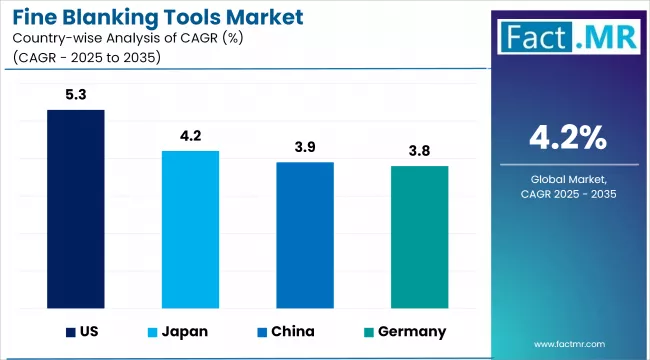
Fine Blanking Tools Market Cagr Analysis By Country | Source: Fact.MR
| Country | CAGR (2025-35) |
|---|---|
| U.S. | 5.3% |
| Japan | 4.2% |
| Germany | 3.8% |
Source: Fact.MR analysis. Updated Sep 29, 2025
U.S. Strengthens Fine Blanking Tools Market through Increasing Demand for High-Precision Components
The fine blanking tools market in the United States has been experiencing steady growth, driven largely by the increasing demand for high-precision components across automotive, aerospace, electronics, and medical device industries. U.S. manufacturers are investing in fine blanking technology to produce complex parts with tight tolerances, smooth edges, and minimal post-processing requirements. This precision is crucial for applications such as automotive transmission parts, aerospace structural components, and medical devices, which require consistent quality and performance.
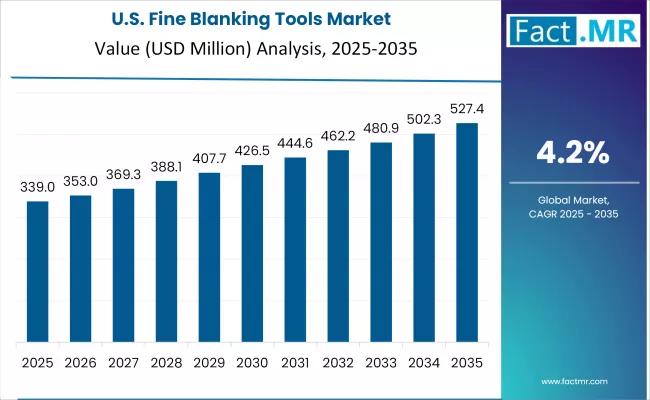
Fine Blanking Tools Market Country Value Analysis | Source: Fact.MR
The growth of the electric vehicle (EV) sector in the U.S. is another major factor driving market adoption. EVs require specialized components for motors, batteries, and electronic systems, all of which demand high precision. Fine blanking tools are ideally suited for producing these parts efficiently, ensuring both reliability and cost-effectiveness. As U.S. EV production expands and government initiatives promote clean energy vehicles, the demand for fine blanking tools in the sector is expected to rise steadily.
- U.S. market driven by automotive, aerospace, and electronics sectors.
- Technological advancements and automation enhance tool efficiency.
- EV production growth fuels demand for high-precision components.
Japan's Fine Blanking Tools Market Thrives on Country’s Advanced Manufacturing Capabilities and Strong Industrial Base
The fine blanking tools market in Japan is witnessing steady growth, fueled by the country’s advanced manufacturing capabilities and strong industrial base. Japanese manufacturers, particularly in the automotive sector, increasingly rely on fine blanking tools to produce high-precision components such as gears, transmission parts, and structural elements.
These components require tight tolerance and smooth finishes, making fine blanking tools essential for maintaining quality and performance. Besides automotive, the aerospace and electronics industries in Japan are also driving demand, as they require precise and reliable manufacturing solutions.
The growing adoption of electric vehicles (EVs) in Japan has also contributed to market growth. EV production requires specialized components for motors, battery systems, and electronic modules, all of which demand precise manufacturing. Fine blanking tools can produce these components efficiently and accurately, meeting both quality and cost-effectiveness requirements. Government incentives supporting EV adoption and technological innovation in the automotive sector are expected to sustain this demand for the coming years.
- Automotive sector remains the primary growth driver.
- Technological innovation enhances precision and operational efficiency.
Germany Advances in Fine Blanking Tools Market with Focus on Country’s Advanced Manufacturing Ecosystem
The fine blanking tools market in Germany is witnessing steady growth, supported by the country’s advanced manufacturing ecosystem and strong industrial base. German manufacturers, especially in the automotive sector, rely heavily on fine blanking tools to produce high-precision components such as gears, transmission parts, and structural elements.
These parts require tight tolerances and smooth finishes, making fine blanking tools essential for ensuring quality, performance, and reliability. Beyond automotive, the aerospace and electronics industries also contribute to market demand, as they require precision components that fine blanking tools can efficiently provide.
The growth of electric vehicle (EV) production in Germany further supports the market. EVs require specialized components for motors, battery systems, and electronic modules, all demanding high-precision manufacturing. Fine blanking tools are ideally suited to produce these components with minimal post-processing, helping manufacturers meet both quality and cost-effectiveness targets. Government initiatives promoting EV adoption and technological innovation are likely to sustain and accelerate this demand in the coming years.
- Automotive sector is the main driver of growth.
- Technological innovation enhances precision and efficiency.
Category-wise Analysis
Automotive to Exhibit Leading Share by Industry
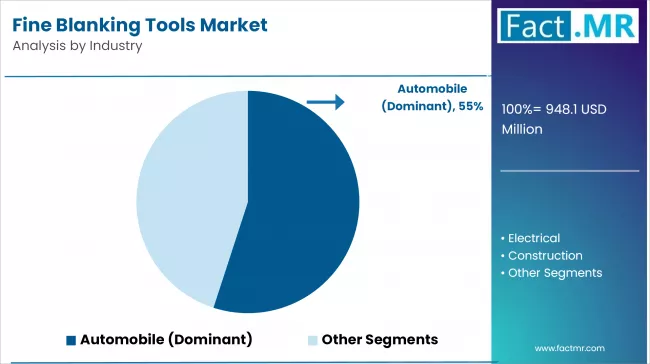
Fine Blanking Tools Market Analysis By Industry | Source: Fact.MR
The automotive industry is the dominating segment in the fine blanking tools market, primarily due to the sector’s high demand for precision-engineered components such as gears, transmission parts, motor housing, and structural elements.
Fine blanking tools enable manufacturers to produce parts with tight tolerances, smooth edges, and minimal post-processing, which is essential for ensuring vehicle performance, reliability, and safety. The large-scale production of automobiles globally, coupled with stringent quality standards and the need for cost-effective manufacturing, drives the continued dominance of this segment.
The electrical and electronics segment is the fastest growing sector in the fine blanking tools market. The increasing miniaturization of electronic devices, expansion of consumer electronics, and rising adoption of smart devices are driving the need for highly precise, intricate components such as connectors, switches, and housing. Fine blanking tools allow manufacturers to produce these parts efficiently, with high accuracy and reduced material wastage.
Sliding-Punch to Exhibit Leading by Type
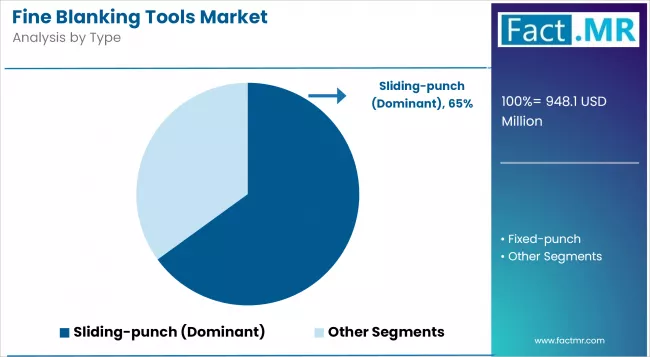
Fine Blanking Tools Market Analysis By Type | Source: Fact.MR
The sliding-punch segment dominates the fine blanking tools market due to its versatility and ability to produce complex parts with high precision. Sliding-punch tools are widely used in industries such as automotive, aerospace, and electronics, where intricate geometries and tight tolerances are essential.
These tools allow for efficient blanking of components with variable thicknesses and detailed profiles, reducing post-processing requirements and minimizing material waste. The high adoption of sliding-punch tools in high-volume production environments, especially in automotive and electrical applications, reinforces their leading position in the market.
The fixed-punch segment is the fastest-growing type in the fine blanking tools market. Fixed-punch tools are preferred for applications that require consistent and repetitive precision, such as in electrical connectors, switches, and standardized industrial components. Their simplicity, durability, and ability to deliver high accuracy with minimal maintenance make them increasingly attractive for manufacturers aiming to improve production efficiency while controlling costs.
Competitive Analysis
The global fine blanking tools market is highly competitive, driven by the growing demand for precision-engineered components in automotive, aerospace, electronics, and medical industries. Companies are focusing on delivering high-quality, durable, and efficient tools that reduce post-processing, minimize waste, and meet strict dimensional tolerances. This demand has encouraged both established players and emerging manufacturers to continuously innovate their product offerings to stay ahead in the market.
Technological innovation is a major factor shaping the competitive landscape. Companies are investing in advanced materials like high-strength steel and carbide coatings, as well as new tool designs that enhance durability, precision, and operational efficiency.
The integration of automation and Industry 4.0 technologies has become critical, as fine blanking tools are increasingly used in automated production lines where consistent quality, speed, and reliability are essential. This focus on innovation allows leading manufacturers to offer solutions tailored to high-volume and complex component production, which strengthens their market position.
Key Players in the Market
- TIDC India
- IFB industries
- Petford Group
- ART Group
- Ferrari & Carena S.r.l
- Quantum Manufacturing Limited
- Kenmode Precision Metal Stamping
- Menear Engineering
Recent Developments
- In February 2025, Tube Investments of India (part of the Murugappa Group) announced a ₹170 crore (~US$20-25 million depending on rate) investment in expanding its fine blanking business. The plan includes setting up a new facility in western India and expanding existing capacity in southern India, with both greenfield and brownfield components.
Segmentation
Segmentation of Fine Blanking Tools Market
-
By Industry :
- Electrical
- Automobile
- Construction
- Precision Machinery
- Oil & Gas
- Aviation
-
By Type :
- Sliding-punch
- Fixed-punch
-
By Die :
- Progressive Die
- Fine Blanking Die
- Single Die
-
By Region :
- North America
- Latin America
- Western Europe
- Eastern Europe
- East Asia
- South Asia & Pacific
- Middle East & Africa
Frequently Asked Questions
What is the Global Fine Blanking Tools Market size in 2025?
Who are the Major Players Operating in the Fine Blanking Tools Market?
What is the Estimated Valuation of the Fine Blanking Tools Market by 2035?
What Value CAGR Did the Fine Blanking Tools Market Exhibit over the Last Five Years?
Who worked on this report


Preview the report firsthand - request a free sample
Free SampleGet the brochure for pricing and purchase details
Download PDF