- Market Value (2025): USD 1.5 Bn
- Estimated Value (2026): USD 1.6 Bn
- Forecast Value (2036): USD 3.2 Bn
- CAGR (2026-2036): 7.2%
What is the Brining Systems Market forecast to be worth by 2036?
USD 1.6 Billion in 2026 to USD 3.2 Billion by 2036, at 7.2% CAGR.
- The brining systems market reached USD 1.5 Billion in 2025 as meat and dairy processors expanded process-control upgrades.
- Demand is projected to increase from USD 1.6 Billion in 2026 to USD 3.2 Billion by 2036.
- The market is forecast to record 7.2% CAGR from 2026 to 2036 owing to controlled brine concentration, safer handling, and stronger batch documentation.
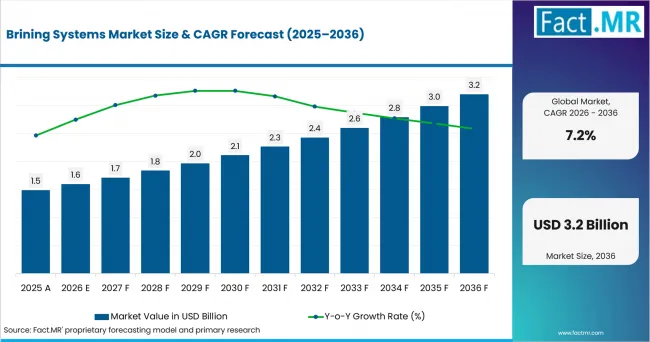
Brining Systems Market Value Analysis | Source: Fact.MR
What are the defining numbers behind Brining Systems Market growth?
USD 1.6 Billion absolute opportunity by 2036, led by Vacuum Brining Systems and Meat Processing Applications alongside Automated Brining Technology.
- Demand Drivers in the Market
- Meat processors need vacuum brining units that reduce uneven salt uptake when high-volume products move through batch and continuous lines.
- USDA ERS reported on August 21, 2025 that its latest data indicated 226 pounds of red meat and poultry were available per U.S. consumer in 2025.
- Cheese makers require brine circulation and cooling systems because texture, rind formation, and salt balance depend on steady brine conditions.
- Seafood processors are expected to prioritize hygienic injection and immersion systems as export customers request tighter process records.
- Key Segments Analyzed
- By Product: Vacuum Brining Systems are expected to hold 62.80% share in 2026 owing to stronger yield control in meat and cheese processing.
- By Application: Meat Processing Applications are projected to account for 74.60% share in 2026 due to high use in poultry, pork, beef, and cured meat lines.
- By End Use: Meat Processing Industry is anticipated to capture 68.40% share in 2026 as industrial plants need repeatable brine delivery.
- By Technology: Automated Brining Technology is estimated to represent 55.90% share in 2026 supported by recipe control and operator safety needs.
- By Formulation: Liquid Brine Formulations are forecast to hold 71.30% share in 2026 because they suit vacuum, injection, and immersion equipment.
- By Distribution Channel: Direct Industrial Sales are projected to account for 44.80% share in 2026 as plant-level specification work favors OEM engagement.
- Analyst Opinion at Fact.MR
- Shambhu Nath Jha, Principal Consultant at Fact.MR, notes, “Salt uptake as a process-control issue rather than only a recipe step. Adoption is expected to depend on how well suppliers connect tanks, pumps, injectors, sensors and cleaning routines. Strong supplier cases combine hygienic design, repeatable brine strength and practical service support for production plants.”
- Strategic Implications
- Plant engineering teams should set brine concentration tolerance before selecting a vacuum tank or injection line.
- Equipment suppliers should prove brine handling, cooling, filtration, and service response under real plant conditions.
- Investors should separate dedicated brining exposure from broader dairy or food processing equipment revenue.
Germany is forecast to post 8.3% CAGR through 2036, supported by meat output and cheese processing depth. Brazil is anticipated to advance at 7.6% CAGR as export meat plants expand automated handling. The USA is expected to record 6.8% CAGR due to poultry scale. The UK is projected to hold 6.1% CAGR as processors balance throughput and retrofit limits. Japan is estimated to reach 5.4% CAGR through seafood and specialty food applications.
How does the Brining Systems Market break down by segment?
Vacuum Brining Systems lead at 62.80%; Meat Processing Applications lead at 74.60%.
Which product type dominates?
Vacuum Brining Systems are projected to account for 62.8% share in 2026.
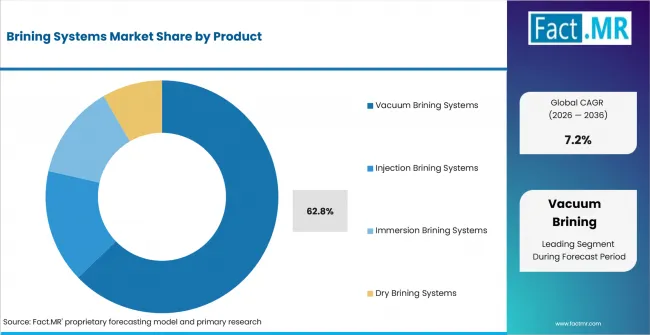
Brining Systems Market Analysis By Product | Source: Fact.MR
Vacuum brining systems are projected to hold the main product position because they help processors control penetration and yield. Batch units fit cheese and cured meat lines. Continuous systems serve plants where throughput and repeatability carry more weight. Tetra Pak, Sordi, and Scherjon show direct cheese brining capability.
What leads the Application segment?
Meat Processing Applications are expected to hold 74.6% share in 2026.
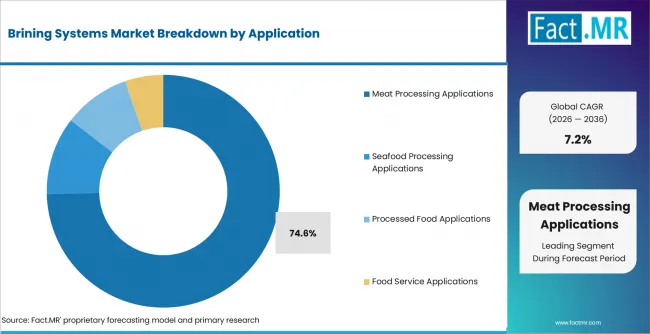
Brining Systems Market Analysis By Application | Source: Fact.MR
Meat processing as the main application base. DEFRA’s Agriculture in the United Kingdom 2025 reports that home-fed poultry meat production increased by 0.2% to 2.0 million tonnes in 2025. The government statistic does not establish the relative size of brining-system applications.
How does End Use shape demand?
Meat Processing Industry is anticipated to lead with 68.4% share in 2026.
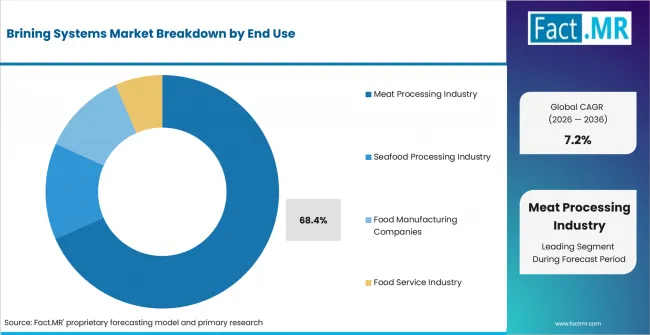
Brining Systems Market Analysis By End Use | Source: Fact.MR
The meat processing industry is anticipated to lead end-use demand because industrial plants need repeatable brine preparation. IBGE reported on March 18, 2026 that 42.94 million cattle were slaughtered in Brazil in 2025. The processing scale as supportive context for automated salinity control and line-fit equipment.
What supports Automated Brining Technology?
Automated Brining Technology is estimated to represent 55.9% share in 2026.
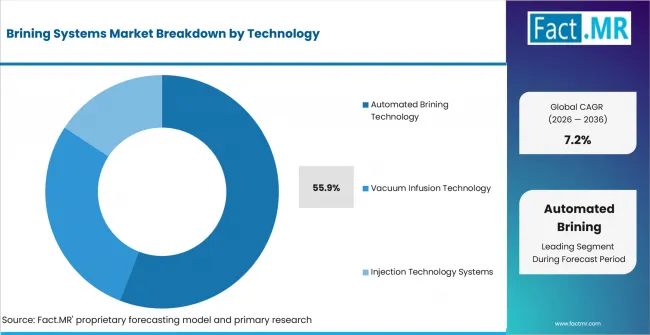
Brining Systems Market Analysis By Technology | Source: Fact.MR
Automated brining technology is estimated to lead because processors want recipe settings, salinity checks, and repeatable contact times. Tetra Pak launched Factory OS in November 2025 for food and beverage automation. Sensor-based monitoring supports temperature, salinity, and circulation records.
What supports Liquid Brine Formulations?
Liquid Brine Formulations are forecast to hold 71.3% share in 2026.
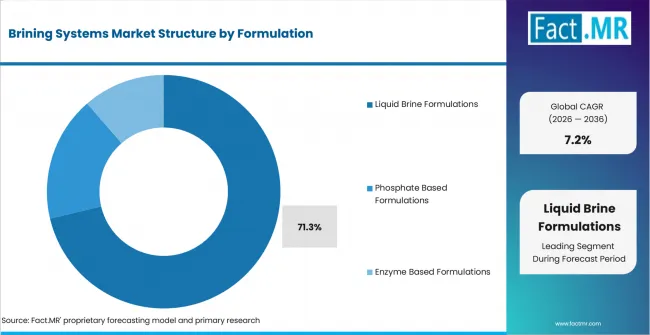
Brining Systems Market Analysis By Formulation | Source: Fact.MR
Liquid brine formulations are forecast to hold the main formulation share because they move through pumps, tanks, nozzles, and circulation loops easily. Salt-based brines remain the base input. Flavor-enhanced and protein-stabilizing formulations serve taste, retention, and texture needs.
What leads Distribution Channel demand?
Direct Industrial Sales are projected to account for 44.8% share in 2026.
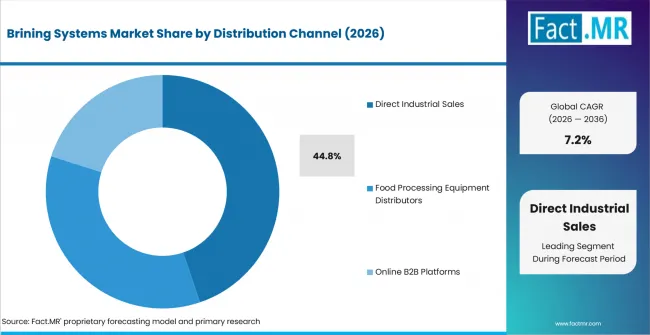
Brining Systems Market Analysis By Distribution Channel | Source: Fact.MR
Direct industrial sales are projected to lead distribution because brining systems require plant surveys, trials, and customized layouts. Food processing contracts support large projects. Specialized distributors remain relevant where service access and spare parts influence purchase timing.
What is accelerating Brining Systems Market adoption, and what is holding it back?
Automation demand drives it; sanitation and plant-fit costs restrain it.
Drivers Impact Analysis
| DRIVER | (~) % IMPACT ON CAGR | GEOGRAPHIC RELEVANCE | IMPACT TIMELINE |
|---|---|---|---|
| Industrial meat throughput | +1.8% | Germany, Brazil, USA | Short term (<= 2 years) |
| Vacuum yield control | +1.5% | Europe and North America | Short term (<= 2 years) |
| Automation and recipe tracking | +1.3% | USA, UK, Japan | Medium term (2-4 years) |
| Cheese and seafood specialization | +0.9% | Germany, Japan, UK | Medium term (2-4 years) |
| Direct plant engineering support | +0.6% | Global processing clusters | Long term (>= 4 years) |
- Industrial meat throughput: Meat plants need brining systems that keep pace with cutting, tumbling, packaging, and chilling lines. Equipment demand is expected to favor documented salt strength and cleaning routines.
- Vacuum yield control: Vacuum systems help processors reduce uneven salt uptake in dense cuts and cheese blocks. Demand is projected to stay linked to higher-value processed proteins.
- Automation and recipe tracking: Programmable controls reduce operator variation across batches. Automated brining technology is anticipated to gain share where audit requirements are tighter.
- Cheese and seafood specialization: Cheese makers and seafood processors require different contact conditions. Application-specific tanks, circulation, and cooling packages are expected to win specification work.
- Direct plant engineering support: Brining equipment must fit floor space, drainage, cleaning access, and upstream handling. Direct sales teams help processors test those limits before purchase.
Opportunity Impact Analysis
| OPPORTUNITY | (~) % IMPACT ON CAGR | GEOGRAPHIC RELEVANCE | IMPACT TIMELINE |
|---|---|---|---|
| Closed-loop brine handling | +1.0% | Europe and Japan | Medium term (2-4 years) |
| Hygienic liquid formulation control | +0.8% | USA and UK | Short term (<= 2 years) |
| Cheese brining upgrades | +0.7% | Germany, UK, Japan | Medium term (2-4 years) |
| Distributor service packages | +0.5% | Brazil and regional processors | Long term (>= 4 years) |
- Closed-loop brine handling: Recirculation, filtration, and temperature control reduce waste and stabilize quality. These systems are expected to appeal where brine reuse requires stronger hygiene checks.
- Hygienic liquid formulation control: Liquid brine systems support automated mixing and controlled dosing. The opportunity is concentrated in plants that manage multiple flavor or retention systems.
- Cheese brining upgrades: Cheese processors need brine baths that fit product geometry and maturation schedules. Replacement demand is anticipated where older baths limit throughput.
- Distributor service packages: Regional distributors can support smaller processors that lack dedicated engineering teams. Service packages are expected to cover installation, parts, salinity checks, and training.
Restraints Impact Analysis
| RESTRAINT | (~) % IMPACT ON CAGR | GEOGRAPHIC RELEVANCE | IMPACT TIMELINE |
|---|---|---|---|
| Sanitation validation cost | -1.2% | Global | Short term (<= 2 years) |
| Plant layout constraints | -0.9% | Older processing sites | Short term (<= 2 years) |
| Ingredient and water management | -0.7% | Europe, USA, Japan | Medium term (2-4 years) |
| Service availability gaps | -0.5% | Regional processors | Long term (>= 4 years) |
- Sanitation validation cost: Brining systems touch salt, protein residue, water, and flavor inputs. Cleaning proof adds cost before plants approve wider use.
- Plant layout constraints: Vacuum tanks, injectors, pumps, and circulation loops need floor space and drainage access. Retrofit cost can slow adoption in older plants.
- Ingredient and water management: Brine disposal, filtration, and reuse require careful control. Processors are anticipated to favor suppliers that reduce water use and simplify records.
- Service availability gaps: Brining systems need periodic inspection of pumps, needles, seals, chillers, and controls. Limited service access raises downtime risk for remote processors.
Which countries are scaling Brining Systems Market fastest?
- The country comparison spans 2.9 percentage points and forms three practical growth bands across the forecast period.
- Germany remains 0.7 percentage point above Brazil through meat production depth and cheese brining replacement needs.
- Brazil remains 0.8 percentage point above the USA as export-oriented meat plants require repeatable salt control.
- The USA remains 0.7 percentage point above the UK due to poultry scale and prepared meat capacity.
- The UK remains 0.7 percentage point above Japan as poultry and pork processors support replacement demand.
- Japan closes the displayed range through seafood processing and high-specification food production.
Comparable CAGRs can create different entry conditions due to plant scale, sanitation requirements, retrofit cost, and local service depth. Full report coverage includes North America, Latin America, Europe, East Asia, South Asia and Pacific, Middle East and Africa.
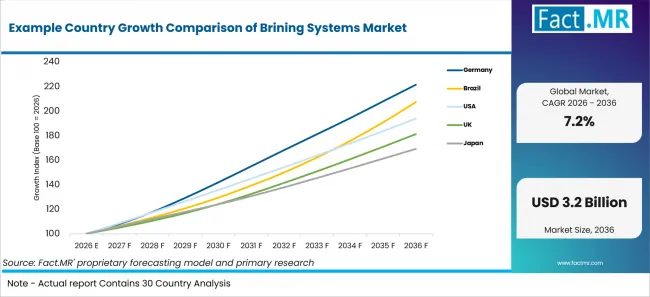
Example Country Growth Comparison Of Brining Systems Market | Source: Fact.MR
| COUNTRY | CAGR |
|---|---|
| Germany | 8.3% |
| Brazil | 7.6% |
| USA | 6.8% |
| UK | 6.1% |
| Japan | 5.4% |
What supports Germany adoption?
8.3% CAGR, supported by meat output and cheese processing depth.
Germany’s growth reflects high-volume meat production and precise dairy processing. Destatis reported on February 13, 2026 that German commercial slaughter establishments produced 6.9 million tonnes of meat in 2025, based on provisional results.
What supports Brazil adoption?
7.6% CAGR, driven by export-linked meat processing and plant-scale brining.
Brazil’s growth is tied to export meat plants that need stable recipes and documentation. Brazil’s Ministry of Ports and Airports reported on February 6, 2026, citing MDIC data compiled by ABIEC, that Brazil shipped 3.45 million tonnes of beef in 2025. The export-processing scale as supportive context for automated brine control and line reliability.
How is USA demand developing?
6.8% CAGR, backed by poultry scale and prepared meat capacity.
The USA’s growth reflects a mature market where poultry and prepared meat plants already use controlled processing equipment. Replacement demand is expected to favor systems that reduce manual brine checks and fit established sanitation plans. Direct industrial sales remain practical because plant trials usually precede purchase orders.
How does the UK perform?
6.1% CAGR, led by poultry throughput and chilled meat processing.
The UK’s outlook is shaped by poultry, pork, and chilled prepared protein lines. Processors are expected to use automated brining where labor availability and audit needs make manual checks harder to scale. Retrofit limits remain visible at older sites with fixed drains and chilled rooms.
What supports Japan’s growth?
5.4% CAGR, supported by seafood processing and compact food plants.
Japan’s growth reflects seafood processing and compact food production sites. MAFF reported on May 29, 2026, that Japan’s fishery and aquaculture production totaled 3,577,400 tonnes in 2025. Smaller production rooms are expected to favor compact systems with hygienic design and reliable service support.
Who leads the Brining Systems Market?
Direct brining evidence is strongest for Tetra Pak, Sordi, Scherjon, DUE CI INOX, D.R. Tech, and C. van 't Riet.
Tetra Pak provides cheese brining systems, while Sordi Impianti lists brining systems for pressed and hard cheese lines. Scherjon supplies tailor-made systems with circulation and automatic temperature control. DUE CI INOX supplies stainless steel brine systems, and D.R. Tech offers automated brine systems.
Which companies are the key providers?
Companies include food processing and dairy equipment suppliers with brining, brine handling, or adjacent hygienic liquid-processing capability.
- van den Heuvel Dairy & Food Equipment
- Sordi Impianti Ltd
- Scherjon Dairy Equipment Holland
- DUE CI INOX
- C. van ‘t Riet Zuiveltechnologie
- DR Tech, Inc.
- Tetra Pak International S.A.
Bibliography
- Brazilian Institute of Geography and Statistics. (2026, March 18). In 2025, Brazil registers the highest production of milk, leather and eggs in history; slaughter of cattle, chickens and pigs also hits record. IBGE News Agency.
- Statistisches Bundesamt (Destatis). (2026, February 13). Fleischproduktion im Jahr 2025 nahezu unverändert [Meat production in 2025 almost unchanged].
- Food Safety and Inspection Service. (2026, August 10). Meat, Poultry and Egg Product Inspection Directory. U.S. Department of Agriculture.
- Department for Environment, Food & Rural Affairs. (2026, July 29). Agriculture in the United Kingdom 2025. GOV.UK.
- SPX FLOW. (2025, November 13). Expanded APV EQ homogenizer range offers higher capacity, more flexibility.
- Tetra Pak. (2025, November 4). Tetra Pak launches Tetra Pak® Factory OS™ to make factories AI-ready.
- Grossen, G. (2025, August 21). Per capita availability of red meat and poultry projected higher in 2025 and 2026. Economic Research Service, U.S. Department of Agriculture.
This Report Addresses
- The report provides strategic intelligence on Product and Application choices that shape industrial food processing projects.
- Segment analysis covers Vacuum Brining Systems and Meat Processing Applications as the share leaders within the 2026 market.
- Country outlook evaluates Germany and Brazil alongside the USA, UK, and Japan across the forecast range.
- Competitive analysis reviews supplier relevance across cheese brining, brine handling, hygienic liquid processing, and direct industrial sales.
- Dairy use connects with cheese categories and parmesan cheese where brine baths and maturation controls influence product quality.
- Equipment comparisons touch heat processing equipment and microwave heating equipment where processors evaluate line control and integration.
What does the Brining Systems Market cover?
Brining systems cover industrial equipment that applies or manages salt-based liquid or dry brines during food processing. The market includes vacuum, injection, immersion, and dry brining systems. It also includes pumps, tanks, controls, and circulation loops sold as part of a brining solution.
Coverage extends to meat, poultry, seafood, cheese, processed food, and food service applications. The market includes systems used for salt uptake, flavor delivery, water retention, texture control, and chilled brine management. Unrelated mixing, pasteurization, and packaging equipment are outside scope.
What is included in the scope?
The scope includes brining units sold to industrial meat plants, packaged meat producers, seafood processors, cheese makers, frozen food companies, and food service processors. Product coverage includes vacuum tanks, injectors, immersion baths, agitation units, brine cooling, salinity control, and stainless cleaning-ready designs.
What is excluded from the scope?
The scope excludes household brining containers, seasoning mixes, retail marinades, and unrelated food preparation tools. Standalone pumps or tanks are excluded unless the seller positions them for brine preparation, circulation, injection, immersion, or dry brining.
How Was the Analysis Built?
The analysis draws on 120+ sources, 35+ company portfolios, 25+ countries, and more than 20 industry interviews.
- Primary Research: Primary research includes discussions with manufacturers, service providers, technology developers, distributors, end users, procurement teams, and subject-matter experts. These conversations examine purchasing priorities, product adoption, operational challenges, approval requirements, competitive positioning, and the factors that influence wider market acceptance.
- Desk Research: Desk research covers government statistics, regulatory publications, company filings, trade data, technical studies, industry associations, standards, public policy, and other authoritative sources. Every source used in the analysis is documented in the bibliography.
- Market Sizing and Forecasting: Market estimates combine historical performance, demand indicators, pricing and volume trends, segment shares, company participation, country-level growth, adoption patterns, investment activity, and barriers to market expansion.
- Data Validation and Update Cycle: Findings are validated by comparing primary interviews with public data, company activity, regulatory changes, trade patterns, and industry developments. Regular updates review new product launches, capacity changes, partnerships, approvals, procurement trends, and shifts in commercial adoption.
What is the report’s scope and coverage?
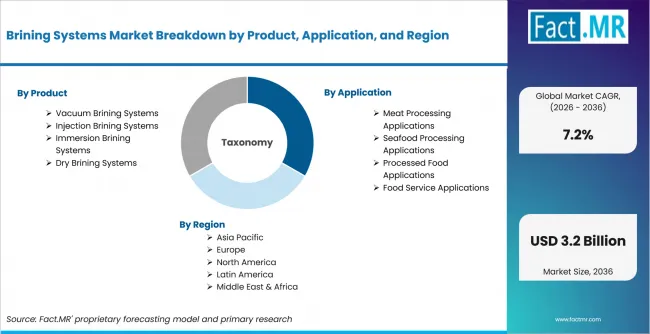
Brining Systems Market Breakdown By Product, Application, And Region | Source: Fact.MR
| ATTRIBUTE | DETAILS |
|---|---|
| Quantitative Units | USD Billion |
| Market Definition | Industrial systems that prepare, circulate, inject, immerse, cool, filter, or control brine in food production. |
| Product | Vacuum Brining Systems; Batch Vacuum Brining Units; Continuous Vacuum Brining Systems; Injection Brining Systems; Immersion Brining Systems; Dry Brining Systems |
| Application | Meat Processing Applications; Seafood Processing Applications; Processed Food Applications; Food Service Applications |
| End Use | Meat Processing Industry; Seafood Processing Industry; Food Manufacturing Companies; Food Service Industry |
| Technology | Automated Brining Technology; Vacuum Infusion Technology; Injection Technology Systems; Sensor Based Monitoring Systems |
| Formulation | Liquid Brine Formulations; Salt Based Solutions; Flavor Enhanced Brines; Phosphate Based Formulations; Enzyme Based Formulations |
| Distribution Channel | Direct Industrial Sales; Food Processing Equipment Distributors; Online B2B Platforms; Manufacturer Direct Platforms |
| Regions Covered | North America; Latin America; Europe; East Asia; South Asia and Pacific; Middle East and Africa |
| Countries Covered | Germany; Brazil; USA; UK; Japan |
| Key Companies Profiled | van den Heuvel Dairy & Food Equipment; Sordi Impianti Ltd; Scherjon Dairy Equipment Holland; DUE CI INOX; C. van ‘t Riet Zuiveltechnologie; DR Tech, Inc.; Tetra Pak International S.A. |
| Forecast Period | 2026 to 2036 |
| Approach | Hybrid top-down and bottom-up approach using food processing equipment demand; meat, cheese, and seafood production indicators; brining system portfolios; automation needs; sanitation requirements; country adoption patterns and company relevance review |
How is the market segmented?
-
By Product:
- Vacuum Brining Systems
- Batch Vacuum Brining Units
- Continuous Vacuum Brining Systems
- Injection Brining Systems
- Needle Injection Systems
- High Pressure Injection Systems
- Immersion Brining Systems
- Static Brining Tanks
- Agitated Brining Systems
- Dry Brining Systems
- Salt Coating Systems
- Seasoning Based Systems
- Vacuum Brining Systems
-
By Application:
- Meat Processing Applications
- Poultry Processing
- Red Meat Processing
- Seafood Processing Applications
- Fish Processing Systems
- Shellfish Processing Systems
- Processed Food Applications
- Ready To Cook Products
- Processed Protein Foods
- Food Service Applications
- Restaurant Supply Chains
- Catering Industry Systems
- Meat Processing Applications
-
By End Use:
- Meat Processing Industry
- Industrial Meat Plants
- Packaged Meat Producers
- Seafood Processing Industry
- Marine Processing Companies
- Aquaculture Processing Firms
- Food Manufacturing Companies
- Frozen Food Producers
- Processed Food Companies
- Food Service Industry
- Quick Service Restaurants
- Institutional Catering
- Meat Processing Industry
-
By Technology:
- Automated Brining Technology
- Programmable Brining Systems
- Sensor Based Monitoring Systems
- Vacuum Infusion Technology
- Pressure Controlled Systems
- Rotary Vacuum Systems
- Injection Technology Systems
- Multi Needle Technology
- Pressure Regulation Systems
- Automated Brining Technology
-
By Formulation:
- Liquid Brine Formulations
- Salt Based Solutions
- Flavor Enhanced Brines
- Phosphate Based Formulations
- Water Retention Solutions
- Protein Stabilizing Formulations
- Enzyme Based Formulations
- Tenderization Systems
- Fermentation Assisted Brines
- Liquid Brine Formulations
-
By Distribution Channel:
- Direct Industrial Sales
- Food Processing Contracts
- Enterprise Supply Deals
- Food Processing Equipment Distributors
- Regional Distributors
- Specialized Food Tech Distributors
- Online B2B Platforms
- Industrial Procurement Portals
- Manufacturer Direct Platforms
- Direct Industrial Sales
-
By Region:
- North America
- Latin America
- Europe
- East Asia
- South Asia and Oceania
- Middle East and Africa