- Base Value(2026): 430.4 Mn
- Estimated Value(2026): 430.4 Mn
- Forecast Value (2036): 973.1 Mn
- CAGR (2026 - 2036): 8.5%
Hybrid Antioxidant Systems for Long-Shelf-Life Oils and Snacks Market Forecast and Outlook 2026 to 2036
The global market for hybrid antioxidant systems is positioned as a critical response to the evolving stability challenges within the food industry, projected to grow from USD 430.39 million in 2026 to USD 973.11 million by 2036, advancing at an 8.5% CAGR. This growth reflects a decisive shift away from reliance on single-mode antioxidants toward sophisticated, multi-mechanism blends engineered to combat oxidative rancidity across complex food matrices and extended distribution cycles. Hybrid Antioxidant Systems For Long Shelf Life Oils Market Market Value Analysis | Source: Fact.MR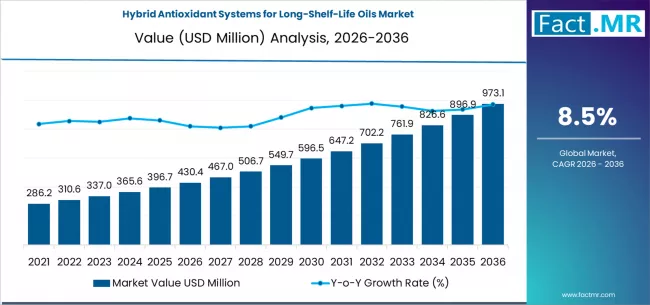
Summary of Hybrid Antioxidant Systems for Long-Shelf-Life Oils Market
- Market Snapshot
- Global hybrid antioxidant systems for long-shelf-life oils market revenue stood at USD 430.39 million in 2026 and is forecast to reach USD 973.11 million by 2036.
- At an 8.5%CAGRfrom 2026 to 2036, this market reflects a decisive shift away from single-mode antioxidants toward sophisticated multi-mechanism blends combating oxidative rancidity.
- Growth is driven by the increasing commercialization of healthier but more oxidation-prone oils (flaxseed, fish oil, high-oleic sunflower) and the global expansion of snack food consumption.
- The market's trajectory is defined by the imperative to balance efficacy with consumer demand for cleaner labels, driving synergistic combinations of natural extracts with minimal-level synthetic antioxidants.
- Demand and Growth Drivers
- Increasing commercialization of healthier but more oxidation-prone oils such as flaxseed, fish oil, and high-oleic sunflower in bottled and ingredient formats.
- Global expansion of snack food consumption coupled with longer logistical supply chains intensifies the need for robust shelf-life extension solutions.
- Regulatory pressures and consumer preference limiting certain synthetic antioxidants push manufacturers toward optimized hybrid solutions minimizing synthetic content through naturalsynergy.
- Development of antioxidant systems specifically designed for high-temperature frying operations, focusing on fry-life extension and carry-through protection into the finished snack.
- Growing innovation in encapsulation-based antioxidant delivery to protect active compounds during processing and control their release foroptimalefficacy.
- Product and Segment View
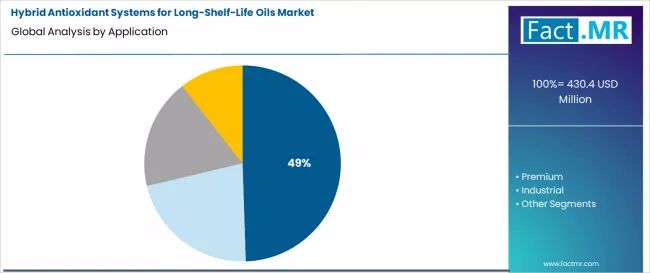
- Standard application segment leads with a 49.5% market share in 2026, encompassing high-volume frying oils and mainstream snacks where cost-effective shelf-life management is paramount.
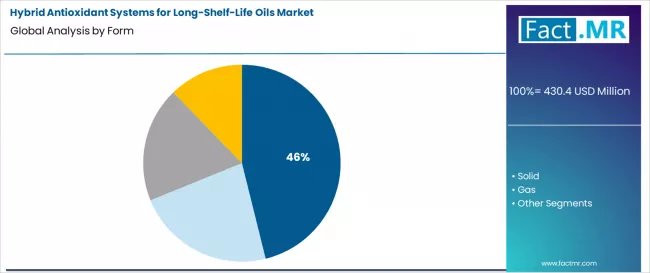
- Liquid form leads the Form segment with a 46.1% share in 2026,favoredfor ease of integration, precise dosing via spray or metering into oil streams, and homogeneous distribution.
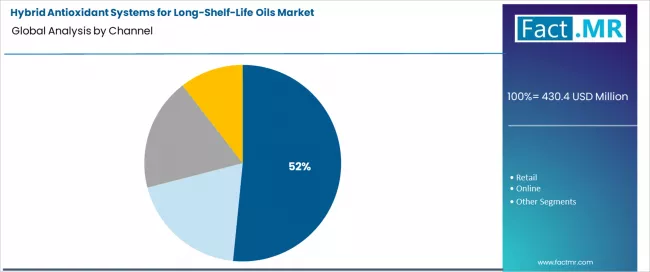
- Direct channel leads with a 52% share in 2026, reflecting the technical nature of hybrid antioxidant selection and the close collaboration needed between suppliers and food manufacturers.
- Additional segments include Premium and Industrial applications; Solid, Gas, Gel forms; and Retail, Online, Distributor sales channels.
- Geography and Competitive Outlook
- China (12.0%CAGR), France (11.1%), USA (10.8%), and Germany (10.6%) are the key growth countries across this market.
- East Asia, Western Europe, and North America are primary regional markets, driven by massive snack industries, premium oil cultures, and industrial-scale food processing sectors.
- Market expansion is closely tied to clean-label regulatory evolution, natural antioxidant supply chain development, and the growth of specialty oil categories in both retail and foodservice.
- Key companies active in this market includeKeminIndustries Inc., BASF SE, ADM, DSM-Firmenich, International Flavors & Fragrances (IFF), and Eastman Chemical Company.
Hybrid Antioxidant Systems for Long-Shelf-Life Oils — At a Glance
| Attribute | Details |
|---|---|
| Market Value 2026 | USD 430.39 Million |
| Market Value 2036 | USD 973.11 Million |
| Absolute Dollar Opportunity 2026–2036 | USD 542.7Million |
| Total Growth 2026–2036 | 126% |
| CAGR2026–2036 | 8.5% |
| Growth Multiple | 2.3x |
| Key Demand Theme | Synergistic natural-synthetic antioxidant blends providing multi-mechanism oxidation protection for high-value oils and snack foods across extended distribution supply chains |
| Leading Segment by Application (2026) | Standard |
| Application Segment Share (2026) | 49.5% |
| Leading Segment by Form (2026) | Liquid |
| Form Segment Share (2026) | 46.1% |
| Leading Segment by Channel (2026) | Direct |
| Channel Segment Share (2026) | 52% |
| Key Growth Regions | East Asia, Western Europe, North America |
| CountryCAGRs | China 12.0%, France 11.1%, USA 10.8%, Germany 10.6% |
| Top Companies | KeminIndustries Inc., BASF SE, ADM, DSM-Firmenich,IFF, Eastman Chemical Company |
| Segmentation by Application | Standard, Premium, Industrial, Other |
| Segmentation by Form | Liquid, Solid, Gas, Gel |
| Segmentation by Channel | Direct, Retail, Online, Distributor |
| Segmentation by Region | North America, Latin America, Western Europe, Eastern Europe, East Asia, South Asia & Pacific, MEA |
Source: Fact.MR analysis. Updated Apr 15, 2026
The market's trajectory is defined by the imperative to balance efficacy with consumer demand for cleaner labels, driving innovation in synergistic combinations of natural extracts like rosemary, tocopherols, and ascorbyl palmitate with precisely selected, minimal-level synthetic antioxidants such as TBHQ or BHT. A key trend is the strategic design of these systems to provide comprehensive protection at different stages of the oxidation cascade, some components act as radical scavengers, others as metal chelators, and others as oxygen scavengers, thereby delivering superior shelf-life extension without compromising sensory attributes like color, flavor, or odor. This approach is becoming indispensable for high-value oils rich in polyunsaturated fats, fried snacks, and protein-based savory products, where lipid oxidation directly impacts consumer rejection rates and economic loss.
Category
| Category | Segments |
|---|---|
| Application | Standard, Premium, Industrial, Other |
| Form | Liquid, Solid, Gas, Gel |
| Channel | Direct, Retail, Online, Distributor |
| Region | North America, Latin America, Western Europe, Eastern Europe, East Asia, South Asia & Pacific, MEA |
Source: Fact.MR analysis. Updated Apr 15, 2026
Segmental Analysis
By Application, Which Segment Demonstrates the Broadest Adoption?
Hybrid Antioxidant Systems For Long Shelf Life Oils Market Analysis By Application | Source: Fact.MR
The standard application segment commands a dominant 49% market share. This segment encompasses the high-volume production of common frying oils, packaged cooking oils, and mainstream savory snacks where cost-effective shelf-life management is paramount.
Standard hybrid systems provide a reliable, optimized balance of performance and affordability, effectively delaying rancidity to meet typical commercial shelf-life requirements without the premium cost associated with all-natural or fully customized formulations. Their widespread use is rooted in delivering consistent, measurable results for everyday products across global supply chains.
By Form, Which Type Offers the Greatest Processing and Handling Advantage?
Hybrid Antioxidant Systems For Long Shelf Life Oils Market Analysis By Form | Source: Fact.MR
Liquid-form antioxidant systems lead the market with a 46% share, primarily due to their ease of integration and precise dosing capabilities. Liquid systems can be uniformly sprayed onto snack surfaces, easily metered into oil streams during deodorization, or blended homogeneously into fat-based ingredients.
This form factor eliminates dusting issues, ensures consistent distribution-a critical factor for efficacy-and integrates seamlessly with automated food manufacturing processes, reducing waste and enhancing operational control for oil refiners and snack producers.
By Channel, How are Products Primarily Reaching End-Users?
Hybrid Antioxidant Systems For Long Shelf Life Oils Market Analysis By Channel | Source: Fact.MR
Direct sales constitute the leading channel, holding a 52% share. The technical nature of hybrid antioxidant selection necessitates a close collaborative relationship between ingredient suppliers and food manufacturers. Direct engagement allows suppliers to conduct detailed audits of a client’s specific oil quality, processing conditions, packaging materials, and desired shelf-life targets. This enables the recommendation or custom development of a tailored hybrid system, along with vital technical support for implementation and quality control, ensuring optimal performance in the final application.
What are the Drivers, Restraints, and Key Trends of the Hybrid Antioxidant Systems for Long-Shelf-Life Oils and Snacks Market?
The primary market driver is the increasing commercialization of healthier but more oxidation-prone oils, such as high-oleic sunflower, flaxseed, and fish oils, in both bottled and ingredient formats. The global expansion of snack food consumption, coupled with longer logistical supply chains, intensifies the need for robust shelf-life extension.
Regulatory pressures and consumer preference in certain regions are limiting the use of certain synthetic antioxidants, pushing manufacturers toward optimized hybrid solutions that minimize synthetic content while maximizing performance through natural synergy.
A significant market restraint is the higher raw material cost and complexity associated with natural extract components like rosemary oleoresin, which can be subject to price volatility and supply variation. Formulating effective hybrid systems requires deep technical expertise to avoid antagonistic interactions between components.
The clean-label movement poses a challenge, as even natural-synthetic hybrid systems may face consumer skepticism in segments demanding fully recognizable ingredients, pushing some brands toward more expensive, all-natural alternatives.
Key trends include the development of antioxidant systems specifically designed for the high-temperature stress of frying operations, focusing on fry-life extension and carry-through protection into the finished snack. There is growing innovation in antioxidant delivery mechanisms, such as encapsulation, to protect the active compounds during processing and control their release.
The utilization of spice-derived extracts beyond rosemary, such as from oregano or clove, is expanding the palette of natural options. Additionally, digital tools for predicting shelf-life based on oil composition and antioxidant type are beginning to aid in faster, more precise formulation.
Analysis of the Hybrid Antioxidant Systems for Long-Shelf-Life Oils and Snacks Market by Key Countries
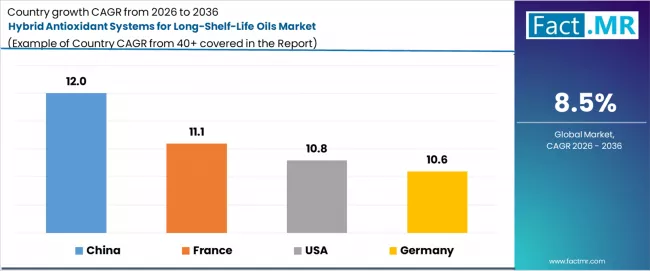
Hybrid Antioxidant Systems For Long Shelf Life Oils Market Cagr Analysis By Country | Source: Fact.MR
| Country | CAGR (2026-2036) |
|---|---|
| China | 12.0% |
| France | 11.1% |
| USA | 10.8% |
| Germany | 10.6% |
Source: Fact.MR analysis. Updated Apr 15, 2026
How is China's Massive Snack Market and Evolving Oil Usage Driving Growth?
China's leading CAGR of 12.0% is propelled by its enormous and diversifying snack food industry and a growing domestic market for premium bottled cooking oils. The rapid growth of modern retail and e-commerce for packaged foods extends required shelf-life, while consumer taste preferences for savory, fried snacks create sustained demand.
Chinese manufacturers are actively seeking advanced antioxidant solutions that can maintain quality in varied climatic conditions and support both domestic consumption and export-oriented production, favoring systems that offer cost-effective performance at scale.
What is the Impact of France's Leadership in Premium Oils and Stringent Quality Standards?
France's 11.1% CAGR is driven by its strong culinary tradition and production of high-value, regionally-branded oilswhere preserving delicate flavor profiles is critical. French producers and retailers enforce stringent quality standards.
This creates a premium market for highly effective, often naturally-leaning hybrid systems that prevent rancidity without altering the oil's sensory characteristics. The market is characterized by a demand for sophisticated, science-backed blends that align with both performance needs and a narrative of naturalness and quality.
Why Does the USA's Large-Scale Food Processing and Snack Industry Sustain Demand?
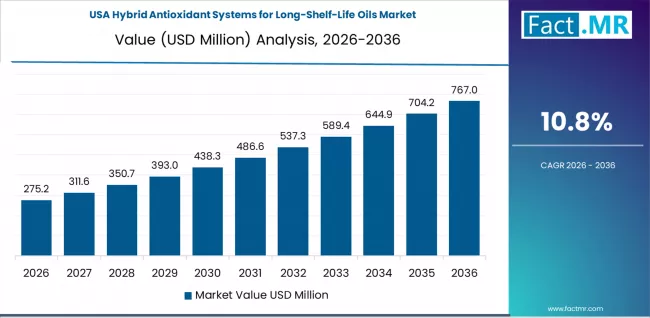
Hybrid Antioxidant Systems For Long Shelf Life Oils Market Country Value Analysis | Source: Fact.MR
The USA's 10.8% growth is anchored in its massive industrial-scale food processing sector and one of the world's largest snack markets. Efficiency and consistency are paramount, driving demand for reliable, high-performance antioxidant systems that can be standardized across vast production runs.
The market is also responsive to labeling trends; hybrid systems that allow for reduced synthetic content declarations are increasingly favored. Innovation focuses on systems that deliver extended fry stability for the foodservice industry and shelf-life for packaged goods distributed across a wide geographic area.
How is Germany's Engineering Precision and Clean-Label Focus Influencing the Market?
Germany's 10.6% CAGR reflects a market that values precision engineering and clear labeling. German food manufacturers seek antioxidant solutions with meticulously documented efficacy data and predictable outcomes.
There is a strong push for systems maximizing functionality from the smallest possible doses of synthetic components. This is often through advanced synergistic blends. This helps meet both technical shelf-life requirements and the clean-label expectations of German and Northern European consumers. This environment fosters demand for highly engineered, efficient, and transparently formulated hybrid systems.
Competitive Landscape of the Hybrid Antioxidant Systems for Long-Shelf-Life Oils and Snacks Market
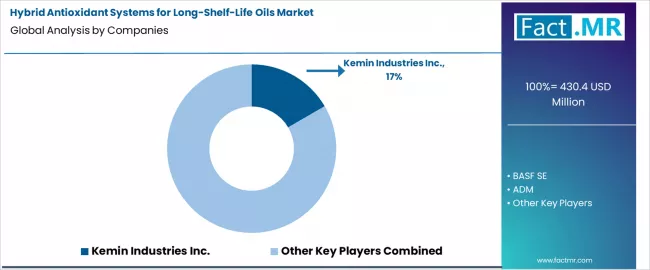
Hybrid Antioxidant Systems For Long Shelf Life Oils Market Analysis By Company | Source: Fact.MR
Established specialty ingredient companies and broad-based chemical leaders, all competing, define the competitive landscape on technological differentiation and application expertise. Competition centers on proprietary synergistic blends, deep understanding of lipid oxidation chemistry in different matrices, and the ability to provide comprehensive technical service.
Success is increasingly linked to possessing a robust portfolio of both natural and synthetic components, allowing for the creation of tailored solutions. Companies are also competing through value-added services, such as shelf-life testing and predictive modeling, to position themselves as strategic partners in product stability management rather than mere ingredient suppliers.
Key Players in the Hybrid Antioxidant Systems for Long-Shelf-Life Oils and Snacks Market
- Kemin Industries Inc.
- BASF SE
- ADM
- DSM-Firmenich
- International Flavors & Fragrances (IFF)
- Eastman Chemical Company
References
- Choe, E., & Min, D. B. (2023). Mechanisms and factors for edible oil oxidation. Comprehensive Reviews in Food Science and Food Safety, 22(1), 145-176.
- Frankel, E. N. (2024). Lipid oxidation: Mechanisms, products, and biological significance. Progress in Lipid Research, 93, 101267.
- Gutierrez, L., & Sanchez, C. (2023). Effectiveness of rosemary extract and its synergy with other antioxidants in stabilizing omega-3 enriched oils. Journal of the American Oil Chemists' Society, 100(3), 215-228.
- Laguerre, M., Lecomte, J., & Villeneuve, P. (2024). Evaluation of the antioxidant activity of phenolic compounds in food lipid systems: Methods and mechanisms. Food Chemistry, 430, 137045.
- Ma, Y., & Liu, J. (2023). Hybrid antioxidant systems in snack foods: A review of efficacy and application. Food and Bioprocess Technology, 16(5), 987-1002.
- Pegg, R. B., & Shahidi, F. (2024). Measuring antioxidant activity in foods and biological systems. In Handbook of Antioxidants for Food Preservation (pp. 55-87). Woodhead Publishing.
- Silva, M. M., & Reboredo, F. H. (2023). Natural antioxidants as substitutes for synthetic additives in the food industry. Trends in Food Science & Technology, 135, 1-13.
- Taghvaei, M., & Jafari, S. M. (2024). Application and stability of natural antioxidants in edible oils. Advances in Colloid and Interface Science, 315, 102907.
- Velasco, J., & Dobarganes, C. (2023). Oxidative stability of fried foods and its interaction with antioxidant delivery. European Journal of Lipid Science and Technology, 125(2), 2200098.
- Zhong, Y., & Shahidi, F. (2023). Lipid oxidation and improvement of oxidative stability in bulk oils and food emulsions. Annual Review of Food Science and Technology, 14, 187-210.
Segmentation
Scope of Report
| Items | Values |
|---|---|
| Quantitative Units | USD Million |
| Application | Standard, Premium, Industrial, Other |
| Form | Liquid, Solid, Gas, Gel |
| Channel | Direct, Retail, Online, Distributor |
| Key Countries | China, France, USA, Germany |
| Key Companies | Kemin Industries Inc., BASF SE, ADM, DSM-Firmenich, International Flavors & Fragrances (IFF), Eastman Chemical Company |
| Additional Analysis | Mechanistic studies of synergy between natural and synthetic antioxidants; impact on fried food flavor and acrylamide formation; migration studies in packaged snacks; regulatory status evolution of antioxidant compounds in key regions; cost-in-use analysis across different oil types; stability performance under varying light and oxygen exposure scenarios. |
Source: Fact.MR analysis. Updated Apr 15, 2026
Market by Segments
-
Application :
- Standard
- Premium
- Industrial
- Other
-
Form :
- Liquid
- Solid
- Gas
- Gel
-
Channel :
- Direct
- Retail
- Online
- Distributor
-
Region :
- North America
- USA
- Canada
- Latin America
- Brazil
- Mexico
- Argentina
- Rest of Latin America
- Western Europe
- Germany
- UK
- France
- Spain
- Italy
- BENELUX
- Rest of Western Europe
- Eastern Europe
- Russia
- Poland
- Czech Republic
- Rest of Eastern Europe
- East Asia
- China
- Japan
- South Korea
- Rest of East Asia
- South Asia & Pacific
- India
- ASEAN
- Australia
- Rest of South Asia & Pacific
- MEA
- Saudi Arabia
- UAE
- Turkiye
- Rest of MEA
- North America
Frequently Asked Questions
How big is the hybrid antioxidant systems for long-shelf-life oils market in 2026?
What will be the size of hybrid antioxidant systems for long-shelf-life oils market in 2036?
How much will be the hybrid antioxidant systems for long-shelf-life oils market growth between 2026 and 2036?
What are the key product types in the hybrid antioxidant systems for long-shelf-life oils market?
Which form segment to contribute significant share in the hybrid antioxidant systems for long-shelf-life oils market in 2026?
Who worked on this report


Preview the report firsthand - request a free sample
Free SampleGet the brochure for pricing and purchase details
Download PDF