- Market Value (2025): USD 2.0 Bn
- Estimated Value (2026): USD 2.1 Bn
- Forecast Value (2036): USD 3.9 Bn
- CAGR (2026-2036): 6.5%
What is the Hydro Chillers Market forecast to be worth by 2036?
USD 3.9 billion by 2036 at a 6.5% CAGR.
- The Hydro Chillers Market was valued at approximately USD 2.0 billion in 2025.
- Demand is projected to increase from USD 2.1 billion in 2026 to USD 3.9 billion by 2036.
- The market is forecast to expand at a 6.5% CAGR from 2026 to 2036.
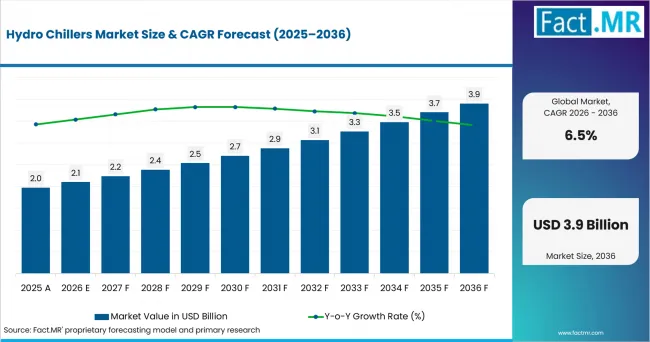
Hydro Chillers Market Value Analysis | Source: Fact.MR
What are the defining numbers behind Hydro Chillers Market growth?
An absolute opportunity of USD 1.8 billion is expected between 2026 and 2036.
- Demand Drivers in the Market
- Industrial energy-efficiency requirements increase the replacement case for older chillers. U.S. Department of Energy guidance sets separate efficiency requirements for air-cooled and water-cooled electric chillers and distinguishes full-load from part-load operation. Buyers therefore compare lifecycle energy use against the actual plant duty cycle before replacing installed equipment.
- Process cooling creates recurring demand because manufacturing equipment and process fluids generate heat during production. A chiller converts that thermal load into a defined utility requirement, so new production lines and plant debottlenecking can require added cooling capacity even when comfort-cooling demand is unchanged.
- Refrigerant rules are changing equipment specifications. U.S. EPA Technology Transitions rules apply a GWP limit of 700 to stand-alone chillers used for industrial process refrigeration at or above -30 degrees C from January 2026. EU Regulation 2024/573 introduces additional stationary-chiller restrictions from January 2027. New purchases therefore have to account for refrigerant availability and future serviceability.
- Food and beverage processing supports liquid-cooling demand through product cooling and production utilities. Brazil's food and beverage industry produced 288 million tonnes in 2025, according to ABIA. Higher throughput can increase the thermal load handled by process-water and chilled-water systems.
- Digital controls are broadening the value of chiller monitoring. The UK Energy Technology List includes performance criteria for packaged chillers, while connected controls can record energy use and operating time. Facility teams can use this information to identify inefficient loading or maintenance issues before they affect production.
- Key Segments Analyzed
- Water-Cooled Hydro Chillers account for 68.4% of Product in 2026 because they suit sustained medium- and high-load cooling where a condenser-water loop is available.
- Industrial Process Cooling represents 41.7% of Application in 2026 because production equipment and process fluids require repeatable heat removal during operating hours.
- Manufacturing Industries account for 74.6% of End Use in 2026 because chilled-water systems support machinery, process equipment and plant utilities across multiple manufacturing settings.
- Vapor Compression Technology holds 53.2% of Technology in 2026 due to established compressor configurations and standardized performance rating across factory-made water-chilling packages.
- Water-Based Cooling Systems represent 62.9% of Formulation in 2026 because water loops provide efficient heat transport and can be configured around plant flow and temperature requirements.
- Direct Sales account for 45.8% of Distribution Channel in 2026 because chiller sizing, refrigerant choice and site integration typically require engineering input before purchase.
- Analyst Opinion at Fact.MR
- Shambhu Nath Jha,Principal Consultant at Fact.MR, states, “Hydro chiller demand will be shaped by operating-load efficiency, refrigerant transition and the need to keep industrial processes within defined temperature ranges. Water-cooled systems remain relevant where plants have steady thermal loads and suitable water-side infrastructure.”
- Strategic Implications
- Equipment suppliers should present performance against the expected duty cycle, including full-load and part-load conditions, so buyers can connect efficiency with annual operating cost.
- Water-cooled portfolios should include condenser-water treatment and heat-exchanger maintenance guidance because fouling can reduce heat-transfer performance over time.
- Refrigerant strategy should be treated as a lifecycle specification. Systems intended for the USA or European Union need a clear path through current GWP limits and future servicing requirements.
- Industrial buyers should size capacity around process load and redundancy needs instead of adding excess nominal capacity that can keep equipment at inefficient operating points.
- Direct-sales teams should organize proposals around plant process conditions, utility constraints and service requirements because the purchase is commonly tied to site engineering rather than a standard catalogue choice.
How does the Hydro Chillers Market break down by segment?
The market is segmented by Product, Application, End Use, Technology, Formulation and Distribution Channel.
Why do Water-Cooled Hydro Chillers lead Product?
Water-Cooled Hydro Chillers are projected to account for a 68.4% share of Product in 2026.
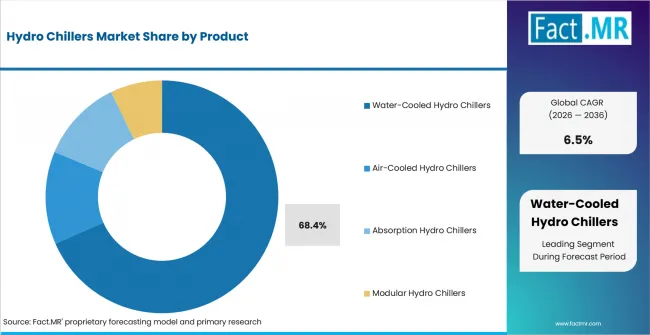
Hydro Chillers Market Analysis By Product | Source: Fact.MR
Water-cooled systems lead because they reject condenser heat through a separate water loop, which suits facilities with sustained cooling loads and central utility infrastructure. The configuration is practical where a plant can operate a cooling tower or another heat-rejection system.
DOE acquisition guidance applies dedicated efficiency requirements to water-cooled chillers and distinguishes full-load from part-load operation. AHRI also notes that water-cooled systems need condenser-water treatment and tube maintenance because dissolved material can concentrate and foul heat-transfer surfaces. Buyers therefore evaluate efficiency together with water quality and maintenance capability.
Why does Industrial Process Cooling lead Application?
Industrial Process Cooling is projected to account for a 41.7% share of Application in 2026.
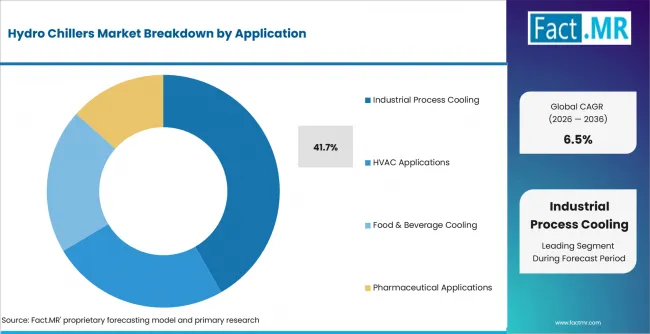
Hydro Chillers Market Analysis By Application | Source: Fact.MR
Industrial process cooling leads because manufacturing equipment and process fluids generate heat as part of production. Cooling demand therefore follows production hours and process intensity instead of outdoor comfort conditions alone.
Buyers use chilled-water systems to stabilize equipment temperatures and process conditions, reducing the risk of overheating or product variation. Chemical processing and manufacturing cooling systems fit this operating logic because thermal control is part of the production utility rather than a stand-alone building service.
Why do Manufacturing Industries lead End Use?
Manufacturing Industries are projected to account for a 74.6% share of End Use in 2026.
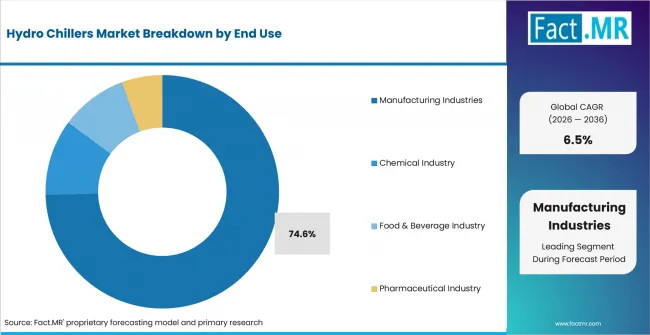
Hydro Chillers Market Analysis By End Use | Source: Fact.MR
Manufacturing industries lead because chilled-water systems can serve several plant loads from a common utility loop. Heavy manufacturing may require cooling for machinery and process equipment, while light manufacturing can use smaller distributed loads. In both cases, the buyer is purchasing heat-removal capacity that supports production continuity.
The UK Department for Energy Security and Net Zero defines industrial energy efficiency around reducing delivered energy per unit of production. That procurement logic supports replacement of older chillers when lower energy use can be demonstrated without weakening process stability.
Why does Vapor Compression Technology lead Technology?
Vapor Compression Technology is projected to account for a 53.2% share of Technology in 2026.
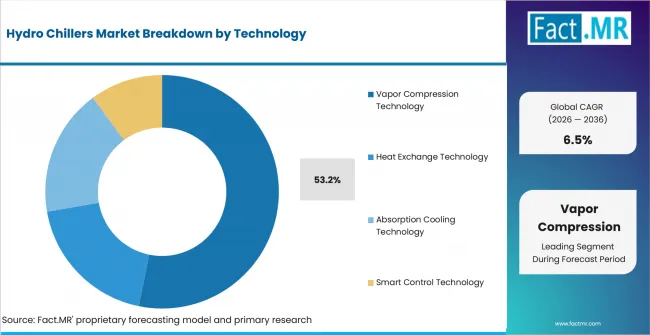
Hydro Chillers Market Analysis By Technology | Source: Fact.MR
Vapor compression leads because it is used across factory-made water-chilling packages with established compressor, evaporator and condenser configurations. The technology can be scaled through different compressor architectures and supports both water-cooled and air-cooled equipment.
AHRI Standards 550/590 and 551/591 cover performance rating of water-chilling packages using the vapor-compression cycle. The standards give buyers a common framework for comparing capacity, efficiency and part-load performance across suppliers.
Why do Water-Based Cooling Systems lead Formulation?
Water-Based Cooling Systems are projected to account for a 62.9% share of Formulation in 2026.
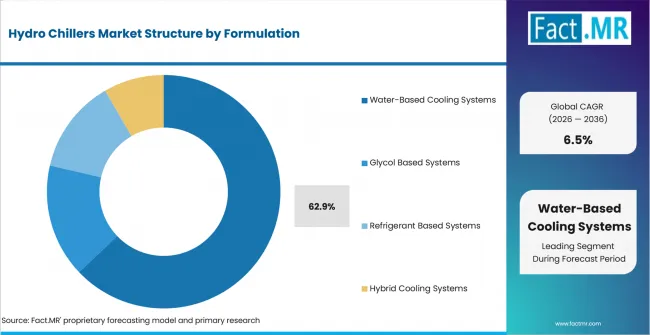
Hydro Chillers Market Analysis By Formulation | Source: Fact.MR
Water-based systems lead because water carries heat efficiently through a plant loop and can be circulated between the chiller and process loads. Closed loops can support stable water quality, while open arrangements may be used where site design permits interaction with the heat-rejection circuit.
Pumps, buffer tanks and heat exchangers can be configured around process temperature and flow requirements. Glycol-based systems remain relevant where freeze protection or lower fluid temperatures are required, but water-based loops cover a broader range of standard chilled-water duties.
Why does Direct Sales lead Distribution Channel?
Direct Sales are projected to account for a 45.8% share of Distribution Channel in 2026.
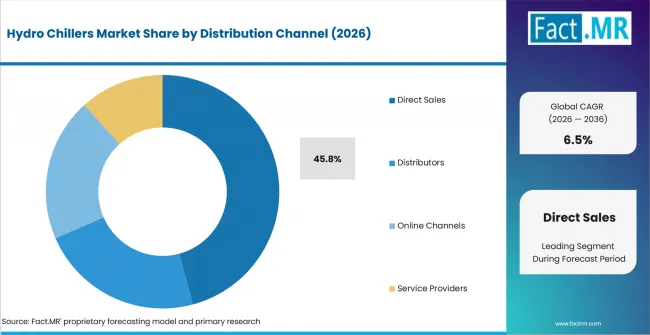
Hydro Chillers Market Analysis By Distribution Channel | Source: Fact.MR
Direct sales lead because hydro chillers are commonly selected through an engineering process. Capacity, leaving-water temperature, refrigerant, heat-rejection method and control integration have to match the site before the purchase order is placed.
OEM contracts and enterprise sales also allow the equipment supplier to coordinate commissioning and service requirements with the buyer. Distributors remain relevant for standardized equipment and parts, while direct engagement is more useful when the customer needs a configured system and site-specific technical support.
What is accelerating Hydro Chillers Market adoption, and what is holding it back?
Growth is supported by industrial cooling demand, energy-efficiency replacement and refrigerant transition, while installation complexity, water-side maintenance and retrofit downtime can constrain purchasing.
Drivers Impact Analysis
| Factor | (~) % Impact on CAGR | Geographic Relevance | Impact Timeline |
|---|---|---|---|
| Industrial energy-efficiency replacement | +1.3% | USA; Germany; UK | Short term (≤ 2 years) |
| Process-cooling capacity additions | +1.1% | Global | Short term (≤ 2 years) |
| Lower-GWP refrigerant transition | +0.9% | USA; European Union | Medium term (2–4 years) |
| Food and beverage processing demand | +0.7% | Brazil; USA; Global | Medium term (2–4 years) |
| Digital controls and operating-data use | +0.5% | USA; UK; Japan | Long term (≥ 4 years) |
Source: Fact.MR analysis. Updated Aug 21, 2026
Opportunity Impact Analysis
| Factor | (~) % Impact on CAGR | Geographic Relevance | Impact Timeline |
|---|---|---|---|
| Natural-refrigerant and lower-GWP systems | +0.7% | Germany; EU; USA | Medium term (2–4 years) |
| Efficiency retrofit and heat-recovery packages | +0.6% | Developed industrial markets | Medium term (2–4 years) |
| Modular and phased capacity additions | +0.5% | Global | Medium term (2–4 years) |
| Service contracts and remote monitoring | +0.4% | Global | Long term (≥ 4 years) |
Source: Fact.MR analysis. Updated Aug 21, 2026
Restraints Impact Analysis
| Factor | (~) % Impact on CAGR | Geographic Relevance | Impact Timeline |
|---|---|---|---|
| Installation and water-side infrastructure cost | -0.9% | Global | Short term (≤ 2 years) |
| Water treatment and condenser fouling | -0.6% | Water-cooled installations | Short term (≤ 2 years) |
| Refrigerant transition and service uncertainty | -0.5% | USA; EU; Japan | Medium term (2–4 years) |
| Retrofit shutdown and engineering complexity | -0.4% | Industrial facilities | Medium term (2–4 years) |
Source: Fact.MR analysis. Updated Aug 21, 2026
Which countries are scaling the Hydro Chillers Market through 2036?
- Germany: Federal support and EU refrigerant rules are pushing industrial refrigeration toward efficient systems and natural refrigerants. The German Environment Agency notes that the Kälte-Klima-Richtlinie supports qualifying stationary refrigeration and air-conditioning systems using non-halogenated refrigerants, strengthening the replacement case for compliant cooling equipment.
- Brazil: The food and beverage industry produced 288 million tonnes in 2025. Processing at this scale creates recurring thermal loads across product cooling and plant utilities, supporting demand for chilled-water capacity in manufacturing facilities.
- USA: DOE acquisition guidance sets full-load and part-load efficiency requirements for electric chillers, while EPA applies GWP limits to stand-alone chiller categories. Buyers therefore evaluate replacement projects against both energy performance and refrigerant compliance.
- UK: The Energy Technology List covers water-cooled high-temperature process chillers up to 2,000 kW and sets seasonal performance thresholds. This gives industrial buyers a defined benchmark for efficient equipment used in process cooling.
- Japan: The Fluorocarbon Emissions Control Act applies management and reporting obligations to covered commercial refrigeration and air-conditioning equipment using fluorocarbons. This raises the value of reliable equipment and service arrangements across the installed base.
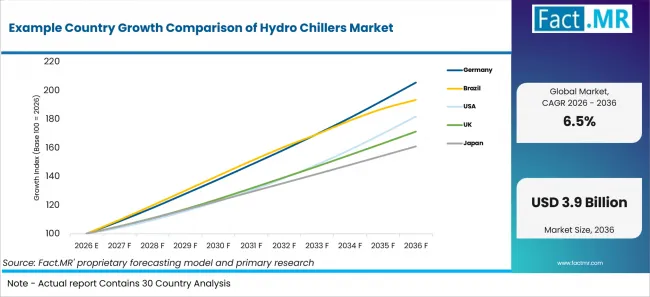
Example Country Growth Comparison Of Hydro Chillers Market | Source: Fact.MR
Country CAGR (2026-2036)
| Country | CAGR |
|---|---|
| Germany | 7.5% |
| Brazil | 6.8% |
| USA | 6.2% |
| UK | 5.5% |
| Japan | 4.9% |
Source: Fact.MR analysis. Updated Aug 21, 2026
What is driving Germany’s growth through 2036?
Germany is forecast to expand at a 7.5% CAGR from 2026 to 2036.
Germany combines industrial energy-efficiency pressure with a shift toward natural refrigerants. The Federal Environment Agency notes that natural-refrigerant systems can be operated efficiently and that federal support under the Kälte-Klima-Richtlinie covers qualifying stationary refrigeration and air-conditioning systems using non-halogenated refrigerants.
EU Regulation 2024/573 adds a specification trigger from January 2027 by restricting fluorinated greenhouse gases in stationary chillers at defined GWP thresholds. Industrial buyers therefore have a reason to evaluate refrigerant path, energy use and serviceability together when replacing equipment.
What is driving Brazil’s growth through 2036?
Brazil is forecast to expand at a 6.8% CAGR from 2026 to 2036.
Brazil’s food and beverage processing base creates a direct thermal-management requirement. ABIA reports that the industry produced 288 million tonnes in 2025. Plants handling higher throughput require chilled water for product cooling, equipment cooling and supporting utility functions.
The Ministry of Mines and Energy also coordinates a U4E programme focused on improving energy performance in commercial refrigeration. Although its scope is broader than hydro chillers, the programme reinforces the operating-cost logic that influences industrial cooling purchases.
What is driving USA growth through 2036?
The USA is forecast to expand at a 6.2% CAGR from 2026 to 2036.
DOE FEMP guidance covers air-cooled and water-cooled electric chillers and requires buyers to consider both full-load and part-load performance. This encourages industrial facilities to evaluate how equipment will perform over the actual duty cycle rather than relying on a single nameplate efficiency value.
EPA Technology Transitions rules add a refrigerant mechanism. Stand-alone chillers used for industrial process refrigeration with exiting fluid at or above -30 degrees C are subject to a GWP limit of 700 from January 2026, while comfort-cooling chillers have been subject to the same limit since January 2025.
What is driving UK growth through 2036?
The UK is forecast to expand at a 5.5% CAGR from 2026 to 2036.
The UK Energy Technology List covers water-cooled comfort chillers and water-cooled high-temperature process chillers up to 2,000 kW, with defined seasonal performance thresholds. This gives industrial buyers a practical reference when comparing efficient equipment.
The Department for Energy Security and Net Zero updated its evidence on industrial energy-efficiency potential in March 2026. The report defines efficiency around reducing delivered energy per unit of production, supporting chiller replacement where cooling electricity can be reduced without weakening process output.
What is driving Japan’s growth through 2036?
Japan is forecast to expand at a 4.9% CAGR from 2026 to 2036.
Japan’s Fluorocarbon Emissions Control Act applies lifecycle obligations to covered commercial refrigeration and air-conditioning equipment using fluorocarbons. Reporting frameworks cover leakage as well as refrigerant filling and recovery, keeping refrigerant management visible throughout the equipment life.
These obligations raise the value of reliable equipment and service access. Industrial and laboratory buyers need maintenance capability that can support inspections, refrigerant handling and operating records while keeping process temperatures stable.
Who Leads the Hydro Chillers Market?
Daikin Industries, Ltd., Carrier Global Corporation, Trane Technologies plc, Johnson Controls International plc, Mitsubishi Electric Corporation.
Daikin competes through air-cooled and water-cooled chiller platforms with scroll, screw and centrifugal configurations. Its recent product development includes inverter-driven equipment and lower-GWP refrigerants, which aligns with buyer requirements around part-load efficiency and refrigerant transition.
Carrier, Trane, Johnson Controls and Mitsubishi Electric compete through chiller engineering and service capability across commercial and industrial installations. Project selection depends on measured efficiency, controls integration and the ability to commission equipment within an existing plant utility system.
Specialist suppliers such as Frigel Firenze, Smardt Chiller Group, Multistack International, Airedale International Air Conditioning, Cold Shot Chillers and Drake Refrigeration compete through process-focused systems, modularity or application-specific temperature control. Thermo Fisher Scientific, Julabo and PolyScience address smaller controlled-fluid applications within the market scope.
Two supplied names require current-status context. Climaveneta merged with RC Group and began operating as Mitsubishi Electric Hydronics & IT Cooling Systems in 2017. Laird Thermal Systems rebranded as Tark Thermal Solutions in May 2025. Hitachi Air Conditioning also underwent a 2025 ownership reorganization, with the Johnson Controls-Hitachi Air Conditioning joint venture transferred to Bosch while Hitachi-branded air-conditioning products continue through Bosch Home Comfort.
Competition is shaped by refrigerant strategy, full-load and part-load efficiency, service capability and controls integration. Water-side engineering matters for water-cooled systems, while process customers also evaluate redundancy and the disruption involved in equipment replacement.
Which companies are the key providers?
Key companies profiled include Daikin Industries, Ltd.; Carrier Global Corporation; Trane Technologies plc; Johnson Controls International plc (York); Mitsubishi Electric Corporation; Lennox International Inc.; LG Electronics; Gree Electric Appliances; Midea Group; Hitachi Air Conditioning; Frigel Firenze S.p.A.; Smardt Chiller Group; Multistack International Limited; Airedale International Air Conditioning; Dunham-Bush; Baltimore Aircoil Company; Climaveneta (Mitsubishi Electric Hydronics & IT Cooling Systems); Cold Shot Chillers; Drake Refrigeration, Inc.; Fluid Chillers, Inc.; Haskris Company; Budzar Industries; Delta T Systems; Laird Thermal Systems (now Tark Thermal Solutions); Advantage Engineering, Inc.; Thermo Fisher Scientific Inc.; Julabo GmbH; and PolyScience.
- Daikin Industries, Ltd.
- Carrier Global Corporation
- Trane Technologies plc
- Johnson Controls International plc (York)
- Mitsubishi Electric Corporation
- Lennox International Inc.
- LG Electronics
- Gree Electric Appliances
- Midea Group
- Hitachi Air Conditioning
- Frigel Firenze S.p.A.
- Smardt Chiller Group
- Multistack International Limited
- Airedale International Air Conditioning
- Dunham-Bush
- Baltimore Aircoil Company
- Climaveneta (Mitsubishi Electric Hydronics & IT Cooling Systems)
- Cold Shot Chillers
- Drake Refrigeration, Inc.
- Fluid Chillers, Inc.
- Haskris Company
- Budzar Industries
- Delta T Systems
- Laird Thermal Systems (now Tark Thermal Solutions)
- Advantage Engineering, Inc.
- Thermo Fisher Scientific Inc.
- Julabo GmbH
- PolyScience
Bibliography
- U.S. Department of Energy. (2024). Purchasing Energy-Efficient Electric Chillers. Federal Energy Management Program.
- Air-Conditioning, Heating, and Refrigeration Institute. (2026). AHRI 550/590 and 551/591: Performance Rating of Water-Chilling and Heat Pump Water-Heating Packages Using the Vapor Compression Cycle.
- Air-Conditioning, Heating, and Refrigeration Institute. (2026). Liquid Chillers: Standards and Maintenance Guidance.
- U.S. Environmental Protection Agency. (2026). Technology Transitions HFC Restrictions by Sector.
- European Parliament and Council of the European Union. (2024). Regulation (EU) 2024/573 on Fluorinated Greenhouse Gases.
- Umweltbundesamt. (2026). Gewerbekälte and Natural Refrigerants Guidance.
- UK Department for Energy Security and Net Zero. (2026). Packaged Chillers. Energy Technology List.
- UK Department for Energy Security and Net Zero. (2026). Updating Evidence on Energy Efficiency Potential for UK Industry.
- Associação Brasileira da Indústria de Alimentos. (2026). Indústria de Alimentos Contribui para Conter Inflação, Lidera a Geração de Empregos e Sustenta Crescimento em 2025.
- Ministry of Mines and Energy, Brazil. (2026). Refrigeradores Comerciais Eficientes no Brasil.
- Ministry of the Environment, Japan. (2026). Fluorocarbon Emissions Control Act Portal and Reporting Information.
- Daikin Industries, Ltd. (2025). Daikin Applied Americas Exhibits High Efficiency, Electrified Decarbonization Solutions at 2025 AHR Expo.
- Mitsubishi Electric Corporation. (2016). Climaveneta S.p.A. and RC Group S.p.A. to Merge and Begin Doing Business as Mitsubishi Electric Hydronics & IT Cooling Systems S.p.A.
- Tark Thermal Solutions. (2025). Sustainability Report 2024 and Corporate Rebranding Information.
- Hitachi, Ltd. (2025). Hitachi Completes Capital Reorganization of Air Conditioning Joint Venture.
This Report Answers
- How hydro chiller demand differs across Product, Application, End Use, Technology, Formulation and Distribution Channel.
- Why Water-Cooled Hydro Chillers, Industrial Process Cooling and Manufacturing Industries account for the stated 2026 segment shares.
- How efficiency standards and refrigerant rules influence equipment replacement across the listed countries.
- How suppliers compete through chiller architecture, controls, refrigerant strategy and service capability.
- Which equipment and applications are included in hydro chillers and which adjacent cooling products remain outside the market
What does the Hydro Chillers Market cover?
The Hydro Chillers Market covers packaged or engineered chiller systems that remove heat from circulating water or another covered water-based fluid loop. Equipment can reject heat through water-cooled or air-cooled condensers, use absorption architecture or be supplied in modular configurations.
Applications include Industrial Process Cooling, HVAC Applications, Food & Beverage Cooling and Pharmaceutical Applications. The assessment follows Product, Application, End Use, Technology, Formulation and Distribution Channel as the supplied segment parents.
What is included in the scope?
The scope includes Water-Cooled Hydro Chillers, Air-Cooled Hydro Chillers, Absorption Hydro Chillers and Modular Hydro Chillers together with their listed subcategories. Industrial process, HVAC, food and beverage and pharmaceutical cooling applications are included.
Technology coverage includes Vapor Compression Technology, Heat Exchange Technology, Absorption Cooling Technology and Smart Control Technology. Formulation coverage includes Water-Based Cooling Systems, Glycol Based Systems, Refrigerant Based Systems and Hybrid Cooling Systems.
Direct Sales, Distributors, Online Channels and Service Providers are included where the transaction relates to a covered hydro chiller system. Integrated controls, pumps or heat-exchange components are counted when supplied as part of the chiller system rather than as independent products.
What is excluded from the scope?
Standalone cooling towers, pumps and heat exchangers sold separately from a hydro chiller system are excluded. Room air-conditioning products that do not generate or circulate chilled water or another covered liquid cooling medium are also outside the market.
General refrigeration racks and cold-storage equipment are excluded when they are not sold as a hydro chiller within the Product taxonomy. Standalone building-management software is outside the scope when sold without chiller hardware or a chiller-control function.
Maintenance-only revenue is excluded when no covered equipment, installation or chiller-related service package is part of the transaction. Adjacent industrial cooling equipment outside the six defined segment parents is also excluded.
How Was the Analysis Built?
The analysis draws on more than 120 sources, over 35 company portfolios and more than 20 industry interviews across at least 25 countries.
- Primary Research: Interviews cover chiller manufacturers, HVAC and process-cooling engineers, industrial facility operators, system integrators, distributors and maintenance providers. Discussions examine duty cycles, replacement timing, refrigerant choice, water-side infrastructure and service expectations.
- Desk Research: The review covers energy-efficiency guidance, chiller performance standards, refrigerant regulation, industrial activity and manufacturer portfolios relevant to the covered applications.
- Market Sizing and Forecasting: Estimates combine installed and replacement demand with application-specific cooling intensity, equipment capacity, pricing and distribution structure. Process-cooling demand is separated from HVAC and other applications to reflect different operating patterns.
- Data Validation and Update Cycle: Updates account for changes in efficiency requirements, refrigerant restrictions, industrial production conditions and chiller product development that can affect replacement timing or technology mix.
Segmentation
What is the report's scope and coverage?
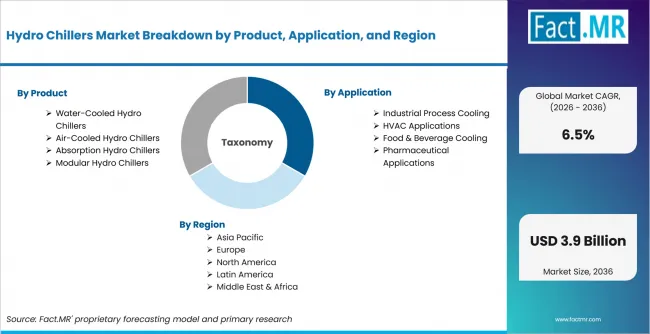
Hydro Chillers Market Breakdown By Product, Application, And Region | Source: Fact.MR
| Attribute | Details |
|---|---|
| Quantitative Units | USD billion |
| Market Definition | Hydro chiller systems sold across the Product, Application, End Use, Technology, Formulation and Distribution Channel categories defined in this report |
| Segments Covered | Product; Application; End Use; Technology; Formulation; Distribution Channel |
| Regions Covered | North America; Latin America; Europe; East Asia; South Asia and Pacific; Middle East and Africa |
| Countries Covered | Germany; Brazil; USA; UK; Japan |
| Key Companies Profiled | Daikin Industries, Ltd.; Carrier Global Corporation; Trane Technologies plc; Johnson Controls International plc (York); Mitsubishi Electric Corporation; and other listed suppliers |
| Forecast Period | 2026 to 2036 |
| Base Year | 2025 |
| Market Value, 2026 | USD 2.1 billion |
| Market Value, 2036 | USD 3.9 billion |
| CAGR, 2026-2036 | 6.5% |
| Absolute Opportunity | USD 1.8 billion |
| Approach | Hybrid top-down and bottom-up approach using installed chiller demand, replacement cycles, process-cooling intensity, equipment pricing, segment mix and country growth. |
Source: Fact.MR analysis. Updated Aug 21, 2026
How is the market segmented?
-
By Product
- Water-Cooled Hydro Chillers
- Shell and Tube Chillers
- Plate Heat Exchanger Chillers
- Air-Cooled Hydro Chillers
- Axial Fan Chillers
- Centrifugal Fan Chillers
- Absorption Hydro Chillers
- Single Effect Absorption Systems
- Double Effect Absorption Systems
- Modular Hydro Chillers
- Scalable Chiller Systems
- Portable Chiller Systems
- Water-Cooled Hydro Chillers
-
By Application
- Industrial Process Cooling
- Chemical Processing Cooling
- Manufacturing Cooling Systems
- HVAC Applications
- Commercial HVAC Systems
- Industrial HVAC Systems
- Food & Beverage Cooling
- Food Processing Cooling
- Cold Storage Applications
- Pharmaceutical Applications
- Drug Manufacturing Cooling
- Laboratory Cooling Systems
- Industrial Process Cooling
-
By End Use
- Manufacturing Industries
- Heavy Manufacturing
- Light Manufacturing
- Chemical Industry
- Bulk Chemical Producers
- Specialty Chemical Producers
- Food & Beverage Industry
- Food Processing Companies
- Beverage Manufacturers
- Pharmaceutical Industry
- Drug Manufacturing Companies
- Biotech Facilities
- Manufacturing Industries
-
By Technology
- Vapor Compression Technology
- Single Stage Compression
- Multi Stage Compression
- Heat Exchange Technology
- Shell and Tube Systems
- Plate Heat Exchangers
- Absorption Cooling Technology
- Thermal Driven Systems
- Chemical Absorption Cycles
- Smart Control Technology
- IoT Enabled Monitoring
- AI Based Optimization
- Vapor Compression Technology
-
By Formulation
- Water-Based Cooling Systems
- Closed Loop Water Systems
- Open Loop Water Systems
- Glycol Based Systems
- Ethylene Glycol Systems
- Propylene Glycol Systems
- Refrigerant Based Systems
- HFC Refrigerant Systems
- Natural Refrigerant Systems
- Hybrid Cooling Systems
- Dual Mode Cooling Systems
- Energy Recovery Systems
- Water-Based Cooling Systems
-
By Distribution Channel
- Direct Sales
- OEM Contracts
- Enterprise Sales
- Distributors
- Regional Distributors
- Specialized Distributors
- Online Channels
- B2B Marketplaces
- Manufacturer Platforms
- Service Providers
- Installation Contractors
- Maintenance Providers
- Direct Sales
Frequently Asked Questions
What is the Hydro Chillers Market value in 2026?
At what CAGR is the market projected to grow?
What is the projected market value by 2036?
Which Product leads the market?
Which Application leads the market?
Which End Use leads the market?
Which Technology leads the market?
Which Formulation leads the market?
Which Distribution Channel leads the market?
Which country records the highest listed CAGR?
Which companies are included in the market assessment?
Who worked on this report


Preview the report firsthand - request a free sample
Free SampleGet the brochure for pricing and purchase details
Download PDF