- Base Value(2025): 527.0 Mn
- Estimated Value(2026): 559.15 Mn
- Forecast Value (2036): 1010.83 Mn
- CAGR (2026 - 2036): 6.1%
Aerospace Floor Panel Market Size, Market Forecast and Outlook By Fact.MR
The global aerospace floor panel market was valued at USD 527.0 million in 2025, projected to reach USD 559.15 million in 2026, and is forecast to expand to USD 1,010.83 million by 2036 at a 6.1% CAGR. Commercial aircraft hold 48.6% of the aircraft type segment in 2026, reflecting the dominance of passenger airline fleet floor panel demand from the large global commercial aircraft installed base whose floor structures require periodic replacement in maintenance cycles and whose new aircraft deliveries generate consistent OEM supply demand. Composite materials command 46.1% of the material type segment, reflecting the aerospace industry's structural commitment to carbon fibre and aramid fibre honeycomb sandwich panel construction that delivers the highest specific stiffness and lowest weight-per-unit-area of any commercially validated floor panel material system available at scale.
The absolute dollar expansion of USD 451.68 million over the forecast period reflects both new aircraft delivery volume growth from the current commercial aviation order backlog that extends several years at current production rates and the accelerating adoption of advanced composite panel systems in maintenance, repair, and overhaul replacement applications where ageing aluminium and first-generation composite panels in service aircraft are being replaced with updated lightweight composite configurations during heavy maintenance checks. OEMs account for 54.3% of the end-user segment, reflecting new aircraft production programme floor panel supply as the primary demand source, with aftermarket and MRO representing the complementary replacement demand stream from the expanding global aircraft fleet accumulated over prior production cycles.
France leads country growth at 5.3% CAGR through 2036, driven by Airbus programme production rate increases at facilities concentrated in France and the surrounding European aerospace cluster that generate direct floor panel supply demand from the world's largest commercial aircraft manufacturer by delivery volume. The United States follows at 5.1% CAGR, where Boeing production recovery and the large domestic commercial and military aircraft fleet generate floor panel demand across both new build OEM supply and aftermarket MRO replacement channels. Japan registers 4.7% CAGR, where Japanese aerospace composite manufacturers supply floor panel sub-components to both Boeing and Airbus programmes under long-term tier-one supply agreements. China advances at 4.5% CAGR, supported by COMAC commercial aircraft programme ramp-up and the expanding Chinese commercial airline fleet generating aftermarket MRO floor panel replacement demand.
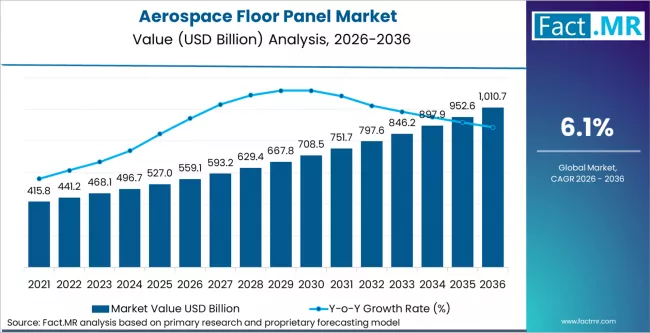
Aerospace Floor Panel Market Market Value Analysis | Source: Fact.MR
Aerospace Floor Panel Market Key Takeaways
| Metric | Details |
|---|---|
| Industry Size (2026) | USD 559.15 Million |
| Industry Value (2036) | USD 1,010.83 Million |
| CAGR (2026-2036) | 6.1% |
Source: Fact.MR analysis. Updated Mar 11, 2026
Aerospace Floor Panel Market Definition
The aerospace floor panel market encompasses structural panel assemblies installed in aircraft cabin and cargo hold floor systems, including primary cabin floor panels that support passenger seating track loads, galley and lavatory floor panels, cargo compartment floor panels, and cockpit deck panels. The scope covers panels manufactured from composite honeycomb sandwich, aluminium alloy, titanium alloy, and hybrid material systems, supplied to aircraft manufacturers through OEM production programmes and to airlines and MRO facilities through replacement maintenance channels.
Aerospace Floor Panel Market Inclusions
Market scope includes carbon fibre reinforced polymer and aramid fibre honeycomb sandwich primary cabin floor panels, aluminium honeycomb sandwich floor panels, seat track and floor beam support interface panels, cargo hold liner and floor panels, galley and lavatory structural floor inserts, and cockpit and flight deck floor panels. Geographic analysis covers North America, Latin America, Europe, East Asia, South Asia, Oceania, and Middle East and Africa. Forecast scope spans 2026 to 2036 with segment breakdowns by aircraft type, end-user, material type, and region.
Aerospace Floor Panel Market Exclusions
Aircraft sidewall panels, overhead stowage bin structures, ceiling panels, lavatory module complete assemblies sold as integrated units, seat assemblies and seat track components, cargo loading system equipment, and floor panel coatings and decorative surface treatments sold as standalone maintenance products fall outside this market scope. Spacecraft and satellite structural panel systems are also excluded.
Aerospace Floor Panel Market Research Methodology
- Primary Research: Fact.MR analysts conducted interviews with aircraft cabin structure engineering managers at commercial aircraft manufacturers, floor panel product managers at tier-one aerospace composite manufacturers, and airline engineering directors responsible for MRO floor panel replacement programme scheduling to validate composite material adoption trends, panel weight reduction specification requirements, and maintenance replacement interval practices across narrow body and wide body aircraft types.
- Desk Research: Secondary research aggregated commercial aircraft production and delivery data from Boeing and Airbus order books and delivery statistics, EASA and FAA airworthiness directive documentation covering floor panel inspection and replacement requirements, aerospace composite material specification updates from ASTM International and SAE aerospace standards, and corporate revenue disclosures from listed aerospace structural component manufacturers.
- Market-Sizing and Forecasting: Baseline market values derive from a bottom-up aggregation of floor panel area demand by aircraft type, multiplied by average panel prices per square metre across composite, aluminium, and titanium material specifications. Commercial aircraft delivery forecasts and fleet retirement schedules were applied as primary volume scaling variables, with composite material penetration growth modelled as a per-unit value uplift driver across the MRO replacement segment.
- Data Validation and Update Cycle: Segment forecasts are cross-validated against revenue disclosures from listed aerospace floor panel and interior component manufacturers and aircraft delivery statistics from manufacturer order book publications. Annual updates incorporate actual delivery rate data and updated airline fleet plans affecting MRO replacement demand timing.
Summary of Aerospace Floor Panel Market
- Aerospace Floor Panel Market Definition
- The aerospace floor panel market covers structural panel assemblies for aircraft cabin and cargo floor systems across composite honeycomb sandwich, aluminium alloy, and titanium alloy material configurations, supplied through OEM aircraft production and aftermarket MRO replacement channels globally.
- Demand Drivers in the Market
- Commercial Aircraft Order Backlog Driving New Build Floor Panel Demand: The multi-year order backlog at Airbus and Boeing representing several years of production at current delivery rates is creating a sustained forward demand pipeline for OEM floor panel supply, with production rate increase programmes at both manufacturers progressively growing the monthly floor panel volume demand from their respective supply chains across the forecast period.
- Composite Panel Weight Reduction Mandatory for Fuel Efficiency Compliance: Airline operator fuel efficiency targets and carbon emission reduction commitments under CORSIA and national aviation decarbonisation frameworks are driving demand for the lightest available floor panel material specifications, making composite honeycomb sandwich panels the preferred replacement choice when aluminium or first-generation composite panels in ageing aircraft reach end of serviceable life during heavy maintenance checks, as the weight saving from composite substitution translates directly into operating cost reduction through fuel burn improvement.
- MRO Replacement Demand from Ageing Commercial Aircraft Fleet: The global commercial airline fleet contains a large population of aircraft manufactured before 2010 that are now in the phase of their operational lifecycle where floor panel inspection findings increasingly require panel replacement rather than repair, generating MRO-driven replacement demand that grows proportionally with fleet age and accumulated operating cycles independent of new aircraft delivery volumes.
- Key Segments Analyzed in the Fact.MR Report
- Commercial Aircraft Type: Commands 48.6% share in 2026, representing the dominant demand source from the global commercial airline fleet that generates both OEM new build floor panel supply requirements from the current aircraft production backlog and consistent MRO replacement demand from the large accumulated fleet of in-service aircraft undergoing scheduled heavy maintenance visits.
- OEM End-User: Holds 54.3% share in 2026, reflecting new aircraft production programme floor panel supply as the primary market demand source, with Airbus and Boeing production rate increases and COMAC programme ramp-up generating growing OEM volume demand that outpaces MRO replacement growth in absolute terms across the current forecast period.
- Composite Materials Type: Accounts for 46.1% of 2026 market value, representing the preferred primary material specification for new aircraft production floor panels and increasingly for MRO replacement applications where the weight reduction, corrosion immunity, and extended panel life of composite honeycomb sandwich systems justify the higher material and manufacturing cost relative to aluminium alternatives.
- Analyst Opinion at Fact.MR
- Fact.MR analysis indicates that the aerospace floor panel market benefits from two complementary and largely independent demand streams that create a stable revenue profile unusual in capital goods adjacent markets: OEM new build demand driven by commercial aircraft production rate cycles and MRO replacement demand driven by fleet age accumulation that is structurally independent of new build production cycles. The current period represents a particularly favourable confluence of both streams, with Airbus and Boeing both in production rate increase phases that are growing OEM floor panel demand while simultaneously a large cohort of aircraft produced in the 2005 to 2015 period reaches the heavy maintenance phase where panel replacement becomes statistically probable. The composite material specification upgrade cycle in the MRO channel is an additional value driver that is increasing average selling prices per square metre of replacement panel beyond what inflation alone would generate, as airlines increasingly specify composite replacement panels for aluminium-floor original specification aircraft during heavy maintenance reconfiguration events that are also used to update cabin interiors and seating configurations.
- Strategic Implications / Executive Takeaways
- Airbus and Boeing Production Rate Increase Capacity Alignment: Floor panel manufacturers should align production capacity expansion plans with publicly disclosed Airbus and Boeing monthly delivery rate targets, ensuring supply chain readiness for programme rate increases that are scheduled across the 2026 to 2028 period and avoiding the production bottleneck situations that caused schedule disruption during previous rate increase cycles when floor panel supply constraints contributed to aircraft delivery delays.
- Composite MRO Replacement Programme Commercial Development: Panel manufacturers holding approvals for composite floor panel configurations in service across major commercial aircraft types should develop MRO replacement programme packages for airline engineering departments managing ageing aluminium-floor aircraft, as the combination of weight saving, extended panel life, and cabin reconfiguration opportunities during heavy maintenance events is creating decision-maker receptivity to composite retrofit specifications that were previously deferred on cost grounds.
- COMAC and Asian OEM Programme Supply Chain Entry: Western floor panel manufacturers should establish supply agreements for COMAC C919 and ARJ21 programme floor panel supply and develop relationships with Japanese and Korean aerospace composite manufacturers serving Airbus and Boeing sub-assembly programmes, as the Asia Pacific aerospace manufacturing base is growing its share of global commercial aircraft component production and represents the most structurally significant new OEM demand source for floor panel suppliers through 2036.
Historic Analysis (2021 to 2025) and Future (2026 to 2036) Pathway Analysis for the Aerospace Floor Panel Market
The market for aerospace floor panels grew at a growth rate of 5.8% from 2021 to 2025, and by the end of 2025, it was valued at US$ 496.7 Million.
| Historical Report Attributes | Details |
|---|---|
| Market Size (2021A) | US$ 391.1 Million |
| Market Size (2025A) | US$ 496.7 Million |
| Historical CAGR (2021 to 2025) | 5.8% |
Source: Fact.MR analysis. Updated Mar 11, 2026
- Short Term (2025 to 2029): The aerospace floor panel faces robust growth in the short term. Advances in 3D printing and core technology in composite materials make floor panels produced by manufacturers more innovative through more efficient dimensions. The reopening of global supply chains is reducing time for material sourcing and production.
- Medium Term (2029 to 2031): One of the growing areas in the aerospace industry that is slated to register impressive gains in the medium term is the aerospace floor panel. That growth has everything to do with the expansion of aircraft fleets and the intense focus being experienced by airlines on passenger experience. Via the rebounding of air travel, airlines are now purchasing again and continuously expanding their fleets to cope with increasing passenger volume.
- Long Term (2031 to 2035): Innovations in materials science, the possibilities of making super-light-weight composites, and smart materials enhance the function and efficiency of the flooring, pleasing to manufacturers as well as for airlines to adopt in their respective planes.
On the back of the aforementioned facts, the Aerospace Floor Panel Market is anticipated to grow at a CAGR of 6.1% during the forecast period from 2025 to 2035, According to the Fact.MR, a market research and competitive intelligence provider.
Market Dynamics
What are the Factors Propelling Global Sales of Aerospace Floor Panel?
“Increased Air Travel Demand is Driving the market for Aerospace Floor Panel”
The aerospace floor panel primarily driven by increasing air travel demand is important for new aircraft procurement and upgrading existing fleet. Air travelers will increase with the reopening of economies and ease of travel restrictions leading to a higher number of airline passengers resulting in an expansion requiring new aircraft acquisition, thereby driving the demand for ultra-modern, durable and top-performing floor panels.
Airlines invest in improving retrofitting of their older aircraft with due attention paid to passenger comfort while adhering to new safety norm guidelines, further boosting the increase in demand for new floor panels. The current focus is on enhancing the entire passenger experience, where emphasis is mainly placed on the design's beauty and functionality, sparking a huge increase in spending in the field of modern interiors. Consequently, the aerospace floor panel is poised for fast growth as the demand for innovative and increasingly efficient solutions in aircraft design and manufacturing continue to rise with the ever-growing demand for air travel.
“Fleet Modernization and Focus on Passenger Experience Boosting the Revenue Growth of the Market”
Revenue growth in the aerospace floor panel is growing significantly because airlines modernize fleets and passenger experience is enhanced. Airlines invest in modernizing aircraft interiors to improve operational efficiency, and reduce maintenance costs.
Upgrading of modern floor panels is usually included in this modernization. These are lighter in weight, more durable panels, and bring cabin aesthetics. Airlines also consider passengers comfort as the first and foremost factor to be considered on attracting and retaining customers.
Manufacturers placing a greater emphasis on good quality floor panels that add a nice touch to the entire passenger journey. All these factors are sure to elicit high requirements for innovative floor panel solutions having dual functionality and aesthetic value out of the aerospace market. This is likely to increase immensely the revenues of the aerospace floor panel fueled by the commitments of airlines to accent project enhancements and passenger journey.
What are the Challenges Encountered by Aerospace Floor Panel Manufacturers?
“Regulatory Compliance and Material Costs Associated with Aerospace Floor Panel is a Significant Challenge in the Market”
To remain highly profitable and in good operations, aerospace panels should cope up with the compliance as well as the material cost effective requirements. The aerospace sector, under the jurisdiction of the Federal Aviation Administration along with the European Union Aviation Safety Agency, delivers the safety and environmental regulations.
There will be a higher likelihood that during a topsy-turvy materials-cost pricing pattern, profit margins will be shrank while budgeting becomes more challenging. Together, they will have to spend lots of time more to be the most productive and to determine appropriate strategies.
Country-wise Insights
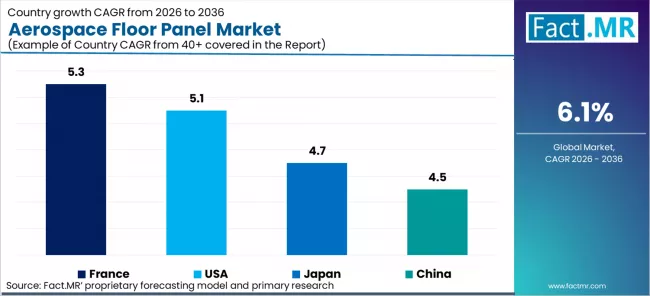
Aerospace Floor Panel Market Cagr Analysis By Country | Source: Fact.MR
Why is Adoption of Aerospace Floor Panel High in the United States?
“Technological Leadership and Huge Aerospace Sector is Fueling the Market in United States”
The market in the United States is estimated at US$ 138.0 Million in 2025 and is projected to expand at a CAGR of 5.1% through 2035. This market is projected to generate a US$ 89.9 Million absolute opportunity from 2025 to 2035.
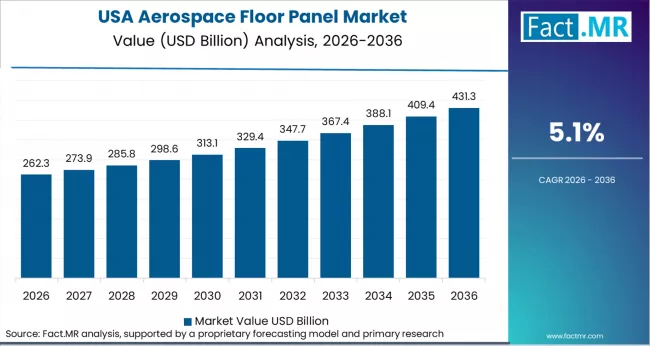
Aerospace Floor Panel Market Country Value Analysis | Source: Fact.MR
Technological leadership and a large aerospace sector in the U.S. are important drivers of the market for aerospace floor panels. Aerospace industry that endures across the borders has set the demand for floor panels including a number of wings belonging to various commercial airlines, a dedicated cargo carrier, and contractors in the defense industry. Airlines are modernizing their fleets today as recent trends of passenger comfort, performance and ergonomics awareness create demand for advanced floor panels.
Why France is one of the Leading Consumer for Aerospace Floor Panel?
“Robust Aviation Industry and Strong Industrial Base Growing the Manufacturing”
The market in the France is forecast to reach US$ 92.3 Million in 2035 at a CAGR of 5.3%. This market is projected to generate a US$ 37.3 Million absolute opportunity from 2025 to 2035.
The aerospace floor panel in France is very much alive and vibrant as a result of one robust aviation industry on the one hand and an effective industrial base on the other. Country have key players like Airbus and Safran- all home to an innovative environment and research into high-end materials and complex manufacturing processes.
With respect to France, it also have quite an established supply chain, not to mention skilled personnel who undoubtedly enhance the effectiveness and quality of production. There is now an introduction of automation and Industry 4.0 that will simplify the overall process and make it more competitive.
Funding through government support and adherence of regulations create great opportunities for growth. All these put France at the top of the aerospace floor panel, guaranteeing continued requirement and development on a global scale as well.
Category-wise Insights
Which Aircraft Type Widely Consumes the Aerospace Floor Panel in Market?
“Commercial Aircraft Dominate the Aerospace Floor Panel Market”
Demand for commercial aircraft is projected to increase at a CAGR of 5.5% from 2025 to 2035.
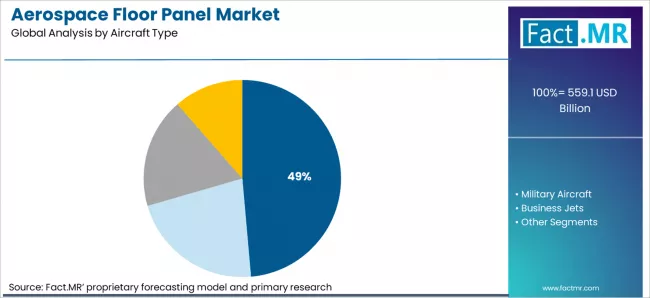
Aerospace Floor Panel Market Analysis By Aircraft Type | Source: Fact.MR
Commercial segment leads the aerospace floor panel right now with most sectors looking forward to more global travels and expansion of the aircraft fleet. Increasing demand, the most modern types of airplanes and new generation models are being updated. Innovations of materials like advanced composites have made it possible for manufacturers to produce safety-standard-compliant and enhanced power-floor panels while at the same time saving a lot of weight.
Capital-intensive retrofits for modern interiors in older aircraft - also creates a demand for floor panels. The increase in orders for commercial aircraft sometimes results from the mushrooming of low-cost carriers. The direct relationship shows the growth of the commercial aircraft industry and increasing the aerospace floor panel.
Which End User to Remain Most Popular for Aerospace Floor Panel Market?
“Original Equipment Manufacturers Expected to Remain Widely Popular Owing to their Extensive Demand”
Original Equipment Manufacturers is estimated to account for 62.3% share of the market in 2025, and the segment is projected to reach a market valuation of US$ 583.4 Million by 2035-end.
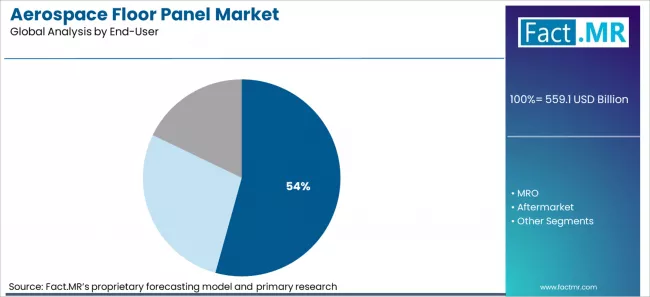
Aerospace Floor Panel Market Analysis By End User | Source: Fact.MR
OEMs are expected to be highly popular in the aerospace floor panel due to their extensive demand driven by several critical factors. First, in producing the highly reputed high-quality components following stringent safety and performance regulations, it is highly trusted by airlines and aircraft manufacturers.
In offering customized solutions tailored to the specific design of aircraft, it augments operational efficiency while also enhancing the comfort of the aircraft passengers. There is significant research and development investment by OEMs, which leads to innovations in lightweight and durable materials that meet the evolving needs of the aerospace industry.
OEMs are renowned for their compliance with international quality standards while setting regulatory benchmarks, further strengthening their standing in the sector. This is especially true across the aviation industry, given that safety is a topmost consideration and there should be a general assumption for aircraft users.
All of these, when taken collectively, signify the importance of the OEMs as major players in the aerospace floor panel, which will make sure that their demand remains high and that growth is sustained.
Competitive Landscape
Aerospace Floor Panel Market Analysis By Company | Source: Fact.MR
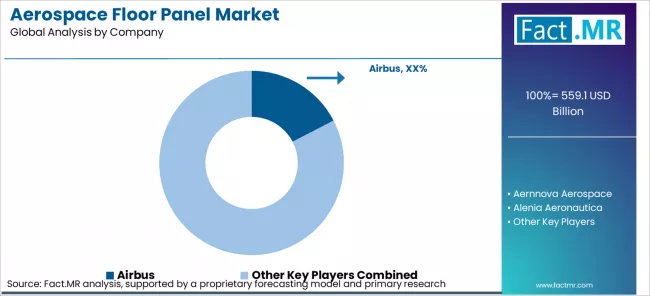
Key players in the market are Aernnova Aerospace, Airbus, Alenia Aeronautica, Boeing, FACC AG, GKN Aerospace, Honeywell Aerospace, Meggitt PLC, Northrop Grumman, Safran, Spirit AeroSystems, Triumph Group and Zodiac Aerospace.
Companies devote a significant portion of their revenue to R&D to resolve problems and offer creative solutions to draw in new customers and stay competitive. Companies are developing customized offerings for issues that meet industry-specific needs to compete with other players.
- On December 2024, Elbe Flugzeugwerke GmbH (EFW), Airbus competence centre for passenger-to-freighter conversions (P2F), lightweight components and cabin systems, marked a milestone in its history with the production of six million lightweight panels at its Dresden and Kodersdorf facilities in Görlitz.
Fact.MR has provided detailed information about the price points of key manufacturers of Aerospace Floor Panel positioned across regions, sales growth, production capacity, and speculative technological expansion, in the recently published report.
Bibliography
- European Union Aviation Safety Agency. (2024, April). CS-25 Amendment 27: Certification Specifications for Large Aeroplanes - Floor Structure and Cargo Compartment Structural Requirements. EASA.
- Federal Aviation Administration. (2024, March). Advisory Circular AC 25.562-1B: Dynamic Evaluation of Seat Restraint Systems and Occupant Protection on Transport Category Airplanes - Floor Panel Load Requirements. FAA.
- ASTM International. (2024, January). ASTM F2559: Standard Guide for Selection of Composite Materials for Aircraft Interior Structural Applications Including Floor Panels. ASTM International.
- Airbus SE. (2024, February). Airbus Global Market Forecast 2024 to 2043: Commercial Aircraft Delivery Projections and Fleet Renewal Analysis. Airbus SE.
- Boeing Company. (2024, March). Boeing Commercial Market Outlook 2024 to 2043: Aircraft Demand Forecast and Fleet Replacement Projections. Boeing Company.
- International Air Transport Association. (2024, January). Aircraft Maintenance Cost Technical and Operational Report: Structural Component Replacement Frequency Analysis for Commercial Narrowbody and Widebody Aircraft. IATA.
This bibliography is provided for reader reference. The full Fact.MR report contains the complete reference list with primary research documentation.
This Report Addresses
- Market sizing and quantitative forecast metrics: detailing precise revenue projections, absolute dollar growth, and compound annual growth rates across major aerospace floor panel segments and geographies through 2036.
- Segmentation analysis: mapping the adoption velocity of leading product, technology, and end-use categories and evaluating structural factors driving segment share transitions over the forecast period.
- Regional deployment intelligence: comparing growth dynamics in high-momentum Asia Pacific and emerging markets against the mature replacement and upgrade demand patterns prevalent in European and North American industry hubs.
- Regulatory compliance assessment: analyzing how evolving product safety standards, environmental directives, and sector-specific mandates are reshaping procurement decisions, material specifications, and supplier qualification criteria.
- Competitive posture evaluation: tracking consolidation trends, platform integration strategies, technology differentiation investments, and the resulting competitive dynamics among established market players and emerging challengers.
- Capital project strategic guidance: defining the procurement specifications, investment thresholds, and performance benchmarks required to support next-generation product adoption and facility modernization programs.
- Supply chain vulnerability analysis: identifying sourcing concentration risks, logistics bottlenecks, raw material price dependencies, and geographic exposure scenarios that affect market participant cost structures.
- Custom data delivery formats: encompassing interactive dashboards, raw Excel datasets, and comprehensive PDF narrative reports tailored for executive decision-making and analyst reference applications.
Segmentation
Scope of the Report
| Metric | Value |
|---|---|
| Quantitative Units | USD 559.15 million to USD 1,010.83 million, at a CAGR of 6.1% |
| Market Definition | Structural panel assemblies for aircraft cabin and cargo floor systems across composite honeycomb sandwich, aluminium alloy, and titanium alloy material configurations, supplied through OEM aircraft production and aftermarket MRO replacement channels. |
| Aircraft Type Segmentation | Commercial Aircraft, Military Aircraft, Business Jets, Helicopters |
| End-User Segmentation | OEMs, Aftermarket and MRO |
| Material Type Segmentation | Composite Materials, Aluminium Alloys, Titanium Alloys, Honeycomb Sandwich Structures |
| Regions Covered | North America, Latin America, Europe, East Asia, South Asia, Oceania, Middle East and Africa |
| Countries Covered | France, USA, Japan, China, and 40 plus countries |
| Key Companies Profiled | Airbus, Aernnova Aerospace, Alenia Aeronautica, Boeing, FACC AG, GKN Aerospace, Honeywell Aerospace, Meggitt PLC, Northrop Grumman, Safran, Spirit AeroSystems, Triumph Group, Zodiac Aerospace |
| Forecast Period | 2026 to 2036 |
| Approach | Bottom-up aggregation of floor panel area demand by aircraft type with commercial delivery forecast and composite material penetration growth modeling |
Source: Fact.MR analysis. Updated Mar 11, 2026
Segmentation of Aerospace Floor Panel Industry Research
-
By Aircraft Type :
- Commercial Aircraft
- Military Aircraft
- Business Jets
- Regional Aircraft
-
By End-User :
- OEMs(Original Equipment Manufacturers)
- MRO (Maintenance, Repair, and Overhaul)
- Aftermarket
-
By Material Type :
- Aluminum
- Composite Materials
- Others
-
By Region :
- North America
- Latin America
- Western Europe
- Eastern Europe
- East Asia
- South Asia & Pacific
- Middle East & Africa
Frequently Asked Questions
How large is the aerospace floor panel market in 2026?
What will the aerospace floor panel market size be by 2036?
What is the expected CAGR between 2026 and 2036?
Which aircraft type leads the market in 2026?
Which material type holds the largest share?
Why do OEMs account for 54.3% of end-user share?
What is driving France's leading 5.3% CAGR?
How are MRO requirements driving aftermarket floor panel demand?
What is excluded from the scope of this report?
Who worked on this report


Preview the report firsthand - request a free sample
Free SampleGet the brochure for pricing and purchase details
Download PDF