Ultra-Thin Dielectric EV Busbar Coatings Market

Ultra-Thin Dielectric EV Busbar Coatings Market Size and Share Forecast Outlook 2026 to 2036

Ultra-thin dielectric ev busbar coatings market is projected to grow from USD 115.4 million in 2026 to USD 428.0 million by 2036, at a CAGR of 14.0%. Battery Electric Vehicles (BEVs) will dominate with a 55.0% market share, while polyimide & polyamide-imide coatings will lead the coating chemistry segment with a 35.0% share.

Ultra-Thin Dielectric EV Busbar Coatings Market Forecast and Outlook 2026 to 2036

The global ultra-thin dielectric EV busbar coatings market is projected to reach USD 428.01 million by 2036. The market is valued at USD 115.43 million in 2026 and is set to rise at a CAGR of 14.0% during the assessment period.

By vehicle type, Battery Electric Vehicles (BEVs) hold a leading 55% share. Polyimide & polyamide-imide coatings represent the dominant coating chemistry at 35%, while 401-800 V systems is the primary voltage class at 25.0%.

Key Takeaways from the Ultra-Thin Dielectric EV Busbar Coatings Market

  • Market Value for 2026: USD 115.43 Million
  • Market Value for 2036: USD 428.01 Million
  • Forecast CAGR (2026-2036): 14.0%
  • Leading Vehicle Type Share (2026): Battery Electric Vehicles (BEVs) (55%)
  • Leading Coating Chemistry Share (2026): Polyimide & Polyamide-Imide Coatings (35%)
  • Leading Voltage Class Share (2026): 401-800 V Systems (25.0%)
  • Key Players in the Market: SolEpoxy, Akzo Nobel N.V., ELANTAS, PPG Industries Inc., Parker LORD
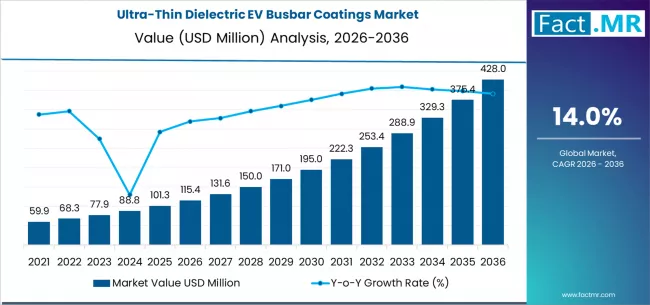
Ultra Thin Dielectric Ev Busbar Coatings Market Market Value Analysis

Defining trends involve the development of ceramic-enhanced and multifunctional polymer systems that offer exceptional thermal conductivity alongside high dielectric strength. Innovation is focused on achieving sub-micron coating thicknesses that maximize power density within constrained battery pack volumes while ensuring absolute reliability under high voltage stress. Integration of these advanced coatings into automated, precision application processes is becoming a key competitive strategy.

The rapid global transition to electric mobility and the automotive industry's accelerated shift towards 800V and higher voltage architectures are the primary market drivers. This technological evolution demands insulation materials capable of preventing electrical breakdown and partial discharge in compact spaces, creating sustained, high-value demand for ultra-thin, high-performance dielectric coating solutions.

Ultra-Thin Dielectric EV Busbar Coatings Market

Metric Value
Market Value (2026) USD 115.43 Million
Market Forecast Value (2036) USD 428.01 Million
Forecast CAGR (2026-2036) 14.0%

Category

Category Segments
Vehicle Type Battery Electric Vehicles (BEVs), Plug-in Hybrid Electric Vehicles (PHEVs), Hybrid Electric Vehicles (HEVs), Fuel Cell Electric Vehicles (FCEVs), Other Electric Platforms
Coating Chemistry Polyimide & Polyamide-Imide Coatings, Epoxy & Epoxy-Hybrid Coatings, Polyamide or Nylon Coatings, Acrylic & Polyester Coatings, Ceramic-Enhanced Polymer Coatings
Voltage Class Up to 400 V Systems, 401-800 V Systems, 801-1000 V Systems, Above 1000 V Systems, Others (Low-Voltage Auxiliary Uses)
Region North America, Latin America, Western Europe, Eastern Europe, East Asia, South Asia & Pacific, MEA

Segmental Analysis

By Vehicle Type, Which Segment is the Core Driver of Volume and Innovation?
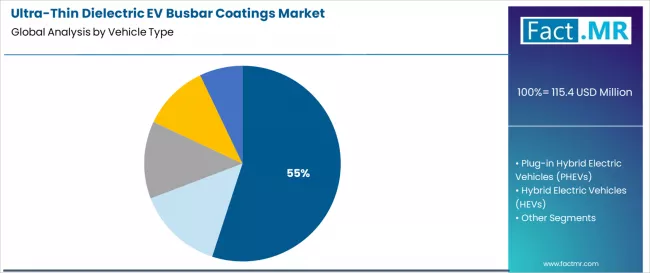
Ultra Thin Dielectric Ev Busbar Coatings Market Analysis By Vehicle Type

Battery electric vehicles (BEVs) lead the segment with a 55% share. This dominance is due to their complete reliance on high-voltage battery packs and extensive power distribution networks.

BEVs contain the highest density of busbars connecting cells, modules, and power electronics, making them the largest addressable market. The relentless pursuit of faster charging and greater range in BEVs directly fuels the need for advanced dielectric coatings that can withstand higher electrical and thermal loads in compact designs.

By Coating Chemistry, Which Material Class is Favored for Extreme Electrical and Thermal Environments?
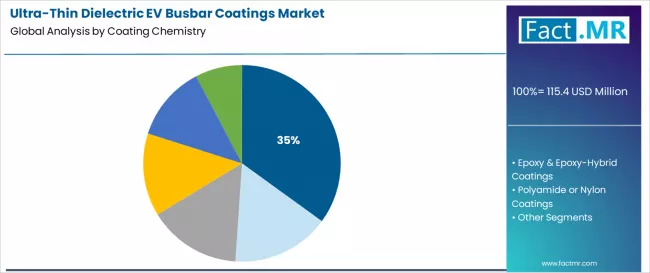
Ultra Thin Dielectric Ev Busbar Coatings Market Analysis By Coating Chemistry

Polyimide & polyamide-imide coatings command the largest coating chemistry share at 35%. Their dominance is attributed to their unparalleled combination of high dielectric strength, exceptional thermal stability, and excellent chemical resistance.

These properties are critical for coatings that must insulate busbars located near high-heat sources like battery cells and inverters, ensuring long-term reliability and safety throughout the vehicle's lifespan, especially under aggressive fast-charging cycles.

By Voltage Class, Which System Range is becoming the New Performance Benchmark?
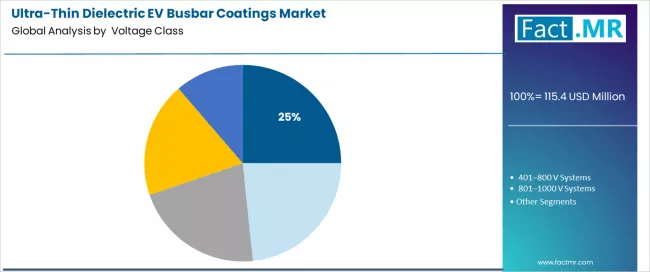
Ultra Thin Dielectric Ev Busbar Coatings Market Analysis By Voltage Class

The 401-800 V systems segment represents the leading voltage class at 25.0%. This reflects the industry's decisive pivot from 400V to 800V architectures as the new standard for next-generation electric vehicles. 800V systems enable significantly faster charging, reduce current-related losses, and allow for lighter cabling.

They, however, impose drastically stricter requirements on insulation materials to prevent catastrophic electrical failure, making the development and adoption of ultra-thin, high-dielectric-strength coatings absolutely essential for this high-growth segment.

What are the Drivers, Restraints, and Key Trends of the Ultra-Thin Dielectric EV Busbar Coatings Market?

The global regulatory push for vehicle electrification and stringent automotive safety standards drive market growth. The competitive race among OEMs to launch vehicles with ultra-fast charging capabilities and higher-voltage platforms creates immediate, technical demand for superior insulation. Furthermore, the trend towards battery pack miniaturization and increased energy density necessitates the use of ultra-thin coatings to save space and maximize power delivery within a confined area.

A significant restraint is the high cost of advanced coating materials like polyimides and the specialized, controlled application processes required to achieve uniform ultra-thin films. The lengthy and rigorous qualification and testing cycles mandated by automotive OEMs for any new material can slow time-to-market for innovative solutions. Additionally, managing supply chain consistency for specialty polymer resins can be challenging at the scale required by mass vehicle production.

Key trends include the development of multi-functional coatings that provide not only insulation but also enhanced thermal management or corrosion protection. There is strong R&D focus on hybrid and ceramic-filled polymer systems designed to offer an optimal balance of flexibility, dielectric strength, and thermal endurance. The market is also moving towards greater integration, with coating suppliers working directly with busbar fabricators and battery pack integrators to co-develop application-specific solutions.

Analysis of the Ultra-Thin Dielectric EV Busbar Coatings Market by Key Countries
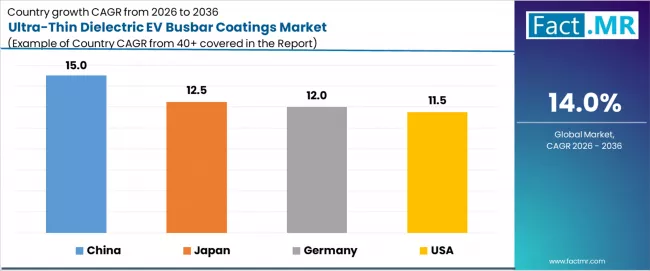
Ultra Thin Dielectric Ev Busbar Coatings Market Cagr Analysis By Country

Country CAGR (2026-2036)
China 15.00%
Japan 12.50%
Germany 12.00%
USA 11.50%

How does China's EV Production Dominance and Technological Adoption Drive Market Leadership?

China's 15.00% CAGR is driven by its position as the world's largest producer and consumer of electric vehicles. The sheer scale of domestic manufacturing, supported by strong government mandates, creates immense volume demand. Chinese OEMs and battery suppliers are also at the forefront of deploying ultra-fast charging and high-voltage battery technologies, making the country a primary market for the advanced coatings these systems require.

Why is Japan's Focus on High-Performance and Hybrid Vehicle Technology a Key Driver?

The automotive industry’s leadership in advanced hybrid and next-generation BEV development fuels Japan’s 12.50% growth. Japanese manufacturers' focus on reliability, quality, and technological sophistication for both domestic and export markets drives demand for high-performance, ultra-reliable component materials like specialized dielectric coatings, particularly for their premium vehicle segments.

What Role does Germany's Premium Automotive Engineering and Regulatory Framework Play?

Germany's 12.00% growth reflects its leadership in the premium automotive sector and its central role in the EU's stringent regulatory environment. German OEMs are pioneers in high-voltage EV platforms, where safety and performance are paramount. The need for coatings that meet the extreme demands of luxury and performance electric vehicles, coupled with clear regulatory timelines for electrification, makes Germany a critical early-adoption market.

How does the USA's Expanding EV Market and Charging Infrastructure Influence Demand?
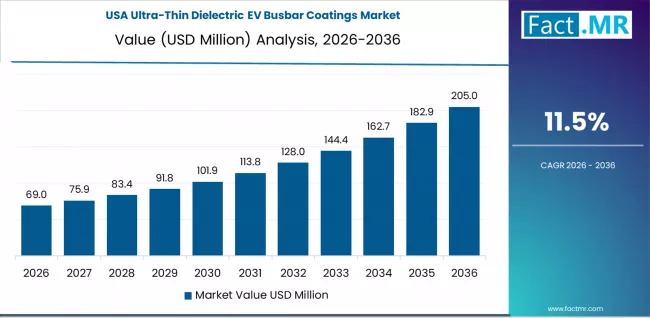
Ultra Thin Dielectric Ev Busbar Coatings Market Country Value Analysis

A rapidly growing domestic EV market, significant federal policy support, and large-scale investments in a national fast-charging network support the USA’s 11.50% growth. Demand is driven by the scaling production of domestic automakers and new entrants, all of which require reliable, high-performance components for their EV platforms, supporting consistent demand for advanced insulation solutions.

Competitive Landscape of the Ultra-Thin Dielectric EV Busbar Coatings Market
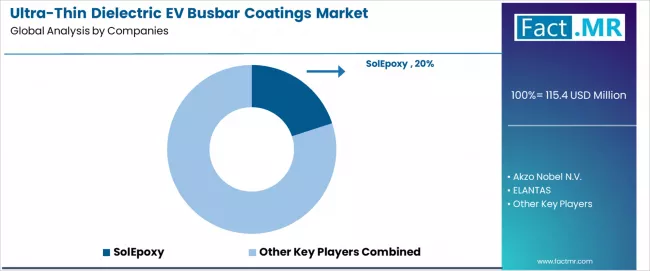
Ultra Thin Dielectric Ev Busbar Coatings Market Analysis By Company

The competitive landscape features global specialty chemical companies and industrial material suppliers with deep expertise in polymer science and dielectric materials. Established players like Akzo Nobel N.V. and PPG Industries Inc. compete based on their extensive R&D resources, global supply chains, and ability to serve multinational automotive OEMs and Tier-1 suppliers with comprehensive material solutions.

Specialist chemical firms like ELANTAS compete through focused innovation in high-performance electrical insulation technologies. Competition centers on technological leadership in formulating coatings that meet the dual challenge of ultra-thin application and uncompromising dielectric performance, the ability to provide extensive validation data for automotive qualification, and forming strategic technical partnerships across the EV supply chain.

Key Players in the Ultra-Thin Dielectric EV Busbar Coatings Market

  • SolEpoxy
  • Akzo Nobel N.V.
  • ELANTAS
  • PPG Industries Inc.
  • Parker LORD

Scope of Report

Items Values
Quantitative Units USD Million
Vehicle Type Battery Electric Vehicles (BEVs), Plug-in Hybrid Electric Vehicles (PHEVs), Hybrid Electric Vehicles (HEVs), Fuel Cell Electric Vehicles (FCEVs), Other Electric Platforms
Coating Chemistry Polyimide & Polyamide-Imide Coatings, Epoxy & Epoxy-Hybrid Coatings, Polyamide or Nylon Coatings, Acrylic & Polyester Coatings, Ceramic-Enhanced Polymer Coatings
Voltage Class Up to 400 V Systems, 401-800 V Systems, 801-1000 V Systems, Above 1000 V Systems, Others (Low-Voltage Auxiliary Uses)
Key Countries China, Japan, Germany, USA
Key Companies SolEpoxy, Akzo Nobel N.V., ELANTAS, PPG Industries Inc., Parker LORD
Additional Analysis Analysis of dielectric breakdown strength versus coating thickness; performance benchmarking under thermal cycling and humidity; review of international automotive safety and material standards; total cost of ownership models for OEMs; and supply chain analysis for critical polymer and filler raw materials.

Ultra-Thin Dielectric EV Busbar Coatings Market by Segments

  • Vehicle Type :

  • Battery Electric Vehicles (BEVs)
  • Plug-in Hybrid Electric Vehicles (PHEVs)
  • Hybrid Electric Vehicles (HEVs)
  • Fuel Cell Electric Vehicles (FCEVs)
  • Other Electric Platforms
  • Coating Chemistry :

  • Polyimide & Polyamide-Imide Coatings
  • Epoxy & Epoxy-Hybrid Coatings
  • Polyamide or Nylon Coatings
  • Acrylic & Polyester Coatings
  • Ceramic-Enhanced Polymer Coatings
  • Voltage Class :

  • Up to 400 V Systems
  • 401-800 V Systems
  • 801-1000 V Systems
  • Above 1000 V Systems
  • Others (Low-Voltage Auxiliary Uses)
  • Region :

    • North America
      • USA
      • Canada
    • Latin America
      • Brazil
      • Mexico
      • Argentina
      • Rest of Latin America
    • Western Europe
      • Germany
      • UK
      • France
      • Spain
      • Italy
      • BENELUX
      • Rest of Western Europe
    • Eastern Europe
      • Russia
      • Poland
      • Czech Republic
      • Rest of Eastern Europe
    • East Asia
      • China
      • Japan
      • South Korea
      • Rest of East Asia
    • South Asia & Pacific
      • India
      • ASEAN
      • Australia
      • Rest of South Asia & Pacific
    • MEA
      • Saudi Arabia
      • UAE
      • Turkiye
      • Rest of MEA

Table of Content

  1. Executive Summary
    • Global Market Outlook
    • Demand to side Trends
    • Supply to side Trends
    • Technology Roadmap Analysis
    • Analysis and Recommendations
  2. Market Overview
    • Market Coverage / Taxonomy
    • Market Definition / Scope / Limitations
  3. Market Background
    • Market Dynamics
      • Drivers
      • Restraints
      • Opportunity
      • Trends
    • Scenario Forecast
      • Demand in Optimistic Scenario
      • Demand in Likely Scenario
      • Demand in Conservative Scenario
    • Opportunity Map Analysis
    • Product Life Cycle Analysis
    • Supply Chain Analysis
    • Investment Feasibility Matrix
    • Value Chain Analysis
    • PESTLE and Porter’s Analysis
    • Regulatory Landscape
    • Regional Parent Market Outlook
    • Production and Consumption Statistics
    • Import and Export Statistics
  4. Global Market Analysis 2021 to 2025 and Forecast, 2026 to 2036
    • Historical Market Size Value (USD Million) Analysis, 2021 to 2025
    • Current and Future Market Size Value (USD Million) Projections, 2026 to 2036
      • Y to o to Y Growth Trend Analysis
      • Absolute $ Opportunity Analysis
  5. Global Market Pricing Analysis 2021 to 2025 and Forecast 2026 to 2036
  6. Global Market Analysis 2021 to 2025 and Forecast 2026 to 2036, By Additive Function
    • Introduction / Key Findings
    • Historical Market Size Value (USD Million) Analysis By Additive Function, 2021 to 2025
    • Current and Future Market Size Value (USD Million) Analysis and Forecast By Additive Function, 2026 to 2036
      • Anti-wear & extreme-pressure packages
      • Oxidation inhibitors & antioxidants
      • Corrosion & rust inhibitors
      • Tackifiers & anti-drip, anti-spatter agents
      • Anti-foam, defoamers & friction modifiers
      • Biobased & biodegradable performance additives
    • Y to o to Y Growth Trend Analysis By Additive Function, 2021 to 2025
    • Absolute $ Opportunity Analysis By Additive Function, 2026 to 2036
  7. Global Market Analysis 2021 to 2025 and Forecast 2026 to 2036, By Chemistry
    • Introduction / Key Findings
    • Historical Market Size Value (USD Million) Analysis By Chemistry, 2021 to 2025
    • Current and Future Market Size Value (USD Million) Analysis and Forecast By Chemistry, 2026 to 2036
      • Ester-based additive systems
      • Polyol & PAE co-additives & low-amine packages
      • Vegetable-oil derived modifiers & biobased concentrates
      • Low-residual organo-metallic additives
      • Solid anti-wear&dispersion concentrates
    • Y to o to Y Growth Trend Analysis By Chemistry, 2021 to 2025
    • Absolute $ Opportunity Analysis By Chemistry, 2026 to 2036
  8. Global Market Analysis 2021 to 2025 and Forecast 2026 to 2036, By End-Use
    • Introduction / Key Findings
    • Historical Market Size Value (USD Million) Analysis By End-Use, 2021 to 2025
    • Current and Future Market Size Value (USD Million) Analysis and Forecast By End-Use, 2026 to 2036
      • Food & beverage Processing
      • Packaging Machinery
      • Food-industry Compressors & Vacuum Systems
      • Greases for Bearings & Chains (NSF H1 greases)
      • Specialty End-Uses
    • Y to o to Y Growth Trend Analysis By End-Use, 2021 to 2025
    • Absolute $ Opportunity Analysis By End-Use, 2026 to 2036
  9. Global Market Analysis 2021 to 2025 and Forecast 2026 to 2036, By Region
    • Introduction
    • Historical Market Size Value (USD Million) Analysis By Region, 2021 to 2025
    • Current Market Size Value (USD Million) Analysis and Forecast By Region, 2026 to 2036
      • North America
      • Latin America
      • Western Europe
      • Eastern Europe
      • East Asia
      • South Asia and Pacific
      • Middle East & Africa
    • Market Attractiveness Analysis By Region
  10. North America Market Analysis 2021 to 2025 and Forecast 2026 to 2036, By Country
    • Historical Market Size Value (USD Million) Trend Analysis By Market Taxonomy, 2021 to 2025
    • Market Size Value (USD Million) Forecast By Market Taxonomy, 2026 to 2036
      • By Country
        • USA
        • Canada
        • Mexico
      • By Additive Function
      • By Chemistry
      • By End-Use
    • Market Attractiveness Analysis
      • By Country
      • By Additive Function
      • By Chemistry
      • By End-Use
    • Key Takeaways
  11. Latin America Market Analysis 2021 to 2025 and Forecast 2026 to 2036, By Country
    • Historical Market Size Value (USD Million) Trend Analysis By Market Taxonomy, 2021 to 2025
    • Market Size Value (USD Million) Forecast By Market Taxonomy, 2026 to 2036
      • By Country
        • Brazil
        • Chile
        • Rest of Latin America
      • By Additive Function
      • By Chemistry
      • By End-Use
    • Market Attractiveness Analysis
      • By Country
      • By Additive Function
      • By Chemistry
      • By End-Use
    • Key Takeaways
  12. Western Europe Market Analysis 2021 to 2025 and Forecast 2026 to 2036, By Country
    • Historical Market Size Value (USD Million) Trend Analysis By Market Taxonomy, 2021 to 2025
    • Market Size Value (USD Million) Forecast By Market Taxonomy, 2026 to 2036
      • By Country
        • Germany
        • UK
        • Italy
        • Spain
        • France
        • Nordic
        • BENELUX
        • Rest of Western Europe
      • By Additive Function
      • By Chemistry
      • By End-Use
    • Market Attractiveness Analysis
      • By Country
      • By Additive Function
      • By Chemistry
      • By End-Use
    • Key Takeaways
  13. Eastern Europe Market Analysis 2021 to 2025 and Forecast 2026 to 2036, By Country
    • Historical Market Size Value (USD Million) Trend Analysis By Market Taxonomy, 2021 to 2025
    • Market Size Value (USD Million) Forecast By Market Taxonomy, 2026 to 2036
      • By Country
        • Russia
        • Poland
        • Hungary
        • Balkan & Baltic
        • Rest of Eastern Europe
      • By Additive Function
      • By Chemistry
      • By End-Use
    • Market Attractiveness Analysis
      • By Country
      • By Additive Function
      • By Chemistry
      • By End-Use
    • Key Takeaways
  14. East Asia Market Analysis 2021 to 2025 and Forecast 2026 to 2036, By Country
    • Historical Market Size Value (USD Million) Trend Analysis By Market Taxonomy, 2021 to 2025
    • Market Size Value (USD Million) Forecast By Market Taxonomy, 2026 to 2036
      • By Country
        • China
        • Japan
        • South Korea
      • By Additive Function
      • By Chemistry
      • By End-Use
    • Market Attractiveness Analysis
      • By Country
      • By Additive Function
      • By Chemistry
      • By End-Use
    • Key Takeaways
  15. South Asia and Pacific Market Analysis 2021 to 2025 and Forecast 2026 to 2036, By Country
    • Historical Market Size Value (USD Million) Trend Analysis By Market Taxonomy, 2021 to 2025
    • Market Size Value (USD Million) Forecast By Market Taxonomy, 2026 to 2036
      • By Country
        • India
        • ASEAN
        • Australia & New Zealand
        • Rest of South Asia and Pacific
      • By Additive Function
      • By Chemistry
      • By End-Use
    • Market Attractiveness Analysis
      • By Country
      • By Additive Function
      • By Chemistry
      • By End-Use
    • Key Takeaways
  16. Middle East & Africa Market Analysis 2021 to 2025 and Forecast 2026 to 2036, By Country
    • Historical Market Size Value (USD Million) Trend Analysis By Market Taxonomy, 2021 to 2025
    • Market Size Value (USD Million) Forecast By Market Taxonomy, 2026 to 2036
      • By Country
        • Kingdom of Saudi Arabia
        • Other GCC Countries
        • Turkiye
        • South Africa
        • Other African Union
        • Rest of Middle East & Africa
      • By Additive Function
      • By Chemistry
      • By End-Use
    • Market Attractiveness Analysis
      • By Country
      • By Additive Function
      • By Chemistry
      • By End-Use
    • Key Takeaways
  17. Key Countries Market Analysis
    • USA
      • Pricing Analysis
      • Market Share Analysis, 2025
        • By Additive Function
        • By Chemistry
        • By End-Use
    • Canada
      • Pricing Analysis
      • Market Share Analysis, 2025
        • By Additive Function
        • By Chemistry
        • By End-Use
    • Mexico
      • Pricing Analysis
      • Market Share Analysis, 2025
        • By Additive Function
        • By Chemistry
        • By End-Use
    • Brazil
      • Pricing Analysis
      • Market Share Analysis, 2025
        • By Additive Function
        • By Chemistry
        • By End-Use
    • Chile
      • Pricing Analysis
      • Market Share Analysis, 2025
        • By Additive Function
        • By Chemistry
        • By End-Use
    • Germany
      • Pricing Analysis
      • Market Share Analysis, 2025
        • By Additive Function
        • By Chemistry
        • By End-Use
    • UK
      • Pricing Analysis
      • Market Share Analysis, 2025
        • By Additive Function
        • By Chemistry
        • By End-Use
    • Italy
      • Pricing Analysis
      • Market Share Analysis, 2025
        • By Additive Function
        • By Chemistry
        • By End-Use
    • Spain
      • Pricing Analysis
      • Market Share Analysis, 2025
        • By Additive Function
        • By Chemistry
        • By End-Use
    • France
      • Pricing Analysis
      • Market Share Analysis, 2025
        • By Additive Function
        • By Chemistry
        • By End-Use
    • India
      • Pricing Analysis
      • Market Share Analysis, 2025
        • By Additive Function
        • By Chemistry
        • By End-Use
    • ASEAN
      • Pricing Analysis
      • Market Share Analysis, 2025
        • By Additive Function
        • By Chemistry
        • By End-Use
    • Australia & New Zealand
      • Pricing Analysis
      • Market Share Analysis, 2025
        • By Additive Function
        • By Chemistry
        • By End-Use
    • China
      • Pricing Analysis
      • Market Share Analysis, 2025
        • By Additive Function
        • By Chemistry
        • By End-Use
    • Japan
      • Pricing Analysis
      • Market Share Analysis, 2025
        • By Additive Function
        • By Chemistry
        • By End-Use
    • South Korea
      • Pricing Analysis
      • Market Share Analysis, 2025
        • By Additive Function
        • By Chemistry
        • By End-Use
    • Russia
      • Pricing Analysis
      • Market Share Analysis, 2025
        • By Additive Function
        • By Chemistry
        • By End-Use
    • Poland
      • Pricing Analysis
      • Market Share Analysis, 2025
        • By Additive Function
        • By Chemistry
        • By End-Use
    • Hungary
      • Pricing Analysis
      • Market Share Analysis, 2025
        • By Additive Function
        • By Chemistry
        • By End-Use
    • Kingdom of Saudi Arabia
      • Pricing Analysis
      • Market Share Analysis, 2025
        • By Additive Function
        • By Chemistry
        • By End-Use
    • Turkiye
      • Pricing Analysis
      • Market Share Analysis, 2025
        • By Additive Function
        • By Chemistry
        • By End-Use
    • South Africa
      • Pricing Analysis
      • Market Share Analysis, 2025
        • By Additive Function
        • By Chemistry
        • By End-Use
  18. Market Structure Analysis
    • Competition Dashboard
    • Competition Benchmarking
    • Market Share Analysis of Top Players
      • By Regional
      • By Additive Function
      • By Chemistry
      • By End-Use
  19. Competition Analysis
    • Competition Deep Dive
      • FUCHS
        • Overview
        • Product Portfolio
        • Profitability by Market Segments (Product/Age /Sales Channel/Region)
        • Sales Footprint
        • Strategy Overview
          • Marketing Strategy
          • Product Strategy
          • Channel Strategy
      • TotalEnergies SE
      • Afton Chemical Corporation
      • Interflon
      • Iillionis Tool Works Inc. (ITW)
      • Klüber Lubrication
      • Kaspersky Lab
      • Anderol (LANXESS AG)
      • Lubrizol Corporation
      • Shell plc.
  20. Assumptions & Acronyms Used
  21. Research Methodology

List Of Table

  • Table 1: Global Market Value (USD Million) Forecast by Region, 2021 to 2036
  • Table 2: Global Market Value (USD Million) Forecast by Additive Function, 2021 to 2036
  • Table 3: Global Market Value (USD Million) Forecast by Chemistry, 2021 to 2036
  • Table 4: Global Market Value (USD Million) Forecast by End-Use, 2021 to 2036
  • Table 5: North America Market Value (USD Million) Forecast by Country, 2021 to 2036
  • Table 6: North America Market Value (USD Million) Forecast by Additive Function, 2021 to 2036
  • Table 7: North America Market Value (USD Million) Forecast by Chemistry, 2021 to 2036
  • Table 8: North America Market Value (USD Million) Forecast by End-Use, 2021 to 2036
  • Table 9: Latin America Market Value (USD Million) Forecast by Country, 2021 to 2036
  • Table 10: Latin America Market Value (USD Million) Forecast by Additive Function, 2021 to 2036
  • Table 11: Latin America Market Value (USD Million) Forecast by Chemistry, 2021 to 2036
  • Table 12: Latin America Market Value (USD Million) Forecast by End-Use, 2021 to 2036
  • Table 13: Western Europe Market Value (USD Million) Forecast by Country, 2021 to 2036
  • Table 14: Western Europe Market Value (USD Million) Forecast by Additive Function, 2021 to 2036
  • Table 15: Western Europe Market Value (USD Million) Forecast by Chemistry, 2021 to 2036
  • Table 16: Western Europe Market Value (USD Million) Forecast by End-Use, 2021 to 2036
  • Table 17: Eastern Europe Market Value (USD Million) Forecast by Country, 2021 to 2036
  • Table 18: Eastern Europe Market Value (USD Million) Forecast by Additive Function, 2021 to 2036
  • Table 19: Eastern Europe Market Value (USD Million) Forecast by Chemistry, 2021 to 2036
  • Table 20: Eastern Europe Market Value (USD Million) Forecast by End-Use, 2021 to 2036
  • Table 21: East Asia Market Value (USD Million) Forecast by Country, 2021 to 2036
  • Table 22: East Asia Market Value (USD Million) Forecast by Additive Function, 2021 to 2036
  • Table 23: East Asia Market Value (USD Million) Forecast by Chemistry, 2021 to 2036
  • Table 24: East Asia Market Value (USD Million) Forecast by End-Use, 2021 to 2036
  • Table 25: South Asia and Pacific Market Value (USD Million) Forecast by Country, 2021 to 2036
  • Table 26: South Asia and Pacific Market Value (USD Million) Forecast by Additive Function, 2021 to 2036
  • Table 27: South Asia and Pacific Market Value (USD Million) Forecast by Chemistry, 2021 to 2036
  • Table 28: South Asia and Pacific Market Value (USD Million) Forecast by End-Use, 2021 to 2036
  • Table 29: Middle East & Africa Market Value (USD Million) Forecast by Country, 2021 to 2036
  • Table 30: Middle East & Africa Market Value (USD Million) Forecast by Additive Function, 2021 to 2036
  • Table 31: Middle East & Africa Market Value (USD Million) Forecast by Chemistry, 2021 to 2036
  • Table 32: Middle East & Africa Market Value (USD Million) Forecast by End-Use, 2021 to 2036

List Of Figures

  • Figure 1: Global Market Pricing Analysis
  • Figure 2: Global Market Value (USD Million) Forecast 2021 to 2036
  • Figure 3: Global Market Value Share and BPS Analysis by Additive Function, 2026 and 2036
  • Figure 4: Global Market Y to o to Y Growth Comparison by Additive Function, 2026 to 2036
  • Figure 5: Global Market Attractiveness Analysis by Additive Function
  • Figure 6: Global Market Value Share and BPS Analysis by Chemistry, 2026 and 2036
  • Figure 7: Global Market Y to o to Y Growth Comparison by Chemistry, 2026 to 2036
  • Figure 8: Global Market Attractiveness Analysis by Chemistry
  • Figure 9: Global Market Value Share and BPS Analysis by End-Use, 2026 and 2036
  • Figure 10: Global Market Y to o to Y Growth Comparison by End-Use, 2026 to 2036
  • Figure 11: Global Market Attractiveness Analysis by End-Use
  • Figure 12: Global Market Value (USD Million) Share and BPS Analysis by Region, 2026 and 2036
  • Figure 13: Global Market Y to o to Y Growth Comparison by Region, 2026 to 2036
  • Figure 14: Global Market Attractiveness Analysis by Region
  • Figure 15: North America Market Incremental Dollar Opportunity, 2026 to 2036
  • Figure 16: Latin America Market Incremental Dollar Opportunity, 2026 to 2036
  • Figure 17: Western Europe Market Incremental Dollar Opportunity, 2026 to 2036
  • Figure 18: Eastern Europe Market Incremental Dollar Opportunity, 2026 to 2036
  • Figure 19: East Asia Market Incremental Dollar Opportunity, 2026 to 2036
  • Figure 20: South Asia and Pacific Market Incremental Dollar Opportunity, 2026 to 2036
  • Figure 21: Middle East & Africa Market Incremental Dollar Opportunity, 2026 to 2036
  • Figure 22: North America Market Value Share and BPS Analysis by Country, 2026 and 2036
  • Figure 23: North America Market Value Share and BPS Analysis by Additive Function, 2026 and 2036
  • Figure 24: North America Market Y to o to Y Growth Comparison by Additive Function, 2026 to 2036
  • Figure 25: North America Market Attractiveness Analysis by Additive Function
  • Figure 26: North America Market Value Share and BPS Analysis by Chemistry, 2026 and 2036
  • Figure 27: North America Market Y to o to Y Growth Comparison by Chemistry, 2026 to 2036
  • Figure 28: North America Market Attractiveness Analysis by Chemistry
  • Figure 29: North America Market Value Share and BPS Analysis by End-Use, 2026 and 2036
  • Figure 30: North America Market Y to o to Y Growth Comparison by End-Use, 2026 to 2036
  • Figure 31: North America Market Attractiveness Analysis by End-Use
  • Figure 32: Latin America Market Value Share and BPS Analysis by Country, 2026 and 2036
  • Figure 33: Latin America Market Value Share and BPS Analysis by Additive Function, 2026 and 2036
  • Figure 34: Latin America Market Y to o to Y Growth Comparison by Additive Function, 2026 to 2036
  • Figure 35: Latin America Market Attractiveness Analysis by Additive Function
  • Figure 36: Latin America Market Value Share and BPS Analysis by Chemistry, 2026 and 2036
  • Figure 37: Latin America Market Y to o to Y Growth Comparison by Chemistry, 2026 to 2036
  • Figure 38: Latin America Market Attractiveness Analysis by Chemistry
  • Figure 39: Latin America Market Value Share and BPS Analysis by End-Use, 2026 and 2036
  • Figure 40: Latin America Market Y to o to Y Growth Comparison by End-Use, 2026 to 2036
  • Figure 41: Latin America Market Attractiveness Analysis by End-Use
  • Figure 42: Western Europe Market Value Share and BPS Analysis by Country, 2026 and 2036
  • Figure 43: Western Europe Market Value Share and BPS Analysis by Additive Function, 2026 and 2036
  • Figure 44: Western Europe Market Y to o to Y Growth Comparison by Additive Function, 2026 to 2036
  • Figure 45: Western Europe Market Attractiveness Analysis by Additive Function
  • Figure 46: Western Europe Market Value Share and BPS Analysis by Chemistry, 2026 and 2036
  • Figure 47: Western Europe Market Y to o to Y Growth Comparison by Chemistry, 2026 to 2036
  • Figure 48: Western Europe Market Attractiveness Analysis by Chemistry
  • Figure 49: Western Europe Market Value Share and BPS Analysis by End-Use, 2026 and 2036
  • Figure 50: Western Europe Market Y to o to Y Growth Comparison by End-Use, 2026 to 2036
  • Figure 51: Western Europe Market Attractiveness Analysis by End-Use
  • Figure 52: Eastern Europe Market Value Share and BPS Analysis by Country, 2026 and 2036
  • Figure 53: Eastern Europe Market Value Share and BPS Analysis by Additive Function, 2026 and 2036
  • Figure 54: Eastern Europe Market Y to o to Y Growth Comparison by Additive Function, 2026 to 2036
  • Figure 55: Eastern Europe Market Attractiveness Analysis by Additive Function
  • Figure 56: Eastern Europe Market Value Share and BPS Analysis by Chemistry, 2026 and 2036
  • Figure 57: Eastern Europe Market Y to o to Y Growth Comparison by Chemistry, 2026 to 2036
  • Figure 58: Eastern Europe Market Attractiveness Analysis by Chemistry
  • Figure 59: Eastern Europe Market Value Share and BPS Analysis by End-Use, 2026 and 2036
  • Figure 60: Eastern Europe Market Y to o to Y Growth Comparison by End-Use, 2026 to 2036
  • Figure 61: Eastern Europe Market Attractiveness Analysis by End-Use
  • Figure 62: East Asia Market Value Share and BPS Analysis by Country, 2026 and 2036
  • Figure 63: East Asia Market Value Share and BPS Analysis by Additive Function, 2026 and 2036
  • Figure 64: East Asia Market Y to o to Y Growth Comparison by Additive Function, 2026 to 2036
  • Figure 65: East Asia Market Attractiveness Analysis by Additive Function
  • Figure 66: East Asia Market Value Share and BPS Analysis by Chemistry, 2026 and 2036
  • Figure 67: East Asia Market Y to o to Y Growth Comparison by Chemistry, 2026 to 2036
  • Figure 68: East Asia Market Attractiveness Analysis by Chemistry
  • Figure 69: East Asia Market Value Share and BPS Analysis by End-Use, 2026 and 2036
  • Figure 70: East Asia Market Y to o to Y Growth Comparison by End-Use, 2026 to 2036
  • Figure 71: East Asia Market Attractiveness Analysis by End-Use
  • Figure 72: South Asia and Pacific Market Value Share and BPS Analysis by Country, 2026 and 2036
  • Figure 73: South Asia and Pacific Market Value Share and BPS Analysis by Additive Function, 2026 and 2036
  • Figure 74: South Asia and Pacific Market Y to o to Y Growth Comparison by Additive Function, 2026 to 2036
  • Figure 75: South Asia and Pacific Market Attractiveness Analysis by Additive Function
  • Figure 76: South Asia and Pacific Market Value Share and BPS Analysis by Chemistry, 2026 and 2036
  • Figure 77: South Asia and Pacific Market Y to o to Y Growth Comparison by Chemistry, 2026 to 2036
  • Figure 78: South Asia and Pacific Market Attractiveness Analysis by Chemistry
  • Figure 79: South Asia and Pacific Market Value Share and BPS Analysis by End-Use, 2026 and 2036
  • Figure 80: South Asia and Pacific Market Y to o to Y Growth Comparison by End-Use, 2026 to 2036
  • Figure 81: South Asia and Pacific Market Attractiveness Analysis by End-Use
  • Figure 82: Middle East & Africa Market Value Share and BPS Analysis by Country, 2026 and 2036
  • Figure 83: Middle East & Africa Market Value Share and BPS Analysis by Additive Function, 2026 and 2036
  • Figure 84: Middle East & Africa Market Y to o to Y Growth Comparison by Additive Function, 2026 to 2036
  • Figure 85: Middle East & Africa Market Attractiveness Analysis by Additive Function
  • Figure 86: Middle East & Africa Market Value Share and BPS Analysis by Chemistry, 2026 and 2036
  • Figure 87: Middle East & Africa Market Y to o to Y Growth Comparison by Chemistry, 2026 to 2036
  • Figure 88: Middle East & Africa Market Attractiveness Analysis by Chemistry
  • Figure 89: Middle East & Africa Market Value Share and BPS Analysis by End-Use, 2026 and 2036
  • Figure 90: Middle East & Africa Market Y to o to Y Growth Comparison by End-Use, 2026 to 2036
  • Figure 91: Middle East & Africa Market Attractiveness Analysis by End-Use
  • Figure 92: Global Market - Tier Structure Analysis
  • Figure 93: Global Market - Company Share Analysis

- FAQs -

How big is the ultra-thin dielectric ev busbar coatings market in 2026?

The global anti-fingerprint in-mold decoration (imd) coatings market is estimated to be valued at USD 77.0 million in 2026.

What will be the size of ultra-thin dielectric ev busbar coatings market in 2036?

The market size for the anti-fingerprint in-mold decoration (imd) coatings market is projected to reach USD 155.8 million by 2036.

How much will be the ultra-thin dielectric ev busbar coatings market growth between 2026 and 2036?

The anti-fingerprint in-mold decoration (imd) coatings market is expected to grow at a 7.3% CAGR between 2026 and 2036.

What are the key product types in the ultra-thin dielectric ev busbar coatings market?

The key product types in anti-fingerprint in-mold decoration (imd) coatings market are polycarbonate imd films, abs or pc blend films, acrylic or san or pmma films, asa or other engineering-plastic films and specialty high-gloss or decorative films (multi-layer).

Which coating chemistry segment to contribute significant share in the ultra-thin dielectric ev busbar coatings market in 2026?

In terms of end-use, consumer electronics (smartphone, tablet, laptop casings) segment to command 30.0% share in the anti-fingerprint in-mold decoration (imd) coatings market in 2026.

Ultra-Thin Dielectric EV Busbar Coatings Market