- Base Value(2025): 4.2 Bn
- Estimated Value(2026): 4.5 Bn
- Forecast Value (2036): 6.7 Bn
- CAGR (2026 - 2036): 6%
Biomedical Refrigerators and Freezers Market Forecast 2026 to 2036
In 2025, the biomedical refrigerators and freezers market was valued at USD 4.2 billion. Based on FMR analysis, demand for biomedical refrigerators and freezers is estimated to grow to USD 4.5 billion in 2026 and USD 6.7 billion by 2036. Fact MR projects a CAGR of 6% during the forecast period.
The absolute dollar growth from 2026 to 2036 is USD 2.2 billion. This growth is driven by the rising demand for temperature-sensitive storage in healthcare, biotechnology, and pharmaceutical sectors, including vaccines, blood products, and laboratory specimens. Expanding healthcare infrastructure, increased research and development activities, and stricter regulations on storage standards are further supporting market growth. However, challenges such as high equipment costs and the need for continuous maintenance may limit growth in certain regions.
China leads with a CAGR of 7.8%, driven by increasing healthcare infrastructure and rising demand for laboratory and clinical storage solutions. India follows with 7.6%, supported by growing healthcare investments and expanding pharmaceutical and biotechnology sectors. Germany grows at 7.0%, reflecting steady demand for high-performance biomedical storage solutions in Europe. The USA grows at 5.8%, driven by the demand for reliable storage equipment in hospitals, laboratories, and research facilities. The UK shows growth at 5.2%, supported by rising healthcare standards and investments in medical research infrastructure.
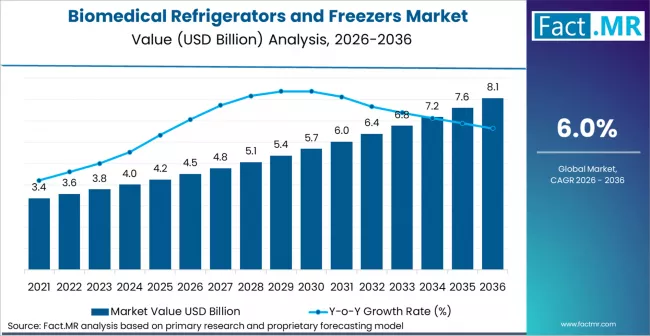
Biomedical Refrigerators And Freezers Market Market Value Analysis | Source: Fact.MR
Biomedical Refrigerators and Freezers Market
| Metric | Value |
|---|---|
| Estimated Value in (2026E) | USD 4.5 billion |
| Forecast Value in (2036F) | USD 6.7 billion |
| Forecast CAGR (2025 to 2036) | 6% |
Source: Fact.MR analysis. Updated Mar 6, 2026
Biomedical Refrigerators and Freezers Market Definition
The Biomedical Refrigerators and Freezers Market involves the manufacture and sale of temperature‑controlled storage units designed to preserve biological materials, vaccines, clinical samples, and pharmaceuticals at specific cold and ultra‑cold temperatures for safe storage and integrity.
Market Inclusions
This report covers global and regional market sizes for biomedical refrigerators and freezers over a defined forecast period, including product types (refrigerators, freezers, ultra‑low temperature units), end‑use settings (hospitals, research labs, blood banks, pharmaceutical facilities), and distribution channels.
Market Exclusions
The scope excludes general household refrigerators and unrelated cooling equipment not certified for biomedical storage, and environmental chambers not specific to biological sample preservation.
Research Methodology
- Primary Research: Interviews were conducted with biomedical equipment buyers, clinical lab managers, and manufacturers.
- Desk Research: Data was sourced from industry reports, healthcare technology journals, and trade association statistics.
- Market‑Sizing and Forecasting: A hybrid model combining top‑down healthcare infrastructure demand with bottom‑up shipment and revenue data was used.
- Data Validation and Update Cycle: Findings were validated through expert review and aligned with recent production, adoption, and trade figures.
Summary of the Biomedical Refrigerators and Freezers Market
- Market Definition
- The Biomedical Refrigerators and Freezers Market involves the manufacture and sale of temperature-controlled storage units designed to preserve biological materials, vaccines, clinical samples, and pharmaceuticals at precise cold and ultra-cold temperatures for safe storage and integrity.
- Demand Drivers
- Hospital and Research Use: Hospitals and research laboratories require reliable storage for blood, plasma, vaccines, and lab specimens, making them the largest end-user segment.
- Regulatory Compliance: Units are adopted to meet stringent standards for biomedical storage, including WHO and FDA guidelines.
- Healthcare Infrastructure Growth: Expansion of hospitals, blood banks, and research facilities increases demand for advanced refrigeration solutions.
- Advanced Technology Adoption: Ultra-low freezers and pharmaceutical-grade units with digital monitoring are gaining share for precision, safety, and cold chain reliability.
- Key Segments Analyzed
- Product: Plasma Freezers, Blood Bank Refrigerators, Ultra-Low Temperature Freezers, Shock Freezers, Pharmacy Refrigerators, Medical Refrigerators, Laboratory Refrigerators, Cryogenic Storage Systems
- End User: Hospitals, Research Laboratories, Pharmacies, Diagnostic Centers, Blood Banks
- Geography: China, India, Germany, USA, United Kingdom
- Analyst Opinion at FMR
- Shambhu Nath Jha, Principal Consultant at Fact MR, comments, “The biomedical refrigerators and freezers market is driven by the rising demand for temperature-controlled storage of vaccines, biologics, and laboratory samples. Adoption is expanding with the growth of hospital infrastructure, clinical research, and regulatory standards. Advanced ultra-low and pharmaceutical-grade units are expected to drive value growth, while emerging regions show rapid uptake due to healthcare and biotechnology investments.”
- Strategic Implications/Executive Takeaways
- Focus on Advanced and Ultra-Low Units: Prioritize high-performance units with digital monitoring and alarm systems to meet strict cold chain standards.
- Target Hospital and Research Expansion: Focus on emerging markets with growing healthcare infrastructure and biotechnology investments.
- Strengthen Regulatory Compliance and Support Services: Provide installation, preventive maintenance, and training services to differentiate offerings.
- Leverage Regional Growth: Capitalize on high growth in China, India, and other Asia Pacific markets for long-term adoption.
- Methodology
- Primary research through interviews with biomedical equipment buyers, clinical lab managers, and manufacturers.
- Desk research using industry reports, healthcare technology journals, and trade association data.
- Market sizing and forecasting using a hybrid top-down and bottom-up approach validated with shipment, revenue, and adoption data.
Segmental Analysis
Biomedical Refrigerators and Freezers Market Analysis by Product
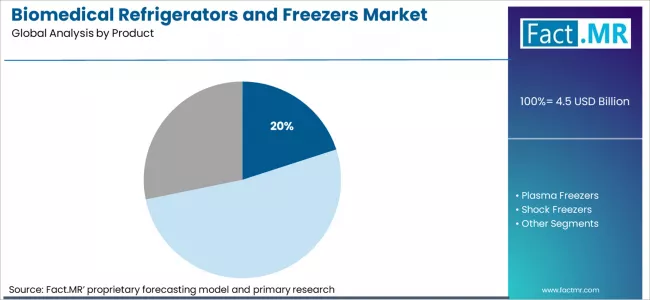
Biomedical Refrigerators And Freezers Market Analysis By Product | Source: Fact.MR
- Market Overview: Blood bank refrigerators are expected to capture 20% of the market share by 2026. These refrigerators are specifically designed to store blood and blood components under controlled temperature conditions, ensuring safety, quality, and longevity. They are widely used in hospitals, blood banks, and diagnostic centers for preserving critical blood supplies.
- Demand Drivers:
- Regulatory Compliance: Blood bank refrigerators meet strict regulatory standards for blood storage, driving their adoption in healthcare facilities.
- Temperature Control and Safety: These refrigerators provide precise temperature management, ensuring blood products remain viable and safe for transfusion.
- Growing Blood Bank and Hospital Infrastructure: The expansion of hospitals and blood banking facilities globally increases the demand for specialized biomedical refrigeration solutions.
Biomedical Refrigerators and Freezers Market Analysis by End User
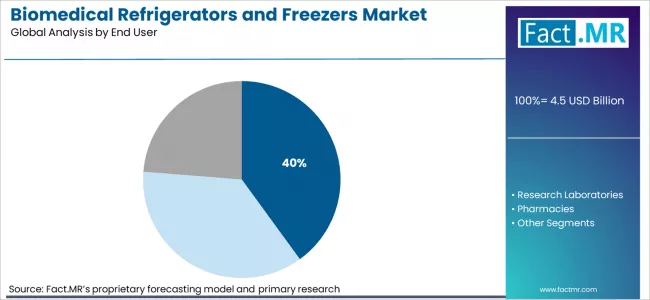
Biomedical Refrigerators And Freezers Market Analysis By End User | Source: Fact.MR
- Market Overview: Hospitals are projected to hold 40% of the market share by 2026. Hospitals use biomedical refrigerators and freezers to store blood, plasma, vaccines, and other critical medical materials, making them the largest end-user segment in this market.
- Demand Drivers:
- High Need for Blood and Medical Storage: Hospitals require reliable refrigeration to preserve blood, vaccines, and laboratory samples, ensuring patient safety and uninterrupted medical care.
- Expansion of Healthcare Services: Growing hospital infrastructure and specialized departments increase the need for advanced biomedical storage solutions.
- Focus on Patient Safety and Compliance: Hospitals prioritize proper storage of biomedical materials to comply with safety standards and prevent degradation, driving adoption of high-quality refrigerators and freezers.
Biomedical Refrigerators and Freezers Market Drivers, Restraints, and Opportunities
FMR analysts observe that the biomedical refrigerators and freezers market is a growth‑aligned, healthcare‑infrastructure segment driven by rising demand for controlled‑temperature storage of vaccines, biologics, laboratory samples, and clinical trial materials. Historically, basic cold storage met general refrigeration needs; as precision medicine, expanded immunization programs, and biologic storage protocols became standard, structural demand emerged for specialized units that maintain tight temperature tolerances and stability. The 2026 valuation reflects this shift, with adoption tied to healthcare expansion, research activity, and stringent storage requirements rather than discretionary purchases.
While basic clinical refrigerators remain common in smaller clinics and cost‑sensitive settings, advanced ultra‑low and pharmaceutical‑grade freezers with digital monitoring and alarm systems are gaining share. These higher‑value units command premium pricing, contributing to net market growth even as overall unit volumes grow in line with healthcare spending and laboratory infrastructure upgrades. The market exists because regulatory and safety standards increasingly require precise, documented cold chain control for sensitive biomedical materials.
- Cold Chain Compliance Demand: Healthcare providers and labs adopt certified refrigerators and freezers to meet stringent storage requirements for vaccines, biologics, and temperature‑sensitive samples.
- Regulatory & Quality Standards: Guidelines such as WHO cold chain standards and FDA storage criteria push adoption of units that meet defined stability and monitoring criteria.
- Regional Healthcare Trends: In North America and Europe strong healthcare infrastructure and research activity drive higher uptake, while Asia‑Pacific sees rapid growth with expanding clinical services.
Regional Analysis
The market analysis covers key global regions, including East Asia, South Asia, Western Europe, and North America. It is segmented geographically, with specific market dynamics for each region. The full report provides a detailed market attractiveness analysis.
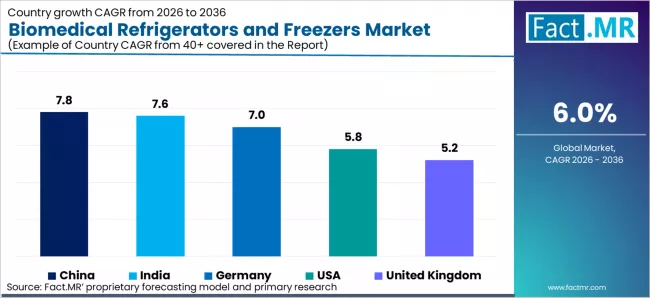
Biomedical Refrigerators And Freezers Market Cagr Analysis By Country | Source: Fact.MR
| Country | CAGR (2026-2036) |
|---|---|
| China | 7.8% |
| India | 7.6% |
| Germany | 7.0% |
| USA | 5.8% |
| United Kingdom | 5.2% |
Source: Fact.MR analysis. Updated Mar 6, 2026
Source: Fact MR (FMR) analysis, based on proprietary forecasting model and primary research.
East Asia:
In East Asia, China is the leading market for biomedical refrigerators and freezers, driven by growing healthcare infrastructure, increasing laboratory and clinical research activities, and rising demand for safe storage of biomedical materials.
- China: Demand for biomedical refrigerators and freezers in China is projected to rise at 7.8% CAGR through 2036. China’s expanding healthcare infrastructure, rising clinical and research activities, and growing adoption of advanced biomedical storage equipment continue to support market growth.
South Asia:
In South Asia, India is a significant market for biomedical refrigerators and freezers, supported by the country’s growing healthcare sector, rising laboratory research, and increasing demand for vaccines and temperature-sensitive biomedical products.
- India: Demand for biomedical refrigerators and freezers in India is projected to rise at 7.6% CAGR through 2036. India’s expanding healthcare and research sectors, increasing vaccine storage requirements, and growing adoption of temperature-controlled storage equipment contribute to market growth.
Western Europe:
In Western Europe, Germany and the United Kingdom are prominent markets for biomedical refrigerators and freezers, driven by well-established healthcare systems, rising clinical research, and growing demand for reliable storage of biomedical materials.
- Germany: Demand for biomedical refrigerators and freezers in Germany is projected to rise at 7.0% CAGR through 2036. Germany’s strong healthcare and research infrastructure, growing clinical research activities, and high adoption of advanced biomedical storage solutions continue to support growth.
- United Kingdom: Demand for biomedical refrigerators and freezers in the UK is projected to rise at 5.2% CAGR through 2036. The UK’s advanced healthcare sector, rising laboratory research, and growing demand for temperature-sensitive storage solutions contribute to steady market growth.
North America:
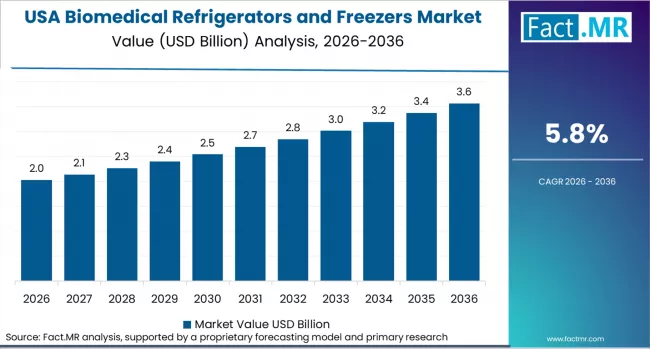
Biomedical Refrigerators And Freezers Market Country Value Analysis | Source: Fact.MR
In North America, the USA is a major market for biomedical refrigerators and freezers, supported by increasing healthcare spending, growing pharmaceutical and biotechnology research, and rising demand for temperature-controlled storage solutions.
- USA: Demand for biomedical refrigerators and freezers in the U.S. is projected to rise at 5.8% CAGR through 2036. The USA’s expanding research and healthcare infrastructure, increased use of biomedical storage solutions, and growing focus on vaccine and biologics storage continue to drive market growth.
Fact MR's analysis of the Biomedical Refrigerators and Freezers Market in East Asia, South Asia, Western Europe, and North America consists of country-wise assessments that include China, India, Germany, the USA, and the United Kingdom. Readers can find detailed trends, regulatory updates, and company-specific investments shaping the market’s growth in these countries.
What is the Competitive Structure and Buyer Behavior in the Biomedical Refrigerators and Freezers Market?
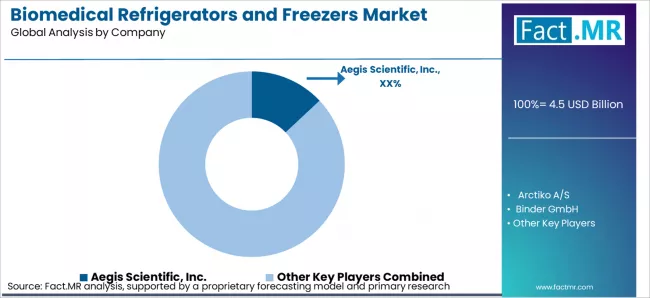
Biomedical Refrigerators And Freezers Market Analysis By Company | Source: Fact.MR
The biomedical refrigerators and freezers market is moderately concentrated, with major global manufacturers such as Thermo Fisher Scientific Inc., Eppendorf AG, Liebherr‑International AG, and Panasonic Healthcare Co., Ltd. holding significant share alongside other established suppliers including Aegis Scientific, Inc., Arctiko A/S, Binder GmbH, Biomedical Solutions, Inc., Bionics Scientific Technologies Co., Ltd., Coldway S.A., Desmon S.p.A., Froilabo SAS, Gram Commercial A/S, Helmer Scientific, Inc., LabRepco, Inc., Philips Kirsch GmbH, and Terumo Corporation. The primary competitive variables are product reliability, temperature precision, energy efficiency, compliance with regulatory standards, and support services including installation and preventive maintenance. Companies with broad product portfolios, global sales and service networks, and strong R&D capabilities hold structural advantages, as they can cater to diverse medical, research, and laboratory requirements while ensuring regulatory compliance and long‑term support. Large institutional buyers such as hospitals, research laboratories, and pharmaceutical companies exert significant leverage by qualifying multiple suppliers, negotiating long‑term service and pricing agreements, and specifying performance standards tied to application needs. To manage supplier dependency, these buyers often diversify approved vendors and standardize technical specifications, which constrains individual suppliers’ pricing power. Consequently, competition focuses more on performance reliability, after‑sales support, and supply assurance rather than on price alone.
Recent Industry Developments
- European Traceability Enforcement: Effective January 2026, new medical cold-chain regulations in Europe mandate that every stage of storage—from hospital pharmacy to bedside—be documented via certified, time-stamped recording systems to prevent thermal variation losses.
- India Manufacturing Expansion: To meet a projected 7.6% regional CAGR, Thermo Fisher Scientific has officially launched its first "Made in India" TSV series of laboratory refrigerators and freezers, designed specifically to provide localized, high-throughput storage for the growing Indian biopharma sector.
Key Players of the Biomedical Refrigerators and Freezers Market
- Aegis Scientific, Inc.
- Arctiko A/S
- Binder GmbH
- Biomedical Solutions, Inc.
- Bionics Scientific Technologies Co., Ltd.
- Coldway S.A.
- Desmon S.p.A.
- Eppendorf AG
- Froilabo SAS
- Gram Commercial A/S (formerly Gram Commercial SAS)
- Helmer Scientific, Inc.
- LabRepco, Inc.
- Liebherr‑International AG
- Panasonic Healthcare Co., Ltd.
- Philips Kirsch GmbH
- Terumo Corporation
- Thermo Fisher Scientific Inc.
Report Scope
| Metric | Value |
|---|---|
| Quantitative Units | USD 4.5 billion (2026) to USD 6.7 billion (2036), at a CAGR of 6% |
| Market Definition | The Biomedical Refrigerators and Freezers Market covers refrigeration and freezing equipment used for the storage of blood, plasma, pharmaceuticals, and laboratory specimens across healthcare and research. |
| By Product | Plasma Freezers, Blood Bank Refrigerators, Ultra-Low Temperature Freezers, Shock Freezers, Pharmacy Refrigerators, Medical Refrigerators, Laboratory Refrigerators, Cryogenic Storage Systems |
| By End User | Hospitals, Research Laboratories, Pharmacies, Diagnostic Centers, Blood Banks |
| Regions Covered | North America, Latin America, Europe, East Asia, South Asia, Oceania, Middle East and Africa |
| Countries Covered | United States, Canada, Mexico, Brazil, Argentina, Germany, France, United Kingdom, Italy, Spain, China, India, Japan, South Korea, Indonesia, Australia, and 40+ countries |
| Key Companies Profiled | Aegis Scientific, Inc., Arctiko A/S, Binder GmbH, Biomedical Solutions, Inc., Bionics Scientific Technologies Co., Ltd., Coldway S.A., Desmon S.p.A., Eppendorf AG, Froilabo SAS, Gram Commercial A/S, Helmer Scientific, Inc., LabRepco, Inc., Liebherr‑International AG, Panasonic Healthcare Co., Ltd., Philips Kirsch GmbH, Terumo Corporation, Thermo Fisher Scientific Inc. |
| Forecast Period | 2026 to 2036 |
| Approach | Hybrid top-down and bottom-up market modeling validated through primary interviews with manufacturers and supported by trade data benchmarking and market research. |
Source: Fact.MR analysis. Updated Mar 6, 2026
Bibliographies
- Thermo Fisher Scientific Inc. (2023). Biomedical refrigeration solutions for hospitals and research facilities.
- Eppendorf AG. (2023). Ultra-low temperature and biomedical storage equipment: Market insights and applications.
- Liebherr International AG. (2023). Biomedical refrigerators and freezers for clinical and laboratory use.
- Panasonic Healthcare Co., Ltd. (2023). Advanced biomedical refrigeration systems and global market trends.
- Medifroid. (2026). Medical cold chain: What regulatory changes are planned for 2026? Medifroid.
- Medical Buyer. (2026). Thermo Fisher Scientific introduces 'Made in India' TSV series lab refrigerators and freezers. Medical Buyer.
This report addresses
- Market intelligence enabling comprehensive assessment of leading countries and product segments across the Biomedical Refrigerators and Freezers Market globally.
- Market volume (sales units) estimates and 10-year revenue forecasts from 2026 to 2036, validated through manufacturer shipment data, channel partner surveys, and country-level demand modeling.
- Growth opportunity mapping across product types (Plasma Freezers, Blood Bank Refrigerators, Ultra-Low Temperature Freezers, Shock Freezers, Pharmacy Refrigerators, Medical Refrigerators, Laboratory Refrigerators, Cryogenic Storage Systems) and end-use sectors (Hospitals, Research Laboratories, Pharmacies, Diagnostic Centers, Blood Banks).
- Segment and regional revenue forecasts by product type, end user, and geography across 40+ countries.
- Competition strategy analysis covering dealer network structure, recent developments, product portfolio, USPs, and market share analysis.
- Product and regulatory compliance tracking aligned with medical storage standards, FDA/WHO guidelines, and hospital safety regulations.
- Regulatory impact analysis addressing cold chain compliance, energy efficiency requirements, and certifications across key markets.
- Report delivery in PDF, Excel, PowerPoint, and interactive dashboard formats for executive, procurement, and operational planning use.
Segmentation
Biomedical Refrigerators and Freezers Market Key Segments
-
Product :
- Plasma Freezers
- Blood Bank Refrigerators
- Ultra-Low Temperature Freezers
- Shock Freezers
- Pharmacy Refrigerators
- Medical Refrigerators
- Laboratory Refrigerators
- Cryogenic Storage Systems
-
End-Use Industry :
- Hospitals
- Research Laboratories
- Pharmacies
- Diagnostic Centers
- Blood Banks
-
Region :
- North America
- USA
- Canada
- Mexico
- Europe
- Germany
- UK
- France
- Italy
- Spain
- Nordic Countries
- BENELUX
- Rest of Europe
- Asia Pacific
- China
- Japan
- South Korea
- India
- Australia
- Rest of Asia Pacific
- Latin America
- Brazil
- Argentina
- Rest of Latin America
- Middle East and Africa
- Kingdom of Saudi Arabia
- United Arab Emirates
- South Africa
- Rest of Middle East and Africa
- Other Regions
- Oceania
- Central Asia
- Other Markets
- North America
Frequently Asked Questions
How large is the demand for Biomedical Refrigerators and Freezers in the global market in 2026?
What will be the market size of Biomedical Refrigerators and Freezers in the global market by 2036?
What is the expected demand growth for Biomedical Refrigerators and Freezers in the global market between 2026 and 2036?
Which end-user sector is expected to dominate the market?
Which region is expected to show the highest growth rate for Biomedical Refrigerators and Freezers?
How significant is the growth outlook for India in this market?
What is the growth outlook for Germany in the Biomedical Refrigerators and Freezers market?
What is the growth forecast for the United States in the Biomedical Refrigerators and Freezers market?
Which company is identified as a leading player in the Biomedical Refrigerators and Freezers market?
What are Biomedical Refrigerators and Freezers used for?
What does the Biomedical Refrigerators and Freezers market include in this report?
How is the market forecast developed in this report?
What is meant by the Biomedical Refrigerators and Freezers market in this report?
Who worked on this report


Preview the report firsthand - request a free sample
Free SampleGet the brochure for pricing and purchase details
Download PDF