- Market Value (2025): USD 1.8 Bn
- Estimated Value (2026): USD 1.9 Bn
- Forecast Value (2036): USD 3.6 Bn
- CAGR (2026-2036): 6.6%
What is the Anti-Snore Device Market forecast to be worth by 2036?
USD 1.9 billion in 2026 to USD 3.6 billion by 2036 at a 6.6% CAGR.
- The anti-snore device market reached USD 1.8 billion in 2025.
- Demand is projected to increase from USD 1.9 billion in 2026 to USD 3.6 billion by 2036.
- The market is forecast to record 6.6% CAGR from 2026 to 2036 as home users, sleep clinics and online retailers expand access to non-invasive nightly therapy.
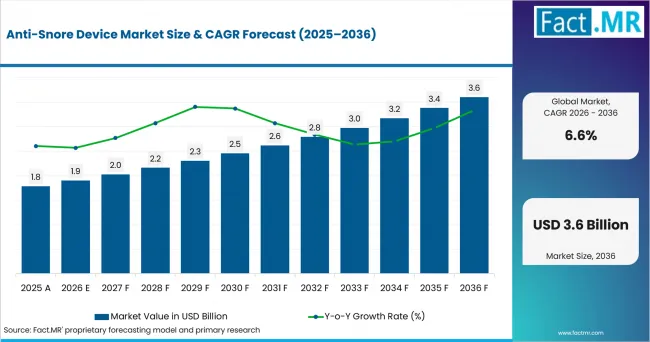
Anti Snore Device Market Value Analysis | Source: Fact.MR
What are the defining numbers behind Anti-Snore Device Market growth?
USD 1.7 billion absolute opportunity between 2026 and 2036.
- Demand Drivers in the Market
- Adults with repeated snoring need airway support that fits home routines and avoids complex setup.
- Dentists need adjustable mandibular devices that balance jaw advance with comfort during nightly use.
- Sleep clinics need non-pressure options for selected mild OSA patients after clinical evaluation.
- Online retailers need clear fitting instructions so first-time users understand device limits before purchase.
- The American Academy of Dental Sleep Medicine updated adult oral-appliance standards in April 2025, reinforcing screening and follow-up expectations for fitted devices.
- Key Segments Analyzed
- By Product: Mandibular Advancement Devices are expected to hold 62.80% share in 2026 because jaw positioning targets upper-airway narrowing.
- By Application: Obstructive Sleep Apnea is projected to account for 74.10% share in 2026 due to its clinical link with snoring.
- By End Use: Home Care Settings are anticipated to capture 68.50% share in 2026 as users manage nightly therapy outside hospitals.
- By Technology: Mechanical Airway Adjustment Technology is estimated to represent 55.90% share in 2026 owing to mandibular repositioning.
- By Formulation: Custom Fit Oral Devices are forecast to hold 47.60% share in 2026 because fit shapes nightly adherence.
- By Distribution Channel: Online Retail is expected to account for 63.40% share in 2026 as direct brand websites influence first purchases.
- Analyst Opinion at Fact.MR
- Shambhu Nath Jha, Principal Consultant at Fact.MR, states, "Anti-snore devices are becoming a comfort and adherence category that reaches beyond simple accessories. Demand is expected to stay tied to dental fit, credible device claims and home-use guidance. Providers that combine adjustment support, clear use limits and follow-up pathways are better positioned to retain users."
- Strategic Implications
- Device makers should document adjustment range, cleaning life and bite-comfort guidance for each oral appliance.
- Dental clinics should screen users for OSA risk before recommending a fitted mandibular device.
- Online retailers should separate clinically cleared oral appliances from general wellness snoring aids.
- Sleep-care providers should connect oral-device selection with follow-up checks when symptoms continue.
Germany is expected to record 7.6% CAGR through 2036 due to sleep-health awareness and online health purchasing. Brazil is projected to post 6.9% CAGR as digital access expands. The USA is anticipated to advance at 6.3% CAGR, supported by short-sleep prevalence and home testing. The UK is estimated to reach 5.6% CAGR with diagnostic demand. Japan is forecast to record 5.0% CAGR as ageing and e-commerce shape access.
How does the Anti-Snore Device Market break down by segment?
Mandibular Advancement Devices lead Product at 62.80%; Obstructive Sleep Apnea leads Application at 74.10%.
Which Product dominates?
Mandibular Advancement Devices are expected to hold 62.8% share in 2026.
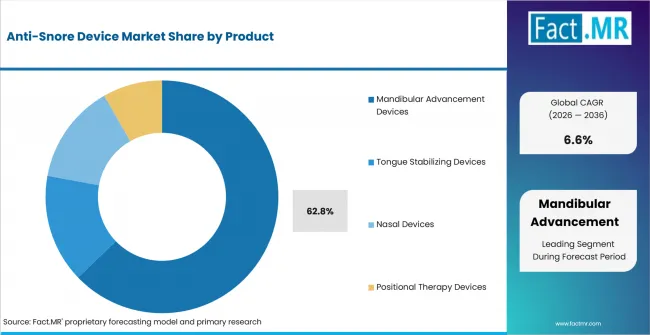
Anti Snore Device Market Analysis By Product | Source: Fact.MR
Mandibular advancement devices lead the product mix because they move the lower jaw forward and help keep the upper airway open during sleep. Adjustable MAD devices support gradual titration, while fixed devices suit simpler routines. FDA 510(k) records show an October 2025 substantial-equivalence decision for Mandibular Advancement Device L07, showing continued review activity for anti-snoring mandibular devices.
What leads the Application segment?
Obstructive Sleep Apnea is projected to account for 74.1% share in 2026.
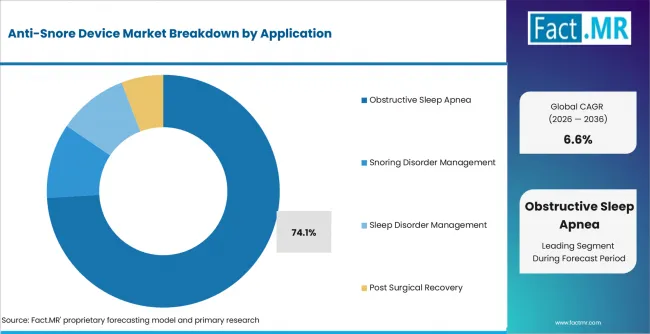
Anti Snore Device Market Analysis By Application | Source: Fact.MR
Obstructive sleep apnea leads application demand because snoring often appears with partial airway obstruction. Mild OSA management supports oral-device use, and moderate cases still need clinician judgement. AADSM guidance updated in April 2025 keeps oral appliance therapy linked to screening, treatment and follow-up.
How does End Use shape demand?
Home Care Settings are anticipated to capture 68.5% share in 2026.
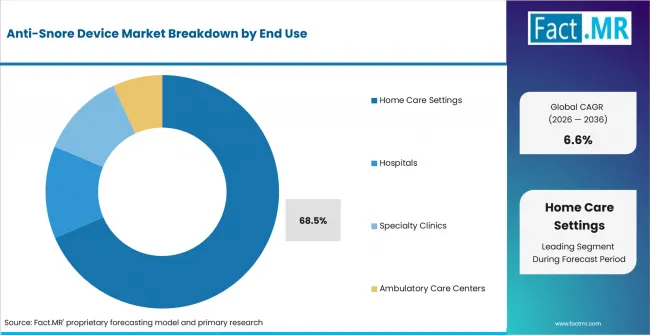
Anti Snore Device Market Analysis By End Use | Source: Fact.MR
Home care settings lead because anti-snore devices are worn nightly and depend on user acceptance. Individual consumers purchase many products directly, while clinics remain part of assessment.
What supports Technology selection?
Mechanical Airway Adjustment Technology is estimated to represent 55.9% share in 2026.
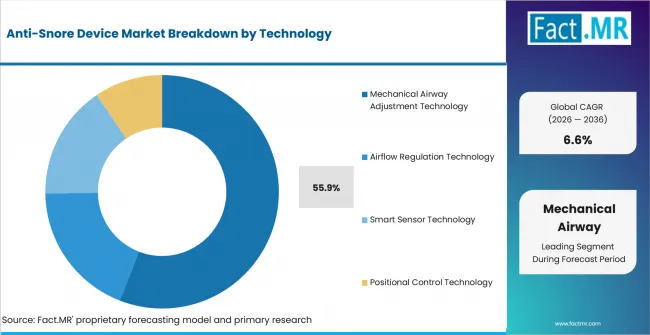
Anti Snore Device Market Analysis By Technology | Source: Fact.MR
Mechanical airway adjustment technology leads because jaw advancement and tongue positioning are easy for clinicians to explain. Airflow regulation supports nasal devices. Positional control remains relevant for users whose snoring worsens during supine sleep.
Which Formulation leads?
Custom Fit Oral Devices are forecast to hold 47.6% share in 2026.
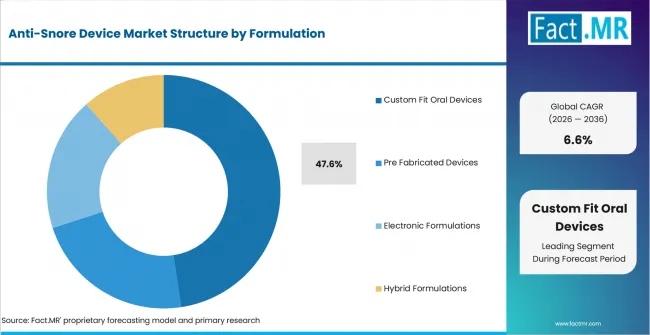
Anti Snore Device Market Analysis By Formulation | Source: Fact.MR
Custom fit oral devices lead formulation demand because comfort and retention influence nightly adherence. Patient-specific molding supports prescription routes. The fit process overlaps with wider dental workflow areas such as dental impression systems where chairside accuracy affects appliance quality.
What leads the Distribution Channel segment?
Online Retail is expected to account for 63.4% share in 2026.
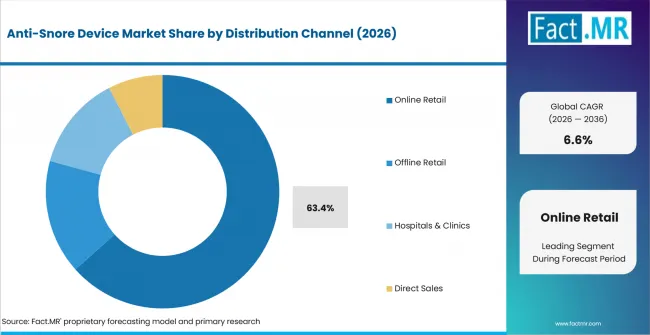
Anti Snore Device Market Analysis By Distribution Channel | Source: Fact.MR
Online retail leads because users compare claims, clearance status and fitting instructions before purchase. E-commerce platforms and health e-pharmacies widen access to oral and nasal devices.
What is accelerating Anti-Snore Device Market adoption, and what is holding it back?
Demand is expected to rise through home care use and online access; adoption is constrained by diagnosis gaps, fit discomfort and product-claim scrutiny.
Drivers Impact Analysis
| DRIVER | (~) % IMPACT ON CAGR | GEOGRAPHIC RELEVANCE | IMPACT TIMELINE |
|---|---|---|---|
| Home-based snoring management | +0.8% | Global | Short term (<= 2 years) |
| Custom oral-appliance use in mild OSA | +0.7% | North America, Europe | Medium term (2-4 years) |
| Online retail access and direct brand channels | +0.5% | North America, East Asia | Short term (<= 2 years) |
| Sleep-clinic referral for oral alternatives | +0.4% | Global | Long term (>= 4 years) |
Source: Fact.MR analysis. Updated Sep 1, 2026
- Home-based snoring management: Users increasingly prefer devices that fit easily into nightly routines. At-home sleep testing and monitoring solutions can support earlier identification of sleep-related breathing concerns and encourage therapy discussions.
- Online retail access and direct brand channels: Product discovery often begins through online platforms and direct brand channels, making clear product descriptions, usage guidance, and device information important during early selection.
- Sleep-clinic referral for oral alternatives: Sleep clinics remain important when snoring may be associated with obstructive sleep apnea and users require professional evaluation, treatment guidance, or recommendations for oral appliance options.
Opportunity Impact Analysis
| OPPORTUNITY | (~) % IMPACT ON CAGR | GEOGRAPHIC RELEVANCE | IMPACT TIMELINE |
|---|---|---|---|
| Adjustable MAD devices for first-time users | +0.6% | Global | Medium term (2-4 years) |
| Custom-fit oral devices through dental clinics | +0.5% | North America, Europe, Japan | Medium term (2-4 years) |
| Connected device systems for follow-up | +0.3% | North America, East Asia | Long term (>= 4 years) |
Source: Fact.MR analysis. Updated Sep 1, 2026
• Adjustable MAD devices for first-time users: Stepwise jaw advancement helps users balance comfort and airway support.
• Custom-fit oral devices through dental clinics: Professionals can match device type with bite pattern, severity and tolerance.
• Connected device systems for follow-up: Use feedback helps clinicians identify adherence problems before therapy abandonment.
Restraints Impact Analysis
| RESTRAINT | (~) % IMPACT ON CAGR | GEOGRAPHIC RELEVANCE | IMPACT TIMELINE |
|---|---|---|---|
| Undiagnosed OSA and self-treatment risk | -0.6% | Global | Short term (<= 2 years) |
| Fit discomfort and dental side effects | -0.4% | Global | Medium term (2-4 years) |
| Adjacent sleep-device quality and post-market scrutiny | -0.3% | North America, Europe | Medium term (2-4 years) |
Source: Fact.MR analysis. Updated Sep 1, 2026
- Undiagnosed OSA and self-treatment risk: Snoring may sometimes be associated with obstructive sleep apnea, making appropriate screening and coordination between dental and medical professionals important when oral appliance therapy is considered.
- Fit discomfort and dental side effects: Oral anti-snoring devices can cause discomfort or dental-related side effects in some users, increasing the importance of proper fitting, adjustment, and ongoing professional follow-up.
- Adjacent sleep-device quality and post-market scrutiny: Quality, device performance, and post-market monitoring remain important across the broader sleep-therapy device landscape, supporting continued attention to product reliability, correct use, and patient safety.
Which countries are scaling the Anti-Snore Device Market through 2036?
The country comparison spans 2.6 percentage points across the forecast period.
- Germany remains 0.7 percentage point above Brazil through sleep-health awareness and online health purchasing.
- Brazil remains 0.6 percentage point above the USA as digital access widens product discovery.
- The USA remains 0.7 percentage point above the UK through short-sleep prevalence and home testing.
- The UK remains 0.6 percentage point above Japan as diagnostic activity keeps sleep disorders visible.
- Japan closes the displayed range through ageing, e-commerce access and regulated device pathways.
Full report coverage includes North America, Latin America, Western Europe, Eastern Europe, East Asia, South Asia & Pacific, Middle East & Africa.
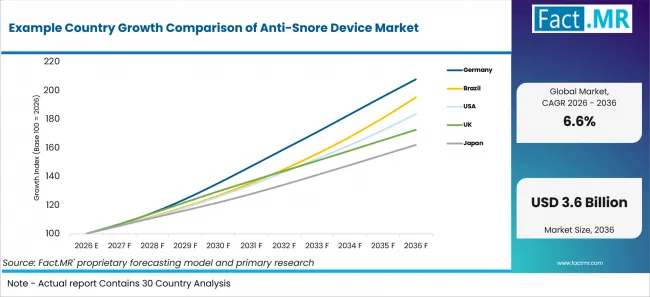
Example Country Growth Comparison Of Anti Snore Device Market | Source: Fact.MR
| Country | CAGR (2026-2036) |
|---|---|
| Germany | 7.6% |
| Brazil | 6.9% |
| USA | 6.3% |
| UK | 5.6% |
| Japan | 5.0% |
Source: Fact.MR analysis. Updated Sep 1, 2026
What supports Germany adoption?
7.6% CAGR, supported by sleep-problem awareness and online health purchasing.
Robert Koch Institute reported in June 2026 that 12.6% of adults in its 2024 panel had both sleep-onset and sleep-maintenance problems. Growing awareness of sleep-related concerns supports interest in snoring-management solutions, while online health purchasing improves product accessibility. Tomed GmbH produces mandibular advancement devices, anti-snoring shirts and nasal dilators in Germany, while custom oral devices fit dentist-led care where bite comfort and professional follow-up influence nightly use.
How is Brazil scaling demand?
6.9% CAGR, shaped by online access and sleep-health risk factors.
IBGE reported in July 2026 that 90.5% of Brazil’s population aged 10 and older used the internet in 2025. Broad internet access supports digital discovery of mouthpieces, nasal devices and other snoring-management products. Brazil’s formal dental-care network also creates pathways for professionally fitted oral appliances, while Anvisa requirements for device regularization, technical documentation, risk management and labeling reinforce structured market participation.
What supports USA adoption?
6.3% CAGR, supported by short-sleep prevalence and active home testing.
CDC NCHS reported in April 2026 that 30.5% of U.S. adults slept less than seven hours in 2024. High awareness of sleep health supports demand for snoring assessment and management solutions. ResMed’s NightOwl home sleep apnea test strengthens home-based assessment pathways, while dental sleep practices support fitted mandibular advancement devices after professional evaluation. FDA oversight of anti-snoring intraoral devices also reinforces established regulatory pathways for oral sleep appliances.
What supports the UK’s growth?
5.6% CAGR, backed by obesity-linked risk and diagnostic demand.
NHS England Digital reported in January 2026 that 66% of adults in England were overweight or living with obesity in 2024. Weight-related sleep-health risks can increase attention to snoring and sleep-apnoea assessment. NHS guidance includes mandibular advancement devices among treatment options for sleep apnoea, while dental and sleep-clinic pathways support professionally fitted oral appliances. Diagnostic waiting pressures can also encourage greater interest in accessible sleep-health assessment pathways.
How does Japan perform?
5.0% CAGR, led by ageing and e-commerce access.
Statistics Bureau of Japan reported in April 2025 that the population aged 65 and over reached 36.24 million in 2024. Japan’s ageing population supports greater attention to sleep health and related management solutions, while established e-commerce channels improve product accessibility. Dental-clinic involvement remains relevant for bite and retention checks, and reimbursement and medical-device requirements support professionally supervised oral-appliance pathways.
Who leads the Anti-Snore Device Market?
Competition centers on comfort, oral-device adjustment, clinical credibility and retail reach. SomnoMed, Apnea Sciences, PureSleep and Tomed focus on oral appliances or snoring devices. ResMed, Philips Healthcare and Fisher & Paykel Healthcare remain relevant to the sleep-disordered breathing care pathway through diagnostics, PAP therapy or OSA accessories.
SomnoMed links its portfolio to oral appliance therapy and compliance monitoring. Apnea Sciences offers SnoreRx and ApneaRx oral appliances. PureSleep supports consumer anti-snoring mouthpieces, while Tomed supplies SomnoGuard devices and positional products. Fisher & Paykel Healthcare reported in May 2026 that Homecare revenue, including products used for OSA and home respiratory support, reached NZD 802.7 million in FY2026.
Which companies are the providers?
Key companies include ResMed; Philips Healthcare; Apnea Sciences Corporation; SomnoMed; Tomed GmbH; The Pure Sleep Company; and Fisher & Paykel Healthcare.
- ResMed
- Philips Healthcare
- Apnea Sciences Corporation
- SomnoMed
- Tomed GmbH
- The Pure Sleep Company
- Fisher & Paykel Healthcare
Bibliography
- Levine, M., Cantwell, M. K., Postol, K., & Schwartz, D. B. (2025). Dental sleep medicine standards for screening, treatment, and management of sleep-related breathing disorders in adults using oral appliance therapy: An update. Journal of Dental Sleep Medicine, 12(2).
- Agência Nacional de Saúde Suplementar. (2026, August 5). ANS divulga número de beneficiários em junho [ANS releases number of beneficiaries in June].
- Agência Nacional de Vigilância Sanitária. (2026, August 25). Anvisa disponibiliza manuais orientativos para regularização de dispositivos médicos [Anvisa makes guidance manuals available for medical-device regularization].
- Ng, A. E., Black, L. I., & Adjaye-Gbewonyo, D. (2026, April 29). Short sleep duration and sleep difficulties among adults: United States, 2024 (NCHS Data Brief No. 559). National Center for Health Statistics.
- Bundesministerium für Gesundheit. (2026, March 10). Finanzentwicklung der GKV im 1.-4. Quartal 2025 [Financial development of statutory health insurance in quarters 1–4 of 2025].
- Regulation (EU) 2017/745 of the European Parliament and of the Council of 5 April 2017 on medical devices, amending Directive 2001/83/EC, Regulation (EC) No 178/2002 and Regulation (EC) No 1223/2009 and repealing Council Directives 90/385/EEC and 93/42/EEC, 2017 O.J. (L 117) 1.
- Statistisches Bundesamt (Destatis). (2025, March 11). 21 % der 16- bis 74-Jährigen kaufen Arzneimittel oder Nahrungsergänzungsmittel online [21% of 16- to 74-year-olds buy medicines or dietary supplements online].
- Fisher & Paykel Healthcare Corporation Limited. (2026, May 26). Fisher & Paykel Healthcare reports strong revenue and profit growth for the 2026 financial year.
- Fisher & Paykel Healthcare Corporation Limited. (2026, May 26). Fisher & Paykel Healthcare reports strong revenue and profit growth for the 2026 financial year.
- Ministry of Economy, Trade and Industry. (2025, August 26). Results of FY2024 E-Commerce Market Survey Compiled.
- NHS England. (2025, November 13). NHS diagnostic waiting times and activity data: September 2025 monthly report.
- NHS England. (2026, January 27). Health Survey for England, 2024: Adults’ overweight and obesity.
- NHS. (2026, May 11). Sleep apnoea.
- Office for National Statistics. (2026, July 24). Retail sales, Great Britain: June 2026.
- Office for National Statistics. (2026, August 21). Retail sales, Great Britain: July 2026.
This Report Answers
- The report explains use across product, application, end use, technology, formulation and channel.
- Segment analysis explains why users select the listed subsegments.
- Country analysis examines Germany, Brazil, the USA, the UK and Japan.
- Competitive analysis reviews oral appliances and sleep-care adjacencies.
- Application analysis assesses OSA, primary snoring and post-surgical recovery.
What does the Anti-Snore Device Market cover?
The Anti-Snore Device Market covers non-invasive devices used to reduce snoring or help manage airway obstruction during sleep. It includes mandibular advancement devices, tongue stabilizing devices, nasal devices and positional therapy products. Scope boundaries are aligned against the wider anti-snoring devices and snoring surgery category.
The analysis focuses on devices, while surgical procedures are separated. Adjacent comparisons include CPAP devices and upper airway stimulation where clinical therapy choices move beyond oral and nasal anti-snore devices.
What is included in the scope?
The scope includes retail and clinically fitted devices, oral appliances for mild OSA, nasal airflow products and positional therapy products. It covers online sales, e-pharmacies, medical equipment stores, hospitals, clinics and direct sales.
Respiratory-device context is captured through digital respiratory devices where connected care features are relevant to sleep and breathing care. Monitoring links to actigraphy sensors and PSG devices when diagnosis or follow-up depends on sleep measurement.
What is excluded from the scope?
The scope excludes snoring surgery, prescription drugs, sedatives, sleep supplements and unrelated wellness accessories. CPAP systems are discussed only as adjacent sleep apnea therapy. Hospital respiratory equipment is excluded unless sold for snoring or sleep-disordered breathing.
Products such as sleep supplements fall outside core sizing because they target rest support instead of mechanical airway support. General wearable products are covered only when sleep support is tied to device use.
How Was the Analysis Built?
The analysis draws on 120+ sources, 35+ company portfolios, 25+ countries and more than 20 industry interviews.
- Primary Research: Primary research includes discussions with device makers, dental sleep specialists, distributors, retailers, clinicians and end users. These conversations examine fit, comfort, channel selection and repeated nightly use.
- Desk Research: Desk research covers government statistics, regulatory publications, company filings, medical-device databases, standards and clinical guidance. The bibliography lists the principal external sources referenced in the report.
- Market Sizing and Forecasting: Market estimates combine historical performance, device pricing, segment shares, channel mix, country growth and adoption barriers.
- Data Validation and Update Cycle: Findings are validated against public data, company activity, regulatory changes and product developments. Regular updates review new device clearances, recalls, product launches and shifts in channel use.
Segmentation
What is the report’s scope and coverage?
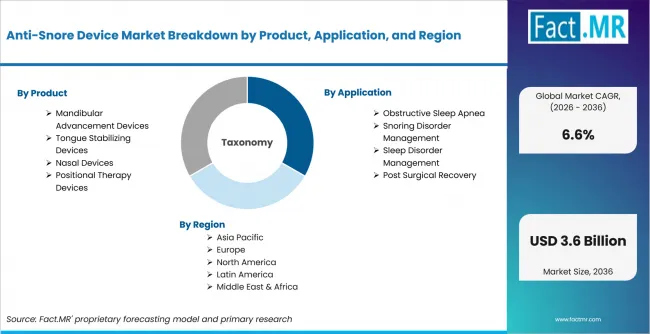
Anti Snore Device Market Breakdown By Product, Application, And Region | Source: Fact.MR
| Attribute | Details |
|---|---|
| Quantitative Units | USD billion |
| Market Definition | Devices used to reduce snoring or manage airway obstruction during sleep, including mandibular advancement devices, tongue stabilizing devices, nasal devices and positional therapy devices. |
| Product | Mandibular Advancement Devices; Tongue Stabilizing Devices; Nasal Devices; Positional Therapy Devices |
| Application | Obstructive Sleep Apnea; Snoring Disorder Management; Sleep Disorder Management; Post Surgical Recovery |
| End Use | Home Care Settings; Hospitals; Specialty Clinics; Ambulatory Care Centers |
| Technology | Mechanical Airway Adjustment Technology; Airflow Regulation Technology; Smart Sensor Technology; Positional Control Technology |
| Formulation | Custom Fit Oral Devices; Pre Fabricated Devices; Electronic Formulations; Hybrid Formulations |
| Distribution Channel | Online Retail; Offline Retail; Hospitals & Clinics; Direct Sales |
| Selected Country Values | USA USD 0.6954 billion; Japan USD 0.0876 billion in 2026 |
| Regions Covered | North America; Latin America; Western Europe; Eastern Europe; East Asia; South Asia & Pacific; Middle East & Africa |
| Countries Covered | Germany; Brazil; USA; UK; Japan |
| Companies Profiled | ResMed; Philips Healthcare; Apnea Sciences Corporation; SomnoMed; Tomed GmbH; The Pure Sleep Company; Fisher & Paykel Healthcare |
| Forecast Period | 2026 to 2036 |
| Approach | Hybrid top-down and bottom-up approach using device type, clinical use, channel mix, country adoption and provider portfolio review. |
Source: Fact.MR analysis. Updated Sep 1, 2026
How is the market segmented?
-
By Product
- Mandibular Advancement Devices
- Adjustable MAD Devices
- Fixed Positioning Devices
- Tongue Stabilizing Devices
- Suction Based Devices
- Mechanical Retention Devices
- Nasal Devices
- Nasal Dilators
- Nasal Airflow Systems
- Positional Therapy Devices
- Wearable Position Trainers
- Posture Correction Devices
- Mandibular Advancement Devices
-
By Application
- Obstructive Sleep Apnea
- Mild OSA Management
- Moderate OSA Treatment
- Snoring Disorder Management
- Primary Snoring Treatment
- Chronic Snoring Conditions
- Sleep Disorder Management
- Sleep Fragmentation Disorders
- Sleep Quality Optimization
- Post Surgical Recovery
- ENT Surgical Recovery
- Maxillofacial Recovery
- Obstructive Sleep Apnea
-
By End Use
- Home Care Settings
- Individual Consumers
- Home Healthcare Providers
- Hospitals
- Sleep Clinics
- ENT Hospitals
- Specialty Clinics
- Dental Clinics
- Pulmonology Clinics
- Ambulatory Care Centers
- Day Care Sleep Units
- Diagnostic Centers
- Home Care Settings
-
By Technology
- Mechanical Airway Adjustment Technology
- Jaw Advancement Mechanisms
- Tongue Position Control Systems
- Airflow Regulation Technology
- Nasal Airflow Enhancement Systems
- Oral Airflow Control Systems
- Smart Sensor Technology
- Sleep Monitoring Sensors
- Wearable Smart Devices
- Positional Control Technology
- Vibration Feedback Systems
- Posture Monitoring Systems
- Mechanical Airway Adjustment Technology
-
By Formulation
- Custom Fit Oral Devices
- Patient Specific Molding Systems
- Thermoformed Devices
- Pre Fabricated Devices
- Standard Size Devices
- Ready to Use Devices
- Electronic Formulations
- Smart Device Systems
- Connected Device Systems
- Hybrid Formulations
- Mechanical Electronic Hybrids
- Multi Mode Therapy Systems
- Custom Fit Oral Devices
-
By Distribution Channel
- Online Retail
- E Commerce Platforms
- Health E Pharmacies
- Offline Retail
- Pharmacy Stores
- Medical Equipment Stores
- Hospitals & Clinics
- Sleep Clinics Sales
- Dental Clinics Sales
- Direct Sales
- Manufacturer Direct Sales
- B2B Institutional Sales
- Online Retail
-
By Region
- North America
- Latin America
- Western Europe
- Eastern Europe
- East Asia
- South Asia & Pacific
- Middle East & Africa
Frequently Asked Questions
How big is the anti-snore device market in 2026?
What is the CAGR of the anti-snore device market from 2026 to 2036?
Which product leads the anti-snore device market?
Which distribution channel leads the anti-snore device market?
Who are the companies profiled in the anti-snore device market?
Who worked on this report


Preview the report firsthand - request a free sample
Free SampleGet the brochure for pricing and purchase details
Download PDF