- Base Value(2025): 12.41 Bn
- Estimated Value(2026): 13.11 Bn
- Forecast Value (2036): 22.82 Bn
- CAGR (2026 - 2036): 5.7%
Vehicle Anti-theft System Market Size, Market Forecast and Outlook By Fact.MR
The global vehicle anti-theft system market was valued at USD 12.41 billion in 2025, projected to reach USD 13.11 billion in 2026, and is forecast to expand to USD 22.82 billion by 2036 at a 5.7% CAGR. Immobilizers and encrypted key systems hold 47.8% of the system type segment in 2026, reflecting the near-universal OEM fitment of engine immobiliser technology across new passenger car production as the foundational anti-theft layer mandated by EU Directive 74/61/EEC and equivalent regulations that require electronic immobilisation to prevent unauthorised engine starting without a cryptographically verified key. Cellular and LTE-M connectivity commands 52.4% of the connectivity segment, establishing mobile network communication as the primary architecture for real-time vehicle location tracking and remote theft alert notification systems whose value to vehicle owners and insurers depends on immediate geolocation data availability.
The absolute dollar expansion of USD 9.71 billion over the forecast period reflects the progressive migration from passive electronic immobilisation toward connected anti-theft ecosystems that combine immobiliser technology with GPS tracking, remote monitoring, and insurance telematics integration. OEM factory-fit accounts for 63.6% of the end market segment, consistent with immobiliser and encrypted key systems as mandatory regulatory compliance components specified during vehicle platform development, with aftermarket retrofit representing the complementary segment serving existing vehicles without OEM-fitted connected security and high-theft-risk vehicle owners seeking enhanced protection beyond immobiliser baseline systems.
India leads country growth at 6.7% CAGR through 2036, driven by rising vehicle ownership rates alongside high vehicle theft rates that motivate both consumer demand for advanced security and insurance industry requirements for theft protection certification in premium vehicle insurance policies. The United States follows at 6.3% CAGR, where catalytic converter theft escalation has prompted both OEM and aftermarket security system investment and relay attack vulnerability concerns about keyless entry proximity key systems are driving demand for signal-blocking key storage solutions and updated immobiliser technology. The United Kingdom registers 6.0% CAGR, supported by strong consumer awareness of vehicle theft risk and insurance premium incentives tied to approved Thatcham-certified security system fitment across the vehicle parc.
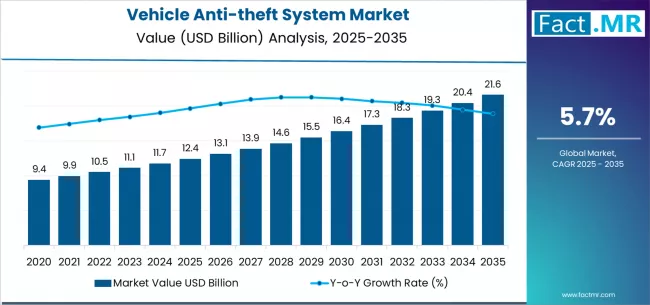
Vehicle Anti Theft System Market Market Value Analysis | Source: Fact.MR
Vehicle Anti-theft System Market Key Takeaways
| Metric | Details |
|---|---|
| Industry Size (2026) | USD 13.11 Billion |
| Industry Value (2036) | USD 22.82 Billion |
| CAGR (2026-2036) | 5.7% |
Source: Fact.MR analysis. Updated Mar 11, 2026
Vehicle Anti-theft System Market Definition
The vehicle anti-theft system market encompasses electronic and electromechanical security systems designed to prevent unauthorised vehicle access, operation, or relocation, including electronic engine immobilisers with rolling code cryptographic key authentication, GPS-based vehicle tracking and remote monitoring systems, alarm systems with motion, shock, and door sensor arrays, steering column and wheel locks, remote kill switch circuits, and connected security ecosystems integrating multiple detection and deterrence functions under a unified mobile application interface. The scope covers systems supplied to vehicle manufacturers as OEM production components and the aftermarket installation channel.
Vehicle Anti-theft System Market Inclusions
Market scope includes electronic engine immobiliser and transponder key systems, GPS and GNSS vehicle tracking units with cellular or satellite connectivity, vehicle alarm sensor systems with ultrasonic, shock, tilt, and glass break detection, remote kill switch and fuel cut-off relay assemblies, steering lock and mechanical column security devices, relay attack signal blocking key cases, and integrated connected car security platform software. Geographic analysis covers North America, Latin America, Europe, East Asia, South Asia, Oceania, and Middle East and Africa. Forecast scope spans 2026 to 2036 with segment breakdowns by system type, connectivity type, end market, and region.
Vehicle Anti-theft System Market Exclusions
Residential and commercial property security systems, personal GPS tracking devices without vehicle-specific integration, fleet telematics systems whose primary function is driver behaviour monitoring or route optimisation rather than theft prevention, automotive cybersecurity systems protecting vehicle network protocols from remote digital intrusion without physical theft prevention function, and motorcycle-specific anti-theft systems classified under two-wheeler security categories fall outside this market scope.
Vehicle Anti-theft System Market Research Methodology
- Primary Research: Fact.MR analysts conducted interviews with vehicle security system product managers at OEMs, aftermarket security system installation specialists, insurance industry underwriting managers setting theft-related premium adjustment policies, and law enforcement vehicle crime statistics analysts to validate immobiliser technology effectiveness, GPS tracking system adoption rates, and emerging relay attack vulnerability response strategies across passenger car and commercial vehicle security markets.
- Desk Research: Secondary research aggregated vehicle crime statistics from national police and transport authority publications, insurance industry vehicle theft claim frequency data, regulatory documentation for mandatory immobiliser fitment requirements across key markets, Thatcham Research security category certification standards, and corporate product development announcements from listed vehicle security system manufacturers.
- Market-Sizing and Forecasting: Baseline market values derive from a bottom-up aggregation of vehicle security system unit volumes by system type and end market, multiplied by average system prices across OEM specification and aftermarket installation tiers. Connected security platform adoption was modelled as a per-system value uplift driver as cellular connectivity and GPS integration progressively augment basic immobiliser configurations.
- Data Validation and Update Cycle: Segment forecasts are cross-validated against revenue disclosures from publicly listed vehicle security system manufacturers and vehicle crime statistics from national law enforcement publications. Annual updates incorporate actual vehicle theft rate data and insurance telematics programme adoption statistics.
Summary of Vehicle Anti-theft System Market
- Vehicle Anti-theft System Market Definition
- The vehicle anti-theft system market covers electronic and electromechanical security systems preventing unauthorised vehicle access and operation, from cryptographic engine immobilisers and GPS tracking to alarm sensor arrays and connected security ecosystems, supplied through OEM factory-fit and aftermarket retrofit channels globally.
- Demand Drivers in the Market
- Relay Attack Vulnerability Driving Encrypted Key and Signal Blocking Demand: The widespread consumer and media awareness of relay attack techniques that extend proximity key radio frequency range to unlock and start keyless entry vehicles without physical key possession is driving demand for signal-blocking Faraday key cases, ultra-wideband proximity sensing upgrades, and next-generation encrypted key systems that are immune to signal relay attacks, creating a technology upgrade demand cycle within the immobiliser and encrypted key category beyond normal replacement cycles.
- Insurance Premium Incentive Programmes Linking Approved Security Systems to Theft-Related Premium Reductions: Growing insurance carrier programmes offering measurable premium reductions for vehicles fitted with Thatcham-approved, TASSA-registered, or equivalent certified security systems are creating consumer financial motivation to invest in aftermarket security upgrades beyond OEM baseline immobiliser fitment, particularly in the United Kingdom, Germany, and Canada where insurance premium levels make security investment cost-effective within a defined payback period.
- Rising Vehicle Theft Rates in India and Emerging Markets Driving New Security Category Adoption: Increasing vehicle theft rates in India and Southeast Asia alongside rising vehicle ownership rates are creating first-time consumer demand for GPS tracking and remote monitoring security systems in markets where OEM-fitted connected security is not standard specification, establishing new demand for aftermarket connected security installation that is growing the addressable market for GPS tracking system providers beyond the premium vehicle owner segment that previously defined their target customer base.
- Key Segments Analyzed in the Fact.MR Report
- Immobilizers and Encrypted Keys System Type: Commands 47.8% share in 2026 as the regulatory-mandated foundational anti-theft layer across all new vehicle production, with next-generation ultra-wideband and encrypted rolling-code key systems addressing relay attack vulnerabilities that have emerged as the primary defeat mechanism against the previous generation of proximity key immobiliser configurations.
- Cellular/LTE-M Connectivity Type: Holds 52.4% share in 2026 as the dominant communication architecture for connected vehicle security systems requiring real-time geolocation data for theft alert notification and stolen vehicle recovery services, with LTE-M network availability and low-power device consumption characteristics making cellular the preferred connectivity for always-on vehicle tracking applications.
- OEM Factory-fit End Market: Accounts for 63.6% of 2026 market value, reflecting engine immobiliser and encrypted key systems as regulatory compliance components specified at vehicle platform level, with factory integration providing security system tamper resistance and vehicle network integration advantages that standalone aftermarket installations cannot replicate.
- Analyst Opinion at Fact.MR
- Fact.MR analysis indicates that the vehicle anti-theft system market is undergoing a structural transformation from discrete security device supply toward integrated connected vehicle security platform delivery, driven by consumer smartphone dependency and insurance industry demand for real-time theft event data that discrete alarm or immobiliser systems cannot provide without cellular connectivity and cloud platform integration. The relay attack problem affecting proximity key entry systems is a particularly significant commercial catalyst, as the mainstream media coverage of keyless vehicle theft techniques has elevated consumer awareness and anxiety to levels that are motivating premium vehicle owners to seek active countermeasures beyond the OEM-fitted proximity key system whose vulnerability is perceived as a systemic design flaw rather than an optional security enhancement opportunity. OEM engineers are responding to relay attack concerns with ultra-wideband positioning technology in next-generation key systems, but the installed base of existing proximity key vehicles without UWB upgrade paths is sustaining aftermarket demand for signal blocking accessories and aftermarket immobiliser supplements. The connected security platform players who have established mobile application ecosystems with real-time tracking, remote kill switch capability, and insurance company data integration are building the most defensible competitive positions, as their recurring software subscription revenue model creates switching costs that hardware-only security system competitors cannot generate.
- Strategic Implications / Executive Takeaways
- Ultra-Wideband Key System Integration for OEM Programme Nominations: Vehicle security system suppliers should develop ultra-wideband ranging technology integration for next-generation keyless entry and immobiliser systems that provides relay attack immunity through precise proximity detection that cannot be defeated by signal relay extension, positioning UWB-capable security systems as the premium specification for OEM programme nominations targeting relay attack vulnerability resolution across the vehicle model range.
- Connected Security Platform Subscription Revenue Model Development: Security system manufacturers should develop connected vehicle security platform business models that generate recurring subscription revenue from remote monitoring, stolen vehicle tracking, and insurance telematics data services, transforming one-time hardware installation revenue into relationship-based recurring revenue streams that improve customer lifetime value and reduce the business development cost of acquiring replacement customers when hardware is renewed.
- India and Emerging Market Aftermarket Connected Security Strategy: Suppliers should develop cost-optimised GPS tracking and cellular connected security products for the aftermarket installation channel in India and Southeast Asia, where high vehicle theft rates, growing vehicle ownership, and limited OEM connected security standard fitment create large addressable markets for aftermarket retrofit security that are not served by the premium product configurations targeting European and North American consumer preferences.
Vehicle Anti-theft System Market Key Takeaways
At-a-Glance Metrics
| Metric | Value |
|---|---|
| $ Market Value (2026) → | USD 12.4 billion |
| $ Market Forecast (2036) ↑ | USD 21.6 billion |
| # Growth Rate ★ | 5.7% CAGR |
| Leading System Type → | Immobilizers & Encrypted Keys |
| Primary Application → | OEM Factory-fit |
Source: Fact.MR analysis. Updated Mar 11, 2026
The market demonstrates strong fundamentals with Immobilizers & Encrypted Keys capturing a dominant share through advanced security features and theft prevention implementation capabilities. OEM Factory-fit applications drive primary demand, supported by increasing automotive manufacturer spending on security enhancement tools and theft protection systems. Geographic expansion remains concentrated in developed markets with established automotive infrastructure, while emerging economies show accelerating adoption rates driven by vehicle security modernization and rising automotive security budgets.
Why is the Vehicle Anti-theft System Market Growing?
Market expansion rests on three fundamental shifts driving adoption across the automotive and security sectors. 1. Vehicle security demand creates compelling operational advantages through immobilizer systems that provide theft protection without traditional alarm dependency risks, enabling automotive manufacturers to maintain security performance while achieving protection superiority and reducing theft costs. 2. Automotive security modernization programs accelerate as vehicle manufacturers worldwide seek advanced telematics systems that complement traditional alarm methods, enabling precise tracking control and recovery applications that align with security standards and protection requirements. 3. Automotive technology enhancement drives adoption from passenger car manufacturers and commercial vehicle companies requiring effective security tools that minimize theft risk while maintaining vehicle accessibility during normal operation procedures and user interactions.
However, growth faces headwinds from cost pressure challenges that vary across manufacturers regarding the deployment of telematics systems and pricing protocols, which may limit operational flexibility in certain automotive environments. Technical limitations also persist regarding system adaptability and integration complexity that may reduce security performance with legacy vehicle electrical systems or non-standardized security formats that limit protection capabilities.
Opportunity Pathways - Vehicle Anti-theft System Market
The vehicle anti-theft system market represents a transformative growth opportunity, expanding from USD 12.4 billion in 2025 to USD 21.6 billion by 2035 at a 5.7% CAGR. As automotive systems worldwide prioritize security enhancement, theft prevention, and vehicle protection, anti-theft systems have evolved from optional equipment to essential security infrastructure, enabling comprehensive protection, reducing theft incidents, and supporting operational excellence across passenger car, commercial vehicle, and fleet management applications.
The convergence of automotive security mandates, increasing vehicle theft prevention quality requirements, telematics technology maturation, and regulatory acceptance of advanced security systems creates unprecedented adoption momentum. Advanced telematics algorithms offering superior effectiveness, seamless automotive integration, and security compliance will capture premium market positioning, while geographic expansion into emerging automotive markets and scalable security deployment will drive volume leadership. Government automotive security programs and anti-theft standardization provide structural support.
- Pathway A - Immobilizer & Encrypted Key Dominance: Leading with 44.0% market share through superior theft prevention, encryption security, and vehicle access control capabilities, immobilizer solutions enable comprehensive vehicle protection across diverse automotive settings without significant electrical modifications. Advanced features, including rolling code encryption, biometric integration, and seamless integration with vehicle control systems, command premium pricing while reducing total theft costs. Expected revenue pool: USD 9.5-11.2 billion.
- Pathway B - OEM Factory-fit Leadership: Dominating with 67.0% market share, OEM applications drive primary demand through integrated anti-theft systems for new vehicles, manufacturer installations, and factory security operations. Specialized systems for OEM integration, warranty compliance, and regulatory standards that exceed security requirements while maintaining vehicle functionality capture significant premiums from automotive manufacturers and system suppliers. Opportunity: USD 14.5-16.8 billion.
- Pathway C - Asian Market Acceleration: India (6.7% CAGR) and USA (6.3% CAGR) lead global growth through aggressive automotive modernization programs, government security initiatives, and vehicle manufacturing development. Local partnerships enabling compliance with domestic automotive regulations, security standards, and cost-effective solutions tailored for emerging market price points capture expanding demand. Geographic expansion upside: USD 8.7-11.4 billion.
- Pathway D - Telematics & GPS Applications: Beyond traditional immobilizer integration, anti-theft applications in GPS tracking, remote monitoring, and fleet security represent high-growth segments. Advanced security systems for connected vehicles, fleet management, and specialized tracking that improve recovery while ensuring operational security create differentiated value propositions with premium pricing potential. Revenue opportunity: USD 7.1-9.3 billion.
- Pathway E - Technology Integration & Connectivity: Automotive connectivity acceleration drives demand for smart anti-theft systems, enabling remote control, real-time monitoring, and automated alert systems. Advanced solutions supporting connected vehicles, IoT integration, and predictive security expand addressable markets beyond traditional anti-theft applications. Technology advancement pool: USD 6.2-8.1 billion.
- Pathway F - Aftermarket Solutions: Growing demand for retrofit anti-theft systems enabling security upgrades across existing vehicle operations, aftermarket installations, and specialized security scenarios. Aftermarket solutions supporting operational flexibility, upgrade compatibility, and multi-vehicle deployment create new market opportunities with moderate premium potential. Aftermarket opportunity: USD 4.8-6.7 billion.
- Pathway G - Cellular & Connectivity Enhancement: Increasing connectivity requirements drive demand for cellular-enabled anti-theft systems with LTE-M connectivity, real-time tracking, and cloud integration capabilities. Connected technology solutions supporting IoT goals, regulatory compliance, and operational monitoring expand addressable markets with connectivity premium positioning. Connectivity solutions pool: USD 3.9-5.6 billion.
Segmental Analysis
The market segments by system type into immobilizers & encrypted keys, telematics/GPS, and alarms categories, representing the evolution from traditional alarm solutions to advanced electronic security systems for comprehensive vehicle protection coverage.
Connectivity segmentation divides the market into cellular/LTE-M, GNSS only, and V2X/other sectors, reflecting distinct requirements for connected security, satellite tracking, vehicle communication, and specialized connectivity applications.
End market distribution covers OEM factory-fit and aftermarket categories, with original equipment manufacturers leading adoption while aftermarket services show steady growth patterns driven by security upgrade programs.
Geographic distribution covers Asia Pacific, North America, Europe, Latin America, and the Middle East & Africa, with developed markets leading adoption while emerging economies show accelerating growth patterns driven by automotive security modernization programs.
The segmentation structure reveals technology progression from traditional alarm anti-theft systems toward integrated telematics platforms with enhanced connectivity and tracking capabilities, while application diversity spans from OEM security to comprehensive aftermarket solutions requiring precise theft protection assistance.
By System Type, the Immobilizers & Encrypted Keys Segment Accounts for Dominant Market Share
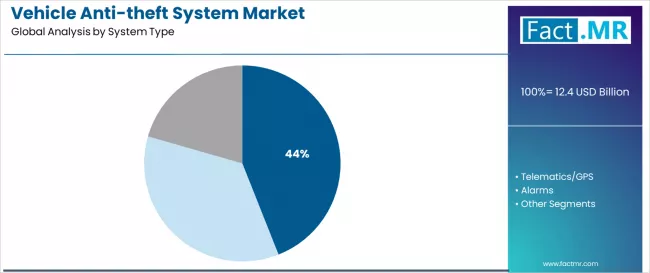
Vehicle Anti Theft System Market Analysis By System Type | Source: Fact.MR
Immobilizers & encrypted keys command the leading position in the vehicle anti-theft system market with approximately 44.0% market share through advanced security features, including superior theft prevention, encrypted access control, and vehicle immobilization that enable automotive manufacturers to deploy anti-theft protection across diverse vehicle platforms without significant electrical modifications.
The segment benefits from automotive OEM preference for secure access systems that provide superior protection without requiring extensive security infrastructure or specialized maintenance protocols. Immobilizer design features enable deployment in passenger cars, commercial vehicles, and high-value applications where security precision and reliability represent critical operational requirements.
Immobilizer systems differentiate through established security effectiveness, proven theft prevention capabilities, and integration with existing vehicle electrical systems that enhance protection effectiveness while maintaining cost-effective operational profiles suitable for automotive manufacturers of all sizes.
Key market characteristics:
- Advanced encryption algorithms with established security capabilities and validated protection parameters
- High-security resources enabling comprehensive vehicle protection and consistent anti-theft outcomes
- Integration capabilities with vehicle electrical systems, security platforms, and automotive control systems for comprehensive protection workflows
By End Market, the OEM Factory-fit Segment Accounts for the Largest Market Share
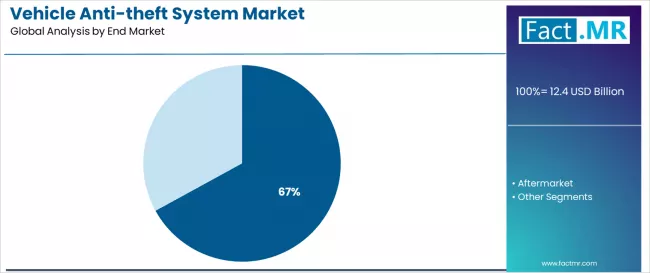
Vehicle Anti Theft System Market Analysis By End Market | Source: Fact.MR
OEM factory-fit applications dominate the vehicle anti-theft system market with approximately 67.0% market share due to widespread adoption of integrated anti-theft systems and increasing focus on vehicle security enhancement, theft prevention, and protection standardization applications that optimize security delivery while maintaining system effectiveness.
OEM customers prioritize security reliability, theft prevention, and integration with existing vehicle design that enables coordinated protection systems across multiple security types and vehicle functions. The segment benefits from substantial automotive manufacturer spending and vehicle security programs that emphasize advanced anti-theft tool acquisition for improved protection performance and theft reduction.
Automotive security modernization programs incorporate immobilizer systems as standard equipment for OEM vehicle security and protection enhancement applications. At the same time, increasing manufacturer security standards are driving demand for anti-theft capabilities that maintain protection requirements and minimize theft incidents.
Application dynamics include:
- Strong growth in OEM vehicles requiring comprehensive anti-theft protection assistance capabilities
- Increasing adoption in premium vehicle segments for enhanced security support applications
- Rising integration with vehicle security platforms for automated protection control and adaptive theft prevention
What are the Drivers, Restraints, and Key Trends of the Vehicle Anti-theft System Market?
Automotive security regulation drives primary adoption as anti-theft systems provide protection enhancement capabilities that enable theft prevention without traditional alarm dependency risks, supporting security decision-making and protection missions that require precise anti-theft management. The demand for vehicle security modernization accelerates market expansion as automotive manufacturers seek effective protection enhancement tools that minimize theft incidents while maintaining operational effectiveness during normal vehicle operation procedures and user scenarios. Automotive spending increases worldwide, creating sustained demand for telematics anti-theft systems that complement traditional alarm equipment and provide operational flexibility in diverse automotive environments.
Cost pressure challenges vary across manufacturers regarding the deployment of telematics systems and pricing allocation protocols, which may limit market penetration and operational flexibility in regions with constrained automotive budgets. Technical performance limitations persist regarding system adaptability and integration complexity that may reduce effectiveness with legacy vehicle electrical systems, non-standardized security formats, or complex automotive workflows that limit protection capabilities. Market fragmentation across multiple automotive standards and operational requirements creates compatibility concerns between different anti-theft providers and existing vehicle infrastructure.
Adoption accelerates in passenger car and commercial vehicle sectors where security enhancement justifies system costs, with geographic concentration in developed markets transitioning toward mainstream adoption in emerging economies driven by automotive modernization and security infrastructure development. Technology development focuses on enhanced protection effectiveness, improved telematics capabilities, and compatibility with diverse automotive systems that optimize security workflow and operational effectiveness. The market could face disruption if alternative security technologies or cost restrictions significantly limit telematics anti-theft deployment in automotive or vehicle applications.
Analysis of the Vehicle Anti-theft System Market by Key Country
The vehicle anti-theft system market demonstrates varied regional dynamics with Growth Leaders including India (6.7% CAGR) and USA (6.3% CAGR) driving expansion through automotive security modernization and vehicle protection infrastructure development. Steady Performers encompass UK (6.0% CAGR), Germany (5.6% CAGR), and Canada (5.3% CAGR), benefiting from established automotive industries and advanced security technology adoption. Mature Markets feature Japan (5.0% CAGR) and Brazil (4.7% CAGR), where specialized automotive applications and security technology integration support consistent growth patterns.
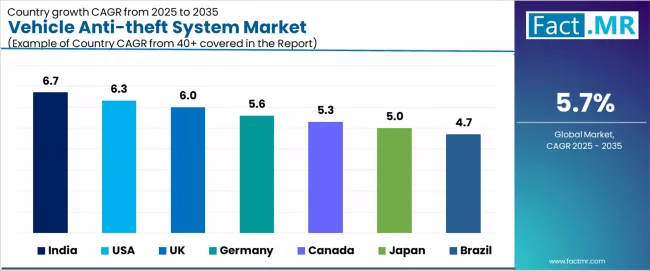
Vehicle Anti Theft System Market Cagr Analysis By Country | Source: Fact.MR
| Country | CAGR (2026-2036) |
|---|---|
| India | 6.7% |
| USA | 6.3% |
| UK | 6.0% |
| Germany | 5.6% |
| Canada | 5.3% |
| Japan | 5.0% |
| Brazil | 4.7% |
Source: Fact.MR analysis. Updated Mar 11, 2026
Regional synthesis reveals Asia-Pacific and North American markets leading growth through automotive security modernization and vehicle protection infrastructure development, while European countries maintain steady expansion supported by security technology advancement and EU automotive standardization requirements. Latin American markets show moderate growth driven by security applications and automotive technology integration trends.
India Drives Global Market Leadership
India establishes market leadership through aggressive automotive security modernization programs and comprehensive vehicle protection infrastructure development, integrating advanced immobilizer anti-theft systems as standard components in passenger car production and commercial vehicle operations. The country's 6.7% CAGR through 2035 reflects government initiatives promoting automotive security and domestic vehicle capabilities that mandate advanced anti-theft systems in automotive manufacturing installations. Growth concentrates in major automotive hubs, including Delhi, Mumbai, and Chennai, where automotive technology development showcases integrated anti-theft systems that appeal to domestic vehicle manufacturers seeking advanced security capabilities and operational enhancement applications.
Indian manufacturers are developing cost-effective immobilizer anti-theft solutions that combine domestic production advantages with advanced features, including precision security algorithms and comprehensive protection capabilities. Distribution channels through automotive OEM procurement and aftermarket suppliers expand market access, while government funding for automotive security development supports adoption across diverse transportation and vehicle segments.
Strategic Market Indicators:
- Automotive systems leading adoption with 76% deployment rate in passenger car and commercial vehicle manufacturing departments
- Government automotive programs providing substantial funding for domestic vehicle security development
- Local manufacturers capturing 62% market share through competitive pricing and localized automotive support
- Commercial segment growth driven by fleet operator requirements for enhanced anti-theft systems
- Export market development for cost-effective immobilizer anti-theft solutions targeting emerging automotive markets
USA Emerges as High-Growth Market
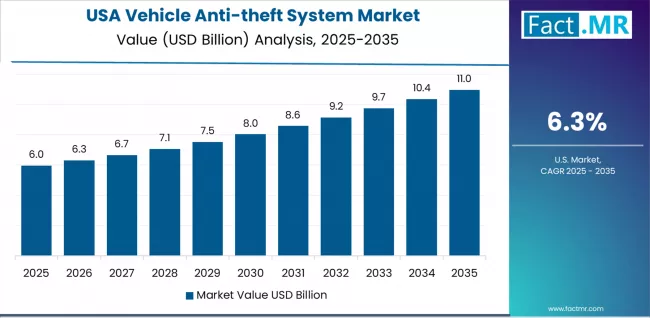
Vehicle Anti Theft System Market Country Value Analysis | Source: Fact.MR
In New York, California, and Texas, automotive manufacturers and vehicle producers are implementing advanced immobilizer anti-theft systems as standard equipment for passenger car production and commercial vehicle applications, driven by increasing automotive spending and modernization programs that emphasize the use of advanced security capabilities. The market is projected to demonstrate a 6.3% CAGR through 2035, supported by government automotive initiatives and vehicle manufacturing infrastructure development programs that promote the use of advanced protection tools for automotive manufacturers and vehicle producers. American automotive companies are adopting immobilizer anti-theft systems that provide superior security capabilities and protection enhancement features, particularly appealing in urban regions where vehicle security represents critical operational requirements.
Market expansion benefits from growing automotive technology capabilities and domestic technology development that enables advancement of security systems for automotive and transportation applications. Technology adoption follows patterns established in automotive infrastructure, where protection enhancement and security quality drive procurement decisions and system deployment.
Market Intelligence Brief:
- Automotive and vehicle manufacturer segments are driving initial adoption with 54% annual growth in immobilizer anti-theft system procurement
- Vehicle modernization programs emphasizing advanced security tools for protection enhancement and operational management
- Domestic automotive technology companies partnering with international providers for system development
- Passenger car and commercial vehicle services implementing immobilizer anti-theft systems for security assistance and operational management
UK Maintains Technology Leadership
UK's advanced automotive technology market demonstrates sophisticated immobilizer anti-theft deployment with documented security effectiveness in automotive manufacturing departments and vehicle production centers through integration with existing automotive systems and protection infrastructure. The country leverages engineering expertise in automotive technology and security systems integration to maintain a 6.0% CAGR through 2035. Automotive centers, including London, Birmingham, and Manchester, showcase premium installations where immobilizer anti-theft systems integrate with comprehensive vehicle information systems and security platforms to optimize protection accuracy and operational workflow effectiveness.
British automotive technology providers prioritize system reliability and regulatory compliance in immobilizer anti-theft development, creating demand for premium systems with advanced features, including security validation and integration with UK automotive standards. The market benefits from established automotive industry infrastructure and a willingness to invest in advanced security technologies that provide long-term operational benefits and compliance with theft prevention regulations.
Market Intelligence Brief:
- Engineering focuses on automotive security standards and system integration, driving premium vehicle segment growth
- Automotive technology partnerships providing 44% faster security validation cycles
- Technology collaboration between British automotive manufacturers and international security companies
- Automotive training programs are expanding immobilizer anti-theft integration in security management and operational scenarios
Germany Shows Strong Technology Innovation
Germany's market expansion benefits from diverse automotive demand, including vehicle modernization in Munich and Stuttgart, automotive system upgrades, and government automotive programs that increasingly incorporate advanced security solutions for vehicle protection applications. The country maintains a 5.6% CAGR through 2035, driven by rising automotive awareness and increasing adoption of immobilizer anti-theft benefits, including superior security capabilities and reduced theft incidents.
Market dynamics focus on high-quality immobilizer anti-theft solutions that balance advanced security features with performance considerations important to German automotive manufacturers. Growing automotive infrastructure creates sustained demand for modern security systems in new vehicle facilities and automotive equipment modernization projects.
Strategic Market Considerations:
- Automotive and vehicle segments leading growth with focus on security automation and protection enhancement applications
- Regional automotive requirements are driving a diverse product portfolio from basic security to advanced protection platforms
- Technology leadership challenges offset by potential innovation partnerships with international automotive technology manufacturers
- Government automotive initiatives beginning to influence procurement standards and security requirements
Canada Demonstrates Regional Leadership
Canada's market expansion benefits from diverse automotive demand, including vehicle modernization in Ontario and Quebec, automotive system upgrades, and government automotive programs that increasingly incorporate advanced security solutions for vehicle protection applications. The country maintains a 5.3% CAGR through 2035, driven by rising automotive awareness and increasing adoption of immobilizer anti-theft benefits, including superior security capabilities and reduced operational theft risks.
Market dynamics focus on cost-effective immobilizer anti-theft solutions that balance advanced security features with affordability considerations important to Canadian automotive manufacturers. Growing automotive infrastructure creates sustained demand for modern security systems in new vehicle facilities and automotive equipment modernization projects.
Strategic Market Considerations:
- Automotive and vehicle segments leading growth with focus on security automation and protection enhancement applications
- Regional automotive requirements are driving a diverse product portfolio from basic security to advanced protection platforms
- NAFTA trade benefits offset by potential technology transfer partnerships with international automotive technology manufacturers
- Government automotive initiatives beginning to influence procurement standards and security requirements
Japan Emphasizes Precision and Integration Excellence
Japan demonstrates steady market development with a 5.0% CAGR through 2035, distinguished by automotive manufacturers' preference for high-quality immobilizer anti-theft systems that integrate seamlessly with existing vehicle equipment and provide reliable long-term operation in specialized automotive applications. The market prioritizes advanced features, including precision security algorithms, protection validation, and integration with comprehensive vehicle platforms that reflect Japanese automotive expectations for technological sophistication and operational excellence.
Strategic Market Considerations:
- Premium focus on immobilizer systems with advanced security algorithms and high-protection capabilities
- Integration requirements with existing vehicle electrical systems and security management platforms
- Emphasis on security reliability and long-term performance in automotive applications
Brazil Drives Latin American Leadership
In São Paulo, Rio de Janeiro, and other automotive centers, Brazilian vehicle manufacturers and automotive companies are implementing advanced immobilizer anti-theft systems to enhance security capabilities and support operational decision-making that aligns with Brazilian automotive standards and protection regulations. The Brazil market is expected to demonstrate sustained growth with a 4.7% CAGR through 2035, driven by automotive modernization programs and vehicle equipment upgrades that emphasize advanced security tools for automotive and vehicle applications. Brazilian automotive facilities are prioritizing immobilizer anti-theft systems that provide superior security capabilities while maintaining compliance with automotive regulations and minimizing operational risks, particularly important in passenger car and specialized vehicle applications.
Market expansion benefits from automotive procurement programs that support automated security capabilities in vehicle equipment specifications, creating sustained demand across Brazil's automotive sectors where operational effectiveness and regulatory compliance represent critical requirements. The regulatory framework supports immobilizer anti-theft adoption through automotive device standards and vehicle technology requirements that promote advanced security systems aligned with national automotive capabilities.
Strategic Market Indicators:
- Automotive and vehicle systems are leading the adoption with automotive equipment modernization programs requiring advanced security systems
- Government automotive procurement providing regulatory support for advanced immobilizer anti-theft system acquisition
- Brazilian compatibility requirements are driving demand for standardized systems with national automotive interoperability
- Specialized automotive departments adopting comprehensive security solutions for protection automation and operational management
Europe Market Split by Country
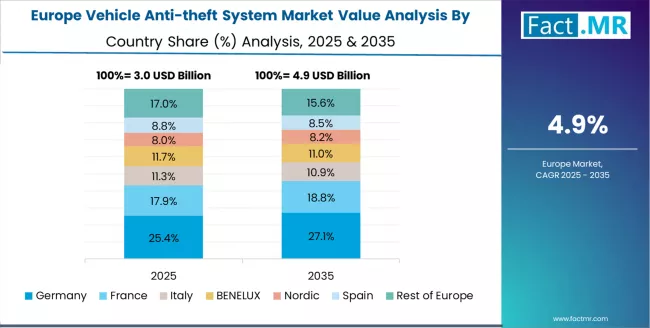
Vehicle Anti Theft System Market Europe Country Market Share Analysis, 2025 & 2035 | Source: Fact.MR
The Vehicle Anti-theft System market in Europe is projected to grow from USD 2.8 billion in 2025 to USD 4.9 billion by 2035, registering a CAGR of 5.8% over the forecast period. Germany is expected to maintain its leadership position with a 26.4% market share in 2025, rising slightly to 27.1% by 2035, supported by its advanced automotive technology sector and major vehicle manufacturing centers, including Munich and Stuttgart.
The United Kingdom follows with a 22.8% share in 2025, projected to reach 23.6% by 2035, driven by comprehensive automotive modernization programs and vehicle security development initiatives. France holds a 18.3% share in 2025, expected to increase to 18.9% by 2035 through specialized automotive applications and regulatory standardization requirements. Italy commands a 14.7% share in 2025, rising to 15.2% by 2035, while Spain accounts for 9.2% in 2025, increasing to 9.6% by 2035. The Rest of Europe region, including Nordic countries, Eastern Europe, BENELUX, and other markets, is anticipated to hold 8.6% in 2025, declining slightly to 5.6% by 2035, attributed to mixed growth patterns with moderate expansion in some advanced automotive markets balanced by steady growth in smaller countries implementing vehicle security development programs.
Competitive Landscape of the Vehicle Anti-theft System Market
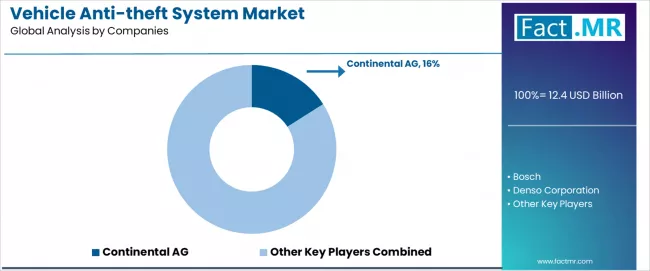
Vehicle Anti Theft System Market Analysis By Company | Source: Fact.MR
The vehicle anti-theft system market operates with moderate concentration, featuring approximately 18-22 meaningful participants, where leading companies control roughly 58-63% of the global market share through established automotive technology relationships and comprehensive security system portfolios. Competition emphasizes advanced security capabilities, system reliability, and integration with automotive platforms rather than price-based rivalry.
Market leaders encompass Continental, Bosch, Denso, Hella/Forvia, and Aptiv, which maintain competitive advantages through extensive automotive technology expertise, global vehicle manufacturer networks, and comprehensive system integration capabilities that create customer switching costs and support premium pricing. These companies leverage decades of automotive security experience and ongoing research investments to develop advanced immobilizer anti-theft systems with precision protection algorithms and security validation features.
Technology challengers include Viper/Directed, LoJack/CalAmp, StarLine, Meta System, and Valeo, which compete through specialized automotive security focus and innovative protection interfaces that appeal to automotive customers seeking advanced security capabilities and operational flexibility. These companies differentiate through rapid technology development cycles and specialized automotive application focus.
Regional specialists feature companies with focus on specific geographic markets and specialized applications, including passenger car systems and integrated protection platforms. Market dynamics favor participants that combine reliable security algorithms with advanced automotive software, including precision theft protection control and automatic security monitoring capabilities. Competitive pressure intensifies as traditional automotive equipment contractors expand into telematics security systems. At the same time, specialized security companies challenge established players through innovative anti-theft solutions and cost-effective platforms targeting specialized automotive segments.
Key Players in the Vehicle Anti-theft System Market
- Continental
- Bosch
- Denso
- Hella/Forvia
- Aptiv
- Viper/Directed
- LoJack/CalAmp
- StarLine
- Meta System
- Valeo
Bibliography
- European Commission, Directorate-General for Internal Market. (2024, March). EU Vehicle Security Regulation: Immobiliser Fitment Requirements and Encrypted Key Authentication Standards Under EU Directive 74/61/EEC Amendments. European Commission.
- Thatcham Research. (2024, January). Vehicle Security Certification Standards: Category Definitions, Test Protocols, and Insurance Group Assessment Criteria for Electronic Immobilisers and Connected Security Systems. Thatcham Research.
- Government of India, Ministry of Road Transport and Highways. (2024, May). AIS-157: Automotive Industry Standard for Vehicle Anti-theft Systems Including Immobiliser and GPS Tracking Requirements for Passenger Vehicles. MoRTH.
- United Kingdom Home Office. (2024, February). Crime Statistics England and Wales: Vehicle Theft Trends, Keyless Entry Relay Attack Frequency, and Anti-theft Technology Effectiveness Analysis. HM Government.
- National Highway Traffic Safety Administration, United States. (2024, April). Motor Vehicle Theft Prevention: Immobiliser Technology Effectiveness Review and Connected Tracking System Performance Assessment. NHTSA.
- GSMA Association. (2024, March). IoT Mobile Connectivity Standards: LTE-M and NB-IoT Deployment for Automotive Tracking and Vehicle Security Applications. GSMA.
This bibliography is provided for reader reference. The full Fact.MR report contains the complete reference list with primary research documentation.
This Report Addresses
- Market sizing and quantitative forecast metrics: detailing precise revenue projections, absolute dollar growth, and compound annual growth rates across major vehicle anti-theft system segments and geographies through 2036.
- Segmentation analysis: mapping the adoption velocity of leading product, technology, and end-use categories and evaluating structural factors driving segment share transitions over the forecast period.
- Regional deployment intelligence: comparing growth dynamics in high-momentum Asia Pacific and emerging markets against the mature replacement and upgrade demand patterns prevalent in European and North American industry hubs.
- Regulatory compliance assessment: analyzing how evolving product safety standards, environmental directives, and sector-specific mandates are reshaping procurement decisions, material specifications, and supplier qualification criteria.
- Competitive posture evaluation: tracking consolidation trends, platform integration strategies, technology differentiation investments, and the resulting competitive dynamics among established market players and emerging challengers.
- Capital project strategic guidance: defining the procurement specifications, investment thresholds, and performance benchmarks required to support next-generation product adoption and facility modernization programs.
- Supply chain vulnerability analysis: identifying sourcing concentration risks, logistics bottlenecks, raw material price dependencies, and geographic exposure scenarios that affect market participant cost structures.
- Custom data delivery formats: encompassing interactive dashboards, raw Excel datasets, and comprehensive PDF narrative reports tailored for executive decision-making and analyst reference applications.
Segmentation
Scope of the Report
| Metric | Value |
|---|---|
| Quantitative Units | USD 13.11 billion to USD 22.82 billion, at a CAGR of 5.7% |
| Market Definition | Electronic and electromechanical security systems preventing unauthorised vehicle access and operation, from cryptographic engine immobilisers and GPS tracking to alarm sensor arrays and connected security ecosystems, supplied through OEM factory-fit and aftermarket retrofit channels. |
| System Type Segmentation | Immobilizers and Encrypted Keys, GPS Tracking Systems, Alarm Systems, Steering Locks, Kill Switches |
| Connectivity Type Segmentation | Cellular/LTE-M, Bluetooth, RF, Satellite |
| End Market Segmentation | OEM Factory-fit, Aftermarket Retrofit |
| Regions Covered | North America, Latin America, Europe, East Asia, South Asia, Oceania, Middle East and Africa |
| Countries Covered | India, USA, UK, Germany, Canada, Japan, Brazil, and 40 plus countries |
| Key Companies Profiled | Bosch, Continental, Denso, Hella/Forvia, Aptiv, Viper/Directed, LoJack/CalAmp, StarLine, Meta System, Valeo |
| Forecast Period | 2026 to 2036 |
| Approach | Bottom-up aggregation of security system units by type and end market with connected security platform value uplift and relay attack vulnerability upgrade demand modeling |
Source: Fact.MR analysis. Updated Mar 11, 2026
Vehicle Anti-theft System Market by Segments
-
System Type:
- Immobilizers & Encrypted Keys
- Telematics/GPS
- Alarms
-
Connectivity Type:
- Cellular/LTE-M
- GNSS Only
- V2X/Other
-
End Market:
- OEM Factory-fit
- Aftermarket
-
Region:
- Asia Pacific
- China
- Japan
- South Korea
- India
- ASEAN
- Australia & New Zealand
- Rest of Asia Pacific
- North America
- United States
- Canada
- Mexico
- Europe
- Germany
- United Kingdom
- France
- Italy
- Spain
- Nordic
- BENELUX
- Rest of Europe
- Latin America
- Brazil
- Chile
- Rest of Latin America
- Middle East & Africa
- Kingdom of Saudi Arabia
- Other GCC Countries
- Turkey
- South Africa
- Other African Union
- Rest of Middle East & Africa
- Asia Pacific
Frequently Asked Questions
How large is the vehicle anti-theft system market in 2026?
What will the anti-theft system market size be by 2036?
What is the expected CAGR between 2026 and 2036?
Which system type leads the market in 2026?
Which connectivity type holds the largest share?
Why does OEM factory-fit account for 63.6% of end market share?
What is driving India's leading 6.7% CAGR?
How is the relay attack problem reshaping anti-theft demand?
What is excluded from the scope of this report?
Who worked on this report


Preview the report firsthand - request a free sample
Free SampleGet the brochure for pricing and purchase details
Download PDF