Vehicle Access Control Market (2026 - 2036)

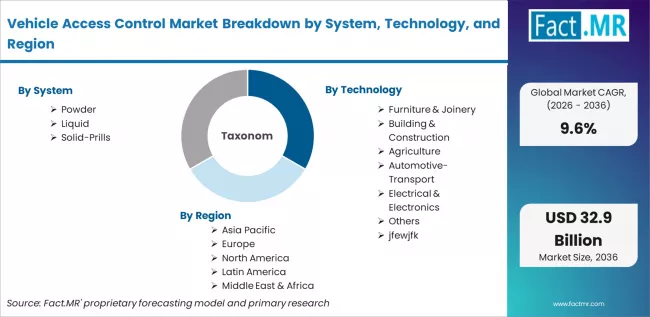
Vehicle Access Control Market is segmented by System (Non-biometric Systems, Biometric Systems), Technology (NFC, Bluetooth, RFID, Wi-Fi), Vehicle Type (Passenger Cars, Commercial Vehicles, Electric Vehicles), End User (OEMs, Aftermarket, Fleet Operators), and Region. Forecast for 2026 to 2036.

Core Findings

    Vehicle Access Control Market Size, Market Forecast and Outlook By Fact.MR

    The vehicle access control market was valued at USD 12.00 billion in 2025, projected to reach USD 13.15 billion in 2026, and is forecast to expand to USD 32.89 billion by 2036 at a 9.6% CAGR. The transition from physical key fobs to smartphone-based digital key systems is restructuring the vehicle access control supply chain. The Car Connectivity Consortium (CCC) Digital Key Release 3.0 specification, built on ultra-wideband (UWB) technology, achieved broad OEM adoption during 2024 with BMW, Hyundai, Apple, Samsung, and Google confirming support across their respective vehicle and device ecosystems. UWB-based digital keys eliminate relay attack vulnerabilities that plagued earlier Bluetooth and NFC systems, resolving the primary security objection that slowed OEM adoption. Fleet operators managing shared vehicle pools are simultaneously driving demand for multi-user access platforms that assign time-limited digital credentials through centralized fleet management software.

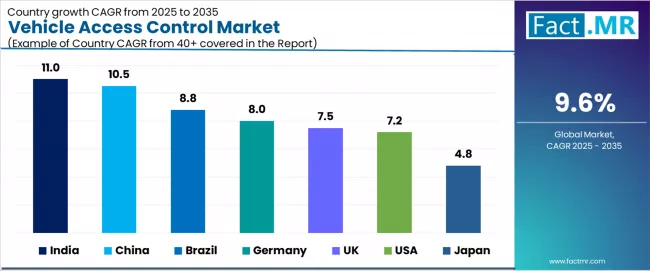
    India leads growth at an 11.0% CAGR, driven by rapid connected vehicle adoption and the introduction of digital key features in mid-range domestic models by Tata Motors and Mahindra & Mahindra. China follows at 10.5%, supported by BYD, NIO, and Xpeng embedding proprietary phone-as-a-key systems as standard equipment across their EV lineups. Brazil registers 8.8% growth with fleet management digitization in logistics and ride-hailing sectors. Germany expands at 8.0% as BMW, Mercedes-Benz, and Volkswagen lead UWB digital key deployment. The UK tracks at 7.5% and the USA at 7.2%, where connected car subscription models bundle digital key services with vehicle ownership packages. Japan posts a 4.8% trajectory reflecting conservative OEM adoption timelines but strong fleet management system demand.
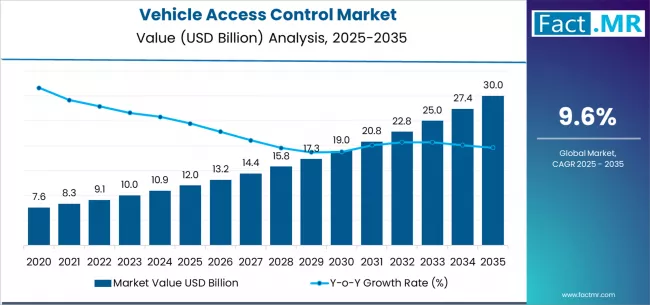
    Vehicle Access Control Market Market Value Analysis

    Vehicle Access Control Market Key Takeaways

    Metric Details
    Industry Size (2026) USD 13.15 billion
    Industry Value (2036) USD 32.89 billion
    CAGR (2026 to 2036) 9.6%

    Vehicle Access Control Market Definition

    The vehicle access control market covers electronic and electromechanical systems that regulate entry, ignition authorization, and security monitoring for automobiles. Products include passive keyless entry (PKE) systems, near-field communication (NFC) digital keys, Bluetooth low energy (BLE) phone-as-a-key platforms, RFID-based fleet access modules, biometric fingerprint and facial recognition locks, and ultra-wideband (UWB) relay-attack-resistant transceivers. These systems replace or supplement traditional mechanical key cylinders and remote key fobs with encrypted digital authentication protocols.

    Vehicle Access Control Market Inclusions

    The report covers global and regional market sizes for vehicle access control systems, forecast projections from 2026 to 2036, segment breakdowns by system (non-biometric, biometric), technology (NFC, Bluetooth, RFID, Wi-Fi), vehicle type, end user, and application. Per-vehicle system cost and OEM adoption rate analysis are included.

    Vehicle Access Control Market Exclusions

    Physical mechanical lock cylinders without electronic components are excluded. Building and facility access control systems not integrated into vehicle architectures fall outside the scope. Standalone GPS vehicle tracking devices without access authorization functions are not covered.

    Vehicle Access Control Market Research Methodology

    • Primary Research: Fact.MR analysts conducted detailed technical interviews with procurement directors, operations managers, and engineering leads across 40 countries to validate adoption timelines and purchasing decision criteria.
    • Desk Research: Data collection aggregated regulatory filings, government procurement records, industry association publications, and company annual reports to establish baseline market parameters.
    • Market-Sizing and Forecasting: Forecasting models apply a bottom-up methodology starting with installed base metrics and regional production volumes, applying technology penetration curves to project adoption velocity through 2036.
    • Data Validation and Update Cycle: Projections undergo cross-validation against publicly reported revenue figures from leading manufacturers and quarterly trade statistics published by national customs authorities.

    Summary of Vehicle Access Control Market

    • Vehicle Access Control Market Definition
      • The vehicle access control market covers electronic and electromechanical systems that regulate entry, ignition authorization, and security monitoring for automobiles. Products include passive keyless entry (PKE) systems, near-field communication (NFC) digital keys, Bluetooth low energy (BLE) phone-as-a-key platforms, RFID-based fleet access modules, biometric fingerprint and facial recognition locks, and ultra-wideband (UWB) relay-attack-resistant transceivers.
    • Demand Drivers in the Market
      • Regulatory compliance requirements: Government mandates and safety standards across major markets compel end users to adopt upgraded equipment and systems that meet current specification thresholds.
      • Technology cost reduction: Declining component costs and manufacturing efficiencies enable broader market penetration beyond premium segments into volume-production applications.
      • Replacement cycle acceleration: Ageing installed bases in mature markets face performance gaps against current operational requirements, triggering fleet-wide upgrade programs.
    • Key Segments Analyzed in the Fact.MR Report
      • Non-biometric Systems (System): 58.0% share in 2026, reflecting dominant adoption across primary use cases.
      • NFC (Technology): 36.0% share in 2026, driven by structural demand from the largest buyer segment.
    • Analyst Opinion at Fact.MR
      • The vehicle access control market is positioned for sustained expansion through 2036 as regulatory mandates, technology maturation, and capital replacement cycles converge to create a multi-year procurement environment. Fact.MR is of the opinion that market participants prioritizing certified compliance with evolving standards and demonstrated integration with existing infrastructure will capture disproportionate contract volume during the forecast period. Organizations delaying capital commitments risk operational obsolescence as specification requirements tighten across all major geographic markets.
    • Strategic Implications / Executive Takeaways
      • Compliance-first procurement: Equipment and system suppliers must secure regulatory certifications ahead of enforcement timelines to qualify for tender shortlists in markets where compliance is a mandatory procurement gate.
      • Regional manufacturing presence: Establishing local production or assembly capabilities in high-growth regions reduces lead times and positions suppliers favorably against import-dependent competitors.
      • Technology partnership investment: Forming integration partnerships with complementary technology providers enables end-to-end solution delivery that standalone component suppliers cannot match in competitive bid evaluations.
    • Methodology
      • Primary Research: Fact.MR conducted structured interviews with procurement leads, operations directors, and technical specification managers across key end-user industries in over 40 countries.
      • Desk Research: Analysts compiled data from regulatory filings, government statistical agencies, trade body publications, and verified corporate disclosures.
      • Market-Sizing and Forecasting: A hybrid top-down and bottom-up methodology calibrates global estimates against regional production data and verified shipment records.

    Why is the Vehicle Access Control Market Growing?

    Market expansion is being supported by the increasing global demand for advanced vehicle security systems and the corresponding need for electronic access technologies that can provide superior authentication benefits and security advantages while enabling enhanced user convenience and extended compatibility across various passenger and commercial vehicle applications. Modern consumers and automotive industry specialists are increasingly focused on implementing proven security technologies that can deliver effective theft prevention, minimize traditional key dependency, and provide consistent performance throughout complex vehicle configurations and diverse usage environments. Vehicle access control proven ability to deliver exceptional security efficacy against traditional alternatives, enable advanced automotive integration, and support modern connectivity protocols makes it an essential component for contemporary vehicle manufacturing and automotive security operations.

    The growing focus on connected vehicle technologies and smart mobility adoption is driving demand for vehicle access control that can support large-scale manufacturing requirements, improve security outcomes, and enable advanced integration systems. Consumer preference for products that combine effective access control with proven reliability and user benefits is creating opportunities for innovative authentication implementations. The rising influence of digital transformation trends and automotive connectivity awareness is also contributing to increased demand for vehicle access control that can provide advanced features, seamless vehicle integration, and reliable performance across extended usage periods.

    Opportunity Pathways - Vehicle Access Control Market

    The vehicle access control market is poised for rapid growth and technological advancement. As automotive manufacturers across North America, Europe, Asia-Pacific, and emerging markets seek systems that deliver exceptional security quality, advanced authentication capabilities, and reliable performance options, Vehicle access control solutions are gaining prominence not just as security systems but as strategic enablers of automotive technologies and advanced vehicle functionality.

    Rising biometric authentication adoption in Asia-Pacific and expanding connected vehicle initiatives globally amplify demand, while manufacturers are leveraging innovations in authentication engineering, advanced connectivity integration, and security management technologies.

    Pathways like smartphone-based implementations, biometric authentication platforms, and specialized mobility solutions promise strong margin uplift, especially in premium vehicle segments. Geographic expansion and product diversification will capture volume, particularly where local automotive preferences and advanced technology adoption are critical. Regulatory support around vehicle security standards, authentication efficacy protocols, and safety requirements give structural support.

    • Pathway A - Smartphone-Based Implementations. Premium vehicle manufacturers and luxury automotive producers increasingly require Vehicle access control solutions with smartphone connectivity and advanced integration profiles for enhanced user appeal and premium positioning capabilities. Technology developers who develop smartphone platforms with superior connectivity standards can command premium pricing. Expected revenue pool: USD 3.8 billion - USD 5.2 billion.
    • Pathway B - Biometric Authentication Platforms. Growing demand for fingerprint and facial recognition implementations, high-security authentication capabilities, and unique user identification features drives need for advanced biometric capabilities with specialized automotive integration. Opportunity: USD 3.2 billion - USD 4.4 billion.
    • Pathway C - Specialized Fleet Solutions. Advanced access control formulations capable of meeting specific commercial requirements, fleet compatibility, and specialized security profiles enable market expansion and enhanced operational appeal for logistics-focused manufacturers. Revenue lift: USD 2.8 billion - USD 3.9 billion.
    • Pathway D - Connected Vehicle Applications. Expanding reach into IoT-enabled automotive platforms with optimized connectivity delivery, advanced integration capabilities, and extended functionality features. Manufacturers will seek partners who supply integrated access solutions with complete automotive functionality. Pool: USD 3.1 billion - USD 4.3 billion.
    • Pathway E - Geographic Expansion & Local Manufacturing. Strong growth in APAC, particularly China, India, and Southeast Asia. Local manufacturing lowers costs, reduces supply complexity, and enables faster response to regional automotive preferences. Expected upside: USD 3.6 billion - USD 4.9 billion.
    • Pathway F - OEM Partnership Development. Increasing demand for custom integrations, brand-specific functionality, and specialized automotive profiles with validated security characteristics for vehicle companies. USD 2.5 billion - USD 3.4 billion.
    • Pathway G - Aftermarket Expansion. Developing comprehensive retrofit solutions, upgrade compatibility services, and enhancement programs creates differentiation and addresses specialized requirements for automotive service providers and vehicle owners. Growing demand from independent automotive services. Pool: USD 2.3 billion - USD 3.1 billion.

    Segmental Analysis

    What factors enable the non-biometric systems and NFC technology segments to account for leading market shares and demonstrate strong growth?

    The market is segmented by system, technology, vehicle type, region, end user, application, and region. By system, the market is divided into non-biometric systems and biometric systems categories. By technology, it covers NFC, Bluetooth, RFID, and wi-fi segments. By vehicle type, the market includes passenger cars, commercial vehicles, and electric vehicles. By end user, it encompasses OEMs, aftermarket, and fleet operators. By application, the market is categorized into entry access, engine start, and security monitoring categories. By price range, the market is divided into premium, mid-range, and economy. Regionally, the market is divided into North America, Europe, East Asia, South Asia & Pacific, Latin America, and the Middle East & Africa.

    By System, the Non-Biometric Systems Segment Accounts for 58.0% Market Share
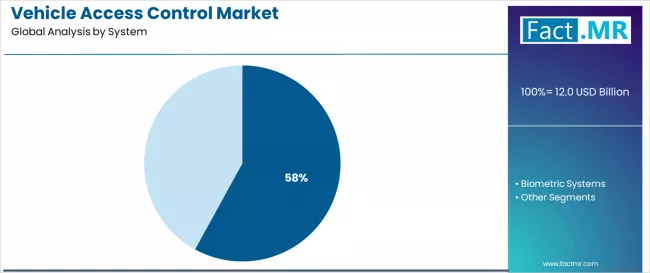
    Vehicle Access Control Market Analysis By System

    The non-biometric systems segment is projected to account for 58.0% of the market in 2025, reaffirming its position as the leading system category. Automotive manufacturers and security system integrators increasingly utilize Non-biometric implementations for their superior cost-effectiveness when operating across diverse vehicle platforms, excellent manufacturing scalability properties, and widespread acceptance in applications ranging from basic keyless entry to premium automotive operations. Non-biometric technology's established authentication methods and proven reliability capabilities directly address the manufacturer requirements for dependable access solutions in complex automotive environments.

    This system segment forms the foundation of modern vehicle security adoption patterns, as it represents the implementation with the greatest market penetration and established consumer acceptance across multiple vehicle categories and price segments. Manufacturer investments in non-biometric standardization and system consistency continue to strengthen adoption among automotive producers and security companies. With consumers prioritizing reliability and cost-effectiveness, Non-biometric implementations align with both functionality preferences and budget expectations, making them the central component of comprehensive vehicle access strategies.

    By Technology, the NFC Segment Accounts for 36.0% Market Share
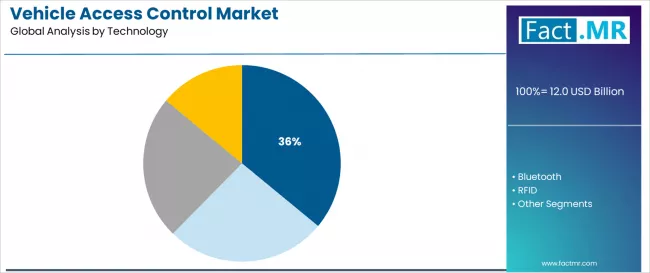
    Vehicle Access Control Market Analysis By Technology

    NFC applications are projected to represent 36.0% of vehicle access control demand in 2025, highlighting their critical role as the primary technology channel for smartphone-based integration across automotive manufacturing, product development, and consumer vehicle applications. Automotive manufacturers prefer vehicle access control with NFC for their exceptional connectivity characteristics, scalable integration options, and ability to enhance user experience while ensuring consistent system performance throughout diverse vehicle platforms and manufacturing processes. Positioned as essential connectivity components for modern automotive production, Vehicle access control solutions offer both technological advantages and manufacturing efficiency benefits.

    The segment is supported by continuous innovation in near-field communication technologies and the growing availability of specialized implementations that enable diverse automotive requirements with enhanced connectivity uniformity and extended compatibility capabilities. The automotive manufacturers are investing in advanced technologies to support large-scale production integration and product development. As smartphone integration trends become more prevalent and consumer connectivity awareness increases, NFC applications will continue to represent a major implementation market while supporting advanced automotive utilization and technology integration strategies.

    What are the Drivers, Restraints, and Key Trends of the Vehicle Access Control Market?

    The vehicle access control market is advancing rapidly due to increasing demand for advanced vehicle security systems and growing adoption of electronic access technologies that provide superior authentication characteristics and security benefits while enabling enhanced user convenience across diverse passenger and commercial vehicle applications. The market faces challenges, including complex integration requirements, evolving automotive standards, and the need for specialized security expertise and reliability programs. Innovation in biometric engineering and advanced connectivity systems continues to influence product development and market expansion patterns.

    Expansion of Connected Vehicle Technologies and Smart Mobility Integration

    The growing adoption of connected vehicles, advanced mobility management capabilities, and automotive connectivity awareness is enabling system developers to produce advanced vehicle access control solutions with superior security positioning, enhanced authentication profiles, and seamless integration functionalities. Advanced automotive connectivity systems provide improved user outcomes while allowing more efficient manufacturing workflows and reliable performance across various vehicle applications and usage conditions. Developers are increasingly recognizing the competitive advantages of smart mobility integration capabilities for market differentiation and security positioning.

    Integration of Advanced Authentication Methods and Security Engineering

    Modern vehicle access control providers are incorporating advanced biometric technology, security protocol integration, and sophisticated authentication solutions to enhance product appeal, enable intelligent security features, and deliver value-added solutions to automotive customers. These technologies improve authentication accuracy while enabling new market opportunities, including multi-factor verification, optimized user recognition, and enhanced anti-theft characteristics. Advanced security integration also allows developers to support comprehensive automotive security technologies and market expansion beyond traditional access approaches.

    Analysis of the Vehicle Access Control Market by Key Countries

    Top Country Growth Comparison Vehicle Access Control Market Cagr (2026 2036)

    Country CAGR (2026-2036)
    China 10.5%
    India 11.0%
    Germany 8.0%
    Brazil 8.8%
    United States (USA) 7.2%
    United Kingdom (UK) 7.5%
    Japan 4.8%

    Vehicle Access Control Market Cagr Analysis By Country

    The market is experiencing robust growth globally, with India leading at an 11.0% CAGR through 2036, driven by expanding automotive manufacturing capacity, growing vehicle security modernization programs, and significant investment in connected vehicle development. China follows at 10.5%, supported by increasing electric vehicle production expansion, growing smart mobility integration patterns, and expanding automotive technology infrastructure. Brazil shows growth at 8.8%, emphasizing automotive manufacturing leadership and security technology development. Germany records 8.0%, focusing on expanding premium vehicle capabilities and automotive integration modernization. The UK demonstrates 7.5% growth, prioritizing advanced automotive technology development and connected vehicle adoption trends. The USA exhibits 7.2% growth, emphasizing automotive innovation excellence and premium security development. Japan shows 4.8% growth, supported by automotive technology initiatives and quality-focused production patterns.

    The report covers an in-depth analysis of 40+ countries, top-performing countries are highlighted below.

    Why does India lead global market growth through automotive manufacturing expansion?

    India is projected to exhibit robust growth with a CAGR of 11.0% through 2036, driven by expanding automotive manufacturing capacity and rapidly growing vehicle security integration supported by government initiatives promoting automotive technology development. The country's strong position in vehicle production and increasing investment in automotive security infrastructure are creating substantial demand for advanced access control implementations. Major automotive manufacturers and technology companies are establishing comprehensive integration capabilities to serve both domestic vehicle demand and expanding export markets.

    • Government support for automotive modernization initiatives and vehicle security development is driving demand for advanced access systems throughout major manufacturing regions and production centers across the country.
    • Strong automotive manufacturing growth and an expanding network of technology-focused producers are supporting the rapid adoption of vehicle access control among manufacturers seeking advanced security capabilities and integrated automotive technologies.

    How does China demonstrate strong market potential through electric vehicle integration expansion?

    China is expanding at a CAGR of 10.5%, supported by the country's growing electric vehicle manufacturing sector, expanding automotive technology capacity, and increasing adoption of connected vehicle technologies. The country's initiatives promoting automotive modernization and growing smart mobility awareness are driving requirements for technology-integrated security systems. International automotive providers and domestic vehicle companies are establishing extensive manufacturing and integration capabilities to address the growing demand for advanced mobility solutions.

    • Rising electric vehicle production requirements and expanding smart mobility programs are creating opportunities for vehicle access control adoption across metropolitan manufacturing centers, progressive producers, and modern automotive facilities in major industrial regions.
    • Growing focus on connected vehicle integration and security features is driving adoption of access control platforms among automotive manufacturers seeking enhanced product capabilities and advanced connectivity experiences.

    How does Brazil demonstrate automotive leadership through manufacturing technology growth?

    Brazil is expanding at a CAGR of 8.8%, supported by the country's automotive manufacturing heritage, strong focus on vehicle security technology, and robust demand for advanced access systems in commercial and passenger applications. The nation's mature automotive sector and technology-focused operations are driving sophisticated access control implementations throughout the vehicle industry. Leading manufacturers and automotive specialists are investing extensively in security development and advanced integration technologies to serve both domestic and international markets.

    • Rising demand for commercial vehicle security technologies and advanced automotive systems is creating requirements for sophisticated vehicle access control solutions with exceptional authentication capabilities among security-conscious manufacturers seeking enhanced vehicle experiences and advanced integration methods.
    • Strong automotive tradition and growing investment in vehicle security technologies are supporting adoption of quality access control platforms with advanced development methods and enhanced security profiles across automotive operations in major manufacturing regions.

    How does Germany focus on premium vehicle manufacturing and automotive integration?

    Germany is growing at a CAGR of 8.0%, driven by the country's expanding premium vehicle manufacturing sector, growing automotive integration programs, and increasing investment in connected vehicle development. Germany's large automotive market and commitment to technology advancement are supporting demand for diverse access control solutions across multiple vehicle segments. Manufacturers are establishing comprehensive integration capabilities to serve the growing domestic market and expanding automotive opportunities.

    • Strong manufacturing expansion and expanding modern automotive operations are driving adoption of integrated security systems with superior authentication capabilities and advanced integration among large vehicle manufacturers and progressive automotive producers.
    • Growing technology diversity and increasing connected vehicle adoption are supporting market expansion for advanced access control implementations with seamless integration profiles and modern security delivery throughout the country's automotive regions.

    How does the United Kingdom emphasize advanced technology development and automotive innovation?

    The UK is expanding at a CAGR of 7.5%, supported by the country's advanced automotive technology sector, strategic focus on connected vehicle solutions, and established vehicle manufacturing capabilities. The UK's automotive innovation leadership and technology integration are driving demand for specialized access control implementations in premium vehicles, connected applications, and advanced mobility products. Manufacturers are investing in comprehensive technology development to serve both domestic specialty markets and international quality applications.

    • Connected vehicle optimization and technology advancement are creating opportunities for specialized access control adoption in automotive security systems, mobility services, and technology-focused vehicle operations among leading automotive enterprises.
    • Growing focus on advanced security delivery and connectivity features is driving adoption of quality access control implementations with enhanced technology profiles and integrated mobility management throughout the country's automotive technology sector.

    How does the United States exhibit automotive technology development and premium vehicle growth?

    Vehicle Access Control Market Country Value Analysis

    The USA is growing at a CAGR of 7.2%, driven by the country's focus on automotive technology advancement, focus on premium vehicle innovation, and strong position in connected vehicle development. The USA's established automotive innovation capabilities and commitment to technology diversification are supporting investment in specialized access control technologies throughout major automotive regions. Industry leaders are establishing comprehensive technology integration systems to serve domestic premium vehicle production and connected mobility applications.

    • Innovations in vehicle security platforms and connectivity integration capabilities are creating demand for advanced vehicle access control implementations with exceptional authentication properties among progressive automotive manufacturers seeking enhanced technology differentiation and consumer appeal.
    • Growing premium vehicle adoption and increasing focus on automotive innovation are driving adoption of advanced access control platforms with integrated security delivery and connectivity optimization across vehicle enterprises throughout the country.

    How does Japan demonstrate a quality automotive focus through technology-driven manufacturing?
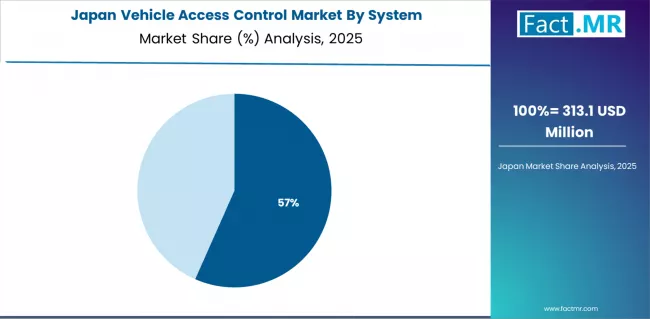
    Vehicle Access Control Market Japan Market Share Analysis By System

    Japan is expanding at a CAGR of 4.8%, supported by the country's automotive excellence initiatives, growing quality technology sector, and strategic focus on advanced vehicle development. Japan's advanced quality control capabilities and integrated automotive systems are driving demand for high-quality access control platforms in premium vehicles, connected mobility, and advanced technology applications. Leading manufacturers are investing in specialized capabilities to serve the stringent requirements of technology-focused automotive and premium vehicle industries.

    • Quality automotive advancement and technology-focused development are creating requirements for specialized vehicle access control solutions with superior quality integration, exceptional authentication capabilities, and advanced security features among quality-conscious automotive operations and premium vehicle manufacturers.
    • Strong position in automotive technology innovation is supporting adoption of advanced access control systems with validated authentication characteristics and quality integration capabilities throughout the country's vehicle technology sector.

    Europe Market Split by Countries
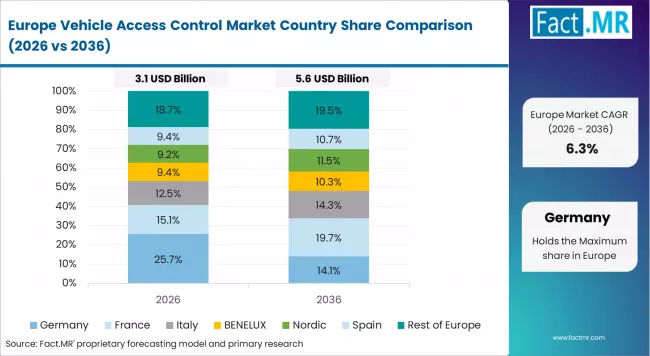
    Vehicle Access Control Market Europe Country Market Share Analysis, 2026 & 2036

    The vehicle access control market in Europe is projected to grow from USD 2.8 billion in 2026 to USD 6.1 billion by 2036, registering a CAGR of 8.1% over the forecast period. Germany is expected to maintain its leadership position with a 42.3% market share in 2026, declining slightly to 41.8% by 2036, supported by its strong automotive engineering culture, sophisticated vehicle manufacturing capabilities, and comprehensive automotive industry serving diverse vehicle access control applications across Europe.

    France follows with a 19.2% share in 2026, projected to reach 19.7% by 2036, driven by robust demand for premium automotive technologies in connected vehicle applications, advanced automotive programs, and luxury vehicle markets, combined with established automotive infrastructure and technology integration expertise. The United Kingdom holds a 14.6% share in 2026, expected to reach 15.1% by 2036, supported by strong automotive technology sector and growing premium vehicle activities. Italy commands a 10.8% share in 2026, projected to reach 11.3% by 2036, while Spain accounts for 7.4% in 2026, expected to reach 7.8% by 2036. The Netherlands maintains a 3.1% share in 2026, growing to 3.3% by 2036. The Rest of Europe region, including Nordic countries, Eastern Europe, Belgium, Poland, and other nations, is anticipated to maintain momentum, with its collective share moving from 2.6% to 1.0% by 2036, attributed to increasing automotive modernization in Eastern Europe and growing technology penetration in Nordic countries implementing advanced vehicle security programs.

    How is the competitive landscape of the vehicle access control market structured and what key factors shape competition?

    Vehicle Access Control Market Analysis By Company

    The market is characterized by competition among established automotive security companies, specialized authentication technology developers, and integrated mobility solution providers. Companies are investing in biometric technology research, connectivity optimization, advanced integration system development, and comprehensive automotive portfolios to deliver consistent, high-quality, and application-specific vehicle access control solutions. Innovation in advanced authentication integration, security enhancement, and automotive compatibility improvement is central to strengthening market position and competitive advantage.

    Denso Corporation leads the market with a strong market share, offering comprehensive automotive technology solutions including quality authentication platforms and advanced integration systems with a focus on premium and OEM vehicle applications. dormakaba International Holding AG provides specialized security capabilities with an focus on advanced access control implementations and innovative automotive solutions. Continental AG delivers comprehensive automotive system services with a focus on integrated platforms and large-scale vehicle applications. Axis Communications AB specializes in advanced security technologies and specialized access control implementations for connected applications. CalAmp Corporation focuses on premium connectivity integration and innovative technology solutions. Alps Alpine Co., Ltd. offers advanced automotive component platforms with focus on quality-critical and high-performance applications.

    Key Players in the Vehicle Access Control Market

    • Denso Corporation
    • dormakaba International Holding AG
    • Continental AG
    • Axis Communications AB
    • CalAmp Corporation
    • Alps Alpine Co., Ltd.
    • Automatic Systems S.A
    • Bosch Security Systems
    • Lear Corporation
    • Magna International Inc.
    • HELLA KGaA Hueck & Co.

    Bibliography

    • Car Connectivity Consortium. (2024). Digital Key Release 3.0: Technical Specification. CCC.
    • European New Car Assessment Programme. (2024). Euro NCAP 2025 Roadmap: Vehicle Security Assessment. Euro NCAP.
    • BMW AG. (2024). Annual Report 2023: Connected Vehicle Services. BMW AG.
    • UK Home Office. (2024). Vehicle Theft Prevention: Keyless Entry Vulnerability Advisory. Home Office.
    • International Organization for Standardization. (2024). ISO 17987: Road Vehicles, Local Interconnect Network. ISO.
    • Society of Automotive Engineers International. (2024). SAE J3101: Hardware Protected Security for Ground Vehicles. SAE.

    This bibliography is provided for reader reference. The full Fact.MR report contains the complete reference list with primary research documentation.

    This Report Addresses

    • Market sizing and quantitative forecast metrics detailing industry revenue projections for the vehicle access control market through 2036.
    • Segmentation analysis identifying adoption patterns across System, Technology, Vehicle Type, End User segments and evaluating structural demand drivers.
    • Regional deployment intelligence comparing growth dynamics across 7 key countries and broader geographic markets.
    • Regulatory compliance assessment analyzing policy frameworks and standards that affect market adoption and procurement specifications.
    • Competitive landscape evaluation profiling 11 companies and their strategic positioning across technology and geographic dimensions.
    • Strategic investment guidance identifying infrastructure requirements and procurement specifications for market participants.
    • Supply chain and operational analysis identifying capacity constraints, lead time factors, and sourcing patterns that influence market dynamics.
    • Data delivery formats including PDF narrative reports, Excel datasets, interactive dashboards, and presentation files.

    Scope of the Report

    Vehicle Access Control Market Breakdown By System, Technology, And Region

    Metric Value
    Quantitative Units USD 13.15 billion to USD 32.89 billion, at a CAGR of 9.6%
    Market Definition The vehicle access control market covers electronic and electromechanical systems that regulate entry, ignition authorization, and security monitoring for automobiles. Products include passive keyless entry (PKE) systems, near-field communication (NFC) digital keys, Bluetooth low energy (BLE) phone-as-a-key platforms, RFID-based fleet access modules, biometric fingerprint and facial recognition locks, and ultra-wideband (UWB) relay-attack-resistant transceivers.
    Segmentation System (Non-biometric Systems, Biometric Systems), Technology (NFC, Bluetooth, RFID, Wi-Fi), Vehicle Type (Passenger Cars, Commercial Vehicles, Electric Vehicles), End User (OEMs, Aftermarket, Fleet Operators)
    Regions Covered North America, Latin America, Europe, East Asia, South Asia, Oceania, Middle East & Africa
    Countries Covered India, China, Brazil, Germany, UK, USA, Japan, and 40 plus countries
    Key Companies Profiled Denso Corporation, dormakaba International Holding AG, Continental AG, Axis Communications AB, CalAmp Corporation, Alps Alpine Co., Ltd., Automatic Systems S.A., Bosch Security Systems, Lear Corporation, Magna International Inc., HELLA KGaA Hueck & Co.
    Forecast Period 2026 to 2036
    Approach Forecasting models apply a hybrid top-down and bottom-up methodology, calibrating global estimates against regional production data and verified shipment records to project market trajectory through 2036.

    Vehicle Access Control Market by Segments

    • System :

      • Non-biometric Systems
      • Biometric Systems
    • Technology :

      • NFC
      • Bluetooth
      • RFID
      • Wi-Fi
    • Vehicle Type :

      • Passenger Cars
      • Commercial Vehicles
      • Electric Vehicles
    • End User :

      • OEMs
      • Aftermarket
      • Fleet Operators
    • Application :

      • Entry Access
      • Engine Start
      • Security Monitoring
    • Price Segment :

      • Premium
      • Mid-range
      • Economy
    • Region :

      • North America
        • United States
        • Canada
        • Mexico
      • Europe
        • Germany
        • United Kingdom
        • France
        • Italy
        • Spain
        • Nordic
        • BENELUX
        • Rest of Europe
      • East Asia
        • China
        • Japan
        • South Korea
      • South Asia & Pacific
        • India
        • ASEAN
        • Australia & New Zealand
        • Rest of South Asia & Pacific
      • Latin America
        • Brazil
        • Chile
        • Argentina
        • Rest of Latin America
      • Middle East & Africa
        • Kingdom of Saudi Arabia
        • Other GCC Countries
        • Turkiye
        • South Africa
        • Other African Union
        • Rest of Middle East & Africa

    Table of Content

    1. Executive Summary
      • Global Market Outlook
      • Demand to side Trends
      • Supply to side Trends
      • Technology Roadmap Analysis
      • Analysis and Recommendations
    2. Market Overview
      • Market Coverage / Taxonomy
      • Market Definition / Scope / Limitations
    3. Research Methodology
      • Chapter Orientation
      • Analytical Lens and Working Hypotheses
        • Market Structure, Signals, and Trend Drivers
        • Benchmarking and Cross-market Comparability
        • Market Sizing, Forecasting, and Opportunity Mapping
      • Research Design and Evidence Framework
        • Desk Research Programme (Secondary Evidence)
          • Company Annual and Sustainability Reports
          • Peer-reviewed Journals and Academic Literature
          • Corporate Websites, Product Literature, and Technical Notes
          • Earnings Decks and Investor Briefings
          • Statutory Filings and Regulatory Disclosures
          • Technical White Papers and Standards Notes
          • Trade Journals, Industry Magazines, and Analyst Briefs
          • Conference Proceedings, Webinars, and Seminar Materials
          • Government Statistics Portals and Public Data Releases
          • Press Releases and Reputable Media Coverage
          • Specialist Newsletters and Curated Briefings
          • Sector Databases and Reference Repositories
          • Fact.MR Internal Proprietary Databases and Historical Market Datasets
          • Subscription Datasets and Paid Sources
          • Social Channels, Communities, and Digital Listening Inputs
          • Additional Desk Sources
        • Expert Input and Fieldwork (Primary Evidence)
          • Primary Modes
            • Qualitative Interviews and Expert Elicitation
            • Quantitative Surveys and Structured Data Capture
            • Blended Approach
          • Why Primary Evidence is Used
          • Field Techniques
            • Interviews
            • Surveys
            • Focus Groups
            • Observational and In-context Research
            • Social and Community Interactions
          • Stakeholder Universe Engaged
            • C-suite Leaders
            • Board Members
            • Presidents and Vice Presidents
            • R&D and Innovation Heads
            • Technical Specialists
            • Domain Subject-matter Experts
            • Scientists
            • Physicians and Other Healthcare Professionals
          • Governance, Ethics, and Data Stewardship
            • Research Ethics
            • Data Integrity and Handling
        • Tooling, Models, and Reference Databases
      • Data Engineering and Model Build
        • Data Acquisition and Ingestion
        • Cleaning, Normalisation, and Verification
        • Synthesis, Triangulation, and Analysis
      • Quality Assurance and Audit Trail
    4. Market Background
      • Market Dynamics
        • Drivers
        • Restraints
        • Opportunity
        • Trends
      • Scenario Forecast
        • Demand in Optimistic Scenario
        • Demand in Likely Scenario
        • Demand in Conservative Scenario
      • Opportunity Map Analysis
      • Product Life Cycle Analysis
      • Supply Chain Analysis
      • Investment Feasibility Matrix
      • Value Chain Analysis
      • PESTLE and Porter’s Analysis
      • Regulatory Landscape
      • Regional Parent Market Outlook
      • Production and Consumption Statistics
      • Import and Export Statistics
    5. Global Market Analysis 2021 to 2025 and Forecast, 2026 to 2036
      • Historical Market Size Value (USD Million) Analysis, 2021 to 2025
      • Current and Future Market Size Value (USD Million) Projections, 2026 to 2036
        • Y to o to Y Growth Trend Analysis
        • Absolute $ Opportunity Analysis
    6. Global Market Pricing Analysis 2021 to 2025 and Forecast 2026 to 2036
    7. Global Market Analysis 2021 to 2025 and Forecast 2026 to 2036, By System
      • Introduction / Key Findings
      • Historical Market Size Value (USD Million) Analysis By System , 2021 to 2025
      • Current and Future Market Size Value (USD Million) Analysis and Forecast By System , 2026 to 2036
        • Non-biometric Systems
        • Biometric Systems
      • Y to o to Y Growth Trend Analysis By System , 2021 to 2025
      • Absolute $ Opportunity Analysis By System , 2026 to 2036
    8. Global Market Analysis 2021 to 2025 and Forecast 2026 to 2036, By Technology
      • Introduction / Key Findings
      • Historical Market Size Value (USD Million) Analysis By Technology, 2021 to 2025
      • Current and Future Market Size Value (USD Million) Analysis and Forecast By Technology, 2026 to 2036
        • NFC
        • Bluetooth
        • RFID
        • Wi-Fi
      • Y to o to Y Growth Trend Analysis By Technology, 2021 to 2025
      • Absolute $ Opportunity Analysis By Technology, 2026 to 2036
    9. Global Market Analysis 2021 to 2025 and Forecast 2026 to 2036, By Vehicle Type
      • Introduction / Key Findings
      • Historical Market Size Value (USD Million) Analysis By Vehicle Type, 2021 to 2025
      • Current and Future Market Size Value (USD Million) Analysis and Forecast By Vehicle Type, 2026 to 2036
        • Passenger Cars
        • Commercial Vehicles
        • Electric Vehicles
      • Y to o to Y Growth Trend Analysis By Vehicle Type, 2021 to 2025
      • Absolute $ Opportunity Analysis By Vehicle Type, 2026 to 2036
    10. Global Market Analysis 2021 to 2025 and Forecast 2026 to 2036, By End User
      • Introduction / Key Findings
      • Historical Market Size Value (USD Million) Analysis By End User, 2021 to 2025
      • Current and Future Market Size Value (USD Million) Analysis and Forecast By End User, 2026 to 2036
        • OEMs
        • Aftermarket
        • Fleet Operators
      • Y to o to Y Growth Trend Analysis By End User, 2021 to 2025
      • Absolute $ Opportunity Analysis By End User, 2026 to 2036
    11. Global Market Analysis 2021 to 2025 and Forecast 2026 to 2036, By Application
      • Introduction / Key Findings
      • Historical Market Size Value (USD Million) Analysis By Application, 2021 to 2025
      • Current and Future Market Size Value (USD Million) Analysis and Forecast By Application, 2026 to 2036
        • Entry Access
        • Engine Start
        • Security Monitoring
      • Y to o to Y Growth Trend Analysis By Application, 2021 to 2025
      • Absolute $ Opportunity Analysis By Application, 2026 to 2036
    12. Global Market Analysis 2021 to 2025 and Forecast 2026 to 2036, By Price Segment
      • Introduction / Key Findings
      • Historical Market Size Value (USD Million) Analysis By Price Segment, 2021 to 2025
      • Current and Future Market Size Value (USD Million) Analysis and Forecast By Price Segment, 2026 to 2036
        • Premium
        • Mid-range
        • Economy
      • Y to o to Y Growth Trend Analysis By Price Segment, 2021 to 2025
      • Absolute $ Opportunity Analysis By Price Segment, 2026 to 2036
    13. Global Market Analysis 2021 to 2025 and Forecast 2026 to 2036, By Region
      • Introduction
      • Historical Market Size Value (USD Million) Analysis By Region, 2021 to 2025
      • Current Market Size Value (USD Million) Analysis and Forecast By Region, 2026 to 2036
        • North America
        • Latin America
        • Western Europe
        • Eastern Europe
        • East Asia
        • South Asia and Pacific
        • Middle East & Africa
      • Market Attractiveness Analysis By Region
    14. North America Market Analysis 2021 to 2025 and Forecast 2026 to 2036, By Country
      • Historical Market Size Value (USD Million) Trend Analysis By Market Taxonomy, 2021 to 2025
      • Market Size Value (USD Million) Forecast By Market Taxonomy, 2026 to 2036
        • By Country
          • USA
          • Canada
          • Mexico
        • By System
        • By Technology
        • By Vehicle Type
        • By End User
        • By Application
        • By Price Segment
      • Market Attractiveness Analysis
        • By Country
        • By System
        • By Technology
        • By Vehicle Type
        • By End User
        • By Application
        • By Price Segment
      • Key Takeaways
    15. Latin America Market Analysis 2021 to 2025 and Forecast 2026 to 2036, By Country
      • Historical Market Size Value (USD Million) Trend Analysis By Market Taxonomy, 2021 to 2025
      • Market Size Value (USD Million) Forecast By Market Taxonomy, 2026 to 2036
        • By Country
          • Brazil
          • Chile
          • Rest of Latin America
        • By System
        • By Technology
        • By Vehicle Type
        • By End User
        • By Application
        • By Price Segment
      • Market Attractiveness Analysis
        • By Country
        • By System
        • By Technology
        • By Vehicle Type
        • By End User
        • By Application
        • By Price Segment
      • Key Takeaways
    16. Western Europe Market Analysis 2021 to 2025 and Forecast 2026 to 2036, By Country
      • Historical Market Size Value (USD Million) Trend Analysis By Market Taxonomy, 2021 to 2025
      • Market Size Value (USD Million) Forecast By Market Taxonomy, 2026 to 2036
        • By Country
          • Germany
          • UK
          • Italy
          • Spain
          • France
          • Nordic
          • BENELUX
          • Rest of Western Europe
        • By System
        • By Technology
        • By Vehicle Type
        • By End User
        • By Application
        • By Price Segment
      • Market Attractiveness Analysis
        • By Country
        • By System
        • By Technology
        • By Vehicle Type
        • By End User
        • By Application
        • By Price Segment
      • Key Takeaways
    17. Eastern Europe Market Analysis 2021 to 2025 and Forecast 2026 to 2036, By Country
      • Historical Market Size Value (USD Million) Trend Analysis By Market Taxonomy, 2021 to 2025
      • Market Size Value (USD Million) Forecast By Market Taxonomy, 2026 to 2036
        • By Country
          • Russia
          • Poland
          • Hungary
          • Balkan & Baltic
          • Rest of Eastern Europe
        • By System
        • By Technology
        • By Vehicle Type
        • By End User
        • By Application
        • By Price Segment
      • Market Attractiveness Analysis
        • By Country
        • By System
        • By Technology
        • By Vehicle Type
        • By End User
        • By Application
        • By Price Segment
      • Key Takeaways
    18. East Asia Market Analysis 2021 to 2025 and Forecast 2026 to 2036, By Country
      • Historical Market Size Value (USD Million) Trend Analysis By Market Taxonomy, 2021 to 2025
      • Market Size Value (USD Million) Forecast By Market Taxonomy, 2026 to 2036
        • By Country
          • China
          • Japan
          • South Korea
        • By System
        • By Technology
        • By Vehicle Type
        • By End User
        • By Application
        • By Price Segment
      • Market Attractiveness Analysis
        • By Country
        • By System
        • By Technology
        • By Vehicle Type
        • By End User
        • By Application
        • By Price Segment
      • Key Takeaways
    19. South Asia and Pacific Market Analysis 2021 to 2025 and Forecast 2026 to 2036, By Country
      • Historical Market Size Value (USD Million) Trend Analysis By Market Taxonomy, 2021 to 2025
      • Market Size Value (USD Million) Forecast By Market Taxonomy, 2026 to 2036
        • By Country
          • India
          • ASEAN
          • Australia & New Zealand
          • Rest of South Asia and Pacific
        • By System
        • By Technology
        • By Vehicle Type
        • By End User
        • By Application
        • By Price Segment
      • Market Attractiveness Analysis
        • By Country
        • By System
        • By Technology
        • By Vehicle Type
        • By End User
        • By Application
        • By Price Segment
      • Key Takeaways
    20. Middle East & Africa Market Analysis 2021 to 2025 and Forecast 2026 to 2036, By Country
      • Historical Market Size Value (USD Million) Trend Analysis By Market Taxonomy, 2021 to 2025
      • Market Size Value (USD Million) Forecast By Market Taxonomy, 2026 to 2036
        • By Country
          • Kingdom of Saudi Arabia
          • Other GCC Countries
          • Turkiye
          • South Africa
          • Other African Union
          • Rest of Middle East & Africa
        • By System
        • By Technology
        • By Vehicle Type
        • By End User
        • By Application
        • By Price Segment
      • Market Attractiveness Analysis
        • By Country
        • By System
        • By Technology
        • By Vehicle Type
        • By End User
        • By Application
        • By Price Segment
      • Key Takeaways
    21. Key Countries Market Analysis
      • USA
        • Pricing Analysis
        • Market Share Analysis, 2025
          • By System
          • By Technology
          • By Vehicle Type
          • By End User
          • By Application
          • By Price Segment
      • Canada
        • Pricing Analysis
        • Market Share Analysis, 2025
          • By System
          • By Technology
          • By Vehicle Type
          • By End User
          • By Application
          • By Price Segment
      • Mexico
        • Pricing Analysis
        • Market Share Analysis, 2025
          • By System
          • By Technology
          • By Vehicle Type
          • By End User
          • By Application
          • By Price Segment
      • Brazil
        • Pricing Analysis
        • Market Share Analysis, 2025
          • By System
          • By Technology
          • By Vehicle Type
          • By End User
          • By Application
          • By Price Segment
      • Chile
        • Pricing Analysis
        • Market Share Analysis, 2025
          • By System
          • By Technology
          • By Vehicle Type
          • By End User
          • By Application
          • By Price Segment
      • Germany
        • Pricing Analysis
        • Market Share Analysis, 2025
          • By System
          • By Technology
          • By Vehicle Type
          • By End User
          • By Application
          • By Price Segment
      • UK
        • Pricing Analysis
        • Market Share Analysis, 2025
          • By System
          • By Technology
          • By Vehicle Type
          • By End User
          • By Application
          • By Price Segment
      • Italy
        • Pricing Analysis
        • Market Share Analysis, 2025
          • By System
          • By Technology
          • By Vehicle Type
          • By End User
          • By Application
          • By Price Segment
      • Spain
        • Pricing Analysis
        • Market Share Analysis, 2025
          • By System
          • By Technology
          • By Vehicle Type
          • By End User
          • By Application
          • By Price Segment
      • France
        • Pricing Analysis
        • Market Share Analysis, 2025
          • By System
          • By Technology
          • By Vehicle Type
          • By End User
          • By Application
          • By Price Segment
      • India
        • Pricing Analysis
        • Market Share Analysis, 2025
          • By System
          • By Technology
          • By Vehicle Type
          • By End User
          • By Application
          • By Price Segment
      • ASEAN
        • Pricing Analysis
        • Market Share Analysis, 2025
          • By System
          • By Technology
          • By Vehicle Type
          • By End User
          • By Application
          • By Price Segment
      • Australia & New Zealand
        • Pricing Analysis
        • Market Share Analysis, 2025
          • By System
          • By Technology
          • By Vehicle Type
          • By End User
          • By Application
          • By Price Segment
      • China
        • Pricing Analysis
        • Market Share Analysis, 2025
          • By System
          • By Technology
          • By Vehicle Type
          • By End User
          • By Application
          • By Price Segment
      • Japan
        • Pricing Analysis
        • Market Share Analysis, 2025
          • By System
          • By Technology
          • By Vehicle Type
          • By End User
          • By Application
          • By Price Segment
      • South Korea
        • Pricing Analysis
        • Market Share Analysis, 2025
          • By System
          • By Technology
          • By Vehicle Type
          • By End User
          • By Application
          • By Price Segment
      • Russia
        • Pricing Analysis
        • Market Share Analysis, 2025
          • By System
          • By Technology
          • By Vehicle Type
          • By End User
          • By Application
          • By Price Segment
      • Poland
        • Pricing Analysis
        • Market Share Analysis, 2025
          • By System
          • By Technology
          • By Vehicle Type
          • By End User
          • By Application
          • By Price Segment
      • Hungary
        • Pricing Analysis
        • Market Share Analysis, 2025
          • By System
          • By Technology
          • By Vehicle Type
          • By End User
          • By Application
          • By Price Segment
      • Kingdom of Saudi Arabia
        • Pricing Analysis
        • Market Share Analysis, 2025
          • By System
          • By Technology
          • By Vehicle Type
          • By End User
          • By Application
          • By Price Segment
      • Turkiye
        • Pricing Analysis
        • Market Share Analysis, 2025
          • By System
          • By Technology
          • By Vehicle Type
          • By End User
          • By Application
          • By Price Segment
      • South Africa
        • Pricing Analysis
        • Market Share Analysis, 2025
          • By System
          • By Technology
          • By Vehicle Type
          • By End User
          • By Application
          • By Price Segment
    22. Market Structure Analysis
      • Competition Dashboard
      • Competition Benchmarking
      • Market Share Analysis of Top Players
        • By Regional
        • By System
        • By Technology
        • By Vehicle Type
        • By End User
        • By Application
        • By Price Segment
    23. Competition Analysis
      • Competition Deep Dive
        • Denso Corporation
          • Overview
          • Product Portfolio
          • Profitability by Market Segments (Product/Age /Sales Channel/Region)
          • Sales Footprint
          • Strategy Overview
            • Marketing Strategy
            • Product Strategy
            • Channel Strategy
        • dormakaba International Holding AG
        • Continental AG
        • Axis Communications AB
        • CalAmp Corporation
        • Alps Alpine Co., Ltd.
        • Automatic Systems S.A
        • Bosch Security Systems
        • Lear Corporation
        • Magna International Inc.
        • HELLA KGaA Hueck & Co.
    24. Assumptions & Acronyms Used

    List Of Table

    • Table 1: Global Market Value (USD Million) Forecast by Region, 2021 to 2036
    • Table 2: Global Market Value (USD Million) Forecast by System , 2021 to 2036
    • Table 3: Global Market Value (USD Million) Forecast by Technology, 2021 to 2036
    • Table 4: Global Market Value (USD Million) Forecast by Vehicle Type, 2021 to 2036
    • Table 5: Global Market Value (USD Million) Forecast by End User, 2021 to 2036
    • Table 6: Global Market Value (USD Million) Forecast by Application, 2021 to 2036
    • Table 7: Global Market Value (USD Million) Forecast by Price Segment, 2021 to 2036
    • Table 8: North America Market Value (USD Million) Forecast by Country, 2021 to 2036
    • Table 9: North America Market Value (USD Million) Forecast by System , 2021 to 2036
    • Table 10: North America Market Value (USD Million) Forecast by Technology, 2021 to 2036
    • Table 11: North America Market Value (USD Million) Forecast by Vehicle Type, 2021 to 2036
    • Table 12: North America Market Value (USD Million) Forecast by End User, 2021 to 2036
    • Table 13: North America Market Value (USD Million) Forecast by Application, 2021 to 2036
    • Table 14: North America Market Value (USD Million) Forecast by Price Segment, 2021 to 2036
    • Table 15: Latin America Market Value (USD Million) Forecast by Country, 2021 to 2036
    • Table 16: Latin America Market Value (USD Million) Forecast by System , 2021 to 2036
    • Table 17: Latin America Market Value (USD Million) Forecast by Technology, 2021 to 2036
    • Table 18: Latin America Market Value (USD Million) Forecast by Vehicle Type, 2021 to 2036
    • Table 19: Latin America Market Value (USD Million) Forecast by End User, 2021 to 2036
    • Table 20: Latin America Market Value (USD Million) Forecast by Application, 2021 to 2036
    • Table 21: Latin America Market Value (USD Million) Forecast by Price Segment, 2021 to 2036
    • Table 22: Western Europe Market Value (USD Million) Forecast by Country, 2021 to 2036
    • Table 23: Western Europe Market Value (USD Million) Forecast by System , 2021 to 2036
    • Table 24: Western Europe Market Value (USD Million) Forecast by Technology, 2021 to 2036
    • Table 25: Western Europe Market Value (USD Million) Forecast by Vehicle Type, 2021 to 2036
    • Table 26: Western Europe Market Value (USD Million) Forecast by End User, 2021 to 2036
    • Table 27: Western Europe Market Value (USD Million) Forecast by Application, 2021 to 2036
    • Table 28: Western Europe Market Value (USD Million) Forecast by Price Segment, 2021 to 2036
    • Table 29: Eastern Europe Market Value (USD Million) Forecast by Country, 2021 to 2036
    • Table 30: Eastern Europe Market Value (USD Million) Forecast by System , 2021 to 2036
    • Table 31: Eastern Europe Market Value (USD Million) Forecast by Technology, 2021 to 2036
    • Table 32: Eastern Europe Market Value (USD Million) Forecast by Vehicle Type, 2021 to 2036
    • Table 33: Eastern Europe Market Value (USD Million) Forecast by End User, 2021 to 2036
    • Table 34: Eastern Europe Market Value (USD Million) Forecast by Application, 2021 to 2036
    • Table 35: Eastern Europe Market Value (USD Million) Forecast by Price Segment, 2021 to 2036
    • Table 36: East Asia Market Value (USD Million) Forecast by Country, 2021 to 2036
    • Table 37: East Asia Market Value (USD Million) Forecast by System , 2021 to 2036
    • Table 38: East Asia Market Value (USD Million) Forecast by Technology, 2021 to 2036
    • Table 39: East Asia Market Value (USD Million) Forecast by Vehicle Type, 2021 to 2036
    • Table 40: East Asia Market Value (USD Million) Forecast by End User, 2021 to 2036
    • Table 41: East Asia Market Value (USD Million) Forecast by Application, 2021 to 2036
    • Table 42: East Asia Market Value (USD Million) Forecast by Price Segment, 2021 to 2036
    • Table 43: South Asia and Pacific Market Value (USD Million) Forecast by Country, 2021 to 2036
    • Table 44: South Asia and Pacific Market Value (USD Million) Forecast by System , 2021 to 2036
    • Table 45: South Asia and Pacific Market Value (USD Million) Forecast by Technology, 2021 to 2036
    • Table 46: South Asia and Pacific Market Value (USD Million) Forecast by Vehicle Type, 2021 to 2036
    • Table 47: South Asia and Pacific Market Value (USD Million) Forecast by End User, 2021 to 2036
    • Table 48: South Asia and Pacific Market Value (USD Million) Forecast by Application, 2021 to 2036
    • Table 49: South Asia and Pacific Market Value (USD Million) Forecast by Price Segment, 2021 to 2036
    • Table 50: Middle East & Africa Market Value (USD Million) Forecast by Country, 2021 to 2036
    • Table 51: Middle East & Africa Market Value (USD Million) Forecast by System , 2021 to 2036
    • Table 52: Middle East & Africa Market Value (USD Million) Forecast by Technology, 2021 to 2036
    • Table 53: Middle East & Africa Market Value (USD Million) Forecast by Vehicle Type, 2021 to 2036
    • Table 54: Middle East & Africa Market Value (USD Million) Forecast by End User, 2021 to 2036
    • Table 55: Middle East & Africa Market Value (USD Million) Forecast by Application, 2021 to 2036
    • Table 56: Middle East & Africa Market Value (USD Million) Forecast by Price Segment, 2021 to 2036

    List Of Figures

    • Figure 1: Global Market Pricing Analysis
    • Figure 2: Global Market Value (USD Million) Forecast 2021-2036
    • Figure 3: Global Market Value Share and BPS Analysis by System, 2026 and 2036
    • Figure 4: Global Market Y-o-Y Growth Comparison by System, 2026 to 2036
    • Figure 5: Global Market Attractiveness Analysis by System
    • Figure 6: Global Market Value Share and BPS Analysis by Technology, 2026 and 2036
    • Figure 7: Global Market Y-o-Y Growth Comparison by Technology, 2026 to 2036
    • Figure 8: Global Market Attractiveness Analysis by Technology
    • Figure 9: Global Market Value Share and BPS Analysis by Vehicle Type, 2026 and 2036
    • Figure 10: Global Market Y-o-Y Growth Comparison by Vehicle Type, 2026 to 2036
    • Figure 11: Global Market Attractiveness Analysis by Vehicle Type
    • Figure 12: Global Market Value Share and BPS Analysis by End User, 2026 and 2036
    • Figure 13: Global Market Y-o-Y Growth Comparison by End User, 2026 to 2036
    • Figure 14: Global Market Attractiveness Analysis by End User
    • Figure 15: Global Market Value Share and BPS Analysis by Application, 2026 and 2036
    • Figure 16: Global Market Y-o-Y Growth Comparison by Application, 2026 to 2036
    • Figure 17: Global Market Attractiveness Analysis by Application
    • Figure 18: Global Market Value Share and BPS Analysis by Price Segment, 2026 and 2036
    • Figure 19: Global Market Y-o-Y Growth Comparison by Price Segment, 2026 to 2036
    • Figure 20: Global Market Attractiveness Analysis by Price Segment
    • Figure 21: Global Market Value (USD Million) Share and BPS Analysis by Region, 2026 and 2036
    • Figure 22: Global Market Y-o-Y Growth Comparison by Region, 2026 to 2036
    • Figure 23: Global Market Attractiveness Analysis by Region
    • Figure 24: North America Market Incremental Dollar Opportunity, 2026 to 2036
    • Figure 25: Latin America Market Incremental Dollar Opportunity, 2026 to 2036
    • Figure 26: Western Europe Market Incremental Dollar Opportunity, 2026 to 2036
    • Figure 27: Eastern Europe Market Incremental Dollar Opportunity, 2026 to 2036
    • Figure 28: East Asia Market Incremental Dollar Opportunity, 2026 to 2036
    • Figure 29: South Asia and Pacific Market Incremental Dollar Opportunity, 2026 to 2036
    • Figure 30: Middle East & Africa Market Incremental Dollar Opportunity, 2026 to 2036
    • Figure 31: North America Market Value Share and BPS Analysis by Country, 2026 and 2036
    • Figure 32: North America Market Value Share and BPS Analysis by System, 2026 and 2036
    • Figure 33: North America Market Y-o-Y Growth Comparison by System, 2026 to 2036
    • Figure 34: North America Market Attractiveness Analysis by System
    • Figure 35: North America Market Value Share and BPS Analysis by Technology, 2026 and 2036
    • Figure 36: North America Market Y-o-Y Growth Comparison by Technology, 2026 to 2036
    • Figure 37: North America Market Attractiveness Analysis by Technology
    • Figure 38: North America Market Value Share and BPS Analysis by Vehicle Type, 2026 and 2036
    • Figure 39: North America Market Y-o-Y Growth Comparison by Vehicle Type, 2026 to 2036
    • Figure 40: North America Market Attractiveness Analysis by Vehicle Type
    • Figure 41: North America Market Value Share and BPS Analysis by End User, 2026 and 2036
    • Figure 42: North America Market Y-o-Y Growth Comparison by End User, 2026 to 2036
    • Figure 43: North America Market Attractiveness Analysis by End User
    • Figure 44: North America Market Value Share and BPS Analysis by Application, 2026 and 2036
    • Figure 45: North America Market Y-o-Y Growth Comparison by Application, 2026 to 2036
    • Figure 46: North America Market Attractiveness Analysis by Application
    • Figure 47: North America Market Value Share and BPS Analysis by Price Segment, 2026 and 2036
    • Figure 48: North America Market Y-o-Y Growth Comparison by Price Segment, 2026 to 2036
    • Figure 49: North America Market Attractiveness Analysis by Price Segment
    • Figure 50: Latin America Market Value Share and BPS Analysis by Country, 2026 and 2036
    • Figure 51: Latin America Market Value Share and BPS Analysis by System, 2026 and 2036
    • Figure 52: Latin America Market Y-o-Y Growth Comparison by System, 2026 to 2036
    • Figure 53: Latin America Market Attractiveness Analysis by System
    • Figure 54: Latin America Market Value Share and BPS Analysis by Technology, 2026 and 2036
    • Figure 55: Latin America Market Y-o-Y Growth Comparison by Technology, 2026 to 2036
    • Figure 56: Latin America Market Attractiveness Analysis by Technology
    • Figure 57: Latin America Market Value Share and BPS Analysis by Vehicle Type, 2026 and 2036
    • Figure 58: Latin America Market Y-o-Y Growth Comparison by Vehicle Type, 2026 to 2036
    • Figure 59: Latin America Market Attractiveness Analysis by Vehicle Type
    • Figure 60: Latin America Market Value Share and BPS Analysis by End User, 2026 and 2036
    • Figure 61: Latin America Market Y-o-Y Growth Comparison by End User, 2026 to 2036
    • Figure 62: Latin America Market Attractiveness Analysis by End User
    • Figure 63: Latin America Market Value Share and BPS Analysis by Application, 2026 and 2036
    • Figure 64: Latin America Market Y-o-Y Growth Comparison by Application, 2026 to 2036
    • Figure 65: Latin America Market Attractiveness Analysis by Application
    • Figure 66: Latin America Market Value Share and BPS Analysis by Price Segment, 2026 and 2036
    • Figure 67: Latin America Market Y-o-Y Growth Comparison by Price Segment, 2026 to 2036
    • Figure 68: Latin America Market Attractiveness Analysis by Price Segment
    • Figure 69: Western Europe Market Value Share and BPS Analysis by Country, 2026 and 2036
    • Figure 70: Western Europe Market Value Share and BPS Analysis by System, 2026 and 2036
    • Figure 71: Western Europe Market Y-o-Y Growth Comparison by System, 2026 to 2036
    • Figure 72: Western Europe Market Attractiveness Analysis by System
    • Figure 73: Western Europe Market Value Share and BPS Analysis by Technology, 2026 and 2036
    • Figure 74: Western Europe Market Y-o-Y Growth Comparison by Technology, 2026 to 2036
    • Figure 75: Western Europe Market Attractiveness Analysis by Technology
    • Figure 76: Western Europe Market Value Share and BPS Analysis by Vehicle Type, 2026 and 2036
    • Figure 77: Western Europe Market Y-o-Y Growth Comparison by Vehicle Type, 2026 to 2036
    • Figure 78: Western Europe Market Attractiveness Analysis by Vehicle Type
    • Figure 79: Western Europe Market Value Share and BPS Analysis by End User, 2026 and 2036
    • Figure 80: Western Europe Market Y-o-Y Growth Comparison by End User, 2026 to 2036
    • Figure 81: Western Europe Market Attractiveness Analysis by End User
    • Figure 82: Western Europe Market Value Share and BPS Analysis by Application, 2026 and 2036
    • Figure 83: Western Europe Market Y-o-Y Growth Comparison by Application, 2026 to 2036
    • Figure 84: Western Europe Market Attractiveness Analysis by Application
    • Figure 85: Western Europe Market Value Share and BPS Analysis by Price Segment, 2026 and 2036
    • Figure 86: Western Europe Market Y-o-Y Growth Comparison by Price Segment, 2026 to 2036
    • Figure 87: Western Europe Market Attractiveness Analysis by Price Segment
    • Figure 88: Eastern Europe Market Value Share and BPS Analysis by Country, 2026 and 2036
    • Figure 89: Eastern Europe Market Value Share and BPS Analysis by System, 2026 and 2036
    • Figure 90: Eastern Europe Market Y-o-Y Growth Comparison by System, 2026 to 2036
    • Figure 91: Eastern Europe Market Attractiveness Analysis by System
    • Figure 92: Eastern Europe Market Value Share and BPS Analysis by Technology, 2026 and 2036
    • Figure 93: Eastern Europe Market Y-o-Y Growth Comparison by Technology, 2026 to 2036
    • Figure 94: Eastern Europe Market Attractiveness Analysis by Technology
    • Figure 95: Eastern Europe Market Value Share and BPS Analysis by Vehicle Type, 2026 and 2036
    • Figure 96: Eastern Europe Market Y-o-Y Growth Comparison by Vehicle Type, 2026 to 2036
    • Figure 97: Eastern Europe Market Attractiveness Analysis by Vehicle Type
    • Figure 98: Eastern Europe Market Value Share and BPS Analysis by End User, 2026 and 2036
    • Figure 99: Eastern Europe Market Y-o-Y Growth Comparison by End User, 2026 to 2036
    • Figure 100: Eastern Europe Market Attractiveness Analysis by End User
    • Figure 101: Eastern Europe Market Value Share and BPS Analysis by Application, 2026 and 2036
    • Figure 102: Eastern Europe Market Y-o-Y Growth Comparison by Application, 2026 to 2036
    • Figure 103: Eastern Europe Market Attractiveness Analysis by Application
    • Figure 104: Eastern Europe Market Value Share and BPS Analysis by Price Segment, 2026 and 2036
    • Figure 105: Eastern Europe Market Y-o-Y Growth Comparison by Price Segment, 2026 to 2036
    • Figure 106: Eastern Europe Market Attractiveness Analysis by Price Segment
    • Figure 107: East Asia Market Value Share and BPS Analysis by Country, 2026 and 2036
    • Figure 108: East Asia Market Value Share and BPS Analysis by System, 2026 and 2036
    • Figure 109: East Asia Market Y-o-Y Growth Comparison by System, 2026 to 2036
    • Figure 110: East Asia Market Attractiveness Analysis by System
    • Figure 111: East Asia Market Value Share and BPS Analysis by Technology, 2026 and 2036
    • Figure 112: East Asia Market Y-o-Y Growth Comparison by Technology, 2026 to 2036
    • Figure 113: East Asia Market Attractiveness Analysis by Technology
    • Figure 114: East Asia Market Value Share and BPS Analysis by Vehicle Type, 2026 and 2036
    • Figure 115: East Asia Market Y-o-Y Growth Comparison by Vehicle Type, 2026 to 2036
    • Figure 116: East Asia Market Attractiveness Analysis by Vehicle Type
    • Figure 117: East Asia Market Value Share and BPS Analysis by End User, 2026 and 2036
    • Figure 118: East Asia Market Y-o-Y Growth Comparison by End User, 2026 to 2036
    • Figure 119: East Asia Market Attractiveness Analysis by End User
    • Figure 120: East Asia Market Value Share and BPS Analysis by Application, 2026 and 2036
    • Figure 121: East Asia Market Y-o-Y Growth Comparison by Application, 2026 to 2036
    • Figure 122: East Asia Market Attractiveness Analysis by Application
    • Figure 123: East Asia Market Value Share and BPS Analysis by Price Segment, 2026 and 2036
    • Figure 124: East Asia Market Y-o-Y Growth Comparison by Price Segment, 2026 to 2036
    • Figure 125: East Asia Market Attractiveness Analysis by Price Segment
    • Figure 126: South Asia and Pacific Market Value Share and BPS Analysis by Country, 2026 and 2036
    • Figure 127: South Asia and Pacific Market Value Share and BPS Analysis by System, 2026 and 2036
    • Figure 128: South Asia and Pacific Market Y-o-Y Growth Comparison by System, 2026 to 2036
    • Figure 129: South Asia and Pacific Market Attractiveness Analysis by System
    • Figure 130: South Asia and Pacific Market Value Share and BPS Analysis by Technology, 2026 and 2036
    • Figure 131: South Asia and Pacific Market Y-o-Y Growth Comparison by Technology, 2026 to 2036
    • Figure 132: South Asia and Pacific Market Attractiveness Analysis by Technology
    • Figure 133: South Asia and Pacific Market Value Share and BPS Analysis by Vehicle Type, 2026 and 2036
    • Figure 134: South Asia and Pacific Market Y-o-Y Growth Comparison by Vehicle Type, 2026 to 2036
    • Figure 135: South Asia and Pacific Market Attractiveness Analysis by Vehicle Type
    • Figure 136: South Asia and Pacific Market Value Share and BPS Analysis by End User, 2026 and 2036
    • Figure 137: South Asia and Pacific Market Y-o-Y Growth Comparison by End User, 2026 to 2036
    • Figure 138: South Asia and Pacific Market Attractiveness Analysis by End User
    • Figure 139: South Asia and Pacific Market Value Share and BPS Analysis by Application, 2026 and 2036
    • Figure 140: South Asia and Pacific Market Y-o-Y Growth Comparison by Application, 2026 to 2036
    • Figure 141: South Asia and Pacific Market Attractiveness Analysis by Application
    • Figure 142: South Asia and Pacific Market Value Share and BPS Analysis by Price Segment, 2026 and 2036
    • Figure 143: South Asia and Pacific Market Y-o-Y Growth Comparison by Price Segment, 2026 to 2036
    • Figure 144: South Asia and Pacific Market Attractiveness Analysis by Price Segment
    • Figure 145: Middle East & Africa Market Value Share and BPS Analysis by Country, 2026 and 2036
    • Figure 146: Middle East & Africa Market Value Share and BPS Analysis by System, 2026 and 2036
    • Figure 147: Middle East & Africa Market Y-o-Y Growth Comparison by System, 2026 to 2036
    • Figure 148: Middle East & Africa Market Attractiveness Analysis by System
    • Figure 149: Middle East & Africa Market Value Share and BPS Analysis by Technology, 2026 and 2036
    • Figure 150: Middle East & Africa Market Y-o-Y Growth Comparison by Technology, 2026 to 2036
    • Figure 151: Middle East & Africa Market Attractiveness Analysis by Technology
    • Figure 152: Middle East & Africa Market Value Share and BPS Analysis by Vehicle Type, 2026 and 2036
    • Figure 153: Middle East & Africa Market Y-o-Y Growth Comparison by Vehicle Type, 2026 to 2036
    • Figure 154: Middle East & Africa Market Attractiveness Analysis by Vehicle Type
    • Figure 155: Middle East & Africa Market Value Share and BPS Analysis by End User, 2026 and 2036
    • Figure 156: Middle East & Africa Market Y-o-Y Growth Comparison by End User, 2026 to 2036
    • Figure 157: Middle East & Africa Market Attractiveness Analysis by End User
    • Figure 158: Middle East & Africa Market Value Share and BPS Analysis by Application, 2026 and 2036
    • Figure 159: Middle East & Africa Market Y-o-Y Growth Comparison by Application, 2026 to 2036
    • Figure 160: Middle East & Africa Market Attractiveness Analysis by Application
    • Figure 161: Middle East & Africa Market Value Share and BPS Analysis by Price Segment, 2026 and 2036
    • Figure 162: Middle East & Africa Market Y-o-Y Growth Comparison by Price Segment, 2026 to 2036
    • Figure 163: Middle East & Africa Market Attractiveness Analysis by Price Segment
    • Figure 164: Global Market - Tier Structure Analysis
    • Figure 165: Global Market - Company Share Analysis

    - Frequently Asked Questions -

    How large is the demand for Vehicle Access Control Market in the global market in 2026?

    Demand for the vehicle access control market is estimated at USD 13.15 billion in 2026.

    What will be the market size of Vehicle Access Control Market by 2036?

    Market size for the vehicle access control market is projected to reach USD 32.89 billion by 2036.

    What is the expected demand growth for Vehicle Access Control Market between 2026 and 2036?

    Demand is expected to grow at a CAGR of 9.6% between 2026 and 2036.

    Which System is poised to lead global sales by 2026?

    Non-biometric Systems accounts for 58.0% share in 2026, reflecting its dominant position across primary applications.

    How significant is the role of NFC in the Vehicle Access Control Market?

    NFC represents 36.0% of the technology segment in 2026, driven by structural demand from the largest buyer category.

    What is the growth outlook for India in this report?

    India is projected to grow at a CAGR of 11.0% during 2026 to 2036.

    What is the growth outlook for China?

    China is projected to expand at a CAGR of 10.5% during 2026 to 2036.

    Does the report cover UK in its regional analysis?

    Yes, UK is included within the regional scope of analysis.

    What is Vehicle Access Control Market and what is it mainly used for?

    The vehicle access control market covers electronic and electromechanical systems that regulate entry, ignition authorization, and security monitoring for automobiles. Products include passive keyless entry (PKE) systems, near-field communication (NFC) digital keys, Bluetooth low energy (BLE) phone-as-a-key platforms, RFID-based fleet access modules, biometric fingerprint and facial recognition locks, and ultra-wideband (UWB) relay-attack-resistant transceivers.

    What is included in the scope of this report?

    The report covers global and regional market sizes for vehicle access control systems, forecast projections from 2026 to 2036, segment breakdowns by system (non-biometric, biometric), technology (NFC, Bluetooth, RFID, Wi-Fi), vehicle type, end user, and application. Per-vehicle system cost and OEM adoption rate analysis are included.

    What is excluded from the scope of this report?

    Physical mechanical lock cylinders without electronic components are excluded. Building and facility access control systems not integrated into vehicle architectures fall outside the scope.

    How does Fact.MR build and validate the Vehicle Access Control Market forecast?

    Forecasting models apply a hybrid top-down and bottom-up methodology, cross-validated against publicly reported revenue figures and quarterly trade statistics.

    What regions are covered in this report?

    The report covers North America, Latin America, Europe, East Asia, South Asia, Oceania, and Middle East & Africa across 40 plus countries.

    Which companies are profiled in this report?

    Key companies profiled include Denso Corporation, dormakaba International Holding AG, Continental AG, Axis Communications AB, CalAmp Corporation, among others. Related Market Links • Automotive Keyless Entry Market • Smart Lock Market • Automotive Biometric Systems Market • Vehicle Telematics Market • Connected Car Security Market • Automotive NFC Market • Fleet Management Systems Market • Digital Key Solutions Market

    How large is the demand for Vehicle Access Control Market in the global market in 2026?

    Demand for the vehicle access control market is estimated at USD 13.15 billion in 2026.

    What will be the market size of Vehicle Access Control Market by 2036?

    Market size for the vehicle access control market is projected to reach USD 32.89 billion by 2036.

    What is the expected demand growth for Vehicle Access Control Market between 2026 and 2036?

    Demand is expected to grow at a CAGR of 9.6% between 2026 and 2036.

    Which System is poised to lead global sales by 2026?

    Non-biometric Systems accounts for 58.0% share in 2026, reflecting its dominant position across primary applications.

    How significant is the role of NFC in the Vehicle Access Control Market?

    NFC represents 36.0% of the technology segment in 2026, driven by structural demand from the largest buyer category.

    What is the growth outlook for India in this report?

    India is projected to grow at a CAGR of 11.0% during 2026 to 2036.

    What is the growth outlook for China?

    China is projected to expand at a CAGR of 10.5% during 2026 to 2036.

    Does the report cover UK in its regional analysis?

    Yes, UK is included within the regional scope of analysis.

    What is Vehicle Access Control Market and what is it mainly used for?

    The vehicle access control market covers electronic and electromechanical systems that regulate entry, ignition authorization, and security monitoring for automobiles. Products include passive keyless entry (PKE) systems, near-field communication (NFC) digital keys, Bluetooth low energy (BLE) phone-as-a-key platforms, RFID-based fleet access modules, biometric fingerprint and facial recognition locks, and ultra-wideband (UWB) relay-attack-resistant transceivers.

    What is included in the scope of this report?

    The report covers global and regional market sizes for vehicle access control systems, forecast projections from 2026 to 2036, segment breakdowns by system (non-biometric, biometric), technology (NFC, Bluetooth, RFID, Wi-Fi), vehicle type, end user, and application. Per-vehicle system cost and OEM adoption rate analysis are included.

    What is excluded from the scope of this report?

    Physical mechanical lock cylinders without electronic components are excluded. Building and facility access control systems not integrated into vehicle architectures fall outside the scope.

    How does Fact.MR build and validate the Vehicle Access Control Market forecast?

    Forecasting models apply a hybrid top-down and bottom-up methodology, cross-validated against publicly reported revenue figures and quarterly trade statistics.

    What regions are covered in this report?

    The report covers North America, Latin America, Europe, East Asia, South Asia, Oceania, and Middle East & Africa across 40 plus countries.

    Which companies are profiled in this report?

    Key companies profiled include Denso Corporation, dormakaba International Holding AG, Continental AG, Axis Communications AB, CalAmp Corporation, among others.

    Vehicle Access Control Market