- Base Value(2025): 2.6 Bn
- Estimated Value(2026): 2.7 Bn
- Forecast Value (2036): 4.5 Bn
- CAGR (2026 - 2036): 5.2%
Animal Feed Mixer Analysis and Forecast by Fact.MR
- The Animal Feed Mixer Market is expected to grow from USD 2.7 billion in 2026 to USD 4.5 billion by 2036, at a 5.2% CAGR.
- Driven by rising global meat and aquaculture consumption, feed-quality and uniformity requirements linked to livestock productivity, and commercial feed-mill consolidation and capacity expansion, with Horizontal Feed Mixers accounting for 46.7% share.
- Poultry Feed Processing contributes 63.4% share as feed manufacturers prioritize feed uniformity, production efficiency, and livestock productivity.
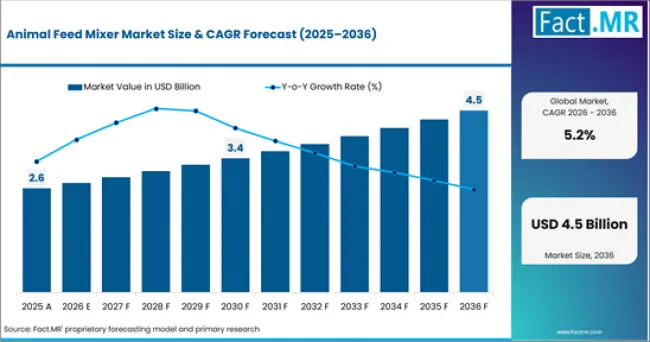
Animal Feed Mixer Market Value Analysis | Source: Fact.MR
Summary of Animal Feed Mixer Market
- Market Snapshot
- In 2025, the global Animal Feed Mixer Market was valued at approximately USD 2.6 billion.
- The market is estimated to reach USD 2.7 billion in 2026 and is projected to attain USD 4.5 billion by 2036.
- The market is likely to expand at a CAGR of 5.2% during the forecast period.
- The market is anticipated to create an absolute dollar opportunity of USD 1.8 billion between 2026 and 2036.
- Horizontal Feed Mixers account for 46.7% of product share in 2026.
- China (7.0%) and India (6.5%) are the key growth markets during the forecast period.
- Demand and Growth Drivers
- Rising global meat and aquaculture consumption is increasing feed-production volumes, driving demand for higher-capacity and more consistent horizontal and vertical feed mixers.
- Feed-quality and uniformity requirements, linked to feed-conversion efficiency and livestock productivity, are pushing adoption of automated mixing systems and precision-dosing technology.
- Commercial feed-mill consolidation and capacity expansion are generating procurement of larger, higher-throughput mixing platforms.
- Automated mixing and precision-dosing integration improve feed consistency and reduce waste, supporting premium equipment demand.
- Aquaculture feed processing growth opens demand for specialized liquid and semi-moist feed mixing systems.
- Product and Segment View
- Horizontal Feed Mixers account for 46.7% of the product segment in 2026, emerging as the leading category.
- Poultry Feed Processing accounts for 63.4% of the application segment in 2026, making it the dominant use setting.
- Key segmentation includes:
- Product: Horizontal Feed Mixers, Vertical Feed Mixers, Paddle Feed Mixers, Ribbon Feed Mixers
- Application: Poultry Feed Processing, Cattle Feed Processing, Swine Feed Processing, Aquaculture Feed Processing
- End Use: Commercial Feed Manufacturers, Livestock Farms, Aquaculture Farms, Agricultural Cooperatives
- Technology: Mechanical Mixing Technology, Automated Mixing Systems, Precision Dosing Technology, Energy Efficient Technology
- Formulation: Dry Feed Mixing Systems, Liquid Feed Mixing Systems, Semi Moist Feed Systems
- Distribution Channel: Direct Industrial Sales, Agricultural Equipment Dealers, Online Agricultural Platforms, Cooperative Purchasing Networks
- These systems enable:
- High-throughput batch feed mixing
- Precision ingredient dosing and weighing
- Uniform multi-ingredient blending
- Geography and Competitive Outlook
- North America leads on commercial feed-mill scale, automation adoption, and established agricultural equipment infrastructure.
- Europe demand reflects structured livestock-production standards, energy-efficiency requirements, and strong equipment-dealer networks.
- Livestock intensification and feed-mill capacity expansion across China and India produce the steepest regional growth, broadening mixer demand across Asia Pacific.
- China (7.0%) and India (6.5%) lead country growth, with other major markets showing steady demand.
- Key companies include Buhler Group, Andritz AG, KUHN Group, Trioliet B.V., SILOKING Mayer Maschinenbau GmbH, GEA Group.
- Analyst Opinion
- Shambhu Nath Jha, Principal Consultant at Fact.MR, says "Feed-mixer demand is tied to global livestock and aquaculture production, and the growth thesis rests on consistency and automation rather than volume alone. Horizontal mixers lead, but the real shift is toward precision-dosing and automated control that improve feed-conversion efficiency and cut waste. Commercial feed-mill consolidation generates procurement of larger, higher-throughput platforms while smallholder settings resist displacement. China and India anchor growth as livestock intensification and feed-mill expansion continue. The suppliers best positioned combine reliable mechanical mixing with sensor integration, automated control, and strong dealer networks, since feed-mill operators buy relationships and after-sales support alongside equipment."
Key Growth Drivers, Constraints, and Opportunities
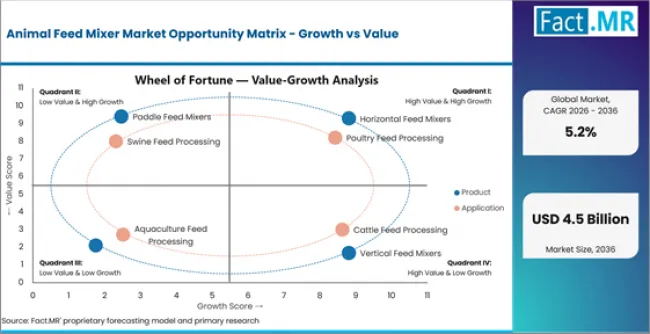
Animal Feed Mixer Market Opportunity Matrix Growth Vs Value | Source: Fact.MR
Key Factors Driving Growth
- Rising global meat and aquaculture consumption is increasing feed-production volumes, driving demand for higher-capacity and more consistent horizontal and vertical feed mixers.
- Feed-quality and uniformity requirements, linked to feed-conversion efficiency and livestock productivity, are pushing adoption of automated mixing systems and precision-dosing technology.
- Commercial feed-mill consolidation and capacity expansion are generating procurement of larger, higher-throughput mixing platforms.
Key Market Constraints
- High capital cost for automated and high-capacity mixers limits adoption among smaller farms and cooperatives.
- Seasonal and cyclical livestock demand creates uneven equipment-purchase patterns.
- Manual mixing practices in smallholder settings resist displacement in regions with fragmented farming.
Key Opportunity Areas
- Automated mixing and precision-dosing integration improve feed consistency and reduce waste, supporting premium equipment demand.
- Aquaculture feed processing growth opens demand for specialized liquid and semi-moist feed mixing systems.
- Emerging-market livestock intensification and feed-mill build-out widen equipment demand beyond established markets.
Segment-wise Analysis of the Animal Feed Mixer
- Horizontal Feed Mixers hold 46.7% of the product segment in 2026, supported by high throughput, mixing uniformity, and commercial feed-mill adoption.
- Poultry Feed Processing represents 63.4% of the application segment in 2026, supported by the scale of global poultry feed production.
The Animal Feed Mixer Market is segmented by product, application, end use, technology, formulation, distribution channel. Demand is shaped by livestock production trends, feed-mill investment cycles, automation adoption, and feed-quality requirements.
Which Product Segment Dominates the Animal Feed Mixer?
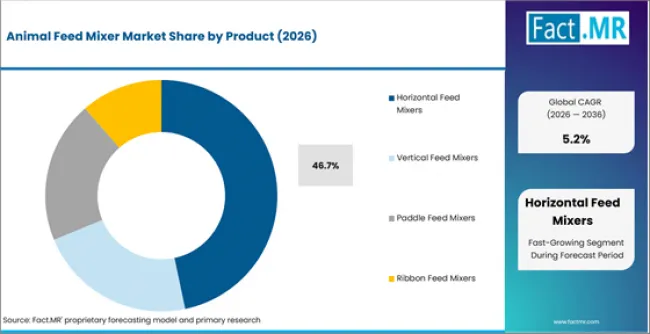
Animal Feed Mixer Market Analysis By Product | Source: Fact.MR
Horizontal Feed Mixers lead the product segment with 46.7% share in 2026, reflecting their suitability for large-batch, high-throughput feed processing in commercial poultry and livestock operations. Their mixing uniformity and capacity range support commercial-scale demand.
The segment is expected to retain leadership as commercial feed-mill procurement favors horizontal configurations. Vertical, paddle, and ribbon mixers hold positions in specific applications, but horizontal systems anchor the largest share through their throughput and uniformity advantages.
Which Application Segment Dominates the Animal Feed Mixer?
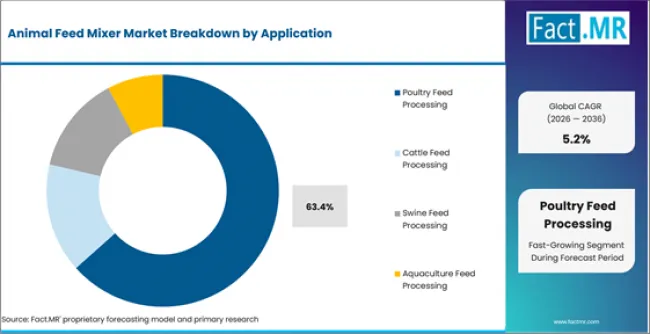
Animal Feed Mixer Market Analysis By Application | Source: Fact.MR
Poultry Feed Processing leads the application segment with 63.4% share in 2026, driven by the scale and intensity of global poultry production and the resulting demand for consistent, high-volume feed mixing. Commercial poultry operations anchor the largest equipment base.
The application is likely to hold its dominant share as global poultry production volumes continue to rise. Cattle, swine, and aquaculture feed processing grow alongside, but poultry anchors the largest application channel through its production scale and feed-conversion sensitivity.
Which Product Trend is Shaping the Next Phase of Growth in the Animal Feed Mixer?
Horizontal Feed Mixers lead the product segment at 46.7%, and the defining dynamic is the push for feed consistency driven by livestock-productivity economics. Mechanical mixing technology anchors the largest technology share, with demand concentrated in poultry feed processing where large-scale commercial operations require high-throughput, uniform-batch output.
Automation is the most consequential shift. Precision-dosing integration and automated mixing systems are gaining share as feed-mill operators prioritize batch accuracy and labor efficiency. Dry feed mixing systems anchor the largest formulation share, while liquid and semi-moist formats grow through aquaculture and specialty-feed demand.
Regional Outlook Across Key Markets
- North America leads on commercial feed-mill scale, automation adoption, and established agricultural equipment infrastructure.
- Europe demand reflects structured livestock-production standards, energy-efficiency requirements, and strong equipment-dealer networks.
- Livestock intensification and feed-mill capacity expansion across China and India produce the steepest regional growth, broadening mixer demand across Asia Pacific.
- Brazil shows steady demand supported by large-scale poultry and cattle production and growing feed-mill modernization.
.webp "Top Country Growth Comparison Animal Feed Mixer Market Cagr (2026 2036)")
Top Country Growth Comparison Animal Feed Mixer Market Cagr (2026 2036) | Source: Fact.MR
CAGR Table
| Country | CAGR (%) |
|---|---|
| China | 7.0% |
| India | 6.5% |
| Germany | 6.0% |
| Brazil | 5.5% |
| U.S. | 4.9% |
| United Kingdom | 4.4% |
| Japan | 3.9% |
Source: Fact.MR analysis. Updated Jun 12, 2026
Source: Fact.MR analysis, based on proprietary forecasting model and primary research.
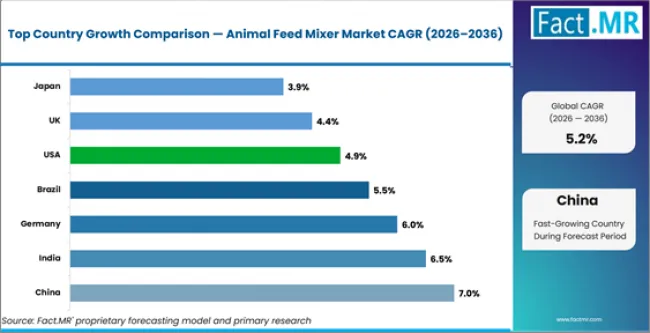
Animal Feed Mixer Market Cagr Analysis By Country | Source: Fact.MR
Market Outlook for Animal Feed Mixer in China
The China Animal Feed Mixer market is projected to grow at a CAGR of 7.0% through 2036. Large-scale poultry and swine production and commercial feed-mill expansion across provinces are widening demand for horizontal and vertical feed mixers. Domestic OEM cost advantages and local equipment networks support adoption of mechanical and automated mixing systems, while industrial upgrading pushes larger-capacity dry feed mixing platforms.
- Commercial feed-mill expansion is lifting demand for high-capacity horizontal feed mixers.
- Domestic OEM cost advantages support adoption of automated mixing platforms.
India Animal Feed Mixer Demand Trends
The India Animal Feed Mixer market is projected to grow at a CAGR of 6.5% through 2036. Demand is shaped by growing poultry and aquaculture production volumes and expanding organized feed-manufacturing capacity. Cost-effectiveness favors horizontal and vertical mechanical mixers, while cooperatives and integrated producers drive procurement of larger dry feed mixing systems as production scales.
- Poultry and aquaculture growth is widening demand for commercial feed mixing equipment.
- Cooperative and integrated-producer expansion drives procurement of higher-capacity mixers.
Animal Feed Mixer Growth Assessment in Germany
The Germany Animal Feed Mixer market is projected to grow at a CAGR of 6.0% through 2036. EU feed-safety and livestock-production standards govern how feed-mixing equipment is specified across German feed mills, with energy-efficiency requirements shaping mixer selection. Precision-engineering strength and established equipment-dealer networks support demand for automated and precision-dosing mixing systems.
- EU feed-safety standards shape mixer specification in commercial feed-mill procurement.
- Energy-efficiency requirements drive selection of automated and precision-dosing systems.
United States Animal Feed Mixer Market Opportunity Outlook
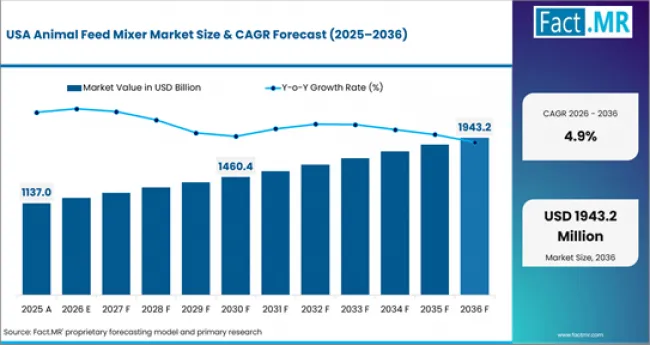
Animal Feed Mixer Market Country Value Analysis | Source: Fact.MR
The United States Animal Feed Mixer market is projected to grow at a CAGR of 4.9% through 2036. Established commercial feed-mill networks and high livestock-production volumes anchor demand, with growth led by automation upgrades and replacement cycles rather than first-time capacity build-out. Large-scale poultry and cattle operations sustain demand for high-throughput horizontal and dry feed mixing systems.
- Automation upgrade cycles sustain demand for precision-dosing mixing systems.
- Large-scale poultry and cattle operations anchor high-throughput feed mixer procurement.
Animal Feed Mixer Demand Analysis in Japan
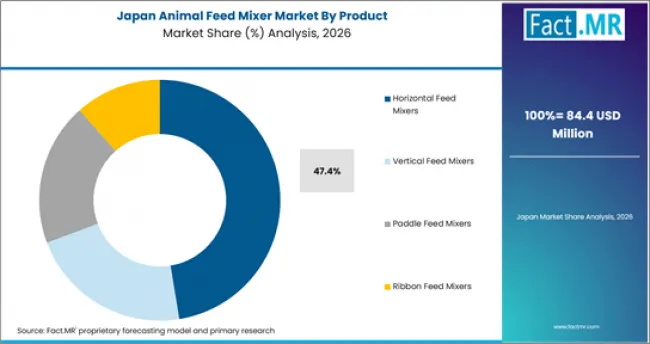
Animal Feed Mixer Market Japan Market Share Analysis By Product | Source: Fact.MR
The Japan Animal Feed Mixer market is projected to grow at a CAGR of 3.9% through 2036. Domestic feed-mill infrastructure and precision equipment manufacturing sustain demand for quality-oriented mixing systems. Strict feed-quality standards and preference for domestic suppliers shape procurement, while declining livestock numbers moderate aggregate equipment demand.
- Strict feed-quality standards sustain demand for precision mixing systems.
- Preference for domestic equipment suppliers shapes feed-mixer procurement.
Competitive Benchmarking and Company Positioning
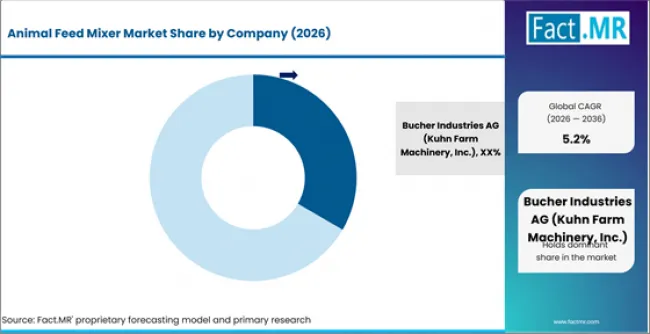
Animal Feed Mixer Market Analysis By Company | Source: Fact.MR
Animal Feed Mixer Analysis By Company
- Buhler, Andritz, and GEA hold leading positions through broad feed-processing portfolios spanning mixing, grinding, and conditioning, supported by global manufacturing and service reach.
- KUHN, Trioliet, SILOKING, and Muyang compete strongly in specific mixer formats and regional markets, where dealer networks and product reliability shape livestock-farm preference.
- Automation integration and precision-dosing capability increasingly differentiate suppliers as feed-mill operators prioritize batch accuracy and labor efficiency.
The competitive landscape is moderately fragmented, with differentiation driven by mixer capacity, automation integration, and dealer-network reach. Buhler, Andritz, and GEA lead through broad feed-processing portfolios, global service capability, and established relationships with large commercial feed manufacturers.
Below the leaders, KUHN, Trioliet, SILOKING, Muyang, Van Aarsen, SKIOLD, and Big Dutchman maintain strong positions across specific formats and geographies. Competition turns on mixing uniformity, energy efficiency, and after-sales support rather than brand alone.
Automation and precision dosing are the emerging competitive frontiers. Suppliers that combine reliable mechanical mixing with sensor integration, automated control, and dependable dealer service are positioned to capture modernization demand as feed-mill operators invest in consistency and productivity.
Key Companies in the Animal Feed Mixer
- Leading companies in the animal feed mixer market include Buhler Group, Andritz AG, KUHN Group, Trioliet B.V., which hold strong positions through portfolio breadth, equipment performance, dealer networks, and after-sales service.
- SILOKING Mayer Maschinenbau GmbH, GEA Group, Muyang Group, Van Aarsen International maintain established positions across specific segments and channels,competing on mixing performance, capacity, automation capability, service, and regional reach.
- SKIOLD, Big Dutchman International GmbH and other specialists compete through focused offerings and niche strength, reinforcing relevance in a competitive but evolving market.
Recent Industry Developments
- Industry Trend - Precision Dosing and Automated Mixing Adoption (2025)
- Through 2025, leading equipment manufacturers continued investing in precision-dosing integration and automated mixing control for commercial feed mills. The activity supports feed-consistency improvement and labor-efficiency gains across large-scale poultry and livestock operations.
- KUHN Group - Continued Feed Mixer Product Innovation (2025)
- KUHN Group continued enhancing its mixer wagon portfolio with advanced weighing, loading, and feed-management capabilities to improve livestock feeding efficiency and operational productivity
- Buhler Group - Feed Processing Technology Expansion (2025)
- Bühler Group continued strengthening its integrated feed-processing solutions portfolio through advancements in feed manufacturing technologies, supporting commercial feed mill modernization and efficiency improvements.
Leading Companies Shaping the Animal Feed Mixer
- Buhler Group
- Andritz AG
- KUHN Group
- Trioliet B.V.
- SILOKING Mayer Maschinenbau GmbH
- GEA Group
- Muyang Group
- Van Aarsen International
- SKIOLD
Sources and Research References
- KUHN Group. (2025). Mixer wagon and livestock feeding equipment solutions.
- International Feed Industry Federation. (2025). Feed manufacturing technology, automation, and feed quality industry developments.
- Bühler Group. (2025). Feed processing and feed mill solutions portfolio.
This bibliography is provided for reader reference and is not exhaustive. The full report contains the complete reference list and detailed citations.
Key Questions This Report Addresses
- What is the current and future size of the Animal Feed Mixer Market?
- How fast is the Animal Feed Mixer Market expected to grow between 2026 and 2036?
- Which product segment is likely to lead the market by 2026?
- Which application segment is expected to account for the highest demand by 2026?
- What factors are driving demand in the animal feed mixer market globally?
- Which countries are projected to show the fastest growth through 2036?
- What is driving market expansion in China and India?
- Who are the key companies active in the animal feed mixer market?
- How is precision-dosing integration changing feed-mixer procurement?
- What is driving feed-mill modernization demand across emerging markets?
- How does Fact.MR estimate and validate the animal feed mixer market forecast?
Animal Feed Mixer Market Definition
The animal feed mixer market covers horizontal, vertical, paddle, and ribbon feed mixers used in poultry, cattle, swine, and aquaculture feed processing. It spans mechanical, automated, precision-dosing, and energy-efficient mixing technologies delivered through dry, liquid, and semi-moist feed mixing systems across commercial feed manufacturers, livestock farms, aquaculture farms, and agricultural cooperatives.
Animal Feed Mixer Market Inclusions
- The scope covers global and regional market size and forecasts for 2026 to 2036 across product type, application, end use, technology, formulation, and distribution channel.
- It includes demand tied to livestock production volumes, feed-quality requirements, and commercial feed mill capacity.
- Pricing analysis spans entry-level to high-capacity mixers across direct, dealer, and cooperative purchasing channels.
- Coverage includes automated mixing systems and precision-dosing technologies for feed-consistency improvement.
Animal Feed Mixer Market Exclusions
- The scope excludes feed ingredients, additives, and premixes outside the mixing-equipment definition.
- It excludes general agricultural processing equipment without a feed-mixing function.
- Feed-delivery and distribution equipment beyond the mixer output point is excluded.
- Non-commercial hobby and small-holder manual mixing equipment is excluded.
Animal Feed Mixer Market Research Methodology
- The methodology combines secondary research, primary interviews, and demand-side modeling.
- It draws on 100 plus secondary sources and benchmarks 40 plus equipment portfolios.
- Market sizing covers 30 plus countries through a livestock-production and feed-mill capacity model with top-down validation.
- Key inputs include poultry, cattle, swine, and aquaculture production volumes, feed-conversion ratios, and mixer replacement cycles.
- The model cross-checks equipment demand with feed-mill capacity, pricing trends, and agricultural-equipment shipments.
- Primary validation includes 20 plus interviews across feed-mill operators, livestock producers, equipment dealers, and OEMs.
- Final estimates pass through supply-chain review and sensitivity testing.
Segmentation
Scope of Analysis
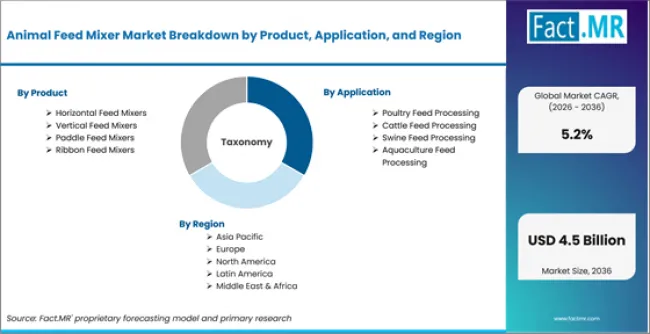
Animal Feed Mixer Market Breakdown By Product, Application, And Region | Source: Fact.MR
| Parameter | Details |
|---|---|
| Quantitative Units | USD 2.7 billion to USD 4.5 billion, at a CAGR of 5.2% |
| Market Definition | The animal feed mixer market covers horizontal, vertical, paddle, and ribbon mixers used in poultry, cattle, swine, and aquaculture feed processing across commercial, farm, and cooperative settings. |
| Regions Covered | North America, Latin America, Europe, East Asia, South Asia and Pacific, Middle East and Africa |
| Countries Covered | China, India, Germany, Brazil, U.S., UK, Japan, 30 plus countries |
| Key Companies | Buhler Group, Andritz AG, KUHN Group, Trioliet B.V., SILOKING Mayer Maschinenbau GmbH, GEA Group, Muyang Group, Van Aarsen International, SKIOLD |
| Forecast Period | 2026 to 2036 |
| Approach | Hybrid demand-side and top-down methodology built on country-level demand, product and equipment benchmarking, pricing analysis, shipment validation, and primary interviews across providers, laboratories, distributors, and end users |
Source: Fact.MR analysis. Updated Jun 12, 2026
Animal Feed Mixer Segmentation
-
Animal Feed Mixer Market Segmented by Product:
- Horizontal Feed Mixers
- Twin Shaft Horizontal Mixers
- High Homogeneity Mixers
- Heavy Duty Batch Mixers
- Single Shaft Horizontal Mixers
- Compact Farm Scale Mixers
- Industrial Feed Blending Units
- Twin Shaft Horizontal Mixers
- Vertical Feed Mixers
- Auger Based Vertical Mixers
- Silo Integrated Mixing Systems
- Portable Vertical Mixers
- Gravity Discharge Mixers
- Low Energy Consumption Mixers
- Farm Level Feed Mixers
- Auger Based Vertical Mixers
- Paddle Feed Mixers
- Batch Paddle Mixers
- High Speed Mixing Units
- Precision Ingredient Mixers
- Continuous Paddle Mixers
- Automated Feed Flow Systems
- Large Scale Feed Processing Mixers
- Batch Paddle Mixers
- Ribbon Feed Mixers
- U Shaped Ribbon Mixers
- Fine Ingredient Blending Systems
- Powder Feed Mixing Units
- Double Ribbon Mixers
- High Viscosity Feed Mixers
- Industrial Compound Feed Systems
- U Shaped Ribbon Mixers
- Horizontal Feed Mixers
-
Animal Feed Mixer Market Segmented by Application:
- Poultry Feed Processing
- Broiler Feed Production
- Starter Feed Mixing Systems
- Grower Feed Blending Units
- Layer Feed Production
- Egg Production Feed Systems
- Calcium Enriched Feed Mixers
- Broiler Feed Production
- Cattle Feed Processing
- Dairy Cattle Feed Systems
- Milk Yield Enhancement Mixers
- Silage Based Feed Mixing Units
- Beef Cattle Feed Systems
- Fattening Feed Mixers
- Protein Enriched Feed Blends
- Dairy Cattle Feed Systems
- Swine Feed Processing
- Piglet Feed Systems
- Starter Pig Feed Mixers
- Growth Phase Feed Blending
- Finisher Feed Systems
- High Energy Feed Mixers
- Fat Deposition Feed Blends
- Piglet Feed Systems
- Aquaculture Feed Processing
- Fish Feed Systems
- Floating Feed Mixers
- Sinking Feed Blending Units
- Shrimp Feed Systems
- Pellet Feed Mixing Systems
- Nutrient Dense Feed Blends
- Fish Feed Systems
- Poultry Feed Processing
-
Animal Feed Mixer Market Segmented by End Use:
- Commercial Feed Manufacturers
- Large Scale Feed Mills
- Industrial Feed Production Plants
- Automated Feed Manufacturing Units
- Regional Feed Producers
- Local Feed Blending Facilities
- Contract Feed Manufacturing Units
- Large Scale Feed Mills
- Livestock Farms
- Integrated Livestock Farms
- Cattle Ranching Operations
- Poultry Farming Enterprises
- Independent Animal Farms
- Small Scale Dairy Farms
- Pig Farming Units
- Integrated Livestock Farms
- Aquaculture Farms
- Freshwater Aquaculture Units
- Fish Hatchery Operations
- Pond Based Farming Systems
- Marine Aquaculture Farms
- Coastal Fish Farming Units
- Shrimp Farming Operations
- Freshwater Aquaculture Units
- Agricultural Cooperatives
- Farmer Cooperatives
- Community Feed Processing Units
- Shared Equipment Farming Groups
- Government Agricultural Programs
- Rural Feed Development Projects
- Subsidized Feed Production Units
- Farmer Cooperatives
- Commercial Feed Manufacturers
-
Animal Feed Mixer Market Segmented by Technology:
- Mechanical Mixing Technology
- Rotational Mixing Systems
- High Torque Drive Mixers
- Gear Driven Mixing Systems
- Gravity Assisted Mixing Systems
- Batch Flow Mixing Technology
- Low Energy Mixing Mechanisms
- Rotational Mixing Systems
- Automated Mixing Systems
- PLC Controlled Mixers
- Programmable Feed Mixing Units
- Sensor Based Mixing Control
- IoT Enabled Mixers
- Remote Monitoring Systems
- Smart Feed Formulation Systems
- PLC Controlled Mixers
- Precision Dosing Technology
- Micro Ingredient Dosing Systems
- High Accuracy Dispensing Units
- Automated Nutrient Balancing Systems
- Weight Based Control Systems
- Load Cell Integrated Mixers
- Real Time Weight Adjustment Systems
- Micro Ingredient Dosing Systems
- Energy Efficient Technology
- Low Power Consumption Systems
- Variable Frequency Drive Mixers
- Optimized Motor Control Systems
- High Power Consumption Systems
- Variable Frequency Drive Mixers
- Optimized Motor Control Systems
- Low Power Consumption Systems
- Mechanical Mixing Technology
-
Animal Feed Mixer Market Segmented by Formulation:
- Dry Feed Mixing Systems
- Powder Feed Blending Systems
- Cereal Based Feed Mixers
- Protein Meal Blending Systems
- Granular Feed Systems
- Pellet Pre Mixing Systems
- Coarse Ingredient Mixers
- Powder Feed Blending Systems
- Liquid Feed Mixing Systems
- Molasses Based Systems
- Nutrient Enriched Liquid Mixers
- Energy Dense Liquid Feed Systems
- Supplement Liquid Systems
- Vitamin Enriched Feed Liquids
- Mineral Fortified Liquid Blends
- Molasses Based Systems
- Semi Moist Feed Systems
- Intermediate Moisture Systems
- Hybrid Feed Mixing Units
- Soft Pellet Feed Systems
- Fermented Feed Systems
- Probiotic Enriched Feed Mixers
- Digestibility Enhanced Feed Systems
- Intermediate Moisture Systems
- Dry Feed Mixing Systems
-
Animal Feed Mixer Market Segmented by Distribution Channel:
- Direct Industrial Sales
- Manufacturer Direct Sales
- OEM Feed Equipment Sales
- Factory Direct Procurement Deals
- Large Farm Contracts
- Corporate Farm Equipment Supply
- Integrated Agriculture Supply Deals
- Manufacturer Direct Sales
- Agricultural Equipment Dealers
- Regional Machinery Dealers
- Farm Equipment Retail Networks
- Local Agro Machinery Suppliers
- Specialized Feed Equipment Dealers
- Livestock Equipment Distributors
- Feed Mill Machinery Dealers
- Regional Machinery Dealers
- Online Agricultural Platforms
- B2B Agro Marketplaces
- Digital Farm Equipment Portals
- Agritech E Commerce Platforms
- Manufacturer Web Stores
- Direct Order Systems
- Subscription Equipment Platforms
- B2B Agro Marketplaces
- Cooperative Purchasing Networks
- Farmer Cooperatives
- Shared Equipment Procurement Systems
- Group Buying Agricultural Networks
- Farmer Cooperatives
- Direct Industrial Sales
-
Animal Feed Mixer Market by Region:
- North America
- USA
- Canada
- Mexico
- Latin America
- Brazil
- Chile
- Rest of Latin America
- Western Europe
- Germany
- UK
- Italy
- Spain
- France
- Nordic
- BENELUX
- Rest of Western Europe
- Eastern Europe
- Russia
- Poland
- Hungary
- Balkan & Baltic
- Rest of Eastern Europe
- East Asia
- China
- Japan
- South Korea
- South Asia and Pacific
- India
- ASEAN
- Australia & New Zealand
- Rest of South Asia and Pacific
- Middle East & Africa
- Kingdom of Saudi Arabia
- Other GCC Countries
- Turkiye
- South Africa
- Other African Union
- Rest of Middle East & Africa
- North America
Frequently Asked Questions
How big is the animal feed mixer market in 2026?
What will be the size of the animal feed mixer market in 2036?
How much will be the animal feed mixer market growth between 2026 and 2036?
What are the key products in the animal feed mixer market?
Which application segment is expected to contribute significant share in the animal feed mixer market in 2026?
Who worked on this report


Preview the report firsthand - request a free sample
Free SampleGet the brochure for pricing and purchase details
Download PDF