The Quantum Computing Advanced Packaging Market is analyzed across its key product, application and end-use segments, with the study covering market dynamics, regional trends and demand outlook, forecast 2026 to 2036.
By Fact.MR Industrial Goods DeskLead analyst:
Shubham PatidarPublished :
Updated :
9 min read
Fact-checked under the Fact.MR editorial process
Quantum Computing Advanced Packaging Market Forecast and Outlook 2026 to 2036
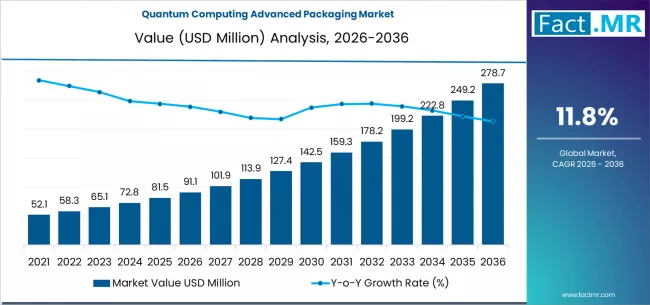
The global quantum computing advanced packaging market is projected to total USD 91.10 million in 2026, advancing to USD 278.65 million by 2036. An 11.8% CAGR is forecast for the period from 2026 to 2036. The transition of quantum processors from laboratory prototypes to more stable and scalable systems creates demand for physical integration and interconnection of qubits. The extreme sensitivity of quantum states to environmental noise, alongside the need to integrate thousands of control and readout lines into cryogenic environments, renders conventional IC packaging wholly inadequate.
Summary of Quantum Computing Advanced Packaging Market
Market Snapshot
Global quantum computing advanced packaging market revenue stood atUSD 91.10 million in 2026and is forecast to reachUSD 278.65 million by 2036.
At a11.8%CAGRfrom 2026 to 2036, this market is set to expand~3.1x in value, addingUSD 187.55 million in absolute opportunity.
This marketrepresentsacritical enabling layer within quantum computing hardware, focused on packaging architectures required tomaintainqubit stability and system scalability.
Advanced packaging is evolving intohigh-precision cryogenic interconnect and integration platforms, enabling reliable operation of quantum processors beyond laboratory environments.
Demand and Growth Drivers
Transition of quantum systems fromexperimental prototypes to scalable commercial platformsis the primary growth driver.
Increasing complexity inqubit integration and interconnect densityis driving demand for advanced packaging solutions.
Need forcryogenic compatibility and thermal managementis accelerating innovation in packaging technologies.
Growth inquantum computing R&D investments and government funding programsis supporting infrastructure expansion.
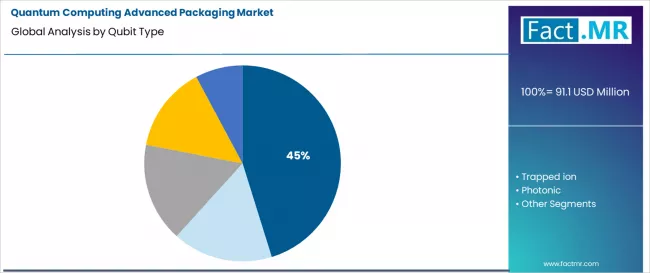
Superconducting qubits hold 45.2% of qubit type share in 2026,emergingas the dominant segment due to technological maturity and scalability.
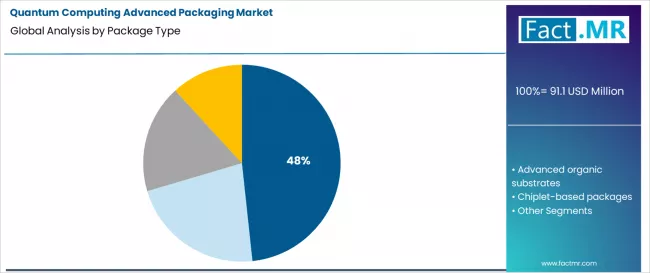
2.5D interposer packaging accounts for 48.3% of package type share in 2026, positioning it as the leading segment due to high-density interconnect capability.
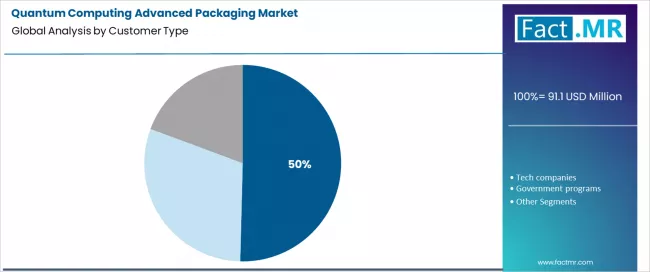
Research labs account for 50.0% of customer share in 2026, reflecting the current stage of technology development and deployment.
Key technology categories include:
Cryogenic quantum chip packaging
2.5D and 3D heterogeneous integration
High-density interconnect systems
Advanced thermal management solutions
Geography and Competitive Outlook
Growth is supported acrossNorth America, Europe, and Asia Pacific, driven by strong quantum computing ecosystems and research investments.
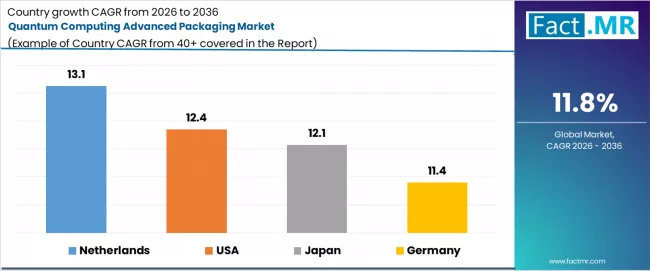
Netherlands (13.1%CAGR), United States (12.4%), Japan (12.1%), and Germany (11.4%)are key growth markets.
Market expansion is closely tied to:
Scaling of quantum processors
Integration of advanced semiconductor packaging technologies
Government and private-sector funding in quantum research
Key companies active in this market include Intel, Amkor Technology, ASE Group, IBM, andTSMC.
Quantum Computing Advanced Packaging Market — At a Glance
Attribute
Details
Market Value 2026
USD 91.10 million
Market Value 2036
USD 278.65 million
Absolute Dollar Opportunity 2026–2036
USD 187.55 million
Total Growth 2026–2036
205.9%
CAGR2026–2036
11.8%
Growth Multiple
~3.1x
Key Demand Theme
Need for advanced packaging to enable scalable, stable, and cryogenic-compatible quantum computing systems
Leading Segment by Qubit Type (2026)
Superconducting
Segment Share (2026)
45.2%
Leading Segment by Package Type (2026)
2.5D Interposer
Segment Share (2026)
48.3%
Leading Segment by Customer (2026)
Research Labs
Segment Share (2026)
50.0%
Key Growth Regions
North America, Europe, Asia Pacific
CountryCAGRs
Netherlands 13.1%, USA 12.4%, Japan 12.1%, Germany 11.4%
Top Companies
Intel, Amkor, ASE Group, IBM,TSMC
Segmentation by Qubit Type
Superconducting, Trapped Ion, Photonic, Neutral Atom
Segmentation by Package Type
2.5D Interposer, 3D Integration, Cryogenic Packaging
Segmentation by Customer
Research Labs, Commercial Deployments
Segmentation by Region
North America, Latin America, Western Europe, Eastern Europe, East Asia, South Asia & Pacific,MEA
Advanced packaging technologies have become indispensable, engineered to provide the necessary thermal management, signal integrity, low-temperature reliability, and dense input/output required to preserve qubit coherence and enable system scaling. The market's growth is a direct product of the global race toward quantum advantage and the consequent need to translate qubit breakthroughs into functional, manufacturable processors. This landscape, encompassing diverse qubit modalities from superconducting circuits to photonic chips, makes specialized packaging a critical bottleneck and enabler for the entire quantum computing industry.
Research Labs, Tech Companies, Government Programs
Region
North America, Latin America, Western Europe, Eastern Europe, East Asia, South Asia & Pacific, MEA
Segmental Analysis
By Qubit Type, Which Modality Presents an Immediate Packaging Challenge?
Quantum Computing Advanced Packaging Market Analysis By Qubit Type | Source: Fact.MR
Superconducting qubits command a leading 45% share. This segment's dominance is tied to its current front-runner status in the race for scalable, gate-based quantum processors, primarily pursued by major technology companies.
These qubits require packaging that operates reliably at millikelvin temperatures, manages massive numbers of coaxial lines for control and readout, and minimizes electromagnetic interference. The complexity and immediate scale of this integration challenge make it the primary driver for advanced, custom packaging solutions today.
By Package Type, Which Architecture Balages Scalability and Signal Integrity?
Quantum Computing Advanced Packaging Market Analysis By Package Type | Source: Fact.MR
2.5D interposer-based packaging leads with a 48% share. This approach involves attaching a quantum processor die and multiple classical control ASICs side-by-side on a silicon or glass interposer.
It is preferred because it provides the high-density, short-path interconnects necessary for speed and signal fidelity, while allowing for the heterogeneous integration of different materials and technologies required for quantum systems, effectively serving as the foundational platform for complex quantum-classical integration.
By Customer Type, Who is the Primary Driver of Bespoke Packaging Development?
Quantum Computing Advanced Packaging Market Analysis By Customer Type | Source: Fact.MR
Research laboratories constitute the dominant customer segment, holding 50% of the market. This includes national labs, university consortia, and dedicated quantum research institutes.
They are the primary drivers because they are pushing the boundaries of qubit count and performance, requiring highly customized, low-volume packaging solutions for their unique architectures. Their work defines the performance requirements and failure modes that later inform commercial packaging standards, making them the critical early-adopter segment.
What are the Principal Drivers, Constraints, and Evolving Dynamics of this Market?
The primary driver is the critical need to scale quantum processors by increasing qubit counts and connectivity, which demands advanced packaging to manage soaring I/O density, minimize signal interference, and overcome physical wiring limitations within cryogenic systems.
A major restraint is the prohibitively high cost and specialized nature of quantum packaging, driven by low production volumes, exotic cryo-compatible materials, and a lack of standardization, which confines development to well-funded programs.
A key opportunity exists in the co-design of qubits and their packages from the start. Developing integrated design methodologies and modular, multi-chiplet platforms could significantly accelerate development timelines and improve overall system yield.
The dominant trend is the formation of deep partnerships between quantum hardware innovators and established advanced packaging leaders. This collaboration is essential to combine quantum IP with manufacturing scale, leading to the creation of dedicated packaging processes and production lines.
Analysis of the Quantum Computing Advanced Packaging Market by Key Countries
Quantum Computing Advanced Packaging Market Cagr Analysis By Country | Source: Fact.MR
Country
CAGR 2026 to 2036
Netherlands
13.1%
USA
12.4%
Japan
12.1%
Germany
11.4%
How does the Netherlands' Research Ecosystem Foster Specialized Packaging Innovation?
The Netherlands' leading growth rate of 13.1% CAGR is anchored by its world-leading quantum research institute, QuTech (a collaboration between TU Delft and TNO), and the presence of key equipment supplier ASML.
This ecosystem focuses heavily on scalable quantum computing architectures, particularly spin qubits in silicon, which require exquisite packaging integration with classical control electronics. The growth is characterized by a strong focus on co-design and the early involvement of packaging experts in fundamental research projects, making the country a hub for developing foundational packaging concepts.
What Underpins the USA's Market Leadership Across Diverse Quantum Modalities?
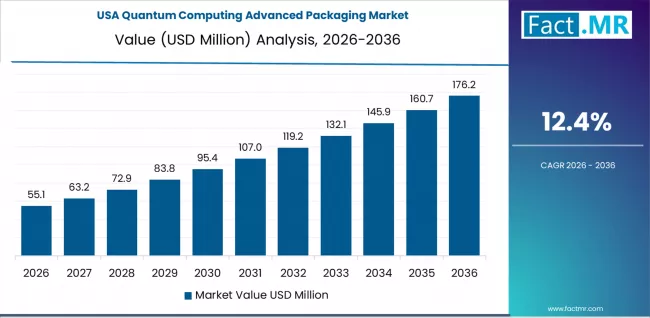
Quantum Computing Advanced Packaging Market Country Value Analysis | Source: Fact.MR
The USA's strong growth at 12.4% CAGR is propelled by its concentration of major technology companies (Google, IBM, Microsoft, Intel), well-funded quantum startups, and national laboratories such as Fermilab, and MIT Lincoln Lab, pursuing every major qubit modality.
This diversity creates demand for a wide spectrum of packaging solutions, from cryogenic interposers for superconducting qubits to photonic integrated circuit packages. The deep integration of the domestic semiconductor packaging industry with these cutting-edge projects drives rapid, application-specific innovation and commercial prototyping.
How does Japan's Materials and Precision Engineering Heritage Contribute?
Japan's significant growth at 12.1% CAGR is driven by its unparalleled strengths in materials science, precision manufacturing, and ceramics engineering, which are all critical for quantum packaging.
Companies and research institutes are leveraging expertise in low-temperature co-fired ceramics, ultra-pure materials, and metrology to develop packages with exceptional thermal stability and minimal dielectric loss at cryogenic temperatures. This positions Japan as a critical supplier of advanced substrates and bespoke packages, particularly for demanding modalities like superconducting and topological qubits.
What Drives Germany's Focus on Industrial-Grade Engineering and Standards?
Engineering-driven approach and leadership in industrial research through institutes like Fraunhofer define Germany’s growth, forecast at 11.4% CAGR. The focus is on developing reliable, repeatable, and characterizable packaging processes that can transition from lab to fab.
This includes work on standardization of interfaces, automation of assembly for complex quantum modules, and rigorous testing protocols. German growth is less about pure qubit count and more about building the robust, engineered packaging platforms necessary for future pre-commercial quantum systems.
Competitive Landscape of the Quantum Computing Advanced Packaging Market
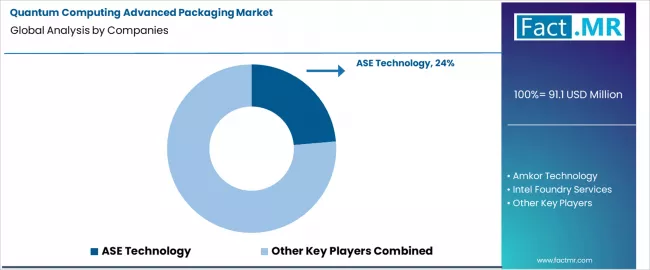
Quantum Computing Advanced Packaging Market Analysis By Company | Source: Fact.MR
The competitive landscape is currently defined by the cautious entry of leading OSATs and foundries into a highly specialized, low-volume but high-value market. Established players like ASE, Amkor, and JCET are engaging in selective partnerships with quantum leaders to adapt their advanced packaging toolkits to cryogenic and quantum-specific requirements.
Foundries like TSMC, Samsung, and Intel are leveraging their co-design and integration capabilities to offer full-stack solutions. Competition is in the early stages, focusing on technological validation and securing flagship partnerships with entities that are likely to define future packaging standards, rather than on volume or price.
Key Players in the Quantum Computing Advanced Packaging Market
ASE Technology
Amkor Technology
Intel Foundry Services
TSMC
Samsung Electronics
JCET Group
Bibliography
Arute, F., et al. (2024). Quantum processor packaging and interconnect challenges. Nature Reviews Physics, 6(3), 145-160.
International Roadmap for Devices and Systems (IRDS). (2025). More than Moore Chapter: Heterogeneous Integration. IEEE.
Ladd, T. D., & Yamamoto, Y. (2025). Engineering the quantum-classical interface: Packaging and control. Cambridge University Press.
National Institute of Standards and Technology (NIST). (2024). Report on Cryogenic Electronics and Interconnects for Quantum Systems. NIST Advanced Manufacturing Series.
Tuckerman, D. B., & Pearton, S. J. (2024). Materials and processes for quantum device packaging. MRS Bulletin, 49(5), 402-410.
Research Labs, Tech Companies, Government Programs
Key Countries
Netherlands, USA, Japan, Germany
Key Companies
ASE Technology, Amkor Technology, Intel Foundry Services, TSMC, Samsung Electronics, JCET Group
Additional Analysis
Analysis of thermal contraction mismatch and stress management at cryogenic temperatures; study of materials for low-loss dielectrics and magnetic shielding in packages; evaluation of testing and validation methodologies for quantum package yield; assessment of the supply chain for specialty substrates and cryo-compatible materials; cost analysis of low-volume, high-complexity packaging runs.
Market by Segments
Qubit Type:
Superconducting
Trapped Ion
Photonic
Neutral Atom
Topological
Package Type:
2.5D Interposer
Advanced Organic Substrates
Chiplet-Based Packages
Wafer-Level Packaging
Customer Type:
Research Labs
Tech Companies
Government Programs
Region:
North America
USA
Canada
Latin America
Brazil
Mexico
Argentina
Rest of Latin America
Western Europe
Germany
France
Italy
Spain
UK
BENELUX
Rest of Western Europe
Eastern Europe
Russia
Poland
Czech Republic
Rest of Eastern Europe
East Asia
China
Japan
South Korea
Rest of East Asia
South Asia & Pacific
India
ASEAN
Australia
Rest of South Asia & Pacific
MEA
GCC Countries
South Africa
Turkiye
Rest of MEA
Questions Answered
Frequently Asked Questions
How big is the quantum computing advanced packaging market in 2026?
The global quantum computing advanced packaging market is estimated to be valued at USD 91.1 million in 2026.
What will be the size of quantum computing advanced packaging market in 2036?
The market size for the quantum computing advanced packaging market is projected to reach USD 278.7 million by 2036.
How much will be the quantum computing advanced packaging market growth between 2026 and 2036?
The quantum computing advanced packaging market is expected to grow at a 11.8% CAGR between 2026 and 2036.
What are the key product types in the quantum computing advanced packaging market?
The key product types in quantum computing advanced packaging market are superconducting, trapped ion, photonic, neutral atom and topological.
Which package type segment to contribute significant share in the quantum computing advanced packaging market in 2026?
In terms of package type, 2.5d interposer segment to command 48.3% share in the quantum computing advanced packaging market in 2026.