The Dynamic Warehouse AI-Powered AMRs Market is analyzed across its key product, application and end-use segments, with the study covering market dynamics, regional trends and demand outlook, forecast 2026 to 2036.
By Fact.MR Industrial Goods DeskLead analyst:
Shubham PatidarPublished :
Updated :
10 min read
Fact-checked under the Fact.MR editorial process
Dynamic Warehouse AI-Powered AMRs Market Forecast and Outlook 2026 to 2036
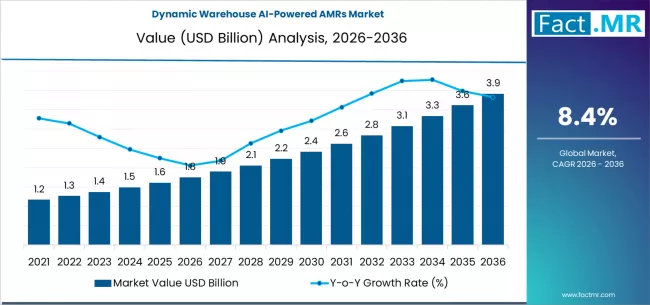
The global dynamic warehouse AI-powered autonomous mobile robot market is projected to total USD 1.75 billion in 2026, expected to advance to USD 3.92 billion by 2036. An 8.4% CAGR is forecasted for this market from 2026 to 2036. Dual pressures of persistent labor shortages and the relentless demand for faster e-commerce fulfillment fundamentally drive this expansion, which render traditional material handling methods inadequate.
Dynamic Warehouse Ai Powered Amrs Market Market Value Analysis | Source: Fact.MR
Summary of Dynamic Warehouse AI-Powered AMRs Market
Market Snapshot
Global dynamic warehouse AI-powered AMRs market revenue stood atUSD 1.75 billion in 2026and is forecast to reachUSD 3.92 billion by 2036.
Ata8.4%CAGRfrom 2026 to 2036, this market is set to expand~2.2x in value, addingUSD 2.17 billion in absolute opportunity.
This marketrepresentsacore automation layer within warehouse robotics, enabling dynamic material handling, real-time optimization, and scalablefulfillmentoperations.
AI-powered AMRs are evolving intointelligent fleet-orchestration systems, capable of adaptive routing, autonomous decision-making, and seamless integration with warehouse execution platforms.
Demand and Growth Drivers
Persistentlaborshortages inlogisticsand warehousingare the primary driver of adoption.
Rising need forflexible automation that can adapt to dynamic warehouse layoutsis supporting market growth.
AI-powered systems enablereal-time route optimization, bottleneck prediction, and task coordination, improving operational efficiency.
Integration withWMS, robotics ecosystems, and AI analytics platformsis expanding functionality and adoption across industries.
Product and Segment View
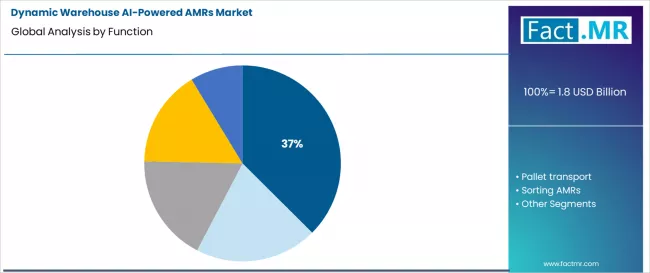
Goods-to-person systems hold 37.5% of function share in 2026,emergingas the dominant segment due to productivity gains in picking operations.
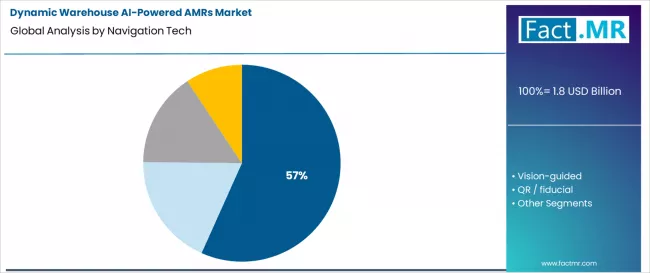
SLAM-based navigation accounts for 56.7% of technology share in 2026, positioning it as the leading segment due to flexibility and infrastructure independence.
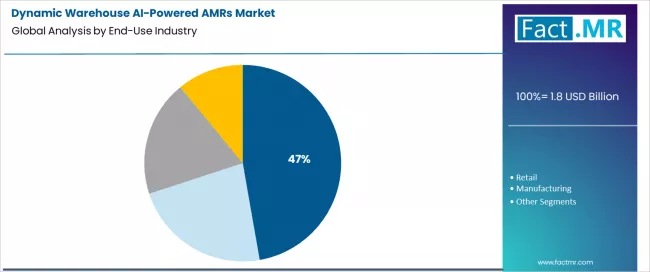
E-commerce accounts for 47.0% of end-use share in 2026, reflecting strong demand driven by order volume and SKU complexity.
Key AMR categories include:
Goods-to-person AMRs
Pallet transport AMRs
Sorting AMRs
Picking assist AMRs
Inventory scanning robots
Core functional capabilities include:
Autonomous navigation and mapping
Real-time task orchestration
Predictive workflow optimization
Geography and Competitive Outlook
Growth is supported acrossNorth America, Europe, and Asia Pacific, driven bylogisticsautomation and e-commerce expansion.
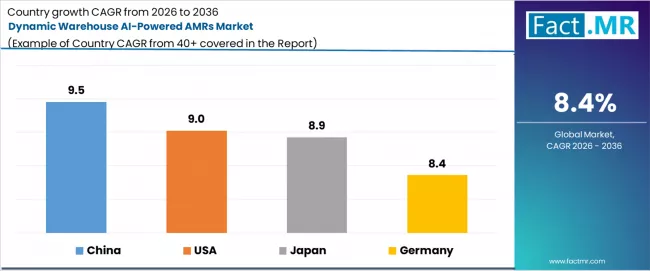
China (9.5%CAGR), United States (9.0%), Japan (8.9%), and Germany (8.4%)are key growth markets.
Market expansion is closely tied to:
Growth in e-commercefulfillmentnetworks
Adoption of intelligent automation technologies
Investment in smart warehouse infrastructure
Key companies active in this market include Locus Robotics, Geek+,GreyOrange,AutoStore,Swisslog, andHikrobot.
Dynamic Warehouse AI-Powered AMRs Market — At a Glance
Attribute
Details
Market Value 2026
USD 1.75 billion
Market Value 2036
USD 3.92 billion
Absolute Dollar Opportunity 2026-2036
USD 2.17 billion
Total Growth 2026-2036
124.0%
CAGR2026-2036
8.4%
Growth Multiple
~2.2x
Key Demand Theme
Increasing adoption of AI-driven autonomous mobile robots for flexible and scalable warehouse automation
Leading Segment by Function (2026)
Goods-to-Person
Segment Share (2026)
37.5%
Leading Segment by Navigation Tech (2026)
SLAM-Based
Segment Share (2026)
56.7%
Leading Segment by End Use (2026)
E-commerce
Segment Share (2026)
47.0%
Key Growth Regions
North America, Europe, Asia Pacific
CountryCAGRs
China 9.5%, USA 9.0%, Japan 8.9%, Germany 8.4%
Top Companies
Locus Robotics, Geek+,GreyOrange,AutoStore,Swisslog,Hikrobot
North America, Latin America, Western Europe, Eastern Europe, East Asia, South Asia & Pacific,MEA
Source: Fact.MR analysis. Updated Apr 29, 2026
In this environment, static automation cannot meet the need for real-time adaptability. Artificial intelligence and machine learning have become indispensable, integrated into warehouse execution systems to dynamically orchestrate fleets, optimize picking paths, and predict workflow bottlenecks. These AI-powered tools are critical for reducing operational costs, maximizing throughput in existing footprints, and achieving the scalability required to manage volatile order volumes. The market's growth is a product of modernizing global supply chain infrastructure and the competitive race among retailers, third-party logistics providers, and manufacturers to achieve superior operational agility. This landscape, encompassing everything from micro-fulfilment centers to vast distribution hubs, makes AI-enhanced AMRs a strategic enabler of logistics resilience and efficiency.
SLAM-based, Vision-guided, QR/Fiducial, Magnetic Tape
End-Use Industry
E-commerce, Retail, Manufacturing, 3PL
Region
North America, Latin America, Western Europe, Eastern Europe, East Asia, South Asia & Pacific, MEA
Source: Fact.MR analysis. Updated Apr 29, 2026
Segmental Analysis
By Function, Which Task is Central to Modern Fulfilment Efficiency?
Dynamic Warehouse Ai Powered Amrs Market Analysis By Function | Source: Fact.MR
The goods-to-person function commands a leading 37% share. This segment’s dominance is directly tied to the e-commerce boom, where maximizing picker productivity is paramount. AI-powered AMRs dynamically bring inventory pods to stationary human pickers, drastically reducing walking time.
The AI component optimizes this by analyzing order patterns and inventory velocity to determine the most efficient pod retrieval sequences, directly impacting fulfillment speed and accuracy.
By Navigation Technology, Which Method Enables Maximum Flexibility?
Dynamic Warehouse Ai Powered Amrs Market Analysis By Navigation Tech | Source: Fact.MR
Simultaneous localization and mapping (SLAM)-based navigation technology is the preferred choice, holding a 57% share. This reflects the demand for flexibility and reduced infrastructure dependency. SLAM-based mapping enables AMRs to navigate complex, dynamic environments without fixed guides.
AI enhances SLAM by improving environmental understanding and enabling robust obstacle avoidance, which is fundamental for deploying scalable and future-proof automation in ever-changing warehouses.
By End-Use Industry, Which Sector is the Primary Driver?
Dynamic Warehouse Ai Powered Amrs Market Analysis By End Use Industry | Source: Fact.MR
The e-commerce industry is the primary end-user, accounting for 47 percent of the market. This sector’s drive for faster delivery and its inherent demand volatility create an ideal use case.
AI-powered AMRs provide the scalable, flexible labor needed to handle peak seasons. AI optimizes the entire workflow by dynamically allocating robot fleets to areas of greatest need based on real-time order flow analytics.
What are the Drivers, Restraints, Opportunities, and Trends in the Dynamic Warehouse AI-Powered AMRs Market?
DROT Element
Analysis
Driver
The acute logistics labor shortage and rising wage pressures make AI-powered AMRs a scalable solution to automate repetitive transport tasks, boosting productivity and containing labor costs.
Restraint
High upfront capital expenditure for fleet deployment and complex integration with legacy warehouse systems create a significant barrier to entry, particularly for small and medium-sized enterprises.
Opportunity
Advancing AI into predictive analytics enables proactive warehouse management, from forecasting robot maintenance to simulating optimal layouts and pre-configuring tasks based on demand predictions.
Trend
The market is shifting from standalone deployments toward integrated, cloud-connected ecosystems where AI orchestrates robotic fleets alongside digital twins and IoT sensors for end-to-end optimization
Source: Fact.MR analysis. Updated Apr 29, 2026
Analysis of the Dynamic Warehouse AI-Powered AMRs Market by Key Countries
Dynamic Warehouse Ai Powered Amrs Market Cagr Analysis By Country | Source: Fact.MR
Country
CAGR 2026 to 2036
China
9.5%
USA
9.0%
Japan
8.9%
Germany
8.4%
Source: Fact.MR analysis. Updated Apr 29, 2026
What Specific Developments Underpin China's Leading Growth Rate?
China's leading growth rate of 9.5% CAGR is anchored in the integration of national industrial policy with massive commercial scale. Government initiatives like "Made in China 2025" actively promote smart logistics and robotics adoption through subsidies and pilot programs. Concurrently, the country's unparalleled e-commerce volume, led by giants such as Alibaba and JD.com, necessitates hyper-automated fulfillment centers.
This creates a dual-driven market where policy encouragement meets intense commercial demand. Furthermore, the rise of competitive domestic AMR manufacturers like Geek+ and Hikrobot fosters a localized ecosystem, reducing deployment costs and accelerating innovation cycles specifically for the Chinese market.
Which Key Factors are Modernizing USA’s Warehouse Automation Landscape?
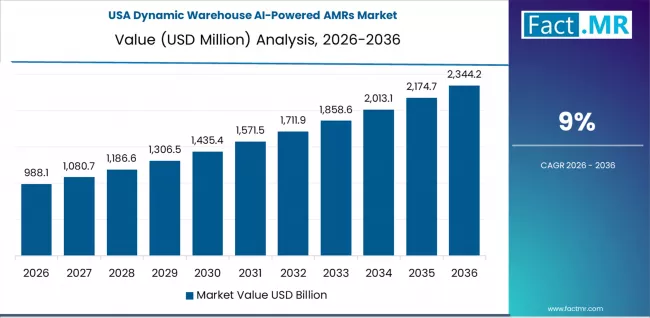
Dynamic Warehouse Ai Powered Amrs Market Country Value Analysis | Source: Fact.MR
USA is projected to grow at a 9.0% CAGR, propelled by a critical need to rebuild resilient supply chain infrastructure amidst persistent labor shortages. The strategic response involves significant capital investment from major retailers, third-party logistics providers, and e-commerce companies to automate distribution hubs for same-day and next-day delivery promises.
This modernization is not merely about adding robots but integrating AI-powered AMRs into comprehensive Warehouse Execution Systems. The market is also driven by the presence of pioneering vendors and the adoption of flexible commercial models like Robotics-as-a-Service, which lower the barrier to entry for mid-sized operators seeking to compete on speed and efficiency.
How do Demographic Challenges Uniquely Shape Japan's Automation Adoption?
Japan's significant growth at an 8.9% CAGR is a direct strategic response to its severe demographic pressures, including a rapidly aging population and a constricting workforce. This makes automation a non-negotiable component for business continuity in logistics and manufacturing.
The development focus is on creating highly reliable, precise, and collaborative AMRs that can work safely in tight spaces alongside an older workforce. Adoption is characterized by a preference for solutions that enhance human productivity rather than simply replace it, leading to advanced developments in human-robot interaction interfaces and error-proofing AI for complex picking and sorting tasks in compact facilities.
What drives Germany's Focus on Integrated Industrial AMR Solutions?
Germany's growth, forecast at an 8.4% CAGR, is defined by its Industry 4.0 framework, which emphasizes cyber-physical systems and data-driven manufacturing. Demand stems predominantly from the automotive, pharmaceutical, and advanced industrial sectors seeking to optimize internal material flow. The development here focuses on deep integration of AMRs into the Manufacturing Execution System for just-in-time part delivery to assembly lines.
This requires AMRs with high levels of navigation precision, interoperability with industrial IoT protocols, and robust safety certification for dynamic factory environments. The market prioritizes system reliability and seamless data exchange over standalone robotic performance, favoring solutions that function as a connected component of a larger automated production ecosystem.
Competitive Landscape
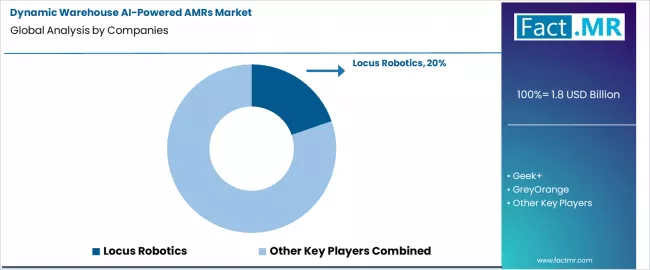
Dynamic Warehouse Ai Powered Amrs Market Analysis By Company | Source: Fact.MR
The competitive environment is characterized by rapid technological iteration and a shift from selling hardware to providing integrated, intelligent orchestration platforms. Market leaders are distinguished by their software capabilities and ecosystem partnerships.
The focus is on delivering measurable improvements in operational metrics through AI-driven efficiency. To navigate this landscape and secure a sustainable advantage, companies must adopt several strategic approaches.
Strategic Imperative
Rationale & Action
Develop Open Platforms
Success requires building systems that integrate with various warehouse software and equipment. Offering robust APIs and partnerships is key to becoming the central orchestration layer.
Focus on TCO & Flexibility
To overcome high upfront costs, innovate with models like Robotics-as-a-Service. Demonstrate clear ROI through productivity analytics and offer modular, scalable solutions.
Advance Swarm Intelligence
Invest in AI for true swarm intelligence in large fleets and edge computing for faster real-time decisions, reducing cloud dependency and enhancing reliability.
Prioritize Safety & UX
Develop certified safety features using AI vision and predictive analytics. Design intuitive interfaces that empower human workers to collaborate effectively with robots.
Source: Fact.MR analysis. Updated Apr 29, 2026
Key Players in the Dynamic Warehouse AI-Powered AMRs Market
Locus Robotics
Geek+
GreyOrange
AutoStore
Swisslog
Hikrobot
References
International Federation of Robotics. (2025). World robotics: Service robots report. IFR Statistical Department.
Meller, R. D., & Klote, J. F. (2024). The evolution of fulfillment center design: From static to dynamic. Journal of Business Logistics, 45(3), 210-225.
Russel, S., & Norvig, P. (2025). Artificial intelligence: A modern approach (5th ed.). Pearson.
Thrun, S., Burgard, W., & Fox, D. (2024). Probabilistic robotics. MIT Press.
World Economic Forum. (2025). The future of the last-mile ecosystem. WEF.
SLAM-based, Vision-guided, QR/Fiducial, Magnetic Tape
End-Use Industry
E-commerce, Retail, Manufacturing, 3PL
Key Countries
China, USA, Japan, Germany
Key Companies
Locus Robotics, Geek+, GreyOrange, AutoStore, Swisslog, Hikrobot
Additional Analysis
Comparative analysis of AI algorithm efficiency for multi-agent fleet coordination; study on the impact of AMRs on warehouse employee safety and job satisfaction; total cost of ownership analysis for RaaS vs. capital purchase models; assessment of AI-driven predictive maintenance for AMR fleets; analysis of data security in cloud-based fleet management systems.
Source: Fact.MR analysis. Updated Apr 29, 2026
Market by Segments
Function :
Goods-to-person
Pallet Transport
Sorting AMRs
Picking Assist AMRs
Inventory Scan AMRs
Navigation Tech :
SLAM-based
Vision-guided
QR/Fiducial
Magnetic Tape
End-Use Industry :
E-commerce
Retail
Manufacturing
3PL
Region :
North America
USA
Canada
Latin America
Brazil
Mexico
Argentina
Rest of Latin America
Western Europe
Germany
France
Italy
Spain
UK
BENELUX
Rest of Western Europe
Eastern Europe
Russia
Poland
Czech Republic
Rest of Eastern Europe
East Asia
China
Japan
South Korea
Rest of East Asia
South Asia & Pacific
India
ASEAN
Australia
Rest of South Asia & Pacific
MEA
GCC Countries
South Africa
Turkiye
Rest of MEA
Questions Answered
Frequently Asked Questions
How big is the dynamic warehouse ai-powered amrs market in 2026?
The global dynamic warehouse ai-powered amrs market is estimated to be valued at USD 1.8 billion in 2026.
What will be the size of dynamic warehouse ai-powered amrs market in 2036?
The market size for the dynamic warehouse ai-powered amrs market is projected to reach USD 3.9 billion by 2036.
How much will be the dynamic warehouse ai-powered amrs market growth between 2026 and 2036?
The dynamic warehouse ai-powered amrs market is expected to grow at a 8.4% CAGR between 2026 and 2036.
What are the key product types in the dynamic warehouse ai-powered amrs market?
The key product types in dynamic warehouse ai-powered amrs market are goods-to-person, pallet transport, sorting amrs, picking assist amrs and inventory scan amrs.
Which navigation tech segment to contribute significant share in the dynamic warehouse ai-powered amrs market in 2026?
In terms of navigation tech, slam-based segment to command 56.7% share in the dynamic warehouse ai-powered amrs market in 2026.