- Market Value (2025): USD 2.4 Bn
- Estimated Value (2026): USD 2.5 Bn
- Forecast Value (2036): USD 4.2 Bn
- CAGR (2026-2036): 5.2%
What is the Bentonite Market forecast to be worth by 2036?
USD 4.2 billion by 2036 at a 5.2% CAGR.
- The bentonite market reached USD 2.4 billion in 2025.
- Demand is projected to increase from USD 2.5 billion in 2026 to USD 4.2 billion by 2036.
- The market is projected to expand at a 5.2% CAGR from 2026 to 2036.
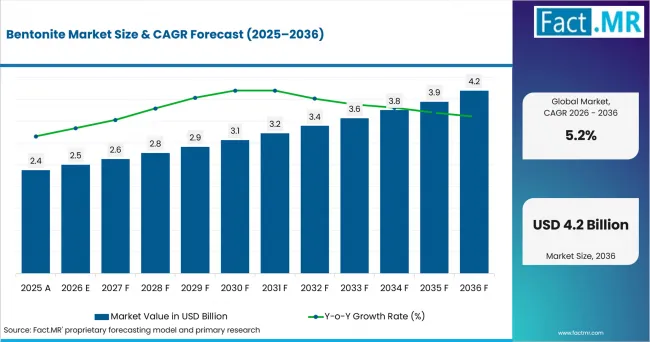
Bentonite Market Value Analysis | Source: Fact.MR
What are the defining numbers behind Bentonite Market growth?
An absolute opportunity of USD 1.7 billion is expected between 2026 and 2036.
- Demand Drivers in the Market
- Oil and gas drilling remains a recurring consumption base for sodium bentonite. The U.S. Geological Survey identified drilling mud as a principal bentonite market, and the U.S. Energy Information Administration recorded an average of 565 rotary rigs in operation in June 2026, including 434 crude-oil rigs and 123 natural-gas rigs. Each active drilling program creates repeated requirements for fluid conditioning, borehole stability and solids suspension, supporting purchases of bentonite and associated rheology-control materials.
- Green-sand casting creates a second recurring demand mechanism because bentonite is consumed as the clay binder that helps molding sand develop cohesion, plasticity and handling strength. Current foundry activity across Japan, the UK, Germany and France keeps binder qualification, sand-system control and casting-defect reduction relevant to metal producers serving automotive, machinery, energy and engineered-component customers.
- Civil engineering adds demand when deep excavations, diaphragm walls, slurry trenches and slurry-face tunneling require a stable suspension. U.S. Army Corps of Engineers guidance describes sodium bentonite-water slurry supporting trench sides during cutoff-wall construction, while Federal Highway Administration tunnel guidance explains that pressurized bentonite slurry can stabilize soft, water-bearing ground at the tunnel face. This makes underground transport, foundations and seepage-control works a direct material-use channel.
- The oilfield value chain increasingly treats fluid performance as a formulation problem rather than a commodity-mineral purchase. Bentonite suppliers that can meet viscosity, filtration and dispersion targets can participate alongside broader drilling fluids programs, where technical qualification, consistent mine feed and field support influence repeat orders.
- Foundry buyers are also raising expectations around sand consistency, emissions and casting quality. Clariant's May 2026 Metal China release describes a Geko P bentonite-based foundry additive designed to improve green-sand flowability and casting surface quality, showing how clay binders are being engineered within wider foundry chemicals portfolios instead of being sold solely on mineral tonnage.
- Construction applications favor grades with predictable swelling and suspension behavior because trench stability depends on controlling slurry properties while excavation proceeds. Bentonite used in slurry walls and related barrier structures also connects the mineral to the broader clay liners ecosystem, although this report counts only the bentonite material sold within the defined civil-engineering applications.
- Agricultural demand is concentrated in sulfur bentonite and soil-conditioning uses. Suppliers that can granulate elemental sulfur with bentonite into dispersible products can address fertilizer programs alongside the sulfur fertilizer category, where physical integrity during handling and rapid breakup after field application determine product usefulness.
- Key Segments Analyzed
- Sodium Bentonite accounts for 76.8% of Product in 2026 because its strong swelling and water-absorption properties make it suitable for applications that depend on viscosity and sealing performance. It is widely used in drilling fluids, foundry sand systems and civil-engineering slurries where consistent hydration is important during repeated use.
- Foundry Applications account for 41.7% of Application in 2026 because bentonite is consumed continuously in green-sand molding. It helps maintain bond strength and mold stability, allowing foundries to reuse molding sand across repeated casting cycles while preserving workable properties.
- Oil & Gas Industry accounts for 69.4% of End Use in 2026 because bentonite is routinely used in water-based drilling muds. Drilling contractors rely on it to support borehole walls and control fluid behavior, making it a recurring consumable rather than a one-time material purchase.
- Bentonite Activation Technology accounts for 35.8% of Technology in 2026 because processors can use activation to modify clay performance when naturally occurring material does not meet a required specification. Adjusting swelling and viscosity helps suppliers tailor bentonite for different drilling, foundry and industrial uses.
- Powder Bentonite Formulations account for 58.3% of Formulation in 2026 because powder is easy to meter and blend into industrial systems. It can be dispersed quickly into drilling fluids, molding sand and construction slurries, which suits operations where users prepare mixtures directly at the site.
- Analyst Opinion at Fact.MR
- Shambhu Nath Jha, Principal Consultant, Fact.MR, notes: "Bentonite demand is won at the application level. The supplier that can hold swelling, viscosity, bond strength and particle-size performance within a buyer's operating window has more influence over repeat business than one competing only on mine-gate price. Through 2036, processing control, technical service and dependable regional logistics will matter as much as access to reserves."
- Strategic Implications
- Bentonite producers need to manage mineral quality from the mine itself. Ore zones can differ in sodium content, montmorillonite characteristics and impurity levels, so careful separation and blending are important before processing begins. Variability that seems minor at the mining stage can create real problems for customers if a drilling fluid does not maintain the required rheology or a foundry has to compensate for weaker green strength.
- More value can be created once the mineral moves into processing. Drying and milling can prepare bentonite for industrial use, while activation, purification and surface modification allow suppliers to tailor performance for specific applications. Clariant’s 2026 foundry launch shows how treated minerals can be combined with additives and technical testing around a defined casting requirement rather than sold simply as bulk clay.
- Transportation also has a direct effect on competitiveness because bentonite is relatively inexpensive compared with the cost of moving large volumes over long distances. Regional processing facilities, rail connections and bulk-storage capacity can therefore influence delivered economics. Reliable logistics are particularly important for foundries and drilling operations where an interruption in material supply can disrupt production.
- Oilfield suppliers also need to consider how bentonite performs alongside the wider oilfield chemicals package. Water chemistry, other drilling-fluid additives and downhole conditions can change the behaviour of the finished mud. Application laboratories and field support therefore help operators qualify grades with less risk and adjust formulations when operating conditions change.
- Reserve development remains relevant as well. In May 2026, the U.S. Bureau of Land Management approved a bentonite mining project in Natrona County, Wyoming, covering about 227 acres of public land under a 20-year operating plan. Additional permitted production can improve feedstock availability, although processors still need beneficiation capacity and efficient logistics before that mineral reaches industrial customers.
How does the Bentonite Market break down by segment?
The market is analyzed by Product, Application, End Use, Technology, Formulation and Distribution Channel.
Why does Sodium Bentonite lead Product?
Sodium Bentonite is projected to account for a 76.8% share of Product in 2026.
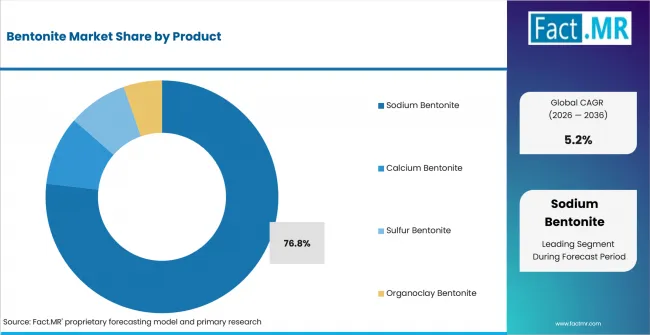
Bentonite Market Analysis By Product | Source: Fact.MR
The lead comes from hydration and swelling behavior that serves several high-volume workflows. In drilling systems, sodium bentonite builds viscosity and supports solids transport. In civil engineering, its suspension behavior helps stabilize excavations. In foundries, it provides the clay bond required to give green sand sufficient cohesiveness for molding and handling.
The same functional profile also rewards consistent processing. Buyers do not purchase swelling capacity in isolation; they qualify particle size, moisture, yield, filtration behavior and application response. Producers that blend ore and control activation can therefore support one sodium-bentonite platform across multiple industrial specifications while maintaining separate grades for drilling, foundry and construction users.
Why do Foundry Applications lead Application?
Foundry Applications are projected to account for a 41.7% share of Application in 2026.
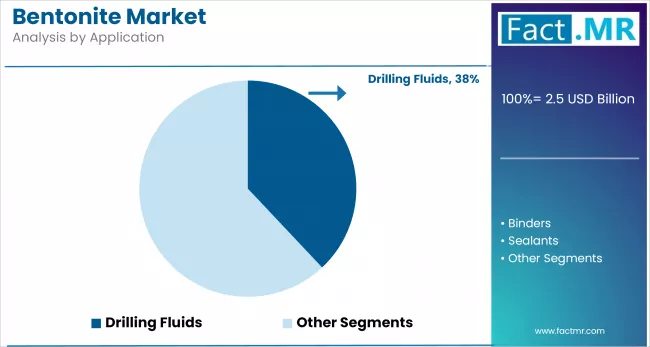
Bentonite Market Analysis By Application | Source: Fact.MR
Green-sand foundries consume bentonite in repeated production cycles, giving the application a durable replenishment pattern. Clay binder is added to sand systems to recover molding properties after exposure to molten metal, attrition and moisture variation. That recurrent dosing links bentonite volumes to casting throughput rather than to the installation of a single piece of equipment.
Quality requirements also support higher-value grades. Clariant's 2026 foundry offering combines Geko P bentonite with a low-emission carbon former and is supported by an upgraded application center with mixing, high-temperature testing and pilot-scale capabilities. The direction of travel is toward binder packages that can be measured against surface quality, defect rates and sand-system stability, which favors technically supported bentonite over undifferentiated clay.
Why does Oil & Gas Industry lead End Use?
Oil & Gas Industry is projected to account for a 69.4% share of End Use in 2026.
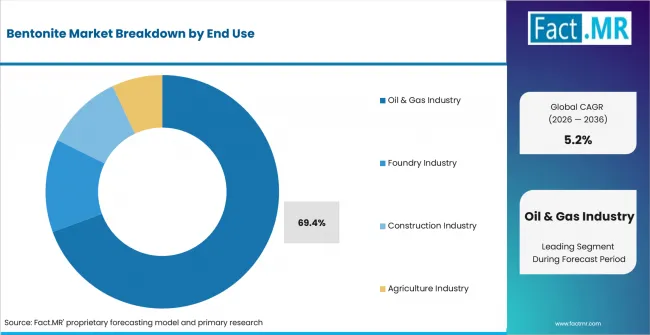
Bentonite Market Analysis By End Use | Source: Fact.MR
Drilling mud uses bentonite as a rheology-building and borehole-support material, and purchases recur as wells are drilled. U.S. Energy Information Administration data show 565 rotary rigs in operation on average in June 2026. While drilling intensity changes with commodity prices and basin economics, active programs still require steady fluid preparation, treatment and replacement.
The segment also values supply reliability. Drilling-service providers need material that hydrates predictably under defined water conditions and that can be delivered to basins on schedule. This favors producers with established mines, milling capacity, quality-control laboratories, storage terminals and direct technical relationships with fluid-service companies.
Why does Bentonite Activation Technology lead Technology?
Bentonite Activation Technology is projected to account for a 35.8% share of Technology in 2026.
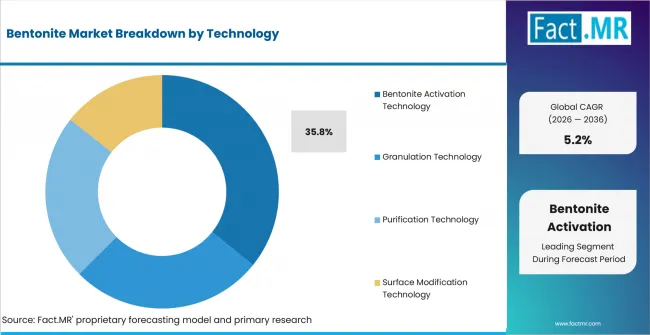
Bentonite Market Analysis By Technology | Source: Fact.MR
Activation lets processors tune natural clay toward the rheological or binding response required by a customer. Natural deposits vary in exchangeable cations and mineral composition, so chemical activation can improve the performance of material that would otherwise fall short of a target viscosity, swelling or bonding specification.
This technology also supports regional resource flexibility. A processor that can characterize ore, select treatment conditions and validate the finished grade in an application laboratory can use a broader raw-material base without asking the customer to absorb the variability. The commercial result is a more repeatable product and greater ability to offer differentiated drilling, foundry and civil-engineering grades.
Why do Powder Bentonite Formulations lead Formulation?
Powder Bentonite Formulations are projected to account for a 58.3% share of Formulation in 2026.
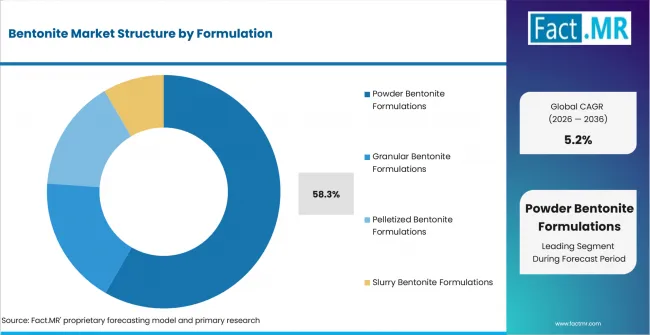
Bentonite Market Analysis By Formulation | Source: Fact.MR
Powder leads because most industrial users need rapid incorporation into an existing process. Drilling crews mix dry bentonite into water to build mud properties, foundries meter powder into sand systems, and construction teams prepare bentonite suspensions for excavation support. Fine and standard powders therefore align with established mixers, hoppers, silos and bulk-handling systems.
Powder also gives processors a practical route to grade control. Milling and classification can narrow particle-size distribution, while blending can combine different ore lots or activated materials before shipment. Granules, pellets and pre-mixed slurries remain useful where dust control, controlled breakup or job-site convenience matters, but powder provides the broadest cross-application compatibility.
Why does Direct Industrial Sales lead Distribution Channel?
Direct Industrial Sales are projected to account for a 73.1% share of Distribution Channel in 2026.
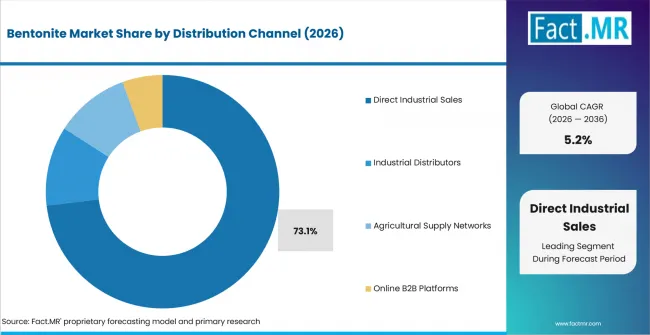
Bentonite Market Analysis By Distribution Channel | Source: Fact.MR
Large users qualify bentonite against process outcomes, which makes the supplier relationship more technical than a standard commodity transaction. Foundries may need binder testing and sand-system support, drilling-service companies require mud-performance documentation, and construction contractors can request project-specific slurry properties. Direct contact shortens the feedback loop between plant, laboratory and customer.
Contract logistics also favor direct supply. Bentonite is moved in bulk bags, sacks, pneumatic bulk systems and other formats, and delivered cost can be highly sensitive to freight and handling. OEM-style supply agreements and project-based contracts give buyers clearer volume planning while allowing producers to schedule milling, packaging and transport against known demand.
What is accelerating Bentonite Market adoption, and what is holding it back?
Demand is being supported by recurring drilling-fluid consumption, green-sand foundry production, tunneling and foundation work that uses bentonite slurry, and the shift toward application-specific activated grades. The market is constrained by bulk freight costs, variability between mineral deposits, energy and processing expenses, and substitution by polymers or alternative binders in selected workflows.
The cyclicality of end markets also matters. Drilling programs respond to oil and gas economics, foundry output follows automotive and industrial orders, and large civil works move through uneven procurement schedules. Suppliers with diversified application exposure and regional inventories are better positioned to absorb these swings than operations dependent on one end use or one distant mine.
Drivers Impact Analysis
| Factor | (~) % Impact on CAGR | Geographic Relevance | Impact Timeline |
|---|---|---|---|
| Oil and gas drilling-fluid consumption | +0.9% | USA and global drilling basins | Short term (<= 2 years) |
| Green-sand foundry binder replenishment | +0.7% | Japan, UK, Germany, France and USA | Short term (<= 2 years) |
| Tunneling, foundation and slurry-wall activity | +0.6% | Europe, Japan and USA | Medium term (2-4 years) |
| Application-specific activation and processing | +0.5% | Global | Medium term (2-4 years) |
| Agricultural sulfur and soil-conditioning demand | +0.3% | Europe, USA and Japan | Long term (>= 4 years) |
Source: Fact.MR analysis. Updated Aug 26, 2026
Opportunity Impact Analysis
| Factor | (~) % Impact on CAGR | Geographic Relevance | Impact Timeline |
|---|---|---|---|
| Higher-performance activated bentonite grades | +0.5% | Global | Medium term (2-4 years) |
| Direct technical-service programs for foundries and drillers | +0.4% | USA, Europe and Japan | Medium term (2-4 years) |
| Powder and granular grades tailored to automated dosing | +0.3% | Germany, France, UK, Japan and USA | Long term (>= 4 years) |
| New permitted mine capacity and regional processing | +0.3% | USA and export markets | Long term (>= 4 years) |
| Specialty sulfur-bentonite agricultural formulations | +0.2% | Europe, USA and Japan | Long term (>= 4 years) |
Source: Fact.MR analysis. Updated Aug 26, 2026
Restraints Impact Analysis
| Factor | (~) % Impact on CAGR | Geographic Relevance | Impact Timeline |
|---|---|---|---|
| Bulk freight and handling cost exposure | -0.5% | Global | Short term (<= 2 years) |
| Mine-quality variability and beneficiation cost | -0.4% | Global | Short term (<= 2 years) |
| Substitution by polymers and alternative binders | -0.3% | USA, Europe and Japan | Medium term (2-4 years) |
| Cyclical drilling, foundry and construction schedules | -0.4% | Global | Medium term (2-4 years) |
Source: Fact.MR analysis. Updated Aug 26, 2026
Which countries are scaling the Bentonite Market through 2036?
- Japan: U.S. Geological Survey data identify Japan as a notable destination for U.S. bentonite exports in 2025, while Japan Foundry Society statistics continue to track iron, precision, aluminum-alloy and copper-alloy casting production. Imported material demand is therefore supported by an industrial customer base that values consistent foundry and specialty grades.
- USA: Domestic mine output, a deep drilling-services base and ongoing civil works support broad consumption. U.S. Geological Survey data place 2025 bentonite production at 4.1 million tonnes, and current Bureau of Land Management approvals in Wyoming show continued development of mine supply for industrial use.
- UK: The Cast Metals Federation states that its members account for about 85% of UK castings output and supply automotive, aerospace, defence, energy, rail and medical users. This maintains demand for qualified foundry binders, while deep-basement and infrastructure construction adds a second channel for bentonite slurry in excavation support.
- Germany: Foundry production is operating in a difficult industrial cycle, which keeps volume growth measured, but Germany retains a substantial casting base serving machinery and vehicle manufacturing. Process-efficiency pressure raises the value of consistent green-sand binders and application support even when total casting tonnage is subdued.
- France: French foundries produced about 1.4 million tonnes of ferrous and non-ferrous castings in 2024 according to the European Foundry Federation annual report, while large underground transport works demonstrate continued civil-engineering capability. Bentonite suppliers can therefore serve both molding-sand and slurry-based construction requirements.
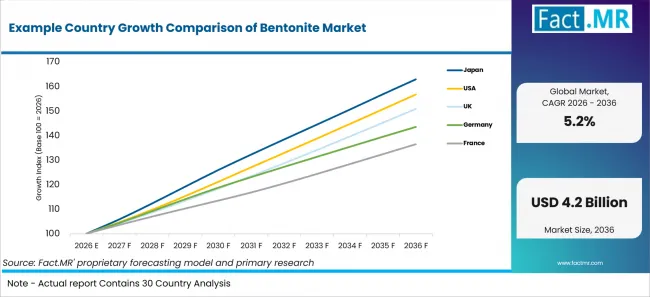
Example Country Growth Comparison Of Bentonite Market | Source: Fact.MR
Country CAGR (2026-2036)
| Country | CAGR, 2026-2036 |
|---|---|
| Japan | 5.0% |
| USA | 4.6% |
| UK | 4.2% |
| Germany | 3.7% |
| France | 3.2% |
Source: Fact.MR analysis. Updated Aug 26, 2026
What is driving Japan's growth through 2036?
Japan is forecast to expand at a 5.0% CAGR from 2026 to 2036.
Japan combines import demand with a technically demanding casting sector. The U.S. Geological Survey lists Japan as a notable destination for U.S. bentonite exports in 2025. That trade relationship matters because high-swelling sodium grades sourced from established deposits can be supplied into industrial applications that require repeatable behavior rather than locally interchangeable clay.
Japan's Ministry of Economy, Trade and Industry continues to publish monthly production statistics across iron and steel, transport machinery, non-ferrous metals and mineral products, while the Japan Foundry Society provides current casting statistics by product type. Stable technical demand across these manufacturing chains supports bentonite used in molding-sand systems and specialized processed grades even as individual end markets fluctuate.
What is driving USA's growth through 2036?
The USA is forecast to expand at a 4.6% CAGR from 2026 to 2036.
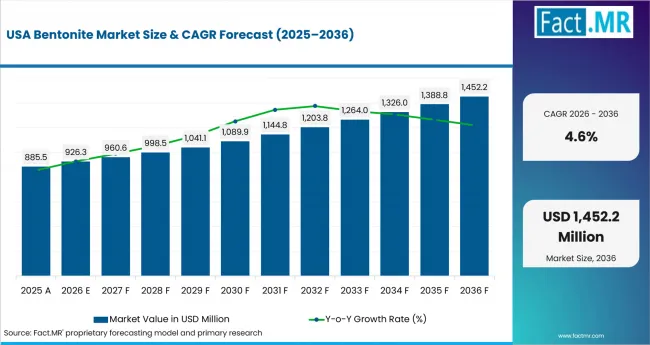
Bentonite Market Country Value Analysis | Source: Fact.MR
The country combines a domestic raw-material base with active downstream consumption. U.S. Geological Survey estimates place bentonite mine production at 4.1 million tonnes in 2025 and identify drilling mud as a principal use. EIA data then show 565 rotary rigs operating on average in June 2026, sustaining a recurring channel for water-based drilling-mud material.
Supply investment is also continuing. In May 2026, the Bureau of Land Management approved the Black Hills Bentonite mine project in Natrona County, Wyoming, authorizing an open-pit operation on about 227 acres of public land over 20 years. Additional permitted feedstock can support processors serving foundry, drilling and construction customers, provided milling, quality control and transport capacity scale with mine output.
What is driving UK's growth through 2036?
The UK is forecast to expand at a 4.2% CAGR from 2026 to 2036.
The country maintains a concentrated but technically broad casting industry. The Cast Metals Federation reports that its members produce around 85% of UK castings output, with applications spanning automotive, aerospace, defence, energy, rail and medical equipment. Green-sand foundries in this base require reliable binder performance and technical support, sustaining demand for foundry-grade bentonite even as production mixes change.
Civil engineering provides a separate demand route. Bentonite suspension is widely used to support the sides of diaphragm-wall excavations before concrete placement, a method used for deep basements, underpasses and other constrained urban works. The UK's continuing infrastructure and redevelopment pipeline therefore supports project-based demand for slurry-grade material alongside the recurring foundry channel.
What is driving Germany's growth through 2036?
Germany is forecast to expand at a 3.7% CAGR from 2026 to 2036.
Germany's casting industry entered 2026 from a weak production base. The German Foundry Industry Association reported that 2025 casting production was about 3.3 million tonnes and remained under pressure from automotive, export and industrial demand. This moderates bulk binder growth, but it also increases the importance of sand-system efficiency, scrap reduction and product consistency for foundries trying to protect operating economics.
That environment favors technically supported bentonite rather than undifferentiated tonnage. Processors that can provide activated grades, stable particle-size distribution and laboratory support can help foundries control compactability and molding behavior with less corrective dosing. Construction and foundation applications provide an additional outlet that is less synchronized with vehicle production cycles.
What is driving France's growth through 2036?
France is forecast to expand at a 3.2% CAGR from 2026 to 2036.
The European Foundry Federation reports that French ferrous and non-ferrous foundries produced 1.423 million tonnes in 2024, with around 330 companies in the sector. Although production declined that year, the installed casting base continues to consume sand binders across automotive and industrial component programs and creates room for value-added grades that improve molding consistency.
Civil engineering broadens the demand base. The Grand Paris Express program has involved extensive tunneling and underground-station construction, including continuing line and systems work through the middle of the decade. Slurry-face tunneling and diaphragm-wall methods use bentonite suspensions to stabilize water-bearing ground and deep excavations, so transport and urban-development projects create project-specific purchases beyond foundry consumption.
Who Leads the Bentonite Market?
Key players in the Bentonite Market include Minerals Technologies Inc., Clariant AG, Ashapura Group, Imerys S.A. (formerly Amcol), Wyo-Ben Inc. and Bentonite Performance Minerals LLC (a Halliburton subsidiary).
Competition is shaped by access to consistent mineral reserves, beneficiation and activation capability, application laboratories, packaging and bulk logistics, and direct relationships with drilling, foundry, construction and agricultural buyers. A supplier that can mine high-quality ore but cannot control milling, activation or delivered consistency risks losing qualified accounts to processors with better technical service and regional inventory.
Corporate lineage requires careful interpretation. Minerals Technologies completed its acquisition of AMCOL International in May 2014, making AMCOL a wholly owned subsidiary. Imerys separately acquired the main industrial-mineral activities of S&B in February 2015, including bentonite activities. Current competitive capability is therefore better judged through operating assets, mineral reserves, processing technology and customer support than through historical brand labels.
Recent activity shows continued investment in both product technology and supply. Clariant introduced a new Geko P bentonite-based foundry additive at Metal China 2026 and upgraded its Zhenjiang foundry applications center. Wyo-Ben announced the acquisition of M-I SWACO's bentonite operation in Greybull, Wyoming, in 2023, expanding its drilling-fluid and mineral platform. Halliburton has also reported Bentonite Performance Minerals operations in Wyoming, confirming the continued relevance of mine stewardship and processing assets to competitive positioning.
Which companies are the key providers?
Key providers are Minerals Technologies Inc., Clariant AG, Ashapura Group, Imerys S.A. (formerly Amcol), Wyo-Ben Inc. and Bentonite Performance Minerals LLC (a Halliburton subsidiary).
- Minerals Technologies Inc.
- Clariant AG
- Ashapura Group
- Imerys S.A. (formerly Amcol)
- Wyo-Ben Inc.
- Bentonite Performance Minerals LLC (a Halliburton subsidiary)
Bibliography
- U.S. Geological Survey. (2026). Mineral Commodity Summaries 2026: Clays. U.S. Geological Survey.
- U.S. Geological Survey. (2026). Clays Statistics and Information. National Minerals Information Center.
- U.S. Energy Information Administration. (2026). Crude Oil and Natural Gas Drilling Activity. U.S. Department of Energy.
- U.S. Army Corps of Engineers. (1986). Seepage Analysis and Control for Dams. U.S. Army Corps of Engineers.
- Federal Highway Administration. (2009). Technical Manual for Design and Construction of Road Tunnels: Civil Elements. U.S. Department of Transportation.
- The Concrete Society. (2025). Diaphragm Walls. The Concrete Society.
- Bureau of Land Management. (2026). BLM Approves Black Hills Bentonite Mine in Natrona County, Wyoming. U.S. Department of the Interior.
- Clariant. (2026). Clariant Showcases Latest Innovative Technologies and CLARITY Digital Solution at Metal China 2026. Clariant.
- Ministry of Economy, Trade and Industry. (2026). Current Survey of Production. Government of Japan.
- Japan Foundry Society. (2026). The Statistical Data. Japan Foundry Society.
- Cast Metals Federation. (2026). About the UK Cast Metals Industry. Cast Metals Federation.
- Bundesverband der Deutschen Giesserei-Industrie. (2026). Jahresausblick: Giesserei-Industrie erneut vor einem sehr anspruchsvollen Jahr. Bundesverband der Deutschen Giesserei-Industrie.
- European Foundry Federation. (2025). Annual Report 2024: Reports of the Countries. European Foundry Federation.
- Societe des grands projets. (2025). 2024 Integrated Report. Societe des grands projets.
- Minerals Technologies Inc. (2014). Minerals Technologies Completes Acquisition of AMCOL International. Minerals Technologies Inc.
- European Commission. (2015). Case M.7456: Imerys/S&B Minerals. European Commission.
- Water Well Journal. (2023). Wyo-Ben Announces Acquisition of M-I SWACO Bentonite Operation. National Ground Water Association.
- Halliburton. (2023). 2022 Annual & Sustainability Report. Halliburton.
This Report Answers
- How the Bentonite Market is expected to progress from USD 2.5 billion in 2026 to USD 4.2 billion by 2036.
- Why sodium bentonite, foundry applications, oil and gas end use, activation technology, powder formulations and direct industrial sales hold their 2026 leadership positions.
- How drilling activity, green-sand casting, civil-engineering slurries and processed-grade performance affect purchasing decisions.
- Why Japan, USA, UK, Germany and France follow different demand pathways through 2036.
- How reserve quality, activation, application testing, freight economics and customer support shape competition among key bentonite suppliers.
What does the Bentonite Market cover?
The market covers revenue from processed bentonite sold as sodium, calcium, sulfur and organoclay products for the specified foundry, drilling, civil-engineering and agricultural applications. It counts material supplied in powder, granular, pelletized and slurry formulations and includes value added through activation, granulation, purification and surface modification before commercial sale.
Revenue is captured at the bentonite product level through direct industrial sales, industrial distributors, agricultural supply networks and online B2B platforms. The analysis follows commercial material supplied to exploration companies, drilling-service providers, metal-casting companies, automotive casting manufacturers, infrastructure contractors, foundation-engineering firms, crop-production companies and agricultural-input suppliers.
What is included in the scope?
Included are natural and processed sodium and calcium bentonite, sulfur bentonite, organoclay bentonite and the specified activated, granular, purified and surface-modified variants sold into the defined applications. The scope includes fine and standard powders, coarse and fine granules, industrial and agricultural pellets, and pre-mixed or specialty slurry systems when the commercial value being purchased is the bentonite formulation itself.
The market also includes producer and processor revenue from OEM-style supply agreements, project-based supply contracts, regional and specialty distributors, farm-input dealers, cooperative supply networks and manufacturer-direct or industrial e-commerce channels.
What is excluded from the scope?
The scope excludes kaolin, attapulgite or palygorskite and other clay minerals sold outside the specified bentonite categories. It also excludes synthetic polymer drilling additives, finished metal castings, complete drilling-service contracts, complete foundation or tunneling contracts, and fertilizer value beyond the bentonite or sulfur-bentonite product being supplied.
Finished downstream systems are not counted at their full project value when bentonite is only one input. Equipment used for mining, milling, mixing, pumping or applying bentonite is also excluded unless its value is embedded in the commercial bentonite formulation sold within the defined market.
How Was the Analysis Built?
The analysis combines primary interviews with producers, processors, distributors and industrial buyers with secondary research across public mineral statistics, drilling activity, foundry production, civil-engineering guidance, company filings and technical publications. More than 120 sources, over 35 company portfolios and more than 20 industry interviews across at least 25 countries were used to test demand assumptions and operating mechanisms.
Primary respondents included bentonite mine and processing managers, foundry procurement and sand-system specialists, drilling-fluid engineers, drilling-service procurement teams, civil-engineering material specialists, agricultural-input distributors and technical sales managers. Interviews focused on grade qualification, dosing, switching behavior, freight exposure, contract structure and the conditions that lead customers to pay for activated or application-specific products.
Sizing variables included bentonite mine output and processed-grade availability, sodium and calcium product mix, activation and milling yields, drilling activity, green-sand casting demand, tunneling and foundation slurry consumption, agricultural sulfur-bentonite use, formulation premiums, direct-versus-distributor sales patterns and country trade flows. Forecasts were then tested against the specified segment hierarchy and country demand mechanisms.
Segmentation
What is the report's scope and coverage?
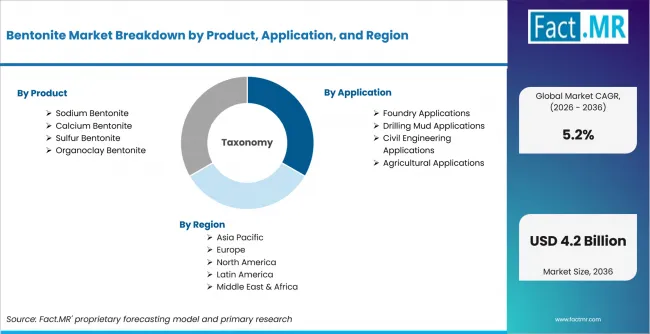
Bentonite Market Breakdown By Product, Application, And Region | Source: Fact.MR
| Metric | Coverage |
|---|---|
| Quantitative Units | USD billion |
| Market Definition | Processed bentonite mineral products sold for specified foundry, drilling, civil-engineering and agricultural applications |
| Segments Covered | Product; Application; End Use; Technology; Formulation; Distribution Channel |
| Regions Covered | North America; Latin America; Europe; East Asia; South Asia and Pacific; Middle East and Africa |
| Countries Covered | Japan; USA; UK; Germany; France |
| Key Companies Profiled | Minerals Technologies Inc.; Clariant AG; Ashapura Group; Imerys S.A. (formerly Amcol); Wyo-Ben Inc.; Bentonite Performance Minerals LLC (a Halliburton subsidiary) |
| Forecast Period | 2026 to 2036 |
| Base Year | 2025 |
| Market Value, 2026 | USD 2.5 billion |
| Market Value, 2036 | USD 4.2 billion |
| CAGR, 2026-2036 | 5.2% |
| Absolute Opportunity | USD 1.7 billion |
| Approach | Hybrid bottom-up and top-down analysis using production, application-consumption, trade and primary-research validation |
Source: Fact.MR analysis. Updated Aug 26, 2026
How is the market segmented?
-
By Product:
- Sodium Bentonite
- Natural Sodium Bentonite
- Activated Sodium Bentonite
- Calcium Bentonite
- Natural Calcium Bentonite
- Processed Calcium Bentonite
- Sulfur Bentonite
- Agricultural Sulfur Bentonite
- Enhanced Sulfur Bentonite
- Organoclay Bentonite
- Solvent Based Organoclays
- Water Compatible Organoclays
- Sodium Bentonite
-
By Application:
- Foundry Applications
- Green Sand Casting Applications
- Molding Sand Applications
- Drilling Mud Applications
- Oil & Gas Drilling Applications
- Geothermal Drilling Applications
- Civil Engineering Applications
- Tunneling Applications
- Foundation Engineering Applications
- Agricultural Applications
- Soil Conditioning Applications
- Fertilizer Applications
- Foundry Applications
-
By End Use:
- Oil & Gas Industry
- Exploration Companies
- Drilling Service Providers
- Foundry Industry
- Metal Casting Companies
- Automotive Casting Manufacturers
- Construction Industry
- Infrastructure Contractors
- Foundation Engineering Firms
- Agriculture Industry
- Crop Production Companies
- Agricultural Input Suppliers
- Oil & Gas Industry
-
By Technology:
- Bentonite Activation Technology
- Chemical Activation Systems
- Thermal Activation Systems
- Granulation Technology
- Dry Granulation Systems
- Wet Granulation Systems
- Purification Technology
- Mechanical Purification Systems
- Chemical Purification Systems
- Surface Modification Technology
- Organic Modification Systems
- Inorganic Modification Systems
- Bentonite Activation Technology
-
By Formulation:
- Powder Bentonite Formulations
- Fine Powder Formulations
- Standard Powder Formulations
- Granular Bentonite Formulations
- Coarse Granular Systems
- Fine Granular Systems
- Pelletized Bentonite Formulations
- Industrial Pellet Systems
- Agricultural Pellet Systems
- Slurry Bentonite Formulations
- Pre Mixed Slurry Systems
- Specialty Slurry Systems
- Powder Bentonite Formulations
-
By Distribution Channel:
- Direct Industrial Sales
- OEM Supply Agreements
- Project Based Supply Contracts
- Industrial Distributors
- Regional Distributors
- Specialty Distributors
- Agricultural Supply Networks
- Farm Input Dealers
- Cooperative Supply Networks
- Online B2B Platforms
- Industrial E Commerce Platforms
- Manufacturer Direct Platforms
- Direct Industrial Sales
Frequently Asked Questions
How large is the Bentonite Market in 2026?
What CAGR is forecast for the Bentonite Market from 2026 to 2036?
What will the Bentonite Market be worth by 2036?
Which Product segment leads the Bentonite Market in 2026?
Which Application segment leads the Bentonite Market in 2026?
Which End Use segment leads the Bentonite Market in 2026?
Which Technology segment leads the Bentonite Market in 2026?
Which Formulation segment leads the Bentonite Market in 2026?
Which Distribution Channel leads the Bentonite Market in 2026?
What is Japan's growth outlook in the Bentonite Market?
Which companies are profiled in the Bentonite Market?
Who worked on this report


Preview the report firsthand - request a free sample
Free SampleGet the brochure for pricing and purchase details
Download PDF