- Market Value (2025): USD 12.2 Bn
- Estimated Value (2026): USD 12.8 Bn
- Forecast Value (2036): USD 20.5 Bn
- CAGR (2026-2036): 4.8%
What is the Disposable Razors Market forecast to be worth by 2036?
USD 12.8 billion in 2026 to USD 20.5 billion by 2036 at a 4.8% CAGR.
- The Disposable Razors Market reached USD 12.2 billion in 2025.
- Demand is projected to increase from USD 12.8 billion in 2026 to USD 20.5 billion by 2036.
- The market is forecast to record 4.8% CAGR from 2026 to 2036 as men, women and online shoppers keep razors inside routine grooming baskets.
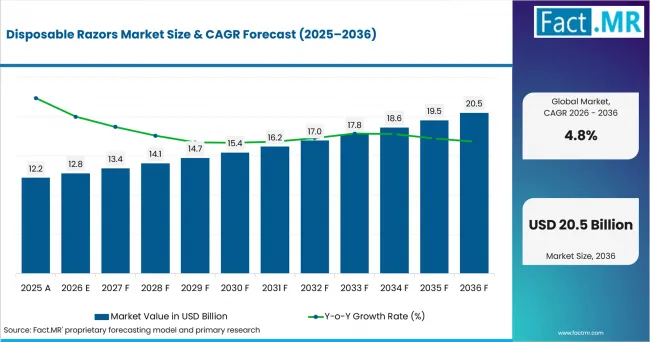
Disposable Razors Market Value Analysis | Source: Fact.MR
What are the defining numbers behind Disposable Razors Market growth?
USD 7.7 billion absolute opportunity is expected between 2026 and 2036.
- Demand Drivers in the Market
- Daily shavers need low-maintenance razors that handle facial shaving with simple pack replacement and cartridge-free planning.
- Sensitive-skin consumers need lubricating strips and guarded heads where irritation risk shapes repeat purchase after one use.
- The U.S. Census Bureau reported on August 18, 2026 that seasonally adjusted U.S. retail e-commerce sales reached USD 340.2 billion in the second quarter of 2026.
- Retailers need compact shelf packs that fit supermarkets and drugstores where grooming trips include quick replacement purchases.
- Travel users need sealed short-use formats where packability and low unit cost carry weight in purchase decisions.
- Key Segments Analyzed
- By Product: Single Blade Razors are expected to hold 38.10% share in 2026 due to low unit cost and simple use across mass retail packs.
- By Skin Type: Sensitive Skin Razors are projected to account for 77.20% share in 2026 as shoppers place comfort claims ahead of blade complexity.
- By End Use: Men are anticipated to represent 66.40% share in 2026 since facial shaving remains the most frequent disposable razor mission.
- By Distribution Channel: Online is estimated to capture 78.30% share in 2026 owing to marketplace pricing and subscription replenishment.
- Analyst Opinion at Fact.MR
- Shambhu Nath Jha, Principal Consultant at Fact.MR, states, “Disposable razors remain a replenishment decision before they become a grooming trend. Shoppers are expected to compare comfort claims, blade format and purchase channel as closely as price. Suppliers should connect skin comfort, packaging discipline and channel execution so the product holds attention against cartridge and electric alternatives.”
- Strategic Implications
- Razor brands should separate sensitive-skin claims from general comfort copy by documenting strip materials and blade guard design.
- Retail category teams should treat online multipacks and offline impulse packs as different missions with separate pack counts.
- Price teams should protect value packs. The U.S. Bureau of Labor Statistics reported in August 2026 that hair, dental, shaving and miscellaneous personal care products rose 3.4% year over year in July 2026.
- Private-label manufacturers should improve packaging consistency and blade inspection so lower prices preserve trust in repeat purchases.
Germany is expected to record 5.3% CAGR through 2036, supported by high digital access and routine retail replacement. Brazil is projected to post 4.8% CAGR as internet participation keeps personal-care products easier to compare. The USA is anticipated to advance at 4.3% CAGR due to e-commerce scale and health-and-personal-care retail depth. The United Kingdom is estimated to hold 3.9% CAGR through mature online retail habits. Japan is forecast to reach 3.4% CAGR with drugstore access and household online shopping.
How does the Disposable Razors Market break down by segment?
Single Blade Razors lead Product at 38.10%; Online leads Distribution Channel at 78.30%.
Which Product dominates?
Single Blade Razors hold 38.1% share in 2026.
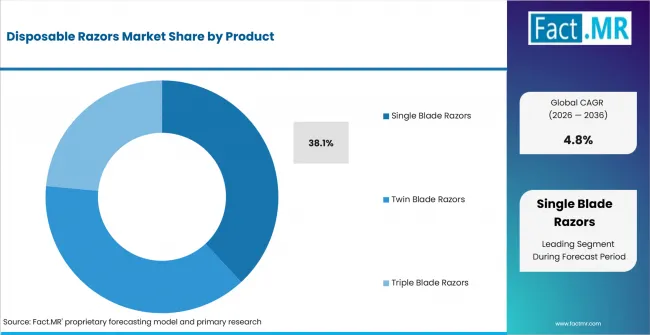
Disposable Razors Market Analysis By Product | Source: Fact.MR
Single blade razors hold the stated share since they keep purchase cost low and make short-use shaving simple. They suit supermarkets and convenience stores where the shopper wants a quick replacement. Lower blade count helps manufacturers hold down material cost. Twin blade and triple blade formats remain relevant where shoppers want a smoother shave before moving to reusable cartridge systems.
What leads the Skin Type segment?
Sensitive Skin Razors lead with 77.2% share in 2026.
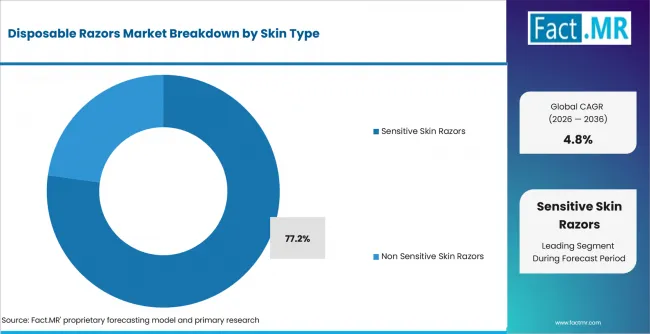
Disposable Razors Market Analysis By Skin Type | Source: Fact.MR
Sensitive skin formats capture the stated share where irritation risk is easy for shoppers to notice after one use. Lubricating strips and covered edges help disposable products defend repeat purchase against refill razors. Brand communication needs precise material language. Comfort claims need a clear link between the strip or guard design and the shaving benefit.
How does End Use shape demand?
Men represent 66.4% share in 2026.
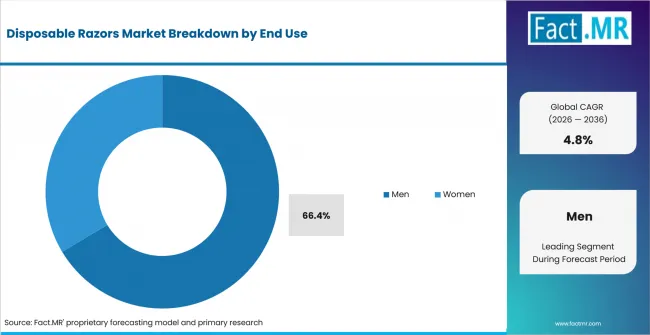
Disposable Razors Market Analysis By End Use | Source: Fact.MR
Men account for the stated share with facial shaving remaining a high-frequency use case for disposable razors. Beard styling and clean-shave routines keep men’s packs visible in pharmacies and online stores. Women’s use remains relevant in leg shaving and body shaving. Grooming brands therefore need separate pack design for facial, body and travel uses.
What supports Online within Distribution Channel?
Online accounts for 78.3% share in 2026.
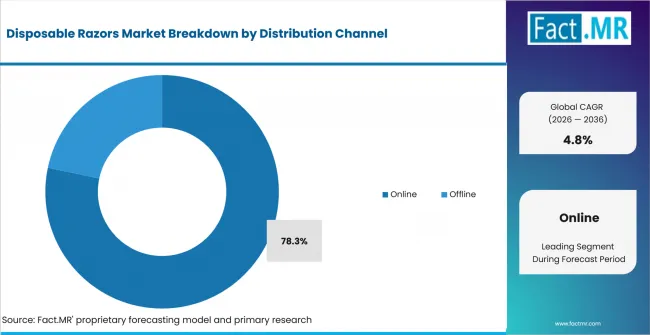
Disposable Razors Market Analysis By Distribution Channel | Source: Fact.MR
Online accounts for the stated share given that disposable razors fit replenishment behavior and price comparison. Search pages allow shoppers to compare blade count and pack size in one place. The Office for National Statistics series released on August 21, 2026 shows that internet sales represented 27.4% of total Great Britain retail sales in 2025.
What is accelerating Disposable Razors Market adoption, and what is holding it back?
Demand is expected to rise through convenience, sensitive-skin positioning and online replenishment. Growth is constrained by price pressure, waste scrutiny and competition from refill systems.
Drivers Impact Analysis
| DRIVER | (~) % IMPACT ON CAGR | GEOGRAPHIC RELEVANCE | IMPACT TIMELINE |
|---|---|---|---|
| Online replenishment and subscription purchasing | +0.9% | North America, Western Europe, East Asia | Short term (<= 2 years) |
| Sensitive-skin and irritation-control positioning | +0.7% | Global | Medium term (2-4 years) |
| Low unit cost in supermarkets and drugstores | +0.5% | Latin America, Europe, East Asia | Short term (<= 2 years) |
| Travel, hospitality and quick-replacement use cases | +0.3% | Global | Long term (>= 4 years) |
Source: Fact.MR analysis. Updated Sep 1, 2026
- Online replenishment and subscription purchasing: Disposable razors fit recurring baskets where shoppers compare pack count and price per handle.
- Sensitive-skin positioning: Lubricating strips and guarded heads help brands justify repeat purchase when irritation remains the main consumer complaint.
- Low unit cost: Value packs let retailers keep shaving products in traffic-heavy channels while shoppers prefer smaller handle commitments.
Opportunity Impact Analysis
| OPPORTUNITY | (~) % IMPACT ON CAGR | GEOGRAPHIC RELEVANCE | IMPACT TIMELINE |
|---|---|---|---|
| Skin-comfort claims with clearer material disclosure | +0.6% | North America, Europe, Japan | Medium term (2-4 years) |
| Retailer-owned online multipack programs | +0.5% | USA, UK, Germany | Short term (<= 2 years) |
| Gender-neutral body grooming packs | +0.4% | Global | Long term (>= 4 years) |
Source: Fact.MR analysis. Updated Sep 1, 2026
- Skin-comfort claims with clearer material disclosure: Brands can improve trust when they explain strip ingredients and blade guard design in simple terms.
- Retailer-owned online multipack programs: Supermarkets and marketplaces can use pack count prompts to retain repeat shave purchases.
- Gender-neutral body grooming packs: Cross-use packs can address facial shaving and body shaving with broader grooming cues and shared pack design.
Restraints Impact Analysis
| RESTRAINT | (~) % IMPACT ON CAGR | GEOGRAPHIC RELEVANCE | IMPACT TIMELINE |
|---|---|---|---|
| Price pressure in personal-care baskets | -0.5% | USA, Brazil, UK, Germany | Short term (<= 2 years) |
| Competition from cartridge and electric razors | -0.4% | North America, Europe, Japan | Medium term (2-4 years) |
| Packaging and plastic-waste scrutiny | -0.3% | Europe, Japan, North America | Long term (>= 4 years) |
Source: Fact.MR analysis. Updated Sep 1, 2026
- Price pressure in personal-care baskets: Shoppers can delay trade-up when shaving products rise beside other hygiene goods.
- Competition from cartridge and electric razors: Reusable systems appeal to shoppers who want fewer handle purchases or a premium shave feel.
- Packaging and plastic-waste scrutiny: Disposable formats face more questions when retailers review material use and shelf-ready packaging.
Which countries are scaling the Disposable Razors Market through 2036?
- The country comparison spans 1.9 percentage points between Germany and Japan across the forecast period.
- Germany remains 0.5 percentage point above Brazil with high digital access and strong drugstore grooming visibility.
- Brazil remains 0.5 percentage point above the USA as broader internet participation widens personal-care price comparison.
- The USA remains 0.4 percentage point above the United Kingdom through e-commerce scale and health-and-personal-care retail depth.
- The United Kingdom remains 0.5 percentage point above Japan as online retail habits support planned replenishment.
- Japan closes the displayed range while household online shopping and drugstore access keep disposable razors available.
Comparable CAGRs can create different entry conditions due to shaving habits, online penetration, retail mix and price sensitivity. Full report coverage includes North America, Latin America, Western Europe, Eastern Europe, East Asia, South Asia & Pacific, Middle East & Africa.
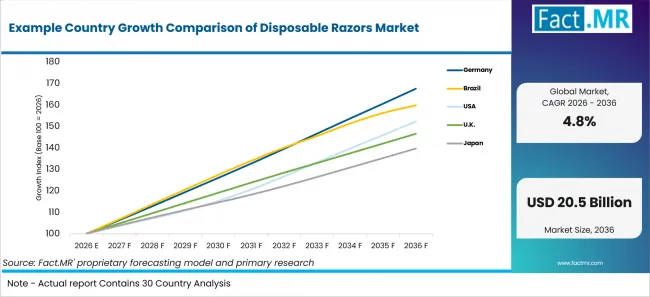
Example Country Growth Comparison Of Disposable Razors Market | Source: Fact.MR
| Country | CAGR (2026-2036) |
|---|---|
| Germany | 5.3% |
| Brazil | 4.8% |
| United States | 4.3% |
| United Kingdom | 3.9% |
| Japan | 3.4% |
Source: Fact.MR analysis. Updated Sep 1, 2026
What supports Germany adoption?
5.3% CAGR, supported by high digital access and routine retail replacement.
Germany's disposable razor outlook is shaped by shoppers who compare basic shaving packs online before buying through drugstores or supermarkets. Destatis reported in April 2026 that 95% of people ages 16-74 in Germany said they had used the internet during the previous three months in 2025.
How is Brazil scaling demand?
4.8% CAGR, shaped by internet participation and value-led grooming purchases.
Brazil is scaling from a value-led base where shoppers compare disposable razors against reusable handles and other hygiene goods. IBGE reported on July 2, 2026 that 90.5% of Brazil's population age 10 and older had used the internet during the previous three-month reference period in 2025.
What supports USA adoption?
4.3% CAGR, backed by personal-care retail depth and online replenishment.
The USA benefits from large health-and-personal-care channels that keep shaving products visible between online subscriptions and store baskets. U.S. Census Bureau data published through FRED show seasonally adjusted health and personal care store sales of USD 40,224 million in June 2026.
What supports the United Kingdom’s growth?
3.9% CAGR, supported by online retail habits and supermarket access.
The United Kingdom's disposable razor demand is tied to mature online retail behavior and broad supermarket access. The Office for National Statistics reported on August 21, 2026 that Great Britain online sales values in July 2026 were 6.5% higher than in July 2025.
How does Japan perform?
3.4% CAGR, led by household online shopping and drugstore availability.
Japan's growth is steadier where compact homes and disciplined replacement habits keep shoppers selective about grooming packs. Japan’s Statistics Bureau reported in its 2025 Survey of Household Economy that the average proportion of two-or-more-person households using online shopping was 56.9% in 2025.
Who leads the Disposable Razors Market?
Procter & Gamble (Gillette) maintains a strong position in disposable razors through a broad shaving portfolio and extensive retail presence. BIC competes across multiple disposable-razor formats spanning entry-level, sensitive-skin and multi-blade products. Edgewell Personal Care participates through brands including Schick and Wilkinson Sword, covering shaving systems and disposable razors. DORCO CO., LTD., LORD International Co. International, Super-Max, Ningbo Kaili Holding Group and Ningbo Ningbo Jiali Century Group Co., Ltd. Century Group add manufacturing depth through disposable razors, blades and private-label capabilities across international markets.
Competition centers on blade performance, shaving comfort, product value and pack configuration. Suppliers differentiate products through blade count, lubricating strips, pivoting or fixed heads, handle design and sensitive-skin features. Retail availability, price positioning, packaging and online product presentation also provide avenues for differentiation as brands compete across value and premium disposable-razor tiers.
Which companies are the key providers?
Key companies include Procter & Gamble (Gillette), LORD International Co., DORCO Co., Ltd., FEATHER Safety Razor Co., Ltd., Super-Max, Ningbo Kaili Holding Group Co., Ltd., and Ningbo Jiali Century Group Co., Ltd.
- Procter & Gamble (Gillette)
- LORD International Co.
- DORCO Co., Ltd.
- FEATHER Safety Razor Co., Ltd.
- Super-Max
- Ningbo Kaili Holding Group Co., Ltd.
- Ningbo Jiali Century Group Co., Ltd.
Bibliography
- U.S. Bureau of Labor Statistics. (2026, August 12). Table 2. Consumer Price Index for All Urban Consumers (CPI-U): U.S. city average, by detailed expenditure category, July 2026.
- U.S. Census Bureau. (2026, August 18). Quarterly retail e-commerce sales.
- U.S. Census Bureau. (2026, August 14). Advance monthly sales for retail and food services.
- U.S. Census Bureau. (2026). Advance retail sales: Health and personal care stores [RSHPCS]. FRED, Federal Reserve Bank of St. Louis.
- Federal Statistical Office (Destatis). (2025, November 27). Internet users and online shoppers.
- Instituto Brasileiro de Geografia e Estatística. (2026, July 2). Proportion of Internet users in Brazil exceeded 90% of population aged 10 or over, in 2025.
- Office for National Statistics. (2026, August 21). Internet sales as a percentage of total retail sales (ratio) (%) [Time series J4MC].
- Office for National Statistics. (2026, August 21). Retail sales, Great Britain: July 2026.
This Report Answers
- The report explains where disposable razors are used across product format, skin type, end use and distribution channel.
- Segment analysis identifies the stated share leaders and the shopping behavior that supports each category.
- Country analysis examines Germany, Brazil, the United States, the United Kingdom and Japan using official retail and pricing evidence.
- Competitive analysis reviews current providers across branded, direct-to-consumer, value and private-label supply positions.
- Application analysis assesses how facial shaving, leg shaving and body shaving influence pack design and channel choice.
What does the Disposable Razors Market cover?
The Disposable Razors Market covers short-use shaving products sold through retail and online channels. It includes single blade, twin blade and triple blade razors used for facial shaving, leg shaving and body grooming. The scope overlaps with the disposable razors category when the product is sold as a short-use handle and blade combination.
The assessment compares disposable packs with manual shaver systems where those alternatives influence replacement behavior. Online replenishment is reviewed with e-commerce personal care when shaving multipacks appear inside wider hygiene baskets.
What is included in the scope?
The scope includes disposable razor handles with attached blades, multipacks, value packs, sensitive-skin variants and body grooming formats. The analysis references aftershave lotions and aftershave products when skin-comfort claims shape razor selection.
The scope also reviews links with men’s personal care, men’s skincare and broader skin grooming categories when facial shaving routines and body shaving needs influence pack design.
What is excluded from the scope?
Outside the scope are electric razors, reusable cartridge systems sold as separate long-life handles, beard trimmers and professional barbering equipment. Adjacent hair removal wax is reviewed only when a substitute comparison affects disposable razor positioning.
Ingredient markets are outside the core scope unless they influence razor-adjacent shave preparations. Examples include brow grooming tools that appear near shaving products in retail baskets.
How Was the Analysis Built?
The analysis draws on 120+ sources, 35+ company portfolios, 25+ countries, and more than 20 industry interviews.
- Primary Research: Primary research includes discussions with manufacturers, distributors, retailers, brand owners, packaging suppliers, end users and subject-matter experts. These conversations examine purchase triggers, shelf competition, pack sizing, product complaints and the factors that influence wider market acceptance.
- Desk Research: Desk research covers government statistics, retail data, price indices, company product pages, official releases, technical studies, associations and regulatory publications. Every reference used in the analysis is documented in the bibliography.
- Market Sizing and Forecasting: Market estimates combine historical performance, demand indicators, pricing and volume trends, segment shares, company participation, country-level growth, adoption patterns and barriers to market expansion.
- Data Validation and Update Cycle: Findings are validated by comparing interviews with public data, company activity, regulatory changes, retail patterns and channel developments. Regular updates review product launches, channel shifts, packaging changes and commercial adoption.
Segmentation
What is the report’s scope and coverage?
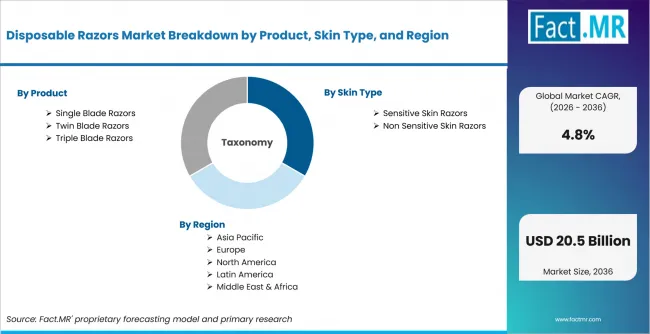
Disposable Razors Market Breakdown By Product, Skin Type, And Region | Source: Fact.MR
| Attribute | Details |
|---|---|
| Quantitative Units | USD billion |
| Market Definition | Disposable razors are pre-assembled shaving products intended for short-use or limited replacement cycles, including single blade, twin blade and triple blade formats. |
| Product | Single Blade Razors; Fixed Head Razors; Pivoting Head Razors; Twin Blade Razors; Triple Blade Razors |
| Skin Type | Sensitive Skin Razors; Hypoallergenic Razors; Skin Protection Razors; Non Sensitive Skin Razors; Standard Razors; Performance Razors |
| End Use | Men; Facial Shaving; Body Grooming; Women; Leg Shaving; Body Shaving |
| Distribution Channel | Online; E Commerce Platforms; Subscription Services; Offline; Supermarkets And Hypermarkets; Convenience Stores; Specialty Stores |
| Regions Covered | North America; Latin America; Western Europe; Eastern Europe; East Asia; South Asia & Pacific; Middle East & Africa |
| Countries Covered | Germany; Brazil; United States; United Kingdom; Japan |
| Key Companies Profiled | Procter & Gamble (Gillette), LORD International Co., DORCO Co., Ltd., FEATHER Safety Razor Co., Ltd., Super-Max, Ningbo Kaili Holding Group Co., Ltd., and Ningbo Jiali Century Group Co., Ltd. |
| Forecast Period | 2026 to 2036 |
| Approach | Hybrid top-down and bottom-up approach using retail channel indicators; product mix; skin-type claims; end-use routines; country adoption; and provider portfolio review. |
Source: Fact.MR analysis. Updated Sep 1, 2026
How is the market segmented?
-
By Product
- Single Blade Razors
- Fixed Head Razors
- Pivoting Head Razors
- Twin Blade Razors
- Fixed Head Razors
- Pivoting Head Razors
- Triple Blade Razors
- Fixed Head Razors
- Pivoting Head Razors
- Single Blade Razors
-
By Skin Type
- Sensitive Skin Razors
- Hypoallergenic Razors
- Skin Protection Razors
- Non Sensitive Skin Razors
- Standard Razors
- Performance Razors
- Sensitive Skin Razors
-
By End Use
- Men
- Facial Shaving
- Body Grooming
- Women
- Leg Shaving
- Body Shaving
- Men
-
By Distribution Channel
- Online
- E Commerce Platforms
- Subscription Services
- Offline
- Supermarkets And Hypermarkets
- Convenience Stores
- Specialty Stores
- Online
-
By Region
- North America
- Latin America
- Western Europe
- Eastern Europe
- East Asia
- South Asia and Pacific
- Middle East & Africa
Frequently Asked Questions
How big is the disposable razors market in 2026?
What is the CAGR of the disposable razors market from 2026 to 2036?
Which product leads the disposable razors market?
Which skin type leads the disposable razors market?
Who are the leading companies in the disposable razors market?
Who worked on this report


Preview the report firsthand - request a free sample
Free SampleGet the brochure for pricing and purchase details
Download PDF