Baby Disposable Diaper Market (2026 - 2036)

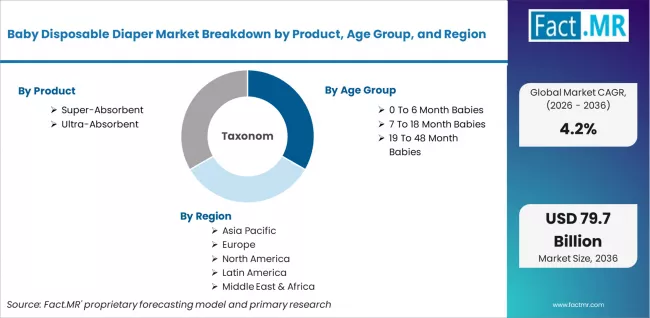
Baby Disposable Diaper Market is segmented by Product (Super-Absorbent, Ultra-Absorbent), Age Group (0 to 6 Month Babies, 7 to 18 Month Babies, 19 to 48 Month Babies), Sales Channel (Hypermarkets/Supermarkets, Convenience Stores, Pharmacy/Drug Stores, Online Channels), and Region. Forecast for 2026 to 2036.

Core Findings

    Baby Disposable Diaper Market Size, Market Forecast and Outlook By FACT.MR

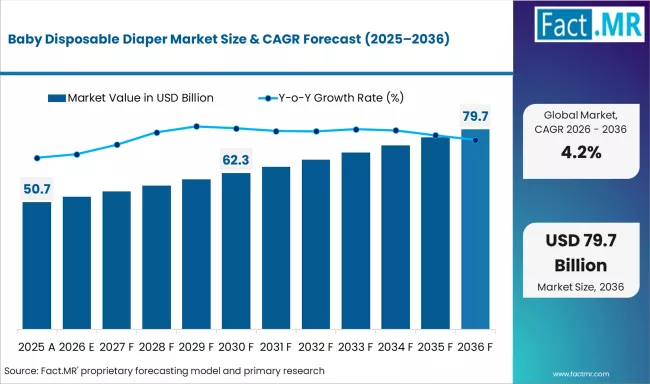
    The Baby Disposable Diaper market was valued at USD 50.79 billion in 2025, projected to reach USD 52.82 billion in 2026, and is forecast to expand to USD 79.71 billion by 2036 at a 4.2% CAGR. Rising birth rates in South Asia and Sub-Saharan Africa, combined with growing middle-class household income levels enabling first-time disposable diaper adoption in emerging markets, drives volume expansion. Premium product innovation including ultra-thin super-absorbent polymers, wetness indicator features, and dermatologically tested formulations sustains average selling price growth in established markets.

    The absolute dollar growth of USD 26.89 billion across the forecast decade represents the largest absolute value opportunity among baby care product categories globally. Super-Absorbent product format capture of 34.8% of product share reflects consumer preference for overnight protection reliability and extended-wear convenience in busy household routines. The 0 to 6 Month age group commanding 57.6% of age group share confirms that birth cohort volume intensity defines the category's demand baseline, with newborn-specific ultra-soft formulations generating both volume throughput and brand loyalty establishment.

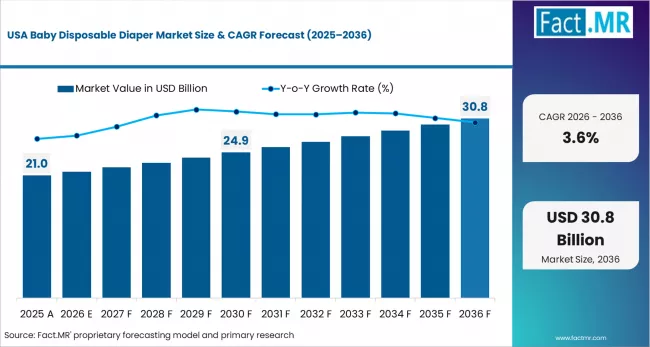
    As per FACT.MR's regional analysis, India leads at 5.25% CAGR as expanding modern retail and organized e-commerce distribution progressively converts traditional cloth diaper households to disposable diaper adoption in urban and semi-urban markets. Germany advances at 4.83%, where premium eco-certified disposable diaper demand from environmentally conscious parent demographics offsets the shift of some households toward cloth diaper alternatives. Brazil tracks at 4.41% as retail infrastructure development and income growth in northeastern states expand the geographic footprint of disposable diaper market access. The United Kingdom records 3.99%, where premium product innovation and own-brand pharmacy chain product ranges compete across a mature, stable market. The United States advances at 3.57% as private-label disposable diaper programs at major retail chains compete with branded products across a saturated but steady demand environment. Japan registers 3.15% as replacement demand from an established high-penetration market sustains category volumes despite demographic aging reducing birth cohort size.
    Baby Disposable Diaper Market Market Value Analysis

    Baby Disposable Diaper Market Key Takeaways

    Metric Details
    Industry Size (2026) USD 52.82 Billion
    Industry Value (2036) USD 79.71 Billion
    CAGR (2026-2036) 4.2%
    Source Fact.MR, 2026

    Baby Disposable Diaper Market Definition

    The Baby Disposable Diaper market encompasses single-use absorbent hygiene products manufactured with super-absorbent polymer cores, nonwoven topsheet materials, and breathable outer layers designed for infant and toddler diapering from birth through toilet training completion. Core product categories include super-absorbent disposable diapers for extended-wear and overnight protection, and ultra-absorbent formats for daytime use. Products are distributed through hypermarkets, supermarkets, pharmacy chains, convenience stores, and online retail channels globally.

    Baby Disposable Diaper Market Inclusions

    Market scope covers super-absorbent and ultra-absorbent disposable diaper products across age groups from birth through 48 months, distributed through hypermarkets and supermarkets, pharmacy and drug store chains, convenience stores, and online retail channels. Regional and country-level market sizing spans North America, Europe, Asia Pacific, Latin America, and the Middle East and Africa for the 2026 to 2036 forecast period. Both branded manufacturer products and private-label retail chain disposable diapers within defined product categories fall within analytical boundaries.

    Baby Disposable Diaper Market Exclusions

    Reusable cloth diapers and washable fabric-based diapering products are excluded from disposable diaper market scope. Adult incontinence disposable products and medical-grade incontinence pads fall outside defined boundaries. Disposable swim diapers marketed exclusively for aquatic use without standard absorbency performance claims are omitted. Training pants and pull-up style transition products positioned exclusively for toilet training use without standard diapering application are explicitly excluded from the core market valuation.

    Baby Disposable Diaper Market Research Methodology

    • Primary Research: Analysts conducted interviews with retail category managers at major grocery and pharmacy chains, baby care brand managers, and emerging market distribution specialists to document channel performance and adoption rate dynamics.
    • Desk Research: Data collection aggregated national birth rate statistics, retail audit sell-out data by channel and product category, and consumer panel purchase frequency data for baby care disposable products.
    • Market-Sizing and Forecasting: Baseline values derive from bottom-up aggregation of retail sell-out volumes across all distribution channels, applying birth cohort size projections and household income growth curves to regional adoption models.
    • Data Validation and Update Cycle: Forecasts cross-validate against baby care segment revenue disclosures from Procter and Gamble, Kimberly-Clark, Kao Corporation, and Unicharm Corporation quarterly and annual investor reports.

    Summary of Baby Disposable Diaper Market

    • Baby Disposable Diaper Market Definition
      • The Baby Disposable Diaper market covers single-use super-absorbent and ultra-absorbent diapering products for infants from birth through 48 months, distributed through hypermarkets, pharmacies, convenience stores, and online channels globally.
    • Demand Drivers in the Market
      • Expanding organized retail and e-commerce distribution networks in India and Southeast Asia convert first-time disposable diaper adopters from cloth diaper households as middle-class income thresholds make product affordability viable.
      • Premium product innovation cycles featuring super-absorbent polymer improvements, wetness indicator features, and dermatologist-endorsed formulations sustain average selling price growth in mature market categories despite high private-label competition.
      • Urbanization-driven household lifestyle changes reduce time available for traditional cloth diaper washing routines, structurally expanding the convenience-based consumer base for disposable diaper adoption in emerging market cities.
    • Key Segments Analyzed in the FACT.MR Report
      • Super-Absorbent leads by Product with 34.8% share in 2026, where overnight protection reliability, extended-wear convenience, and premium brand positioning drive consumer willingness to pay above standard category price points.
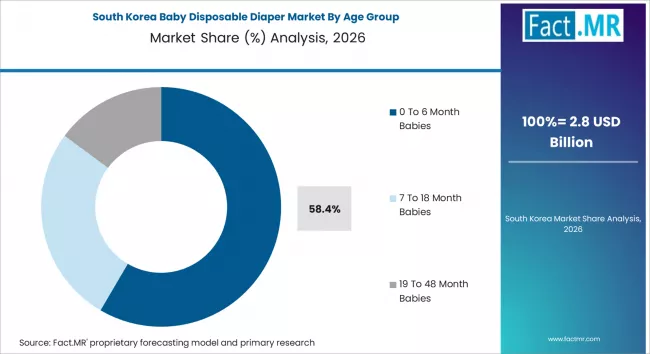
      • 0 to 6 Month Babies account for 57.6% of Age Group share in 2026, as newborn-stage diapering frequency and product-specific formulation requirements generate the highest category purchase intensity per household.
      • Hypermarkets and Supermarkets capture 42.2% of Sales Channel share in 2026, where physical product trial visibility, promotional pricing, and bundled baby care purchase convenience drive category volume concentration.
    • Analyst Opinion at FACT.MR
      • Shambhu Nath Jha, Principal Consultant, opines: 'The baby disposable diaper category faces margin compression from two directions simultaneously: private-label retail chain programs eroding branded value share from below, and eco-certified premium products capturing household spending from above. Manufacturers occupying the mid-market value tier without clear product differentiation face the sharpest volume pressure. Brands that invest in demonstrable clinical claims for sensitive skin formulations and establish pediatrician recommendation pathways at birth will build household loyalty that retail promotions from private-label programs cannot readily displace.'
    • Strategic Implications / Executive Takeaways
      • Disposable diaper manufacturers must develop eco-certified product lines with verified biodegradable component claims to defend premium positioning against both cloth diaper category expansion and sustainably branded competitors.
      • Emerging market distribution strategies for India and Brazil require affordable entry-tier product lines alongside premium formats to capture first-time adopters converting from cloth diapering at household income thresholds below established premium brand pricing.
      • Online subscription channel development with automatic replenishment and loyalty reward programs creates recurring revenue streams that reduce brand switching vulnerability to retail promotional pricing cycles.
    • Methodology
      • Primary Research: FACT.MR interviewed retail category managers and baby care brand directors across 40 countries to validate channel performance and adoption rate dynamics.
      • Desk Research: Analysts aggregated national birth rate statistics, retail audit sell-out data, and consumer panel purchase frequency data for baby care disposable products.
      • Market-Sizing and Forecasting: Bottom-up aggregation of retail sell-out volumes across all distribution channels applies birth cohort size projections and household income growth curves to regional adoption models.
      • Data Validation: Cross-validation against Procter and Gamble, Kimberly-Clark, Kao Corporation, and Unicharm Corporation quarterly baby care segment revenue disclosures.

    What is Driving Baby Disposable Diaper Market Growth?

    Hypoallergenic Features of Baby Disposable Diapers

    Baby disposable diapers not only ensure baby safety but also have hypoallergenic properties. Different materials that are used in various standard baby diapers along with their allergic and chemical reactions are predicted to cause harm to the skin of the baby. Therefore, as a preventive measure, manufacturers are producing hypoallergenic diapers that are further contributing to market growth opportunities.

    Numerous benefits of disposable diapers, hypoallergenic properties, and the rising awareness about different types of disposable baby diapers are projected to drive lucrative growth in the market over the coming 10 years.

    What’s Projected to Slow Down Adoption of Baby Disposable Diapers?

    High Price, Skin Irritation, Negative Environmental Impacts - Key Limitations

    Skin irritation and allergies that are caused due to chemicals used in the production of baby disposable diapers are predicted to limit their adoption. In addition, increasing awareness about the negative effects of disposable diapers on the environment is also hindering their sales. The high price of industrial products is also forecasted to restrain demand for baby disposable diapers.

    High Demand for Baby Cloth Diapers

    Many parents are inclined to use baby cloth diapers due to increased environmental awareness. Features such as reusability, convenience, eco-friendliness, etc., are stimulating consumers to opt for baby cloth diapers. In addition, cloth diapers are rash-free as well as skin-friendly and these features are expected to decrease sales of disposable diapers over the forecast period.

    How are Start-ups Making a Buzz in the Baby Disposable Diaper Landscape?

    Increasing Involvement in Production of Eco-friendly Baby Diapers

    Consumers are becoming aware of the adverse impact of disposable diapers on the environment. Materials that are used in these diapers are not easily disposable and have adverse environmental impacts. Therefore, start-ups are investing a significant amount to produce eco-friendly baby diapers to ensure the protection of children from rashes, keeping them dry. Reduced landfill waste through these green diapers is also projected to help new players increase their profit share.

    Country-wise Insights

    Top Country Growth Comparison Baby Disposable Diaper Market Cagr (2026 2036)

    Why is the United States a Lucrative Market for Diaper Manufacturers?
    Baby Disposable Diaper Market Country Value Analysis

    Medical Advancements Leading to Reduced Infertility Boosting Sales of Baby Disposable Diapers

    The United States market is projected to advance at a CAGR of 4% and reach US$ 22.98 billion by 2033.

    • According to the National Diaper Bank Network, in the United States, 1 in every 3 families is reporting requirements for diapers.

    Consistent population, rising number of nuclear families with working parents, and rapid urban growth are some pivotal factors that are contributing to the rising demand for baby diapers. Medical advances and new technologies for the treatment of infertility are also projected to stimulate the demand for infant disposable diapers.

    What is Resulting in Rising Demand for Baby Disposable Diapers in the United Kingdom?

    Breakthroughs in Baby Diaper Production Technology

    Sales of baby disposable diapers in the United Kingdom are forecasted to expand at a CAGR of 3%, reaching a valuation of US$ 3.60 billion by the end of 2033.

    Increasing spending on infant care items, developing online retailing drift, growing population of working women, and changing standards of living are some pivotal factors impacting market growth in the United Kingdom.

    Breakthroughs in the technology used for baby diaper production, including the manufacture of diapers from biodegradable and organic raw materials are generating enormous opportunities for market players.

    How is Demand for Baby Disposable Diapers Evolving in South Korea?

    Emergence of Smart Diapers Due to Advanced Research
    Baby Disposable Diaper Market South Korea Market Share Analysis By Age Group

    Demand for baby disposable diapers in South Korea is predicted to progress at a CAGR of 5.3%, reaching a valuation of US$ 2.86 billion by 2033.

    Increased R&D investments by players led to the production of smart diapers that can easily track the hygiene status of babies. Various suppliers of baby disposable diapers in South Korea are investing in innovative technologies and marketing strategies to attract consumers.

    Baby diapers are easily available at online stores and can also be bought from supermarkets/hypermarkets. The crucial part for industry players is to live up to the expectations of consumers. Easy technology access, cost-effectiveness, and rapid expansion of various e-Commerce platforms are some other pivotal factors boosting opportunities for industry players.

    Category-wise Insights

    Which Distribution Platform is Preferred for Purchasing Baby Disposable Diapers?
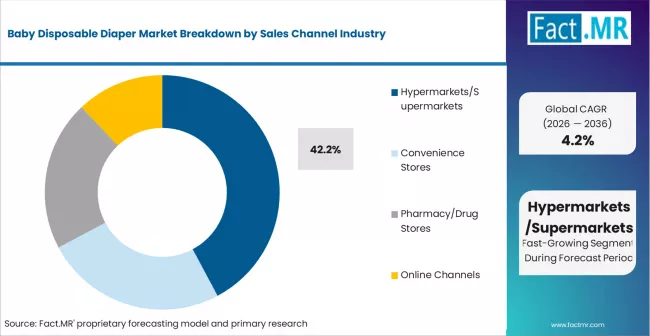
    Baby Disposable Diaper Market Analysis By Sales Channel

    Rising Sales of Baby Disposable Diapers through Supermarkets/Hypermarkets

    Consumers can purchase diapers from various specialty stores as well as from e-Commerce platforms. Sales of baby disposable diapers through hypermarkets/supermarkets are predicted to advance at a CAGR of 4.3% and reach US$ 20.63 billion by the end of the forecast period.

    Demand for baby disposable diapers is predicted to increase through supermarkets due to the easy availability of different brands under a single roof. Parents can make a comparative analysis of all available brands and can opt for one according to their desired choice. Moreover, some occasional discounts offered by supermarkets are also forecasted to attract consumers.

    Why is Demand for Super-absorbent Disposable Diapers Increasing Rapidly?
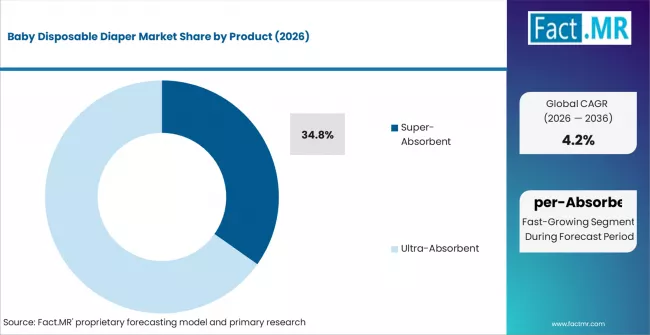
    Baby Disposable Diaper Market Analysis By Product

    Rising Use of Super-absorbent Polymers for Designing Extremely Absorbent Cores and Ensuring Thinness

    Demand for super-absorbent baby disposable diapers is increasing due to the increased use of super-absorbent polymers in designing extremely absorbent cores. These materials ensure the thinness of these baby disposable diapers. Leakage prevention allows diapers to absorb and lock wetness, which is further contributing to the popularity of baby disposable diapers.

    Key Market Players
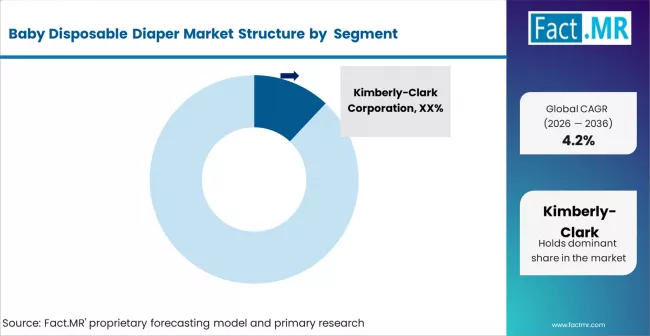
    Baby Disposable Diaper Market Analysis By Company

    In recent years, market players have been investing in new developments, strengthening their supply chain management systems, ensuring the delivery of quality products, maintaining product standards, etc.

    Acquisitions, mergers, product launches, etc., are some strategies that are adopted by industry players.

    For instance :

    • Kimberly-Clark opened its new manufacturing unit in Ikorodu, Lagos, Nigeria in March 2022. This facility is predicted to engage in the manufacturing of Huggies baby diapers along with Kotex feminine care products. Investments by the company equipped it with the latest technology to ensure consumer satisfaction while delivering quality products.
    • In December 2021, Ontex Group launched Climaflex technology for manufacturing a next-generation diaper core. It has breathable and ultra-thin technology that preserves absorbency and makes it suitable for fast-moving babies as well.

    Key players in the baby disposable diaper market are Kao Corporation, RAD Medical, MEGA, Kimberly-Clark Corporation, TZMO, The Procter & Gamble Company, Fippi, Domtar, Delipap Oy, Ontex International N.V., Linette HELLAS, Futura Line, Europrosan SpA, Hygienika, Unicharm Corporation, and Svenska Cellulose Aktiebolaget SCA.

    Scope of the Report

    Baby Disposable Diaper Market Breakdown By Product, Age Group, And Region
    Metric Value
    Quantitative Units USD 52.82 billion to USD 79.71 billion, at a CAGR of 4.2%
    Market Definition The Baby Disposable Diaper market covers single-use super-absorbent and ultra-absorbent diapering products for infants from birth through 48 months, distributed through hypermarkets, pharmacies, convenience stores, and online channels globally.
    Product Segmentation Super-Absorbent, Ultra-Absorbent
    Age Group Segmentation 0 to 6 Month Babies, 7 to 18 Month Babies, 19 to 48 Month Babies
    Sales Channel Segmentation Hypermarkets/Supermarkets, Convenience Stores, Pharmacy/Drug Stores, Online Channels
    Regions Covered North America, Latin America, Europe, East Asia, South Asia, Oceania, Middle East and Africa
    Countries Covered India, Germany, Brazil, UK, USA, Japan, and 40 plus countries
    Key Companies Profiled Kimberly-Clark Corporation, Ontex Group, Kao Corporation, RAD Medical, MEGA, TZMO, The Procter and Gamble Company, Fippi, Domtar, Delipap Oy, Linette HELLAS, Futura Line, Europrosan SpA, Hygienika, Unicharm Corporation, Svenska Cellulose Aktiebolaget SCA
    Forecast Period 2026 to 2036
    Approach Bottom-up aggregation of retail sell-out volumes with birth cohort size projections and household income growth curves applied to regional adoption models

    Segmentation of Baby Disposable Diaper Industry Research

    • By Product :

      • Super-absorbent
      • Ultra-absorbent
    • By Age Group :

      • 0 to 6 Month Babies
      • 7 to 18 Month Babies
      • 19 to 48 Month Babies
    • By Sales Channel :

      • Hypermarkets/Supermarkets
      • Convenience Stores
      • Pharmacy/Drug Stores
      • Online Channels
    • By Region :

      • North America
      • Europe
      • Asia Pacific
      • Latin America
      • Middle East & Africa

    Bibliography

    • United Nations Population Fund. (2024). World population dashboard: Birth rate and infant population statistics. UNFPA.
    • European Commission, Directorate-General for Environment. (2024). Packaging and Packaging Waste Regulation: Disposable hygiene product requirements. European Commission.
    • United States Environmental Protection Agency. (2024). Solid waste and municipal solid waste: Diaper disposal statistics. US EPA.
    • Organisation for Economic Co-operation and Development. (2024). Extended producer responsibility: Disposable hygiene product management. OECD Publishing.
    • Government of India, Ministry of Commerce and Industry. (2024). Bureau of Indian Standards: Baby care product quality standards update. BIS.
    • World Health Organization. (2024). Infant and young child health statistics: Global birth rate data. WHO.

    This bibliography is provided for reader reference. The full FACT.MR report contains the complete reference list with primary research documentation.

    This Report Addresses

    • Market sizing and quantitative forecast metrics detailing revenue projections for the Baby Disposable Diaper market across product, age group, and sales channel categories through 2036.
    • Segmentation analysis mapping adoption velocity across super-absorbent and ultra-absorbent product formats by infant age group and retail distribution channel.
    • Regional intelligence comparing first-time adoption dynamics in India and Brazil against premium product premiumization strategies in mature markets in Germany, UK, and the USA.
    • Packaging waste regulatory assessment analyzing how EU Packaging and Packaging Waste Regulation and national environmental standards affect disposable diaper product design requirements.
    • Competitive landscape evaluation tracking branded manufacturer strategy against expanding private-label retail chain programs across hypermarket and pharmacy distribution channels.
    • Consumer behavior analysis identifying urbanization, convenience preference, and premium skin-care claim responsiveness as key household adoption and retention drivers.
    • Channel strategy guidance defining hypermarket, pharmacy, online subscription, and convenience store optimization priorities for disposable diaper volume and margin management.
    • Custom data delivery formats encompassing interactive dashboards, raw Excel datasets, and comprehensive PDF narrative reports.

    Table of Content

  • Global Market Outlook
  • Demand to side Trends
  • Supply to side Trends
  • Technology Roadmap Analysis
  • Analysis and Recommendations
  • Market Overview
    • Market Coverage / Taxonomy
    • Market Definition / Scope / Limitations
  • Research Methodology
    • Chapter Orientation
    • Analytical Lens and Working Hypotheses
      • Market Structure, Signals, and Trend Drivers
      • Benchmarking and Cross-market Comparability
      • Market Sizing, Forecasting, and Opportunity Mapping
    • Research Design and Evidence Framework
      • Desk Research Programme (Secondary Evidence)
        • Company Annual and Sustainability Reports
        • Peer-reviewed Journals and Academic Literature
        • Corporate Websites, Product Literature, and Technical Notes
        • Earnings Decks and Investor Briefings
        • Statutory Filings and Regulatory Disclosures
        • Technical White Papers and Standards Notes
        • Trade Journals, Industry Magazines, and Analyst Briefs
        • Conference Proceedings, Webinars, and Seminar Materials
        • Government Statistics Portals and Public Data Releases
        • Press Releases and Reputable Media Coverage
        • Subscription Datasets and Paid Sources
        • Social Channels, Communities, and Digital Listening Inputs
        • Additional Desk Sources
      • Expert Input and Fieldwork (Primary Evidence)
        • Primary Modes
          • Qualitative Interviews and Expert Elicitation
          • Quantitative Surveys and Structured Data Capture
          • Blended Approach
        • Why Primary Evidence is Used
        • Field Techniques
          • Interviews
          • Surveys
          • Focus Groups
          • Observational and In-context Research
          • Social and Community Interactions
        • Stakeholder Universe Engaged
          • C-suite Leaders
          • Board Members
          • Presidents and Vice Presidents
          • R&D and Innovation Heads
          • Technical Specialists
          • Domain Subject-matter Experts
          • Scientists
          • Physicians and Other Healthcare Professionals
        • Governance, Ethics, and Data Stewardship
          • Research Ethics
          • Data Integrity and Handling
      • Tooling, Models, and Reference Databases
    • Data Engineering and Model Build
      • Data Acquisition and Ingestion
      • Cleaning, Normalisation, and Verification
      • Synthesis, Triangulation, and Analysis
    • Quality Assurance and Audit Trail
  • Market Background
    • Market Dynamics
      • Drivers
      • Restraints
      • Opportunity
      • Trends
    • Scenario Forecast
      • Demand in Optimistic Scenario
      • Demand in Likely Scenario
      • Demand in Conservative Scenario
    • Opportunity Map Analysis
    • Product Life Cycle Analysis
    • Supply Chain Analysis
    • Investment Feasibility Matrix
    • Value Chain Analysis
    • PESTLE and Porter’s Analysis
    • Regulatory Landscape
    • Regional Parent Market Outlook
    • Production and Consumption Statistics
    • Import and Export Statistics
  • Global Market Analysis 2021 to 2025 and Forecast, 2026 to 2036
    • Historical Market Size Value (USD Million) Analysis, 2021 to 2025
    • Current and Future Market Size Value (USD Million) Projections, 2026 to 2036
      • Y to o to Y Growth Trend Analysis
      • Absolute $ Opportunity Analysis
  • Global Market Pricing Analysis 2021 to 2025 and Forecast 2026 to 2036
  • Global Market Analysis 2021 to 2025 and Forecast 2026 to 2036, By Product
    • Introduction / Key Findings
    • Historical Market Size Value (USD Million) Analysis By Product , 2021 to 2025
    • Current and Future Market Size Value (USD Million) Analysis and Forecast By Product , 2026 to 2036
      • Super-Absorbent
      • Ultra-Absorbent
    • Y to o to Y Growth Trend Analysis By Product , 2021 to 2025
    • Absolute $ Opportunity Analysis By Product , 2026 to 2036
  • Global Market Analysis 2021 to 2025 and Forecast 2026 to 2036, By Age Group
    • Introduction / Key Findings
    • Historical Market Size Value (USD Million) Analysis By Age Group, 2021 to 2025
    • Current and Future Market Size Value (USD Million) Analysis and Forecast By Age Group, 2026 to 2036
      • 0 To 6 Month Babies
      • 7 To 18 Month Babies
      • 19 To 48 Month Babies
    • Y to o to Y Growth Trend Analysis By Age Group, 2021 to 2025
    • Absolute $ Opportunity Analysis By Age Group, 2026 to 2036
  • Global Market Analysis 2021 to 2025 and Forecast 2026 to 2036, By Sales Channel
    • Introduction / Key Findings
    • Historical Market Size Value (USD Million) Analysis By Sales Channel, 2021 to 2025
    • Current and Future Market Size Value (USD Million) Analysis and Forecast By Sales Channel, 2026 to 2036
      • Hypermarkets/Supermarkets
      • Convenience Stores
      • Pharmacy/Drug Stores
      • Online Channels
    • Y to o to Y Growth Trend Analysis By Sales Channel, 2021 to 2025
    • Absolute $ Opportunity Analysis By Sales Channel, 2026 to 2036
  • Global Market Analysis 2021 to 2025 and Forecast 2026 to 2036, By Flavor
    • Introduction / Key Findings
    • Historical Market Size Value (USD Million) Analysis By Flavor, 2021 to 2025
    • Current and Future Market Size Value (USD Million) Analysis and Forecast By Flavor, 2026 to 2036
      • Vanilla
      • Chocolate
      • Butter Pecan
      • Strawberry
      • Neapolitan
      • Cookies and Cream
      • Mint Choco Chip
      • Caramel
      • Others
      • Y to o to Y Growth Trend Analysis By Flavor, 2021 to 2025
      • Absolute $ Opportunity Analysis By Flavor, 2026 to 2036
    • Global Market Analysis 2021 to 2025 and Forecast 2026 to 2036, By Region
      • Introduction
      • Historical Market Size Value (USD Million) Analysis By Region, 2021 to 2025
      • Current Market Size Value (USD Million) Analysis and Forecast By Region, 2026 to 2036
        • North America
        • Latin America
        • Western Europe
        • Eastern Europe
        • East Asia
        • South Asia and Pacific
        • Middle East & Africa
      • Market Attractiveness Analysis By Region
    • North America Market Analysis 2021 to 2025 and Forecast 2026 to 2036, By Country
      • Historical Market Size Value (USD Million) Trend Analysis By Market Taxonomy, 2021 to 2025
      • Market Size Value (USD Million) Forecast By Market Taxonomy, 2026 to 2036
        • By Country
          • USA
          • Canada
          • Mexico
        • By Product
        • By Age Group
        • By Sales Channel
        • By Flavor
      • Market Attractiveness Analysis
        • By Country
        • By Product
        • By Age Group
        • By Sales Channel
        • By Flavor
      • Key Takeaways
    • Latin America Market Analysis 2021 to 2025 and Forecast 2026 to 2036, By Country
      • Historical Market Size Value (USD Million) Trend Analysis By Market Taxonomy, 2021 to 2025
      • Market Size Value (USD Million) Forecast By Market Taxonomy, 2026 to 2036
        • By Country
          • Brazil
          • Chile
          • Rest of Latin America
        • By Product
        • By Age Group
        • By Sales Channel
        • By Flavor
      • Market Attractiveness Analysis
        • By Country
        • By Product
        • By Age Group
        • By Sales Channel
        • By Flavor
      • Key Takeaways
    • Western Europe Market Analysis 2021 to 2025 and Forecast 2026 to 2036, By Country
      • Historical Market Size Value (USD Million) Trend Analysis By Market Taxonomy, 2021 to 2025
      • Market Size Value (USD Million) Forecast By Market Taxonomy, 2026 to 2036
        • By Country
          • Germany
          • UK
          • Italy
          • Spain
          • France
          • Nordic
          • BENELUX
          • Rest of Western Europe
        • By Product
        • By Age Group
        • By Sales Channel
        • By Flavor
      • Market Attractiveness Analysis
        • By Country
        • By Product
        • By Age Group
        • By Sales Channel
        • By Flavor
      • Key Takeaways
    • Eastern Europe Market Analysis 2021 to 2025 and Forecast 2026 to 2036, By Country
      • Historical Market Size Value (USD Million) Trend Analysis By Market Taxonomy, 2021 to 2025
      • Market Size Value (USD Million) Forecast By Market Taxonomy, 2026 to 2036
        • By Country
          • Russia
          • Poland
          • Hungary
          • Balkan & Baltic
          • Rest of Eastern Europe
        • By Product
        • By Age Group
        • By Sales Channel
        • By Flavor
      • Market Attractiveness Analysis
        • By Country
        • By Product
        • By Age Group
        • By Sales Channel
        • By Flavor
      • Key Takeaways
    • East Asia Market Analysis 2021 to 2025 and Forecast 2026 to 2036, By Country
      • Historical Market Size Value (USD Million) Trend Analysis By Market Taxonomy, 2021 to 2025
      • Market Size Value (USD Million) Forecast By Market Taxonomy, 2026 to 2036
        • By Country
          • China
          • Japan
          • South Korea
        • By Product
        • By Age Group
        • By Sales Channel
        • By Flavor
      • Market Attractiveness Analysis
        • By Country
        • By Product
        • By Age Group
        • By Sales Channel
        • By Flavor
      • Key Takeaways
    • South Asia and Pacific Market Analysis 2021 to 2025 and Forecast 2026 to 2036, By Country
      • Historical Market Size Value (USD Million) Trend Analysis By Market Taxonomy, 2021 to 2025
      • Market Size Value (USD Million) Forecast By Market Taxonomy, 2026 to 2036
        • By Country
          • India
          • ASEAN
          • Australia & New Zealand
          • Rest of South Asia and Pacific
        • By Product
        • By Age Group
        • By Sales Channel
        • By Flavor
      • Market Attractiveness Analysis
        • By Country
        • By Product
        • By Age Group
        • By Sales Channel
        • By Flavor
      • Key Takeaways
    • Middle East & Africa Market Analysis 2021 to 2025 and Forecast 2026 to 2036, By Country
      • Historical Market Size Value (USD Million) Trend Analysis By Market Taxonomy, 2021 to 2025
      • Market Size Value (USD Million) Forecast By Market Taxonomy, 2026 to 2036
        • By Country
          • Kingdom of Saudi Arabia
          • Other GCC Countries
          • Turkiye
          • South Africa
          • Other African Union
          • Rest of Middle East & Africa
        • By Product
        • By Age Group
        • By Sales Channel
        • By Flavor
      • Market Attractiveness Analysis
        • By Country
        • By Product
        • By Age Group
        • By Sales Channel
        • By Flavor
      • Key Takeaways
    • Key Countries Market Analysis
      • USA
        • Pricing Analysis
        • Market Share Analysis, 2025
          • By Product
          • By Age Group
          • By Sales Channel
          • By Flavor
      • Canada
        • Pricing Analysis
        • Market Share Analysis, 2025
          • By Product
          • By Age Group
          • By Sales Channel
          • By Flavor
      • Mexico
        • Pricing Analysis
        • Market Share Analysis, 2025
          • By Product
          • By Age Group
          • By Sales Channel
          • By Flavor
      • Brazil
        • Pricing Analysis
        • Market Share Analysis, 2025
          • By Product
          • By Age Group
          • By Sales Channel
          • By Flavor
      • Chile
        • Pricing Analysis
        • Market Share Analysis, 2025
          • By Product
          • By Age Group
          • By Sales Channel
          • By Flavor
      • Germany
        • Pricing Analysis
        • Market Share Analysis, 2025
          • By Product
          • By Age Group
          • By Sales Channel
          • By Flavor
      • UK
        • Pricing Analysis
        • Market Share Analysis, 2025
          • By Product
          • By Age Group
          • By Sales Channel
          • By Flavor
      • Italy
        • Pricing Analysis
        • Market Share Analysis, 2025
          • By Product
          • By Age Group
          • By Sales Channel
          • By Flavor
      • Spain
        • Pricing Analysis
        • Market Share Analysis, 2025
          • By Product
          • By Age Group
          • By Sales Channel
          • By Flavor
      • France
        • Pricing Analysis
        • Market Share Analysis, 2025
          • By Product
          • By Age Group
          • By Sales Channel
          • By Flavor
      • India
        • Pricing Analysis
        • Market Share Analysis, 2025
          • By Product
          • By Age Group
          • By Sales Channel
          • By Flavor
      • ASEAN
        • Pricing Analysis
        • Market Share Analysis, 2025
          • By Product
          • By Age Group
          • By Sales Channel
          • By Flavor
      • Australia & New Zealand
        • Pricing Analysis
        • Market Share Analysis, 2025
          • By Product
          • By Age Group
          • By Sales Channel
          • By Flavor
      • China
        • Pricing Analysis
        • Market Share Analysis, 2025
          • By Product
          • By Age Group
          • By Sales Channel
          • By Flavor
      • Japan
        • Pricing Analysis
        • Market Share Analysis, 2025
          • By Product
          • By Age Group
          • By Sales Channel
          • By Flavor
      • South Korea
        • Pricing Analysis
        • Market Share Analysis, 2025
          • By Product
          • By Age Group
          • By Sales Channel
          • By Flavor
      • Russia
        • Pricing Analysis
        • Market Share Analysis, 2025
          • By Product
          • By Age Group
          • By Sales Channel
          • By Flavor
      • Poland
        • Pricing Analysis
        • Market Share Analysis, 2025
          • By Product
          • By Age Group
          • By Sales Channel
          • By Flavor
      • Hungary
        • Pricing Analysis
        • Market Share Analysis, 2025
          • By Product
          • By Age Group
          • By Sales Channel
          • By Flavor
      • Kingdom of Saudi Arabia
        • Pricing Analysis
        • Market Share Analysis, 2025
          • By Product
          • By Age Group
          • By Sales Channel
          • By Flavor
      • Turkiye
        • Pricing Analysis
        • Market Share Analysis, 2025
          • By Product
          • By Age Group
          • By Sales Channel
          • By Flavor
      • South Africa
        • Pricing Analysis
        • Market Share Analysis, 2025
          • By Product
          • By Age Group
          • By Sales Channel
          • By Flavor
    • Market Structure Analysis
      • Competition Dashboard
      • Competition Benchmarking
      • Market Share Analysis of Top Players
        • By Regional
        • By Product
        • By Age Group
        • By Sales Channel
        • By Flavor
    • Competition Analysis
      • Competition Deep Dive
        • Kimberly-Clark Corporation
          • Overview
          • Product Portfolio
          • Profitability by Market Segments (Product/Age /Sales Channel/Region)
          • Sales Footprint
          • Strategy Overview
            • Marketing Strategy
            • Product Strategy
            • Channel Strategy
        • Ontex Group (Ontex International N.V.)
        • Kao Corporation
        • RAD Medical
        • MEGA
        • TZMO
        • The Procter & Gamble Company
        • Fippi
        • Domtar
        • Delipap Oy
        • Linette HELLAS
        • Futura Line
        • Europrosan SpA
        • Hygienika
        • Unicharm Corporation
        • Svenska Cellulose Aktiebolaget SCA
  • Assumptions & Acronyms Used
  • List Of Table

    • Table 1: Global Market Value (USD Million) Forecast by Region, 2021 to 2036
    • Table 2: Global Market Value (USD Million) Forecast by Product , 2021 to 2036
    • Table 3: Global Market Value (USD Million) Forecast by Age Group, 2021 to 2036
    • Table 4: Global Market Value (USD Million) Forecast by Sales Channel, 2021 to 2036
    • Table 5: Global Market Value (USD Million) Forecast by Flavor, 2021 to 2036
    • Table 6: North America Market Value (USD Million) Forecast by Country, 2021 to 2036
    • Table 7: North America Market Value (USD Million) Forecast by Product , 2021 to 2036
    • Table 8: North America Market Value (USD Million) Forecast by Age Group, 2021 to 2036
    • Table 9: North America Market Value (USD Million) Forecast by Sales Channel, 2021 to 2036
    • Table 10: North America Market Value (USD Million) Forecast by Flavor, 2021 to 2036
    • Table 11: Latin America Market Value (USD Million) Forecast by Country, 2021 to 2036
    • Table 12: Latin America Market Value (USD Million) Forecast by Product , 2021 to 2036
    • Table 13: Latin America Market Value (USD Million) Forecast by Age Group, 2021 to 2036
    • Table 14: Latin America Market Value (USD Million) Forecast by Sales Channel, 2021 to 2036
    • Table 15: Latin America Market Value (USD Million) Forecast by Flavor, 2021 to 2036
    • Table 16: Western Europe Market Value (USD Million) Forecast by Country, 2021 to 2036
    • Table 17: Western Europe Market Value (USD Million) Forecast by Product , 2021 to 2036
    • Table 18: Western Europe Market Value (USD Million) Forecast by Age Group, 2021 to 2036
    • Table 19: Western Europe Market Value (USD Million) Forecast by Sales Channel, 2021 to 2036
    • Table 20: Western Europe Market Value (USD Million) Forecast by Flavor, 2021 to 2036
    • Table 21: Eastern Europe Market Value (USD Million) Forecast by Country, 2021 to 2036
    • Table 22: Eastern Europe Market Value (USD Million) Forecast by Product , 2021 to 2036
    • Table 23: Eastern Europe Market Value (USD Million) Forecast by Age Group, 2021 to 2036
    • Table 24: Eastern Europe Market Value (USD Million) Forecast by Sales Channel, 2021 to 2036
    • Table 25: Eastern Europe Market Value (USD Million) Forecast by Flavor, 2021 to 2036
    • Table 26: East Asia Market Value (USD Million) Forecast by Country, 2021 to 2036
    • Table 27: East Asia Market Value (USD Million) Forecast by Product , 2021 to 2036
    • Table 28: East Asia Market Value (USD Million) Forecast by Age Group, 2021 to 2036
    • Table 29: East Asia Market Value (USD Million) Forecast by Sales Channel, 2021 to 2036
    • Table 30: East Asia Market Value (USD Million) Forecast by Flavor, 2021 to 2036
    • Table 31: South Asia and Pacific Market Value (USD Million) Forecast by Country, 2021 to 2036
    • Table 32: South Asia and Pacific Market Value (USD Million) Forecast by Product , 2021 to 2036
    • Table 33: South Asia and Pacific Market Value (USD Million) Forecast by Age Group, 2021 to 2036
    • Table 34: South Asia and Pacific Market Value (USD Million) Forecast by Sales Channel, 2021 to 2036
    • Table 35: South Asia and Pacific Market Value (USD Million) Forecast by Flavor, 2021 to 2036
    • Table 36: Middle East & Africa Market Value (USD Million) Forecast by Country, 2021 to 2036
    • Table 37: Middle East & Africa Market Value (USD Million) Forecast by Product , 2021 to 2036
    • Table 38: Middle East & Africa Market Value (USD Million) Forecast by Age Group, 2021 to 2036
    • Table 39: Middle East & Africa Market Value (USD Million) Forecast by Sales Channel, 2021 to 2036
    • Table 40: Middle East & Africa Market Value (USD Million) Forecast by Flavor, 2021 to 2036

    List Of Figures

    • Figure 1: Global Market Pricing Analysis
    • Figure 2: Global Market Value (USD Million) Forecast 2021-2036
    • Figure 3: Global Market Value Share and BPS Analysis by Product , 2026 and 2036
    • Figure 4: Global Market Y-o-Y Growth Comparison by Product , 2026-2036
    • Figure 5: Global Market Attractiveness Analysis by Product
    • Figure 6: Global Market Value Share and BPS Analysis by Age Group, 2026 and 2036
    • Figure 7: Global Market Y-o-Y Growth Comparison by Age Group, 2026-2036
    • Figure 8: Global Market Attractiveness Analysis by Age Group
    • Figure 9: Global Market Value Share and BPS Analysis by Sales Channel, 2026 and 2036
    • Figure 10: Global Market Y-o-Y Growth Comparison by Sales Channel, 2026-2036
    • Figure 11: Global Market Attractiveness Analysis by Sales Channel
    • Figure 12: Global Market Value Share and BPS Analysis by Flavor, 2026 and 2036
    • Figure 13: Global Market Y-o-Y Growth Comparison by Flavor, 2026-2036
    • Figure 14: Global Market Attractiveness Analysis by Flavor
    • Figure 15: Global Market Value (USD Million) Share and BPS Analysis by Region, 2026 and 2036
    • Figure 16: Global Market Y-o-Y Growth Comparison by Region, 2026-2036
    • Figure 17: Global Market Attractiveness Analysis by Region
    • Figure 18: North America Market Incremental Dollar Opportunity, 2026-2036
    • Figure 19: Latin America Market Incremental Dollar Opportunity, 2026-2036
    • Figure 20: Western Europe Market Incremental Dollar Opportunity, 2026-2036
    • Figure 21: Eastern Europe Market Incremental Dollar Opportunity, 2026-2036
    • Figure 22: East Asia Market Incremental Dollar Opportunity, 2026-2036
    • Figure 23: South Asia and Pacific Market Incremental Dollar Opportunity, 2026-2036
    • Figure 24: Middle East & Africa Market Incremental Dollar Opportunity, 2026-2036
    • Figure 25: North America Market Value Share and BPS Analysis by Country, 2026 and 2036
    • Figure 26: North America Market Value Share and BPS Analysis by Product , 2026 and 2036
    • Figure 27: North America Market Y-o-Y Growth Comparison by Product , 2026-2036
    • Figure 28: North America Market Attractiveness Analysis by Product
    • Figure 29: North America Market Value Share and BPS Analysis by Age Group, 2026 and 2036
    • Figure 30: North America Market Y-o-Y Growth Comparison by Age Group, 2026-2036
    • Figure 31: North America Market Attractiveness Analysis by Age Group
    • Figure 32: North America Market Value Share and BPS Analysis by Sales Channel, 2026 and 2036
    • Figure 33: North America Market Y-o-Y Growth Comparison by Sales Channel, 2026-2036
    • Figure 34: North America Market Attractiveness Analysis by Sales Channel
    • Figure 35: North America Market Value Share and BPS Analysis by Flavor, 2026 and 2036
    • Figure 36: North America Market Y-o-Y Growth Comparison by Flavor, 2026-2036
    • Figure 37: North America Market Attractiveness Analysis by Flavor
    • Figure 38: Latin America Market Value Share and BPS Analysis by Country, 2026 and 2036
    • Figure 39: Latin America Market Value Share and BPS Analysis by Product , 2026 and 2036
    • Figure 40: Latin America Market Y-o-Y Growth Comparison by Product , 2026-2036
    • Figure 41: Latin America Market Attractiveness Analysis by Product
    • Figure 42: Latin America Market Value Share and BPS Analysis by Age Group, 2026 and 2036
    • Figure 43: Latin America Market Y-o-Y Growth Comparison by Age Group, 2026-2036
    • Figure 44: Latin America Market Attractiveness Analysis by Age Group
    • Figure 45: Latin America Market Value Share and BPS Analysis by Sales Channel, 2026 and 2036
    • Figure 46: Latin America Market Y-o-Y Growth Comparison by Sales Channel, 2026-2036
    • Figure 47: Latin America Market Attractiveness Analysis by Sales Channel
    • Figure 48: Latin America Market Value Share and BPS Analysis by Flavor, 2026 and 2036
    • Figure 49: Latin America Market Y-o-Y Growth Comparison by Flavor, 2026-2036
    • Figure 50: Latin America Market Attractiveness Analysis by Flavor
    • Figure 51: Western Europe Market Value Share and BPS Analysis by Country, 2026 and 2036
    • Figure 52: Western Europe Market Value Share and BPS Analysis by Product , 2026 and 2036
    • Figure 53: Western Europe Market Y-o-Y Growth Comparison by Product , 2026-2036
    • Figure 54: Western Europe Market Attractiveness Analysis by Product
    • Figure 55: Western Europe Market Value Share and BPS Analysis by Age Group, 2026 and 2036
    • Figure 56: Western Europe Market Y-o-Y Growth Comparison by Age Group, 2026-2036
    • Figure 57: Western Europe Market Attractiveness Analysis by Age Group
    • Figure 58: Western Europe Market Value Share and BPS Analysis by Sales Channel, 2026 and 2036
    • Figure 59: Western Europe Market Y-o-Y Growth Comparison by Sales Channel, 2026-2036
    • Figure 60: Western Europe Market Attractiveness Analysis by Sales Channel
    • Figure 61: Western Europe Market Value Share and BPS Analysis by Flavor, 2026 and 2036
    • Figure 62: Western Europe Market Y-o-Y Growth Comparison by Flavor, 2026-2036
    • Figure 63: Western Europe Market Attractiveness Analysis by Flavor
    • Figure 64: Eastern Europe Market Value Share and BPS Analysis by Country, 2026 and 2036
    • Figure 65: Eastern Europe Market Value Share and BPS Analysis by Product , 2026 and 2036
    • Figure 66: Eastern Europe Market Y-o-Y Growth Comparison by Product , 2026-2036
    • Figure 67: Eastern Europe Market Attractiveness Analysis by Product
    • Figure 68: Eastern Europe Market Value Share and BPS Analysis by Age Group, 2026 and 2036
    • Figure 69: Eastern Europe Market Y-o-Y Growth Comparison by Age Group, 2026-2036
    • Figure 70: Eastern Europe Market Attractiveness Analysis by Age Group
    • Figure 71: Eastern Europe Market Value Share and BPS Analysis by Sales Channel, 2026 and 2036
    • Figure 72: Eastern Europe Market Y-o-Y Growth Comparison by Sales Channel, 2026-2036
    • Figure 73: Eastern Europe Market Attractiveness Analysis by Sales Channel
    • Figure 74: Eastern Europe Market Value Share and BPS Analysis by Flavor, 2026 and 2036
    • Figure 75: Eastern Europe Market Y-o-Y Growth Comparison by Flavor, 2026-2036
    • Figure 76: Eastern Europe Market Attractiveness Analysis by Flavor
    • Figure 77: East Asia Market Value Share and BPS Analysis by Country, 2026 and 2036
    • Figure 78: East Asia Market Value Share and BPS Analysis by Product , 2026 and 2036
    • Figure 79: East Asia Market Y-o-Y Growth Comparison by Product , 2026-2036
    • Figure 80: East Asia Market Attractiveness Analysis by Product
    • Figure 81: East Asia Market Value Share and BPS Analysis by Age Group, 2026 and 2036
    • Figure 82: East Asia Market Y-o-Y Growth Comparison by Age Group, 2026-2036
    • Figure 83: East Asia Market Attractiveness Analysis by Age Group
    • Figure 84: East Asia Market Value Share and BPS Analysis by Sales Channel, 2026 and 2036
    • Figure 85: East Asia Market Y-o-Y Growth Comparison by Sales Channel, 2026-2036
    • Figure 86: East Asia Market Attractiveness Analysis by Sales Channel
    • Figure 87: East Asia Market Value Share and BPS Analysis by Flavor, 2026 and 2036
    • Figure 88: East Asia Market Y-o-Y Growth Comparison by Flavor, 2026-2036
    • Figure 89: East Asia Market Attractiveness Analysis by Flavor
    • Figure 90: South Asia and Pacific Market Value Share and BPS Analysis by Country, 2026 and 2036
    • Figure 91: South Asia and Pacific Market Value Share and BPS Analysis by Product , 2026 and 2036
    • Figure 92: South Asia and Pacific Market Y-o-Y Growth Comparison by Product , 2026-2036
    • Figure 93: South Asia and Pacific Market Attractiveness Analysis by Product
    • Figure 94: South Asia and Pacific Market Value Share and BPS Analysis by Age Group, 2026 and 2036
    • Figure 95: South Asia and Pacific Market Y-o-Y Growth Comparison by Age Group, 2026-2036
    • Figure 96: South Asia and Pacific Market Attractiveness Analysis by Age Group
    • Figure 97: South Asia and Pacific Market Value Share and BPS Analysis by Sales Channel, 2026 and 2036
    • Figure 98: South Asia and Pacific Market Y-o-Y Growth Comparison by Sales Channel, 2026-2036
    • Figure 99: South Asia and Pacific Market Attractiveness Analysis by Sales Channel
    • Figure 100: South Asia and Pacific Market Value Share and BPS Analysis by Flavor, 2026 and 2036
    • Figure 101: South Asia and Pacific Market Y-o-Y Growth Comparison by Flavor, 2026-2036
    • Figure 102: South Asia and Pacific Market Attractiveness Analysis by Flavor
    • Figure 103: Middle East & Africa Market Value Share and BPS Analysis by Country, 2026 and 2036
    • Figure 104: Middle East & Africa Market Value Share and BPS Analysis by Product , 2026 and 2036
    • Figure 105: Middle East & Africa Market Y-o-Y Growth Comparison by Product , 2026-2036
    • Figure 106: Middle East & Africa Market Attractiveness Analysis by Product
    • Figure 107: Middle East & Africa Market Value Share and BPS Analysis by Age Group, 2026 and 2036
    • Figure 108: Middle East & Africa Market Y-o-Y Growth Comparison by Age Group, 2026-2036
    • Figure 109: Middle East & Africa Market Attractiveness Analysis by Age Group
    • Figure 110: Middle East & Africa Market Value Share and BPS Analysis by Sales Channel, 2026 and 2036
    • Figure 111: Middle East & Africa Market Y-o-Y Growth Comparison by Sales Channel, 2026-2036
    • Figure 112: Middle East & Africa Market Attractiveness Analysis by Sales Channel
    • Figure 113: Middle East & Africa Market Value Share and BPS Analysis by Flavor, 2026 and 2036
    • Figure 114: Middle East & Africa Market Y-o-Y Growth Comparison by Flavor, 2026-2036
    • Figure 115: Middle East & Africa Market Attractiveness Analysis by Flavor
    • Figure 116: Global Market - Tier Structure Analysis
    • Figure 117: Global Market - Company Share Analysis

    - FAQs -

    How large is the demand for Baby Disposable Diapers in the global market in 2026?

    Demand for Baby Disposable Diapers in the global market is estimated to be valued at USD 52.82 billion in 2026.

    What will be the market size of Baby Disposable Diapers by 2036?

    Market size for Baby Disposable Diapers is projected to reach USD 79.71 billion by 2036.

    What is the expected demand growth between 2026 and 2036?

    Demand for Baby Disposable Diapers is expected to grow at a CAGR of 4.2% between 2026 and 2036.

    Which Product format leads global sales by 2026?

    Super-Absorbent diapers account for 34.8% of product share in 2026, where overnight protection reliability, extended-wear convenience, and premium positioning sustain consumer willingness to pay above standard category price points.

    Which Age Group dominates the Baby Disposable Diaper market?

    0 to 6 Month Babies represent 57.6% of Age Group share in 2026, as newborn-stage diapering frequency and product-specific formulation requirements generate the highest purchase intensity per household.

    What is India's growth outlook in this report?

    India is projected to expand at a CAGR of 5.25% during 2026 to 2036, as modern retail and e-commerce distribution progressively converts traditional cloth diaper households to disposable adoption in urban and semi-urban markets.

    What drives demand in Germany?

    Premium eco-certified disposable diaper demand from environmentally conscious parent demographics supports Germany's 4.83% CAGR through 2036, partially offsetting household shifts toward cloth diaper alternatives.

    Which Sales Channel leads distribution?

    Hypermarkets and Supermarkets capture 42.2% of Sales Channel share in 2026, where physical product visibility, promotional pricing, and bundled baby care convenience drive category volume concentration.

    What is excluded from the report scope?

    Reusable cloth diapers, adult incontinence products, aquatic swim diapers, and toilet training pull-up pants are excluded from the core baby disposable diaper market valuation.

    How does FACT.MR validate the Baby Disposable Diaper forecast?

    Forecasts cross-validate against Procter and Gamble, Kimberly-Clark, Kao Corporation, and Unicharm Corporation quarterly baby care segment revenue disclosures.

    Baby Disposable Diaper Market