Hybrid Electric Vehicles Market (2026 - 2036)

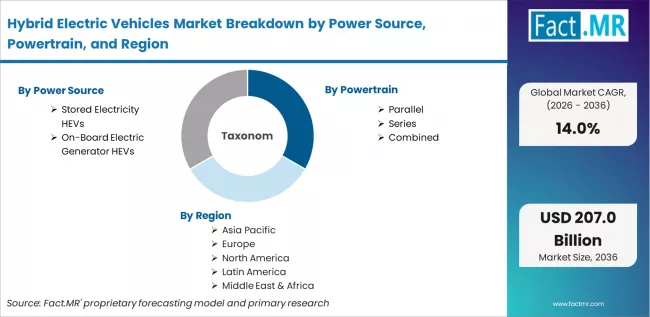
Hybrid Electric Vehicles Market is segmented by Power Source (Stored Electricity HEVs, On-Board Electric Generator HEVs), Powertrain (Parallel, Series, Combined), Vehicle (Hybrid Electric Passenger Cars, Commercial Hybrid Electric Vehicles, Hybrid Electric Two Wheelers, Other HEVs), and Region. Forecast for 2026 to 2036.

Core Findings

    Hybrid Electric Vehicles Market Definition

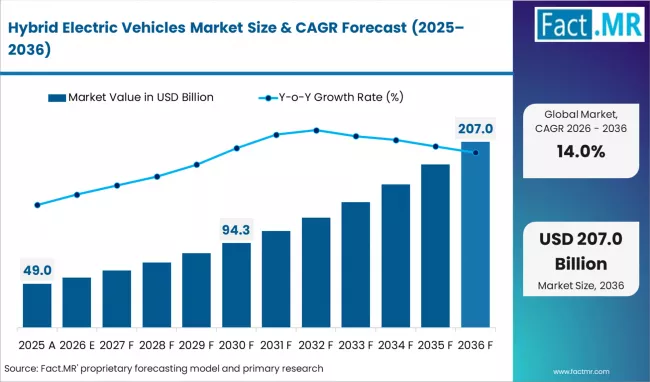
    The hybrid electric vehicles market was valued at USD 48.98 billion in 2025, projected to reach USD 55.84 billion in 2026, and is forecast to expand to USD 207.00 billion by 2036 at a 14.00% CAGR. Tightening emissions standards across the European Union, United States, and China are accelerating fleet electrification timelines for original equipment manufacturers. Corporate average fuel economy mandates compel automakers to expand their hybrid model portfolios, particularly in markets where full battery electric infrastructure remains incomplete.
    Hybrid Electric Vehicles Market Market Value Analysis

    Summary of Hybrid Electric Vehicles Market

    • Hybrid Electric Vehicles Market Definition
      • Hybrid electric vehicles integrate dual powertrain architectures combining combustion engines with electric motor assemblies, enabling reduced fuel consumption and lower tailpipe emissions across passenger and commercial vehicle platforms.
    • Demand Drivers in the Market
      • Government fleet emission targets in Europe, China, and North America compel automakers to expand hybrid vehicle production capacity to meet compliance deadlines that penalize manufacturers exceeding CO2 fleet averages.
      • Consumer preference for reduced fuel expenditure in markets with volatile petroleum pricing sustains procurement of hybrid passenger vehicles that deliver measurable per-kilometer cost advantages over conventional engines.
      • Incomplete public charging infrastructure in rural and suburban geographies positions hybrid drivetrains as the practical electrification pathway for buyers who cannot rely on daily access to dedicated battery charging points.
    • Key Segments Analyzed in the Fact.MR Report
      • Stored Electricity HEVs: 64.0% share in 2026, reflecting the dominant configuration within the power source category across global markets.
      • Parallel: 46.0% share in 2026, as the leading sub-segment within powertrain segmentation.
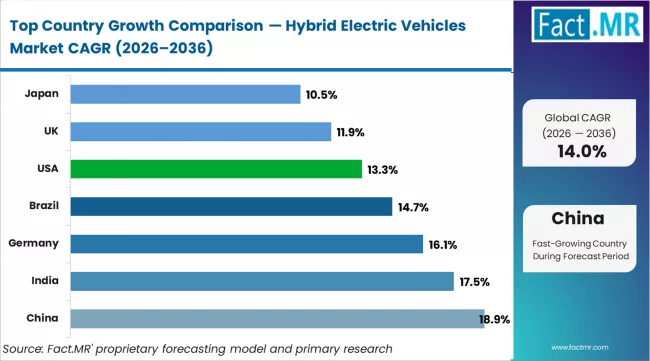
      • China: 18.9% compound growth, representing the fastest-expanding national market within the forecast period.
    • Analyst Opinion at Fact.MR
      • The hybrid electric vehicle sector is at a critical juncture where regulatory compliance deadlines, battery material cost trajectories, and charging infrastructure gaps converge to determine the pace of powertrain migration. Automakers that fail to establish scalable hybrid production platforms before the next round of fleet CO2 penalties risk margin compression that pure pricing adjustments cannot offset. The parallel hybrid architecture retains a structural cost advantage over series configurations in mid-size passenger segments, but this advantage narrows as battery cell costs continue their decline curve. Supply chain directors must secure long-term commitments for electric motor assemblies and power electronics to avoid allocation bottlenecks during peak model launch cycles.
    • Strategic Implications / Executive Takeaways
      • Powertrain engineering directors must accelerate parallel hybrid platform development to meet 2028 to 2030 fleet CO2 compliance deadlines in Europe and North America before penalty thresholds trigger margin erosion.
      • Supply chain leads should secure multi-year procurement agreements for electric motor assemblies and power inverter modules to prevent allocation shortfalls during concentrated model launch windows.
      • Regional sales strategists must prioritize hybrid model availability in markets where public charging infrastructure coverage falls below the threshold needed for full battery electric vehicle viability.

    Hybrid Electric Vehicles Market Key Takeaways

    Metric Details
    Industry Size (2026) USD 55.84 billion
    Industry Value (2036) USD 207.00 billion
    CAGR (2026 to 2036) 14.00%

    The absolute dollar opportunity between 2026 and 2036 amounts to approximately USD 151.16 billion. This expansion is concentrated in parallel hybrid drivetrains, which allow manufacturers to leverage existing transmission architectures while meeting progressively stringent CO2 fleet targets. Feedstock cost variability in battery materials, combined with infrastructure constraints in rural markets, limits the pace at which full electric vehicles can displace hybrid platforms. As per Fact.MR analysis, hybrid vehicles serve as a transitional powertrain solution where charging network maturity remains below the threshold required for mass BEV adoption.

    All major regional markets reflect differentiated deployment parameters. China leads the pace with a 18.9% CAGR, followed by India at 16.8%, USA registers 13.5%, Germany registers 12.2%, UK registers 11.8%, Japan registers 10.5%, and South Korea expands at a 9.7% trajectory.

    Hybrid electric vehicles combine a conventional internal combustion engine with an electric propulsion system, allowing the vehicle to operate on either power source or both simultaneously. The market covers the sale of vehicles equipped with parallel, series, or combined hybrid drivetrains across passenger and commercial vehicle categories.

    How are Power-Split and Gasoline Powered Hybrid Electric Vehicles Acquiring Traction?

    Amongst all hybrid vehicle architectures, the power-split hybrid electric vehicles (PS-HEVs) have been proven to be the most efficient and are projected to hold a majority of the global hybrid vehicles market revenue share.

    Gasoline hybrid vehicles are favored over diesel hybrid vehicles due to improved performance, high fuel efficiency, and low tailpipe emissions. A vehicle uses only a small fraction of the energy available in gasoline to operate.

    Gasoline is the dominant transportation fuel in the United States. On an energy content basis, finished motor gasoline accounted for 62% of total U.S. transportation energy use in 2020, while distillate fuels, mostly diesel, accounted for 24%, and jet fuel accounted for 10%.

    How are the Algorithmic Trends Stepping up Fuel Efficiency in Hybrid Electric Vehicles?

    Newer and smarter algorithms are all set to revolutionize the fuel efficiency of hybrid electric vehicles. Owing to these trends, hybrid electric vehicles will capture a large market share of around US$ 29 Bn in the year 2021.

    Hybrid electric vehicles are largely dependent on an energy management system that helps them to maintain an equilibrium between the electric motor and the internal combustion engine. Many new universities are now pioneering algorithms to help achieve this objective.

    Technical teams at several universities are developing highly nuanced algorithms that can calculate the energy consumption of a hybrid vehicle in a very optimal manner.

    For instance, a team at the Technical University of Dresden developed a new algorithm that could calculate optimal energy use up to one hundred thousand times faster than systems in use today. According to researchers, this method could increase fuel efficiency by as much as 50%.

    This would help to enhance fuel efficiency by at least 50% thus bolstering the demand for hybrid electric vehicles during the forecast period. Since these algorithms have been found to be highly complex, future research will focus on reducing the computational effort of these algorithms. This will improve drivability.

    How are Refillable Batteries Generating Opportunities for HEV Sales?

    Hybrid electric vehicles induce considerable anxiety amongst motorists due to the limited availability of charging stations and range limitations. This can now be offset with scientists working on refillable or flow batteries that can be refueled in minutes at any gas station.

    In April 2021, BYD announced the launch of 4 new electric vehicles equipped with an ultra-safe battery technology developed by the company itself. Pure electric vehicles come with blade batteries. The brand has always ensured the safety offered by its batteries by conducting various safety standard tests and thereafter installing them in their vehicles.

    What Potential Do the Innovative Technology Fluids Hold?

    Key market players are rushing to reach the finish line by innovating a broad line of fluids and lubricants for the electric and hybrid-electric fleet of cars.

    For instance, Total is massively consolidating its position by introducing a range of fluids that are specially designed for electric and hybrid vehicles. Total’s research and development teams are all geared up to meet the cooling and lubrication needs of these modern and differently-abled engines.

    This is done to ensure that they maintain their peak condition throughout the engine’s lifecycle. Their new product line consists of an eclectic mix such as Total Quartz EV fluid and Total Rubia EV fluid for a wide range of hybrid and electric vehicles.

    These dynamic fluids help to fulfill myriad applications such as boosting dielectric properties of the engine, compatibility with new electric components, lubrication for transmission, and a solution for temperature constraints.

    In addition to this, in July 2021, TotalEnergies and Technip Energies signed a Technical Cooperation Agreement to jointly develop low-carbon solutions for Liquefied Natural Gas (LNG) production and offshore facilities to accelerate the energy transition.

    Country-Wise Analysis

    Top Country Growth Comparison Hybrid Electric Vehicles Market Cagr (2026 2036)

    What is the Growth Outlook for Hybrid Electric Vehicles in India?
    Hybrid Electric Vehicles Market Cagr Analysis By Country

    India is expected to remain lucrative during the forecast period owing to the presence of industry giants, rapid urbanization, and government initiatives. A market share worth 20% is projected for the Indian market in the forthcoming decade.

    The Government of India announced the imposition of Faster Adoption and Manufacturing of (Hybrid) and Electric Vehicles (FAME) in October 2019. As part of Faster Adoption and Manufacturing of (Hybrid) and Electric Vehicles (FAME), the Indian government announced the acquisition of 7,000 electric buses, 55k four-wheelers, and 10,00,000 two-wheelers.

    What is Bolstering the Market in the U.S?
    Hybrid Electric Vehicles Market Country Value Analysis

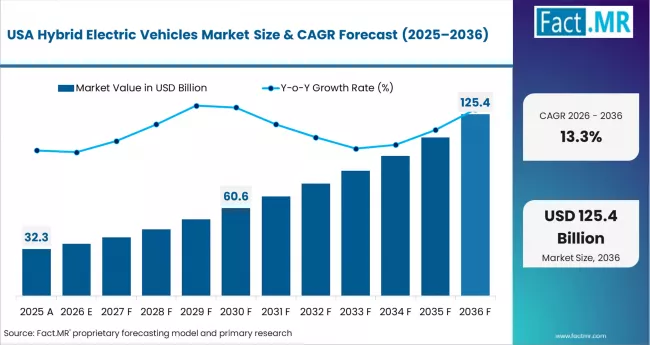
    The U.S will witness major growth as the research and development in the region have made way for significant uptakes in infrastructure, costs, and product innovation. A CAGR of 7% is projected for the region through 2031.

    In April 2021 President Biden announced that he wants 50 percent of all new cars sold in the United States in 2030 to be an all-electric, plug-in hybrid, or hydrogen-powered.

    In addition to this, he also announced that he will sign an executive order that tasks the Environmental Protection Agency (EPA) and National Highway Traffic Safety Administration (NHTSA) to develop aggressive long-term rules to support his 2030 target, ones that include medium and heavy-duty vehicles as well.

    How is Europe Emerging as an Attractive Market for HEVs?
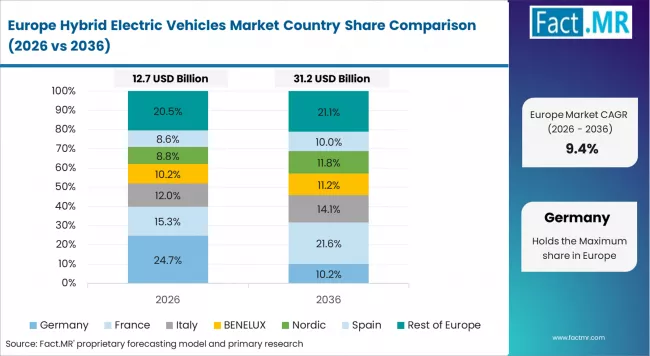
    Hybrid Electric Vehicles Market Europe Country Market Share Analysis, 2026 & 2036

    The European region is projected to be the largest revenue contributor to the global market for hybrid electric vehicles through 2031, emerging as one of the frontrunners, capturing a significant market share of nearly 16% by the end of the forecast period.

    Many countries in Europe have affiliated themselves with a project known as ECOCHAMPS. The challenge taken up by the ECOCHAMPS consortium of 26 partners is to gain a leading position in hybrid powertrain technology. Extending the use of this technology will significantly reduce CO2 emissions from road transport and have a positive effect on air quality.

    With improved functionalities, users will have a lot of flexibility and the introduction of hybrid electric vehicles in the European market space would become easier. Moreover, according to the Federal Motor Transport Authority (KBA), sales of full-electric vehicles in Germany increased three-fold to 194,163 units in 2020.

    Category-Wise Analysis

    How is the Passenger Cars Segment Performing?

    According to International Energy Agency (IEA), electric vehicles will make 40% of all passenger vehicles by 2040. The estimation may not be surprising as electric vehicle makers like Tesla have already made a foray into new areas that serve the urban transportation demands like taxis.

    Most prominently, the hybrid vehicles market registers demand from vehicle types such as passenger cars, light commercial vehicles, and heavy commercial vehicles. Nearly 2/5th of total HEV sales will comprise of passenger cars.

    Bibliography

    • International Energy Agency. (2024, April). Global EV Outlook 2024: Scaling up the transition. IEA.
    • European Commission. (2024). CO2 emission performance standards for new passenger cars and light commercial vehicles. Official Journal of the European Union.
    • United States Environmental Protection Agency. (2024, March). Multi-pollutant emissions standards for model years 2027 and later light-duty and medium-duty vehicles. EPA.
    • Japan Automobile Manufacturers Association. (2024). Motor vehicle statistics of Japan 2024. JAMA.
    • Ministry of Heavy Industries, Government of India. (2024). FAME II scheme: Progress report and revised guidelines. Department of Heavy Industry.
    • Society of Automobile Manufacturers (VDA). (2024). German automotive industry: Electrification update Q3 2024. VDA.

    This bibliography is provided for reader reference. The full Fact.MR report contains the complete reference list with primary research documentation.

    This Report Addresses

    • Market sizing and quantitative forecast metrics detailing global and regional expenditure on hybrid electric vehicles through 2036.
    • Segmentation analysis evaluating adoption patterns across power source, powertrain, vehicle categories and their respective sub-segments.
    • Regional deployment intelligence comparing growth trajectories, regulatory environments, and competitive dynamics across North America, Europe, Asia Pacific, Latin America, and the Middle East & Africa.
    • Regulatory compliance assessment analyzing how safety, environmental, or performance standards shape procurement specifications and product development priorities.
    • Competitive landscape evaluation tracking market structure, supplier positioning, and integration strategies among leading industry participants.
    • Strategic investment guidance defining the procurement specifications, technology transitions, and capacity allocation decisions required for market positioning through the forecast period.
    • Supply chain risk analysis identifying material sourcing constraints, manufacturing concentration vulnerabilities, and logistics dependencies affecting market participants.
    • Custom data delivery formats encompassing interactive dashboards, raw Excel datasets, and comprehensive PDF narrative reports.

    Hybrid Electric Vehicles Market Definition

    Hybrid electric vehicles represent the automotive product category that integrates an internal combustion engine with one or more electric motors and an energy storage unit, typically a battery pack or supercapacitor, to deliver propulsion through parallel, series, or combined drivetrain configurations. The computational and mechanical coordination between these power sources enables regenerative braking energy recovery, reduced idle fuel consumption, and compliance with fleet emission regulations. Carrier applications span from compact passenger sedans to medium-duty commercial transport platforms where full battery electric operation is constrained by range or payload requirements.

    Hybrid Electric Vehicles Market Inclusions

    The analytical scope encompasses sales of stored electricity and on-board electric generator hybrid vehicles, parallel, series, and combined powertrain configurations, and hybrid electric passenger cars, commercial vehicles, and two-wheelers. Geographic coverage spans North America, Latin America, Europe, East Asia, South Asia, Oceania, and the Middle East & Africa for the 2026 to 2036 forecast window.

    Hybrid Electric Vehicles Market Exclusions

    Pure battery electric vehicles, plug-in hybrids relying primarily on grid-charged battery operation, fuel cell electric vehicles, and mild hybrid systems that cannot independently propel the vehicle on electric power are excluded. Aftermarket electrification conversion kits and hydrogen-powered hybrid prototypes not yet in serial production also fall outside the analytical boundary.

    Hybrid Electric Vehicles Market Research Methodology

    • Primary Research: Fact.MR analysts conducted structured interviews with senior procurement managers, product development leads, and regulatory compliance officers operating within the hybrid electric vehicles supply chain to validate adoption patterns and specification requirements.
    • Desk Research: Publicly available regulatory databases, industry association publications, corporate annual reports, and standards body documentation formed the secondary data foundation for this assessment.
    • Market-Sizing and Forecasting: A hybrid approach combining top-down macroeconomic indicators with bottom-up product-level shipment tracking was applied to generate baseline and projected market values across all segments and regions.
    • Data Validation and Update Cycle: Segment-level projections were stress-tested against quarterly financial disclosures, import-export trade databases, and independent industry census data to verify directional accuracy and magnitude consistency.

    Scope of the Report

    Hybrid Electric Vehicles Market Breakdown By Power Source, Powertrain, And Region

    Metric Value
    Quantitative Units USD 55.84 billion to USD 207.00 billion, at a CAGR of 14.00%
    Market Definition Hybrid electric vehicles integrate dual powertrain architectures combining combustion engines with electric motor assemblies, enabling reduced fuel consumption and lower tailpipe emissions across passenger and commercial vehicle platforms.
    Power Source Segmentation Stored Electricity HEVs, On-Board Electric Generator HEVs
    Powertrain Segmentation Parallel, Series, Combined
    Vehicle Segmentation Hybrid Electric Passenger Cars, Commercial Hybrid Electric Vehicles, Hybrid Electric Two Wheelers, Other HEVs
    Regions Covered North America, Latin America, Europe, East Asia, South Asia, Oceania, Middle East & Africa
    Countries Covered India, China, USA, Canada, UK, Germany, Japan, and 40 plus countries
    Key Companies Profiled Toyota Motor Corporation, Ford Motor Company, Volvo Cars, Honda Motor Company, Hyundai Motor Company, Daimler AG, BorgWarner, Continental AG, ZF and Schaeffler, Allison Transmission, Nissan Motor Company Ltd., Delphi
    Forecast Period 2026 to 2036
    Approach Forecasting models apply a hybrid top-down and bottom-up methodology, cross-validated against primary research and public industry filings.

    Key Segments Covered

    • By Power Source:

      • Stored Electricity HEVs
      • On-Board Electric Generator HEVs
    • By Powertrain:

      • Series
      • Parallel
      • Combined
    • By Vehicle:

      • Hybrid Electric Passenger Cars
      • Commercial Hybrid Electric Vehicles
      • Hybrid Electric Two Wheelers
      • Other HEVs (Golf Cart, etc.)

    Table of Content

    1. Executive Summary
      • Demand to side Trends
      • Supply to side Trends
      • Technology Roadmap Analysis
      • Analysis and Recommendations
    2. Market Overview
      • Market Coverage / Taxonomy
      • Market Definition / Scope / Limitations
    3. Research Methodology
      • Chapter Orientation
      • Analytical Lens and Working Hypotheses
        • Market Structure, Signals, and Trend Drivers
        • Benchmarking and Cross-market Comparability
        • Market Sizing, Forecasting, and Opportunity Mapping
      • Research Design and Evidence Framework
        • Desk Research Programme (Secondary Evidence)
          • Company Annual and Sustainability Reports
          • Peer-reviewed Journals and Academic Literature
          • Corporate Websites, Product Literature, and Technical Notes
          • Earnings Decks and Investor Briefings
          • Statutory Filings and Regulatory Disclosures
          • Technical White Papers and Standards Notes
          • Trade Journals, Industry Magazines, and Analyst Briefs
          • Conference Proceedings, Webinars, and Seminar Materials
          • Government Statistics Portals and Public Data Releases
          • Press Releases and Reputable Media Coverage
          • Specialist Newsletters and Curated Briefings
          • Expert Input and Fieldwork (Primary Evidence)
            • Primary Modes
              • Qualitative Interviews and Expert Elicitation
              • Quantitative Surveys and Structured Data Capture
              • Blended Approach
            • Why Primary Evidence is Used
            • Field Techniques
              • Interviews
              • Surveys
              • Focus Groups
              • Observational and In-context Research
              • Social and Community Interactions
            • Stakeholder Universe Engaged
              • C-suite Leaders
              • Board Members
              • Presidents and Vice Presidents
              • R&D and Innovation Heads
              • Technical Specialists
              • Domain Subject-matter Experts
              • Scientists
              • Physicians and Other Healthcare Professionals
            • Governance, Ethics, and Data Stewardship
              • Research Ethics
              • Data Integrity and Handling
          • Tooling, Models, and Reference Databases
        • Data Engineering and Model Build
          • Data Acquisition and Ingestion
          • Cleaning, Normalisation, and Verification
          • Synthesis, Triangulation, and Analysis
        • Quality Assurance and Audit Trail
      • Market Background
        • Market Dynamics
          • Drivers
          • Restraints
          • Opportunity
          • Trends
        • Scenario Forecast
          • Demand in Optimistic Scenario
          • Demand in Likely Scenario
          • Demand in Conservative Scenario
        • Opportunity Map Analysis
        • Product Life Cycle Analysis
        • Supply Chain Analysis
        • Investment Feasibility Matrix
        • Value Chain Analysis
        • PESTLE and Porter’s Analysis
        • Regulatory Landscape
        • Regional Parent Market Outlook
        • Production and Consumption Statistics
        • Import and Export Statistics
      • Global Market Analysis 2021 to 2025 and Forecast, 2026 to 2036
        • Historical Market Size Value (USD Million) Analysis, 2021 to 2025
        • Current and Future Market Size Value (USD Million) Projections, 2026 to 2036
          • Y to o to Y Growth Trend Analysis
          • Absolute $ Opportunity Analysis
      • Global Market Pricing Analysis 2021 to 2025 and Forecast 2026 to 2036
      • Global Market Analysis 2021 to 2025 and Forecast 2026 to 2036, By Power Source
        • Introduction / Key Findings
        • Historical Market Size Value (USD Million) Analysis By Power Source , 2021 to 2025
        • Current and Future Market Size Value (USD Million) Analysis and Forecast By Power Source , 2026 to 2036
          • Stored Electricity HEVs
          • On-Board Electric Generator HEVs
        • Y to o to Y Growth Trend Analysis By Power Source , 2021 to 2025
        • Absolute $ Opportunity Analysis By Power Source , 2026 to 2036
      • Global Market Analysis 2021 to 2025 and Forecast 2026 to 2036, By Powertrain
        • Introduction / Key Findings
        • Historical Market Size Value (USD Million) Analysis By Powertrain, 2021 to 2025
        • Current and Future Market Size Value (USD Million) Analysis and Forecast By Powertrain, 2026 to 2036
          • Parallel
          • Series
          • Combined
        • Y to o to Y Growth Trend Analysis By Powertrain, 2021 to 2025
        • Absolute $ Opportunity Analysis By Powertrain, 2026 to 2036
      • Global Market Analysis 2021 to 2025 and Forecast 2026 to 2036, By Vehicle
        • Introduction / Key Findings
        • Historical Market Size Value (USD Million) Analysis By Vehicle, 2021 to 2025
        • Current and Future Market Size Value (USD Million) Analysis and Forecast By Vehicle, 2026 to 2036
          • Hybrid Electric Passenger Cars
          • Commercial Hybrid Electric Vehicles
          • Hybrid Electric Two Wheelers
          • Other HEVs
        • Y to o to Y Growth Trend Analysis By Vehicle, 2021 to 2025
        • Absolute $ Opportunity Analysis By Vehicle, 2026 to 2036
      • Global Market Analysis 2021 to 2025 and Forecast 2026 to 2036, By Region
        • Introduction
        • Historical Market Size Value (USD Million) Analysis By Region, 2021 to 2025
        • Current Market Size Value (USD Million) Analysis and Forecast By Region, 2026 to 2036
          • North America
          • Latin America
          • Western Europe
          • Eastern Europe
          • East Asia
          • South Asia and Pacific
          • Middle East & Africa
        • Market Attractiveness Analysis By Region
      • North America Market Analysis 2021 to 2025 and Forecast 2026 to 2036, By Country
        • Historical Market Size Value (USD Million) Trend Analysis By Market Taxonomy, 2021 to 2025
        • Market Size Value (USD Million) Forecast By Market Taxonomy, 2026 to 2036
          • By Country
            • USA
            • Canada
            • Mexico
          • By Power Source
          • By Powertrain
          • By Vehicle
        • Market Attractiveness Analysis
          • By Country
          • By Power Source
          • By Powertrain
          • By Vehicle
        • Key Takeaways
      • Latin America Market Analysis 2021 to 2025 and Forecast 2026 to 2036, By Country
        • Historical Market Size Value (USD Million) Trend Analysis By Market Taxonomy, 2021 to 2025
        • Market Size Value (USD Million) Forecast By Market Taxonomy, 2026 to 2036
          • By Country
            • Brazil
            • Chile
            • Rest of Latin America
          • By Power Source
          • By Powertrain
          • By Vehicle
        • Market Attractiveness Analysis
          • By Country
          • By Power Source
          • By Powertrain
          • By Vehicle
        • Key Takeaways
      • Western Europe Market Analysis 2021 to 2025 and Forecast 2026 to 2036, By Country
        • Historical Market Size Value (USD Million) Trend Analysis By Market Taxonomy, 2021 to 2025
        • Market Size Value (USD Million) Forecast By Market Taxonomy, 2026 to 2036
          • By Country
            • Germany
            • UK
            • Italy
            • Spain
            • France
            • Nordic
            • BENELUX
            • Rest of Western Europe
          • By Power Source
          • By Powertrain
          • By Vehicle
        • Market Attractiveness Analysis
          • By Country
          • By Power Source
          • By Powertrain
          • By Vehicle
        • Key Takeaways
      • Eastern Europe Market Analysis 2021 to 2025 and Forecast 2026 to 2036, By Country
        • Historical Market Size Value (USD Million) Trend Analysis By Market Taxonomy, 2021 to 2025
        • Market Size Value (USD Million) Forecast By Market Taxonomy, 2026 to 2036
          • By Country
            • Russia
            • Poland
            • Hungary
            • Balkan & Baltic
            • Rest of Eastern Europe
          • By Power Source
          • By Powertrain
          • By Vehicle
        • Market Attractiveness Analysis
          • By Country
          • By Power Source
          • By Powertrain
          • By Vehicle
        • Key Takeaways
      • East Asia Market Analysis 2021 to 2025 and Forecast 2026 to 2036, By Country
        • Historical Market Size Value (USD Million) Trend Analysis By Market Taxonomy, 2021 to 2025
        • Market Size Value (USD Million) Forecast By Market Taxonomy, 2026 to 2036
          • By Country
            • China
            • Japan
            • South Korea
          • By Power Source
          • By Powertrain
          • By Vehicle
        • Market Attractiveness Analysis
          • By Country
          • By Power Source
          • By Powertrain
          • By Vehicle
        • Key Takeaways
      • South Asia and Pacific Market Analysis 2021 to 2025 and Forecast 2026 to 2036, By Country
        • Historical Market Size Value (USD Million) Trend Analysis By Market Taxonomy, 2021 to 2025
        • Market Size Value (USD Million) Forecast By Market Taxonomy, 2026 to 2036
          • By Country
            • India
            • ASEAN
            • Australia & New Zealand
            • Rest of South Asia and Pacific
          • By Power Source
          • By Powertrain
          • By Vehicle
        • Market Attractiveness Analysis
          • By Country
          • By Power Source
          • By Powertrain
          • By Vehicle
        • Key Takeaways
      • Middle East & Africa Market Analysis 2021 to 2025 and Forecast 2026 to 2036, By Country
        • Historical Market Size Value (USD Million) Trend Analysis By Market Taxonomy, 2021 to 2025
        • Market Size Value (USD Million) Forecast By Market Taxonomy, 2026 to 2036
          • By Country
            • Kingdom of Saudi Arabia
            • Other GCC Countries
            • Turkiye
            • South Africa
            • Other African Union
            • Rest of Middle East & Africa
          • By Power Source
          • By Powertrain
          • By Vehicle
        • Market Attractiveness Analysis
          • By Country
          • By Power Source
          • By Powertrain
          • By Vehicle
        • Key Takeaways
      • Key Countries Market Analysis
        • USA
          • Pricing Analysis
          • Market Share Analysis, 2025
            • By Power Source
            • By Powertrain
            • By Vehicle
        • Canada
          • Pricing Analysis
          • Market Share Analysis, 2025
            • By Power Source
            • By Powertrain
            • By Vehicle
        • Mexico
          • Pricing Analysis
          • Market Share Analysis, 2025
            • By Power Source
            • By Powertrain
            • By Vehicle
        • Brazil
          • Pricing Analysis
          • Market Share Analysis, 2025
            • By Power Source
            • By Powertrain
            • By Vehicle
        • Chile
          • Pricing Analysis
          • Market Share Analysis, 2025
            • By Power Source
            • By Powertrain
            • By Vehicle
        • Germany
          • Pricing Analysis
          • Market Share Analysis, 2025
            • By Power Source
            • By Powertrain
            • By Vehicle
        • UK
          • Pricing Analysis
          • Market Share Analysis, 2025
            • By Power Source
            • By Powertrain
            • By Vehicle
        • Italy
          • Pricing Analysis
          • Market Share Analysis, 2025
            • By Power Source
            • By Powertrain
            • By Vehicle
        • Spain
          • Pricing Analysis
          • Market Share Analysis, 2025
            • By Power Source
            • By Powertrain
            • By Vehicle
        • France
          • Pricing Analysis
          • Market Share Analysis, 2025
            • By Power Source
            • By Powertrain
            • By Vehicle
        • India
          • Pricing Analysis
          • Market Share Analysis, 2025
            • By Power Source
            • By Powertrain
            • By Vehicle
        • ASEAN
          • Pricing Analysis
          • Market Share Analysis, 2025
            • By Power Source
            • By Powertrain
            • By Vehicle
        • Australia & New Zealand
          • Pricing Analysis
          • Market Share Analysis, 2025
            • By Power Source
            • By Powertrain
            • By Vehicle
        • China
          • Pricing Analysis
          • Market Share Analysis, 2025
            • By Power Source
            • By Powertrain
            • By Vehicle
        • Japan
          • Pricing Analysis
          • Market Share Analysis, 2025
            • By Power Source
            • By Powertrain
            • By Vehicle
        • South Korea
          • Pricing Analysis
          • Market Share Analysis, 2025
            • By Power Source
            • By Powertrain
            • By Vehicle
        • Russia
          • Pricing Analysis
          • Market Share Analysis, 2025
            • By Power Source
            • By Powertrain
            • By Vehicle
        • Poland
          • Pricing Analysis
          • Market Share Analysis, 2025
            • By Power Source
            • By Powertrain
            • By Vehicle
        • Hungary
          • Pricing Analysis
          • Market Share Analysis, 2025
            • By Power Source
            • By Powertrain
            • By Vehicle
        • Kingdom of Saudi Arabia
          • Pricing Analysis
          • Market Share Analysis, 2025
            • By Power Source
            • By Powertrain
            • By Vehicle
        • Turkiye
          • Pricing Analysis
          • Market Share Analysis, 2025
            • By Power Source
            • By Powertrain
            • By Vehicle
        • South Africa
          • Pricing Analysis
          • Market Share Analysis, 2025
            • By Power Source
            • By Powertrain
            • By Vehicle
      • Market Structure Analysis
        • Competition Dashboard
        • Competition Benchmarking
        • Market Share Analysis of Top Players
          • By Regional
          • By Power Source
          • By Powertrain
          • By Vehicle
      • Competition Analysis
        • Competition Deep Dive
          • Delphi
            • Overview
            • Product Portfolio
            • Profitability by Market Segments (Product/Age /Sales Channel/Region)
            • Sales Footprint
            • Strategy Overview
              • Marketing Strategy
              • Product Strategy
              • Channel Strategy
          • Continental AG
          • BorgWarner
          • ZF and Schaeffler
          • Toyota Motor Corporation
          • Ford Motor Company
          • Volvo Cars
          • Honda Motor Company
          • Hyundai Motor Company
          • Daimler AG
          • Allison Transmission
          • Nissan Motor Company Ltd.
    4. Assumptions & Acronyms Used

    List Of Table

    • Table 1: Global Market Value (USD Million) Forecast by Region, 2021 to 2036
    • Table 2: Global Market Value (USD Million) Forecast by Power Source , 2021 to 2036
    • Table 3: Global Market Value (USD Million) Forecast by Powertrain, 2021 to 2036
    • Table 4: Global Market Value (USD Million) Forecast by Vehicle, 2021 to 2036
    • Table 5: North America Market Value (USD Million) Forecast by Country, 2021 to 2036
    • Table 6: North America Market Value (USD Million) Forecast by Power Source , 2021 to 2036
    • Table 7: North America Market Value (USD Million) Forecast by Powertrain, 2021 to 2036
    • Table 8: North America Market Value (USD Million) Forecast by Vehicle, 2021 to 2036
    • Table 9: Latin America Market Value (USD Million) Forecast by Country, 2021 to 2036
    • Table 10: Latin America Market Value (USD Million) Forecast by Power Source , 2021 to 2036
    • Table 11: Latin America Market Value (USD Million) Forecast by Powertrain, 2021 to 2036
    • Table 12: Latin America Market Value (USD Million) Forecast by Vehicle, 2021 to 2036
    • Table 13: Western Europe Market Value (USD Million) Forecast by Country, 2021 to 2036
    • Table 14: Western Europe Market Value (USD Million) Forecast by Power Source , 2021 to 2036
    • Table 15: Western Europe Market Value (USD Million) Forecast by Powertrain, 2021 to 2036
    • Table 16: Western Europe Market Value (USD Million) Forecast by Vehicle, 2021 to 2036
    • Table 17: Eastern Europe Market Value (USD Million) Forecast by Country, 2021 to 2036
    • Table 18: Eastern Europe Market Value (USD Million) Forecast by Power Source , 2021 to 2036
    • Table 19: Eastern Europe Market Value (USD Million) Forecast by Powertrain, 2021 to 2036
    • Table 20: Eastern Europe Market Value (USD Million) Forecast by Vehicle, 2021 to 2036
    • Table 21: East Asia Market Value (USD Million) Forecast by Country, 2021 to 2036
    • Table 22: East Asia Market Value (USD Million) Forecast by Power Source , 2021 to 2036
    • Table 23: East Asia Market Value (USD Million) Forecast by Powertrain, 2021 to 2036
    • Table 24: East Asia Market Value (USD Million) Forecast by Vehicle, 2021 to 2036
    • Table 25: South Asia and Pacific Market Value (USD Million) Forecast by Country, 2021 to 2036
    • Table 26: South Asia and Pacific Market Value (USD Million) Forecast by Power Source , 2021 to 2036
    • Table 27: South Asia and Pacific Market Value (USD Million) Forecast by Powertrain, 2021 to 2036
    • Table 28: South Asia and Pacific Market Value (USD Million) Forecast by Vehicle, 2021 to 2036
    • Table 29: Middle East & Africa Market Value (USD Million) Forecast by Country, 2021 to 2036
    • Table 30: Middle East & Africa Market Value (USD Million) Forecast by Power Source , 2021 to 2036
    • Table 31: Middle East & Africa Market Value (USD Million) Forecast by Powertrain, 2021 to 2036
    • Table 32: Middle East & Africa Market Value (USD Million) Forecast by Vehicle, 2021 to 2036

    List Of Figures

    • Figure 1: Global Market Pricing Analysis
    • Figure 2: Global Market Value (USD Million) Forecast 2021-2036
    • Figure 3: Global Market Value Share and BPS Analysis by Power Source , 2026 and 2036
    • Figure 4: Global Market Y-o-Y Growth Comparison by Power Source , 2026-2036
    • Figure 5: Global Market Attractiveness Analysis by Power Source
    • Figure 6: Global Market Value Share and BPS Analysis by Powertrain, 2026 and 2036
    • Figure 7: Global Market Y-o-Y Growth Comparison by Powertrain, 2026-2036
    • Figure 8: Global Market Attractiveness Analysis by Powertrain
    • Figure 9: Global Market Value Share and BPS Analysis by Vehicle, 2026 and 2036
    • Figure 10: Global Market Y-o-Y Growth Comparison by Vehicle, 2026-2036
    • Figure 11: Global Market Attractiveness Analysis by Vehicle
    • Figure 12: Global Market Value (USD Million) Share and BPS Analysis by Region, 2026 and 2036
    • Figure 13: Global Market Y-o-Y Growth Comparison by Region, 2026-2036
    • Figure 14: Global Market Attractiveness Analysis by Region
    • Figure 15: North America Market Incremental Dollar Opportunity, 2026-2036
    • Figure 16: Latin America Market Incremental Dollar Opportunity, 2026-2036
    • Figure 17: Western Europe Market Incremental Dollar Opportunity, 2026-2036
    • Figure 18: Eastern Europe Market Incremental Dollar Opportunity, 2026-2036
    • Figure 19: East Asia Market Incremental Dollar Opportunity, 2026-2036
    • Figure 20: South Asia and Pacific Market Incremental Dollar Opportunity, 2026-2036
    • Figure 21: Middle East & Africa Market Incremental Dollar Opportunity, 2026-2036
    • Figure 22: North America Market Value Share and BPS Analysis by Country, 2026 and 2036
    • Figure 23: North America Market Value Share and BPS Analysis by Power Source , 2026 and 2036
    • Figure 24: North America Market Y-o-Y Growth Comparison by Power Source , 2026-2036
    • Figure 25: North America Market Attractiveness Analysis by Power Source
    • Figure 26: North America Market Value Share and BPS Analysis by Powertrain, 2026 and 2036
    • Figure 27: North America Market Y-o-Y Growth Comparison by Powertrain, 2026-2036
    • Figure 28: North America Market Attractiveness Analysis by Powertrain
    • Figure 29: North America Market Value Share and BPS Analysis by Vehicle, 2026 and 2036
    • Figure 30: North America Market Y-o-Y Growth Comparison by Vehicle, 2026-2036
    • Figure 31: North America Market Attractiveness Analysis by Vehicle
    • Figure 32: Latin America Market Value Share and BPS Analysis by Country, 2026 and 2036
    • Figure 33: Latin America Market Value Share and BPS Analysis by Power Source , 2026 and 2036
    • Figure 34: Latin America Market Y-o-Y Growth Comparison by Power Source , 2026-2036
    • Figure 35: Latin America Market Attractiveness Analysis by Power Source
    • Figure 36: Latin America Market Value Share and BPS Analysis by Powertrain, 2026 and 2036
    • Figure 37: Latin America Market Y-o-Y Growth Comparison by Powertrain, 2026-2036
    • Figure 38: Latin America Market Attractiveness Analysis by Powertrain
    • Figure 39: Latin America Market Value Share and BPS Analysis by Vehicle, 2026 and 2036
    • Figure 40: Latin America Market Y-o-Y Growth Comparison by Vehicle, 2026-2036
    • Figure 41: Latin America Market Attractiveness Analysis by Vehicle
    • Figure 42: Western Europe Market Value Share and BPS Analysis by Country, 2026 and 2036
    • Figure 43: Western Europe Market Value Share and BPS Analysis by Power Source , 2026 and 2036
    • Figure 44: Western Europe Market Y-o-Y Growth Comparison by Power Source , 2026-2036
    • Figure 45: Western Europe Market Attractiveness Analysis by Power Source
    • Figure 46: Western Europe Market Value Share and BPS Analysis by Powertrain, 2026 and 2036
    • Figure 47: Western Europe Market Y-o-Y Growth Comparison by Powertrain, 2026-2036
    • Figure 48: Western Europe Market Attractiveness Analysis by Powertrain
    • Figure 49: Western Europe Market Value Share and BPS Analysis by Vehicle, 2026 and 2036
    • Figure 50: Western Europe Market Y-o-Y Growth Comparison by Vehicle, 2026-2036
    • Figure 51: Western Europe Market Attractiveness Analysis by Vehicle
    • Figure 52: Eastern Europe Market Value Share and BPS Analysis by Country, 2026 and 2036
    • Figure 53: Eastern Europe Market Value Share and BPS Analysis by Power Source , 2026 and 2036
    • Figure 54: Eastern Europe Market Y-o-Y Growth Comparison by Power Source , 2026-2036
    • Figure 55: Eastern Europe Market Attractiveness Analysis by Power Source
    • Figure 56: Eastern Europe Market Value Share and BPS Analysis by Powertrain, 2026 and 2036
    • Figure 57: Eastern Europe Market Y-o-Y Growth Comparison by Powertrain, 2026-2036
    • Figure 58: Eastern Europe Market Attractiveness Analysis by Powertrain
    • Figure 59: Eastern Europe Market Value Share and BPS Analysis by Vehicle, 2026 and 2036
    • Figure 60: Eastern Europe Market Y-o-Y Growth Comparison by Vehicle, 2026-2036
    • Figure 61: Eastern Europe Market Attractiveness Analysis by Vehicle
    • Figure 62: East Asia Market Value Share and BPS Analysis by Country, 2026 and 2036
    • Figure 63: East Asia Market Value Share and BPS Analysis by Power Source , 2026 and 2036
    • Figure 64: East Asia Market Y-o-Y Growth Comparison by Power Source , 2026-2036
    • Figure 65: East Asia Market Attractiveness Analysis by Power Source
    • Figure 66: East Asia Market Value Share and BPS Analysis by Powertrain, 2026 and 2036
    • Figure 67: East Asia Market Y-o-Y Growth Comparison by Powertrain, 2026-2036
    • Figure 68: East Asia Market Attractiveness Analysis by Powertrain
    • Figure 69: East Asia Market Value Share and BPS Analysis by Vehicle, 2026 and 2036
    • Figure 70: East Asia Market Y-o-Y Growth Comparison by Vehicle, 2026-2036
    • Figure 71: East Asia Market Attractiveness Analysis by Vehicle
    • Figure 72: South Asia and Pacific Market Value Share and BPS Analysis by Country, 2026 and 2036
    • Figure 73: South Asia and Pacific Market Value Share and BPS Analysis by Power Source , 2026 and 2036
    • Figure 74: South Asia and Pacific Market Y-o-Y Growth Comparison by Power Source , 2026-2036
    • Figure 75: South Asia and Pacific Market Attractiveness Analysis by Power Source
    • Figure 76: South Asia and Pacific Market Value Share and BPS Analysis by Powertrain, 2026 and 2036
    • Figure 77: South Asia and Pacific Market Y-o-Y Growth Comparison by Powertrain, 2026-2036
    • Figure 78: South Asia and Pacific Market Attractiveness Analysis by Powertrain
    • Figure 79: South Asia and Pacific Market Value Share and BPS Analysis by Vehicle, 2026 and 2036
    • Figure 80: South Asia and Pacific Market Y-o-Y Growth Comparison by Vehicle, 2026-2036
    • Figure 81: South Asia and Pacific Market Attractiveness Analysis by Vehicle
    • Figure 82: Middle East & Africa Market Value Share and BPS Analysis by Country, 2026 and 2036
    • Figure 83: Middle East & Africa Market Value Share and BPS Analysis by Power Source , 2026 and 2036
    • Figure 84: Middle East & Africa Market Y-o-Y Growth Comparison by Power Source , 2026-2036
    • Figure 85: Middle East & Africa Market Attractiveness Analysis by Power Source
    • Figure 86: Middle East & Africa Market Value Share and BPS Analysis by Powertrain, 2026 and 2036
    • Figure 87: Middle East & Africa Market Y-o-Y Growth Comparison by Powertrain, 2026-2036
    • Figure 88: Middle East & Africa Market Attractiveness Analysis by Powertrain
    • Figure 89: Middle East & Africa Market Value Share and BPS Analysis by Vehicle, 2026 and 2036
    • Figure 90: Middle East & Africa Market Y-o-Y Growth Comparison by Vehicle, 2026-2036
    • Figure 91: Middle East & Africa Market Attractiveness Analysis by Vehicle
    • Figure 92: Global Market - Tier Structure Analysis
    • Figure 93: Global Market - Company Share Analysis

    - Frequently Asked Questions -

    How large is the hybrid electric vehicles market in 2026?

    The hybrid electric vehicles market is estimated to be valued at USD 55.84 billion in 2026.

    What will the hybrid electric vehicles market size be by 2036?

    The hybrid electric vehicles market is projected to reach USD 207.00 billion by 2036.

    What is the expected CAGR for the hybrid electric vehicles market between 2026 and 2036?

    The hybrid electric vehicles market is expected to grow at a CAGR of 14.00% between 2026 and 2036.

    Which power source segment is poised to lead in 2026?

    Stored Electricity HEVs accounts for 64.0% of power source share in 2026, making it the leading sub-segment within this category.

    Which country is the fastest-growing market?

    China is projected to grow at a CAGR of 18.9% during 2026 to 2036, representing the fastest compound expansion among countries analyzed.

    What is the scope of this hybrid electric vehicles market report?

    The report covers market sizing, segmentation by power source, powertrain, vehicle, regional analysis across 40 plus countries, competitive landscape evaluation, and regulatory impact assessment for 2026 to 2036.

    What methodology does Fact.MR use for this forecast?

    Fact.MR applies a hybrid top-down and bottom-up methodology, cross-validated against primary research interviews, public financial disclosures, and independent industry association data.

    Which companies are profiled in this report?

    Companies profiled include Toyota Motor Corporation, Ford Motor Company, Volvo Cars, Honda Motor Company, Hyundai Motor Company, and others. The full list is available in the scope of the report section.

    Hybrid Electric Vehicles Market