- Market Value (2025): USD 2.1 Bn
- Estimated Value (2026): USD 2.3 Bn
- Forecast Value (2036): USD 5.4 Bn
- CAGR (2026-2036): 9.0%
What is the Aromatherapy Diffuser Market forecast to be worth by 2036?
USD 5.4 billion by 2036 at a 9.0% CAGR.
- The 2025 market value is approximately USD 2.1 billion.
- Demand is projected to increase from USD 2.3 billion in 2026 to USD 5.4 billion by 2036.
- The market is forecast to record a 9.0% CAGR from 2026 to 2036.
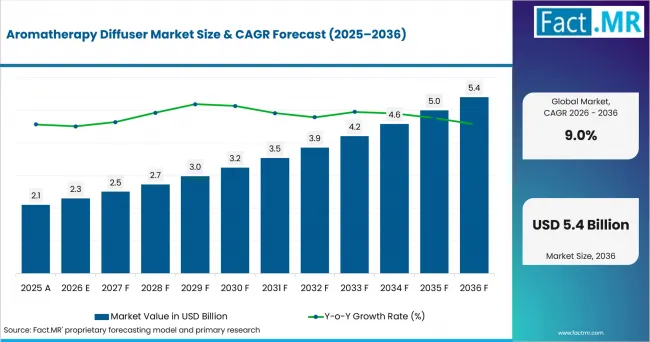
Aromatherapy Diffuser Market Value Analysis | Source: Fact.MR
What are the defining numbers behind Aromatherapy Diffuser Market growth?
An absolute opportunity of USD 3.1 billion is expected between 2026 and 2036.
- Demand Drivers in the Market
- Daily wellness routines are expanding the addressable household use case for diffusers. The Global Wellness Institute valued the wellness economy at USD 6.8 trillion in 2024 and reported 12.4% average annual growth in mental wellness from 2019 to 2024. This broad spending base supports small home devices that turn essential oils into repeatable room-based scent routines.
- Aromatherapy is commonly delivered through inhalation. The U.S. National Center for Complementary and Integrative Health describes inhalation as one of the main ways essential oils are used. A diffuser converts that use pattern into a household device purchase by dispersing a measured aroma through a room without direct skin application.
- Connected controls are adding convenience to a category that was traditionally timer based. Young Living currently sells an app-enabled diffuser that supports scheduling through its AromaConnect platform. App control can increase purchase interest among users who want scent routines tied to waking, working or evening use.
- Online retail reduces the need to inspect the device in person because capacity, run time and room coverage can be compared through product pages. This matters for a category sold by oil brands, home-product retailers and specialist diffuser companies, and it strengthens access to replacement models and oil-compatible accessories.
- Safety information is becoming part of product selection. ANSES reports that essential-oil diffusers can emit volatile organic compounds and advises ventilation of confined spaces. Buyers therefore have a practical reason to value controlled output, automatic shut-off and clear operating guidance when selecting devices for bedrooms or other enclosed rooms.
- Key Segments Analyzed
- Ultrasonic Diffusers account for 74.8% of Product in 2026 because water-based cool-mist operation combines simple setup with broad availability across household diffuser brands.
- Residential Wellness Applications hold 36.4% of Application in 2026 as compact diffusers fit relaxation, sleep-time and personal scent routines inside the home.
- Individual Consumers represent 68.7% of End Use in 2026 because most devices can be purchased and operated without professional installation or service support.
- Smart Connected Diffusion Technology accounts for 52.3% of Technology in 2026 as app-based scheduling and remote control make diffuser operation easier to fit around daily routines.
- Essential Oil Compatible Systems hold 79.1% of Formulation in 2026 because aromatherapy use is centered on plant-derived essential oils and blended oil formulations.
- Online Retail Channels account for 43.7% of Distribution Channel in 2026 because buyers can compare device capacity, run time and compatible oils across brand-owned sites and e-commerce marketplaces.
- Analyst Opinion at Fact.MR
- Shambhu Nath Jha, Senior Consultant at Fact.MR, states, "The purchase decision is moving beyond fragrance alone. Consumers compare the diffuser as a small home appliance, looking at mist output, run time, reservoir cleaning and control options before deciding which essential-oil routine they want to maintain. Suppliers that connect simple hardware use with dependable oil compatibility and clear safety guidance can support repeat engagement without turning the device into a complex installation."
- Strategic Implications
- Diffuser brands should make oil compatibility explicit because the recurring value of the device depends on continued use with single oils and blends.
- Ultrasonic products should communicate reservoir size, run time and cleaning requirements in practical terms that help households compare everyday use rather than abstract technical specifications.
- Connected-product investment should focus on reliable scheduling and simple pairing. Smart features have limited value if setup adds friction to a product that is otherwise purchased for low-effort home use.
- Online product pages should show room coverage, operating modes and replacement guidance because digital channels carry 43.7% of Distribution Channel in 2026.
- Safety instructions should address ventilation, oil handling and automatic shut-off. Clear guidance can reduce misuse and help position the diffuser as a controlled indoor fragrance device.
How does the Aromatherapy Diffuser Market break down by segment?
The market is segmented by Product; Application; End Use; Technology; Formulation; Distribution Channel.
Why do Ultrasonic Diffusers lead Product?
Ultrasonic Diffusers are projected to account for a 74.8% share in 2026.
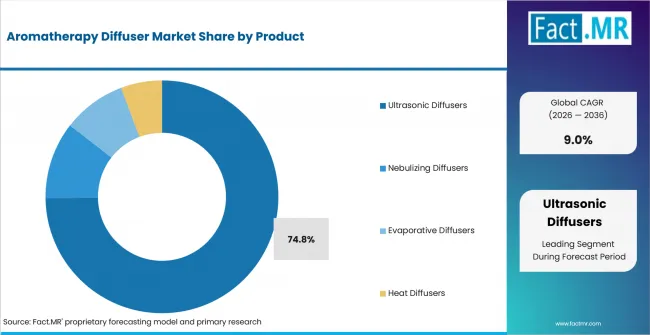
Aromatherapy Diffuser Market Analysis By Product | Source: Fact.MR
Ultrasonic systems lead because they use high-frequency vibration to disperse a water-and-oil mixture as a cool mist. That operating model avoids the open flame associated with some heat products and gives households a familiar fill-and-run workflow. Current ultrasonic diffusers are sold by doTERRA, MUJI, NOW Foods and Vitruvi, showing that the format is supported across essential-oil and home-product brands.
The buying trade-off is also straightforward. Ultrasonic products can combine fragrance dispersion with timers, lights or automatic shut-off while retaining a compact form factor. Nebulizing devices serve users who want direct-oil output, while evaporative diffusers remain relevant where passive or fan-driven operation is preferred.
Why do Residential Wellness Applications lead Application?
Residential Wellness Applications are projected to account for a 36.4% share in 2026.
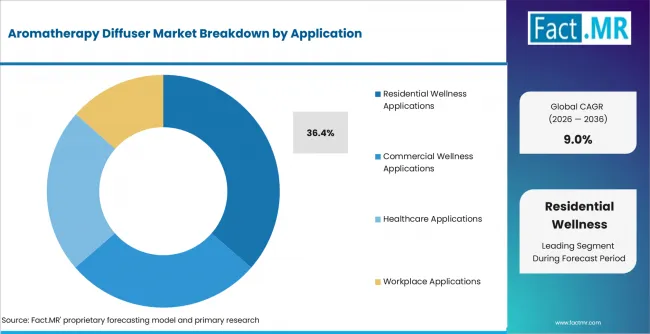
Aromatherapy Diffuser Market Analysis By Application | Source: Fact.MR
Residential use leads because a diffuser is easy to place in bedrooms, living areas or work-from-home spaces and does not require a dedicated treatment setting. The hardware supports short, repeatable use occasions around relaxation, ambient scent and personal routines, which makes the home the most direct environment for recurring operation.
NCCIH notes that aromatherapy commonly uses inhalation of essential oils. The evidence for specific health outcomes varies by use case, so household purchasing is better understood around scent experience and self-directed wellness routines than around treatment claims. This favours devices that are simple to operate and easy to clean.
Why do Individual Consumers lead End Use?
Individual Consumers are projected to account for a 68.7% share in 2026.
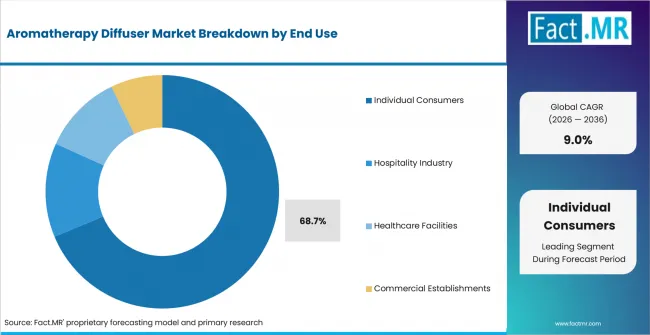
Aromatherapy Diffuser Market Analysis By End Use | Source: Fact.MR
Individual consumers lead because the purchase is usually a small-appliance decision rather than an infrastructure project. A user can buy the diffuser, select compatible oils and begin using it without installer support. This reduces the buying threshold compared with hospitality or healthcare settings that may need standardized operating procedures across several rooms.
Brand-owned online stores reinforce this direct relationship. doTERRA, Young Living, MUJI, Vitruvi and NOW Foods all maintain consumer-facing diffuser offers, allowing hardware to be sold alongside compatible oils or fragrance products. The same channel also supports replacement purchases when users add a second device for another room.
Why does Smart Connected Diffusion Technology lead Technology?
Smart Connected Diffusion Technology is projected to account for a 52.3% share in 2026.
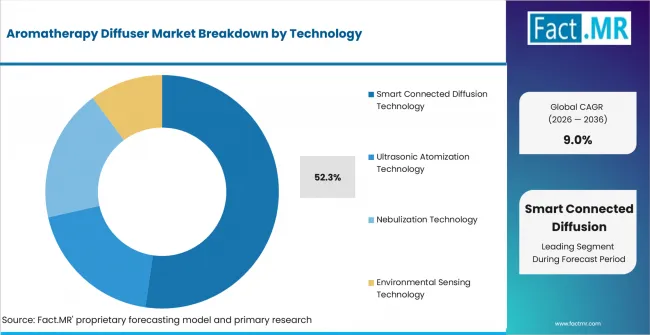
Aromatherapy Diffuser Market Analysis By Technology | Source: Fact.MR
Connected technology leads because scenting is time dependent. Users may want different output around waking, working or evening routines, and app scheduling removes the need to adjust the device manually each time. Wi-Fi and Bluetooth connectivity can also make intensity control more convenient when the diffuser is placed away from the user.
Young Living provides a current example through its AromaConnect LunaMist diffuser, which pairs through Bluetooth and 2.4 GHz Wi-Fi and allows app-based scheduling. This shows how connectivity is being used for operating convenience rather than as a separate digital service, which fits the low-complexity expectations of consumer diffuser buyers.
Why do Essential Oil Compatible Systems lead Formulation?
Essential Oil Compatible Systems are projected to account for a 79.1% share in 2026.
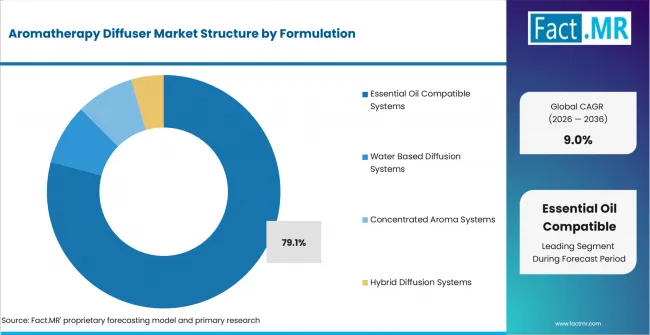
Aromatherapy Diffuser Market Analysis By Formulation | Source: Fact.MR
Essential-oil compatibility leads because aromatherapy itself is organized around plant-derived oils used through inhalation or topical application. A diffuser therefore gains utility when users can choose among single oils and multi-oil blends without buying a proprietary fragrance cartridge for every use occasion. Familiar materials such as lavender oil also give consumers a recognizable entry point into the category.
Compatibility also supports repeat purchasing beyond the original hardware sale. doTERRA, Young Living, Neal's Yard Remedies and NOW Foods combine oil portfolios with diffuser products, allowing buyers to use one device across changing scent preferences. Water-based and hybrid systems remain useful when the design is optimized for a specific reservoir or controlled-release format.
Why do Online Retail Channels lead Distribution Channel?
Online Retail Channels are projected to account for a 43.7% share in 2026.
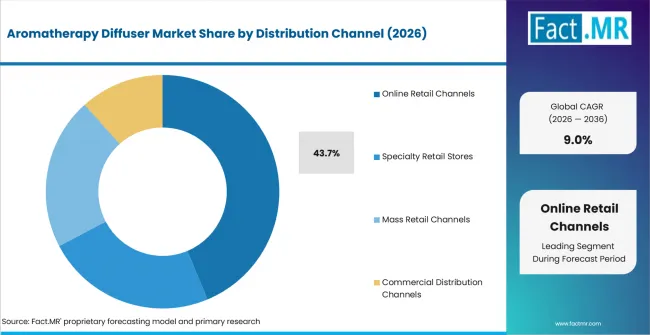
Aromatherapy Diffuser Market Analysis By Distribution Channel | Source: Fact.MR
Online retail leads because diffuser attributes can be communicated through standardized product information. Buyers can compare room coverage, run time, water capacity and control modes before purchase, then order compatible oils through the same channel. This makes the device well suited to digital comparison across wellness and adjacent air care categories.
Country-level retail behavior supports the channel. Germany reported that 83% of internet users shopped online in 2024, while U.S. e-commerce represented 17.1% of retail sales in the second quarter of 2026. Online penetration does not determine diffuser demand on its own, but it reduces access friction for a product that requires little physical fitting before purchase.
What is accelerating Aromatherapy Diffuser Market adoption, and what is holding it back?
Household wellness routines and digital purchasing are supporting diffuser adoption, while indoor-air concerns and competition from lower-cost fragrance formats can limit demand.
Drivers Impact Analysis
| Factor | (~) % Impact on CAGR | Geographic Relevance | Impact Timeline |
|---|---|---|---|
| Expansion of household wellness routines | +1.7% | Global; Germany; USA; UK | Near term |
| Growth of online diffuser purchasing | +1.3% | Germany; USA; UK; Japan | Near to mid term |
| Smart scheduling and connected diffuser controls | +0.8% | USA; Germany; Japan | Mid term |
| Recurring essential-oil consumption linked to diffuser ownership | +1.1% | Global | Mid to long term |
Source: Fact.MR analysis. Updated Aug 21, 2026
Opportunity Impact Analysis
| Factor | (~) % Impact on CAGR | Geographic Relevance | Impact Timeline |
|---|---|---|---|
| Quieter and portable ultrasonic diffuser development | +0.7% | Global | Near to mid term |
| Smart connected diffuser expansion | +0.9% | USA; Germany; Japan | Mid term |
| Multi-room commercial diffusion for hospitality and wellness facilities | +0.6% | Europe; USA; Japan | Mid to long term |
| Broader essential-oil and blend compatibility | +0.5% | Global | Mid term |
Source: Fact.MR analysis. Updated Aug 21, 2026
Restraints Impact Analysis
| Factor | (~) % Impact on CAGR | Geographic Relevance | Impact Timeline |
|---|---|---|---|
| Indoor-air exposure and ventilation concerns | -0.8% | Global; Europe | Near term |
| Competition from passive and heat-based fragrance alternatives | -0.7% | Global | Near to mid term |
| Cleaning and maintenance requirements for oil-based systems | -0.4% | Global | Mid term |
| Added cost and setup requirements for connected products | -0.3% | USA; Europe; Japan | Mid term |
Source: Fact.MR analysis. Updated Aug 21, 2026
Which countries are scaling the Aromatherapy Diffuser Market through 2036?
- Germany: Global Wellness Institute data values Germany's wellness economy at USD 281 billion in 2024. A developed wellness-spending base supports home fragrance and self-care purchases, while broad online shopping participation gives diffuser brands a practical direct-to-consumer route.
- Brazil: Aromatherapy is formally recognized within Brazil's integrative and complementary health framework, and a 2025 Federal Council of Pharmacy resolution regulates pharmacist activity involving aromatherapy and essential oils. This provides institutional familiarity with the underlying practice alongside household use.
- USA: The Global Wellness Institute values the U.S. wellness economy at USD 2.1 trillion in 2024. Consumer spending across personal wellness and home-based routines gives diffuser brands room to sell hardware alongside oil portfolios through direct and digital channels.
- UK: The UK wellness economy was valued at USD 261 billion in 2024 by the Global Wellness Institute. A mature wellness market and a high online retail share support consumer access to diffusers, oil blends and replacement devices without reliance on specialist physical stores.
- Japan: The Global Wellness Institute values Japan's wellness economy at USD 262 billion in 2024. The country also has established home-product retailers with ultrasonic aroma ranges, giving diffuser purchases a clear connection with interior and personal-wellness merchandising.
Country CAGR (2026-2036)
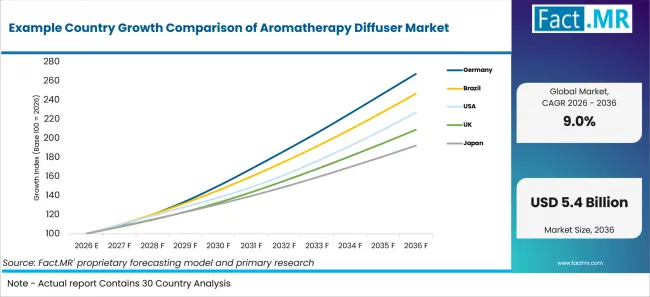
Example Country Growth Comparison Of Aromatherapy Diffuser Market | Source: Fact.MR
| Country | CAGR (2026-2036) |
|---|---|
| Germany | 10.35% |
| Brazil | 9.45% |
| USA | 8.55% |
| UK | 7.65% |
| Japan | 6.75% |
Source: Fact.MR analysis. Updated Aug 21, 2026
What is driving Germany's growth through 2036?
Germany is forecast to expand at a 10.35% CAGR from 2026 to 2036.
Germany combines wellness spending with strong digital purchasing behavior. Destatis reported that 83% of internet users in Germany shopped online in 2024. Diffuser brands can therefore reach household buyers through marketplaces and direct sites while using detailed product pages to explain room coverage, timers and oil compatibility.
The market also benefits from a broad home and personal-wellness retail base. Buyers can compare diffusers as functional home devices rather than relying only on aromatherapy specialists, which supports wider distribution of ultrasonic and design-led products.
What is driving Brazil's growth through 2036?
Brazil is forecast to expand at a 9.45% CAGR from 2026 to 2036.
Brazil has a formal policy context for aromatherapy. The Ministry of Health framework recognizes aromatherapy among integrative and complementary health practices, while the Federal Council of Pharmacy issued a 2025 resolution defining pharmacist activity in aromatherapy and essential oils. This supports awareness of essential-oil use beyond fragrance alone.
Consumer wellness spending provides a second demand route. Global Wellness Institute research released in 2024 valued Brazil's wellness economy at USD 96 billion. Diffusers can participate in that spending through home relaxation and personal-wellness use, particularly where brands combine hardware with accessible oil assortments.
What is driving the USA's growth through 2036?
The USA is forecast to expand at an 8.55% CAGR from 2026 to 2036.
U.S. digital retail gives diffuser suppliers national reach without requiring a specialist store network. The U.S. Census Bureau reported USD 340.2 billion in retail e-commerce sales in the second quarter of 2026, equal to 17.1% of total retail sales. A product that can be described through size, run time and room coverage fits this purchasing model well.
The country also supports direct selling by essential-oil companies. Hardware can be bundled with oils or starter collections, allowing the initial diffuser sale to sit inside a broader recurring-consumption relationship rather than functioning as a one-time home appliance purchase.
What is driving the UK's growth through 2036?
The UK is forecast to expand at a 7.65% CAGR from 2026 to 2036.
Online retail is a practical growth mechanism in the UK. The Office for National Statistics reported that online sales represented 29.4% of retail spending in June 2026. This gives diffuser brands a channel where product details, operating videos and oil bundles can be shown before purchase.
The market also has a domestic aromatherapy retail presence through companies such as Neal's Yard Remedies, which sells diffusers designed for use with essential oils. This helps keep the category visible across wellbeing gifting and home-fragrance use rather than limiting it to appliance retailers.
What is driving Japan's growth through 2036?
Japan is forecast to expand at a 6.75% CAGR from 2026 to 2036.
Japan has an established consumer route through home-goods retail. MUJI sells ultrasonic aroma diffusers as part of its fragrance and household offer, integrating the device with room ambiance and everyday interior use rather than presenting it only as specialist wellness equipment.
Digital commerce adds access outside store networks. Japan's Ministry of Economy, Trade and Industry reported a 32.58% business-to-consumer e-commerce ratio for household goods, furniture and interiors in its FY2024 survey. Diffusers can benefit from this channel because they are compact home products with specifications that can be compared online.
Who leads the Aromatherapy Diffuser Market?
doTERRA International is projected to account for a 33.2% company share in 2026. Its current product line includes essential-oil diffusers sold alongside a broad oil portfolio, giving the company a direct route to bundle hardware with recurring consumables.
Young Living competes through an essential-oil ecosystem and connected diffuser products, including the app-enabled AromaConnect LunaMist. Ryohin Keikaku Co. Ltd. (Muji) and Vitruvi compete through home-oriented ultrasonic designs, while NOW Foods and Neal's Yard Limited connect diffuser hardware with essential-oil ranges.
Stadler Form Aktiengesellschaft competes through dedicated aroma-diffuser designs. Ellia Aromatherapy remains active as a diffuser brand through HoMedics channels, where cordless ultrasonic products are still sold. This keeps the brand distinct in the assessment even though current distribution is connected with HoMedics.
Competition is shaped by mist performance, operating time, cleaning effort and compatible formulations. App reliability matters for connected products, while direct-oil systems compete on fragrance intensity. Aura Cacia, Pilgrim Collection, Hubmar International, EO Products and Helias LLC are other key companies.
Which companies are the key providers?
Key Companies includes doTERRA International; Young Living; Ryohin Keikaku Co. Ltd. (Muji); Vitruvi; Neal's Yard Limited; Aura Cacia; Ellia Aromatherapy; Pilgrim Collection; Hubmar International; NOW Foods; EO Products; Helias LLC; Stadler Form Aktiengesellschaft
- doTERRA International
- Young Living
- Ryohin Keikaku Co. Ltd. (Muji)
- Vitruvi
- Neal’s Yard Limited
- Aura Cacia
- Ellia Aromatherapy
- Pilgrim Collection
- Hubmar International
- NOW Foods
- EO Products
- Helias LLC
- Stadler Form Aktiengesellschaft
Bibliography
- Global Wellness Institute. (2025). 2025 Global Wellness Economy Monitor. Global Wellness Institute.
- Global Wellness Institute. (2026). Global Wellness Economy: Country Rankings (2019-2024 Data). Global Wellness Institute.
- National Center for Complementary and Integrative Health. (2020). Aromatherapy. National Institutes of Health.
- ANSES. (2020). ANSES Calls for Vigilance Concerning Essential-Oil Based Sprays and Diffusers. French Agency for Food, Environmental and Occupational Health & Safety.
- Federal Statistical Office of Germany. (2025). 8 out of 10 Internet Users Shop Online. Destatis.
- U.S. Census Bureau. (2026). Quarterly Retail E-Commerce Sales: Second Quarter 2026. U.S. Department of Commerce.
- Office for National Statistics. (2026). Retail Sales, Great Britain: June 2026. UK Government.
- Ministry of Economy, Trade and Industry, Japan. (2025). Results of FY2024 E-Commerce Market Survey. Government of Japan.
- Ministry of Health, Brazil and Federal Council of Pharmacy. (2025). Resolução CFF Nº 3 de 20/02/2025: Aromaterapia, Aromatologia e Óleos Essenciais. Government of Brazil.
- doTERRA International. (2026). Essential Oil Diffusers. doTERRA International.
- Young Living Essential Oils. (2026). AromaConnect LunaMist Plug-In Diffuser. Young Living Essential Oils.
- Ryohin Keikaku Co., Ltd. (2026). Aroma Diffuser. MUJI.
- Vitruvi. (2026). Stone Essential Oil Diffuser. Vitruvi.
- NOW Foods. (2026). Essential Oil Diffusers. NOW Foods.
- Neal's Yard Remedies. (2026). Aromatherapy Diffusers & Burners. Neal's Yard Remedies.
- Stadler Form Aktiengesellschaft. (2026). Aroma Diffusers. Stadler Form.
- HoMedics. (2026). Wander Cordless Ultrasonic Aroma Diffuser. HoMedics.
This Report Answers
- The report explains how aromatherapy diffuser demand is distributed across Product, Application, End Use, Technology, Formulation and Distribution Channel.
- Segment analysis identifies the operating and purchasing reasons behind the leading category within each main segment.
- Country analysis examines the household wellness, digital retail and policy conditions shaping demand across Germany, Brazil, the USA, the UK and Japan.
- Competitive analysis reviews the companies included in the market assessment and the hardware, oil compatibility and control features that influence buyer selection.
- The scope distinguishes diffuser hardware from standalone essential oils, general air-treatment equipment and unrelated fragrance products.
What does the Aromatherapy Diffuser Market cover?
The Aromatherapy Diffuser Market covers devices designed to disperse aromatic formulations into indoor air for residential wellness, commercial wellness, healthcare and workplace applications. Covered product types include ultrasonic, nebulizing, evaporative and heat diffusers, with technology assessed from connected control through atomization and environmental sensing.
Revenue is counted where the commercial product performs the diffuser function and is sold within the stated Product, Application, End Use, Technology, Formulation and Distribution Channel taxonomy. The assessment follows hardware demand rather than the full value of essential oils consumed after purchase.
What is included in the scope?
The scope includes portable and stationary ultrasonic diffusers; glass and commercial nebulizing diffusers; fan-based and passive evaporative diffusers; electric and candle-based heat diffusers. It also includes connected, atomization, nebulization and sensing technologies when these functions are integrated into diffuser products.
Formulation coverage includes essential-oil compatible, water-based, concentrated-aroma and hybrid diffusion systems. Buyers include individual consumers, hospitality operators, healthcare facilities and commercial establishments across the listed regions and distribution channels.
What is excluded from the scope?
Standalone essential oils, fragrance blends and carrier oils are excluded when sold without diffuser hardware. General humidifiers and air purifiers are also excluded when their primary commercial function is moisture control or air treatment rather than aromatic diffusion.
Spa treatments, massage services and other wellness services are outside the device market. HVAC scenting systems and industrial fragrance-dispensing equipment are excluded when they do not fit the supplied diffuser product taxonomy. Unrelated candles and room sprays are not counted.
How Was the Analysis Built?
The analysis combines device-level demand assessment with public evidence on wellness spending, aromatherapy use, digital retail and current supplier portfolios.
- Primary Research: Relevant respondent groups include diffuser brands, essential-oil suppliers, home-wellness retailers, hospitality buyers and consumer-product distributors. Interviews examine device selection, oil compatibility, run time, cleaning, smart controls and channel preferences.
- Desk Research: The review covers public-health guidance on aromatherapy and indoor-air use, official e-commerce statistics, wellness-economy research and current company product documentation. External sources used in the article are recorded in the bibliography.
- Market Sizing and Forecasting: Estimates combine diffuser product mix, application demand, end-use purchasing, technology adoption, formulation compatibility, distribution-channel mix and country-level growth. Company participation is used to test the commercial structure of the market.
- Data Validation and Update Cycle: Findings are cross-checked against public statistics, current product availability and company portfolio changes. Updates account for channel shifts, connected-product launches, safety guidance and changes in diffuser or essential-oil compatibility.
Segmentation
What is the report's scope and coverage?
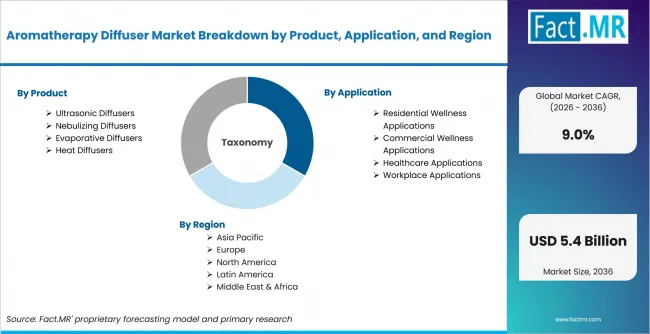
Aromatherapy Diffuser Market Breakdown By Product, Application, And Region | Source: Fact.MR
| Attribute | Details |
|---|---|
| Quantitative Units | USD Billion |
| Market Definition | Aromatherapy diffuser devices that disperse essential-oil or compatible aromatic formulations into indoor spaces through ultrasonic, nebulizing, evaporative or heat-based diffusion. |
| Segments Covered | Product; Application; End Use; Technology; Formulation; Distribution Channel |
| Regions Covered | North America; Latin America; Europe; East Asia; South Asia and Pacific; Middle East and Africa |
| Countries Covered | Germany; Brazil; USA; UK; Japan |
| Key Companies Profiled | doTERRA International; Young Living; Ryohin Keikaku Co. Ltd. (Muji); Vitruvi; Neal’s Yard Limited; and others |
| Forecast Period | 2026 to 2036 |
| Base Year | 2025 |
| Market Value, 2025 | Approximately USD 2.1 billion, calculated from the 2026 value and CAGR |
| Market Value, 2026 | USD 2.3 billion |
| Market Value, 2036 | USD 5.4 billion |
| CAGR, 2026-2036 | 9.0% |
| Absolute Opportunity | USD 3.1 billion |
| Approach | Hybrid top-down and bottom-up assessment using diffuser device revenue, product mix, application demand, end-use purchasing, technology adoption, formulation compatibility, channel mix and country-level growth. |
Source: Fact.MR analysis. Updated Aug 21, 2026
How is the market segmented?
-
By Product:
- Ultrasonic Diffusers
- Portable Ultrasonic Diffusers
- Stationary Ultrasonic Diffusers
- Nebulizing Diffusers
- Glass Nebulizing Diffusers
- Commercial Nebulizing Diffusers
- Evaporative Diffusers
- Fan Based Diffusers
- Passive Evaporative Diffusers
- Heat Diffusers
- Electric Heat Diffusers
- Candle Based Diffusers
- Ultrasonic Diffusers
-
By Application:
- Residential Wellness Applications
- Home Relaxation Applications
- Personal Wellness Applications
- Commercial Wellness Applications
- Spa & Salon Applications
- Hospitality Applications
- Healthcare Applications
- Clinical Wellness Applications
- Alternative Therapy Applications
- Workplace Applications
- Corporate Wellness Applications
- Retail Environment Applications
- Residential Wellness Applications
-
By End Use:
- Individual Consumers
- Home Users
- Personal Care Users
- Hospitality Industry
- Hotels & Resorts
- Spa Facilities
- Healthcare Facilities
- Hospitals & Clinics
- Wellness Centers
- Commercial Establishments
- Corporate Offices
- Retail Businesses
- Individual Consumers
-
By Technology:
- Smart Connected Diffusion Technology
- Wi-Fi Enabled Systems
- Bluetooth Enabled Systems
- Ultrasonic Atomization Technology
- Single Frequency Systems
- Multi Frequency Systems
- Nebulization Technology
- Cold Air Nebulization Systems
- High Output Nebulization Systems
- Environmental Sensing Technology
- Humidity Responsive Systems
- Occupancy Responsive Systems
- Smart Connected Diffusion Technology
-
By Formulation:
- Essential Oil Compatible Systems
- Single Oil Formulations
- Multi Oil Blend Systems
- Water Based Diffusion Systems
- Standard Water Reservoir Systems
- Enhanced Water Systems
- Concentrated Aroma Systems
- High Intensity Formulations
- Controlled Release Systems
- Hybrid Diffusion Systems
- Oil Water Combination Systems
- Multi Fragrance Systems
- Essential Oil Compatible Systems
-
By Distribution Channel:
- Online Retail Channels
- E Commerce Marketplaces
- Brand Owned Platforms
- Specialty Retail Stores
- Wellness Retail Stores
- Home Décor Retail Stores
- Mass Retail Channels
- Hypermarkets & Supermarkets
- Department Stores
- Commercial Distribution Channels
- Hospitality Supply Distributors
- Corporate Procurement Channels
- Online Retail Channels
-
By Region
- North America
- Latin America
- Western Europe
- Eastern Europe
- East Asia
- South Asia and Pacific
- Middle East & Africa
Frequently Asked Questions
What is the Aromatherapy Diffuser Market value in 2026?
At what CAGR is the market projected to grow?
What is the projected market value by 2036?
Which Product leads the market?
Which Application leads the market?
Which End Use leads the market?
Which Technology leads the market?
Which Formulation leads the market?
Which Distribution Channel leads the market?
What CAGR is projected for Germany?
Which company leads the market?
What is the primary driver in this market?
What is the main restraint?
Which companies are included in the market assessment?
Who worked on this report


Preview the report firsthand - request a free sample
Free SampleGet the brochure for pricing and purchase details
Download PDF