- Base Value(2025): 1.98 Bn
- Estimated Value(2026): 2.09 Bn
- Forecast Value (2036): 3.57 Bn
- CAGR (2026 - 2036): 5.5%
Lemon Oil Market Size, Market Forecast and Outlook By FACT.MR
The Lemon Oil market was valued at USD 1.98 billion in 2025, projected to reach USD 2.09 billion in 2026, and is forecast to expand to USD 3.57 billion by 2036 at a 5.5% CAGR. Broad multi-application demand spanning food and beverage flavoring, fine fragrance, personal care, aromatherapy, and natural home care formulation categories positions lemon oil as one of the highest-volume citrus essential oil commodities in the global ingredient supply chain. Cold-pressed lemon peel oil from Sicilian and Spanish production origins commands premium pricing above steam-distilled and solvent-extracted alternatives in fine fragrance house and natural personal care formulation procurement programs.
The absolute dollar growth of USD 1.48 billion across the forecast decade reflects lemon oil's consistent multi-sector demand base complemented by organic certification adoption and application category premiumization. Natural source type leading at 45.6% of source share confirms authenticated botanical origin as the primary quality criterion across the broadest range of lemon oil buyer categories. Concentrates commanding 45.0% of form type share indicates industrial formulator preference for standardized high-potency lemon oil extracts enabling consistent citral and limonene content dosing across beverage flavoring, fragrance, and personal care formulation applications.
Based on FACT.MR's regional analysis, China leads at 7.7% CAGR as expanding premium food and beverage industry demand for natural citrus flavoring, growing natural cosmetic market development, and rising aromatherapy consumer adoption drive multi-application lemon oil growth. South Korea advances at 6.9% where K-beauty formulation investment in vitamin C-effect citrus ingredient skin care and hair care products and premium natural fragrance adoption sustain consistent ingredient demand. Germany registers 6.5% as COSMOS-certified natural personal care brand formulation programs and premium natural cleaning product development specify authenticated botanical lemon oil. The United Kingdom records 6.6% where premium gin and craft beverage natural lemon flavoring demand and natural cosmetic ingredient sourcing sustain dual-application procurement. France tracks at 6.3% as Grasse fragrance house lemon top note formulation and premium natural cosmetic ingredient procurement sustain structured demand. Italy advances at 6.1% as Sicilian cold-pressed lemon oil production origin investment and premium food and beverage export market development sustain domestic sector growth.
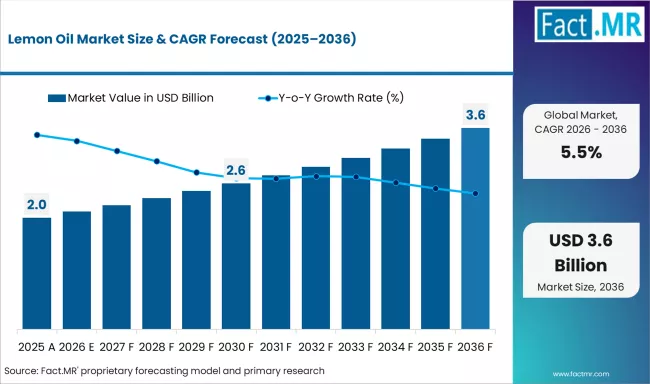
Lemon Oil Market Market Value Analysis | Source: Fact.MR
Lemon Oil Market Key Takeaways
| Metric | Details |
|---|---|
| Industry Size (2026) | USD 2.09 Billion |
| Industry Value (2036) | USD 3.57 Billion |
| CAGR (2026-2036) | 5.5% |
Source: Fact.MR analysis. Updated Mar 14, 2026
Lemon Oil Market Definition
The Lemon Oil market encompasses cold-pressed and steam-distilled essential oil extracted from the peel of Citrus limon fruits, sold in natural and organic certified grades across concentrate, absolute, and blend forms for food and beverage flavoring, aromatherapy, therapeutic, cosmetic, toiletry, fragrance, and cleaning and home applications. Cold-pressed lemon peel oil with authenticated Sicilian or Spanish origin commands premium F&F grade positioning in fragrance house and beverage flavoring supply chains. Organic certified lemon oil serves natural personal care and health food product formulation requirements. Distilled steam-processed variants supply cost-sensitive industrial flavoring and cleaning product applications.
Lemon Oil Market Inclusions
Market scope covers natural and organic certified lemon oil in concentrate, absolute, and blend form types across food and beverage, aromatherapy, therapeutic, cosmetic, toiletry, fragrance, cleaning and home, and other application categories. Distribution channel analysis spans modern trade, franchise outlets, specialty stores, and online platforms. Regional and country-level sizing covers China, South Korea, Germany, UK, France, Italy, Japan, Australia and New Zealand, and 40 plus countries for the 2026 to 2036 forecast period.
Lemon Oil Market Exclusions
Synthetic lemon fragrance compounds and isolated limonene and citral manufactured without Citrus limon peel oil derivation are excluded. Lemon juice concentrate, lemon pulp derivatives, and lemon peel powder products without essential oil extraction are omitted. Other Citrus species essential oils including lime, grapefruit, and bergamot peel oils without Citrus limon botanical authentication fall outside defined boundaries. Finished consumer beverage and personal care products containing lemon oil as a minor formulation component are excluded from ingredient market calculations.
Lemon Oil Market Research Methodology
- Primary Research: Analysts conducted interviews with Sicilian and Spanish lemon oil processor operators, fragrance house natural citrus ingredient buyers, natural personal care brand formulation directors, and premium beverage manufacturer flavour procurement teams to document supply chain dynamics and multi-application demand growth drivers.
- Desk Research: Data aggregation covered Italian and Spanish citrus essential oil production statistics from national agricultural ministries, IFRA fragrance ingredient use standards, EFSA lemon oil flavoring authorization data, and Ecocert COSMOS certification databases for natural origin ingredient documentation.
- Market-Sizing and Forecasting: Baseline values derive from bottom-up aggregation of Mediterranean cold-pressed lemon oil production volume data, applying fragrance house procurement growth rates, natural personal care formulation adoption curves, beverage flavoring expansion rates, and aromatherapy retail growth curves to regional demand projections.
- Data Validation and Update Cycle: Forecasts cross-validate against natural citrus ingredient purchasing disclosures from Symrise AG, Biolandes, Ultra International, Citrosuco Paulista, and Citromax annual sustainability and sourcing reports.
Summary of Lemon Oil Market
- Lemon Oil Market Definition
- The Lemon Oil market covers cold-pressed and steam-distilled Citrus limon peel oil in natural and organic certified grades across concentrate, absolute, and blend forms for food and beverage, fragrance, personal care, aromatherapy, and home care applications globally.
- Demand Drivers in the Market
- COSMOS-certified natural personal care brand formulation programs in Germany, France, and the UK specify authenticated cold-pressed botanical lemon oil as a compliant fragrance and active ingredient, sustaining structured industrial procurement above synthetic citrus fragrance alternatives.
- K-beauty formulation investment in vitamin C-effect citrus ingredient skin care and premium natural fragrance products in South Korea drives ingredient specification demand for authenticated lemon peel oil with documented bioactive limonene and citral constituent content.
- Premium gin, craft beverage, and natural sparkling water citrus flavoring programs in the UK and Germany create consistent demand for cold-pressed lemon oil with authenticated Sicilian or Spanish origin above steam-distilled industrial flavoring alternatives.
- Key Segments Analyzed in the FACT.MR Report
- Natural Source Type leads with 45.6% of source share in 2026, where authenticated botanical origin certification across the broadest buyer category range sustains natural source procurement preference above organic certified and synthetic alternatives.
- Concentrates command 45.0% of Form Type share in 2026, as industrial formulator preference for standardized high-potency lemon oil extracts with consistent citral and limonene content enables precise dosing across beverage, fragrance, and personal care formulation programs.
- Food and Beverage accounts for 27.0% of Application share in 2026, anchoring lemon oil's largest single-application volume through premium soft drink, craft gin, confectionery, and bakery natural citrus flavoring demand across global food manufacturing and beverage production.
- Analyst Opinion at FACT.MR
- Shambhu Nath Jha, Principal Consultant, Client Partner at Future Market Insights, opines: 'Lemon oil's structural advantage over most other essential oils lies in its simultaneous presence as a primary ingredient across fragrance, food flavoring, personal care, aromatherapy, and home care categories, which insulates total demand from single-application market cyclicality. The Sicilian production origin carries specific commercial significance beyond geographic branding, as the cold-pressing process preserves bioactive constituent profiles that steam-distilled alternatives cannot replicate, and fragrance house and natural personal care buyers are increasingly building origin-specific sourcing criteria into their approved ingredient specifications. Producers that invest in cold-pressing capacity expansion and origin certification documentation will command sustainable price premiums above the commodity steam-distilled lemon oil market.'
- Strategic Implications / Executive Takeaways
- Lemon oil processors must develop Sicilian or Spanish origin certification programs with third-party GC-MS authentication and isotope ratio analysis documentation to qualify for premium fine fragrance house and natural personal care brand approved supplier lists.
- Organic certified lemon oil supply chain investment with COSMOS and EU organic regulation compliance documentation enables access to German, French, and UK natural personal care manufacturer procurement programs that restrict conventional oil sourcing.
- K-beauty and premium Asian personal care formulation market development requires bioactive citral and limonene constituent content documentation and photosensitivity safety dossier preparation for leave-on personal care product application authorization.
- Methodology
- Primary Research: FACT.MR interviewed Sicilian and Spanish lemon oil processors and fragrance house buyers across 40 countries to document supply chain dynamics and multi-application demand drivers.
- Desk Research: Analysts aggregated Italian and Spanish citrus oil production statistics, IFRA fragrance standards, EFSA flavoring authorization data, and Ecocert COSMOS certification databases.
- Market-Sizing and Forecasting: Bottom-up aggregation of Mediterranean cold-pressed lemon oil production data with fragrance, personal care, beverage, and aromatherapy adoption curves applied to regional demand projections.
- Data Validation: Cross-validation against natural citrus ingredient disclosures from Symrise AG, Biolandes, Ultra International, Citrosuco Paulista, and Citromax annual sourcing reports.
Country-wise Analysis
.webp "Top Country Growth Comparison Lemon Oil Market Cagr (2026 2036)")
Top Country Growth Comparison Lemon Oil Market Cagr (2026 2036) | Source: Fact.MR
| Countries | CAGR (2026 to 2036) |
|---|---|
| U.S. | 7.1% |
| UK | 6.6% |
| France | 6.3% |
| Germany | 6.5% |
| Italy | 6.1% |
| South Korea | 6.9% |
| Japan | 6.2% |
| China | 7.7% |
| Australia-NZ | 6.0% |
Source: Fact.MR analysis. Updated Mar 14, 2026
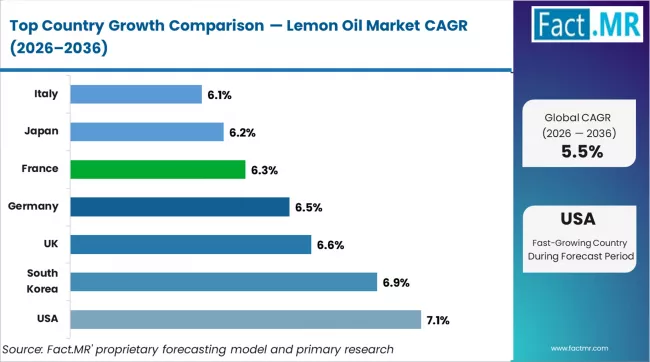
Lemon Oil Market Cagr Analysis By Country | Source: Fact.MR
The U.S.
The U.S. lemon oil market is anticipated to expand at 7.1% CAGR over the analysis period. Growing demand for natural and organic products in personal care, food, and wellness sectors is fueling high growth in the lemon oil market. The growing adoption of aromatherapy, cosmetics, cleaning agents, and dietary supplements is increasing application domains. Demand for chemical-free ingredients and plant-based formulations is driving growth. Consumer demand for chemical-free ingredients and plant-based formulations is driving growth.
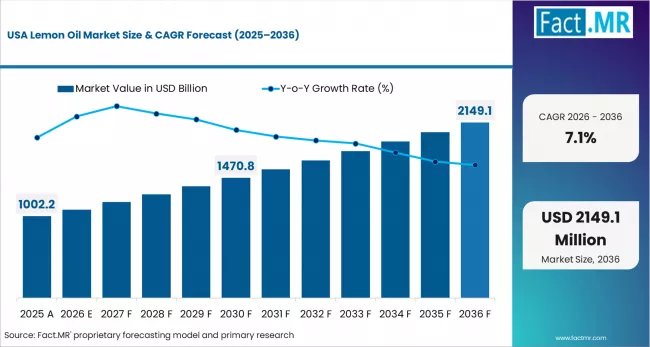
Lemon Oil Market Country Value Analysis | Source: Fact.MR
Increased awareness of the health benefits of its antibacterial, antifungal, and mood-enhancing attributes is driving purchasing decisions. Increased online shopping platforms and wellness-oriented retail chains are increasing product availability and visibility.
UK
The UK lemon oil market is forecasted to grow at 6.6% CAGR over the study period. Increased consumer demand for natural remedies and organic personal care products is driving the lemon oil market. The growth of wellness and aromatherapy practices is driving demand for high-quality essential oils. Increasing emphasis on clean-label beauty and personal care is stimulating innovation.
The availability of strong retail infrastructure and online offtake growth are supporting the product's reach. Rising awareness of lemon peel oil's therapeutic uses, such as stress management and antimicrobial activity, is anticipated to continue steady growth during 2036.
France
The French lemon oil market is anticipated to expand at 6.3% CAGR throughout the study. High consumer preference for natural ingredients and botanical compositions are fueling the demand. Growth in the natural cosmetics and personal care segment, along with the increasing application of essential oils in wellness therapies, is increasing opportunities.
Initiatives focused on organic certification and sustainable sourcing policies are boosting consumer confidence. An increase in the demand for aromatherapy clinics and spa facilities based on essential oils is also growing. Expansion in distribution via health-oriented retailers and online channels facilitates positive growth prospects.
Germany
The German lemon oil market will grow at 6.5% CAGR during the forecast period. Increasing demand for clean-label health and wellness products is driving the lemon oil market. Germany's large aromatherapy and natural healthcare industries are creating a supportive climate for the consumption of essential oils. The growth of natural household cleaning products is creating new avenues for growth. Sustainably produced, organic-certified essential oils are impacting brand strategies through consumer demand.
Expanded availability from pharmacies, wellness stores, and websites are underpinning broad sales penetration. Growing awareness campaigns on the benefits of essential oils will be expected to boost revenue growth in the forthcoming decade.
Italy
Italy's lemon oil market is predicted to increase by 6.1% CAGR over the study period. Italy's cultural heritage of herbal use and botanic medicine is driving demand across personal care and culinary use. The growing appeal of aromatherapy and natural skin care products is creating robust opportunities for growth.
Innovation in multifunctional products for therapeutic and cosmetic purposes is driving product uptake. Increased eco-friendly consumerism is prompting manufacturers to emphasize sustainable sourcing and clean formulations. Widening distribution channels such as natural product stores and online platforms ensures enhanced accessibility, supporting fast growth.
South Korea
The South Korean lemon oil market is anticipated to register a growth rate of 6.9% CAGR over the study period. The growing interest in natural beauty products and wellness trends is driving the lemon oil market. The strong pull of K-beauty, which focuses on natural and functional ingredients, is increasing the demand for essential oils. Aromatherapy and spa culture expansion with lemon oil treatments is expanding application fields.
Innovations in home care and lifestyle products with essential oils are making product offerings diverse. Digital campaigns highlighting the overall advantages of lemon peel oil are building brand visibility. The expansion of online health and wellness platforms is enhancing product reach and availability.
Japan
The Japanese lemon oil market is projected to grow at 6.2% CAGR during the forecast period. Increased consumer interest in holistic wellness and aversion to highly processed, unnatural products is boosting demand. The expansion of aromatherapy treatments and natural wellness solutions is bolstering growth in the lemon oil market.
The growing incorporation of skincare, personal care products, and household cleaning products is increasing product application. Innovations focused on high-purity, organic-certified lemon peel oils are attracting quality-sensitive consumers. The development of e-commerce and specialty health and wellness outlets is boosting product availability and distribution, fueling consistent growth through 2036.
China
The Chinese lemon oil market is anticipated to expand at 7.7% CAGR over the analysis period. Urbanization at a fast pace, an increase in disposable income, and increased health and wellness awareness are driving the lemon oil market. Growth in application areas in personal care, household cleaning, and food sectors is providing enormous opportunities for growth.
The increased popularity of aromatherapy and complementary wellness practices is augmenting demand. Growing emphasis on natural and chemical-free products is motivating manufacturers to create innovative products. The growth of digital selling platforms and bold marketing campaigns to promote lemon peel oil benefits are expected further to promote strong growth during the entire forecast period.
Australia-New Zealand
The Australia-New Zealand lemon oil market is expected to grow at 6.0% CAGR during the study period. Epic demand for natural and eco-friendly products is underpinning the lemon oil market throughout Australia and New Zealand. Growing natural personal care and wellness businesses are driving applications of essential oils.
Increased awareness regarding the antimicrobial and mood-modulating virtues of lemon peel oil is driving buying decisions. Upsurge in spas and aromatherapy services is augmenting penetration into the marketplace. Organic stores, pharmacies, and online health retailers are making products available to ensure continuous accessibility and facilitate consistent growth.
Segment-wise Analysis
By Source Type
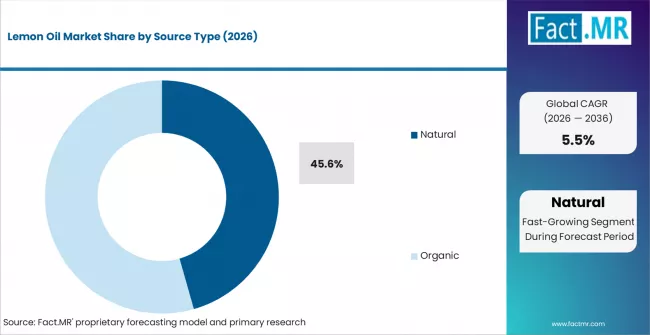
Lemon Oil Market Analysis By Source Type | Source: Fact.MR
By source type, Natural Lemon Oil is predicted to command around 55% of the total revenue share in 2025, and Organic Lemon Oil will capture about 45% of the total Lemon Oil market.
Lemon peel Oil is majorly procured from natural sources, as it is easily available and economical compared to other oils. It is generally used for several applications like cosmetics, cleaning, and aromatherapy. It is prepared through a cold press of lemon peel and retains its natural fragrance and properties.
Major producers in this segment are Citrus and Allied Essences Ltd. and doTERRA, for which natural oil is very important for industrial, commercial, or consumer applications. Therefore, this increasing acceptance of products with natural ingredients across industries such as beauty and wellness will work well for the growth of natural lemon oil.
Organic lemon oil is experiencing a boom today since consumers are becoming increasingly conscious of organic and eco-friendly products in the marketplace. It is made from lemons derived without any synthetic pesticides, fertilizers, or chemicals and provides greener and healthier products for consumers wishing to buy with a sense of environmental preservation.
Major players in the segment include Mountain Rose Herbs and Edens Garden, which dominate the supply of organic lemon oil consumed in top-notch cosmetics, premium essential oil blends, and organic food products. Further, the organic segment has increased with improved health awareness and a shift toward organic-oriented lifestyles among environmentally sensitive consumers.
By Form Type
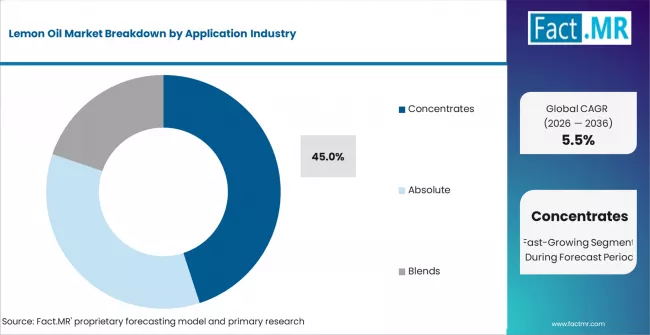
Lemon Oil Market Analysis By Form Type | Source: Fact.MR
Concentrates will lead the lemon oil market because these will account for 45% of the total industry share in 2025, while blends will cover 35% of the value.
Concentrates greatly nourish their utility, potency, and adaptability; thus, they have been much preferred in industries such as food and beverages, cosmetics, and aromatherapy. Concentrates are for the strong lemon scent and flavor, which is increasingly valued in applications where natural lemon profiles have to be extremely heavy. Major suppliers, including Citrus and Allied Essences Ltd. and doTERRA, offer concentrated lemon peel oil products that meet different consumer and industrial demands.
Key applications include active ingredients of cleaning agents, formulations of essential oils, and flavoring agents in the food and beverage industry. Other factors in spice, like ease of storage and transportation, have also encouraged sales of concentrates in both commercial and consumer settings.
Blends are obtained by mixing lemon peel oil with some other essential oil or ingredients to create a completely new fragrance profile and/or therapeutic benefits. Such blends are mostly found in the commercial wellness market in aroma diffusion, personal care, or aromatherapy products.
Well-known names would certainly feature among these within mostly marketed combinations of lemon oil: Young Living and Edens Garden. Combined oils with lemon, like lavender or eucalyptus, are usually pursued for their superior therapeutic activity regarding stress reduction, mood enhancement, and respiratory benefits. These blends are favored by the rising trend within holistic and natural wellness solutions, thus increasing their demand.
Competitive Outlook
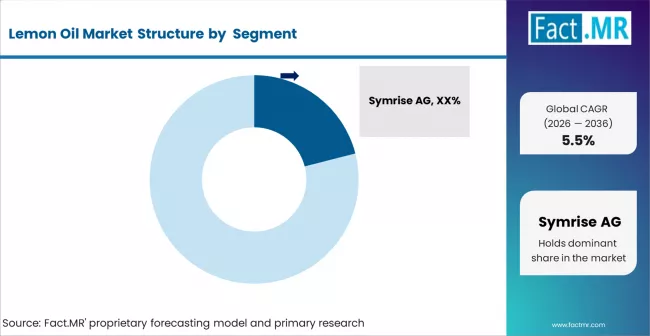
Lemon Oil Market Analysis By Company | Source: Fact.MR
The lemon oil market is characterized by the rivalry between multinational entities engaged in flavor and fragrance, specialized producers of essential oils, and integrated citrus processors. Symrise AG has a leading position supported by a portfolio of flavor solutions and sustainability initiatives to strengthen its presence in food, beverage, and personal care.
Lionel Hitchen (Essential Oils) Ltd strengthens its competitive position through a focus on customized citrus oil formulations and its expansion into emerging markets. Bontoux S.A.S. combines its long-standing tradition in natural extracts with an emphasis on traceability and organic certifications, creating a strong appeal in premium sectors.
Citrus and Allied Essences Ltd. and Young Living Essential Oils LC give great focus to quality differentiation, with Young Living using direct-to-consumer networks to foster brand loyalty in the aromatherapy and wellness markets. Regional specialists like Citrus Oleo, Citrosuco Paulista SA, and Citromax S.A.C.I., integrating their upstream citrus processing capability, emerge with raw material security and thus enhance competitiveness.
The landscape is even further diversified by the likes of Plant Therapy Essential Oils and Ultra International B.V., with natural product brands aligning their product strategies with growing consumer demand for natural and transparent sourcing.
Market Share Analysis by Company
| Company Name | Estimated Market Share (%) |
|---|---|
| Symrise AG | 18-22% |
| Lionel Hitchen (Essential Oils) Ltd | 14-18% |
| Bontoux S.A.S. | 10-14% |
| Citrus and Allied Essences Ltd. | 8-11% |
| Young Living Essential Oils LC | 6-9% |
| Other Players | 30-40% |
Source: Fact.MR analysis. Updated Mar 14, 2026
Key Company Insights
Symrise AG accounts for an estimated 18-22% share of the lemon oil market, which is a consequence of strategic investments in citrus innovation and sustainable sourcing partnerships that continue to solidify its sway across the food, beverage, and cosmetics sectors. Vertically integrated supply chains in citrus-growing regions ensure that Symrise can meet huge demands for natural flavor profiles by guaranteeing environmental integrity at the same time.
Lionel Hitchen (Essential Oils) Ltd captures about 14-18% of the share. Bontoux S.A.S. will be able to secure around 10-14% share based on its historical presence and availability of certified organic offerings. Citrus and Allied Essences Ltd. commands 8-11% of the industry by delivering consistent quality and maintaining long-term supplier connections with multinational food and fragrance houses. Young Living Essential Oils LC holds a 6-9% share, emphasizing wellness-driven product branding and a powerful direct sales network that extends the appeal for personal and household care applications.
Key Players
- Symrise AG
- Lionel Hitchen (Essential Oils) Ltd
- Bontoux S.A.S.
- Citrus and Allied Essences Ltd.
- Young Living Essential Oils LC
- Citrus Oleo
- Mountain Rose Herbs, Inc.
- doTERRA International, LLC
- Citrosuco Paulista SA
- Citromax S.A.C.I.
- Plant Therapy Essential Oils
- Ultra International B.V.
- Biolandes
- Aksuvital
- Aromaaz International
Bibliography
- Italian Ministry of Agricultural, Food and Forestry Policies. (2024). Sicilian citrus essential oil production statistics and quality standards. MiPAAF.
- European Food Safety Authority. (2024). Flavouring substances: Lemon oil authorization update under Regulation EC 1334/2008. EFSA.
- International Fragrance Association. (2024). IFRA standards: Lemon oil and citrus peel oil use guidelines and photosensitivity restrictions. IFRA.
- Ecocert Group. (2024). COSMOS organic standard: Cold-pressed citrus oil certification requirements for lemon oil. Ecocert.
- European Commission, Directorate-General for Health and Food Safety. (2024). Cosmetics Regulation EC 1223/2009: Citrus oil ingredient photosensitivity documentation requirements. European Commission.
- Food and Agriculture Organization of the United Nations. (2024). Citrus production: Lemon cultivation statistics and essential oil trade data by production origin. FAO.
This bibliography is provided for reader reference. The full FACT.MR report contains the complete reference list with primary research documentation.
This Report Addresses
- Market sizing and quantitative forecast metrics detailing revenue projections for the Lemon Oil market across source type, form type, application, and distribution channel categories through 2036.
- Segmentation analysis mapping adoption velocity across natural and organic lemon oil in concentrate, absolute, and blend forms by food and beverage, fragrance, personal care, and aromatherapy applications.
- Regional intelligence comparing Sicilian and Spanish cold-pressed premium demand in Germany, France, and Italy against K-beauty ingredient integration growth in South Korea and multi-application demand expansion in China.
- Supply chain assessment analyzing Mediterranean cold-pressing capacity, Sicilian origin certification programs, GC-MS authentication documentation, and organic certification conversion for premium buyer qualification.
- Regulatory compliance assessment analyzing IFRA photosensitivity restrictions, EFSA flavoring authorization, EU Cosmetics Regulation citrus oil documentation requirements, and COSMOS organic certification criteria.
- Competitive landscape evaluation tracking Symrise, Biolandes, and Ultra International origin certification and multi-application supply chain strategies for fragrance house and natural personal care brand procurement programs.
- Application growth analysis identifying K-beauty citrus ingredient formulation, premium craft beverage natural flavoring, and COSMOS-certified natural home care product development as the primary multi-regional demand expansion categories.
- Custom data delivery formats encompassing interactive dashboards, raw Excel datasets, and comprehensive PDF narrative reports.
Segmentation
Scope of the Report
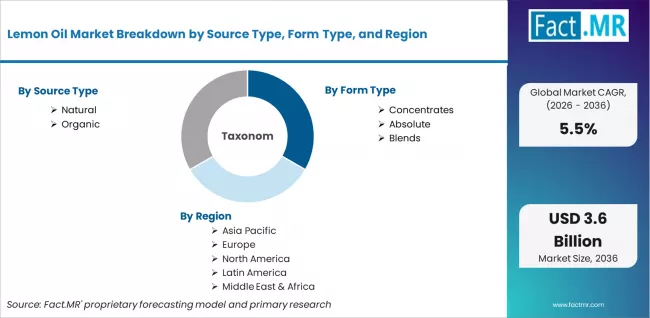
Lemon Oil Market Breakdown By Source Type, Form Type, And Region | Source: Fact.MR
| Metric | Value |
|---|---|
| Quantitative Units | USD 2.09 billion to USD 3.57 billion, at a CAGR of 5.5% |
| Market Definition | The Lemon Oil market covers cold-pressed and steam-distilled Citrus limon peel oil in natural and organic grades across concentrate, absolute, and blend forms for food and beverage, fragrance, personal care, aromatherapy, therapeutic, and home care applications globally. |
| Source Type Segmentation | Natural, Organic |
| Form Type Segmentation | Concentrates, Absolute, Blends |
| Application Segmentation | Food and Beverage, Aromatherapy, Therapeutics, Cosmetics, Toiletries, Fragrances, Cleaning and Home, Others |
| Distribution Channel Segmentation | Modern Trade, Franchise Outlets, Specialty Stores, Online |
| Regions Covered | North America, Latin America, Europe, East Asia, South Asia, Oceania, Middle East and Africa |
| Countries Covered | China, South Korea, Germany, UK, France, Italy, Japan, Australia-New Zealand, and 40 plus countries |
| Key Companies Profiled | Symrise AG, Lionel Hitchen (Essential Oils) Ltd, Bontoux S.A.S., Citrus and Allied Essences Ltd., Young Living Essential Oils, Citrus Oleo, Mountain Rose Herbs Inc., doTERRA International LLC, Citrosuco Paulista SA, Citromax S.A.C.I., Plant Therapy Essential Oils, Ultra International B.V., Biolandes, Aksuvital, Aromaaz International |
| Forecast Period | 2026 to 2036 |
| Approach | Bottom-up aggregation of Mediterranean cold-pressed lemon oil production volume data with fragrance, personal care, beverage, and aromatherapy adoption curves applied to regional demand projections |
Source: Fact.MR analysis. Updated Mar 14, 2026
Segmentation
-
By Source Type :
- Natural
- Organic
-
By Form Type :
- Absolute
- Concentrates
- Blends
-
By Application :
- Therapeutics
- Aromatherapy
- Food & Beverage
- Cosmetics
- Toiletries
- Fragrances
- Cleaning & Home
- Others
-
By Distribution Channel :
- Modern Trade
- Franchise Outlets
- Specialty Stores
- Online
-
By Region :
- North America
- Latin America
- Europe
- Japan
- APEJ
- MEA
Frequently Asked Questions
How large is the demand for Lemon Oil in the global market in 2026?
What will be the market size of Lemon Oil by 2036?
What is the expected demand growth between 2026 and 2036?
Which Source Type leads global sales by 2026?
Which Form Type dominates?
What is China's growth outlook?
What drives demand in South Korea?
Which Application category leads?
What is excluded from the scope?
How does FACT.MR validate the Lemon Oil forecast?
Who worked on this report


Preview the report firsthand - request a free sample
Free SampleGet the brochure for pricing and purchase details
Download PDF