- Market Value (2025): USD 156.9 Bn
- Estimated Value (2026): USD 167.9 Bn
- Forecast Value (2036): USD 330.3 Bn
- CAGR (2026-2036): 7.0%
What is the Hydrogen Generation Market forecast to be worth by 2036?
USD 167.9 billion in 2026 to USD 330.3 billion by 2036 at 7.0% CAGR.
- The hydrogen generation market crossed USD 156.9 billion in 2025 as industrial users reviewed supply reliability and low-carbon procurement routes.
- Demand is projected to rise from USD 167.9 billion in 2026 to USD 330.3 billion by 2036.
- The market is forecast to record 7.0% CAGR from 2026 to 2036 as refiners and chemical producers evaluate hydrogen generation closer to consumption points.
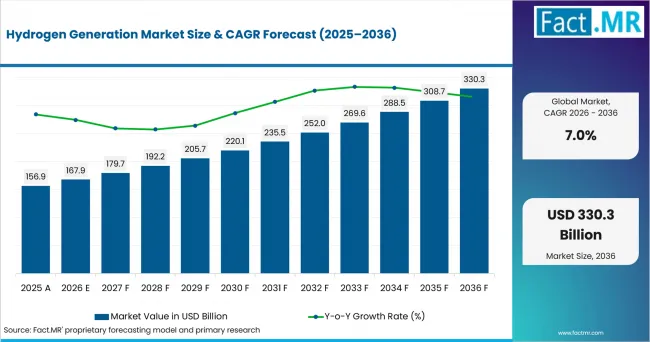
Hydrogen Generation Market Value Analysis | Source: Fact.MR
What are the defining numbers behind Hydrogen Generation Market growth?
USD 162.4 billion absolute opportunity by 2036, led by Electrolyzer Based Hydrogen Systems and Oil & Gas Industry alongside Direct Industrial Sales.
- Demand Drivers in the Market
- Refinery operators need reliable industrial hydrogen supply for hydrotreating and fuel-quality processes. The International Energy Agency reported that global hydrogen demand exceeded 100 million tonnes in 2025, with low-emissions production growing by 20% to nearly 1 million tonnes.
- Chemical producers need high purity hydrogen gas since feedstock quality affects ammonia and methanol production.
- Project developers need bankable offtake agreements before electrolyzer plants move from design into construction.
- Key Segments Analyzed
- By Product: Electrolyzer Based Hydrogen Systems is expected to hold 71.60% share in 2026 as industrial users evaluate cleaner production routes and modular system design.
- By Application: Industrial Hydrogen Supply is projected to account for 36.80% share in 2026 because stable use continues in refining and chemical processes.
- By End Use: Oil & Gas Industry is anticipated to capture 62.40% share in 2026 owing to refinery hydrogen needs and fuel-quality compliance.
- By Technology: Electrolysis Technology is estimated to represent 54.90% share in 2026 due to power-to-hydrogen project pipelines.
- By Formulation: High Purity Hydrogen Gas is forecast to hold 48.30% share in 2026 as electronics and refining users require controlled quality.
- By Distribution Channel: Direct Industrial Sales is expected to hold 39.50% share in 2026 since large users prefer dedicated supply contracts and technical service.
- Analyst Opinion at Fact.MR
- Shambhu Nath Jha, Senior Consultant at Fact.MR, states, “Hydrogen generation purchasing is moving from project size to delivered reliability. Industrial users are expected to reward suppliers that combine stack uptime, storage planning and service support. The commercial case links production cost with purity and offtake.”
- Strategic Implications
- Industrial users should test supply options against purity, pressure and delivery risk before signing long contracts.
- Equipment manufacturers should document stack life and power conversion efficiency alongside maintenance requirements.
- Project developers should secure anchor customers before expanding production capacity.
- Policy teams should align incentives with industrial consumption that converts planned capacity into purchased hydrogen. In May 2026, the European Commission initially selected nine IF25 hydrogen projects for EUR 1.09 billion, representing almost 1.1 GW of electrolyzer capacity and more than 1.3 million tonnes of planned hydrogen production over their first 10 years of operation.
Germany is projected to record 8.1% CAGR through 2036 led by core network planning. Brazil is anticipated to post 7.4% CAGR as hydrogen rules improve project clarity. The USA is forecast to advance at 6.7% CAGR through hubs and clean hydrogen financing. The UK is estimated to reach 6.0% CAGR as allocation-round contracts move construction forward. Japan is expected to record 5.3% CAGR owing to low-carbon hydrogen policy and industrial use cases.
How does the Hydrogen Generation Market break down by segment?
Electrolyzer Based Hydrogen Systems lead Product at 71.60%; Industrial Hydrogen Supply leads Application at 36.80%.
Which product dominates?
Electrolyzer Based Hydrogen Systems are projected to account for 71.6% share in 2026.
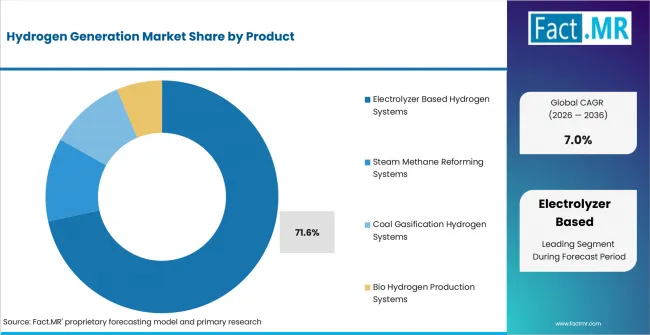
Hydrogen Generation Market Analysis By Product | Source: Fact.MR
Electrolyzer Based Hydrogen Systems lead as producers compare efficiency with renewable power access. Alkaline electrolyzers remain useful where proven operation guides procurement. PEM units fit power-linked projects. In September 2025, the IEA reported global installed water electrolysis capacity of 2 GW in 2024 and more than 1 GW added by July 2025.
What leads the Application segment?
Industrial Hydrogen Supply is expected to hold 36.8% share in 2026.
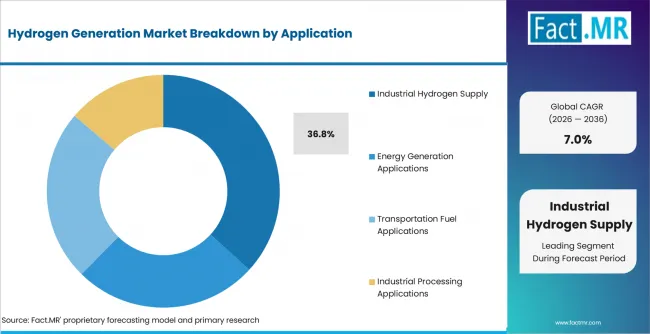
Hydrogen Generation Market Analysis By Application | Source: Fact.MR
Industrial Hydrogen Supply leads because refineries and chemical plants need steady feedstock flow. Chemical manufacturing relies on predictable quality for ammonia and methanol. Refinery operations use hydrogen for fuel upgrading.
How does End Use shape demand?
Oil & Gas Industry is anticipated to capture 62.4% share in 2026.
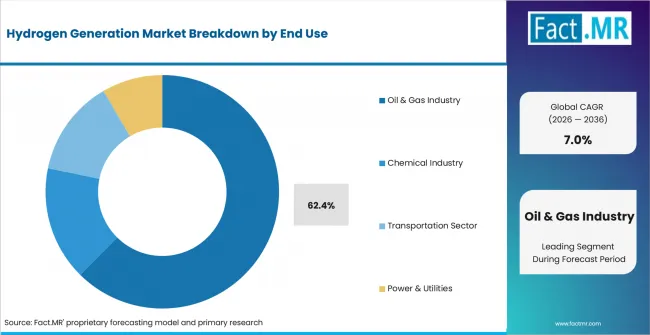
Hydrogen Generation Market Analysis By End Use | Source: Fact.MR
Oil & Gas Industry leads due to refinery hydrogen demand and fuel-quality rules. Refining companies remain the clearest use case. Upstream producers evaluate hydrogen for process emissions. The IEA noted in September 2025 that existing refining and chemical uses account for almost all firm private-sector offtake agreements for low-emissions hydrogen.
What supports Electrolysis Technology?
Electrolysis Technology is forecast to represent 54.9% share in 2026.
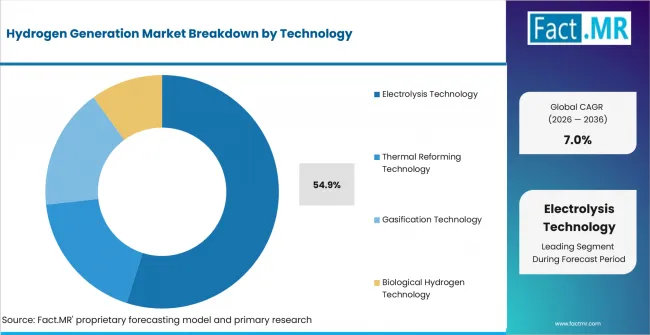
Hydrogen Generation Market Analysis By Technology | Source: Fact.MR
Electrolysis Technology leads as developers pair hydrogen production with renewable power. Water electrolysis systems shape many low-carbon projects. Reforming remains used where natural gas access shapes economics. In February 2025, Accelera by Cummins said it would supply a 100 MW PEM electrolyzer system for bp’s Lingen green hydrogen project.
Which Formulation leads demand?
High Purity Hydrogen Gas is estimated to account for 48.3% share in 2026.
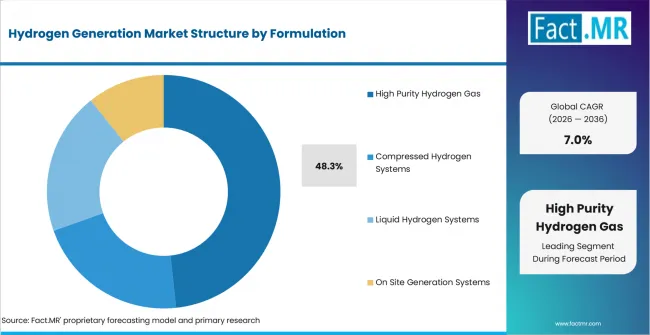
Hydrogen Generation Market Analysis By Formulation | Source: Fact.MR
High Purity Hydrogen Gas leads because refining and electronics users rely on tight specifications. Ultra pure systems serve stricter process environments. Industrial grade hydrogen supports plant operations.
What supports Direct Industrial Sales?
Direct Industrial Sales are expected to hold 39.5% share in 2026.
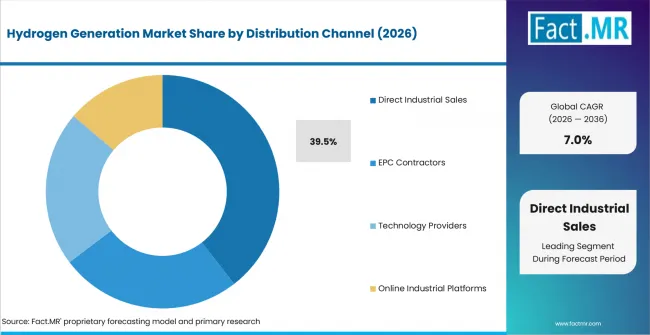
Hydrogen Generation Market Analysis By Distribution Channel | Source: Fact.MR
Direct Industrial Sales lead since large customers prefer dedicated supply terms. OEM contract sales support equipment-led projects. EPC contractors support compression and storage integration. In July 2025, 10 of the UK’s first commercial-scale green hydrogen projects signed contracts under Hydrogen Allocation Round 1 (HAR1).
What is accelerating Hydrogen Generation Market adoption, and what is holding it back?
Electrolyzer scale drives it; offtake and infrastructure risk restrain it.
Drivers Impact Analysis
| DRIVER | (~) % IMPACT ON CAGR | GEOGRAPHIC RELEVANCE | IMPACT TIMELINE |
|---|---|---|---|
| Electrolyzer project scale | +2.0% | Germany, USA, UK | Short term (<= 2 years) |
| Industrial hydrogen supply | +1.6% | Refining and chemicals | Short term (<= 2 years) |
| Low-carbon policy support | +1.3% | Germany, USA, Brazil | Medium term (2-4 years) |
| Direct industrial sales | +1.1% | Industrial clusters | Medium term (2-4 years) |
| High purity requirements | +0.8% | Electronics and refining | Long term (>= 4 years) |
- Electrolyzer project scale: Larger projects are expected to raise demand for stacks and plant controls.
- Industrial hydrogen supply: Refining and chemical users keep hydrogen generation anchored in plant processes. Stable demand is expected to protect direct supply models during early low-carbon project growth.
- Direct industrial sales: Contracted volumes reduce demand risk for producers. Large accounts are expected to prefer suppliers that combine generation assets with delivery support.
- High purity requirements: Purity affects catalysts and specialty materials. Suppliers with monitoring and purification capability are projected to win repeat contracts from industrial users.
Opportunity Impact Analysis
| OPPORTUNITY | (~) % IMPACT ON CAGR | GEOGRAPHIC RELEVANCE | IMPACT TIMELINE |
|---|---|---|---|
| Renewable electrolysis hubs | +1.2% | USA, Germany, UK | Medium term (2-4 years) |
| Hydrogen storage and pipeline buildout | +0.9% | Germany and Japan | Medium term (2-4 years) |
| Refinery replacement projects | +0.8% | USA, Brazil, Japan | Long term (>= 4 years) |
| Liquid hydrogen logistics | +0.6% | USA and Japan | Long term (>= 4 years) |
- Renewable electrolysis hubs: Hub planning is expected to create orders for electrolyzers and plant controls.
- Hydrogen storage and pipeline buildout: Pipeline planning is anticipated to create demand for compression systems.
- Refinery replacement projects: Refineries offer a practical route for lower-emission hydrogen. Developers are expected to pursue sites with firm fuel-quality demand first.
- Liquid hydrogen logistics: Liquid supply networks are expected to support users that cannot host generation assets.
Restraints Impact Analysis
| RESTRAINT | (~) % IMPACT ON CAGR | GEOGRAPHIC RELEVANCE | IMPACT TIMELINE |
|---|---|---|---|
| Power cost exposure | -1.2% | Electrolyzer projects | Short term (<= 2 years) |
| Offtake uncertainty | -1.0% | Emerging project markets | Short term (<= 2 years) |
| Transport and storage gaps | -0.8% | Germany, Brazil, Japan | Medium term (2-4 years) |
| Certification and safety complexity | -0.6% | Global industrial users | Long term (>= 4 years) |
- Power cost exposure: Electricity cost is expected to remain a purchase barrier. Industrial customers need clear power sourcing before accepting long-term hydrogen pricing.
- Transport and storage gaps: Infrastructure gaps are anticipated to raise delivered cost. Germany’s storage planning shows why generation projects must tie into storage and pipeline access.
- Certification and safety complexity: Industrial users need carbon, purity and pressure documentation. Audits are expected to lengthen supplier sales cycles.
Which countries are scaling Hydrogen Generation Market fastest?
- The country comparison spans 2.8 percentage points across three growth bands.
- Germany remains 0.7 point above Brazil through core network financing.
- Brazil remains 0.7 point above the USA as hydrogen rules improve clarity.
- The USA remains 0.7 point above the UK through clean hydrogen financing.
- The UK remains 0.7 point above Japan as contracts move projects toward construction.
- Japan closes the range through support for industry and power generation.
Comparable CAGRs create different entry conditions through industrial demand and infrastructure. Coverage spans six regions.
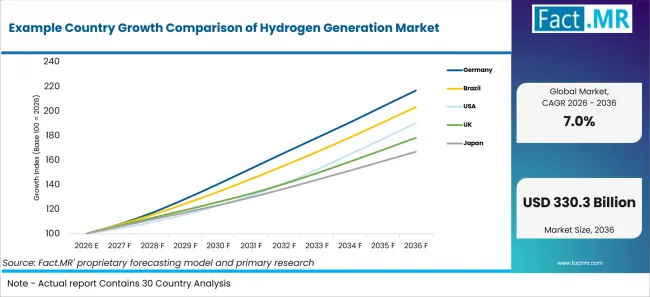
Example Country Growth Comparison Of Hydrogen Generation Market | Source: Fact.MR
| Country | CAGR (2026-2036) |
|---|---|
| Germany | 8.1% |
| Brazil | 7.4% |
| USA | 6.7% |
| UK | 6.0% |
| Japan | 5.3% |
What supports Germany adoption?
8.1% CAGR, supported by core network financing and industrial demand.
Germany’s growth reflects a market where hydrogen generation must connect with transport infrastructure and industrial offtake. Bundesnetzagentur set a EUR 25/kWh/h/a ramp-up tariff for the hydrogen core network in July 2025. In March 2025, Germany’s federal ministries reported that KfW transferred EUR 172 million into the amortisation account supporting construction of the approved 9,040 km hydrogen core network.
How is Brazil scaling demand?
7.4% CAGR, shaped by hydrogen regulation and refinery use.
Brazil’s growth is tied to renewable power potential and refinery use. ANP stated in February 2025 that Law No. 14.948/2024 defines low-carbon hydrogen at no more than 7 kgCO2eq/kgH2 until 2030.
What supports USA demand?
6.7% CAGR, supported by clean hydrogen financing and industrial hubs.
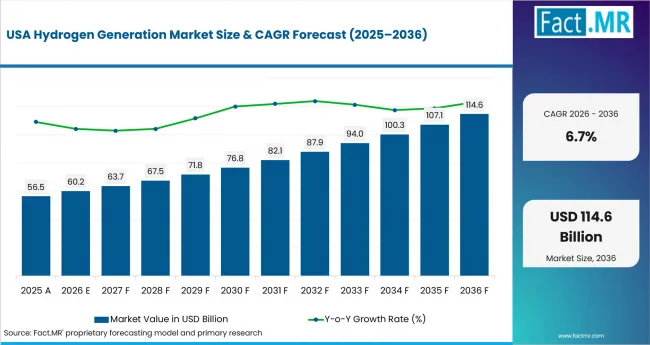
Hydrogen Generation Market Country Value Analysis | Source: Fact.MR
The USA market is supported by funding that links clean hydrogen production with end-use customers. DOE closed a $1.66 billion loan guarantee in January 2025 for up to six Plug Power facilities producing and liquefying clean hydrogen. In the same month, DOE awarded $20 million to the Heartland Hydrogen Hub and $18.8 million to the Mid-Atlantic Hydrogen Hub to begin Phase 1 activities.
How is the UK developing adoption?
6.0% CAGR, led by contract-backed electrolytic hydrogen projects.
The UK’s growth is shaped by allocation contracts that reduce early revenue risk for producers. DESNZ confirmed in July 2025 that 10 of the UK’s first commercial-scale green hydrogen projects had signed contracts and were expected to bring in over £400 million of private capital investment. In April 2025, HAR2 cost guidance stated that the selected HAR1 projects achieved a weighted average strike price of £241/MWh H₂ (HHV).
How does Japan perform?
5.3% CAGR, supported by low-carbon hydrogen policy and industrial use cases.
Japan’s growth reflects policy support for hydrogen use across hard-to-electrify industries. The 2025 Energy White Paper identified hydrogen and related products as having applications across steel, chemicals, mobility, industrial heat and power generation, while ammonia was also identified for chemicals, industrial heat, shipping and power generation.
Who leads the Hydrogen Generation Market?
Air Products and Chemicals, Air Liquide and Linde have broad industrial gas reach. Plug Power, Iwatani and Nel ASA add electrolyzer and clean-hydrogen exposure.
Air Products and Chemicals, Air Liquide and Linde serve industrial hydrogen users through production assets. Plug Power adds electrolyzer-based production. Iwatani supports Japanese distribution. Nel ASA carries the Proton OnSite heritage. In April 2025, Linde agreed to supply Samsung's Pyeongtaek complex with hydrogen from existing on-site production facilities starting in mid-2026.
Which companies are the key providers?
Key companies include Air Products and Chemicals, Inc., Air Liquide S.A., Linde plc, Plug Power Inc., Iwatani Corporation, and Nel ASA.
- Air Products and Chemicals, Inc.
- Air Liquide S.A.
- Linde plc
- Plug Power Inc.
- Iwatani Corporation
- Nel ASA
Bibliography
- Cummins Inc. (2025, February 11). Accelera to power 100 MW electrolyzer system for bp’s Lingen green hydrogen project.
- Agência Nacional do Petróleo, Gás Natural e Biocombustíveis. (2025, February 10). Hidrogênio [Hydrogen].
- Air Liquide. (2025, July 23). Air Liquide takes the final investment decision to build ELYgator, a large-scale electrolyzer in the Netherlands.
- Bundesnetzagentur. (2025, July 14). Bundesnetzagentur sets ramp-up tariff for hydrogen core network.
- Department for Energy Security and Net Zero. (2025, April 7). Hydrogen Allocation Round 2 (HAR2): Projects.
- Department for Energy Security and Net Zero. (2025, July 23). Jobs unlocked as first wave of hydrogen projects sign contracts.
- International Energy Agency. (2025, September 12). Global Hydrogen Review 2025.
- Plug Power Inc. (2025, May 29). Plug Power’s Georgia hydrogen plant sets U.S. production record using Plug electrolyzer technology.
- U.S. Department of Energy. (2025, January 16). DOE announces $1.66 billion loan guarantee to Plug Power to produce and liquify clean hydrogen fuel.
This Report Answers
- The report provides intelligence on Hydrogen Generation Market product and application choices.
- Segment analysis covers Electrolyzer Based Hydrogen Systems and Industrial Hydrogen Supply.
- Country outlook evaluates Germany, Brazil, the USA, the UK and Japan.
- Competitive analysis profiles Air Products and Chemicals, Air Liquide, Linde, Plug Power, Iwatani and Nel ASA.
- Technology assessment covers electrolysis, reforming, gasification and biological routes.
What does the Hydrogen Generation Market cover?
Hydrogen generation systems produce hydrogen for industrial, energy, transport and on-site uses where purity and reliability shape procurement decisions.
Coverage includes electrolyzer-based systems, reforming systems, gasification systems and biological routes. Adjacent coverage connects to hydrogen generator systems, green hydrogen systems and water electrolysis machines where these links support production decisions.
What is included in the scope?
Hydrogen generation systems are used across industrial gas supply, refining and chemical production. Energy developers are included when hydrogen is generated for direct use or supply.
The scope includes Product, Application, End Use, Technology, Formulation, Distribution Channel and Region. Coverage spans electrolyzer systems, reforming systems and on-site units. The scope connects to industrial hydrogen where equipment supports direct production.
What is excluded from the scope?
Fuel cells, hydrogen vehicles and unrelated power equipment remain outside the scope of this market.
The scope excludes carbon capture systems and trading-only activity unless they directly support hydrogen generation. Ammonia, methanol and synthetic fuels are excluded except where generation equipment serves those chains.
How Was the Analysis Built?
The analysis draws on 120+ sources, 35+ company portfolios, 25+ countries and 20+ interviews.
- Primary Research: Interviews cover producers, electrolyzer manufacturers, industrial gas companies, EPC firms, refiners and utilities. Discussions focus on purchasing priorities and service needs.
- Desk Research: Desk research covers government statistics, regulator publications, company releases, project funding and official energy planning sources.
- Market Sizing and Forecasting: Estimates combine historical performance, demand indicators, segment shares, country growth and policy incentives.
- Data Validation and Update Cycle: Findings are validated against public data, company activity and procurement trends. Updates review capacity changes, partnerships and approvals.
What is the report’s scope and coverage?
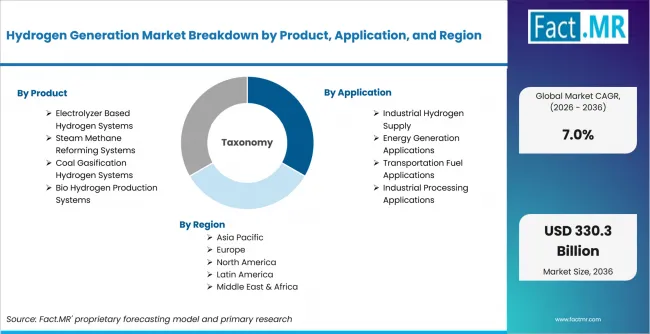
Hydrogen Generation Market Breakdown By Product, Application, And Region | Source: Fact.MR
| Attribute | Details |
|---|---|
| Quantitative Units | USD billion |
| Market Definition | Systems and services used to generate hydrogen through electrolysis, reforming, gasification, biological routes, and on-site systems |
| Product | Electrolyzer Based Hydrogen Systems; Alkaline Electrolyzers; PEM Electrolyzers; Steam Methane Reforming Systems; Coal Gasification Hydrogen Systems; Bio Hydrogen Production Systems |
| Application | Industrial Hydrogen Supply; Chemical Manufacturing; Refinery Operations; Energy Generation Applications; Transportation Fuel Applications; Industrial Processing Applications |
| End Use | Oil & Gas Industry; Refining Companies; Upstream Energy Producers; Chemical Industry; Fertilizer Manufacturers; Basic Chemical Producers; Transportation Sector; Automotive OEMs; Aerospace & Marine Operators; Power & Utilities; Renewable Energy Developers; Utility Companies |
| Technology | Electrolysis Technology; Water Electrolysis Systems; Advanced Electrolysis Systems; Thermal Reforming Technology; Steam Reforming Systems; Autothermal Reforming Systems; Gasification Technology; Biological Hydrogen Technology |
| Formulation | High Purity Hydrogen Gas; Ultra Pure Hydrogen Systems; Industrial Grade Hydrogen; Compressed Hydrogen Systems; Liquid Hydrogen Systems; On Site Generation Systems |
| Distribution Channel | Direct Industrial Sales; OEM Contract Sales; Government Energy Projects; EPC Contractors; Technology Providers; Online Industrial Platforms; Manufacturer Direct Platforms |
| Regions Covered | North America; Latin America; Europe; East Asia; South Asia and Pacific; Middle East and Africa |
| Countries Covered | Germany; Brazil; USA; UK; Japan |
| Key Companies Profiled | Air Products and Chemicals, Inc.; Air Liquide S.A.; Linde plc; Plug Power Inc.; Iwatani Corporation; Nel ASA |
| Forecast Period | 2026 to 2036 |
| Approach | Hybrid top-down and bottom-up approach using industrial hydrogen demand; electrolyzer project activity; refining and chemical use; power cost exposure; hydrogen pipeline and storage planning; purity requirements; direct industrial sales; country policy support; company portfolio review |
How is the market segmented?
-
By Product
- Electrolyzer Based Hydrogen Systems
- Alkaline Electrolyzers
- PEM Electrolyzers
- Steam Methane Reforming Systems
- Conventional SMR Units
- Advanced SMR Systems
- Coal Gasification Hydrogen Systems
- Gasification Reactors
- Syngas Processing Units
- Bio Hydrogen Production Systems
- Biomass Gasification Systems
- Biological Hydrogen Systems
- Electrolyzer Based Hydrogen Systems
-
By Application
- Industrial Hydrogen Supply
- Chemical Manufacturing
- Refinery Operations
- Energy Generation Applications
- Power Plant Fuel Systems
- Energy Storage Applications
- Transportation Fuel Applications
- Fuel Cell Vehicles
- Aviation & Marine Fuel
- Industrial Processing Applications
- Steel Manufacturing
- Glass & Electronics Industry
- Industrial Hydrogen Supply
-
By End Use
- Oil & Gas Industry
- Refining Companies
- Upstream Energy Producers
- Chemical Industry
- Fertilizer Manufacturers
- Basic Chemical Producers
- Transportation Sector
- Automotive OEMs
- Aerospace & Marine Operators
- Power & Utilities
- Renewable Energy Developers
- Utility Companies
- Oil & Gas Industry
-
By Technology
- Electrolysis Technology
- Water Electrolysis Systems
- Advanced Electrolysis Systems
- Thermal Reforming Technology
- Steam Reforming Systems
- Autothermal Reforming Systems
- Gasification Technology
- Coal Gasification Systems
- Biomass Gasification Systems
- Biological Hydrogen Technology
- Microbial Systems
- Algal Systems
- Electrolysis Technology
-
By Formulation
- High Purity Hydrogen Gas
- Ultra Pure Hydrogen Systems
- Industrial Grade Hydrogen
- Compressed Hydrogen Systems
- High Pressure Storage Systems
- Mobile Hydrogen Storage
- Liquid Hydrogen Systems
- Cryogenic Storage Systems
- Transport Liquefaction Systems
- On Site Generation Systems
- Modular Hydrogen Units
- Distributed Hydrogen Systems
- High Purity Hydrogen Gas
-
By Distribution Channel
- Direct Industrial Sales
- OEM Contract Sales
- Government Energy Projects
- EPC Contractors
- Engineering Procurement Firms
- Construction Integration Firms
- Technology Providers
- Hydrogen Equipment Manufacturers
- System Integrators
- Online Industrial Platforms
- B2B Energy Marketplaces
- Manufacturer Direct Platforms
- Direct Industrial Sales
-
By Region
- North America
- Latin America
- Western Europe
- Eastern Europe
- East Asia
- South Asia and Pacific
- Middle East & Africa