Hydrogen Peroxide Stabilizers Market
Hydrogen Peroxide Stabilizers Market Size and Share Forecast Outlook 2026 to 2036
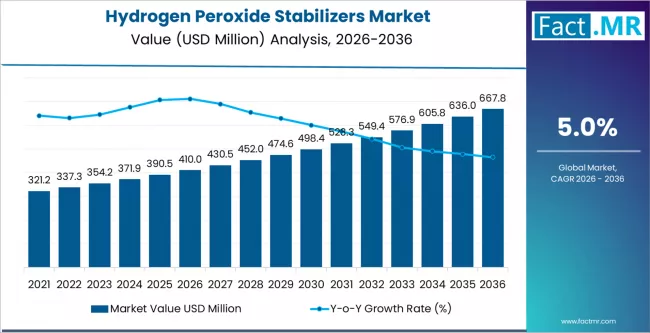
Hydrogen peroxide stabilizers market is projected to grow from USD 410.0 million in 2026 to USD 667.8 million by 2036, at a CAGR of 5.0%. Phosphonates will dominate with a 34.0% market share, while textile bleaching will lead the application segment with a 28.0% share.
Hydrogen Peroxide Stabilizers Market Supply Chain and Production Control Forecast Outlook 2026 to 2036
The hydrogen peroxide stabilizers market is projected to reach USD 410 million in 2026 and grow to USD 668 million by 2036, with a CAGR of 5%. Production concentration in this market is notable, with a few large manufacturers dominating the supply of stabilizers.
Key Takeaways from Hydrogen Peroxide Stabilizers Market
- Hydrogen Peroxide Stabilizers Market Value (2026): USD 410 million
- Hydrogen Peroxide Stabilizers Market Forecast Value (2036): USD 668 million
- Hydrogen Peroxide Stabilizers Market Forecast CAGR (2026 to 2036): 5%
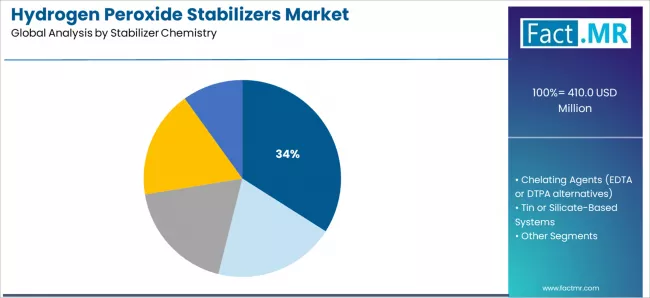
- Leading Segment in Hydrogen Peroxide Stabilizers Market: Phosphonates (34%)
- Key Growth Region in Hydrogen Peroxide Stabilizers Market: Asia Pacific
- Key Players in Hydrogen Peroxide Stabilizers Market: Nouryon, Solvay, BASF, Kemira, Evonik Industries, Italmatch Chemicals, ICL Group, LANXESS, Aditya Birla Chemicals, Shandong IRO Chelating

These producers control key stages of the supply chain, from raw material procurement to final product delivery, affecting both cost structures and market access. Regional manufacturing control plays a significant role, as localized production hubs are essential to meet regional regulatory standards and reduce logistical expenses. The reliability of the supply chain is increasingly critical, with any disruptions in raw material supply or transportation having direct impacts on product availability. The market is heavily dependent on stable supply sources, and any variability in the production process can result in delays or quality concerns. These constraints limit the agility of the market, placing a premium on supply chain stability and operational control.
Hydrogen Peroxide Stabilizers Market
| Metric | Value |
|---|---|
| Estimated Value in (2026E) | USD 410 million |
| Forecast Value in (2036F) | USD 668 million |
| Forecast CAGR (2026 to 2036) | 5% |
Category
| Category | Segments |
|---|---|
| Stabilizer Chemistry | Phosphonates; Chelating Agents (EDTA or DTPA alternatives); Tin or Silicate-Based Systems; Organic Acid Systems; Other |
| Application | Textile Bleaching; Pulp and Paper Bleaching; Electronics Cleaning; Disinfection or Formulations; Mining or Metal Treatment; Other |
| End Use | Textile Processors; Pulp and Paper Mills; Electronics Manufacturers; Chemical Formulators; Other |
| Region | North America; Europe; Asia Pacific; Latin America; Middle East & Africa |
Segmental Analysis
What Is the Impact of Stabilizer Chemistry on the Hydrogen Peroxide Stabilizers Market?

In the hydrogen peroxide stabilizers market, stabilizer chemistry plays a vital role in ensuring the stability and effectiveness of hydrogen peroxide during various industrial processes. Phosphonates lead the market with a 34% share due to their ability to prevent the decomposition of hydrogen peroxide, enhancing its shelf life and effectiveness in bleaching and cleaning applications. Phosphonates are widely used in industries such as textile and pulp and paper bleaching, where stable hydrogen peroxide is crucial for maintaining high-quality results. As industries demand more reliable and efficient chemical solutions, phosphonates will continue to dominate the market, driving stability in hydrogen peroxide applications.
How Does Application Influence the Hydrogen Peroxide Stabilizers Market?

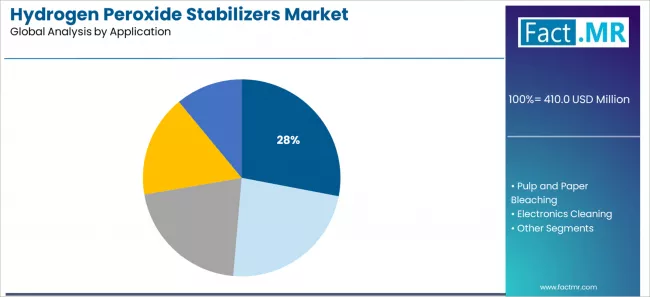
Application is a significant factor in determining the demand for hydrogen peroxide stabilizers, with textile bleaching holding a 28% share. Hydrogen peroxide is commonly used in textile bleaching due to its strong oxidizing properties, and stabilizers are crucial for maintaining its activity during prolonged processing. In addition to textile bleaching, hydrogen peroxide stabilizers are also used in pulp and paper bleaching, electronics cleaning, and disinfection formulations. As industries focus on efficiency, sustainability, and product quality, the use of stabilizers across various applications will continue to grow, supporting the demand for stable hydrogen peroxide in multiple industrial processes.
What are the Drivers, Restraints, and Key Trends of the Hydrogen Peroxide Stabilizers Market?
- Drivers: Demand for hydrogen peroxide stabilizers is influenced by needs in paper bleaching, textile processing, and industrial cleaning to maintain oxidant strength during storage and use. End users specify stabilizers that extend effective peroxide activity, reduce decomposition losses, and support consistent processing outcomes. Quality requirements tied to product performance in bleaching and disinfection influence selection of stabilizer chemistries and addition rates.
- Restraints: Variability in hydrogen peroxide grades and impurities affects stabilizer effectiveness, prompting adjustments in formulation and dosing. Cost sensitivity in commodity segments constrains spend on auxiliary chemicals where margins are narrow. Regulatory constraints related to worker safety and chemical handling influence acceptance of certain stabilizer types.
- Trend 1: Development of stabilizer blends that enhance performance across a range of temperatures and process conditions.
- Trend 2: Use of monitoring tools that correlate peroxide stability with process parameters to optimize dosing.
Analysis of the Hydrogen Peroxide Stabilizers Market by Key Country

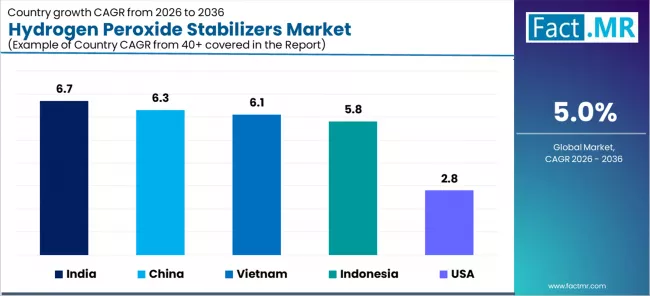
| Country | CAGR (2026–2036) |
|---|---|
| India | 6.7% |
| China | 6.3% |
| Vietnam | 6.1% |
| Indonesia | 5.8% |
| USA | 2.8% |
The report covers an in-depth analysis of 40+ countries; top-performing countries are highlighted below.
What is the Growth Outlook for Hydrogen Peroxide Stabilizers Market in India?
India’s hydrogen peroxide stabilizers market is projected to grow at a CAGR of 6.7% from 2026 to 2036. As India’s industries, particularly textiles, paper, and chemicals, continue to expand, the demand for hydrogen peroxide stabilizers is rising. These stabilizers are essential for maintaining the stability and efficiency of hydrogen peroxide, which is widely used in bleaching and cleaning applications. With increasing industrial activities and a growing emphasis on sustainability, India’s market for hydrogen peroxide stabilizers is expected to grow steadily. Furthermore, regulatory support for cleaner and more efficient industrial processes will drive further demand for these stabilizers.
How is the Hydrogen Peroxide Stabilizers Market Performing in China?
China’s hydrogen peroxide stabilizers market is expected to grow at a CAGR of 6.3% from 2026 to 2036. As China continues to lead in manufacturing and chemical production, the demand for stabilizers to maintain hydrogen peroxide’s stability and effectiveness in various applications is increasing. Hydrogen peroxide is crucial in industries like textiles, pulp and paper, and electronics, where it is used as a bleaching and cleaning agent. China’s rapid industrial growth, combined with rising regulatory standards for waste management and sustainability, will continue to drive the market for hydrogen peroxide stabilizers, ensuring steady growth throughout the forecast period.
What is the Market Outlook for Hydrogen Peroxide Stabilizers Market in Vietnam?
Vietnam’s hydrogen peroxide stabilizers market is projected to grow at a CAGR of 6.1% from 2026 to 2036. As Vietnam’s manufacturing sector continues to grow, particularly in textiles, paper, and food processing, the need for hydrogen peroxide stabilizers is increasing. These stabilizers ensure the safe and effective use of hydrogen peroxide, which is vital for bleaching, cleaning, and sterilization applications. With industrial growth, along with the country’s focus on improving sustainability and efficiency in manufacturing processes, the market for hydrogen peroxide stabilizers in Vietnam is expected to continue its steady rise, driven by both domestic and international demand.
What is the Growth Potential for Hydrogen Peroxide Stabilizers Market in Indonesia?
Indonesia’s hydrogen peroxide stabilizers market is forecast to grow at a CAGR of 5.8% from 2026 to 2036. As Indonesia’s industrial base expands, especially in industries such as textiles, pulp and paper, and agriculture, the demand for hydrogen peroxide stabilizers is increasing. These stabilizers are essential for ensuring the stability and performance of hydrogen peroxide, which is widely used in cleaning and bleaching processes. With the government focusing on sustainability and eco-friendly production processes, the market for hydrogen peroxide stabilizers is set to experience steady growth, driven by both industrial demand and regulatory pressures for more sustainable practices.
What is the Demand for Hydrogen Peroxide Stabilizers Market in the USA?
The USA’s hydrogen peroxide stabilizers market is set to grow at a CAGR of 2.8% from 2026 to 2036. While growth is expected to be slower compared to other regions, the demand for hydrogen peroxide stabilizers remains steady, driven by industries like textiles, food processing, and chemicals. These stabilizers are crucial in maintaining the effectiveness of hydrogen peroxide, particularly in cleaning and sterilization applications. The USA’s ongoing focus on sustainability, coupled with increasing regulatory standards for chemical use and waste management, will support steady demand for hydrogen peroxide stabilizers, even in a more mature market.
How is Competition Structured in the Hydrogen Peroxide Stabilizers Market?
Competition in the hydrogen peroxide stabilizers market is shaped by chemistry performance, impurity control, and regulatory compliance for bleaching and disinfection applications. Nouryon and Solvay compete with broad portfolios of stabilizer blends that enhance peroxide stability across pH ranges. BASF and Evonik Industries focus on engineered additives that balance stabilization with minimal decomposition.
Kemira and ICL Group position offerings with strong technical support for pulp, paper, and textile processes. LANXESS and Italmatch Chemicals emphasize niche formulations for specialty applications. Aditya Birla Chemicals and Shandong IRO Chelating provide costcompetitive stabilizers tailored to regional markets. Buyers assess suppliers based on product consistency, documented stability gains, and ease of integration into existing peroxide systems.
Key Players of the Hydrogen Peroxide Stabilizers Market
- Nouryon
- Solvay
- BASF
- Kemira
- Evonik Industries
- Italmatch Chemicals
- ICL Group
- LANXESS
- Aditya Birla Chemicals
- Shandong IRO Chelating
Scope of the Report
| Items | Values |
|---|---|
| Quantitative Units (2026) | USD Million |
| Stabilizer Chemistry | Phosphonates, Chelating Agents (EDTA or DTPA alternatives), Tin or Silicate-Based Systems, Organic Acid Systems, Other |
| Application | Textile Bleaching, Pulp and Paper Bleaching, Electronics Cleaning, Disinfection or Formulations, Mining or Metal Treatment |
| End Use | Textile Processors, Pulp and Paper Mills, Electronics Manufacturers, Chemical Formulators, Other |
| Regions Covered | North America, Europe, Asia Pacific, Latin America, Middle East & Africa |
| Countries Covered | United States, Canada, Mexico, Brazil, Germany, United Kingdom, France, Italy, Spain, China, Japan, South Korea, India, Australia & New Zealand |
| Key Companies Profiled | Nouryon, Solvay, BASF, Kemira, Evonik Industries, Italmatch Chemicals, ICL Group, LANXESS, Aditya Birla Chemicals, Shandong IRO Chelating |
| Additional Attributes | Dollar revenue by stabilizer chemistry, application, and end use; regional demand trends, competitive landscape, technological advancements in hydrogen peroxide stabilizers, and innovations in stabilization and treatment formulations |
Hydrogen Peroxide Stabilizers Market Key Segments
-
Stabilizer Chemistry :
- Phosphonates
- Chelating Agents (EDTA or DTPA alternatives)
- Tin or Silicate-Based Systems
- Organic Acid Systems
- Other
-
Application :
- Textile Bleaching
- Pulp and Paper Bleaching
- Electronics Cleaning
- Disinfection or Formulations
- Mining or Metal Treatment
-
End Use :
- Textile Processors
- Pulp and Paper Mills
- Electronics Manufacturers
- Chemical Formulators
- Other
-
Region :
-
North America
- U.S.
- Canada
- Mexico
-
Europe
- Germany
- UK
- France
- Italy
- Spain
- Nordic Countries
- BENELUX
- Rest of Europe
-
Asia Pacific
- China
- Japan
- South Korea
- India
- Australia
- Rest of Asia Pacific
-
Latin America
- Brazil
- Argentina
- Rest of Latin America
-
Middle East and Africa
- Kingdom of Saudi Arabia
- United Arab Emirates
- South Africa
- Rest of Middle East and Africa
-
Other Regions
- Oceania
- Central Asia
- Other Markets
-
Bibliographies
- Evonik Industries. (n.d.). Hydrogen peroxide stabilizers and applications for paper and textile bleaching.
- Kemira. (n.d.). Hydrogen peroxide stabilizers for paper and industrial applications.
- European Chemicals Agency. (2023). Hydrogen peroxide: Uses, hazard assessment, and risk management under REACH. ECHA.
- United States Environmental Protection Agency. (2024). Hydrogen peroxide: Industrial uses, exposure pathways, and environmental fate. EPA.
- Technical Association of the Pulp and Paper Industry. (2023). Hydrogen peroxide bleaching chemistry and process stability in pulp and paper manufacturing. TAPPI.
Table of Content
- Executive Summary
- Global Market Outlook
- Demand to side Trends
- Supply to side Trends
- Technology Roadmap Analysis
- Analysis and Recommendations
- Market Overview
- Market Coverage / Taxonomy
- Market Definition / Scope / Limitations
- Market Background
- Market Dynamics
- Drivers
- Restraints
- Opportunity
- Trends
- Scenario Forecast
- Demand in Optimistic Scenario
- Demand in Likely Scenario
- Demand in Conservative Scenario
- Opportunity Map Analysis
- Product Life Cycle Analysis
- Supply Chain Analysis
- Investment Feasibility Matrix
- Value Chain Analysis
- PESTLE and Porter’s Analysis
- Regulatory Landscape
- Regional Parent Market Outlook
- Production and Consumption Statistics
- Import and Export Statistics
- Market Dynamics
- Global Market Analysis 2021 to 2025 and Forecast, 2026 to 2036
- Historical Market Size Value (USD Million) Analysis, 2021 to 2025
- Current and Future Market Size Value (USD Million) Projections, 2026 to 2036
- Y to o to Y Growth Trend Analysis
- Absolute $ Opportunity Analysis
- Global Market Pricing Analysis 2021 to 2025 and Forecast 2026 to 2036
- Global Market Analysis 2021 to 2025 and Forecast 2026 to 2036, By Stabilizer Chemistry
- Introduction / Key Findings
- Historical Market Size Value (USD Million) Analysis By Stabilizer Chemistry, 2021 to 2025
- Current and Future Market Size Value (USD Million) Analysis and Forecast By Stabilizer Chemistry, 2026 to 2036
- Phosphonates
- Chelating Agents (EDTA or DTPA alternatives)
- Tin or Silicate-Based Systems
- Organic Acid Systems
- Other
- Phosphonates
- Y to o to Y Growth Trend Analysis By Stabilizer Chemistry, 2021 to 2025
- Absolute $ Opportunity Analysis By Stabilizer Chemistry, 2026 to 2036
- Global Market Analysis 2021 to 2025 and Forecast 2026 to 2036, By Application
- Introduction / Key Findings
- Historical Market Size Value (USD Million) Analysis By Application, 2021 to 2025
- Current and Future Market Size Value (USD Million) Analysis and Forecast By Application, 2026 to 2036
- Textile Bleaching
- Pulp and Paper Bleaching
- Electronics Cleaning
- Disinfection or Formulations
- Mining or Metal Treatment
- Textile Bleaching
- Y to o to Y Growth Trend Analysis By Application, 2021 to 2025
- Absolute $ Opportunity Analysis By Application, 2026 to 2036
- Global Market Analysis 2021 to 2025 and Forecast 2026 to 2036, By End Use
- Introduction / Key Findings
- Historical Market Size Value (USD Million) Analysis By End Use, 2021 to 2025
- Current and Future Market Size Value (USD Million) Analysis and Forecast By End Use, 2026 to 2036
- Textile Processors
- Pulp and Paper Mills
- Electronics Manufacturers
- Chemical Formulators
- Other
- Textile Processors
- Y to o to Y Growth Trend Analysis By End Use, 2021 to 2025
- Absolute $ Opportunity Analysis By End Use, 2026 to 2036
- Global Market Analysis 2021 to 2025 and Forecast 2026 to 2036, By Region
- Introduction
- Historical Market Size Value (USD Million) Analysis By Region, 2021 to 2025
- Current Market Size Value (USD Million) Analysis and Forecast By Region, 2026 to 2036
- North America
- Latin America
- Western Europe
- Eastern Europe
- East Asia
- South Asia and Pacific
- Middle East & Africa
- Market Attractiveness Analysis By Region
- North America Market Analysis 2021 to 2025 and Forecast 2026 to 2036, By Country
- Historical Market Size Value (USD Million) Trend Analysis By Market Taxonomy, 2021 to 2025
- Market Size Value (USD Million) Forecast By Market Taxonomy, 2026 to 2036
- By Country
- USA
- Canada
- Mexico
- By Stabilizer Chemistry
- By Application
- By End Use
- By Country
- Market Attractiveness Analysis
- By Country
- By Stabilizer Chemistry
- By Application
- By End Use
- Key Takeaways
- Latin America Market Analysis 2021 to 2025 and Forecast 2026 to 2036, By Country
- Historical Market Size Value (USD Million) Trend Analysis By Market Taxonomy, 2021 to 2025
- Market Size Value (USD Million) Forecast By Market Taxonomy, 2026 to 2036
- By Country
- Brazil
- Chile
- Rest of Latin America
- By Stabilizer Chemistry
- By Application
- By End Use
- By Country
- Market Attractiveness Analysis
- By Country
- By Stabilizer Chemistry
- By Application
- By End Use
- Key Takeaways
- Western Europe Market Analysis 2021 to 2025 and Forecast 2026 to 2036, By Country
- Historical Market Size Value (USD Million) Trend Analysis By Market Taxonomy, 2021 to 2025
- Market Size Value (USD Million) Forecast By Market Taxonomy, 2026 to 2036
- By Country
- Germany
- UK
- Italy
- Spain
- France
- Nordic
- BENELUX
- Rest of Western Europe
- By Stabilizer Chemistry
- By Application
- By End Use
- By Country
- Market Attractiveness Analysis
- By Country
- By Stabilizer Chemistry
- By Application
- By End Use
- Key Takeaways
- Eastern Europe Market Analysis 2021 to 2025 and Forecast 2026 to 2036, By Country
- Historical Market Size Value (USD Million) Trend Analysis By Market Taxonomy, 2021 to 2025
- Market Size Value (USD Million) Forecast By Market Taxonomy, 2026 to 2036
- By Country
- Russia
- Poland
- Hungary
- Balkan & Baltic
- Rest of Eastern Europe
- By Stabilizer Chemistry
- By Application
- By End Use
- By Country
- Market Attractiveness Analysis
- By Country
- By Stabilizer Chemistry
- By Application
- By End Use
- Key Takeaways
- East Asia Market Analysis 2021 to 2025 and Forecast 2026 to 2036, By Country
- Historical Market Size Value (USD Million) Trend Analysis By Market Taxonomy, 2021 to 2025
- Market Size Value (USD Million) Forecast By Market Taxonomy, 2026 to 2036
- By Country
- China
- Japan
- South Korea
- By Stabilizer Chemistry
- By Application
- By End Use
- By Country
- Market Attractiveness Analysis
- By Country
- By Stabilizer Chemistry
- By Application
- By End Use
- Key Takeaways
- South Asia and Pacific Market Analysis 2021 to 2025 and Forecast 2026 to 2036, By Country
- Historical Market Size Value (USD Million) Trend Analysis By Market Taxonomy, 2021 to 2025
- Market Size Value (USD Million) Forecast By Market Taxonomy, 2026 to 2036
- By Country
- India
- ASEAN
- Australia & New Zealand
- Rest of South Asia and Pacific
- By Stabilizer Chemistry
- By Application
- By End Use
- By Country
- Market Attractiveness Analysis
- By Country
- By Stabilizer Chemistry
- By Application
- By End Use
- Key Takeaways
- Middle East & Africa Market Analysis 2021 to 2025 and Forecast 2026 to 2036, By Country
- Historical Market Size Value (USD Million) Trend Analysis By Market Taxonomy, 2021 to 2025
- Market Size Value (USD Million) Forecast By Market Taxonomy, 2026 to 2036
- By Country
- Kingdom of Saudi Arabia
- Other GCC Countries
- Turkiye
- South Africa
- Other African Union
- Rest of Middle East & Africa
- By Stabilizer Chemistry
- By Application
- By End Use
- By Country
- Market Attractiveness Analysis
- By Country
- By Stabilizer Chemistry
- By Application
- By End Use
- Key Takeaways
- Key Countries Market Analysis
- USA
- Pricing Analysis
- Market Share Analysis, 2025
- By Stabilizer Chemistry
- By Application
- By End Use
- Canada
- Pricing Analysis
- Market Share Analysis, 2025
- By Stabilizer Chemistry
- By Application
- By End Use
- Mexico
- Pricing Analysis
- Market Share Analysis, 2025
- By Stabilizer Chemistry
- By Application
- By End Use
- Brazil
- Pricing Analysis
- Market Share Analysis, 2025
- By Stabilizer Chemistry
- By Application
- By End Use
- Chile
- Pricing Analysis
- Market Share Analysis, 2025
- By Stabilizer Chemistry
- By Application
- By End Use
- Germany
- Pricing Analysis
- Market Share Analysis, 2025
- By Stabilizer Chemistry
- By Application
- By End Use
- UK
- Pricing Analysis
- Market Share Analysis, 2025
- By Stabilizer Chemistry
- By Application
- By End Use
- Italy
- Pricing Analysis
- Market Share Analysis, 2025
- By Stabilizer Chemistry
- By Application
- By End Use
- Spain
- Pricing Analysis
- Market Share Analysis, 2025
- By Stabilizer Chemistry
- By Application
- By End Use
- France
- Pricing Analysis
- Market Share Analysis, 2025
- By Stabilizer Chemistry
- By Application
- By End Use
- India
- Pricing Analysis
- Market Share Analysis, 2025
- By Stabilizer Chemistry
- By Application
- By End Use
- ASEAN
- Pricing Analysis
- Market Share Analysis, 2025
- By Stabilizer Chemistry
- By Application
- By End Use
- Australia & New Zealand
- Pricing Analysis
- Market Share Analysis, 2025
- By Stabilizer Chemistry
- By Application
- By End Use
- China
- Pricing Analysis
- Market Share Analysis, 2025
- By Stabilizer Chemistry
- By Application
- By End Use
- Japan
- Pricing Analysis
- Market Share Analysis, 2025
- By Stabilizer Chemistry
- By Application
- By End Use
- South Korea
- Pricing Analysis
- Market Share Analysis, 2025
- By Stabilizer Chemistry
- By Application
- By End Use
- Russia
- Pricing Analysis
- Market Share Analysis, 2025
- By Stabilizer Chemistry
- By Application
- By End Use
- Poland
- Pricing Analysis
- Market Share Analysis, 2025
- By Stabilizer Chemistry
- By Application
- By End Use
- Hungary
- Pricing Analysis
- Market Share Analysis, 2025
- By Stabilizer Chemistry
- By Application
- By End Use
- Kingdom of Saudi Arabia
- Pricing Analysis
- Market Share Analysis, 2025
- By Stabilizer Chemistry
- By Application
- By End Use
- Turkiye
- Pricing Analysis
- Market Share Analysis, 2025
- By Stabilizer Chemistry
- By Application
- By End Use
- South Africa
- Pricing Analysis
- Market Share Analysis, 2025
- By Stabilizer Chemistry
- By Application
- By End Use
- USA
- Market Structure Analysis
- Competition Dashboard
- Competition Benchmarking
- Market Share Analysis of Top Players
- By Regional
- By Stabilizer Chemistry
- By Application
- By End Use
- Competition Analysis
- Competition Deep Dive
- Nouryon
- Overview
- Product Portfolio
- Profitability by Market Segments (Product/Age /Sales Channel/Region)
- Sales Footprint
- Strategy Overview
- Marketing Strategy
- Product Strategy
- Channel Strategy
- Solvay
- BASF
- Kemira
- Evonik Industries
- Italmatch Chemicals
- ICL Group
- LANXESS
- Aditya Birla Chemicals
- Shandong IRO Chelating
- Nouryon
- Competition Deep Dive
- Assumptions & Acronyms Used
- Research Methodology
List Of Table
- Table 1: Global Market Value (USD Million) Forecast by Region, 2021 to 2036
- Table 2: Global Market Value (USD Million) Forecast by Stabilizer Chemistry, 2021 to 2036
- Table 3: Global Market Value (USD Million) Forecast by Application, 2021 to 2036
- Table 4: Global Market Value (USD Million) Forecast by End Use, 2021 to 2036
- Table 5: North America Market Value (USD Million) Forecast by Country, 2021 to 2036
- Table 6: North America Market Value (USD Million) Forecast by Stabilizer Chemistry, 2021 to 2036
- Table 7: North America Market Value (USD Million) Forecast by Application, 2021 to 2036
- Table 8: North America Market Value (USD Million) Forecast by End Use, 2021 to 2036
- Table 9: Latin America Market Value (USD Million) Forecast by Country, 2021 to 2036
- Table 10: Latin America Market Value (USD Million) Forecast by Stabilizer Chemistry, 2021 to 2036
- Table 11: Latin America Market Value (USD Million) Forecast by Application, 2021 to 2036
- Table 12: Latin America Market Value (USD Million) Forecast by End Use, 2021 to 2036
- Table 13: Western Europe Market Value (USD Million) Forecast by Country, 2021 to 2036
- Table 14: Western Europe Market Value (USD Million) Forecast by Stabilizer Chemistry, 2021 to 2036
- Table 15: Western Europe Market Value (USD Million) Forecast by Application, 2021 to 2036
- Table 16: Western Europe Market Value (USD Million) Forecast by End Use, 2021 to 2036
- Table 17: Eastern Europe Market Value (USD Million) Forecast by Country, 2021 to 2036
- Table 18: Eastern Europe Market Value (USD Million) Forecast by Stabilizer Chemistry, 2021 to 2036
- Table 19: Eastern Europe Market Value (USD Million) Forecast by Application, 2021 to 2036
- Table 20: Eastern Europe Market Value (USD Million) Forecast by End Use, 2021 to 2036
- Table 21: East Asia Market Value (USD Million) Forecast by Country, 2021 to 2036
- Table 22: East Asia Market Value (USD Million) Forecast by Stabilizer Chemistry, 2021 to 2036
- Table 23: East Asia Market Value (USD Million) Forecast by Application, 2021 to 2036
- Table 24: East Asia Market Value (USD Million) Forecast by End Use, 2021 to 2036
- Table 25: South Asia and Pacific Market Value (USD Million) Forecast by Country, 2021 to 2036
- Table 26: South Asia and Pacific Market Value (USD Million) Forecast by Stabilizer Chemistry, 2021 to 2036
- Table 27: South Asia and Pacific Market Value (USD Million) Forecast by Application, 2021 to 2036
- Table 28: South Asia and Pacific Market Value (USD Million) Forecast by End Use, 2021 to 2036
- Table 29: Middle East & Africa Market Value (USD Million) Forecast by Country, 2021 to 2036
- Table 30: Middle East & Africa Market Value (USD Million) Forecast by Stabilizer Chemistry, 2021 to 2036
- Table 31: Middle East & Africa Market Value (USD Million) Forecast by Application, 2021 to 2036
- Table 32: Middle East & Africa Market Value (USD Million) Forecast by End Use, 2021 to 2036
List Of Figures
- Figure 1: Global Market Pricing Analysis
- Figure 2: Global Market Value (USD Million) Forecast 2021 to 2036
- Figure 3: Global Market Value Share and BPS Analysis by Stabilizer Chemistry, 2026 and 2036
- Figure 4: Global Market Y to o to Y Growth Comparison by Stabilizer Chemistry, 2026 to 2036
- Figure 5: Global Market Attractiveness Analysis by Stabilizer Chemistry
- Figure 6: Global Market Value Share and BPS Analysis by Application, 2026 and 2036
- Figure 7: Global Market Y to o to Y Growth Comparison by Application, 2026 to 2036
- Figure 8: Global Market Attractiveness Analysis by Application
- Figure 9: Global Market Value Share and BPS Analysis by End Use, 2026 and 2036
- Figure 10: Global Market Y to o to Y Growth Comparison by End Use, 2026 to 2036
- Figure 11: Global Market Attractiveness Analysis by End Use
- Figure 12: Global Market Value (USD Million) Share and BPS Analysis by Region, 2026 and 2036
- Figure 13: Global Market Y to o to Y Growth Comparison by Region, 2026 to 2036
- Figure 14: Global Market Attractiveness Analysis by Region
- Figure 15: North America Market Incremental Dollar Opportunity, 2026 to 2036
- Figure 16: Latin America Market Incremental Dollar Opportunity, 2026 to 2036
- Figure 17: Western Europe Market Incremental Dollar Opportunity, 2026 to 2036
- Figure 18: Eastern Europe Market Incremental Dollar Opportunity, 2026 to 2036
- Figure 19: East Asia Market Incremental Dollar Opportunity, 2026 to 2036
- Figure 20: South Asia and Pacific Market Incremental Dollar Opportunity, 2026 to 2036
- Figure 21: Middle East & Africa Market Incremental Dollar Opportunity, 2026 to 2036
- Figure 22: North America Market Value Share and BPS Analysis by Country, 2026 and 2036
- Figure 23: North America Market Value Share and BPS Analysis by Stabilizer Chemistry, 2026 and 2036
- Figure 24: North America Market Y to o to Y Growth Comparison by Stabilizer Chemistry, 2026 to 2036
- Figure 25: North America Market Attractiveness Analysis by Stabilizer Chemistry
- Figure 26: North America Market Value Share and BPS Analysis by Application, 2026 and 2036
- Figure 27: North America Market Y to o to Y Growth Comparison by Application, 2026 to 2036
- Figure 28: North America Market Attractiveness Analysis by Application
- Figure 29: North America Market Value Share and BPS Analysis by End Use, 2026 and 2036
- Figure 30: North America Market Y to o to Y Growth Comparison by End Use, 2026 to 2036
- Figure 31: North America Market Attractiveness Analysis by End Use
- Figure 32: Latin America Market Value Share and BPS Analysis by Country, 2026 and 2036
- Figure 33: Latin America Market Value Share and BPS Analysis by Stabilizer Chemistry, 2026 and 2036
- Figure 34: Latin America Market Y to o to Y Growth Comparison by Stabilizer Chemistry, 2026 to 2036
- Figure 35: Latin America Market Attractiveness Analysis by Stabilizer Chemistry
- Figure 36: Latin America Market Value Share and BPS Analysis by Application, 2026 and 2036
- Figure 37: Latin America Market Y to o to Y Growth Comparison by Application, 2026 to 2036
- Figure 38: Latin America Market Attractiveness Analysis by Application
- Figure 39: Latin America Market Value Share and BPS Analysis by End Use, 2026 and 2036
- Figure 40: Latin America Market Y to o to Y Growth Comparison by End Use, 2026 to 2036
- Figure 41: Latin America Market Attractiveness Analysis by End Use
- Figure 42: Western Europe Market Value Share and BPS Analysis by Country, 2026 and 2036
- Figure 43: Western Europe Market Value Share and BPS Analysis by Stabilizer Chemistry, 2026 and 2036
- Figure 44: Western Europe Market Y to o to Y Growth Comparison by Stabilizer Chemistry, 2026 to 2036
- Figure 45: Western Europe Market Attractiveness Analysis by Stabilizer Chemistry
- Figure 46: Western Europe Market Value Share and BPS Analysis by Application, 2026 and 2036
- Figure 47: Western Europe Market Y to o to Y Growth Comparison by Application, 2026 to 2036
- Figure 48: Western Europe Market Attractiveness Analysis by Application
- Figure 49: Western Europe Market Value Share and BPS Analysis by End Use, 2026 and 2036
- Figure 50: Western Europe Market Y to o to Y Growth Comparison by End Use, 2026 to 2036
- Figure 51: Western Europe Market Attractiveness Analysis by End Use
- Figure 52: Eastern Europe Market Value Share and BPS Analysis by Country, 2026 and 2036
- Figure 53: Eastern Europe Market Value Share and BPS Analysis by Stabilizer Chemistry, 2026 and 2036
- Figure 54: Eastern Europe Market Y to o to Y Growth Comparison by Stabilizer Chemistry, 2026 to 2036
- Figure 55: Eastern Europe Market Attractiveness Analysis by Stabilizer Chemistry
- Figure 56: Eastern Europe Market Value Share and BPS Analysis by Application, 2026 and 2036
- Figure 57: Eastern Europe Market Y to o to Y Growth Comparison by Application, 2026 to 2036
- Figure 58: Eastern Europe Market Attractiveness Analysis by Application
- Figure 59: Eastern Europe Market Value Share and BPS Analysis by End Use, 2026 and 2036
- Figure 60: Eastern Europe Market Y to o to Y Growth Comparison by End Use, 2026 to 2036
- Figure 61: Eastern Europe Market Attractiveness Analysis by End Use
- Figure 62: East Asia Market Value Share and BPS Analysis by Country, 2026 and 2036
- Figure 63: East Asia Market Value Share and BPS Analysis by Stabilizer Chemistry, 2026 and 2036
- Figure 64: East Asia Market Y to o to Y Growth Comparison by Stabilizer Chemistry, 2026 to 2036
- Figure 65: East Asia Market Attractiveness Analysis by Stabilizer Chemistry
- Figure 66: East Asia Market Value Share and BPS Analysis by Application, 2026 and 2036
- Figure 67: East Asia Market Y to o to Y Growth Comparison by Application, 2026 to 2036
- Figure 68: East Asia Market Attractiveness Analysis by Application
- Figure 69: East Asia Market Value Share and BPS Analysis by End Use, 2026 and 2036
- Figure 70: East Asia Market Y to o to Y Growth Comparison by End Use, 2026 to 2036
- Figure 71: East Asia Market Attractiveness Analysis by End Use
- Figure 72: South Asia and Pacific Market Value Share and BPS Analysis by Country, 2026 and 2036
- Figure 73: South Asia and Pacific Market Value Share and BPS Analysis by Stabilizer Chemistry, 2026 and 2036
- Figure 74: South Asia and Pacific Market Y to o to Y Growth Comparison by Stabilizer Chemistry, 2026 to 2036
- Figure 75: South Asia and Pacific Market Attractiveness Analysis by Stabilizer Chemistry
- Figure 76: South Asia and Pacific Market Value Share and BPS Analysis by Application, 2026 and 2036
- Figure 77: South Asia and Pacific Market Y to o to Y Growth Comparison by Application, 2026 to 2036
- Figure 78: South Asia and Pacific Market Attractiveness Analysis by Application
- Figure 79: South Asia and Pacific Market Value Share and BPS Analysis by End Use, 2026 and 2036
- Figure 80: South Asia and Pacific Market Y to o to Y Growth Comparison by End Use, 2026 to 2036
- Figure 81: South Asia and Pacific Market Attractiveness Analysis by End Use
- Figure 82: Middle East & Africa Market Value Share and BPS Analysis by Country, 2026 and 2036
- Figure 83: Middle East & Africa Market Value Share and BPS Analysis by Stabilizer Chemistry, 2026 and 2036
- Figure 84: Middle East & Africa Market Y to o to Y Growth Comparison by Stabilizer Chemistry, 2026 to 2036
- Figure 85: Middle East & Africa Market Attractiveness Analysis by Stabilizer Chemistry
- Figure 86: Middle East & Africa Market Value Share and BPS Analysis by Application, 2026 and 2036
- Figure 87: Middle East & Africa Market Y to o to Y Growth Comparison by Application, 2026 to 2036
- Figure 88: Middle East & Africa Market Attractiveness Analysis by Application
- Figure 89: Middle East & Africa Market Value Share and BPS Analysis by End Use, 2026 and 2036
- Figure 90: Middle East & Africa Market Y to o to Y Growth Comparison by End Use, 2026 to 2036
- Figure 91: Middle East & Africa Market Attractiveness Analysis by End Use
- Figure 92: Global Market - Tier Structure Analysis
- Figure 93: Global Market - Company Share Analysis
- FAQs -
How big is the hydrogen peroxide stabilizers market in 2026?
The global hydrogen peroxide stabilizers market is estimated to be valued at USD 410.0 million in 2026.
What will be the size of hydrogen peroxide stabilizers market in 2036?
The market size for the hydrogen peroxide stabilizers market is projected to reach USD 667.8 million by 2036.
How much will be the hydrogen peroxide stabilizers market growth between 2026 and 2036?
The hydrogen peroxide stabilizers market is expected to grow at a 5.0% CAGR between 2026 and 2036.
What are the key product types in the hydrogen peroxide stabilizers market?
The key product types in hydrogen peroxide stabilizers market are phosphonates, chelating agents (edta or dtpa alternatives), tin or silicate-based systems, organic acid systems and other.
Which application segment to contribute significant share in the hydrogen peroxide stabilizers market in 2026?
In terms of application, textile bleaching segment to command 28.0% share in the hydrogen peroxide stabilizers market in 2026.