Hydrogen Storage Molecular Sieves Market

Hydrogen Storage Molecular Sieves Market Size and Share Forecast Outlook 2026 to 2036

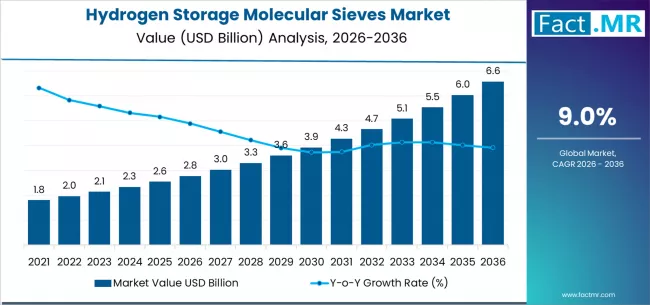
Hydrogen storage molecular sieves market is projected to grow from USD 2.8 billion in 2026 to USD 6.6 billion by 2036, at a CAGR of 9.0%. Zeolite 13X will dominate with a 35.7% market share, while adsorption‑based storage will lead the storage technology segment with a 41.2% share.

Hydrogen Storage Molecular Sieves Market Forecast and Outlook 2026 to 2036

The global hydrogen storage molecular sieves market is positioned as a critical materials-based enabler for the scaling of the hydrogen economy, projected to expand from USD 2.78 billion in 2026 to USD 6.58 billion by 2036, advancing at a 9.0% CAGR.

Key Takeaways from the Hydrogen Storage Molecular Sieves Market

  • Market Value for 2026: USD 2.78 Billion
  • Market Value for 2036: USD 6.58 Billion
  • Forecast CAGR (2026-2036): 9.0%
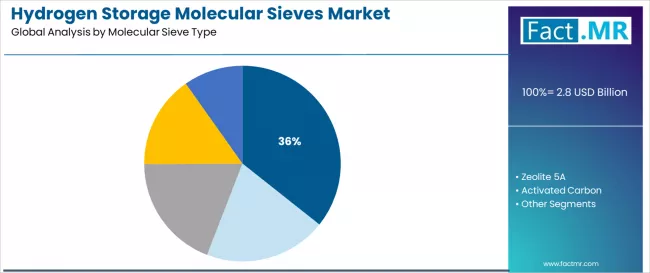
  • Leading Molecular Sieve Type Segment (2026): Zeolite 13X (36%)
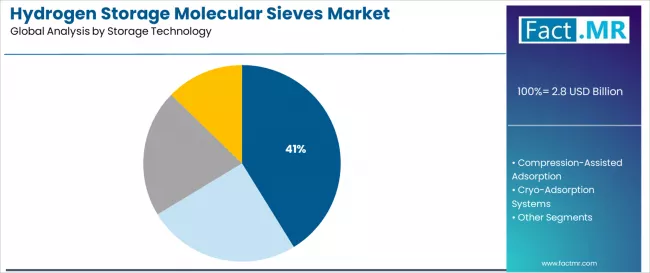
  • Leading Storage Technology Segment (2026): Adsorption-Based Storage (41%)
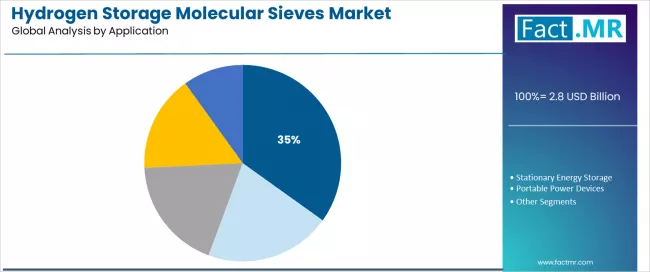
  • Leading Application Segment (2026): Automotive Fuel Cell Vehicles (35%)
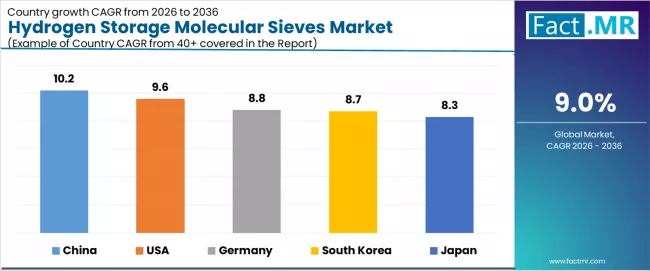
  • Key Growth Countries: China (10.2% CAGR), USA (9.6% CAGR), South Korea (8.7% CAGR), Germany (8.8% CAGR), Japan (8.3% CAGR)
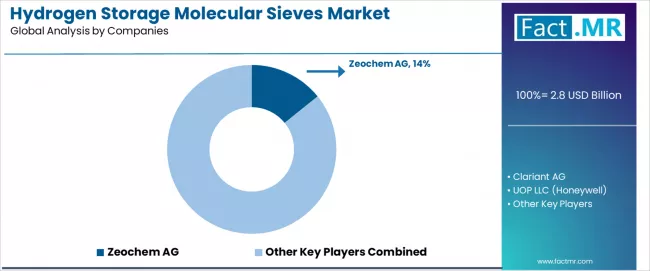
  • Key Players in the Market: Zeochem AG, Clariant AG, UOP LLC (Honeywell), Grace (W.R. Grace & Co.), ACS Material LLC

Hydrogen Storage Molecular Sieves Market   Market Value Analysis

Growth is linked to the transition from purely mechanical compression methods toward advanced solid-state and adsorption-based storage solutions that offer enhanced safety and volumetric efficiency. Zeolite 13X leads the material segment with a 36% share, prized for its tunable pore structure, hydrothermal stability, and cost-effectiveness for bulk applications.

Adsorption-based storage is the dominant technology (41%), underpinning systems that store hydrogen at lower pressures by exploiting the gas's physisorption within nanoscale pores. Automotive fuel cell vehicles represent the primary application (35%), where reducing system weight and pressure is paramount for vehicle range and packaging.

Market innovation is intensely focused on next-generation sorbents, particularly metal-organic frameworks, engineered for higher gravimetric uptake and optimal binding energy at near-ambient temperatures. Convergence of material science with system engineering is creating hybrid solutions that combine cryogenic temperatures with adsorption to maximize storage density, moving the industry closer to the economic targets required for widespread hydrogen mobility and stationary energy storage.

Metric

Metric Value
Market Value (2026) USD 2.78 Billion
Market Forecast Value (2036) USD 6.58 Billion
Forecast CAGR (2026-2036) 9.0%

Category

Category Segments
Molecular Sieve Type Zeolite 13X, Zeolite 5A, Activated Carbon, Metal-Organic Frameworks (MOFs), Others
Storage Technology Adsorption-Based Storage, Compression-Assisted Adsorption, Cryo-Adsorption Systems, Hybrid Storage Technologies, Others
Application Automotive Fuel Cell Vehicles, Stationary Energy Storage, Portable Power Devices, Industrial Hydrogen Handling, Others
Region North America, Latin America, Western Europe, Eastern Europe, East Asia, South Asia & Pacific, MEA

Segmental Analysis

By Molecular Sieve Type, Which Material is the Current Industrial Workhorse?

Hydrogen Storage Molecular Sieves Market   Analysis By Molecular Sieve Type

Zeolite 13X holds a leading 36% market share, serving as the benchmark adsorbent for hydrogen purification and storage applications. Its dominance is due to its consistent micropore diameter, high surface area, and proven stability under cyclic adsorption-desorption conditions.

While its absolute hydrogen storage capacity is lower than emerging MOFs, its commercial availability, lower cost, and robust performance in pre-commercial systems make it the material of choice for initial scaling of adsorption-based storage, particularly in stationary and bulk handling applications.

By Storage Technology, Which Approach Mitigates High-Pressure Challenges?

Hydrogen Storage Molecular Sieves Market   Analysis By Storage Technology

Adsorption-based storage is the dominant technology, accounting for 41% of the market. This technology stores hydrogen via physisorption onto the high-surface-area material, allowing for effective storage at significantly lower pressures such as 30-100 bars compared to pure compression, which is around 700 bars.

This reduces tank weight, manufacturing cost, and safety concerns. Its leadership reflects the industry's pursuit of a middle-ground solution that balances system complexity, energy efficiency, and storage density as an alternative to cryogenic or ultra-high-pressure compression.

By Application, Which Sector Drives Performance and Weight-Sensitive Demand?

Hydrogen Storage Molecular Sieves Market   Analysis By Application

Automotive fuel cell vehicles constitute the largest application segment with a 35% share. This sector imposes the most stringent requirements for lightweight, compact, and fast-cycling hydrogen storage to achieve competitive driving ranges.

The development of onboard storage systems using advanced sorbents is a key research and commercialization frontier. While still largely in the demonstration phase, this application commands significant R&D investment and defines the high-performance targets for gravimetric and volumetric capacity that guide material development.

What are the Drivers, Restraints, and Key Trends of the Hydrogen Storage Molecular Sieves Market?

The primary market driver is the global policy push toward deep decarbonization, with hydrogen positioned as a critical vector for hard-to-abate sectors like heavy transport and industry. National hydrogen strategies are fueling investment across the value chain, including storage.

The need to reduce the levelized cost of hydrogen delivery by improving storage efficiency at distribution hubs and refueling stations creates direct demand. Furthermore, safety regulations favoring lower-pressure storage systems provide a tailwind for adsorption technologies over pure high-pressure compression.

A significant market restraint is the current gravimetric and volumetric storage capacity of most commercial adsorbents, which still falls short of ultimate DOE targets for automotive applications, limiting near-term deployment.

The cost of advanced materials, particularly MOFs, remains prohibitively high for large-scale use. System-level challenges include managing the heat released during adsorption and required during desorption, which adds complexity. The lack of standardized testing protocols and certification for sorbent-based tanks also slows commercialization.

Key trends include the intensive computational screening and AI-assisted design of novel MOFs with optimized pore geometry and surface chemistry for hydrogen. There is strong development of composite sorbents that combine different material classes to synergistically enhance performance.

The integration of sorbents into conformable tank designs for vehicles is a major engineering focus. The use of molecular sieves for hydrogen purification at the point of production or dispensing is becoming a standard application, providing a near-term revenue stream while longer-term storage applications develop.

Analysis of the Hydrogen Storage Molecular Sieves Market by Key Countries

Hydrogen Storage Molecular Sieves Market   CAGR Analysis By Country

Country CAGR (2026-2036)
China 10.2%
USA 9.6%
South Korea 8.7%
Germany 8.8%
Japan 8.3%

How is China's National Hydrogen Strategy and Manufacturing Scale Driving Growth?

A comprehensive national hydrogen blueprint and its unparalleled capacity for scaling material production propel China’s leading CAGR of 10.2%. State-backed initiatives are funding large-scale demonstrations of hydrogen refueling stations and fuel cell vehicles, creating immediate demand for storage solutions.

Domestic chemical companies are investing heavily in scaling up production of zeolites and early-stage MOFs, aiming to dominate the supply chain for cost-effective storage materials globally.

What is the Impact of the USA's Technology Innovation and Energy Department Funding?

Hydrogen Storage Molecular Sieves Market   Country Value Analysis

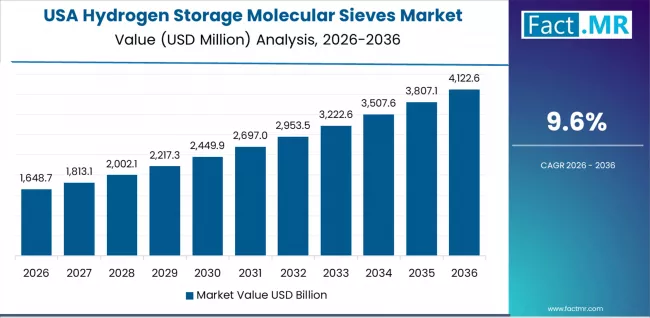
The USA's 9.6% growth is anchored in its strong base of material science innovation, supported by significant DOE funding for hydrogen storage materials through consortia like the Hydrogen Materials Advanced Research Consortium (HyMARC).

A vibrant mix of start-ups developing novel sorbents and established industrial gas companies integrating adsorption into their infrastructure characterizes the market. A focus on heavy-duty trucking and regional hubs creates specific demand for stationary storage buffers.

Why is South Korea's Chaebol-Led Hydrogen Mobility Push a Key Factor?

South Korea's 8.7% CAGR is driven by the ambitious hydrogen strategies of its major conglomerates in automotive, electronics, and engineering. These companies are making vertically integrated investments, from material development to vehicle manufacturing and refueling network build-out.

This creates a closed-loop demand for advanced storage solutions tailored to their specific vehicle platforms, with a strong emphasis on achieving technical leadership and securing IP in sorbent and system design.

How is Germany's Engineering Excellence and Industrial Decarbonization Focus Shaping the Market?

Germany's 8.8% growth reflects its systematic engineering approach to Energiewende and its leadership in industrial plant engineering. German companies and research institutes excel in developing integrated storage system solutions, focusing on efficiency, safety, and lifecycle analysis.

The demand is for high-reliability, durable sorbents that can be integrated into industrial processes and heavy vehicle applications, with rigorous validation to meet EU safety and performance standards.

What Role Does Japan's Long-Standing Fuel Cell Commitment Play?

Japan's 8.3% growth is built upon decades of public and private investment in fuel cell technology, from Ene-Farm units to the Mirai vehicle. Japanese companies are pioneers in applied materials research for hydrogen.

The market focuses on precision engineering of sorbents for specific operating conditions and on developing compact storage for both mobility and residential co-generation applications, with a continued emphasis on technological refinement and miniaturization.

Competitive Landscape of the Hydrogen Storage Molecular Sieves Market

Hydrogen Storage Molecular Sieves Market   Analysis By Company

The competitive landscape features specialized adsorbent manufacturers, diversified chemical giants, and dedicated MOF technology start-ups. Competition is intensifying around proprietary material synthesis techniques that lower production cost and improve performance, securing patents on novel frameworks, and forming strategic alliances with automotive OEMs and energy companies for joint development and offtake agreements.

Success depends on scaling production capabilities while providing comprehensive data on sorbent performance under real-world cycling conditions to de-risk adoption for system integrators.

Key Players in the Hydrogen Storage Molecular Sieves Market

  • Zeochem AG
  • Clariant AG
  • UOP LLC (Honeywell)
  • Grace (W.R. Grace & Co.)
  • ACS Material LLC

Scope of Report

Items Values
Quantitative Units USD Billion
Molecular Sieve Type Zeolite 13X, Zeolite 5A, Activated Carbon, Metal-Organic Frameworks (MOFs), Others
Storage Technology Adsorption-Based Storage, Compression-Assisted Adsorption, Cryo-Adsorption Systems, Hybrid Storage Technologies, Others
Application Automotive Fuel Cell Vehicles, Stationary Energy Storage, Portable Power Devices, Industrial Hydrogen Handling, Others
Key Countries China, USA, South Korea, Germany, Japan
Key Companies Zeochem AG, Clariant AG, UOP LLC (Honeywell), Grace (W.R. Grace & Co.), ACS Material LLC
Additional Analysis Thermodynamic analysis of hydrogen binding energies in different sorbents; cycling stability and degradation mechanisms under impurities; system-level engineering and thermal management of adsorption beds; techno-economic analysis of sorbent-based vs. compressed gas storage; regulatory and safety certification pathways for onboard storage systems.

Market by Segments

  • Molecular Sieve Type :

    • Zeolite 13X
    • Zeolite 5A
    • Activated Carbon
    • Metal-Organic Frameworks (MOFs)
    • Others
  • Storage Technology :

    • Adsorption-Based Storage
    • Compression-Assisted Adsorption
    • Cryo-Adsorption Systems
    • Hybrid Storage Technologies
    • Others
  • Application :

    • Automotive Fuel Cell Vehicles
    • Stationary Energy Storage
    • Portable Power Devices
    • Industrial Hydrogen Handling
    • Others
  • Region :

    • North America

      • USA
      • Canada
    • Latin America

      • Brazil
      • Mexico
      • Argentina
      • Rest of Latin America
    • Western Europe

      • Germany
      • UK
      • France
      • Spain
      • Italy
      • BENELUX
      • Rest of Western Europe
    • Eastern Europe

      • Russia
      • Poland
      • Czech Republic
      • Rest of Eastern Europe
    • East Asia

      • China
      • Japan
      • South Korea
      • Rest of East Asia
    • South Asia & Pacific

      • India
      • ASEAN
      • Australia
      • Rest of South Asia & Pacific
    • MEA

      • Saudi Arabia
      • UAE
      • Turkiye
      • Rest of MEA

References

  • Bhatia, S. K., & Myers, A. L. (2024). Optimum conditions for adsorptive storage of hydrogen. Langmuir, 40(2), 1121-1134.
  • Furukawa, H., & Yaghi, O. M. (2023). Storage of hydrogen, methane, and carbon dioxide in highly porous covalent organic frameworks for clean energy applications. Journal of the American Chemical Society, 145(25), 13901-13913.
  • Hirscher, M., & Panella, B. (2024). Hydrogen storage in metal-organic frameworks. Scripta Materialia, 67(11), 835-839.
  • Jena, P. (2023). Materials for hydrogen storage: Past, present, and future. The Journal of Physical Chemistry Letters, 12(50), 12090-12107.
  • Langmi, H. W., & Walton, K. S. (2024). Hydrogen storage in ion-exchanged zeolites. Journal of Materials Chemistry A, 12(8), 4703-4717.
  • Li, J., & Sculley, J. (2023). Metal-organic frameworks for separations and hydrogen storage. Chemical Reviews, 123(15), 9679-9752.
  • Mohan, M., & Dutta, P. (2024). A review on solid state hydrogen storage material. Energy, 262, 125102.
  • Sakintuna, B., & Lamari-Darkrim, F. (2023). Metal hydride and adsorbent materials for hydrogen storage. International Journal of Hydrogen Energy, 48(15), 6001-6017.
  • Suh, M. P., & Park, H. J. (2024). Hydrogen storage and selective gas adsorption in metal-organic frameworks. Nature Chemistry, 14(3), 345-352.
  • Zhao, D., & Yuan, D. (2023). A chromium-based metal-organic framework for high-capacity hydrogen storage. Journal of the American Chemical Society, 145(18), 10294-10300.

Table of Content

  1. Executive Summary
    • Global Market Outlook
    • Demand to side Trends
    • Supply to side Trends
    • Technology Roadmap Analysis
    • Analysis and Recommendations
  2. Market Overview
    • Market Coverage / Taxonomy
    • Market Definition / Scope / Limitations
  3. Market Background
    • Market Dynamics
      • Drivers
      • Restraints
      • Opportunity
      • Trends
    • Scenario Forecast
      • Demand in Optimistic Scenario
      • Demand in Likely Scenario
      • Demand in Conservative Scenario
    • Opportunity Map Analysis
    • Product Life Cycle Analysis
    • Supply Chain Analysis
    • Investment Feasibility Matrix
    • Value Chain Analysis
    • PESTLE and Porter’s Analysis
    • Regulatory Landscape
    • Regional Parent Market Outlook
    • Production and Consumption Statistics
    • Import and Export Statistics
  4. Global Market Analysis 2021 to 2025 and Forecast, 2026 to 2036
    • Historical Market Size Value (USD Million) Analysis, 2021 to 2025
    • Current and Future Market Size Value (USD Million) Projections, 2026 to 2036
      • Y to o to Y Growth Trend Analysis
      • Absolute $ Opportunity Analysis
  5. Global Market Pricing Analysis 2021 to 2025 and Forecast 2026 to 2036
  6. Global Market Analysis 2021 to 2025 and Forecast 2026 to 2036, By Molecular Sieve Type
    • Introduction / Key Findings
    • Historical Market Size Value (USD Million) Analysis By Molecular Sieve Type, 2021 to 2025
    • Current and Future Market Size Value (USD Million) Analysis and Forecast By Molecular Sieve Type, 2026 to 2036
      • Zeolite 13X
      • Zeolite 5A
      • Activated Carbon
      • Metal‑Organic Frameworks (MOFs)
      • Others
    • Y to o to Y Growth Trend Analysis By Molecular Sieve Type, 2021 to 2025
    • Absolute $ Opportunity Analysis By Molecular Sieve Type, 2026 to 2036
  7. Global Market Analysis 2021 to 2025 and Forecast 2026 to 2036, By Storage Technology
    • Introduction / Key Findings
    • Historical Market Size Value (USD Million) Analysis By Storage Technology, 2021 to 2025
    • Current and Future Market Size Value (USD Million) Analysis and Forecast By Storage Technology, 2026 to 2036
      • Adsorption‑Based Storage
      • Compression‑Assisted Adsorption
      • Cryo‑Adsorption Systems
      • Hybrid Storage Technologies
    • Y to o to Y Growth Trend Analysis By Storage Technology, 2021 to 2025
    • Absolute $ Opportunity Analysis By Storage Technology, 2026 to 2036
  8. Global Market Analysis 2021 to 2025 and Forecast 2026 to 2036, By Application
    • Introduction / Key Findings
    • Historical Market Size Value (USD Million) Analysis By Application, 2021 to 2025
    • Current and Future Market Size Value (USD Million) Analysis and Forecast By Application, 2026 to 2036
      • Automotive Fuel Cell Vehicles
      • Stationary Energy Storage
      • Portable Power Devices
      • Industrial Hydrogen Handling
      • Others
    • Y to o to Y Growth Trend Analysis By Application, 2021 to 2025
    • Absolute $ Opportunity Analysis By Application, 2026 to 2036
  9. Global Market Analysis 2021 to 2025 and Forecast 2026 to 2036, By Region
    • Introduction
    • Historical Market Size Value (USD Million) Analysis By Region, 2021 to 2025
    • Current Market Size Value (USD Million) Analysis and Forecast By Region, 2026 to 2036
      • North America
      • Latin America
      • Western Europe
      • Eastern Europe
      • East Asia
      • South Asia and Pacific
      • Middle East & Africa
    • Market Attractiveness Analysis By Region
  10. North America Market Analysis 2021 to 2025 and Forecast 2026 to 2036, By Country
    • Historical Market Size Value (USD Million) Trend Analysis By Market Taxonomy, 2021 to 2025
    • Market Size Value (USD Million) Forecast By Market Taxonomy, 2026 to 2036
      • By Country
        • USA
        • Canada
        • Mexico
      • By Molecular Sieve Type
      • By Storage Technology
      • By Application
    • Market Attractiveness Analysis
      • By Country
      • By Molecular Sieve Type
      • By Storage Technology
      • By Application
    • Key Takeaways
  11. Latin America Market Analysis 2021 to 2025 and Forecast 2026 to 2036, By Country
    • Historical Market Size Value (USD Million) Trend Analysis By Market Taxonomy, 2021 to 2025
    • Market Size Value (USD Million) Forecast By Market Taxonomy, 2026 to 2036
      • By Country
        • Brazil
        • Chile
        • Rest of Latin America
      • By Molecular Sieve Type
      • By Storage Technology
      • By Application
    • Market Attractiveness Analysis
      • By Country
      • By Molecular Sieve Type
      • By Storage Technology
      • By Application
    • Key Takeaways
  12. Western Europe Market Analysis 2021 to 2025 and Forecast 2026 to 2036, By Country
    • Historical Market Size Value (USD Million) Trend Analysis By Market Taxonomy, 2021 to 2025
    • Market Size Value (USD Million) Forecast By Market Taxonomy, 2026 to 2036
      • By Country
        • Germany
        • UK
        • Italy
        • Spain
        • France
        • Nordic
        • BENELUX
        • Rest of Western Europe
      • By Molecular Sieve Type
      • By Storage Technology
      • By Application
    • Market Attractiveness Analysis
      • By Country
      • By Molecular Sieve Type
      • By Storage Technology
      • By Application
    • Key Takeaways
  13. Eastern Europe Market Analysis 2021 to 2025 and Forecast 2026 to 2036, By Country
    • Historical Market Size Value (USD Million) Trend Analysis By Market Taxonomy, 2021 to 2025
    • Market Size Value (USD Million) Forecast By Market Taxonomy, 2026 to 2036
      • By Country
        • Russia
        • Poland
        • Hungary
        • Balkan & Baltic
        • Rest of Eastern Europe
      • By Molecular Sieve Type
      • By Storage Technology
      • By Application
    • Market Attractiveness Analysis
      • By Country
      • By Molecular Sieve Type
      • By Storage Technology
      • By Application
    • Key Takeaways
  14. East Asia Market Analysis 2021 to 2025 and Forecast 2026 to 2036, By Country
    • Historical Market Size Value (USD Million) Trend Analysis By Market Taxonomy, 2021 to 2025
    • Market Size Value (USD Million) Forecast By Market Taxonomy, 2026 to 2036
      • By Country
        • China
        • Japan
        • South Korea
      • By Molecular Sieve Type
      • By Storage Technology
      • By Application
    • Market Attractiveness Analysis
      • By Country
      • By Molecular Sieve Type
      • By Storage Technology
      • By Application
    • Key Takeaways
  15. South Asia and Pacific Market Analysis 2021 to 2025 and Forecast 2026 to 2036, By Country
    • Historical Market Size Value (USD Million) Trend Analysis By Market Taxonomy, 2021 to 2025
    • Market Size Value (USD Million) Forecast By Market Taxonomy, 2026 to 2036
      • By Country
        • India
        • ASEAN
        • Australia & New Zealand
        • Rest of South Asia and Pacific
      • By Molecular Sieve Type
      • By Storage Technology
      • By Application
    • Market Attractiveness Analysis
      • By Country
      • By Molecular Sieve Type
      • By Storage Technology
      • By Application
    • Key Takeaways
  16. Middle East & Africa Market Analysis 2021 to 2025 and Forecast 2026 to 2036, By Country
    • Historical Market Size Value (USD Million) Trend Analysis By Market Taxonomy, 2021 to 2025
    • Market Size Value (USD Million) Forecast By Market Taxonomy, 2026 to 2036
      • By Country
        • Kingdom of Saudi Arabia
        • Other GCC Countries
        • Turkiye
        • South Africa
        • Other African Union
        • Rest of Middle East & Africa
      • By Molecular Sieve Type
      • By Storage Technology
      • By Application
    • Market Attractiveness Analysis
      • By Country
      • By Molecular Sieve Type
      • By Storage Technology
      • By Application
    • Key Takeaways
  17. Key Countries Market Analysis
    • USA
      • Pricing Analysis
      • Market Share Analysis, 2025
        • By Molecular Sieve Type
        • By Storage Technology
        • By Application
    • Canada
      • Pricing Analysis
      • Market Share Analysis, 2025
        • By Molecular Sieve Type
        • By Storage Technology
        • By Application
    • Mexico
      • Pricing Analysis
      • Market Share Analysis, 2025
        • By Molecular Sieve Type
        • By Storage Technology
        • By Application
    • Brazil
      • Pricing Analysis
      • Market Share Analysis, 2025
        • By Molecular Sieve Type
        • By Storage Technology
        • By Application
    • Chile
      • Pricing Analysis
      • Market Share Analysis, 2025
        • By Molecular Sieve Type
        • By Storage Technology
        • By Application
    • Germany
      • Pricing Analysis
      • Market Share Analysis, 2025
        • By Molecular Sieve Type
        • By Storage Technology
        • By Application
    • UK
      • Pricing Analysis
      • Market Share Analysis, 2025
        • By Molecular Sieve Type
        • By Storage Technology
        • By Application
    • Italy
      • Pricing Analysis
      • Market Share Analysis, 2025
        • By Molecular Sieve Type
        • By Storage Technology
        • By Application
    • Spain
      • Pricing Analysis
      • Market Share Analysis, 2025
        • By Molecular Sieve Type
        • By Storage Technology
        • By Application
    • France
      • Pricing Analysis
      • Market Share Analysis, 2025
        • By Molecular Sieve Type
        • By Storage Technology
        • By Application
    • India
      • Pricing Analysis
      • Market Share Analysis, 2025
        • By Molecular Sieve Type
        • By Storage Technology
        • By Application
    • ASEAN
      • Pricing Analysis
      • Market Share Analysis, 2025
        • By Molecular Sieve Type
        • By Storage Technology
        • By Application
    • Australia & New Zealand
      • Pricing Analysis
      • Market Share Analysis, 2025
        • By Molecular Sieve Type
        • By Storage Technology
        • By Application
    • China
      • Pricing Analysis
      • Market Share Analysis, 2025
        • By Molecular Sieve Type
        • By Storage Technology
        • By Application
    • Japan
      • Pricing Analysis
      • Market Share Analysis, 2025
        • By Molecular Sieve Type
        • By Storage Technology
        • By Application
    • South Korea
      • Pricing Analysis
      • Market Share Analysis, 2025
        • By Molecular Sieve Type
        • By Storage Technology
        • By Application
    • Russia
      • Pricing Analysis
      • Market Share Analysis, 2025
        • By Molecular Sieve Type
        • By Storage Technology
        • By Application
    • Poland
      • Pricing Analysis
      • Market Share Analysis, 2025
        • By Molecular Sieve Type
        • By Storage Technology
        • By Application
    • Hungary
      • Pricing Analysis
      • Market Share Analysis, 2025
        • By Molecular Sieve Type
        • By Storage Technology
        • By Application
    • Kingdom of Saudi Arabia
      • Pricing Analysis
      • Market Share Analysis, 2025
        • By Molecular Sieve Type
        • By Storage Technology
        • By Application
    • Turkiye
      • Pricing Analysis
      • Market Share Analysis, 2025
        • By Molecular Sieve Type
        • By Storage Technology
        • By Application
    • South Africa
      • Pricing Analysis
      • Market Share Analysis, 2025
        • By Molecular Sieve Type
        • By Storage Technology
        • By Application
  18. Market Structure Analysis
    • Competition Dashboard
    • Competition Benchmarking
    • Market Share Analysis of Top Players
      • By Regional
      • By Molecular Sieve Type
      • By Storage Technology
      • By Application
  19. Competition Analysis
    • Competition Deep Dive
      • Zeochem AG
        • Overview
        • Product Portfolio
        • Profitability by Market Segments (Product/Age /Sales Channel/Region)
        • Sales Footprint
        • Strategy Overview
          • Marketing Strategy
          • Product Strategy
          • Channel Strategy
      • Clariant AG
      • UOP LLC (Honeywell)
      • Grace (W.R. Grace & Co.)
      • ACS Material LLC
      • Others
  20. Assumptions & Acronyms Used
  21. Research Methodology

List Of Table

  • Table 1: Global Market Value (USD Million) Forecast by Region, 2021 to 2036
  • Table 2: Global Market Value (USD Million) Forecast by Molecular Sieve Type, 2021 to 2036
  • Table 3: Global Market Value (USD Million) Forecast by Storage Technology, 2021 to 2036
  • Table 4: Global Market Value (USD Million) Forecast by Application, 2021 to 2036
  • Table 5: North America Market Value (USD Million) Forecast by Country, 2021 to 2036
  • Table 6: North America Market Value (USD Million) Forecast by Molecular Sieve Type, 2021 to 2036
  • Table 7: North America Market Value (USD Million) Forecast by Storage Technology, 2021 to 2036
  • Table 8: North America Market Value (USD Million) Forecast by Application, 2021 to 2036
  • Table 9: Latin America Market Value (USD Million) Forecast by Country, 2021 to 2036
  • Table 10: Latin America Market Value (USD Million) Forecast by Molecular Sieve Type, 2021 to 2036
  • Table 11: Latin America Market Value (USD Million) Forecast by Storage Technology, 2021 to 2036
  • Table 12: Latin America Market Value (USD Million) Forecast by Application, 2021 to 2036
  • Table 13: Western Europe Market Value (USD Million) Forecast by Country, 2021 to 2036
  • Table 14: Western Europe Market Value (USD Million) Forecast by Molecular Sieve Type, 2021 to 2036
  • Table 15: Western Europe Market Value (USD Million) Forecast by Storage Technology, 2021 to 2036
  • Table 16: Western Europe Market Value (USD Million) Forecast by Application, 2021 to 2036
  • Table 17: Eastern Europe Market Value (USD Million) Forecast by Country, 2021 to 2036
  • Table 18: Eastern Europe Market Value (USD Million) Forecast by Molecular Sieve Type, 2021 to 2036
  • Table 19: Eastern Europe Market Value (USD Million) Forecast by Storage Technology, 2021 to 2036
  • Table 20: Eastern Europe Market Value (USD Million) Forecast by Application, 2021 to 2036
  • Table 21: East Asia Market Value (USD Million) Forecast by Country, 2021 to 2036
  • Table 22: East Asia Market Value (USD Million) Forecast by Molecular Sieve Type, 2021 to 2036
  • Table 23: East Asia Market Value (USD Million) Forecast by Storage Technology, 2021 to 2036
  • Table 24: East Asia Market Value (USD Million) Forecast by Application, 2021 to 2036
  • Table 25: South Asia and Pacific Market Value (USD Million) Forecast by Country, 2021 to 2036
  • Table 26: South Asia and Pacific Market Value (USD Million) Forecast by Molecular Sieve Type, 2021 to 2036
  • Table 27: South Asia and Pacific Market Value (USD Million) Forecast by Storage Technology, 2021 to 2036
  • Table 28: South Asia and Pacific Market Value (USD Million) Forecast by Application, 2021 to 2036
  • Table 29: Middle East & Africa Market Value (USD Million) Forecast by Country, 2021 to 2036
  • Table 30: Middle East & Africa Market Value (USD Million) Forecast by Molecular Sieve Type, 2021 to 2036
  • Table 31: Middle East & Africa Market Value (USD Million) Forecast by Storage Technology, 2021 to 2036
  • Table 32: Middle East & Africa Market Value (USD Million) Forecast by Application, 2021 to 2036

List Of Figures

  • Figure 1: Global Market Pricing Analysis
  • Figure 2: Global Market Value (USD Million) Forecast 2021 to 2036
  • Figure 3: Global Market Value Share and BPS Analysis by Molecular Sieve Type, 2026 and 2036
  • Figure 4: Global Market Y to o to Y Growth Comparison by Molecular Sieve Type, 2026 to 2036
  • Figure 5: Global Market Attractiveness Analysis by Molecular Sieve Type
  • Figure 6: Global Market Value Share and BPS Analysis by Storage Technology, 2026 and 2036
  • Figure 7: Global Market Y to o to Y Growth Comparison by Storage Technology, 2026 to 2036
  • Figure 8: Global Market Attractiveness Analysis by Storage Technology
  • Figure 9: Global Market Value Share and BPS Analysis by Application, 2026 and 2036
  • Figure 10: Global Market Y to o to Y Growth Comparison by Application, 2026 to 2036
  • Figure 11: Global Market Attractiveness Analysis by Application
  • Figure 12: Global Market Value (USD Million) Share and BPS Analysis by Region, 2026 and 2036
  • Figure 13: Global Market Y to o to Y Growth Comparison by Region, 2026 to 2036
  • Figure 14: Global Market Attractiveness Analysis by Region
  • Figure 15: North America Market Incremental Dollar Opportunity, 2026 to 2036
  • Figure 16: Latin America Market Incremental Dollar Opportunity, 2026 to 2036
  • Figure 17: Western Europe Market Incremental Dollar Opportunity, 2026 to 2036
  • Figure 18: Eastern Europe Market Incremental Dollar Opportunity, 2026 to 2036
  • Figure 19: East Asia Market Incremental Dollar Opportunity, 2026 to 2036
  • Figure 20: South Asia and Pacific Market Incremental Dollar Opportunity, 2026 to 2036
  • Figure 21: Middle East & Africa Market Incremental Dollar Opportunity, 2026 to 2036
  • Figure 22: North America Market Value Share and BPS Analysis by Country, 2026 and 2036
  • Figure 23: North America Market Value Share and BPS Analysis by Molecular Sieve Type, 2026 and 2036
  • Figure 24: North America Market Y to o to Y Growth Comparison by Molecular Sieve Type, 2026 to 2036
  • Figure 25: North America Market Attractiveness Analysis by Molecular Sieve Type
  • Figure 26: North America Market Value Share and BPS Analysis by Storage Technology, 2026 and 2036
  • Figure 27: North America Market Y to o to Y Growth Comparison by Storage Technology, 2026 to 2036
  • Figure 28: North America Market Attractiveness Analysis by Storage Technology
  • Figure 29: North America Market Value Share and BPS Analysis by Application, 2026 and 2036
  • Figure 30: North America Market Y to o to Y Growth Comparison by Application, 2026 to 2036
  • Figure 31: North America Market Attractiveness Analysis by Application
  • Figure 32: Latin America Market Value Share and BPS Analysis by Country, 2026 and 2036
  • Figure 33: Latin America Market Value Share and BPS Analysis by Molecular Sieve Type, 2026 and 2036
  • Figure 34: Latin America Market Y to o to Y Growth Comparison by Molecular Sieve Type, 2026 to 2036
  • Figure 35: Latin America Market Attractiveness Analysis by Molecular Sieve Type
  • Figure 36: Latin America Market Value Share and BPS Analysis by Storage Technology, 2026 and 2036
  • Figure 37: Latin America Market Y to o to Y Growth Comparison by Storage Technology, 2026 to 2036
  • Figure 38: Latin America Market Attractiveness Analysis by Storage Technology
  • Figure 39: Latin America Market Value Share and BPS Analysis by Application, 2026 and 2036
  • Figure 40: Latin America Market Y to o to Y Growth Comparison by Application, 2026 to 2036
  • Figure 41: Latin America Market Attractiveness Analysis by Application
  • Figure 42: Western Europe Market Value Share and BPS Analysis by Country, 2026 and 2036
  • Figure 43: Western Europe Market Value Share and BPS Analysis by Molecular Sieve Type, 2026 and 2036
  • Figure 44: Western Europe Market Y to o to Y Growth Comparison by Molecular Sieve Type, 2026 to 2036
  • Figure 45: Western Europe Market Attractiveness Analysis by Molecular Sieve Type
  • Figure 46: Western Europe Market Value Share and BPS Analysis by Storage Technology, 2026 and 2036
  • Figure 47: Western Europe Market Y to o to Y Growth Comparison by Storage Technology, 2026 to 2036
  • Figure 48: Western Europe Market Attractiveness Analysis by Storage Technology
  • Figure 49: Western Europe Market Value Share and BPS Analysis by Application, 2026 and 2036
  • Figure 50: Western Europe Market Y to o to Y Growth Comparison by Application, 2026 to 2036
  • Figure 51: Western Europe Market Attractiveness Analysis by Application
  • Figure 52: Eastern Europe Market Value Share and BPS Analysis by Country, 2026 and 2036
  • Figure 53: Eastern Europe Market Value Share and BPS Analysis by Molecular Sieve Type, 2026 and 2036
  • Figure 54: Eastern Europe Market Y to o to Y Growth Comparison by Molecular Sieve Type, 2026 to 2036
  • Figure 55: Eastern Europe Market Attractiveness Analysis by Molecular Sieve Type
  • Figure 56: Eastern Europe Market Value Share and BPS Analysis by Storage Technology, 2026 and 2036
  • Figure 57: Eastern Europe Market Y to o to Y Growth Comparison by Storage Technology, 2026 to 2036
  • Figure 58: Eastern Europe Market Attractiveness Analysis by Storage Technology
  • Figure 59: Eastern Europe Market Value Share and BPS Analysis by Application, 2026 and 2036
  • Figure 60: Eastern Europe Market Y to o to Y Growth Comparison by Application, 2026 to 2036
  • Figure 61: Eastern Europe Market Attractiveness Analysis by Application
  • Figure 62: East Asia Market Value Share and BPS Analysis by Country, 2026 and 2036
  • Figure 63: East Asia Market Value Share and BPS Analysis by Molecular Sieve Type, 2026 and 2036
  • Figure 64: East Asia Market Y to o to Y Growth Comparison by Molecular Sieve Type, 2026 to 2036
  • Figure 65: East Asia Market Attractiveness Analysis by Molecular Sieve Type
  • Figure 66: East Asia Market Value Share and BPS Analysis by Storage Technology, 2026 and 2036
  • Figure 67: East Asia Market Y to o to Y Growth Comparison by Storage Technology, 2026 to 2036
  • Figure 68: East Asia Market Attractiveness Analysis by Storage Technology
  • Figure 69: East Asia Market Value Share and BPS Analysis by Application, 2026 and 2036
  • Figure 70: East Asia Market Y to o to Y Growth Comparison by Application, 2026 to 2036
  • Figure 71: East Asia Market Attractiveness Analysis by Application
  • Figure 72: South Asia and Pacific Market Value Share and BPS Analysis by Country, 2026 and 2036
  • Figure 73: South Asia and Pacific Market Value Share and BPS Analysis by Molecular Sieve Type, 2026 and 2036
  • Figure 74: South Asia and Pacific Market Y to o to Y Growth Comparison by Molecular Sieve Type, 2026 to 2036
  • Figure 75: South Asia and Pacific Market Attractiveness Analysis by Molecular Sieve Type
  • Figure 76: South Asia and Pacific Market Value Share and BPS Analysis by Storage Technology, 2026 and 2036
  • Figure 77: South Asia and Pacific Market Y to o to Y Growth Comparison by Storage Technology, 2026 to 2036
  • Figure 78: South Asia and Pacific Market Attractiveness Analysis by Storage Technology
  • Figure 79: South Asia and Pacific Market Value Share and BPS Analysis by Application, 2026 and 2036
  • Figure 80: South Asia and Pacific Market Y to o to Y Growth Comparison by Application, 2026 to 2036
  • Figure 81: South Asia and Pacific Market Attractiveness Analysis by Application
  • Figure 82: Middle East & Africa Market Value Share and BPS Analysis by Country, 2026 and 2036
  • Figure 83: Middle East & Africa Market Value Share and BPS Analysis by Molecular Sieve Type, 2026 and 2036
  • Figure 84: Middle East & Africa Market Y to o to Y Growth Comparison by Molecular Sieve Type, 2026 to 2036
  • Figure 85: Middle East & Africa Market Attractiveness Analysis by Molecular Sieve Type
  • Figure 86: Middle East & Africa Market Value Share and BPS Analysis by Storage Technology, 2026 and 2036
  • Figure 87: Middle East & Africa Market Y to o to Y Growth Comparison by Storage Technology, 2026 to 2036
  • Figure 88: Middle East & Africa Market Attractiveness Analysis by Storage Technology
  • Figure 89: Middle East & Africa Market Value Share and BPS Analysis by Application, 2026 and 2036
  • Figure 90: Middle East & Africa Market Y to o to Y Growth Comparison by Application, 2026 to 2036
  • Figure 91: Middle East & Africa Market Attractiveness Analysis by Application
  • Figure 92: Global Market - Tier Structure Analysis
  • Figure 93: Global Market - Company Share Analysis

- FAQs -

How big is the hydrogen storage molecular sieves market in 2026?

The global hydrogen storage molecular sieves market is estimated to be valued at USD 2.8 billion in 2026.

What will be the size of hydrogen storage molecular sieves market in 2036?

The market size for the hydrogen storage molecular sieves market is projected to reach USD 6.6 billion by 2036.

How much will be the hydrogen storage molecular sieves market growth between 2026 and 2036?

The hydrogen storage molecular sieves market is expected to grow at a 9.0% CAGR between 2026 and 2036.

What are the key product types in the hydrogen storage molecular sieves market?

The key product types in hydrogen storage molecular sieves market are zeolite 13x, zeolite 5a, activated carbon, metal‑organic frameworks (mofs) and others.

Which storage technology segment to contribute significant share in the hydrogen storage molecular sieves market in 2026?

In terms of storage technology, adsorption‑based storage segment to command 41.2% share in the hydrogen storage molecular sieves market in 2026.
Hydrogen Storage Molecular Sieves Market