- Base Value(2025): 32.73 Bn
- Estimated Value(2026): 34 Bn
- Forecast Value (2036): 35.45 Bn
- CAGR (2026 - 2036): 4.2%
Wear Resistant Steel Market Forecast and Outlook By Fact.MR
In 2025, the Wear Resistant Steel Plate Market was valued at USD 32.73 billion. In 2026 update from Fact.MR, global market is estimated to surpass USD 34 billion by 2026 and reach USD 35.45 billion by 2036, exhibiting a CAGR of 4.2% during the forecast period. Absolute dollar growth during the forecast period is projected at approximately USD 1.43 billion. In addition, investments across application industries such as in heavy machinery, construction machinery, road and building construction will drive the market growth even further.
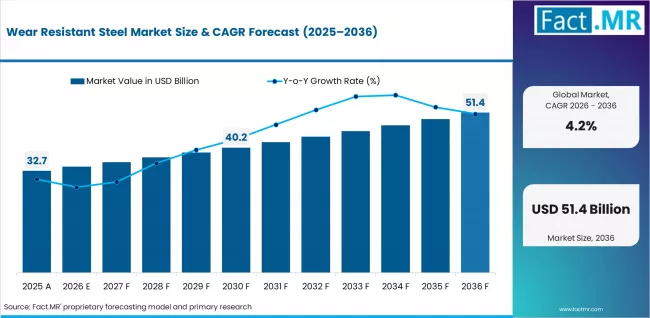
Wear Resistant Steel Market Market Value Analysis | Source: Fact.MR
Summary of Wear Resistant Steel Plate Market
- Market Snapshot
- Global wear resistant steel plate market revenue stood at USD 34.02 billion in 2026 and is forecast to reach USD 35.45 billion by 2036.
- The market was valued at USD 32.73 billion in 2025, indicating steady year-on-year expansion.
- At a 4.2% CAGR from 2026 to 2036, this market is set to expand 1.04x in value, adding USD 1.43 billion in absolute opportunity.
- Growth is primarily driven by increasing demand across heavy machinery, construction equipment, and infrastructure development, where wear resistant steel plates enhance durability and reduce maintenance cycles.
- These materials remain critical in high-abrasion industrial environments, supporting operational efficiency and lifecycle cost optimization.
- Demand and Growth Drivers
- Rising demand from heavy machinery and mining equipment is driving adoption of wear resistant steel plates for high-impact and abrasive environments.
- Increasing investments in construction machinery, road infrastructure, and building development are supporting consistent material demand.
- Expansion of industrial manufacturing and equipment production is reinforcing the need for high-performance steel materials.
- Focus on reducing downtime and maintenance costs is encouraging adoption of wear-resistant solutions across industries.
- Advancements in steel processing technologies are improving hardness, strength, and wear resistance, enabling broader application scope.
- Product and Segment View
- Wear resistant steel plates are widely used across applications such as heavy machinery, construction equipment, and industrial processing systems, supporting diversified demand.
- Demand is influenced by performance parameters such as hardness, impact resistance, and durability, which determine suitability across use cases.
- Product variants include different hardness grades and metallurgical compositions, tailored for specific industrial environments.
- Geography and Competitive Outlook
- Growth is supported globally, particularly in regions with strong construction, mining, and industrial manufacturing activity.
- Market expansion is closely tied to infrastructure investment cycles, industrial output, and equipment demand trends.
- Increasing demand in developing economies is driven by rapid urbanization and industrialization, supporting steady consumption of wear resistant materials.
- Key companies active in this market include SSAB, ArcelorMittal, Nippon Steel, POSCO, JFE Steel, and Thyssenkrupp.
Wear Resistant Steel Plate Market — At a Glance
| Attribute | Details |
|---|---|
| Market Value 2025 | USD 32.73 billion |
| Market Value 2026 | USD 34.02 billion |
| Market Value 2036 | USD 35.45 billion |
| Absolute Dollar Opportunity 2026-2036 | USD 1.43 billion |
| Total Growth 2026-2036 | 4.2% (CAGR basis) |
| CAGR 2026-2036 | 4.2% |
| Growth Multiple | 1.04x |
| Key Demand Theme | Increasing demand for durable, wear-resistant materials in heavy machinery and construction applications |
| Key Application Areas | Heavy Machinery, Construction Machinery, Road & Building Construction |
| Top Companies | SSAB, ArcelorMittal, Nippon Steel, POSCO, JFE Steel, Thyssenkrupp |
| Segmentation by Product Type | Quenched & Tempered, Martensitic, Others |
| Segmentation by Application | Mining Equipment, Construction Equipment, Material Handling, Industrial Processing |
| Segmentation by End Use | Mining, Construction, Manufacturing, Energy |
| Segmentation by Region | North America, Europe, Asia Pacific, Latin America, Middle East & Africa |
Source: Fact.MR analysis. Updated Apr 2, 2026
Among the major countries, India expands with a CAGR of 5.5% backed by rapid development of infrastructure, mining, and growing mechanization of agriculture. China is 5.1%, based on robust steel production capacity, massive mining, and rapid industrialization. Japan is 4.6%, on the back of high-tech manufacturing and consistent demand for superior quality wear resistant materials. At the same time, mature markets like the United States (3.1%) and Germany (1.6%) predominantly serve replacement and efficiency-related demand rather than structural growth, limited by market maturity, slower industrial growth and trends of cost optimization.
Where is the real growth coming from?
According to an analysis by Fact.MR, the growth of the wear-resistant steel plate market isn't just about volume on a global scale, it's more about specific applications and regions, particularly in capital-heavy industries. While the market is projected to see a modest growth rate of 4.2% CAGR from 2026 to 2036, there are notable growth areas emerging in sectors like mining equipment, construction machinery, and infrastructure development, especially in the Asia Pacific region and some developing economies.
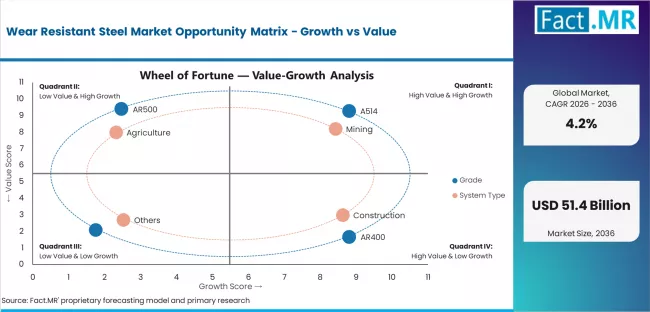
Wear Resistant Steel Market Opportunity Matrix Growth Vs Value | Source: Fact.MR
Growing investments in road construction, urban infrastructure, and heavy equipment manufacturing are keeping the demand for durable materials strong. Moreover, mining operations, which often face harsh abrasion conditions, are driving a significant need for replacements, making up a large portion of consumption. Fact.MR highlights that the most significant growth is happening in high-wear applications, where the savings on lifecycle costs outweigh the material costs, positioning these segments as key players in the market's incremental opportunities.
The Conflict Premium: Why Specialty Steel is Defying the Market Downturn
The global market for wear-resistant steel, especially high-strength grades like AR400 and AR500, is currently facing a challenging period of structural volatility. As we look ahead to April 2026, the pricing trend for these specialized plates shows a "high-plateau" stability. While general carbon steel futures have experienced a slight dip, the costs for abrasion-resistant (AR) materials remain notably high. This stability can be attributed to the energy-intensive quenching and tempering processes that give the steel its strength, making the industry particularly sensitive to any shifts in the industrial supply chain.
The ongoing conflict in the Middle East has been a major driver of this price pressure, turning regional instability into a global supply chain issue:
- Energy-Driven Inflation: With crude oil prices soaring above USD 100 per barrel and natural gas prices climbing nearly 85% due to disruptions at key hubs, steel mills have had to impose significant energy surcharges to manage the hefty electricity and fuel demands of specialty heat-treating.
- Logistical "Conflict Surcharges": The operational challenges in the Strait of Hormuz and the Red Sea have disrupted global trade, resulting in a 40% increase in ocean freight rates and much longer lead times for raw material deliveries.
- Raw Material Scarcity: The war has restricted the supply of essential alloy additives and high-quality scrap metal sourced from Middle Eastern routes, creating a "risk premium" that keeps manufacturers from lowering prices, even as demand in some areas starts to cool.
- Shift to "Just-in-Case" Procurement: Geopolitical uncertainty has prompted a shift away from lean inventory practices, as industrial buyers in mining and defense rush to secure existing stocks of wear-resistant plates, further pushing prices up against a backdrop of dwindling global supply.
How to differentiate beyond price?
Latest Fact.MR report on wear resistant steel plate also identifies the differentiator beyond price for manufacturers. The wear-resistant steel plate market is seeing a shift in focus from just pricing to a greater emphasis on performance assurance and integrated services. With major players like SSAB and ArcelorMittal offering similar foundational products, the competitive edge is now being gained through technical support, application engineering, and guarantees on lifecycle performance.
The 2026 study by Fact.MR reveals that close to 35% customers in the mining and industrial sectors are particularly keen on materials that help minimize unexpected downtime, making durability and reliability crucial factors in their decision-making. Moreover, providing tailored solutions, quicker delivery, and fabrication services can significantly boost customer loyalty. Fact.MR also notes that companies that offer comprehensive wear solutions instead of just standalone products tend to enjoy better customer retention and pricing power, as buyers are increasingly considering the overall operational impact rather than just the initial material cost.
How to improve margins in a commoditizing market?
Fact.MR's analysis also reveals that while there's a steady demand for wear-resistant steel plates, the market is facing increasing pressures of commoditization, especially with standard grades like AR400 equivalents. This means that expanding profit margins is becoming less about simply increasing volume and more about offering unique, value-added features. Manufacturers are now focusing on higher hardness grades (like AR500 and above), custom thicknesses, and pre-fabricated components that can fetch higher prices. Moreover, by incorporating services such as cutting, forming, and ready-to-install kits, companies can boost their margins by 10% to 20% compared to just selling base plates.
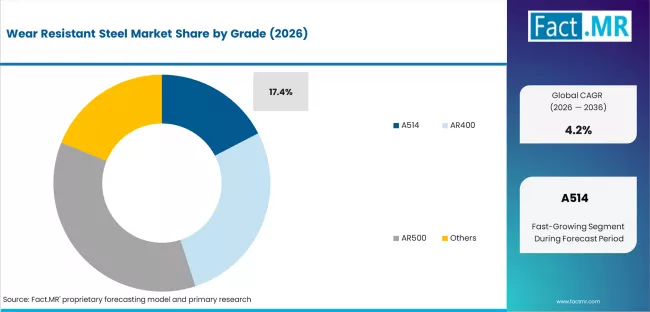
Wear Resistant Steel Market Analysis By Grade | Source: Fact.MR
Fact.MR also notes that customers are willing to invest more in materials that significantly cut down on downtime and the need for replacements. Consequently, businesses that transition from merely selling commodity plates to providing performance-driven solutions and optimizing lifecycle costs are in a stronger position to maintain their margins in this competitive market.
Why are Wear Resistant Steel Plates So Widely Adopted?
Wear Resistant Steel Plates Increasing Lifespan of Mining Equipment
Mining industry leaders are focusing on improving operational efficiency and reducing downtime on account of failed/non-functional machinery. The use of equipment that can withstand harsh conditions without undergoing wear and tear is gaining traction in this sector.
With momentum towards increasing the lifetime of mining equipment, the demand for wear resistant steel plates is bound to increase over the assessment period. Typical usage of heavy AR400 is done in the mining industry in large excavating and earth-moving machines which hold the capacity to shift huge tonnages.
Advanced high strength steel are used for the complete range of loading shovels, dump trucks, cutting edges, screen plates, deflectors, silos, chutes, and slide conveyors. Wear resistant steels have become the choice of material in the excavation of mineral ores in a safe and efficient manner.
Other benefits such as lower maintenance costs, high payload capacity, lighter weight, and reduced fuel consumption are contributing to the increasing demand for wear resistant steel plates. In addition, the hydroelectric sector is also witnessingrising demand for electrical steel.
What is the right product & portfolio strategy?
To create a winning portfolio strategy in the wear-resistant steel market, it’s essential to strike a balance between standard volume products and high-performance specialty grades. While quenched and tempered plates still lead in volume demand, the real growth in profitability is increasingly tied to advanced martensitic grades and ultra-high hardness variants, which provide exceptional wear life in tough conditions.
When we look at demand segmentation, it’s clear that mining and heavy machinery applications prioritize durability and impact resistance, while construction equipment tends to focus on balancing cost and performance. Consequently, top producers are broadening their portfolios to include solutions tailored to specific applications instead of sticking to generic grade offerings. Fact.MR has found that companies that align their product mix with the specific needs of end-users like distinguishing between abrasion and impact resistance can tap into higher-value segments, especially in industries where operational efficiency and reduced maintenance are key decision-making factors.
Farmers Demanding Agricultural Machinery and Equipment Made Using Wear Resistant Steel
Wear resistant steel plates are increasingly being used in agriculture due to their long-term benefits. Continuous wear and tension are placed on agricultural gear and equipment. The machinery is very prone to abrasion during demanding field labor. The lifespan of agricultural equipment components and the frequency of wear part replacement are extended and reduced, respectively, by the use of wear resistant steel plates.
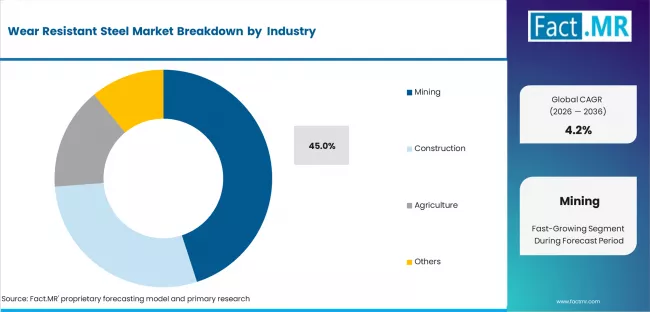
Wear Resistant Steel Market Analysis By System Type | Source: Fact.MR
Growing demand for agricultural equipment in Eastern Europe and North Africa is expected to open up new business opportunities for wear resistant steel plate producers. Due to its additional packaged advantages, including its resistance to corrosive and acidic environments, its demand is rising from a variety of specialized applications.
Wear resistant steel are becoming the preferred metal to produce garbage trucks, containers, and wear surfaces that are regularly exposed to acidic and corrosive conditions in municipal and industrial waste management.
What is the optimal go-to-market model?
Fact.MR points out that the way companies are going to market in this industry is shifting from the old-school distribution methods to more application-focused and partnership-driven strategies.
While distributors still play a vital role in driving volume sales, particularly in fragmented markets, building direct relationships with OEMs and major industrial clients is becoming more important than ever. Collaborating with mining firms, construction equipment makers, and EPC contractors allows for early material specification, which in turn enhances long-term demand visibility.
Additionally, Fact.MR notes a rising trend in solution selling, where suppliers work hand-in-hand with customers to fine-tune material choices and application performance. This strategy not only boosts value realization but also helps lessen price sensitivity. Consequently, a hybrid model that combines direct sales for key accounts with distributors for broader reach is emerging as the most effective go-to-market approach.
How producers are exposed to raw material volatility?
Analysis reveals that producers of wear-resistant steel face significant challenges due to fluctuations in the prices of iron ore, coking coal, and alloying elements like chromium and nickel, all of which have a direct effect on production costs. With the market growing at a relatively slow pace, these producers often struggle to pass on rising costs, especially in competitive standard product segments.
The report indicates that raw material expenses can make up about 60% to 70% of the total production costs, meaning that profit margins are highly sensitive to changes in input prices. Moreover, disruptions in the supply chain or geopolitical issues can further exacerbate price volatility. Those producers who have integrated operations or long-term supply contracts tend to be in a better position to manage these risks. To navigate this unpredictable environment, many are turning to strategic pricing strategies and cost pass-through agreements to help maintain their profitability.
What is the long-term strategic positioning?
The future success of players in the wear-resistant steel plate market relies on their ability to evolve from being mere commodity suppliers to becoming solution providers. While the market is projected to see modest growth, the real value will increasingly stem from expertise in applications, tailored solutions, and integrated services, rather than just boosting volume.
.webp "Top Country Growth Comparison Wear Resistant Steel Market Cagr (2026 2036)")
Top Country Growth Comparison Wear Resistant Steel Market Cagr (2026 2036) | Source: Fact.MR
Industry leaders like SSAB, POSCO and Thyssenkrupp are already taking steps to provide comprehensive wear solutions, which include engineered components and lifecycle support. Fact.MR highlights that companies that prioritize high-performance materials, foster strong customer relationships, and focus on downstream integration will be in a prime position to capture value. Ultimately, long-term differentiation will rely on the ability to deliver tangible operational benefits to customers, rather than just competing on price.
Regional Analysis
The report on the global market also categorizes different key regions, including South Asia & Pacific, Middle East & Africa, North America, Latin America, Western Europe and Eastern Europe. It has a geographic segment, and the market dynamics vary by mining, infrastructure investment, agricultural mechanization and industrialization.
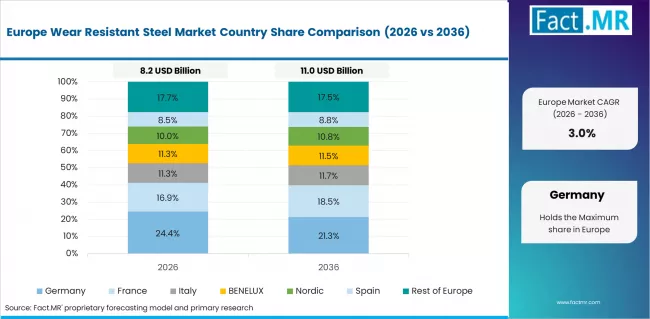
Wear Resistant Steel Market Europe Country Market Share Analysis, 2026 & 2036 | Source: Fact.MR
The report also offers a comprehensive assessment of the market attractiveness at a regional level over the period of forecast with the help of the parameters such as growth opportunity, production, demand, supply chain, high performance steel grades, etc. Regional demand patterns are shaped by varying degrees of industrialization, mining production, infrastructure development, and levels of utilization of equipment, which dictate the overall growth trend in the world wear resistant steel plate market.
| Country | CAGR (%) |
|---|---|
| Canada | 5.6% |
| India | 5.5% |
| China | 5.1% |
| Japan | 4.6% |
| U.S. | 3.1% |
| Germany | 1.6% |
Source: Fact.MR analysis. Updated Apr 2, 2026
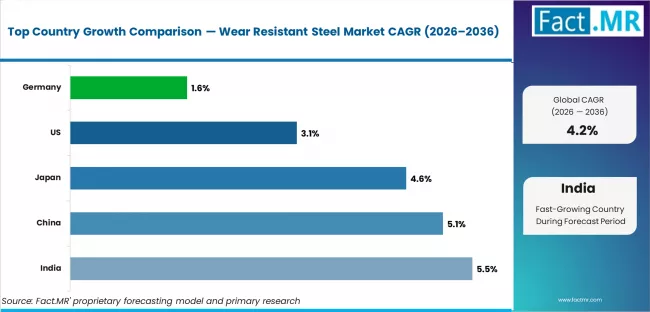
Wear Resistant Steel Market Cagr Analysis By Country | Source: Fact.MR
Source: Fact MR (FMR) analysis, based on proprietary forecasting model and primary research.
South Asia & Pacific
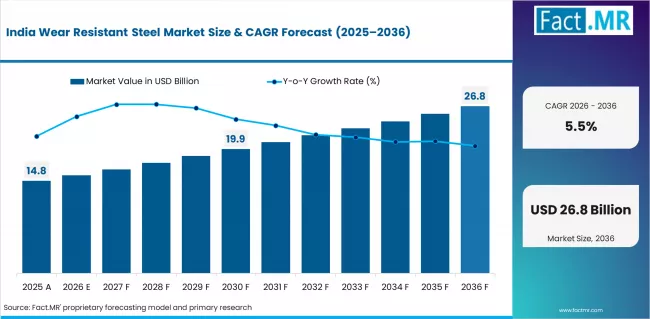
Wear Resistant Steel Market Country Value Analysis | Source: Fact.MR
South Asia & Pacific is emerging as a high-growth region for the Wear Resistant Steel Plate Market, supported by rapid infrastructure development, mining expansion, and increasing agricultural mechanization.
- India: Demand is projected to grow at a CAGR of 5.5% through 2036, fueled by large-scale infrastructure projects, expanding mining activities, and rising adoption of heavy-duty construction and agricultural equipment.
- Japan: Market growth is projected at a 4.6% CAGR, driven by advanced manufacturing capabilities, steady demand for high-grade wear resistant steel, and increasing focus on equipment durability and efficiency.
Middle East & Africa
The Middle East & Africa is an emerging market, where mining activities, infrastructure investments, and industrial expansion are gradually supporting demand for wear resistant steel plates.
- Growth is supported by mineral extraction activities, construction projects, and increasing adoption of heavy machinery, though from a relatively smaller base.
North America
North America remains a mature yet stable market, supported by established mining operations, infrastructure maintenance, and replacement demand for high-performance materials.
- United States: Demand is projected to grow at a CAGR of 3.1%, driven by replacement cycles in mining and construction equipment, along with steady infrastructure upgrades.
- Canada: Growth is supported by mining sector expansion and demand for durable materials in resource extraction and heavy equipment applications.
Latin America
Latin America represents a resource-driven growth market, where demand for wear resistant steel plates is increasing due to strong mining activity and infrastructure development.
- Growth is supported by mining expansion in countries such as Brazil and Chile, along with rising investments in construction and industrial equipment.
Western Europe
Western Europe remains a mature and quality-driven market, characterized by advanced manufacturing, high standards for material performance, and steady replacement demand.
- Germany: Projected CAGR of 1.6%, driven by industrial machinery demand and high-performance steel applications, though growth remains moderate due to market maturity.
- France: Growth is supported by infrastructure upgrades and industrial applications, with demand focused on efficiency and durability improvements.
Eastern Europe
Eastern Europe is witnessing gradual expansion, supported by industrial development, infrastructure investments, and increasing use of heavy machinery.=
- Growth is driven by manufacturing expansion and construction activities, along with rising demand for cost-effective and durable steel solutions.
Fact.MR’s analysis of the Wear Resistant Steel Plate Market across South Asia & Pacific, Middle East & Africa, North America, Latin America, Western Europe, and Eastern Europe includes country-level assessments covering India, China, Japan, United States, Germany, and other key markets. The report evaluates regional industrial activity, mining output, infrastructure investments, equipment demand, and steel production capabilities. It further examines advancements in high-hardness steel grades, manufacturing technologies, and supply chain dynamics, which collectively shape long-term growth across these key industrial regions.
Competitive Landscape
How Are Key Players Competing in the Wear Resistant Steel Market?
The market for Wear Resistant Steel Plate is dominated by the likes of SSAB AB, ArcelorMittal, Thyssenkrupp AG, Nippon Steel Corporation, JFE Holdings Inc., China Baowu Steel Group Corporatio, Ansteel Group Corporation, Bisalloy Steel Group Limited, Dillinger Hütte Saarstahl AG among others global steel producers. These players are concentrated on advancing higher hardness HSS steel grades, enhancing the product performance, and diversifying their global production lines.
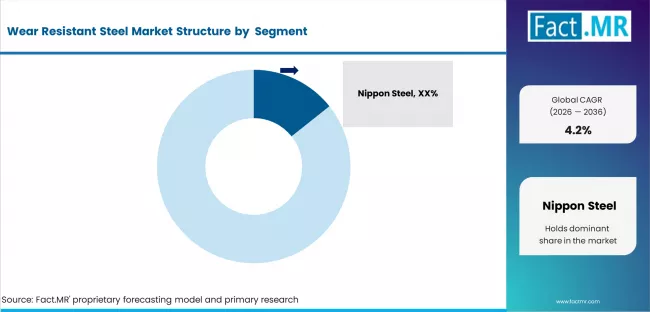
Wear Resistant Steel Market Analysis By Company | Source: Fact.MR
Product innovation is focused on increasing hardness, resistance to impact, weldability, and overall strength while maintaining optimal performance in extreme conditions of use in industries such as mining, construction and heavy material handling. Manufacturers at the forefront of science have improved their processes, including controlled rolling, quenching and tempering, and alkali powder optimization to create high performance products such as AR400 and AR500 which can deliver longer service life with less maintenance expense.
The manufacturers are also increasing their production capacity in order to cater to the growing demand for them in the infrastructure building and mining activities through the expansion of their capacities establish manufacturing hubs in various regions, and find partnerships with mining and construction equipment oems. Strategic partnerships between steel producers, equipment manufacturers and distributors are enhancing supply chain efficiency and ensuring region-wide product reliability. Specialized features include excellent resistance to wear, good impact toughness, homogenous hardness through the plate thickness, and good suitability for cutting, welding and forming. Competitive pricing, high quality consistent hardness, heat treatment process know how, global coverage and long term supply contracts to industry and heavy equipment manufacturers defines differentiation in the wear resistant steel plate market.
Recent Industry Developments
- SSAB AB — Facility Investment (Mar 2025)
SSAB announced the opening of a new steel service center in Mumbai, India, focused on Hardox® wear plates and high-strength steel solutions. The facility strengthens localized processing and distribution capabilities, supporting demand from mining, construction, and heavy equipment industries. (SSAB AB) [1] - SSAB AB — Product Innovation / Sustainability Launch (Dec 2024)
- SSAB announced the launch of Hardox® 450 made from SSAB Zero™, its first emission-free wear plate produced using fossil-free energy and recycled steel. The product maintains the same hardness and performance as conventional Hardox® while significantly reducing carbon emissions. (SSAB AB) [2]
Key Players of the Wear Resistant Steel Plate Market
- Nippon Steel
- Sumitomo Metal Corporation
- Bisalloy Steel Group Limited
- China Baowu Steel Group Corporation Limited
- DHS - Dillinger Hütte Saarstahl AG
- GIPO AG
- Ansteel Group Corporation
- ArcelorMittal
- JFE Holdings Incorporation
- SSAB AB
- Thyssenkrupp AG
Research Methodology
The basis for the analysis of the wear-resistant steel plate market has been a combination of primary research, validation of secondary research, and quantitative modeling for accurate and authentic representation. Secondary research has been used as a foundation for analysis, wherein information has been obtained from credible sources like the World Steel Association, International Energy Association, and the United States Geological Survey. Indicators for infrastructure and construction have been obtained from credible sources like the World Bank.
Source of primary research has been interviews with industry participants like steel manufacturers, OEMs, and distributors, wherein information has been obtained about trends in demand for the material in industries like mining, construction, and heavy machinery. Information has also been obtained from credible sources like the American Iron and Steel Institute.
For market sizing has been a bottom-up approach, wherein information has been aggregated from various industries for accurate representation. Historical trends have also been analyzed for forecasting, wherein information has been obtained from credible sources like the World Steel Association and the International Energy Association. Triangulation has also been used for accurate representation, wherein discrepancies have been reconciled from both the supply and demand sides.
- Data Validation: Outputs were cross-verified through triangulation with supply chain data, expert insights, and recalibration based on raw material price trends, production capacity expansions, infrastructure investments, and evolving demand for high-performance steel grades.
- Analyst Opinion: The Wear Resisting Steel Plate Market is at steady growth stage, owing to the growing demand for wear resistant materials in the impact industries including mining, construction and farming. The growth is associated with the increasing heavy equipment and infrastructure development, which high hardness steel grades like AR400 and AR500 have significantly better abrasion resistance than regular structural steel, resulting in longer service life and less maintenance cost. With more industries focused on operating efficiency, equipment longevity and cost of ownership, the wear resistant steel plate is emerging as our critical material solution in severe working conditions where the traditional rolls and steels do not consistently perform.
Strategic Insights
- Development and performance improvement of alloys: Leading industry participants are actively working on new alloy compositions, tailored heat-treatment schemes (quenching and tempering) and high hardness grades (such as AR400 and AR500) to provide superior levels of wear, impact energy and useful life in extreme environments.
- Regional Production and Major Industrial Use Hubs: East Asia, South Asia & Pacific, North America and Europe have long been the major producers and consumers of wear resistant steel plate, and the outlook is attributable to growth in mining, infrastructure and heavy equipment manufacturing.
- Simplifying the Supply Chain: Steel producers are increasingly focusing on the supply side, to better control costs and to procure the right materials in the right quantities, at the right time, and at the right place to provide a reliable source of supply, cost competitiveness and on-time delivery in global market.
Case Study - Plant Feasibility Analysis for a Leading Wear Resistant Steel Manufacturer in Europe
A leading European wear resistant steel plate manufacturer wanted to assess the feasibility of setting up a new manufacturing facility in Central Europe to serve the rising demand from mining and construction equipment OEMs. The client was uncertain about the demand concentration in the region, cost competitiveness, and the size of the new facility.
Fact.MR undertook a thorough techno-commercial feasibility study for the project. This began with a detailed demand analysis in the region's key industries such as the mining, infrastructure, and heavy machinery sectors. By using a bottom-up approach, the demand was quantified at the country level to identify the high-growth clusters in Central and Eastern Europe.
On the supply side, Fact.MR's study also analyzed the existing steel manufacturers, their capacities, and the price dynamics. This gave a clear picture to the client about the competitive intensity in the region. A cost modeling framework was also developed to assess the cost parameters such as raw material costs (iron ore and alloys), energy costs, logistics, and labor economics in the proposed locations.
The study also assessed different plant configuration options such as greenfield and brownfield expansion and recommended the optimum size of the new facility. Finally, the study also undertook a sensitivity analysis on the parameters such as input costs and demand.
The study helped the client take a well-informed decision on setting up a new facility in Central Europe and also identify the optimum size and configuration.
Bibliographies
- Polish Walcownia Blach Batory invests in wear-resistant steel production. The WBB project is an key step in exhibiting Weglokoks’ strong position in the flat steel market and improving the technological level of production. [1]
- SSAB Launches New Steel Service Center in Mumbai to Support Advanced Manufacturing and Wear Resistant Steel [2]
- Industeel, subsidiary of Luxembourg-headquartered steelmaker ArcelorMittal, has announced that it has signed an agreement with Portugal-based heavy plate supplier Norsider to distribute its Creusabro® wear-resistant steels for the Spain and Portugal [3]
- SSAB AB — “Hardox® HiAce steel sets new standard in corrosive wear and high-heat environments.”
- Leading the charge by injecting fossil-free steel into American supply chains. By replacing coal with hydrogen, American OEMs are now enabled to cut their Scope 3 emissions while meeting the growing demand for green infrastructure and EVs [5]
Wear Resistant Steel Market Definition
Wear Resistant Steel Plate Market for Production and Application high strength and high abrasion resistance steel plate materials suitable for various industry fields such as mining, construction, agriculture and material handling. Instead of traditional structural steel, wear resistant steel plates have been specially processed to be able to resist extreme friction, impact and material wear, which leads to longer service life, reduction in maintenance schedules and better operational efficiency in the most abrasive environments.
Wear resistant steel is available in grades including A514, AR400, AR500, and other special alloy formulations, processed using advanced metallurgy including controlled rolling, quenching, and tempering to provide enhanced hardness and toughness. The sheet plates find application in heavy equipment build such as dump truck bodies, excavator buckets, crushers, conveyor belts, hoppers, and chutes because of their uniform resistance to wear and tear. They are used in critical end-use sectors such as mining, construction, agriculture and other industrial applications and for OEM (original equipment manufacturer) as well as in replacements demand trends.
These plates are high strength, impact resistant, possess good structural stability and are reliable for use in severe conditions, so it can be highly trusted for continuous abrasion and heavy load applications. The main end use is the heavy-duty equipment and infrastructure space, where increasing equipment uptime, reducing lifecycle costs, and enhancing equipment productivity are critical to driving greater operating efficiency and asset life.
Wear Resistant Steel Market Inclusions
The report covers global and regional market size estimates and forecasts for the Wear Resistant Steel Plate Market from 2025 to 2036, including:
- Segment analysis by Product Type (A514, AR400, AR500, Others), End-use Industry (Mining, Construction, Agriculture, Others), and Region (North America, Latin America, East Asia, South Asia & Pacific, Western Europe, Eastern Europe, Middle East & Africa).
- Regional performance comparison across North America, Latin America, Western Europe, Eastern Europe, East Asia, South Asia & Pacific, and Middle East & Africa, highlighting demand variations driven by industrial activity and infrastructure development.
- Pricing trend evaluation, raw material cost analysis (iron ore, alloying elements), supply chain structure, and production dynamics for wear resistant steel plates.
- Technology and product outlook, including advancements in high-hardness grades (AR400, AR500), alloy optimization, and heat-treatment processes enhancing durability, performance, and lifecycle efficiency.
- Analysis of demand shifts driven by growth in mining operations, infrastructure and construction activities, agricultural mechanization, and increased use of heavy-duty equipment requiring enhanced wear resistance and reduced maintenance costs.
Wear Resistant Steel Market Exclusions
The scope excludes:
- Conventional products of structural steels without enhanced abrasion resistant properties Ex: carbon steel plates for a general use and low wear matter applications.
- Fabricated equipment and machinery downstream including full mining equipment, construction equipment, agricultural tools and material handling systems (only wear resistant steel plates as a material / component are considered).
- Surface coatings, treatments and other protect against the wear physics solutions (e.g. rubber linings, ceramic coatings, composites) other than wear resistant steel plates.
- Stainless and special alloys intended for use more as corrosion or temperature resistant material rather than abrasion resistant material.
- Any non-industrial or minimal wear applications where wear resistance is secondary to performance. Applications include decorative, architectural or light-use steel.
Segmentation
Report Scope
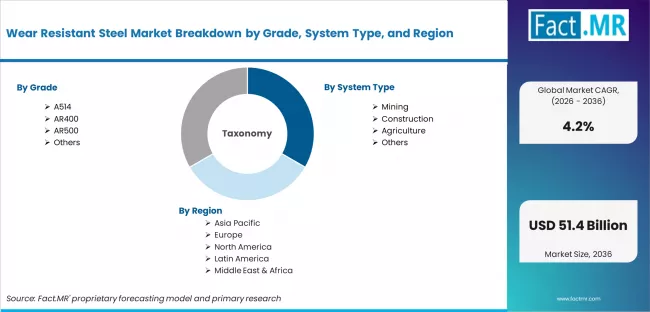
Wear Resistant Steel Market Breakdown By Grade, System Type, And Region | Source: Fact.MR
| Metric | Value |
|---|---|
| Quantitative Units | USD 32.73 billion (2025) to USD 35.45 billion (2036), at a CAGR of 4.2% |
| Market Definition | The Wear Resistant Steel Plate Market includes high-strength, abrasion-resistant steel solutions designed for industries such as mining, construction, agriculture, and material handling. These plates (A514, AR400, AR500, and others) are engineered using advanced processes such as quenching and tempering to deliver superior hardness, durability, and resistance to wear and impact, enabling extended equipment life, reduced maintenance costs, and improved operational efficiency in harsh environments. |
| By Product | A514, AR400, AR500, Others |
| By End-use Industry | Mining, Construction, Agriculture & Forestry, Others |
| Regions Covered | North America, Latin America, Western Europe, Eastern Europe, East Asia, South Asia & Pacific, Middle East & Africa |
| Countries Covered | United States, Canada, Germany, France, China, Japan, India, Brazil, Australia, other key industrial markets |
| Key Companies Profiled | SSAB AB, ArcelorMittal, Thyssenkrupp AG, Nippon Steel Corporation, JFE Holdings Inc., China Baowu Steel Group Corporation, Ansteel Group Corporation, Bisalloy Steel Group Limited, Dillinger Hütte Saarstahl AG |
| Forecast Period | 2026 to 2036 |
| Approach | Hybrid top-down and bottom-up modeling validated through primary interviews with steel manufacturers, distributors, and equipment OEMs, supported by analysis of mining output, infrastructure investments, agricultural mechanization trends, raw material pricing, production capacity, and global trade flow dynamics. |
Source: Fact.MR analysis. Updated Apr 2, 2026
Wear Resistant Steel Market Key Segments
-
By Product Type :
- Quenched & Tempered Steel Plates
- Martensitic Steel Plates
- Bainitic Steel Plates
- Dual-Phase & Advanced High-Strength Steel Plates
- Others (Specialty Alloys / Composite Plates)
-
By Hardness Grade:
- Up to 400 HB (AR400 Grade)
- 400–500 HB (AR450–AR500 Grade)
- Above 500 HB (Ultra High Hardness Plates)
-
By Thickness :
- Thin Plates (<10 mm)
- Medium Plates (10–30 mm)
- Thick Plates (>30 mm)
-
By Processing Technology :
- Conventional Rolling & Heat Treatment
- Quenching & Tempering (Q&T)
- Thermo-Mechanical Controlled Processing (TMCP)
- Surface Hardening / Coating-Integrated Plates
- Laser Cladding / Overlay-Integrated Plates
-
By Application Industry :
- Mining Equipment Manufacturing
- Excavators
- Crushers & Screens
- Dump Trucks & Buckets
- Construction Equipment
- Loaders
- Bulldozers
- Road Construction Machinery
- Material Handling Equipment
- Conveyors
- Chutes & Hoppers
- Bulk Handling Systems
- Industrial Processing Equipment
- Cement Plants
- Steel Plants
- Power Generation Systems
- Agricultural & Forestry Equipment
- Mining Equipment Manufacturing
-
By Region :
- North America
- Latin America
- Western Europe
- Eastern Europe
- East Asia
- South Asia & Pacific
- Middle East & Africa
Frequently Asked Questions
What is the current size of the global Wear Resistant Steel Plate Market?
How large will the market be by 2036?
What is the expected growth rate of the market?
Which segment is leading the market by product type?
Who are the major industry participants?
Which region is expected to show the highest growth rate in the market?
How strong is the growth outlook for China?
What is the growth outlook for the United States in this market?
What is the growth forecast for Japan in this market?
Which European market is highlighted in this analysis?
Who worked on this report


Preview the report firsthand - request a free sample
Free SampleGet the brochure for pricing and purchase details
Download PDF