- Base Value(2025): 4.7 Bn
- Estimated Value(2026): 5.3 Bn
- Forecast Value (2036): 18.8 Bn
- CAGR (2026 - 2036): 13.4%
Oligonucleotide Synthesis Market Analysis and Forecast by Fact.MR
- The global oligonucleotide synthesis market is estimated at USD 5.3 billion in 2026 and has been forecast to expand at a CAGR of 13.4% to reach USD 18.8 billion by 2036.
- Oligonucleotide synthesis covers the chemical and enzymatic production of DNA and RNA sequences including primers, probes, antisense oligonucleotides, siRNA, mRNA, and sgRNA for CRISPR applications, along with reagents, consumables, instruments, and custom synthesis services.
- Growth is shaped by expanding RNA therapeutics pipelines, gene therapy clinical programs, mRNA vaccine development, CRISPR gene editing research, and growing demand for large-scale GMP-grade oligonucleotide manufacturing.
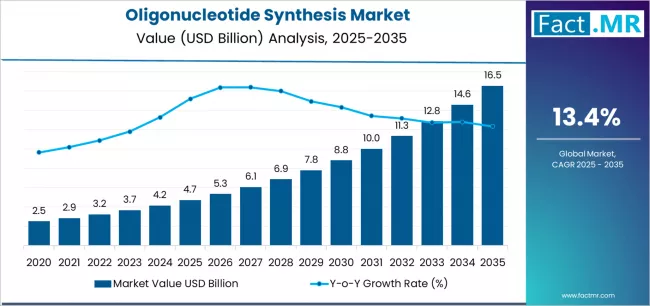
Oligonucleotide Synthesis Market Market Value Analysis | Source: Fact.MR
Summary of Oligonucleotide Synthesis Market
- Market Snapshot
- In 2025, the global Oligonucleotide Synthesis Market was valued at approximately USD 4.71 billion.
- The market is estimated to reach USD 5.3 billion in 2026 and is projected to attain USD 18.8 billion by 2036.
- The oligonucleotide synthesis market is likely to expand at a CAGR of 13.4% during the forecast period.
- The market is anticipated to create an absolute dollar opportunity of USD 13.5 billion between 2026 and 2036.
- Oligonucleotides account for 52.6% of product segment share in 2026, including DNA and RNA sequences for research and therapeutic applications.
- India (14.2%) and China (13.8%) are the key growth markets during the forecast period.
- Demand and Growth Drivers
- Expanding RNA therapeutics pipelines, including antisense oligonucleotides, siRNA, and mRNA-based drugs, are creating large-scale demand for GMP-grade oligonucleotide manufacturing.
- CRISPR gene editing research is generating accelerating demand for guide RNA and other synthetic oligonucleotide tools across academic and pharmaceutical research settings.
- mRNA vaccine development, building on COVID-19 platform validation, continues to drive demand for large-scale RNA synthesis capacity and associated reagent supply chains.
- Growing adoption of liquid biopsy and molecular diagnostics is increasing demand for diagnostic-grade oligonucleotide probes and primers.
- Pharmaceutical industry investment in nucleic acid therapeutics manufacturing infrastructure is creating sustained long-term demand for synthesis platforms and consumables.
- Product and Segment View
- Oligonucleotides account for 52.6% of the product segment in 2026, encompassing DNA and RNA sequences including primers, probes, antisense oligonucleotides, siRNA, mRNA, and sgRNA products.
- Research represents 41.3% of the application segment in 2026, driven by genomics research programs, PCR and sequencing workflows, and CRISPR gene editing applications.
- Solid phase synthesis holds 63.5% of the synthesis method segment in 2026, remaining the dominant manufacturing approach for both research-grade and therapeutic-grade oligonucleotides.
- Key segmentation includes:
- Product: Oligonucleotides (DNA: primers, probes, antisense, siRNA; RNA: mRNA, sgRNA, lncRNA), Reagents and consumables (phosphoramidites, enzymes, solvents, columns), Instruments (DNA/RNA synthesizers, column-based, microarray), Services (custom synthesis, oligo libraries, gene synthesis, modification)
- Application: Research (diagnostics, PCR, sequencing, therapeutics, gene therapy, RNA-based therapy, antisense therapy, vaccines)
- End Use: Pharmaceutical companies, Biotechnology companies, Academic and research institutes, Diagnostic laboratories
- Synthesis Method: Solid phase synthesis, Column-based synthesis, Microarray-based synthesis
- These systems enable:
- Chemical and enzymatic synthesis of custom DNA and RNA sequences for research, diagnostic, and therapeutic applications
- Scalable manufacturing from milligram research quantities to kilogram GMP-grade therapeutic production
- Sequence-specific modifications including fluorescent labeling, backbone modifications, and conjugation chemistry
- Geography and Competitive Outlook
- North America remains the largest regional market, driven by the concentration of pharmaceutical R&D investment, RNA therapeutics pipeline activity, and established manufacturing infrastructure.
- Europe shows strong growth led by Germany and UK, supported by academic research funding, biotechnology cluster development, and manufacturing capacity expansion.
- Asia Pacific is the fastest-growing region as India, China, and Japan expand pharmaceutical manufacturing capabilities, invest in nucleic acid therapeutics development, and build domestic oligonucleotide synthesis infrastructure.
- India (14.2%) and China (13.8%) lead country-level growth, while USA (12.5%), Japan (11.9%), and Germany (10.7%) maintain strong expansion.
- Leading companies include Thermo Fisher Scientific Inc., Merck KGaA, Danaher Corporation, Revvity Discovery Limited, Agilent Technologies Inc., Bio-Synthesis Inc., and Twist Bioscience Corporation.
- Analyst Opinion
- Shambhu Nath Jha, Principal Consultant at Fact.MR, says 'The oligonucleotide synthesis market is at an inflection point where the transition from research-scale to therapeutic-scale manufacturing is creating a fundamentally different competitive landscape. The RNA therapeutics revolution, catalyzed by mRNA vaccine success, has validated nucleic acid medicines as a major pharmaceutical modality. This is driving unprecedented investment in GMP-grade synthesis capacity. Companies that control large-scale manufacturing platforms, proprietary chemistry, and integrated service offerings from custom synthesis through GMP production are capturing the highest-value positions. Enzymatic synthesis innovations from companies like Twist Bioscience are also reshaping the competitive dynamics by offering greener, longer-read alternatives to traditional chemical methods.'
Key Growth Drivers, Constraints, and Opportunities
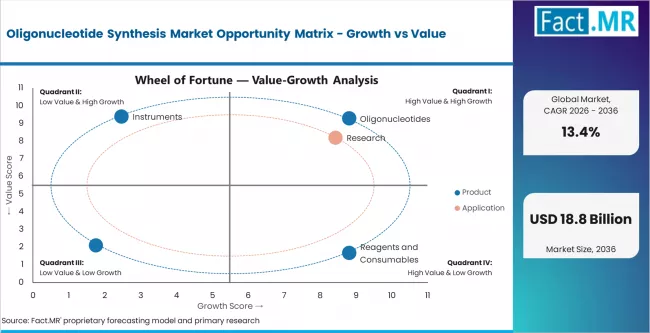
Oligonucleotide Synthesis Market Opportunity Matrix Growth Vs Value | Source: Fact.MR
Key Factors Driving Growth
- The RNA therapeutics revolution, validated by mRNA vaccine success, is driving unprecedented pharmaceutical investment in oligonucleotide-based drug development across antisense, siRNA, mRNA, and gene therapy modalities.
- CRISPR gene editing adoption across academic, pharmaceutical, and agricultural research is generating accelerating demand for guide RNA and supporting oligonucleotide reagents.
- Large-scale GMP manufacturing investment by pharmaceutical companies and CDMOs is expanding the total addressable market for synthesis platforms, reagents, and services.
Key Market Constraints
- Manufacturing scale-up challenges in transitioning from research-grade to GMP-grade oligonucleotide production, including yield optimization and purity requirements, create development bottlenecks.
- Raw material supply concentration, particularly for phosphoramidite building blocks, creates cost volatility and potential supply chain vulnerabilities.
- Intellectual property complexity around modified nucleotide chemistry and proprietary synthesis platforms can limit competitive market entry.
Key Opportunity Areas
- Therapeutic oligonucleotide manufacturing represents the highest-growth opportunity, with pharmaceutical GMP-grade production commanding premium pricing and long-term contract visibility.
- Enzymatic synthesis technologies offer a potential paradigm shift in oligonucleotide production, enabling longer reads, reduced solvent use, and expanded sequence capabilities.
- Emerging market manufacturing capacity development, particularly in India and China, is creating new cost-competitive production centers for both research-grade and therapeutic-grade synthesis.
Segment-wise Analysis of the Oligonucleotide Synthesis Market
- Oligonucleotides hold 52.6% of the product segment in 2026, driven by growing demand for custom DNA and RNA sequences across research, diagnostics, and therapeutic applications.
- Research applications represent 41.3% of the application segment in 2026, with PCR, sequencing, CRISPR editing, and molecular biology workflows generating the largest volume of oligonucleotide orders.
- Pharmaceutical companies hold 34.8% of the end use segment in 2026, reflecting the concentration of RNA therapeutics pipeline investment and GMP manufacturing demand.
The oligonucleotide synthesis market is segmented by product, application, end use, synthesis method, scale of synthesis, and region. By product, the market covers oligonucleotides, reagents and consumables, instruments, and services. By application, coverage includes research and therapeutic uses spanning diagnostics, PCR, sequencing, gene therapy, and vaccine development. Oligonucleotides lead by value because of the high pricing of custom and modified sequences, while services represent the fastest-growing category as outsourced synthesis demand expands.
Which Product Segment Dominates the Oligonucleotide Synthesis Market?
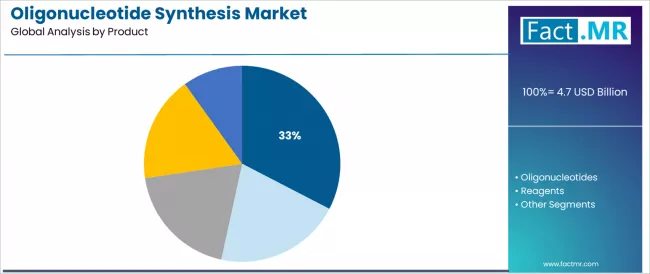
Oligonucleotide Synthesis Market Analysis By Product | Source: Fact.MR
Oligonucleotides are expected to account for 52.6% of the product segment value in 2026. This includes both DNA oligonucleotides (primers, probes, antisense sequences, siRNA) and RNA oligonucleotides (mRNA, sgRNA, lncRNA). The segment leadership reflects the core product nature of synthetic nucleic acid sequences, which represent the primary output of the synthesis industry.
Within the oligonucleotide category, therapeutic-grade sequences are commanding increasingly higher pricing as pharmaceutical demand grows. Reagents and consumables, including phosphoramidites, enzymes, and solvents, generate steady recurring revenue from the installed base of synthesis instruments. Custom synthesis services are growing rapidly as pharmaceutical and biotechnology companies increasingly outsource production to specialized providers.
Which Application Segment Dominates the Oligonucleotide Synthesis Market?

Oligonucleotide Synthesis Market Analysis By Application | Source: Fact.MR
Research applications are expected to hold 41.3% of the application segment value in 2026. This includes diagnostic development, PCR and sequencing workflows, gene expression analysis, and CRISPR gene editing tool production. Academic and biotechnology research programs generate the largest volume of individual oligonucleotide orders, though at lower per-unit values than therapeutic applications.
Therapeutic applications, including gene therapy, RNA-based therapy, antisense therapy, and vaccine development, represent the fastest-growing application category. While still smaller by volume than research, therapeutic applications command significantly higher pricing and are driving the majority of new manufacturing capacity investment.
Which Product Trend is Shaping the Next Phase of Growth in the Oligonucleotide Synthesis Market?
Large-scale GMP-grade oligonucleotide manufacturing is the defining product trend reshaping the market. The pharmaceutical industry's growing commitment to nucleic acid therapeutics is driving investments in manufacturing capacity. Agilent Technologies announced a USD 725 million capacity expansion for its oligonucleotide therapeutics manufacturing facility in Frederick, Colorado, one of the largest single investments in the industry. Similar capacity expansions are underway across multiple manufacturers globally.
Alongside scale expansion, enzymatic synthesis technologies are emerging as a potential paradigm shift. Companies including Twist Bioscience, DNA Script, and Ansa Biotechnologies are developing enzymatic approaches that extend achievable sequence lengths, reduce solvent consumption, and offer environmental benefits compared to traditional chemical phosphoramidite chemistry. Twist Bioscience operates its manufacturing at Wilsonville, Oregon, and has introduced Express Genes services with 5 to 7 business day turnaround. As these technologies mature and achieve GMP qualification, they could reshape both the cost structure and capability boundaries of oligonucleotide production.
Regional Outlook Across Key Markets
.webp "Top Country Growth Comparison Oligonucleotide Synthesis Market Cagr (2026 2036)")
Top Country Growth Comparison Oligonucleotide Synthesis Market Cagr (2026 2036) | Source: Fact.MR
- India leads growth at 14.2%, supported by pharmaceutical manufacturing capacity expansion, the Make in India initiative for nucleic acid therapeutics, and growing domestic biotechnology research investment.
- China at 13.8% benefits from government science funding, pharmaceutical industry development programs, and growing domestic oligonucleotide synthesis company capabilities.
- USA at 12.5% reflects the concentration of RNA therapeutics pipeline investment, established GMP manufacturing infrastructure, and leading academic research programs.
- Japan at 11.9% and Germany at 10.7% maintain strong growth through pharmaceutical R&D investment, academic research excellence, and expanding manufacturing capacity.
CAGR Table
| Country | CAGR (%) |
|---|---|
| India | 14.2% |
| China | 13.8% |
| USA | 12.5% |
| Japan | 11.9% |
| Germany | 10.7% |
| UK | 10.1% |
| Canada | 9.4% |
Source: Fact.MR analysis. Updated May 8, 2026
Source: Fact MR (FMR) analysis, based on proprietary forecasting model and primary research.
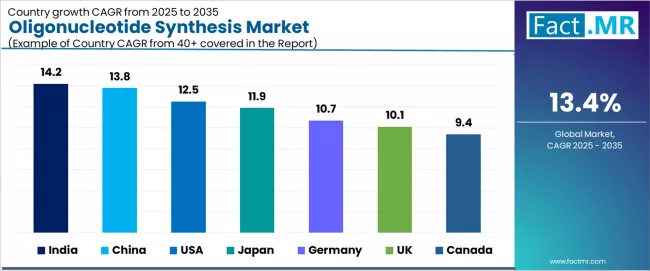
Oligonucleotide Synthesis Market Cagr Analysis By Country | Source: Fact.MR
Market Outlook for Oligonucleotide Synthesis in the United States

Oligonucleotide Synthesis Market Country Value Analysis | Source: Fact.MR
The US oligonucleotide synthesis market is projected to grow at a CAGR of 12.5% through 2036. Demand is supported by the concentration of RNA therapeutics pipeline activity, established GMP manufacturing infrastructure, and leading academic research programs across genomics and gene editing.
- RNA therapeutics pipeline investment drives GMP manufacturing demand.
- Academic research programs generate high-volume research-grade orders.
- Manufacturing capacity expansions support growing therapeutic production needs.
Oligonucleotide Synthesis Demand Trends in India
The India oligonucleotide synthesis market is projected to grow at a CAGR of 14.2% through 2036, the fastest among countries studied. Growth is supported by pharmaceutical manufacturing capacity expansion, government initiatives, and growing biotechnology research investment.
- Pharmaceutical manufacturing capacity is expanding for nucleic acid therapeutics.
- Government initiatives support domestic synthesis capability development.
- Growing biotech sector creates expanding research-grade demand.
China Oligonucleotide Synthesis Market Growth Assessment
The China oligonucleotide synthesis market is projected to grow at a CAGR of 13.8% through 2036. Growth is driven by government science funding, pharmaceutical industry development, and growing domestic synthesis company capabilities.
- Government science funding supports genomics and gene therapy research.
- Domestic synthesis companies are expanding manufacturing capacity.
- Pharmaceutical development programs create growing therapeutic-grade demand.
Japan Oligonucleotide Synthesis Market Outlook
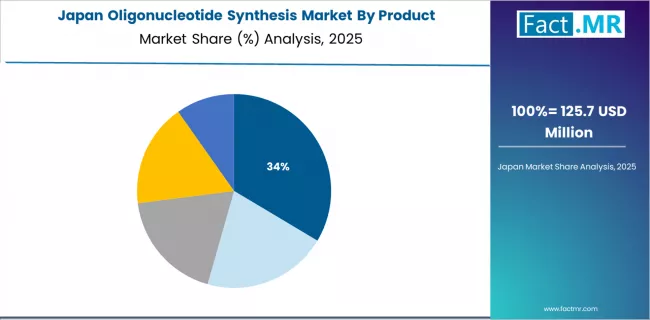
Oligonucleotide Synthesis Market Japan Market Share Analysis By Product | Source: Fact.MR
The Japan oligonucleotide synthesis market is projected to grow at a CAGR of 11.9% through 2036. Demand is supported by strong pharmaceutical R&D investment, advanced academic research programs, and growing demand for therapeutic-grade oligonucleotide manufacturing.
- Pharmaceutical R&D investment sustains premium synthesis demand.
- Academic research programs generate steady research-grade orders.
- Therapeutic manufacturing demand is growing as RNA drug pipelines advance.
Germany Oligonucleotide Synthesis Market Demand Analysis
The Germany oligonucleotide synthesis market is projected to grow at a CAGR of 10.7% through 2036. Demand is supported by biotechnology cluster development, pharmaceutical manufacturing investment, and academic research funding across genomics and molecular biology.
- Biotechnology clusters create concentrated synthesis demand.
- Manufacturing investment supports European therapeutic production capacity.
- Academic research funding sustains research-grade oligonucleotide orders.
Competitive Benchmarking and Company Positioning

Oligonucleotide Synthesis Market Analysis By Company | Source: Fact.MR
Oligonucleotide Synthesis Market Analysis By Company
- Thermo Fisher Scientific Inc., Danaher Corporation (Integrated DNA Technologies), and Merck KGaA hold dominant positions through comprehensive product portfolios spanning oligonucleotides, reagents, instruments, and custom synthesis services with global manufacturing and distribution scale.
- Agilent Technologies Inc., Twist Bioscience Corporation, and Bio-Synthesis Inc. compete through specialized capabilities in therapeutic-grade manufacturing, enzymatic synthesis innovation, and custom service offerings.
- Competition is increasingly defined by the ability to serve both research-grade and GMP therapeutic-grade markets, with manufacturing scale, regulatory compliance, and proprietary chemistry platforms determining competitive positioning.
The competitive landscape shows moderate concentration among established life science companies, with Thermo Fisher Scientific maintaining an estimated 17% market share. Thermo Fisher's strength lies in its comprehensive oligonucleotide portfolio spanning research primers and probes through large-scale GMP manufacturing, combined with global distribution infrastructure serving pharmaceutical, biotechnology, and academic customers.
Danaher Corporation, through Integrated DNA Technologies, and Merck KGaA compete as major full-service providers with broad product portfolios and global manufacturing networks. Agilent Technologies is investing significantly in therapeutic-grade manufacturing expansion, with its USD 725 million Frederick, Colorado facility representing one of the industry's largest capacity investments.
Twist Bioscience Corporation represents the most significant disruptive force in the market, leveraging proprietary silicon-based DNA synthesis technology that enables high-throughput, high-quality production. The company has expanded into gene synthesis services with rapid turnaround offerings and continues to develop enzymatic synthesis approaches that could reshape production economics.
Strategic priorities include expanding GMP manufacturing capacity, developing enzymatic synthesis platforms, securing long-term pharmaceutical supply agreements, and building integrated service offerings that span from custom research-grade synthesis through therapeutic-grade manufacturing.
Key Companies in the Oligonucleotide Synthesis Market
- Thermo Fisher Scientific Inc., Danaher Corporation (IDT), and Merck KGaA are among the leading players globally, supported by comprehensive portfolios, global manufacturing, and established pharmaceutical customer relationships.
- Revvity Discovery Limited, Agilent Technologies Inc., and Bio-Synthesis Inc. hold strong positions through specialized capabilities in therapeutic manufacturing, large-scale synthesis, and research service offerings.
- Kaneka Eurogentec S.A., LGC Biosearch Technologies, Biolegio B.V., and Twist Bioscience Corporation compete through focused product offerings, enzymatic synthesis innovation, and niche strength in specific oligonucleotide categories.
Recent Industry Developments
- Agilent Technologies, Major Manufacturing Capacity Expansion (2025)
- Agilent Technologies advanced its USD 725 million oligonucleotide therapeutics manufacturing expansion in Frederick, Colorado. The investment represents one of the largest dedicated oligonucleotide manufacturing facilities and positions Agilent to serve growing pharmaceutical GMP production demand.
- Twist Bioscience, Express Genes Service Expansion (2025)
- Twist Bioscience continued to expand its Express Genes synthesis service offering rapid 5 to 7 business day turnaround, manufactured at its Wilsonville, Oregon facility. The service targets pharmaceutical and biotechnology customers requiring accelerated gene synthesis timelines.
- Co-Diagnostics and CoSara Diagnostics, India Joint Venture (2025)
- Co-Diagnostics Inc. advanced its Indian joint venture CoSara Diagnostics Pvt., supporting the development of domestic oligonucleotide synthesis and molecular diagnostic capabilities in line with India's Make in India pharmaceutical manufacturing initiative.
Leading Companies Shaping the Oligonucleotide Synthesis Market
- Thermo Fisher Scientific Inc.
- Merck KGaA
- Danaher Corporation
- Revvity Discovery Limited
- Agilent Technologies, Inc.
- Bio-Synthesis Inc.
- Kaneka Eurogentec S.A.
- LGC Biosearch Technologies
- Biolegio B.V.
- Twist Bioscience Corporation
Sources and Research References
- Thermo Fisher Scientific. Oligonucleotide product portfolio and manufacturing updates.
- Agilent Technologies. Manufacturing capacity expansion disclosures and therapeutic synthesis capabilities.
- Twist Bioscience Corporation. Express Genes service data and enzymatic synthesis development updates.
- Danaher Corporation. Integrated DNA Technologies product portfolio and market positioning.
- Primary interviews with synthesis companies, pharmaceutical manufacturers, academic researchers, and diagnostic laboratory operators.
This bibliography is provided for reader reference and is not exhaustive. The full report contains the complete reference list and detailed citations.
Key Questions This Report Addresses
- What is the current and future size of the Oligonucleotide Synthesis Market?
- How fast is the market expected to grow between 2026 and 2036?
- Which product type is likely to lead the market by 2026?
- Which application segment drives the highest demand?
- What factors are driving demand for oligonucleotide synthesis?
- How is the RNA therapeutics revolution shaping the market?
- Why are India and China the fastest-growing markets?
- How are enzymatic synthesis technologies changing production?
- Which countries are projected to show the fastest growth?
- Who are the key companies active in the market?
- How does Fact.MR estimate and validate the market forecast?
Oligonucleotide Synthesis Market Definition
The oligonucleotide synthesis market covers the production of synthetic DNA and RNA sequences, associated reagents and consumables, synthesis instruments, and custom synthesis services used across pharmaceutical, biotechnology, academic, and diagnostic applications.
Oligonucleotide Synthesis Market Inclusions
- The scope covers global and regional market size and forecasts for 2026 to 2036 across product, application, end use, synthesis method, scale of synthesis, and region.
- It includes demand analysis based on RNA therapeutics pipeline activity, research funding trends, diagnostic test volumes, and manufacturing capacity expansion.
- The report covers pricing and cost analysis across research-grade and GMP-grade oligonucleotide categories.
- It includes technology trends, competitive positioning, and strategic priorities of leading synthesis companies.
Oligonucleotide Synthesis Market Exclusions
- The scope excludes finished pharmaceutical products containing oligonucleotide active ingredients sold to patients.
- It excludes general laboratory equipment not specifically designed for oligonucleotide synthesis.
- The report excludes bioinformatics software platforms sold independently of synthesis products.
- It also excludes natural nucleic acid extraction and purification services without a synthetic component.
Oligonucleotide Synthesis Market Research Methodology
- The methodology combines secondary research, primary interviews, and forecast modelling.
- It draws on 120+ secondary sources and benchmarks 55+ company product portfolios.
- Market sizing covers 30+ countries through a demand-side model, supported by top-down validation.
- Key inputs include RNA therapeutics pipeline activity, research grant funding, diagnostic test volumes, and manufacturing capacity investments.
- The model cross-checks demand with synthesis service orders, reagent sales, and instrument placements.
- Primary validation includes 25+ interviews across synthesis companies, pharmaceutical manufacturers, academic researchers, and diagnostic companies.
- Final estimates go through order-volume checks, sales-pattern review, and sensitivity testing.
Segmentation
Scope of Analysis
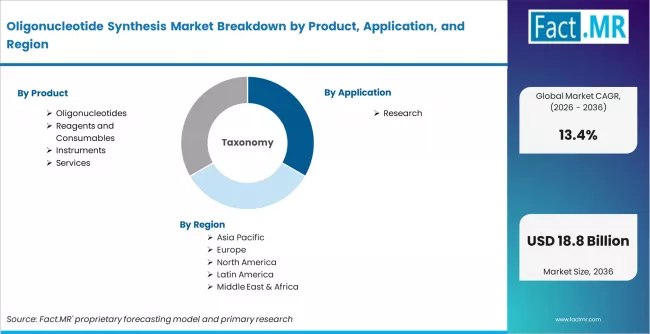
Oligonucleotide Synthesis Market Breakdown By Product, Application, And Region | Source: Fact.MR
| Parameter | Details |
|---|---|
| Quantitative Units | USD 5.3 billion to USD 18.8 billion, at a CAGR of 13.4% |
| Market Definition | The Oligonucleotide Synthesis Market covers production of synthetic DNA and RNA sequences, reagents, instruments, and services for pharmaceutical, biotechnology, academic, and diagnostic applications. |
| Regions Covered | North America, Latin America, Europe, East Asia, South Asia and Pacific, Middle East and Africa |
| Countries Covered | USA, India, China, Japan, Germany, UK, Canada, 30 plus countries |
| Key Companies | Thermo Fisher Scientific, Merck KGaA, Danaher Corporation, Revvity, Agilent Technologies, Bio-Synthesis, Kaneka Eurogentec, LGC Biosearch, Biolegio, Twist Bioscience |
| Forecast Period | 2026 to 2036 |
| Approach | Hybrid demand-side and top-down methodology built on RNA therapeutics pipeline data, research funding trends, manufacturing capacity assessments, and primary interviews across synthesis companies, pharmaceutical manufacturers, and academic researchers |
Source: Fact.MR analysis. Updated May 8, 2026
Oligonucleotide Synthesis Market Segmentation
-
Oligonucleotide Synthesis Market Segmented by Product:
- Oligonucleotides
- DNA Oligonucleotides
- Primers
- Probes
- Antisense Oligonucleotides
- siRNA
- miRNA
- RNA Oligonucleotides
- mRNA
- sgRNA
- lncRNA
- DNA Oligonucleotides
- Reagents and Consumables
- Phosphoramidites
- Enzymes
- Solvents
- Columns and Cartridges
- Instruments
- DNA Synthesizers
- RNA Synthesizers
- Column Based Synthesizers
- Microarray Synthesizers
- Services
- Custom Oligonucleotide Synthesis
- Oligo Library Synthesis
- Gene Synthesis Services
- Modification Services
- Oligonucleotides
-
Oligonucleotide Synthesis Market Segmented by Application:
- Research
- Diagnostics
- Polymerase Chain Reaction
- Sequencing
- Therapeutics
- Gene Therapy
- RNA Based Therapy
- Antisense Therapy
- Vaccines
- Diagnostics
- Research
-
Oligonucleotide Synthesis Market Segmented by End Use:
- Pharmaceutical Companies
- Biotechnology Companies
- Academic and Research Institutes
- Diagnostic Laboratories
-
Oligonucleotide Synthesis Market Segmented by Synthesis Method:
- Solid Phase Synthesis
- Column Based Synthesis
- Microarray Based Synthesis
-
Oligonucleotide Synthesis Market Segmented by Scale of Synthesis:
- Small Scale Synthesis
- Medium Scale Synthesis
- Large Scale Synthesis
-
Oligonucleotide Synthesis Market by Region:
- North America
- USA
- Canada
- Mexico
- Latin America
- Brazil
- Chile
- Rest of Latin America
- Western Europe
- Germany
- UK
- Italy
- Spain
- France
- Nordic
- BENELUX
- Rest of Western Europe
- Eastern Europe
- Russia
- Poland
- Hungary
- Balkan & Baltic
- Rest of Eastern Europe
- East Asia
- China
- Japan
- South Korea
- South Asia and Pacific
- India
- ASEAN
- Australia & New Zealand
- Rest of South Asia and Pacific
- Middle East & Africa
- Kingdom of Saudi Arabia
- Other GCC Countries
- Turkiye
- South Africa
- Other African Union
- Rest of Middle East & Africa
- North America
Frequently Asked Questions
How big is the oligonucleotide synthesis market in 2025?
What will be the size of the oligonucleotide synthesis market in 2036?
How much will the oligonucleotide synthesis market grow between 2026 and 2036?
What are the key product types in the oligonucleotide synthesis market?
Which product segment will contribute significant share in the oligonucleotide synthesis market in 2026?
Which are the fastest-growing countries in the oligonucleotide synthesis market?
Who worked on this report


Preview the report firsthand - request a free sample
Free SampleGet the brochure for pricing and purchase details
Download PDF