- Base Value(2025): 175.9 Mn
- Estimated Value(2026): 191.9 Mn
- Forecast Value (2036): 458.6 Mn
- CAGR (2026 - 2036): 9.1%
Endoscope Flushing Pump Market Analysis and Forecast by Fact.MR
The global market for endoscope flushing pump is estimated to be around USD 191.9 million in 2026 and has been forecast to expand at a CAGR of 9.1% to end up at USD 458.6 million by 2036. The Endoscope Flushing Pump segment is led by Automated Flushing Pumps, which is anticipated to account for 56.0% of the product segment in 2026, while Gastroenterology is expected to remain the leading application with around 41.0% share. The market was valued at USD 175.9 million in 2025 and is poised for steady growth driven by evolving industry dynamics and regional demand patterns.
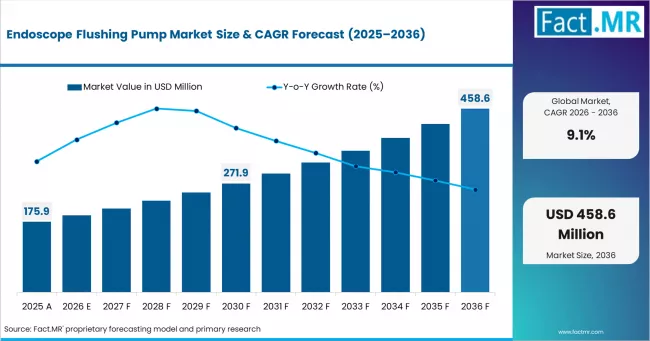
Endoscope Flushing Pump Market Market Value Analysis | Source: Fact.MR
Summary of Endoscope Flushing Pump Market
- Market Snapshot
- In 2025, the global Endoscope Flushing Pump Market was valued at approximately USD 175.9 million.
- The market is estimated to reach USD 191.9 million in 2026 and is projected to attain USD 458.6 million by 2036
- The endoscope flushing pump market is likely to expand at a CAGR of 9.1% during the forecast period.
- The market is anticipated to create an absolute dollar opportunity of USD 266.7 million between 2026 and 2036.
- Automated Flushing Pumps account for 56.0% of market share in 2026.
- China (12.3%) and India (11.4%) are the key growth markets during the forecast period
- Demand and Growth Drivers
- Tightening infection control regulations in endoscopy suites are mandating automated reprocessing workflows that depend on standardized flushing pump systems for consistent cleaning outcomes.
- Rising endoscopic procedure volumes across gastroenterology, pulmonology, and urology are increasing the installed base of endoscopes requiring routine reprocessing with flushing pump equipment.
- Hospital investment in endoscopy suite modernization is driving replacement of manual flushing processes with automated pump systems that reduce human error and improve turnaround times.
- Product and Segment View
- Automated flushing pumps account for 56% of the product segment in 2026, reflecting the shift toward standardized, regulation-compliant endoscope reprocessing workflows.
- Gastroenterology applications represent 41% in 2026, with colonoscopy and upper GI endoscopy generating the highest reprocessing volumes.
- Hospitals hold 62% of end-use demand in 2026, with centralized sterile processing departments as the primary procurement channel.
- Geography and Competitive Outlook
- China leads at 12.3% CAGR, supported by hospital endoscopy suite expansion and tightening infection prevention standards.
- North America and Europe maintain established installed bases with mature infection control compliance frameworks.
- Olympus America holds 25% market share, with competition from MEDIVATORS, Karl Storz, and regional medical device manufacturers.
- Analyst Opinion
- The endoscope flushing pump market is fundamentally an infection control compliance market. Demand is not discretionary; it follows directly from endoscopy procedure volumes and regulatory reprocessing mandates. The growth opportunity is concentrated in Asia Pacific where endoscopy suite construction is accelerating and infection control standards are tightening toward Western benchmarks. Olympus holds a structural advantage through its integrated endoscope and reprocessing ecosystem, creating switching costs that benefit its flushing pump portfolio. The competitive opening for challengers lies in offering cost-competitive automated systems that meet regulatory standards while providing flexibility across multi-vendor endoscope fleets.
Why is the Endoscope Flushing Pump Market Growing?
- Endoscopy procedure volume growth across gastroenterology, pulmonology, and urology is expanding the installed base of endoscopes requiring routine reprocessing.
- Infection control regulation tightening is mandating automated, validated flushing processes that reduce contamination risk and improve reprocessing documentation.
- Hospital endoscopy suite construction in Asia Pacific and Latin America is creating new equipment procurement opportunities for flushing pump manufacturers.
The market is shaped by the relationship between endoscopy procedure volumes and reprocessing requirements. Each reusable endoscope requires standardized cleaning between uses, and flushing pumps are integral to the reprocessing workflow. As procedure volumes increase and infection control standards tighten, the installed base of flushing pump systems expands accordingly.
Automation is the primary technology trend. Manual flushing processes are being displaced by automated pump systems that deliver consistent flow rates, document cleaning parameters, and reduce operator-dependent variation. This transition is most advanced in North America and Europe, with Asia Pacific following as regulatory frameworks mature.
Segment-wise Analysis of the Endoscope Flushing Pump Market
- Automated flushing pumps lead at 56% share in 2026, reflecting infection control compliance requirements for standardized reprocessing.
- Gastroenterology accounts for 41% of applications in 2026, with colonoscopy and upper GI endoscopy driving the highest reprocessing volumes.
- Diaphragm pump technology holds 45% in 2026, with reliable fluid delivery for channel flushing applications.
The market is segmented by product type (automated, manual, portable, peristaltic flushing pumps), application (gastroenterology, pulmonology, urology, gynecology), end use (hospitals, ambulatory surgical centers, specialty clinics, research institutes), technology (diaphragm, peristaltic, piston pump, automated control systems), and packaging (sterile device packaging, medical pouch, boxed clinical kits).
Which Product Segment Leads the Endoscope Flushing Pump Market?
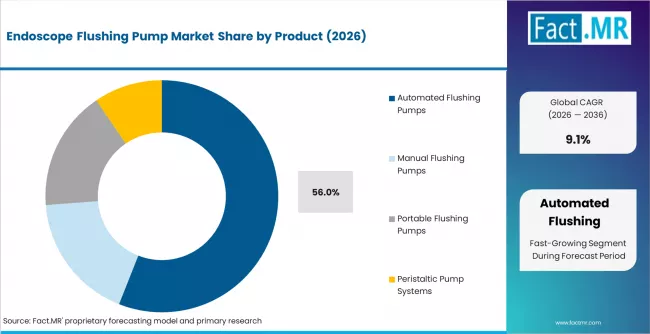
Endoscope Flushing Pump Market Analysis By Product | Source: Fact.MR
Automated flushing pumps hold 56% of the product segment in 2026. Their leadership reflects regulatory pressure for validated, documented reprocessing workflows that minimize operator variability. Automated systems deliver consistent flow rates, cycle documentation, and alarm functions that manual pumps cannot match, making them the standard for compliance-focused endoscopy suites.
Which Application Drives the Largest Demand?
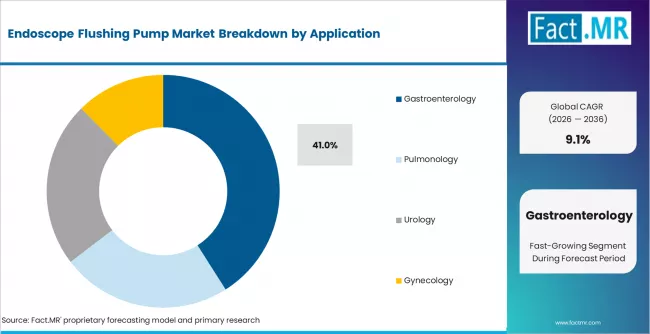
Endoscope Flushing Pump Market Analysis By Application | Source: Fact.MR
Gastroenterology accounts for 41% of applications in 2026. Colonoscopy screening programs, diagnostic upper GI endoscopy, and therapeutic procedures generate the highest endoscope reprocessing volumes among clinical specialties. Pulmonology and urology contribute growing shares as bronchoscopy and cystoscopy procedure volumes increase.
Key Growth Drivers, Constraints, and Market Scope
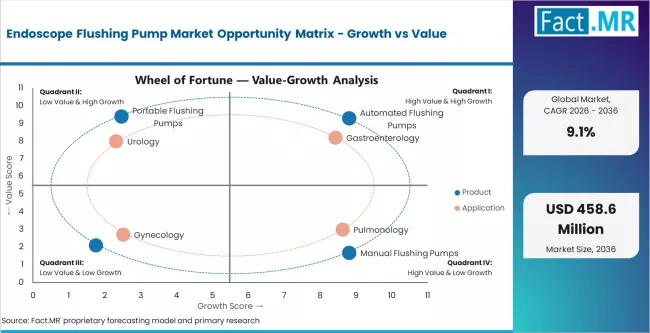
Endoscope Flushing Pump Market Opportunity Matrix Growth Vs Value | Source: Fact.MR
- Infection control regulation tightening mandates automated reprocessing equipment procurement.
- Endoscopy procedure volume growth expands the installed base requiring reprocessing equipment.
- High capital costs for automated systems limit adoption in resource-constrained healthcare settings.
The endoscope flushing pump market is shaped by infection control regulation, endoscopy procedure trends, healthcare infrastructure investment, and reprocessing technology development.
Growth Drivers
Demand is shaped by endoscopy procedure volume growth, infection control regulation mandating validated reprocessing, and hospital investment in endoscopy suite modernization. Cancer screening program expansion increases colonoscopy volumes and associated reprocessing demand.
Constraints
Capital cost of automated flushing systems limits adoption in smaller clinics and resource-constrained settings. Single-use disposable endoscopes represent a long-term competitive threat to the reprocessing equipment category. Maintenance and calibration requirements add to total cost of ownership.
Opportunities
Endoscopy suite construction in Asia Pacific creates the largest new equipment procurement opportunity. Portable flushing pumps serve ambulatory and field settings where fixed installations are impractical. Integration with digital reprocessing documentation systems adds value for compliance-focused hospital procurement.
Regional Outlook Across Key Markets
.webp "Top Country Growth Comparison Endoscope Flushing Pump Market Cagr (2026 2036)")
Top Country Growth Comparison Endoscope Flushing Pump Market Cagr (2026 2036) | Source: Fact.MR
- China leads at 12.3% CAGR, driven by hospital endoscopy suite expansion and infection control standard development.
- India follows at 11.4% CAGR, reflecting growing endoscopy infrastructure and regulatory modernization.
- Germany records 10.5% CAGR, supported by strict reprocessing standards and equipment replacement cycles.
- USA grows at 8.6% CAGR, with mature compliance frameworks and procedure volume stability.
Country CAGR Table
| Country | CAGR (%) |
|---|---|
| China | 12.3% |
| India | 11.4% |
| Germany | 10.5% |
| Brazil | 9.6% |
| USA | 8.6% |
| UK | 7.7% |
| Japan | 6.8% |
Source: Fact.MR analysis. Updated Apr 27, 2026
Regional demand reflects endoscopy procedure volume maturity, infection control regulatory frameworks, healthcare infrastructure investment, and reprocessing equipment replacement cycles.
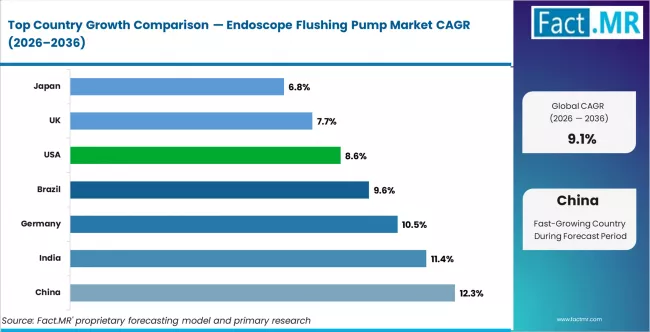
Endoscope Flushing Pump Market Cagr Analysis By Country | Source: Fact.MR
Market Outlook in China
The China endoscope flushing pump market is projected to grow at a CAGR of 12.3% through 2036. Demand is driven by rapid hospital endoscopy suite construction, tightening infection control standards, and increasing adoption of automated reprocessing systems.
- Hospital endoscopy suite expansion creates new equipment procurement.
- Infection control standards are tightening toward international benchmarks.
- Automated reprocessing adoption is displacing manual cleaning workflows.
Demand Trends in India
The India endoscope flushing pump market is projected to grow at a CAGR of 11.4% through 2036. Growth reflects expanding endoscopy infrastructure, increasing procedure volumes, and gradual regulatory modernization for reprocessing compliance.
- Endoscopy infrastructure expansion broadens equipment procurement.
- Procedure volume growth increases reprocessing equipment utilization.
- Regulatory modernization supports automated system adoption.
Germany Market Growth
The Germany endoscope flushing pump market is projected to grow at a CAGR of 10.5% through 2036. Demand is supported by strict reprocessing regulations, established endoscopy procedure volumes, and ongoing equipment replacement and upgrade cycles.
- Strict reprocessing standards mandate validated flushing equipment.
- Established procedure volumes sustain baseline equipment demand.
- Equipment replacement cycles drive upgrade procurement.
USA Market Outlook
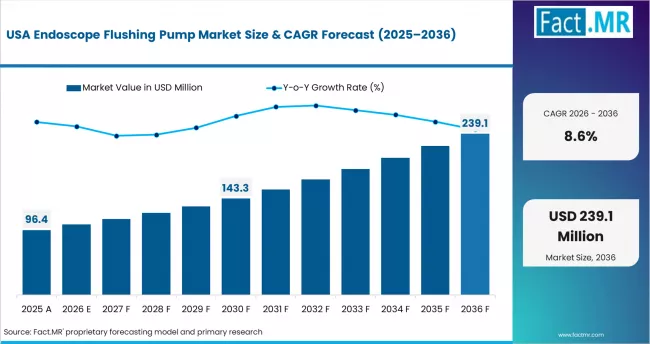
Endoscope Flushing Pump Market Country Value Analysis | Source: Fact.MR
The USA endoscope flushing pump market is projected to grow at a CAGR of 8.6% through 2036. Demand is shaped by mature infection control compliance, stable endoscopy volumes, and incremental technology upgrades in endoscopy suite equipment.
- Mature compliance frameworks sustain automated equipment demand.
- Stable procedure volumes support consistent procurement patterns.
- Technology upgrades drive equipment replacement cycles.
Competitive Benchmarking and Company Positioning
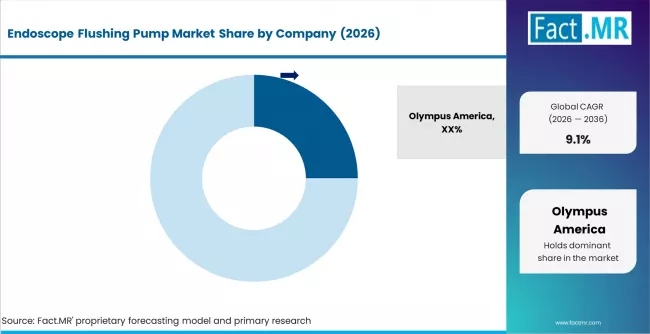
Endoscope Flushing Pump Market Analysis By Company | Source: Fact.MR
- Olympus America holds 25% market share through its integrated endoscope and reprocessing equipment ecosystem.
- MEDIVATORS and Karl Storz compete through reprocessing equipment portfolios and established hospital distribution.
- Competition is shaped by endoscope ecosystem integration, regulatory certification, service network coverage, and clinical workflow compatibility.
The competitive landscape is shaped by integration between endoscope manufacturers and reprocessing equipment. Olympus holds a structural advantage through its complete endoscopy suite offering. MEDIVATORS (Cantel Medical), Karl Storz, and Fujifilm compete through reprocessing equipment portfolios and multi-vendor compatibility.
Strategic priorities include developing connected reprocessing documentation systems, expanding multi-vendor endoscope compatibility, building service networks in emerging markets, and developing portable systems for ambulatory settings.
Competitive Benchmarking
| Company | Ecosystem Integration | Product Range | Service Network | Geographic Reach |
|---|---|---|---|---|
| Olympus | Full ecosystem | Comprehensive | Global | Global |
| MEDIVATORS | Reprocessing focused | Broad | Americas/Europe | Multi-region |
| Karl Storz | Partial | Endoscopy focused | Global | Global |
| Fujifilm | Partial | Growing | Asia/Americas | Multi-region |
| Stryker | Moderate | Diversified | Americas/Europe | Multi-region |
Source: Fact.MR analysis. Updated Apr 27, 2026
Recent Industry Developments
- Olympus launched an updated automated flushing pump with digital documentation capability in 2025, targeting infection control compliance documentation requirements.
- MEDIVATORS expanded its reprocessing equipment distribution in Asia Pacific in early 2026, targeting hospital endoscopy suite construction projects.
- Karl Storz invested in portable flushing pump development in 2025, addressing demand for reprocessing equipment in ambulatory surgical settings.
Leading Companies Shaping the Endoscope Flushing Pump Market
-
Major Players
- Olympus America
- MEDIVATORS Inc.
- Karl Storz
- Fujifilm
- Stryker
-
Emerging Players
- Amity International
- Richard Wolf
- B.Braun
- Cantel Medical Group
- Vimex
- Wisap Medical Technology
- Hoya
- Smith & Nephew
Sources and Research References
- World Gastroenterology Organisation (WGO). Endoscopy procedure volumes and standards.
- Centers for Disease Control and Prevention (CDC). Endoscope reprocessing infection control guidelines.
- Olympus Corporation. Annual reports and endoscopy portfolio disclosures.
- Association for the Advancement of Medical Instrumentation (AAMI). Reprocessing equipment standards.
- World Health Organization (WHO). Healthcare infection prevention guidelines.
- Primary interviews with endoscopy suite managers, infection control officers, and device distributors.
This bibliography is provided for reader reference. The full report contains the complete reference list.
Key Questions This Report Addresses
- What is the current and projected size of the endoscope flushing pump market through 2036?
- What CAGR is expected for the endoscope flushing pump market between 2026 and 2036?
- Which product type holds the largest market share in 2026?
- Which application segment accounts for the highest demand in 2026?
- What factors are shaping demand for endoscope flushing pumps globally?
- Which countries are projected to show the fastest growth through 2036?
- How is the competitive landscape structured and who are the leading companies?
- How does Fact.MR estimate and validate the market forecast?
Endoscope Flushing Pump Market Definition
The endoscope flushing pump market covers devices used to deliver cleaning solution, water, and air through endoscope channels during reprocessing to remove biological debris and reduce infection risk. The market spans automated, manual, and portable flushing systems distributed to hospitals, ambulatory surgical centers, and specialty clinics.
Endoscope Flushing Pump Market Inclusions
The scope covers global and regional market size and forecasts for 2026 to 2036 across product type, application, end use, technology, packaging, and region. It includes demand analysis based on endoscopy procedure volumes, infection control regulation, and reprocessing equipment procurement patterns.
Endoscope Flushing Pump Market Exclusions
The scope excludes automated endoscope reprocessors (AERs) classified as separate device categories, endoscope storage systems, sterilization autoclaves, and single-use disposable endoscopes that eliminate reprocessing requirements.
Endoscope Flushing Pump Market Research Methodology
- Primary research includes interviews with endoscopy suite managers, infection control officers, hospital procurement teams, and device distributors.
- Desk research draws on endoscopy procedure volume data, infection control regulatory filings, device registration databases, and company financial disclosures.
- Market sizing uses a demand-side model validated through procedure volume cross-checks, device per-suite utilization rates, and pricing benchmarks.
- Data validation involves reconciliation with medical device registry data and expert panel review.
Segmentation
Scope of Analysis
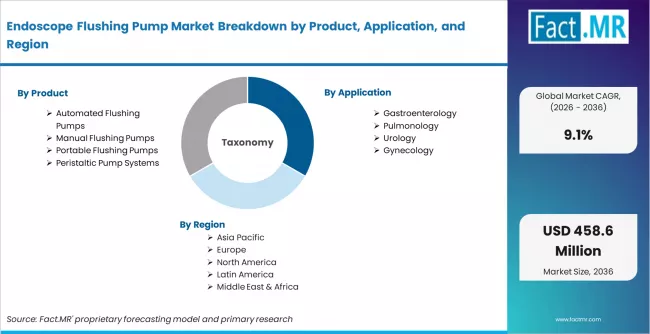
Endoscope Flushing Pump Market Breakdown By Product, Application, And Region | Source: Fact.MR
| Parameter | Details |
|---|---|
| Quantitative Units | USD 191.9 million to USD 458.6 million, at a CAGR of 9.1% |
| Market Definition | Covers flushing pump devices used in endoscope reprocessing to deliver cleaning solution through channels during infection control workflows. |
| Regions Covered | North America, Latin America, Europe, East Asia, South Asia and Pacific, Middle East and Africa |
| Countries Covered | USA, China, India, Germany, Brazil, UK, Japan, and 30+ countries |
| Key Companies | Olympus, MEDIVATORS, Karl Storz, Fujifilm, Stryker, Amity, Richard Wolf, B.Braun, Cantel Medical, Vimex, Wisap, Hoya |
| Forecast Period | 2026 to 2036 |
| Approach | Hybrid demand-side methodology built on endoscopy procedure volumes, infection control regulation, reprocessing equipment procurement data, and primary interviews across endoscopy suite managers and device distributors. |
Source: Fact.MR analysis. Updated Apr 27, 2026
Analysis by Product Type, Application, End Use, Technology, Source, Packaging, and Region
-
Endoscope Flushing Pump Market Market Segmented by Product:
- Automated Flushing Pumps
- Fully Automated Pumps
- Smart Integrated Systems
- Fully Automated Pumps
- Manual Flushing Pumps
- Foot & Hand Operated Pumps
- Basic Cleaning Systems
- Foot & Hand Operated Pumps
- Portable Flushing Pumps
- Mobile Endoscope Systems
- Compact Clinical Units
- Mobile Endoscope Systems
- Peristaltic Pump Systems
- Precision Flow Pumps
- Controlled Irrigation Systems
- Precision Flow Pumps
- Automated Flushing Pumps
-
Endoscope Flushing Pump Market Market Segmented by Application:
- Gastroenterology
- GI Endoscopy Procedures
- Colonoscopy & Gastroscopy
- GI Endoscopy Procedures
- Pulmonology
- Bronchoscopy Cleaning Systems
- Respiratory Endoscopy Support
- Bronchoscopy Cleaning Systems
- Urology
- Urinary Tract Endoscopy
- Bladder & Kidney Procedures
- Urinary Tract Endoscopy
- Gynecology
- Female Reproductive Endoscopy
- Minimally Invasive Diagnostics
- Female Reproductive Endoscopy
- Gastroenterology
-
Endoscope Flushing Pump Market Market Segmented by End Use:
- Hospitals
- Large Acute Care Hospitals
- Advanced Endoscopy Units
- Large Acute Care Hospitals
- Ambulatory Surgical Centers
- Day Care Surgery Clinics
- Outpatient Procedure Centers
- Day Care Surgery Clinics
- Specialty Clinics
- Gastro & Pulmonology Clinics
- Diagnostic Centers
- Gastro & Pulmonology Clinics
- Research & Academic Institutes
- Medical Training Hospitals
- Clinical Research Facilities
- Medical Training Hospitals
- Hospitals
-
Endoscope Flushing Pump Market Market Segmented by Technology:
- Diaphragm Pump Technology
- Pressure Controlled Systems
- Fluid Regulation Mechanisms
- Pressure Controlled Systems
- Peristaltic Pump Technology
- Tube Compression Flow Systems
- Precision Irrigation Control
- Tube Compression Flow Systems
- Piston Pump Technology
- High Pressure Cleaning Systems
- Rapid Flushing Mechanisms
- High Pressure Cleaning Systems
- Automated Control Systems
- Smart Flow Regulation Units
- Sensor-Based Monitoring Systems
- Smart Flow Regulation Units
- Diaphragm Pump Technology
-
Endoscope Flushing Pump Market Market Segmented by Source:
- Medical Grade Components
- Biocompatible Plastics
- Sterilizable Polymer Materials
- Medical Grade Tubing Systems
- Biocompatible Plastics
- Medical Grade Components
-
Endoscope Flushing Pump Market Market Segmented by Packaging:
- Sterile Device Packaging
- Single Use Sterile Kits
- Endoscope Cleaning Kits
- Single Use Sterile Kits
- Medical Pouch Packaging
- Sealed Hospital Packs
- Procedure Ready Units
- Sealed Hospital Packs
- Boxed Clinical Kits
- Hospital Supply Boxes
- Bulk Endoscopy Storage Packs
- Hospital Supply Boxes
- Sterile Device Packaging
-
Endoscope Flushing Pump Market Market by Region:
- North America
- USA
- Canada
- Mexico
- Latin America
- Brazil
- Chile
- Rest of Latin America
- Western Europe
- Germany
- UK
- Italy
- Spain
- France
- Nordic
- BENELUX
- Rest of Western Europe
- Eastern Europe
- Russia
- Poland
- Hungary
- Balkan & Baltic
- Rest of Eastern Europe
- East Asia
- China
- Japan
- South Korea
- South Asia and Pacific
- India
- ASEAN
- Australia & New Zealand
- Rest of South Asia and Pacific
- Middle East & Africa
- Kingdom of Saudi Arabia
- Other GCC Countries
- Turkiye
- South Africa
- Other African Union
- Rest of Middle East & Africa
- North America
Frequently Asked Questions
What is the size of the endoscope flushing pump market in 2026?
What will be the size of the endoscope flushing pump market in 2036?
How much will the endoscope flushing pump market grow between 2026 and 2036?
What are the key product types in the endoscope flushing pump market?
Which application segment will contribute significant share in the endoscope flushing pump market in 2026?
Which country is the fastest growing market for endoscope flushing pumps?
What does the endoscope flushing pump market cover?
How does Fact.MR estimate and validate the market forecast?
Who worked on this report


Preview the report firsthand - request a free sample
Free SampleGet the brochure for pricing and purchase details
Download PDF