- Base Value(2025): 4.8 Bn
- Estimated Value(2026): 5.5 Bn
- Forecast Value (2036): 23.2 Bn
- CAGR (2026 - 2036): 15.4%
Heart Pump Devices Market Forecast and Outlook 2026 to 2036
In 2025, the market was valued at USD 4.8 billion. Based on industry analysis, demand is expected to reach USD 5.5 billion in 2026 and USD 23.2 billion by 2036. FACT.MR projects a CAGR of 15.4% during this period.
The projected absolute growth of USD 17.7 billion reflects a structural expansion of mechanical circulatory support into mainstream cardiovascular care. Continuous flow LVADs are delivering five-year survival rates close to 60%, while regulatory agencies such as the U.S. Food and Drug Administration and the European Medicines Agency are approving destination therapy for earlier stage heart failure patients. Growth is supported by aging populations, rising cases of ischemic cardiomyopathy linked to diabetes and hypertension, and advances in fully magnetically levitated pumps that improve durability.
As Michael Minogue, Chairman, President and CEO of Abbott Laboratories, noted during the Q3 2024 earnings call, the HeartMate 3 platform has become the standard of care for advanced heart failure, with ongoing investment in miniaturized technologies aimed at expanding treatment to earlier stage patients.
Country level CAGR trends vary based on healthcare infrastructure and reimbursement policies. China leads at 4.5%, supported by cardiac center expansion under national development plans and the rise of domestic LVAD manufacturers. South Korea follows at 4.0%, helped by broader reimbursement and clinical leadership in BiVAD research. The United States and United Kingdom both grow at 4.1%, reflecting steady but policy moderated adoption. Japan records 3.9% CAGR as regulatory review timelines remain longer than in the US and Europe.
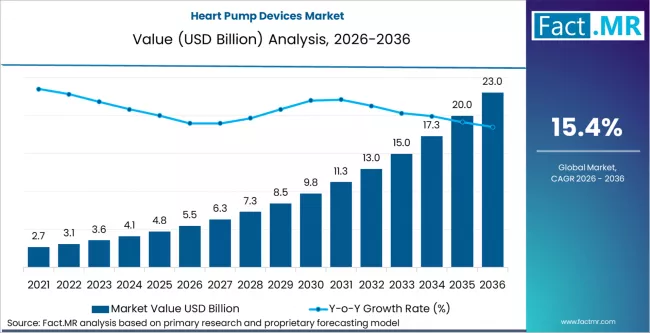
Heart Pump Devices Market Market Value Analysis | Source: Fact.MR
Market Definition
Heart pump devices are implantable or extracorporeal systems that support or replace cardiac pumping in patients with severe heart failure. The category includes ventricular assist devices for left, right, or both ventricles, total artificial hearts that replace the natural heart, intra-aortic balloon pumps for temporary support, and ECMO systems that provide both cardiac and respiratory assistance. These devices are used as bridge to transplant, bridge to recovery, bridge to candidacy, or as destination therapy depending on patient condition and institutional expertise.
Market Inclusions
The report covers global and regional market size from 2026 to 2036, segmented by device type implanted versus extracorporeal, product category including VADs, total artificial hearts, IABPs and ECMO, end use setting hospitals, cardiac centers and ambulatory facilities, and geography across North America, Europe, Asia Pacific, Latin America and Middle East. It also reviews average selling prices, implant volumes, readmission rates and regulatory approval timelines.
Market Exclusions
The analysis excludes pacemakers, implantable cardioverter defibrillators and cardiac resynchronization therapy devices that regulate electrical activity without providing mechanical pumping support. It also excludes short duration percutaneous support devices used only during brief cath lab procedures, early stage investigational devices without regulatory approval, and veterinary cardiac support systems.
Research Methodology
- Primary Research: Primary research involved structured interviews with cardiac surgeons at advanced heart failure programs, perfusionists managing ECMO deployments, and cardiac device procurement directors at Level 1 cardiac surgery centers across North America, Europe, and Asia-Pacific.
- Desk Research: Desk research synthesized data from FDA 510(k) clearance databases, CMS NCD coverage determinations, European Society of Cardiology clinical practice guidelines, and disclosed segment revenues from publicly traded medical device manufacturers including Abbott, Medtronic, and LivaNova.
- Market-Sizing and Forecasting: Market sizing employed a hybrid approach, triangulating device implant procedure volumes from national cardiac surgery registries (STS, INTERMACS, EUROMACS) with manufacturer-disclosed unit shipments and average selling prices validated against hospital capital equipment procurement records.
- Data Validation and Update Cycle: Outputs were cross-validated against quarterly earnings disclosures from Abbott Laboratories and Medtronic cardiovascular divisions, reconciled semi-annually with FDA MAUDE adverse event database submission volumes as proxy for installed base size, and updated quarterly following publication of pivotal trial results in peer-reviewed cardiology journals.
Summary
Market Definition
- Heart pump devices comprise implantable and extracorporeal mechanical circulatory support systems serving as bridge-to-transplant, bridge-to-recovery, and destination therapy for acute and chronic heart failure patients whose native cardiac function is insufficient for adequate systemic perfusion.
Demand Drivers
- The U.S. Food and Drug Administration expanded the destination therapy indication for HeartMate 3. The approval now includes earlier stage heart failure patients classified under INTERMACS Profile 3 and 4. This expanded the eligible U.S. patient pool from about 2,500 end stage cases annually to an estimated 15,000 to 20,000 NYHA Class III patients. As a result, demand growth is no longer tied only to transplant waitlists.
- Global organ donor shortages remain severe. In many developed markets, donor to recipient ratios average 1 to 10. Median transplant wait times often exceed 12 to 18 months. Mechanical circulatory support is therefore becoming a necessity rather than a temporary solution. More than 180 cardiac centers in the United States and over 220 institutions in Europe now offer destination therapy programs in addition to transplant services.
- Clinical outcomes have improved significantly with continuous flow LVADs. Two-year survival rates have reached about 80 percent. Five-year survival is close to 60 percent. Older pulsatile devices showed much lower survival rates at similar time points. Current results are approaching heart transplant benchmarks of 85 percent at two years and 70 percent at five years.
Key Segments Analyzed
- By Type, Implanted Heart Pump Devices command 69.3% share, dominated by durable VAD systems including Abbott HeartMate 3, Medtronic HVAD, and emerging Jarvik 2000 platforms that enable hospital discharge and outpatient management versus extracorporeal ECMO and IABP devices requiring ICU confinement.
- By Product, Left Ventricular Assist Devices (LVADs) hold 70.1% of VAD segment share, reflecting left ventricular failure predominance in ischemic and dilated cardiomyopathy etiologies that constitute 85% of advanced heart failure presentations, with isolated right heart failure and biventricular failure comprising minority indications.
- By End-use, Hospitals capture 84.2% market share as surgical VAD implantation and ECMO cannulation require cardiac surgery operating rooms and cardiopulmonary bypass capability, though specialized cardiac centers are expanding share via volume concentration and outcome optimization that attract payer narrow network contracting.
Analyst Opinion at FACT.MR
- Shambhu Nath Jha, Principal Consultant at Fact.MR, opines, 'CXOs will find this report valuable for understanding how regulatory pathway evolution from conditional bridge-to-transplant approval toward definitive destination therapy indication is reshaping commercial strategy from niche transplant center penetration to broad cardiac surgery network coverage, and how device miniaturization and full magnetic levitation technologies are expanding addressable populations from terminal INTERMACS Profile 1-2 patients to earlier Class III ambulatory candidates where intervention can prevent rather than rescue end-stage decline.'
Strategic Implications / Executive Takeaways
- Medical device manufacturers should accelerate transition from fee-per-device sales to outcomes-based contracting models bundling device cost with post-implant care coordination, targeting destination therapy programs where five-year total cost of ownership versus heart transplant becomes the relevant comparison rather than single-procedure device acquisition cost.
- Hospital cardiac programs must invest in multidisciplinary heart failure teams integrating cardiac surgery, interventional cardiology, heart failure medicine, palliative care, and mechanical circulatory support coordination to meet CMS quality metrics for VAD center certification, as regulatory trajectory favors volume concentration at high-outcome specialized centers over geographic dispersion.
- Payers should develop risk-adjusted bundled payment methodologies for mechanical circulatory support incorporating device cost, surgical implantation, 90-day readmissions, and durable medical equipment for controller/battery systems, aligning provider incentives with total episode cost reduction rather than individual component cost minimization.
Methodology
- Market sizing triangulated cardiac surgery registry data from Society of Thoracic Surgeons (STS), INTERMACS (U.S.), and EUROMACS (Europe) procedure volumes with Abbott and Medtronic disclosed VAD shipment units and average selling prices validated through hospital capital equipment procurement bid analysis.
- Device adoption curves for continuous-flow versus pulsatile LVADs and destination therapy versus bridge-to-transplant indication mix calibrated using INTERMACS annual reports, FDA approval effective dates, and CMS National Coverage Determination revisions expanding eligible patient populations.
- Regulatory pathway modeling incorporated FDA Breakthrough Device designation timelines, CE Mark technical file submission-to-approval durations, and China NMPA innovative medical device approval acceleration for domestically manufactured VAD platforms including Evaheart and Chio pumps.
Segmental Analysis
Heart Pump Devices Market Analysis by Type
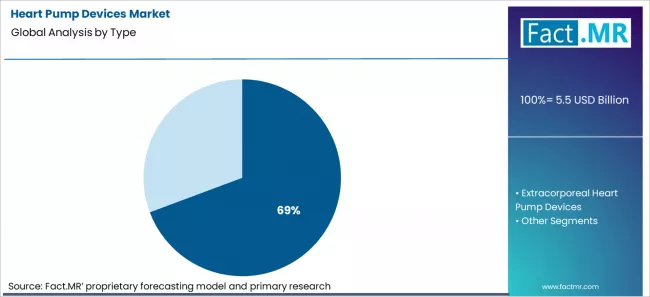
Heart Pump Devices Market Analysis By Type | Source: Fact.MR
Implanted heart pump devices are expected to hold 69.3% of the market in 2026. These surgically placed systems allow patients to leave the hospital and return to daily activities. With durability ranging from 3 to 10 years, they offer meaningful quality-of-life improvement compared to extracorporeal systems that require intensive care unit support.
- Abbott reported USD 480 million in HeartMate 3 sales in 2024, representing roughly 1,600 implants [5]. Since the withdrawal of Medtronic’s HVAD, HeartMate 3 remains the only FDA-approved durable LVAD for destination therapy in the U.S., effectively creating a single-supplier market under regulatory oversight.
- Innovation is also focused on miniaturization. In September 2024, BiVACOR began first-in-human trials for a smaller total artificial heart designed to fit patients previously excluded due to body size constraints [6]. This could expand eligibility to thousands of additional patients.
- Outpatient care is improving as well. According to a 2024 scientific statement from the American Heart Association, 75% of HeartMate 3 patients are discharged within two weeks, with significantly fewer readmissions compared to earlier devices [7]. This supports the expansion of VAD programs beyond traditional transplant centers.
Heart Pump Devices Market Analysis by Product
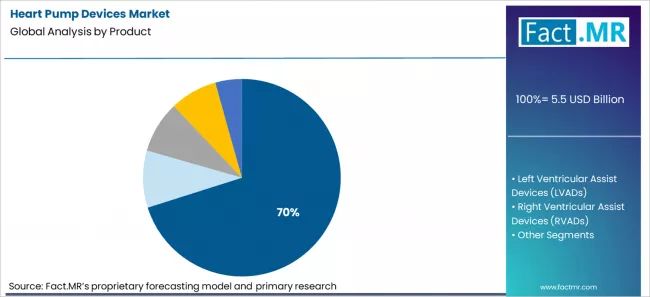
Heart Pump Devices Market Analysis By Product | Source: Fact.MR
Left Ventricular Assist Devices are projected to account for 70.1% of the market in 2026. This reflects the fact that most advanced heart failure cases involve left ventricular dysfunction. Right ventricular and biventricular failure cases represent a smaller share of mechanical support needs.
- Five-year survival for Heartmate 3 patients reached 59.1% in the MOMENTUM 3 destination therapy cohort, with fewer adverse events compared to earlier systems [8]. These results led professional guidelines to upgrade LVAD destination therapy to a recommended standard of care.
- In the temporary support segment, Abiomed’s Impella devices reached 160,000 procedures in 2023 across 2,500 U.S. hospitals [9]. These percutaneous systems are typically used for short-term stabilization and complement rather than replace durable LVAD therapy.
- Total artificial hearts such as SynCardia’s CardioWest remain approved only for bridge-to-transplant use, with 79% survival to transplant or recovery since 2004 [10]. However, regulatory caution around permanent external drivers has limited their expansion into destination therapy, leaving room for future innovation in fully implantable systems.
Drivers, Restraints, and Opportunities
Fact.MR analysis shows the heart pump devices market is being shaped by two powerful forces. First, aging populations and rising diabetes rates are increasing the number of patients with advanced heart failure. Second, regulators are steadily expanding access to mechanical circulatory support, moving it from a temporary bridge-to-transplant solution to a recognized destination therapy. In the past, ventricular assist devices were limited to the sickest patients under INTERMACS Profile 1 and 2. This kept the U.S. market to roughly 2,000 to 3,000 procedures per year.
- A key challenge has been balancing durability with quality of life. Early pulsatile LVADs were bulky and lasted only 12 to 24 months. Second-generation continuous-flow devices improved durability but required intensive anticoagulation, increasing bleeding risk.
- CMS National Coverage Determination 20.9.1, revised in October 2022, expanded Medicare coverage for destination therapy to include INTERMACS Profile 3 patients [2]. Coverage is limited to centers meeting strict survival benchmarks and registry reporting requirements. As a result, implant volumes are increasingly concentrated in about 65 high-volume U.S. centers performing the majority of procedures.
- Clinical evidence has reinforced this shift. The MOMENTUM 3 trial, published in the New England Journal of Medicine in November 2019, showed superior outcomes for HeartMate 3 compared to earlier devices, with 86% freedom from disabling stroke or device failure at two years [3].
Regional Analysis
The heart pump devices market is analyzed across North America, Europe, Asia-Pacific, Latin America, and Middle East. Regional device adoption intensity is shaped by cardiac transplant infrastructure maturity, interventional cardiology versus cardiac surgery competitive dynamics, national health insurance reimbursement policy, and per-capita cardiac surgical case volumes. The report offers detailed market attractiveness analysis comparing destination therapy coverage status, VAD center certification requirements, and device approval timelines across regional regulatory jurisdictions.
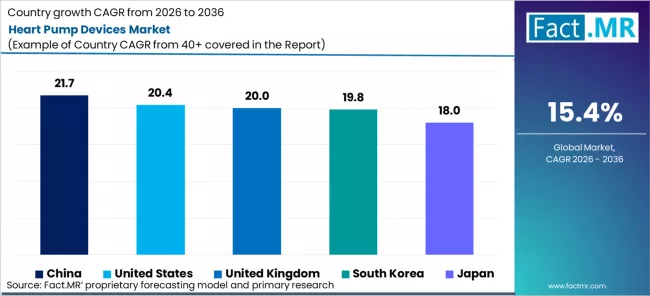
Heart Pump Devices Market Cagr Analysis By Country | Source: Fact.MR
| Country | CAGR% |
|---|---|
| China | 21.7% |
| United States | 20.4% |
| United Kingdom | 20.0% |
| South Korea | 19.8% |
| Japan | 18.0% |
Source: Fact.MR analysis. Updated Feb 23, 2026
Source: Fact.MR (FACT.MR) analysis, based on proprietary forecasting model and primary research
North America Heart Pump Devices Market Analysis
North America remains the global center for mechanical circulatory support innovation. Regulatory precedents from the FDA, Medicare coverage expansion, and the INTERMACS registry system have created the most advanced VAD adoption environment worldwide. Abbott Laboratories leads the U.S. durable LVAD market with HeartMate 3 following Medtronic’s HVAD withdrawal. Abiomed, now part of Johnson and Johnson, dominates the temporary percutaneous segment with Impella devices across more than 2,500 hospitals. Strong transplant infrastructure, high cardiac surgery volumes, and supportive reimbursement sustain regional leadership.
- United States: U.S. demand is projected to grow at 20.4% CAGR through 2036. In 2024, Abbott invested USD 150 million to expand production capacity in California to address backlog demand. The Joint Commission introduced VAD center certification in 2023, further formalizing quality standards.
Europe Heart Pump Devices Market Analysis
Europe offers an alternative regulatory pathway through CE Mark approval, often enabling earlier access for emerging technologies. Registry systems such as EUROMACS support data tracking, though reimbursement varies by country. Adoption remains more conservative than in the U.S., reflecting transplant preference and budget constraints.
- United Kingdom: The UK market is forecast to grow at 20.0% CAGR. NHS England centralized VAD implantation into 12 designated centers in 2024. NICE recommended HeartMate 3 as cost effective destination therapy in late 2023, expanding access beyond bridge to transplant. Clinical trials and registry partnerships continue to support broader adoption.
Asia Pacific Heart Pump Devices Market Analysis
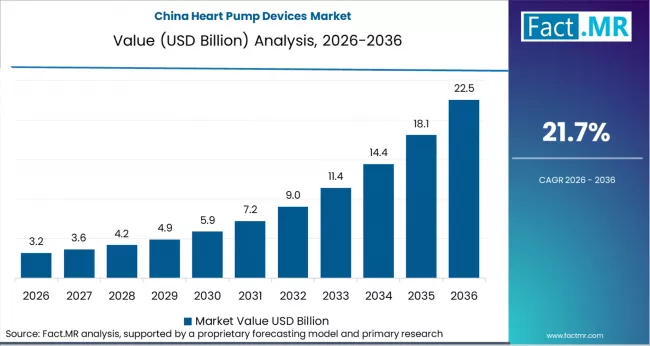
Heart Pump Devices Market Country Value Analysis | Source: Fact.MR
Asia Pacific represents the strongest long term growth opportunity. Aging populations, diabetes prevalence, and expanding cardiac infrastructure are increasing demand. Domestic manufacturers in China are introducing lower cost LVADs, reducing reliance on imports and supporting wider access.
- China: China is projected to grow at 21.7% CAGR. National reimbursement pilots launched in 2024 now cover destination therapy in major provinces. The National Medical Products Administration accelerated approvals for domestic LVADs, enabling more affordable alternatives to imported systems. Leading cardiac centers report rising destination therapy volumes.[4]
- Japan: Japan is expected to grow at 19.8% CAGR. HeartMate 3 received bridge to transplant approval in 2023, with destination therapy under review. Reimbursement expanded in 2024, and domestic manufacturers such as Terumo Corporation are advancing next generation systems.
- South Korea: South Korea is forecast to grow at 18.0% CAGR. National insurance expanded reimbursement to include destination therapy in 2024. Major hospitals have developed outpatient VAD management programs, strengthening long term care infrastructure.
Competitive Aligners for Market Players
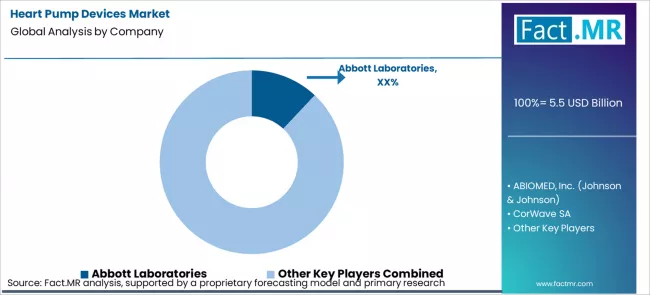
Heart Pump Devices Market Analysis By Company | Source: Fact.MR
The heart pump devices market is highly concentrated in the durable implanted LVAD segment. FDA destination therapy approvals require long term randomized trials that can take over a decade and cost hundreds of millions of dollars, limiting participation to large, well-funded cardiovascular device companies.
Abbott’s leadership is reinforced by its long clinical history, with continuous FDA approvals from HeartMate XVE to HeartMate 3, and close alignment with evolving Medicare coverage policies. Its integrated approach, spanning device design, clinical trials, and post market registries, creates barriers that smaller innovators struggle to overcome. Medtronic’s exit highlights that clinical outcomes, not scale or investment size, ultimately determine market survival. [5]
Buyer behavior further strengthens supplier dominance. Surgeons prioritize outcomes, familiarity, and institutional protocols, with price playing a secondary role. Group purchasing organizations achieve only modest discounts, while high switching costs tied to training, registries, and consumables limit hospitals’ ability to change suppliers.
Recent Development
- In December 2025, Johnson & Johnson completed the acquisition of Abiomed, with the business continuing to operate independently under Johnson and Johnson’s MedTech division.
- In 2025, Abiomed announced that the U.S. Food and Drug Administration granted approval for two clinical research studies evaluating Impella heart pump systems in patients experiencing acute myocardial infarction and cardiogenic shock.
Key Players
- Abbott Laboratories
- ABIOMED, Inc. (Johnson & Johnson)
- CorWave SA
- LivaNova PLC
- Berlin Heart GmbH
- SynCardia Systems LLC
- Jarvik Heart, Inc.
- BiVACOR Inc.
- Medtronic plc
Bibliography
- [1] Abbott Laboratories. (2024, October). Q3 2024 Earnings Call Transcript Mechanical Circulatory Support Business Update.
- [2] Centers for Medicare & Medicaid Services. (2022, October). National Coverage Determination (NCD) 20.9.1 Ventricular Assist Devices as Destination Therapy.
- [3] Mehra, M. R., et al. (2019, November). Two-Year Outcomes with a Magnetically Levitated Cardiac Pump in Heart Failure. New England Journal of Medicine, 381(17), 1618-1627.
- [4] China National Medical Products Administration. (2024, March). Innovative Medical Device Priority Review Approval List LVAD Category 2020-2024.
- [5] Abbott Laboratories. (2025, January). Q4 2024 Earnings Release Cardiovascular & Neuromodulation Segment Revenue.
This Report Addresses
- Market intelligence for strategic planning: Clear analysis of mechanical circulatory support adoption trends. Review of bridge to transplant versus destination therapy shift. Comparison of regulatory timelines across FDA, CE Mark, and NMPA pathways. Assessment of clinical evidence requirements for approval and reimbursement.
- Market size and forecast: Global market valued at USD 4.8 billion in 2025. Projected to reach USD 23.2 billion by 2036 at 15.4% CAGR. Segment sizing by device type, product, end use, and region included.
- Growth opportunity mapping: Focus on destination therapy LVADs for INTERMACS Profile 3 to 4 patients. Coverage of miniaturized pumps for smaller body sizes. Analysis of total artificial hearts for biventricular failure. Review of percutaneous support in cardiogenic shock.
- Segment and regional forecasts: Country level CAGR for the United States, United Kingdom, China, Japan, South Korea, and additional markets. Breakdown by device type and indication mix. Evaluation of demographic and reimbursement drivers.
- Competition strategy assessment: Positioning analysis of Abbott, ABIOMED under Johnson and Johnson, LivaNova, and emerging Chinese players. Review of clinical trial timelines, surgeon training reach, and payer contracting models.
- Product and compliance tracking: Analysis of FDA indication expansion, CMS coverage updates, European MDR rules, and registry participation requirements.
- Clinical outcomes benchmarking: Survival comparisons across device generations. Review of stroke, bleeding, readmissions, and cost effectiveness versus transplant.
- Report delivery formats: Excel data tables with procedure and pricing forecasts. PowerPoint summary with milestones and competition insights. Full PDF report with verified clinical and regulatory references.
Segmentation
Scope of Report
| Items | Values |
|---|---|
| Quantitative Units | USD 1.6 billion (2026) to USD 2.7 billion (2036), at a CAGR of 5.5% |
| Market Definition | Aquaculture lighting and environmental control systems encompass LED and spectrum-tunable lighting, aeration and oxygenation equipment, water quality sensors, and automated feeding systems deployed in fish and shellfish farming facilities to precisely manage the biological environment and optimize production performance. |
| System Type | LED Lighting, Aeration/Oxygenation, Water Quality Sensors, Feeding/Automation |
| Species | Salmonids, Tilapia, Shrimp, Others |
| Farm Type | Land-Based, Offshore Marine, RAS, Cage Farms |
| Buyer Type | Large Farms, SME Farms, Research/Other |
| Regions Covered | Asia Pacific, Europe, North America, Latin America, Middle East & Africa |
| Countries Covered | China, Japan, South Korea, Australia & New Zealand, India, ASEAN, Rest of Asia Pacific, Norway, Germany, United Kingdom, France, Spain, Netherlands, Nordics, Rest of Europe, United States, Canada, Mexico, Brazil, Chile, Ecuador, Rest of Latin America, Kingdom of Saudi Arabia, United Arab Emirates, South Africa, Turkey, Rest of Middle East & Africa |
| Key Companies Profiled | Signify, AKVA Group, ams OSRAM, Innovasea, Xylem, Pentair, Monitorfish, LumenAqua, ScaleAQ, OxyGuard |
| Forecast Period | 2026 to 2036 |
| Approach | Top-down and bottom-up market modeling validated through primary interviews with aquaculture operators, environmental control system vendors, RAS technology integrators, and fisheries ministry officials, supported by FAO production statistics, national aquaculture development plans, and company disclosed capex data. |
Source: Fact.MR analysis. Updated Feb 23, 2026
Heart Pump Devices Market by Segment
-
By Type :
- Implanted Heart Pump Devices
- Extracorporeal Heart Pump Devices
-
By Product :
- Ventricular Assist Devices (VADs)
- Left Ventricular Assist Devices (LVADs)
- Right Ventricular Assist Devices (RVADs)
- Bi-ventricular Assist Devices (BiVADs)
- Percutaneous Ventricular Assist Devices (PVADs)
- Ventricular Assist Devices (VADs)
-
By End-use :
- Hospitals
- Cardiac Centers
- Others
-
Region :
- Asia Pacific
- China
- Japan
- South Korea
- Australia & New Zealand
- India
- ASEAN
- Rest of Asia Pacific
- Europe
- Norway
- Germany
- United Kingdom
- France
- Spain
- Netherlands
- Nordics
- Rest of Europe
- North America
- United States
- Canada
- Mexico
- Latin America
- Brazil
- Chile
- Ecuador
- Rest of Latin America
- Middle East & Africa
- Kingdom of Saudi Arabia
- United Arab Emirates
- South Africa
- Turkey
- Rest of Middle East & Africa
- Asia Pacific
Frequently Asked Questions
How large is the heart pump devices market in 2025?
What will the market size be in 2026?
What is the projected market size by 2036?
What is the expected CAGR for the forecast period 2026 to 2036?
Which Type segment holds the largest market share?
Which Product sub-segment leads within VADs?
Which End-use setting captures the largest share?
What is the absolute dollar growth from 2026 to 2036?
What is driving China's growth acceleration?
Who worked on this report


Preview the report firsthand - request a free sample
Free SampleGet the brochure for pricing and purchase details
Download PDF