- Base Value(2025): 55.90 Bn
- Estimated Value(2026): 59.65 Bn
- Forecast Value (2036): 114.08 Bn
- CAGR (2026 - 2036): 6.7%
Automotive Mobile Accessories Market Size, Market Forecast and Outlook By Fact.MR
The global automotive mobile accessories market was valued at USD 55.90 billion in 2025, projected to reach USD 59.65 billion in 2026, and is forecast to expand to USD 114.08 billion by 2036 at a 6.7% CAGR. Phone holders command 32.7% of the product segment in 2026, reflecting the universal demand for hands-free smartphone visibility and voice control access during vehicle operation that has established dashboard and vent mounting solutions as one of the most consistently purchased automotive accessories globally. Passenger cars account for 69.4% of the vehicle type segment, consistent with production volume dominance and the concentration of connected smartphone integration accessory demand where individual consumer purchasing decisions drive aftermarket attachment rates. The mid price tier holds 46.2% of the price range segment, capturing the broadest consumer base that seeks functional wireless charging and magnetic mounting features without the cost of flagship premium configurations.
The absolute dollar expansion of USD 54.43 billion over the forecast period reflects both rising smartphone ownership rates across emerging markets and a product mix migration toward multi-function wireless charging mounts that combine holding, Qi charging, and GPS navigation positioning in single integrated units. The aftermarket channel accounts for 71.8% of sales, consistent with accessories as post-purchase consumer decisions driven by smartphone model changes and personal preference rather than vehicle purchase integration. The 6.7% CAGR positions this market well above global vehicle production growth, reflecting the accessory attachment rate expansion and average unit value uplift from premium tier adoption.
India leads country growth at 7.5% CAGR through 2036, driven by rapid smartphone ownership expansion, growing vehicle parc, and hands-free legislation that converts phone holder adoption from convenience to legal compliance necessity. China follows at 7.3% CAGR where the large vehicle fleet and consumer electronics market convergence creates high-volume accessory purchasing. The United States advances at 6.4% CAGR, supported by universal smartphone ownership and consistent replacement and upgrade purchasing from the large vehicle parc. Japan registers 6.3% CAGR, where premium wireless charging mount adoption and technology-forward consumer preferences sustain above-average per-unit values.
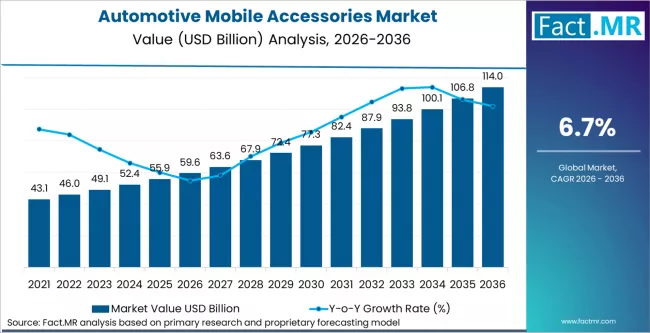
Automotive Mobile Accessories Market Market Value Analysis | Source: Fact.MR
Automotive Mobile Accessories Market Key Takeaways
| Metric | Details |
|---|---|
| Industry Size (2026) | USD 59.65 Billion |
| Industry Value (2036) | USD 114.08 Billion |
| CAGR (2026-2036) | 6.7% |
Source: Fact.MR analysis. Updated Mar 10, 2026
Automotive Mobile Accessories Market Definition
The automotive mobile accessories market encompasses consumer electronic accessories designed for vehicle use that enhance smartphone connectivity, charging, audio integration, and in-vehicle organisation, including dashboard and windshield smartphone mounts, in-car USB and wireless chargers, Bluetooth audio transmitters and speakers, and vehicle-specific storage and organiser products sold through automotive aftermarket and OEM accessory channels.
Automotive Mobile Accessories Market Inclusions
Market scope includes magnetic, suction cup, and vent-mounted smartphone holders, wireless Qi charging pad mounts, USB-A and USB-C multi-port car chargers, portable power banks with automotive form factors, FM transmitter and Bluetooth audio adapter devices, vehicle seat back organizers, console storage inserts, and boot and cargo organisation systems. Geographic analysis covers North America, Latin America, Europe, East Asia, South Asia, Oceania, and Middle East and Africa. Forecast scope spans 2026 to 2036 across product, vehicle type, price range, and sales channel segments.
Automotive Mobile Accessories Market Exclusions
OEM-integrated wireless charging embedded in vehicle centre consoles, factory-fitted smartphone integration systems sold as vehicle options, aftermarket vehicle audio head units with integrated connectivity beyond accessory scope, vehicle tracking devices classified under security systems, and commercial fleet management devices are excluded.
Automotive Mobile Accessories Market Research Methodology
- Primary Research: Fact.MR analysts conducted interviews with automotive accessories category managers at e-commerce platforms and retail chains, consumer electronics accessory brand managers, and road safety authority communications officers to validate phone holder adoption trends, wireless charging mount premium adoption rates, and hands-free legislation compliance purchasing patterns.
- Desk Research: Secondary research aggregated mobile phone ownership statistics from ITU and national telecommunications authorities, hands-free driving legislation documentation across major markets, e-commerce platform automotive accessories category data, and corporate revenue disclosures from listed consumer electronics accessory manufacturers.
- Market-Sizing and Forecasting: Baseline market values derive from a bottom-up aggregation of accessory unit volumes by product type and price tier, multiplied by average retail prices. Vehicle parc size and smartphone penetration rates were applied as primary demand scaling variables, with wireless charging mount adoption modelled as a per-unit value uplift driver as premium product penetration expands.
- Data Validation and Update Cycle: Segment forecasts are cross-validated against e-commerce platform automotive accessories category revenue estimates and consumer electronics retail data. Annual updates incorporate actual smartphone ownership statistics and updated vehicle parc registration data by country.
Summary of Automotive Mobile Accessories Market
- Automotive Mobile Accessories Market Definition
- The automotive mobile accessories market covers consumer electronics accessories enhancing smartphone connectivity, charging, and organisation within vehicles, including phone holders, in-car chargers, Bluetooth audio devices, and storage products, sold through aftermarket and OEM accessory channels globally.
- Demand Drivers in the Market
- Hands-Free Legislation Converting Phone Holders from Convenience to Compliance: Expanding hands-free mobile phone legislation across EU member states, US states, India, and other major markets is converting smartphone holder adoption into a legal compliance purchase for drivers who wish to use navigation and communication during vehicle operation, creating regulatory-driven demand that expands the addressable market beyond technology adopters to the mainstream driving population.
- Wireless Charging Integration Driving Average Selling Price Expansion: Consumer adoption of wireless Qi charging mounts that simultaneously hold, charge, and position the smartphone is driving average selling price expansion beyond basic passive holder categories, with combined functionality justifying retail prices three to five times above entry-level holders and being normalised across mid-premium consumer segments as wireless charging becomes standard on new smartphone models.
- Rising Vehicle Ownership and Smartphone Penetration in India and Southeast Asia: Simultaneous growth of vehicle ownership and smartphone penetration in India, Indonesia, Vietnam, and other Southeast Asian markets is creating first-time accessory purchasing demand from an expanding consumer base, generating consistent volume growth that sustains aggregate market expansion above what mature market replacement demand alone would generate.
- Key Segments Analyzed in the Fact.MR Report
- Phone Holders Product Category: Commands 32.7% share in 2026 as the most universally purchased automotive mobile accessory, with demand spanning from basic vent clip configurations to premium magnetic wireless charging mounts, driven by consistent replacement and upgrade purchasing as smartphone models change device dimensions and wireless charging requirements.
- Passenger Cars Vehicle Type: Holds 69.4% share in 2026, reflecting the concentration of personal smartphone connectivity accessory purchasing where individual consumer decisions, direct e-commerce access, and the personal nature of smartphone use create the highest accessory attachment rates relative to commercial vehicle segments.
- Aftermarket Sales Channel: Accounts for 71.8% of 2026 market value, reflecting automotive mobile accessories as post-purchase consumer electronics decisions driven by smartphone model changes and personal preference rather than vehicle purchase event integration, sustaining aftermarket dominance across all market segments.
- Analyst Opinion at Fact.MR
- Fact.MR analysis indicates the automotive mobile accessories market is consolidating toward multi-function wireless charging mounts as the dominant product, replacing the fragmented landscape of separate passive holders and charging cables. The Indian consumer segment represents the highest near-term growth opportunity, where mandatory hands-free enforcement, rapidly growing vehicle ownership, and improving average smartphone quality are creating a large and rapidly expanding addressable market for mid-tier wireless charging holders. Brands with localised product configurations meeting Indian regulatory standards and active compliance communication messaging are best positioned to capture this growth ahead of commodity competitors who lack either the product certification or the distribution investment to access the mainstream driver segment effectively.
- Strategic Implications / Executive Takeaways
- Wireless Charging Mount as Core Product Line Focus: Accessory brands should concentrate development resources on wireless Qi charging mount configurations combining holding and charging functionality, as wireless mounting is becoming the replacement standard for passive holders across mid and premium price tiers that generate the majority of category revenue.
- India Market Localisation and Regulatory Compliance Communication: Brands entering India should develop localised product configurations and messaging linking phone holder adoption to hands-free legislation compliance, as the regulatory compliance angle accelerates adoption beyond the technology-enthusiast segment to the mainstream driver population where enforcement is active.
- E-Commerce Platform Partnership for Emerging Market Distribution: In markets where specialist automotive retail is underdeveloped, brands should prioritise e-commerce listing optimisation and social commerce channels dominant in each market, as direct-to-consumer e-commerce is the primary distribution pathway for automotive mobile accessories in India, Southeast Asia, and Latin America.
What are the Drivers of Automotive Mobile Accessories Market?
The automotive mobile accessories market is witnessing robust growth, primarily driven by the increasing penetration of smartphones and the growing demand for in-vehicle connectivity. Consumers are increasingly reliant on their mobile devices for navigation, entertainment, communication, and real-time traffic updates, all of which have amplified the need for compatible automotive accessories.
Products such as phone mounts, wireless chargers, USB hubs, and Bluetooth adapters are becoming essential in modern vehicles, especially as automakers integrate platforms like Apple CarPlay and Android Auto. This shift is especially prominent in urban areas and among younger, tech-savvy drivers who expect seamless digital experiences on the road.
Another major driver is the accelerating adoption of electric vehicles (EVs) and connected cars. These vehicles often come equipped with digital dashboards, advanced infotainment systems, and smart diagnostics, which increase the demand for high-tech accessories such as portable EV chargers, AI-powered dashcams, and voice-activated phone holders.
The integration of Internet of Things (IoT) technology into cars has led to a surge in demand for accessories that can interface with apps, collect performance data, and enhance user convenience. Additionally, tech-forward EV owners often seek accessories that match their vehicle’s modern aesthetic and energy-efficient profile.
Government regulations mandating hands-free phone usage while driving are also shaping the market. These laws have led to growing sales of hands-free accessories like magnetic phone mounts, Bluetooth kits, and smart head-up displays (HUDs) that allow drivers to stay connected while minimizing distractions.
At the same time, consumers are showing greater interest in vehicle personalization and comfort, driving demand for stylish, customizable, and multifunctional accessories. Products that combine functionality with design such as ambient lighting phone chargers or premium leather dash mounts, are increasingly preferred.
Lastly, the rise of e-commerce has significantly expanded access to a wide variety of automotive mobile accessories. Online platforms offer convenience, competitive pricing, and access to product reviews, encouraging consumers to purchase and install accessories themselves.
This trend, combined with the growing popularity of DIY installations and influencer-led product promotions, is accelerating global demand. Altogether, these factors are transforming automotive mobile accessories from optional add-ons to essential components of the modern driving experience.
What are the Regional Trends of Automotive Mobile Accessories Market?
Asia-Pacific is the largest and fastest-growing market for automotive mobile accessories, driven by the high volume of vehicle production, increasing middle-class income, and rapid urbanization in countries like China, India, Japan, and South Korea. Smartphone penetration is exceptionally high, and consumers are increasingly looking for in-car connectivity solutions.
India, in particular, is witnessing a boom in aftermarket accessory sales due to cost-conscious buyers upgrading basic car models with add-ons such as Bluetooth kits, phone mounts, and smart chargers. The growing adoption of EVs in China and Southeast Asia is also driving demand for compatible charging and connectivity accessories.
North America, especially the U.S. and Canada, represents a mature and innovation-driven market. Consumers in this region have a high preference for premium and tech-integrated accessories, including wireless chargers, smart HUDs, dashcams, and voice-activated controls. Strong vehicle ownership rates, a large aftermarket ecosystem, and a culture of vehicle customization continue to fuel growth. Additionally, stringent laws around distracted driving are pushing demand for hands-free and safety-oriented mobile accessories. The presence of leading accessory manufacturers and tech startups in the U.S. also fosters continuous product innovation.
A strong focus on road safety regulations, environmental sustainability, and high levels of EV and connected vehicle adoption shapes Europe’s market. Countries like Germany, France, the U.K., and the Netherlands have strict hands-free driving laws, driving the demand for Bluetooth-enabled and voice-controlled accessories. European consumers also exhibit a strong preference for aesthetically designed and eco-friendly accessories, reflecting regional values around sustainability and product quality. The region is also seeing rising sales of in-car infotainment and navigation accessories in line with smart mobility trends.
In Latin America and parts of the Middle East & Africa, the market is still emerging. Still, it shows significant potential, especially in urban centers like São Paulo, Mexico City, Dubai, and Johannesburg. These regions are characterized by a high rate of used vehicle ownership, which fuels the aftermarket accessory segment. Cost-effective, functional accessories such as phone holders, USB chargers, and Bluetooth transmitters are particularly popular. In the Gulf countries, rising disposable incomes and premium vehicle ownership support the demand for luxury mobile accessories, while African markets are experiencing steady growth in basic utility-based products.
What are the Challenges and Restraining Factors of Automotive Mobile Accessories Market?
The automotive mobile accessories market, despite its growth trajectory, faces several restraining factors that can significantly impact its performance. A key concern is the market's fragmentation and price-based competition, especially in developing economies. The presence of numerous local and unorganized players offering cheap, low-quality accessories makes it difficult for premium and established brands to compete effectively.
This intense price war often leads to compromised product quality, poor customer experiences, and reduced brand loyalty. It also discourages innovation, as companies are forced to prioritize affordability over technological advancement.
Another major challenge is the issue of compatibility and rapid technological obsolescence. With constant upgrades in smartphone models and vehicle infotainment systems, many accessories, such as chargers, holders, and connectors, face issues with integration. Products designed for a particular phone size, charging protocol, or operating system may become obsolete within a year. Moreover, the growing trend of factory-fitted infotainment systems, wireless charging pads, and voice-control features in newer vehicle models reduces the demand for aftermarket alternatives, creating pressure on accessory makers to stay technologically relevant.
Environmental concerns and limited awareness in rural regions also present long-term challenges. With increasing scrutiny on plastic usage and e-waste, there is a growing demand for sustainable and recyclable accessory products.
However, producing eco-friendly solutions often raises costs, which conflicts with the affordability expectations of many consumers. In rural and semi-urban areas, low awareness about advanced mobile accessories, limited access to e-commerce platforms, and a lack of skilled installation services restrict market penetration, leaving a large potential segment underdeveloped. Addressing these challenges requires strategic investment in consumer education, sustainability practices, and product standardization.
Country-Wise Outlook
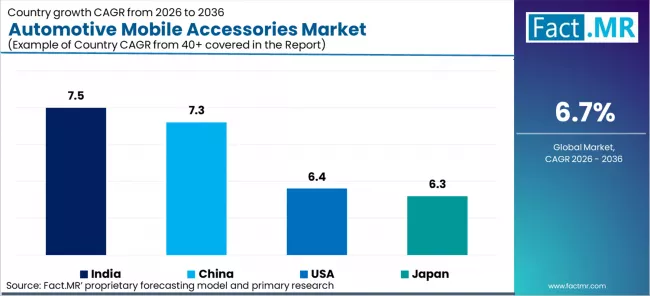
Automotive Mobile Accessories Market Cagr Analysis By Country | Source: Fact.MR
U.S. Automotive Mobile Accessories Market sees Growth Driven by Demand for Compatible Automotive Accessories
The U.S. automotive mobile accessories market is witnessing steady and significant growth, fueled by high vehicle ownership rates, strong smartphone penetration, and evolving consumer preferences for in-car connectivity and safety. With most drivers depending on their mobile devices for navigation, communication, and entertainment, the demand for compatible automotive accessories such as wireless chargers, phone mounts, and Bluetooth hands-free kits continues to rise. The integration of Android Auto and Apple CarPlay in many new vehicles further boosts the use of mobile devices on the road, creating sustained demand for high-quality, tech-compatible accessories.
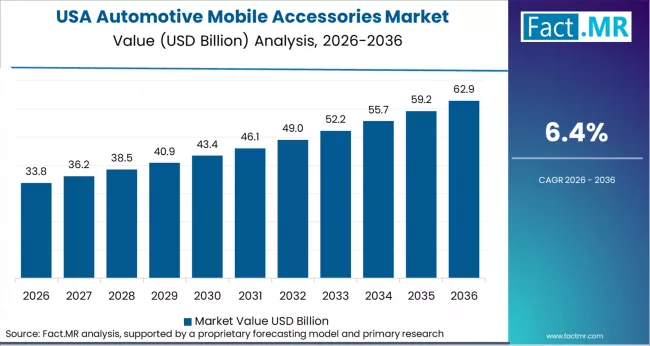
Automotive Mobile Accessories Market Country Value Analysis | Source: Fact.MR
Another critical driver in the U.S. market is the emphasis on road safety and regulatory compliance. Several states have implemented strict hands-free driving laws that prohibit holding a phone while driving, leading to an increase in the adoption of magnetic mounts, dashboard holders, and voice-activated accessories. Consumers are also turning to accessories that enhance safety, such as smart dashcams and head-up displays (HUDs), reflecting a broader awareness of distracted driving risks. These trends are pushing consumers toward more sophisticated, integrated, and multifunctional mobile accessories.
The growth of e-commerce and online retail platforms has played a crucial role in market expansion. Major platforms like Amazon, Best Buy, and Walmart offer a vast selection of automotive mobile accessories, making it easier for consumers to compare features, prices, and reviews before making a purchase. The rise of online sales has particularly benefited smaller brands and niche products, allowing them to reach a national audience without traditional retail constraints. Moreover, U.S. consumers are known for their willingness to invest in premium and tech-forward accessories, especially those that improve driving convenience, comfort, and aesthetics.
China witnesses Rapid Market Growth Backed by Booming Electric Vehicle (EV) Sector
The automotive mobile accessories market in China is experiencing robust growth, driven by the country’s massive vehicle population, rapid smartphone penetration, and booming electric vehicle (EV) sector. China is the world’s largest automotive market, both in terms of production and sales, and this expansive vehicle base directly supports demand for mobile accessories such as phone holders, wireless chargers, Bluetooth kits, and dashcams. As smartphone usage becomes deeply integrated into daily commuting, Chinese consumers increasingly seek accessories that enhance convenience, safety, and connectivity inside vehicles.
One of the primary growth drivers in China is the rapid rise of electric and connected vehicles. The increasing adoption of in-car infotainment systems like Huawei HiCar and the rollout of 5G infrastructure are enabling seamless integration of smartphones with vehicle systems. As a result, tech-savvy Chinese drivers are demanding high-performance accessories that support fast wireless charging, real-time app connectivity, and hands-free control features.
In addition to technological trends, the strong presence of domestic accessory manufacturers is also a key enabler of market growth. Companies like Baseus, UGREEN, and Joyroom lead in producing innovative and affordable accessories tailored to local preferences. These brands, supported by China’s efficient manufacturing infrastructure and supply chains, are quick to adapt to new trends and bring them to market at competitive prices. The country’s vibrant e-commerce platforms, such as JD.com and Tmall, further fuel market accessibility and product diversity, making it easy for consumers to purchase and upgrade their accessories regularly.
Overall, the China market is positioned not just for steady growth but also for technological leadership in the global automotive mobile accessories landscape. The intersection of EV momentum, mobile-tech integration, and domestic production capacity creates a fertile environment for long-term market expansion.
Japan sees Precision Manufacturing Fuels Demand for Ultra-Pure Piping
The automotive mobile accessories market in Japan is experiencing moderate yet steady growth, driven by the country’s strong emphasis on technology integration, mobile connectivity, and road safety. Japan has one of the world’s highest smartphone penetration rates and a well-established automotive culture, which makes mobile accessories such as wireless chargers, phone mounts, Bluetooth adapters, and in-car organizers increasingly essential. As more vehicles adopt Apple CarPlay, Android Auto, and other connected systems, consumer demand for complementary mobile accessories is on the rise, particularly among urban commuters and tech-savvy users.
A significant factor influencing market growth is Japan's urban vehicle design and compact interiors, which encourage the adoption of sleek, space-saving mobile accessories. Accessories that are minimalistic, multifunctional, and easy to install such as magnetic phone holders, fast-charging hubs, and clip-on dashboard mounts, are particularly popular. Moreover, with strict enforcement of hands-free driving laws, products that enhance driving safety, such as HUD displays and voice-controlled mounts, are in strong demand.
Japan's consumer culture also places a premium on quality, sustainability, and aesthetic appeal, shaping the type of accessories that perform well in the market. Eco-conscious brands like Anker and Elecom are developing accessories with recyclable materials, energy-efficient designs, and premium finishes. This reflects the broader Japanese preference for high-quality, durable products that align with environmental values. Accessories with artisanal craftsmanship or minimalist design, especially those that blend seamlessly with vehicle interiors, are increasingly preferred over generic, mass-market alternatives.
The market is supported by a strong omnichannel distribution ecosystem, with both e-commerce platforms (like Rakuten and Amazon Japan) and physical electronics stores (such as Yodobashi Camera and Bic Camera) playing key roles. While online channels are gaining momentum due to convenience and broader product variety, physical stores remain vital for showcasing build quality, allowing customers to test and compare accessories before purchasing.
Overall, the Japan market is not the fastest-growing globally. Still, it is marked by stable demand, high product standards, and a loyal consumer base, making it an important and innovation-conscious segment within the global automotive mobile accessories landscape.
Category-wise Analysis
Phone Holders to Exhibit Leading by Product
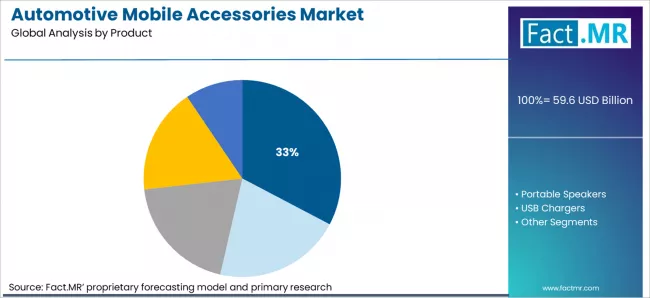
Automotive Mobile Accessories Market Analysis By Product | Source: Fact.MR
The phone holders segment dominates the automotive mobile accessories market, due to increasing regulations around hands-free driving, especially in countries like the U.S., Japan, and across Europe. Consumers are prioritizing safety and compliance with legal restrictions, which has led to a surge in the use of dashboard mounts, magnetic holders, air-vent mounts, and windshield brackets.
Moreover, the widespread adoption of smartphones for GPS navigation, music, and communication further supports demand for secure and accessible phone mounting solutions. The integration of wireless charging features into modern phone holders has also enhanced their appeal, particularly in premium and tech-savvy consumer segments.
The USB chargers segment is the fastest-growing in the automotive mobile accessories market, driven by the increasing number of electronic devices such as smartphones, tablets, smartwatches, and dashcams that require constant charging while on the go. The popularity of multi-port fast-charging USB hubs, Type-C chargers, and integrated power delivery (PD) systems has grown significantly, especially in regions with high digital penetration like China, India, and North America.
Moreover, the proliferation of electric vehicles (EVs) with advanced infotainment and display systems has boosted the need for high-efficiency in-car charging solutions, making USB chargers an essential part of modern driving experiences. The ongoing trend toward tech-enabled, long-distance travel further supports this segment’s rapid expansion.
Light Commercial Vehicles (LCVs) toE xhibit Leading by Vehicle Type
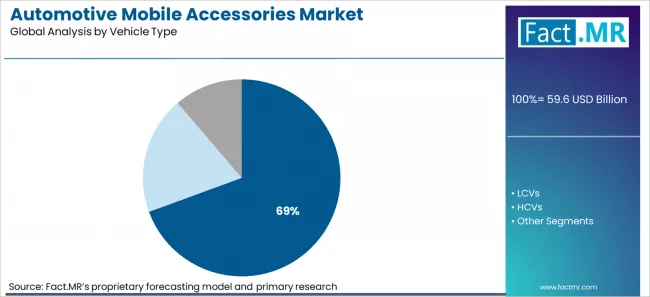
Automotive Mobile Accessories Market Analysis By Vehicle Type | Source: Fact.MR
The passenger cars segment dominates the automotive mobile accessories market, driven by the massive global base of privately owned vehicles and the growing demand for in-vehicle connectivity, infotainment, and safety solutions among individual consumers. With smartphones becoming essential for navigation, entertainment, and communication, passenger car owners are investing heavily in accessories such as phone holders, USB chargers, wireless mounts, and Bluetooth audio kits. Urbanization, rising disposable incomes, and an increased focus on driving comfort and personalization further strengthen this segment's lead, particularly in high-growth automotive markets like China, India, and the U.S.
The Light Commercial Vehicles (LCVs) segment is the fastest-growing in the automotive mobile accessories market, fueled by the rapid expansion of e-commerce, logistics, and on-demand delivery services. Drivers of LCVs, such as vans and utility vehicles, increasingly rely on mobile devices for real-time navigation, fleet communication, and delivery management, prompting demand for durable and multi-functional accessories. Products like rugged phone holders, high-output USB chargers, and voice-activated tools are especially critical in commercial environments where safety, productivity, and hands-free operation are priorities. The adoption of connected fleet solutions and the digitization of last-mile delivery are further accelerating the uptake of mobile accessories in the LCV segment.
Mid-Price to Exhibit Leading by Price Range
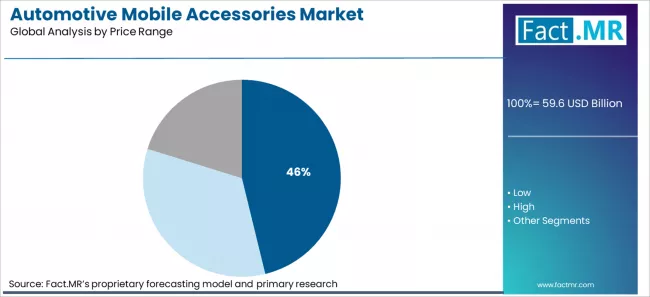
Automotive Mobile Accessories Market Analysis By Price Range | Source: Fact.MR
The mid-price range segment dominates the automotive mobile accessories market, due to its balance of cost and functionality, making it ideal for mass-market vehicles. Mid-range products typically include essential HMI features such as touchscreens, voice commands, and steering-mounted controls, offering good value for both OEMs and consumers. Widely adopted in sedans and SUVs, this segment caters to mainstream consumer needs, ensuring consistent demand across developed and developing markets alike.
The high-price range segment is the fastest-growing in the automotive mobile accessories market, driven by increased demand for premium vehicles equipped with advanced features such as AI-powered voice assistants, AR-based HUDs, and multi-screen cockpit displays. Luxury and sports car buyers are willing to pay a premium for intuitive, high-performance interfaces. As EVs and high-end models become more tech-centric, automakers are pushing innovations in high-value HMI components, boosting growth in this upper-tier price segment.
OEMs to Exhibit Leading by Sale Channel
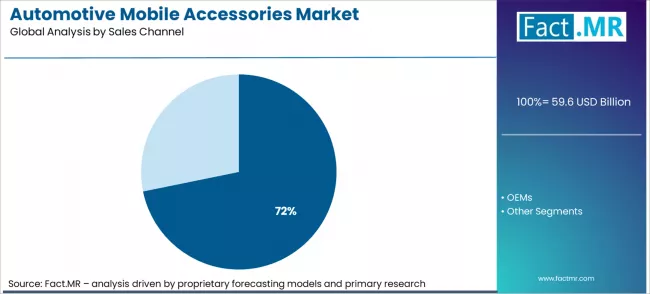
Automotive Mobile Accessories Market Analysis By Sales Channel | Source: Fact.MR
OEMs dominate the automotive mobiel accessories market, as they integrate HMI systems directly during vehicle production to ensure seamless design, safety compliance, and system reliability. Original equipment ensures tighter integration with vehicle electronics and branding, leading to increased consumer trust and preference. OEM-installed systems dominate in new car sales, making them the primary source of revenue generation in this market segment.
The aftermarket segment is the fastest-growing due to increasing consumer interest in upgrading or replacing outdated systems. Drivers of older vehicles are retrofitting with modern HMI solutions such as touchscreen infotainment units, digital clusters, and HUDs. Rising affordability, DIY-friendly options, and the availability of customizable, plug-and-play devices are driving adoption. Growth in e-commerce platforms and third-party service providers is also accelerating this segment globally.
Competitive Analysis
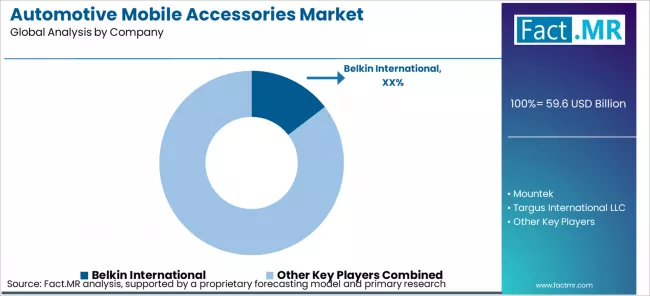
Automotive Mobile Accessories Market Analysis By Company | Source: Fact.MR
The automotive mobile accessories market is becoming increasingly competitive, with a mix of global technology brands, regional players, and low-cost local manufacturers. Well-established companies such as Anker Innovations, Belkin International, Baseus, Aukey, and Scosche Industries dominate the premium and mid-tier segments, offering technologically advanced products like fast wireless chargers, AI-integrated phone holders, and multi-port USB hubs.
These brands emphasize innovation, build quality, and consumer trust, often targeting tech-savvy customers in mature markets like North America, Europe, and East Asia. Their strategies typically include investments in R&D, sleek product design, and compatibility with the latest smartphones and automotive systems.
In contrast, regional and local manufacturers, particularly in China, India, and Southeast Asia, compete aggressively on pricing and speed to market. These companies often cater to the mass market by offering affordable alternatives with basic features, targeting emerging economies where price sensitivity is high.
While their products may not match the quality or longevity of global brands, they hold a significant share in volume sales due to their extensive offline distribution network and accessibility through local shops and regional e-commerce platforms. However, this price-driven competition can also lead to market saturation and the proliferation of low-quality or counterfeit products, which poses a challenge to brand-conscious consumers.
The distribution landscape is another key battleground in the competitive structure. Leading players are increasingly adopting omnichannel strategies, leveraging both online and offline platforms.
Online marketplaces like Amazon, Flipkart, JD.com, and Tmall have become crucial sales channels, offering vast reach and convenience. Simultaneously, offline distribution through electronics retailers, automotive accessory shops, and OEM dealerships remains important, particularly in regions where hands-on product experience drives purchase decisions. Strategic partnerships with car manufacturers, ride-hailing companies, and EV infrastructure providers are also emerging as new growth channels for premium accessory brands.
Furthermore, growing awareness around sustainability and regulatory compliance is shaping competition. Brands that offer eco-friendly, RoHS-compliant, and recyclable products are gaining traction among environmentally conscious consumers, especially in Japan, Europe, and parts of North America.
To stay ahead, companies must balance technological innovation with affordability, regulatory alignment, and consumer expectations. In such a dynamic and saturated market, success increasingly depends on a brand’s ability to deliver value-added features, safety, smart connectivity, and durability while maintaining agility in product development and marketing.
Key players in the automotive mobile accessories industry include Belkin International, Mountek, Targus International LLC, BRACKETRON INC., Car Mate Mfg Co. Ltd., Mophie Inc., Anker Technology Co. Limited, Arkon Resources Inc., Griffin Technology Inc., iOttie, Pro. Fit International Inc., Moshi, Wizgear, and other players.
Recent Development
- In July 2025, Tata Elxsi and Synopsys entered into a strategic partnership aimed at accelerating the development of software-defined vehicles (SDVs). This collaboration was announced via a Memorandum of Understanding (MoU) signed at the SNUG India 2025 event in Bengaluru.
Bibliography
- 1. International Telecommunication Union. (2024, January). Measuring Digital Development: Mobile Phone Ownership and Smartphone Penetration by Country 2024. ITU.
- 2. Government of India, Ministry of Road Transport and Highways. (2024, May). Motor Vehicle Act Amendment: Hands-Free Mobile Phone Use Requirements and Enforcement Framework for Passenger Vehicle Operators. MoRTH.
- 3. European Commission, Directorate-General for Road Safety. (2024, March). EU Road Safety Policy Framework: Mobile Phone Distraction Legislation and Hands-Free Technology Adoption Statistics Across Member States. European Commission.
- 4. Wireless Power Consortium. (2024, January). Qi 2.0 Standard: Wireless Charging Performance Specifications and Automotive Application Certification Requirements. WPC.
- 5. World Bank Group. (2024, April). Digital Economy and Consumer Electronics Market Development in South and Southeast Asia. World Bank.
- 6. OECD. (2024, February). Road Safety Annual Report 2024: Mobile Phone Distraction Legislation Effectiveness Across OECD Member States. OECD.
This bibliography is provided for reader reference. The full Fact.MR report contains the complete reference list with primary research documentation.
This Report Addresses
- Market sizing and quantitative forecast metrics: detailing precise revenue projections, absolute dollar growth, and compound annual growth rates across major automotive mobile accessories segments and geographies through 2036.
- Segmentation analysis: mapping adoption velocity of leading product, technology, and end-use categories and evaluating structural factors driving segment share transitions over the forecast period.
- Regional deployment intelligence: comparing growth dynamics in high-momentum Asia Pacific and emerging markets against the mature replacement and upgrade demand patterns prevalent in European and North American hubs.
- Regulatory compliance assessment: analyzing how evolving product safety standards, environmental directives, and sector-specific mandates are reshaping procurement decisions, material specifications, and supplier qualification criteria.
- Competitive posture evaluation: tracking consolidation trends, platform integration strategies, technology differentiation investments, and the resulting competitive dynamics among established players and emerging challengers.
- Capital project strategic guidance: defining the procurement specifications, investment thresholds, and performance benchmarks required to support next-generation product adoption and facility modernization programs.
- Supply chain vulnerability analysis: identifying sourcing concentration risks, logistics bottlenecks, raw material price dependencies, and geographic exposure scenarios that affect market participant cost structures.
- Custom data delivery formats: encompassing interactive dashboards, raw Excel datasets, and comprehensive PDF narrative reports tailored for executive decision-making and analyst reference applications.
Segmentation
Scope of the Report
| Metric | Value |
|---|---|
| Quantitative Units | USD 59.65 billion to USD 114.08 billion, at a CAGR of 6.7% |
| Market Definition | Consumer electronics accessories enhancing smartphone connectivity, charging, and organisation within vehicles, including phone holders, in-car chargers, Bluetooth audio devices, and storage products, sold through aftermarket and OEM channels. |
| Product Segmentation | Phone Holders, Chargers and Power Banks, Bluetooth Speakers, Organizers and Storage, Others |
| Vehicle Type Segmentation | Passenger Cars, LCVs, HCVs |
| Price Range Segmentation | Budget, Mid, Premium |
| Sales Channel Segmentation | OEM, Aftermarket |
| Regions Covered | North America, Latin America, Europe, East Asia, South Asia, Oceania, Middle East and Africa |
| Countries Covered | India, China, USA, Japan, and 40 plus countries |
| Key Companies Profiled | Belkin International, Mountek, Targus International LLC, BRACKETRON INC., Car Mate Mfg Co. Ltd., Mophie Inc., Anker Technology Co. Limited, Arkon Resources Inc., Griffin Technology Inc., iOttie, Pro.Fit International Inc., Moshi, Wizgear |
| Forecast Period | 2026 to 2036 |
| Approach | Bottom-up aggregation of accessory units by product type and price tier with vehicle parc and smartphone penetration scaling and wireless charging mount ASP uplift modeling |
Source: Fact.MR analysis. Updated Mar 10, 2026
Segmentation of Automotive Mobile Accessories Market
-
By Product :
- Portable Speakers
- Phone Holders
- USB Chargers
- Adapters
- Others
-
By Vehicle Type :
- Passenger Cars
- LCVs (Light Commercial Vehicles)
- HCVs (Heavy Commercial Vehicles)
-
By Price Range :
- Low
- Mid
- High
-
By Sales Channel :
- OEMs
- Aftermarket
-
By Region :
- North America
- Latin America
- Western Europe
- Eastern Europe
- East Asia
- South Asia & Pacific
- Middle East & Africa
Frequently Asked Questions
How large is the automotive mobile accessories market in 2026?
What will the market size be by 2036?
What is the expected CAGR between 2026 and 2036?
Which product leads the market in 2026?
Why does aftermarket account for 71.8% of sales?
What is driving India's 7.5% CAGR?
What is excluded from the scope of this report?
Who worked on this report


Preview the report firsthand - request a free sample
Free SampleGet the brochure for pricing and purchase details
Download PDF