- Base Value(2025): 10.9 Bn
- Estimated Value(2025): 10.9 Bn
- Forecast Value (2035): 24.9 Bn
- CAGR (2025 - 2035): 8.6%
Automotive Silicone Market Forecast and Outlook 2025 to 2035
The global automotive silicone market is projected to reach USD 24.9 billion by 2035, recording an absolute increase of USD 14.0 billion over the forecast period. The market is valued at USD 10.9 billion in 2025 and is set to rise at a CAGR of 8.6% during the assessment period.
Quick Stats for Automotive Silicone Market
- Automotive Silicone Market Value (2025): USD 10.9 billion
- Automotive Silicone Market Forecast Value (2035): USD 24.9 billion
- Automotive Silicone Market Forecast CAGR: 8.6%
- Leading Product Type in Automotive Silicone Market: Rubber (67.2%)
- Key Growth Regions in Automotive Silicone Market: Asia Pacific, North America, and Europe
- Top Players in Automotive Silicone Market: Henkel AG & Co. KGaA, 3M Company, Permatex, Elkem ASA, Basildon Chemicals, Specialty Silicone Products, Inc., Dow, ACC Silicones Ltd., Wacker Chemie AG, Shin-Etsu Chemical Co.
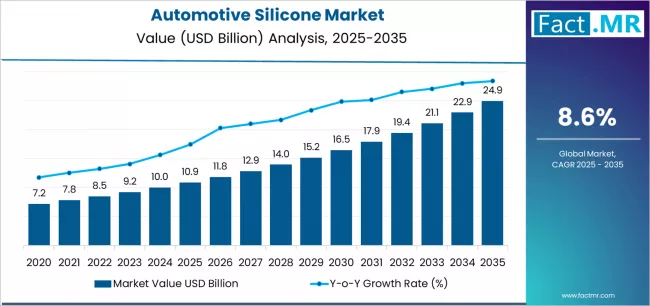
Automotive Silicone Market Market Value Analysis | Source: Fact.MR
The market is expected to grow 2.3x during the same period, supported by increasing electrification of automotive platforms requiring advanced thermal management and electrical insulation solutions worldwide, driving demand for specialized silicone formulations and increasing investments in high-performance materials with superior temperature resistance across electric vehicle battery systems and autonomous driving sensor applications globally.
Automotive manufacturers face mounting pressure to ensure component durability and operational reliability while addressing extreme temperature conditions and electrical safety requirements, with modern automotive silicone products providing documented performance benefits including enhanced thermal stability, superior electrical insulation properties, and extended service life compared to conventional organic polymer materials alone.
Rising adoption of electric vehicles and expanding advanced driver assistance systems enabling sophisticated electronic architectures create substantial opportunities for manufacturers and automotive partners. However, volatile raw material prices and stringent automotive qualification requirements may pose obstacles to rapid market expansion.
The rubber segment dominates market activity, driven by extensive application versatility supporting critical sealing and vibration damping functions across diverse automotive subsystems worldwide. Automotive engineers increasingly recognize the essential role of silicone rubber components, with typical product offerings providing effective thermal management and mechanical performance at competitive price points through established automotive supply networks.
The adhesives & sealants segment demonstrates robust growth potential, supported by rising demand for structural bonding solutions and evidence-based protocols integrating advanced sealing technologies in modern vehicle assembly approaches. Gaskets & seals emerge as the dominant rubber application, reflecting critical sealing requirements for powertrain and body systems in automotive manufacturing routines. Interior & exterior parts represent the leading application segment, driven by weatherproofing demands and aesthetic finishing requirements enabling comprehensive vehicle protection solutions.
Regional dynamics show Asia Pacific maintaining market leadership, supported by high automotive production volumes and established silicone manufacturing capabilities across passenger vehicle categories. North America demonstrates strong growth trajectory driven by accelerating electric vehicle adoption and expanding autonomous vehicle development adopting advanced silicone technologies, while Europe emphasizes sustainability standards and regulatory compliance for automotive material specifications.
China leads country-level growth through extensive electric vehicle manufacturing expansion and electronics integration initiatives, followed by India supported by fast automotive build-out and rising original equipment manufacturer output. The competitive landscape features moderate concentration with Henkel AG & Co. KGaA maintaining market leadership position at 8.1% share, while specialized players including 3M Company, Permatex, Elkem ASA, and Dow compete through targeted automotive-grade formulations and comprehensive technical support programs across diverse vehicle applications.
Automotive Silicone Market Year-over-Year Forecast 2025 to 2035
Between 2025 and 2029, the automotive silicone market is projected to expand from USD 10.9 billion to USD 15.1 billion, resulting in a value increase of USD 4.2 billion, which represents 30.0% of the total forecast growth for the period. This phase of development will be shaped by rising demand for electric vehicle thermal management systems and battery sealing applications, product innovation in high-temperature resistant formulations with enhanced electrical insulation properties and mechanical durability, as well as expanding integration with advanced manufacturing processes and automated dispensing technologies. Companies are establishing competitive positions through investment in application engineering capabilities, automotive certification programs, and strategic market expansion across original equipment manufacturer partnerships, tier-one supplier networks, and aftermarket distribution models.
From 2029 to 2035, the market is forecast to grow from USD 15.1 billion to USD 24.9 billion, adding another USD 9.8 billion, which constitutes 70.0% of the overall expansion. This period is expected to be characterized by the expansion of specialized product applications, including autonomous vehicle sensor encapsulation materials and advanced battery thermal interface compounds tailored for specific electric vehicle architectures, strategic collaborations between silicone manufacturers and automotive technology companies, and an enhanced focus on sustainability initiatives and bio-based silicone alternatives. The growing emphasis on vehicle lightweighting protocols and rising manufacturer preference for multi-functional silicone solutions addressing thermal management, sealing, and bonding requirements simultaneously will drive demand for comprehensive material solutions across diverse automotive platforms.
Automotive Silicone Market Key Takeaways
| Metric | Value |
|---|---|
| Market Value (2025) | USD 10.9 billion |
| Market Forecast Value (2035) | USD 24.9 billion |
| Forecast CAGR (2025-2035) | 8.6% |
Source: Fact.MR analysis. Updated Dec 11, 2025
Why is the Automotive Silicone Market Growing?
The automotive silicone market grows by enabling vehicle manufacturers to achieve superior component performance and reliability while addressing extreme operating conditions and stringent safety requirements without exclusive reliance on conventional organic polymer materials.
Automotive engineers face mounting pressure to ensure thermal stability and electrical safety while managing lightweight design objectives, chemical resistance needs, and long-term durability expectations, with modern silicone formulations. These materials typically provide exceptional temperature resistance ranging from -60oC to +300oC, outstanding electrical insulation properties for high-voltage battery systems, and superior weathering resistance compared to traditional rubber and plastic materials alone, making automotive silicones essential for comprehensive vehicle development.
The automotive industry's need for advanced materials supporting electrification and autonomous driving technologies creates demand for specialized silicone solutions that can provide thermal management capabilities, enhance electronic system protection, and support structural integrity without compromising vehicle performance or safety standards.
Original equipment manufacturer endorsements and performance validation supporting silicone benefits drive adoption in electric vehicle manufacturing, advanced driver assistance system integration, and premium automotive applications, where material performance has direct impact on vehicle safety and operational longevity. The accelerating electric vehicle production globally, with battery electric vehicle sales expected to represent approximately 30% of new vehicle sales by 2030, creates expanding market opportunities for thermal interface materials and battery sealing solutions.
Rising consumer expectations for vehicle quality and regulatory emphasis on emission reduction enable informed material selection and adherence to sustainability-focused manufacturing protocols. However, qualification complexity for new automotive applications and performance variability across different silicone chemistries may limit standardization rates and optimal implementation across diverse vehicle platforms serving different market segments with varying performance requirements.
Segmental Analysis
The market is segmented by product, application, and region. By product, the market is divided into rubber, adhesives & sealants, coatings, and other products. Based on application, the market is categorized into interior & exterior parts, engine & drive train system, electrical system, suspension system, and other applications. Regionally, the market is divided into Asia Pacific, Europe, North America, Latin America, and Middle East & Africa.
By Product, Which Segment Accounts for the Dominant Market Share?
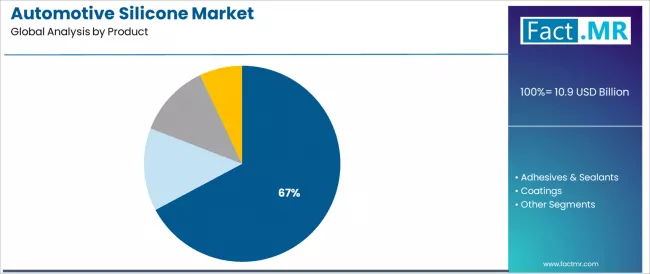
Automotive Silicone Market Analysis By Product | Source: Fact.MR
Rubber-based automotive silicone represents the dominant force, capturing 67.2% of the total market share in 2025. This established product category encompasses solutions featuring exceptional elastomeric properties and thermal resistance characteristics, including advanced high-consistency rubber formulations and liquid silicone rubber systems that enable superior sealing performance and vibration isolation capabilities across powertrain components, body systems, and electrical enclosures worldwide.
The rubber segment's market leadership stems from its versatile application portfolio, with solutions capable of addressing critical automotive functions including fluid containment, environmental sealing, noise reduction, and mechanical cushioning while maintaining excellent performance across extreme temperature ranges and aggressive chemical environments.
The adhesives & sealants segment maintains a substantial market share in the 18-19% range, serving automotive assembly operations that require structural bonding and gap sealing capabilities addressing manufacturing efficiency and component integration including windshield installation, body panel attachment, and electronic module protection.
These solutions offer essential functionality for modern vehicle construction enabling lightweight multi-material assemblies while providing sufficient mechanical strength to support crash safety requirements. The adhesives & sealants segment demonstrates strong growth potential, driven by expanding adoption of adhesive bonding technologies replacing traditional mechanical fastening methods and increasing emphasis on acoustic performance optimization.
Within the rubber category, gaskets & seals represent the dominant application at 41% share, driven by critical sealing requirements across engine systems, transmission assemblies, and body closures. Hoses command 34% share for fluid transfer and cooling system applications, while vibration components account for 25% serving engine mounts and suspension bushings.
Key performance advantages driving the rubber segment include:
- Advanced thermal resistance mechanisms with clinically demonstrated stability across temperature extremes from negative 60 to positive 300 degrees Celsius without mechanical property degradation across automotive operating conditions
- Established sealing reliability allowing superior compression set resistance and long-term fluid containment without extensive maintenance complexity
- Enhanced vibration damping features enabling noise reduction and mechanical isolation while maintaining material integrity and performance consistency
- Superior chemical resistance profile providing optimal durability against automotive fluids including oils, coolants, and fuels across various vehicle subsystems and service life expectations
By Application, Which Segment Accounts for the Largest Market Share?
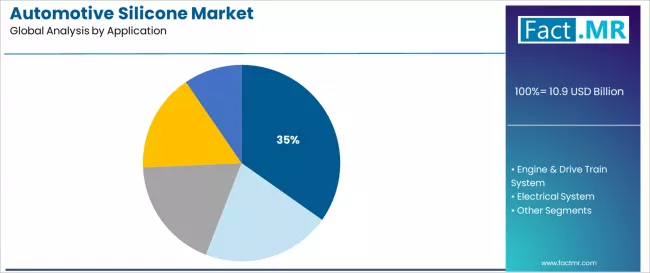
Automotive Silicone Market Analysis By Application | Source: Fact.MR
Interior & exterior parts dominate the automotive silicone application landscape with approximately 34.8% market share in 2025, reflecting the critical role of environmental protection and aesthetic finishing systems in supporting passenger comfort, vehicle appearance, and structural weatherproofing across automotive platforms worldwide. The interior & exterior parts segment's market leadership is reinforced by automotive design priorities for comprehensive sealing against water ingress, dust infiltration, and noise transmission, combined with aesthetic requirements that characterize premium vehicle positioning and consumer satisfaction expectations.
Within this segment, weatherstripping represents the primary application area at 43% share, driven by door sealing, window sealing, and trunk sealing requirements across all vehicle segments. This sub-segment benefits from established automotive specifications and universal application requirements across diverse vehicle architectures.
The electrical system segment represents a rapidly growing application category at 27.6% share, demonstrating strong expansion through specialized requirements for high-voltage insulation, sensor protection, and wiring harness management in modern vehicles with increasing electronic content and electrification levels. This segment benefits from electric vehicle adoption trends and advanced driver assistance system proliferation driving exponential growth in automotive electronic component counts.
The engine & drive train system segment maintains meaningful presence through powertrain sealing and thermal management requirements, while suspension system applications serve bushings and mounting systems supporting vehicle dynamics and ride quality optimization.
Key market dynamics supporting application growth include:
- Interior & exterior protection expansion driven by premium vehicle proliferation and consumer quality expectations, requiring comprehensive sealing solutions and aesthetic performance
- Electrical system modernization trends require advanced insulation materials for high-voltage battery systems and sophisticated electronic architecture protection
- Integration of thermal management protocols enabling battery cooling and power electronics temperature control across electric vehicle platforms
- Growing emphasis on lightweighting strategies supporting silicone adoption over heavier traditional materials without compromising sealing effectiveness
What are the Drivers, Restraints, and Key Trends of the Automotive Silicone Market?
The market is driven by three concrete demand factors tied to automotive technology evolution. First, accelerating electric vehicle production creates expanding requirements for advanced thermal management and electrical insulation materials, with silicones representing critical enabling technologies for battery safety and power electronics reliability in comprehensive vehicle electrification strategies, requiring widespread material adoption. Second, increasing electronic content in vehicles drives original equipment manufacturer demand and material innovation, with autonomous driving sensor systems, advanced driver assistance features, and connected vehicle technologies demonstrating substantial requirements for environmental protection and signal integrity through specialized silicone encapsulation by 2030. Third, growing regulatory emphasis on vehicle safety and emission reduction enables more stringent material performance standards that favor high-temperature silicones over conventional materials for critical automotive applications.
Market restraints include raw material price volatility and supply chain dependency on specialized siloxane intermediates that can challenge cost predictability and margin stability across automotive supply chains, particularly during periods of tight petrochemical feedstock availability and fluctuating silicon metal pricing. Lengthy automotive qualification processes for new material formulations pose another significant obstacle, as automotive silicone applications require extensive testing protocols including temperature cycling, chemical exposure, mechanical fatigue, and long-term aging validation, potentially affecting product development timelines and market entry speed. Competition from alternative high-performance polymers including fluoroelastomers and thermoplastic elastomers creates additional market pressure, demanding continuous innovation and performance differentiation initiatives.
Key trends indicate accelerated bio-based silicone development in developed markets, particularly Europe and North America, where automotive manufacturers demonstrate commitment to sustainable material sourcing and circular economy principles aligned with corporate environmental goals. Smart material integration trends toward self-healing silicones with damage repair capabilities and conductive silicone formulations enabling electromagnetic interference shielding combine material functionality with electronic integration that optimizes component design and system reliability. However, the market thesis could face disruption if significant advances in solid-state battery technologies reduce thermal management complexity or major shifts in vehicle architecture designs minimize traditional sealing requirements through integrated manufacturing approaches.
Analysis of the Automotive Silicone Market by Key Countries
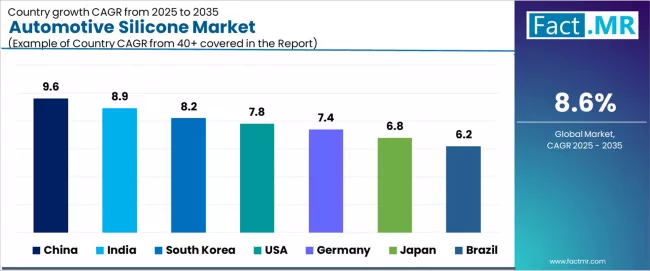
Automotive Silicone Market Cagr Analysis By Country | Source: Fact.MR
| Country | CAGR (2025-2035) |
|---|---|
| China | 9.6% |
| India | 8.9% |
| South Korea | 8.2% |
| USA | 7.8% |
| Germany | 7.4% |
| Japan | 6.8% |
| Brazil | 6.2% |
Source: Fact.MR analysis. Updated Dec 11, 2025
The global automotive silicone market is expanding rapidly, with China leading at a 9.6% CAGR through 2035, driven by highest electric vehicle production volumes, massive electronics integration in vehicles, and comprehensive manufacturing scale advantages. India follows at 8.9%, supported by fast automotive build-out, rising original equipment manufacturer output, and expanding component manufacturing capabilities. South Korea records 8.2%, reflecting battery and electric vehicle component leadership and advanced automotive technology development.
USA advances at 7.8%, leveraging electric vehicle adoption acceleration, advanced driver assistance system growth, and regulatory pressure for vehicle safety enhancement. Germany posts 7.4%, focusing on strong premium automotive manufacturing, sustainability laws, and engineering excellence standards, while Japan grows steadily at 6.8%, emphasizing mature original equipment manufacturer operations, strong electrical systems demand, and quality-focused production methodologies. Brazil demonstrates 6.2% growth, anchored by growing local production capabilities, aftermarket silicone demand, and automotive industry expansion.
How is China Leading Global Market Expansion?
China demonstrates the strongest growth potential in the automotive silicone market with a CAGR of 9.6% through 2035. The country's leadership position stems from dominating global electric vehicle production with approximately 60% of worldwide battery electric vehicle manufacturing, extensive electronics integration across all vehicle segments, and massive automotive production scale supporting comprehensive silicone demand.
Growth is concentrated in major automotive manufacturing clusters and new energy vehicle production bases, including Shanghai, Shenzhen, Hefei, and Chongqing, where manufacturers are increasingly implementing advanced silicone solutions for battery thermal management, high-voltage electrical insulation, and autonomous driving sensor protection.
Distribution channels through original equipment manufacturer supply chains, tier-one component manufacturers, and specialized automotive chemical distributors expand material accessibility across domestic and export-oriented production facilities. The country's growing integration of domestic silicone production capacity with international technology partnerships provides strong momentum for automotive-grade material development, including comprehensive adoption across vehicle segments from entry-level electric vehicles to premium autonomous driving platforms.
Key market factors:
- Electric vehicle production dominance concentrated in coastal manufacturing regions and inland new energy vehicle industrial parks with advanced assembly capabilities
- Electronics integration expansion through comprehensive in-vehicle connectivity systems, autonomous driving hardware, and battery management electronics requiring advanced silicone protection
- Manufacturing scale advantages enabling cost-competitive silicone procurement and specialized formulation development for domestic automotive requirements
- Local silicone production capacity featuring companies establishing automotive-certified manufacturing lines offering regionally competitive solutions
Why is India Emerging as a High-Growth Market?
In major automotive manufacturing centers including Pune, Chennai, Gurugram, and Ahmedabad, the adoption of automotive silicone solutions is accelerating across vehicle assembly operations and component manufacturing facilities, driven by rapidly expanding automotive production volumes and increasing localization of advanced vehicle technologies. The market demonstrates strong growth momentum with a CAGR of 8.9% through 2035, linked to comprehensive automotive industry expansion trends and increasing focus on quality enhancement and performance optimization.
Indian automotive manufacturers are implementing modern material specifications and quality standards to meet export requirements while serving growing domestic demand for feature-rich vehicles. The country's expanding middle class creates ongoing demand for passenger vehicles with advanced comfort and safety features, while increasing government emphasis on electric vehicle adoption drives investment in specialized silicone applications for battery systems and power electronics.
Key development areas:
- Automotive manufacturing expansion leading silicone adoption with emphasis on passenger vehicle production growth and two-wheeler electrification initiatives
- Component localization programs through both multinational tier-one suppliers and rapidly growing domestic automotive component manufacturers
- Technology partnerships enabling knowledge transfer from international automotive silicone suppliers and domestic manufacturing capability development
- Growing investment in electric vehicle infrastructure alongside original equipment manufacturer commitments supporting specialized thermal management material demand
What Drives USA Market Resilience?
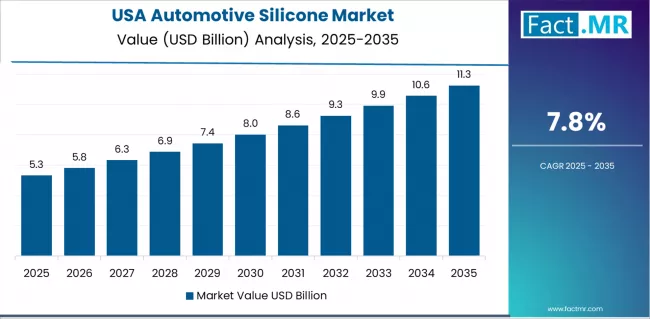
Automotive Silicone Market Country Value Analysis | Source: Fact.MR
USA market expansion is driven by diverse automotive technology preferences, including electric vehicle acceleration in consumer and commercial segments and advanced autonomous driving development across technology companies and traditional automotive manufacturers. The country demonstrates steady growth potential with a CAGR of 7.8% through 2035, supported by continuous innovation from established automotive manufacturers including Tesla, General Motors, and Ford implementing aggressive electrification strategies.
American automotive companies face implementation challenges related to supply chain restructuring and domestic content requirements, requiring material suppliers to demonstrate local manufacturing capabilities and responsive technical support. However, established automotive production infrastructure and high adoption rates for premium vehicle technologies create stable baseline demand for automotive silicones, particularly among electric vehicle manufacturers and advanced driver assistance system integrators where performance-critical applications drive primary material selection decisions.
Market characteristics:
- Electric vehicle manufacturing expansion and legacy automotive electrification showing robust demand with substantial material volume growth across battery electric and plug-in hybrid platforms
- Regional preferences varying between performance-focused applications in premium vehicles and cost-optimized solutions in mass-market segments
- Future projections indicate continued growth with emphasis on domestic battery manufacturing and semiconductor packaging applications requiring specialized silicone materials
- Growing emphasis on reshoring initiatives and supply chain resilience supporting domestic silicone production capacity investments
How does Germany Demonstrate Engineering Excellence Leadership?
The market in Germany leads in premium automotive material applications based on integration with rigorous performance specifications and advanced engineering validation methodologies for enhanced reliability and longevity. The country shows strong potential with a CAGR of 7.4% through 2035, driven by strict regulatory frameworks and automotive manufacturer preferences for high-performance materials in major production regions, including Bavaria, Baden-Württemberg, Lower Saxony, and North Rhine-Westphalia.
German automotive manufacturers are adopting advanced silicone solutions through established relationships with chemical suppliers and emphasis on comprehensive testing protocols for critical vehicle systems, particularly in quality-conscious production environments and engineering-focused development programs demanding extensive validation credentials. Distribution channels through automotive chemical distributors and direct original equipment manufacturer supply agreements expand coverage across premium vehicle manufacturers and specialized component suppliers.
Leading market segments:
- Premium vehicle production in major automotive centers implementing comprehensive material specifications for luxury and performance applications
- Strategic partnerships between automotive manufacturers and silicone suppliers achieving high technical collaboration rates
- Technology development collaborations between German chemical companies and international automotive platforms expanding innovation capabilities
- Focus on sustainability initiatives and circular economy principles addressing European Union regulatory requirements
What Positions Japan for Quality Manufacturing Leadership?
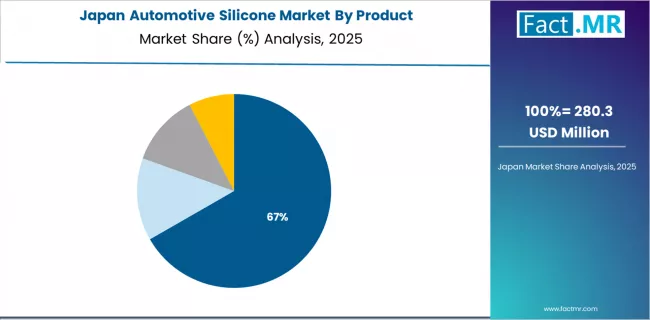
Automotive Silicone Market Japan Market Share Analysis By Product | Source: Fact.MR
In major automotive production centers including Toyota City, Yokohama, Hiroshima, and Oppama, automotive manufacturers are implementing silicone solutions through established quality management systems and supplier partnership frameworks, with documented production excellence showing substantial performance reliability through comprehensive material validation protocols. The market shows steady growth potential with a CAGR of 6.8% through 2035, linked to ongoing vehicle electrification programs, mature original equipment manufacturer operations, and strong electrical systems demand in premium vehicle segments.
Automotive manufacturers are adopting proven silicone materials with extensive qualification history to ensure production consistency while maintaining standards demanded by Japanese automotive quality philosophies and consumer expectations. The country's established automotive supply chain infrastructure creates ongoing opportunities for specialized silicone applications that differentiate through superior performance consistency and long-term reliability validation.
Market development factors:
- Mature automotive manufacturers leading adoption of validated silicone solutions across Japan with emphasis on quality assurance and production stability
- Electrical system sophistication providing growth opportunities in hybrid electric vehicle powertrains and advanced electronic control systems
- Strategic collaborations between domestic silicone producers and automotive manufacturers expanding application-specific material development
- Emphasis on manufacturing precision and defect elimination supporting premium silicone material specifications
How does South Korea show Technology Innovation Leadership?
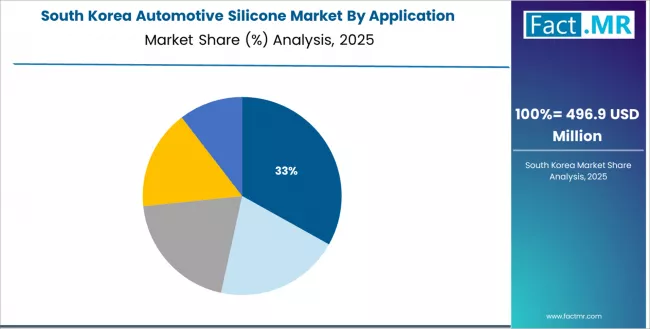
Automotive Silicone Market South Korea Market Share Analysis By Application | Source: Fact.MR
South Korea's automotive silicone market demonstrates advanced capabilities focused on battery technology and electric vehicle component manufacturing, with documented integration of specialized thermal interface materials achieving substantial improvement in battery cooling efficiency and power electronics reliability across electric vehicle applications.
The country maintains strong growth momentum with a CAGR of 8.2% through 2035, driven by leadership in lithium-ion battery production and electric vehicle component supply chains emphasizing material innovation and manufacturing excellence that align with Korean automotive and electronics industry standards.
Major manufacturing centers, including Ulsan, Gwangju, and Asan, showcase advanced adoption of automotive silicone protocols where battery thermal management materials integrate seamlessly with high-voltage electrical insulation systems and comprehensive vehicle electronics protection programs.
Key market characteristics:
- Battery manufacturing leadership driving demand for specialized thermal management silicones with emphasis on performance and safety optimization
- Electric vehicle component excellence enabling consistent export growth with comprehensive material qualification programs
- Technology collaboration between Korean chemical companies and automotive electronics manufacturers expanding formulation capabilities
- Emphasis on next-generation battery technologies and solid-state battery development addressing future material requirements
What Characterizes Brazil's Market Development?
In major automotive production centers including São Paulo, Rio de Janeiro, Curitiba, and Betim, the adoption of automotive silicone solutions is expanding across vehicle assembly facilities and aftermarket distribution channels, driven by increasing local content requirements and growing quality expectations from consumers. The market demonstrates solid growth potential with a CAGR of 6.2% through 2035, linked to comprehensive automotive industry modernization and increasing focus on export competitiveness and domestic market premium segment growth.
Brazilian automotive manufacturers are implementing improved material specifications and quality control processes to align with international standards while serving regional market requirements. The country's expanding middle class creates ongoing demand for vehicles with enhanced comfort and durability features, while growing aftermarket sector drives adoption of maintenance and repair silicone products for aging vehicle populations.
Key development areas:
- Local automotive production expansion leading silicone adoption with emphasis on light vehicle manufacturing and commercial vehicle production
- Aftermarket channel growth through distribution networks serving repair and maintenance applications providing accessible product availability
- Original equipment manufacturer partnerships supporting technology transfer and local material sourcing development
- Integration of South American automotive supply chains and regional manufacturing consolidation supporting demand growth
Europe Market Split by Country
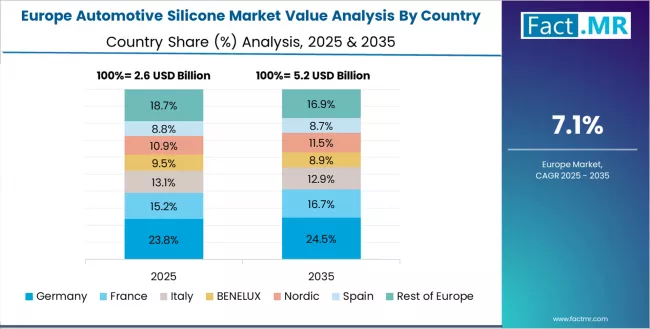
Automotive Silicone Market Europe Country Market Share Analysis, 2025 & 2035 | Source: Fact.MR
The automotive silicone market in Europe is projected to grow from USD 2.8 billion in 2025 to USD 6.4 billion by 2035, registering a CAGR of 8.6% over the forecast period. Germany is expected to maintain its leadership position with a 32.5% market share in 2025, adjusting to 31.8% by 2035, supported by its dominant premium automotive manufacturing base, comprehensive engineering capabilities, and advanced material qualification standards serving major European markets.
France follows with a 19.5% share in 2025, projected to reach 20.0% by 2035, driven by comprehensive electric vehicle development programs and automotive supplier network modernization in major production regions implementing advanced material technologies. UK holds a 16.5% share in 2025, expected to maintain 16.8% by 2035 through ongoing luxury vehicle manufacturing and electric vehicle battery production facility expansion.
Italy commands a 14.0% share, while Spain accounts for 11.5% in 2025. The rest of Europe region is anticipated to gain momentum, expanding its collective share from 6.0% to 6.9% by 2035, attributed to increasing automotive silicone adoption in Central European manufacturing facilities and emerging Eastern European automotive production hubs implementing modern material standards.
Competitive Landscape of the Automotive Silicone Market
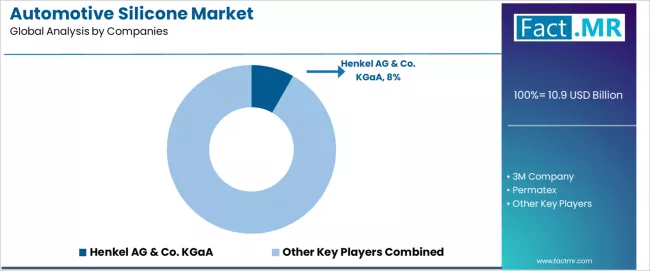
Automotive Silicone Market Analysis By Company | Source: Fact.MR
The automotive silicone market features approximately 15-20 meaningful players with moderate concentration, where the top three companies control roughly 20-30% of global market share through established automotive relationships, comprehensive product portfolios, and multi-region manufacturing capabilities. Competition centers on application engineering expertise, automotive certification achievements, and technical service capabilities rather than price competition alone.
Market leaders include Henkel AG & Co. KGaA with an 8.1% market share, along with 3M Company and Dow, which maintain competitive advantages through comprehensive automotive silicone product lines, global manufacturing footprints, and deep technical collaboration with original equipment manufacturers, creating high credibility among automotive engineers seeking reliable material solutions.
These companies leverage extensive automotive application experience and proprietary formulation technologies to defend market positions while expanding into adjacent categories including electric vehicle thermal management materials and autonomous vehicle sensor encapsulation systems.
Challengers encompass specialized silicone manufacturers including Wacker Chemie AG, Shin-Etsu Chemical Co., and Elkem ASA, which compete through focused product development and strong engagement with automotive tier-one suppliers through dedicated automotive business units and application engineering teams.
Chemical distributors and application specialists, including Permatex, Basildon Chemicals, and Specialty Silicone Products, focus on specific automotive segments or regional markets, offering differentiated capabilities in aftermarket applications, maintenance products, and specialized automotive assembly solutions.
Emerging material technology companies and regional silicone producers create competitive pressure through innovative formulation approaches and responsive customer service, particularly in high-growth markets including China and India, where local manufacturing presence provides advantages in automotive supply chain integration and cost-competitive positioning strategies.
Market dynamics favor companies that combine automotive-grade manufacturing quality with application development partnerships that address complete vehicle lifecycles from initial design validation through production ramp-up and field performance monitoring. Strategic emphasis on sustainability credentials, electric vehicle-specific solutions, and digital technical support platforms enables differentiation in increasingly competitive automotive materials segments across developed and emerging markets.
Recent Company Developments 2024 to 2025
- January 2025: KCC Silicone merged with Momentive Korea, strengthening global silicone portfolio and expanding automotive market presence through combined technical capabilities and manufacturing assets.
- June 2024: BRB Silicones launched BRB SF 1802, an aminoalkyl silicone specifically formulated for automotive maintenance applications, addressing aftermarket demand for specialized cleaning and protection products.
- 2025: Dow expanded electric vehicle-focused silicone manufacturing capacity in Asia Pacific region, responding to growing demand for battery thermal interface materials and high-voltage electrical insulation solutions.
Global Automotive Silicone Market — Stakeholder Contribution Framework
Automotive silicones represent a critical material category that enables vehicle manufacturers to achieve superior component performance and operational reliability while addressing extreme temperature conditions and stringent safety requirements without exclusive conventional polymer dependency, typically providing exceptional thermal resistance ranging from negative 60 to positive 300 degrees Celsius, outstanding electrical insulation properties for high-voltage systems, and superior weathering resistance compared to traditional rubber and plastic materials alone while ensuring improved vehicle durability and comprehensive performance outcomes.
With the market projected to grow from USD 10.9 billion in 2025 to USD 24.9 billion by 2035 at an 8.6% CAGR, these solutions offer compelling advantages for electric vehicle applications, thermal management systems, and diverse automotive platforms seeking advanced material performance. Scaling market penetration and automotive adoption requires coordinated action across material standards, application engineering, silicone manufacturers, automotive suppliers, and vehicle development programs.
How Could Governments Spur Local Development and Adoption?
- Automotive Industry Support: Include advanced materials in automotive competitiveness programs, providing targeted support for domestic silicone manufacturing capacity and supporting research institutions through development grants and application testing funding.
- Tax Policy & Investment Support: Implement reduced tax rates for automotive material manufacturers, provide tax incentives for companies investing in electric vehicle material technologies and sustainable production processes, and establish favorable import duty structures that encourage domestic silicone production over imported alternatives.
- Regulatory Framework Development: Create harmonized material qualification standards across automotive applications, establish clear performance specifications and testing protocols for electric vehicle components, and develop international standards alignment that facilitates cross-border material certification.
- Research & Innovation Support: Establish public-private partnerships for automotive material research, support academic-industry collaborations investigating next-generation silicone chemistries and application methodologies, and create funding mechanisms that encourage innovation in sustainable silicone production approaches.
- Supply Chain Resilience: Fund domestic raw material production capabilities, invest in silicon metal processing infrastructure, and support strategic material stockpiling for automotive supply chain security.
How Could Industry Bodies Support Market Development?
- Technical Standards & Specifications: Define standardized performance requirements for automotive silicone applications across thermal, electrical, and mechanical properties, establish universal testing protocols and qualification methodologies, and create material databases that automotive engineers can rely on for design decisions.
- Market Education & Best Practices: Lead messaging that demonstrates automotive silicone benefits, emphasizing performance advantages over alternative materials, application success stories, and total cost of ownership benefits compared to traditional material approaches.
- Quality Assurance Standards: Develop guidelines for manufacturing processes, raw material specifications, quality control requirements, and traceability protocols, ensuring consistent material performance across production batches and supply chain operations.
- Professional Development: Run certification programs for application engineers, automotive designers, and manufacturing technicians on optimizing silicone material selection, processing techniques, and troubleshooting methodologies in diverse automotive applications.
How Could Manufacturers and Technology Players Strengthen the Ecosystem?
- Advanced Product Development: Develop next-generation automotive silicone formulations with enhanced thermal conductivity, optimized electrical properties, and application-specific characteristics that improve vehicle performance while reducing component complexity and assembly costs.
- Technical Validation Programs: Provide comprehensive performance data, accelerated aging studies, and field validation results that support automotive engineer confidence and informed material selection aligned with vehicle development timelines.
- Application Engineering Support: Offer extensive technical assistance programs including material selection guidance, processing optimization support, and failure analysis capabilities that help automotive suppliers achieve successful material implementation.
- Research & Development Networks: Build comprehensive R&D capabilities, collaborative automotive partnerships, and advanced testing facilities that ensure automotive silicones maintain competitive performance standards and consistent quality across diverse vehicle platforms.
How Could Automotive Suppliers and Original Equipment Manufacturers Navigate the Market?
- Material Qualification Integration: Incorporate advanced silicone materials into component development programs, with particular focus on electric vehicle battery systems, thermal management applications, and high-voltage electrical components for comprehensive vehicle performance.
- Supply Chain Partnership Excellence: Establish long-term relationships with qualified silicone suppliers, implementing collaborative development agreements and capacity planning frameworks through optimized procurement strategies.
- Performance Validation Systems: Develop comprehensive material testing protocols, environmental exposure programs, and field performance monitoring that enable continuous material optimization and quality assurance.
- Technology Roadmap Alignment: Integrate material technology developments with vehicle platform planning, ensuring silicone solutions align with electrification timelines and autonomous driving technology deployment.
How Could Investors and Financial Enablers Unlock Value?
- Manufacturing Capacity Financing: Provide growth capital for established companies like Henkel, Dow, and Wacker to fund production line expansions and automotive-certified manufacturing investments that support increasing vehicle production demand.
- Innovation Investment: Back startups developing advanced silicone chemistries, bio-based alternatives, and specialty formulations that enhance automotive performance and environmental sustainability.
- Market Expansion Funding: Finance manufacturing localization strategies for silicone producers establishing operations in high-growth regions including India and Southeast Asia, supporting automotive supply chain development initiatives that address regional production requirements while maintaining quality standards.
- Technology Integration: Support companies developing smart material solutions, digital application platforms, and data-driven material selection tools that enhance automotive engineering productivity through technology-enabled material development.
Key Players in the Automotive Silicone Market
- Henkel AG & Co. KGaA
- 3M Company
- Permatex
- Elkem ASA
- Basildon Chemicals
- Specialty Silicone Products, Inc.
- Dow
- ACC Silicones Ltd.
- Wacker Chemie AG
- Shin-Etsu Chemical Co.
Segmentation
Scope of the Report
| Items | Values |
|---|---|
| Quantitative Units | USD 10.9 Billion |
| Product | Rubber, Adhesives & Sealants, Coatings, Other Products |
| Application | Interior & Exterior Parts, Engine & Drive Train System, Electrical System, Suspension System, Other Applications |
| Regions Covered | Asia Pacific, Europe, North America, Latin America, Middle East & Africa |
| Country Covered | China, India, USA, Germany, Japan, South Korea, Brazil, and 40+ countries |
| Key Companies Profiled | Henkel AG & Co. KGaA, 3M Company, Permatex, Elkem ASA, Basildon Chemicals, Specialty Silicone Products, Inc., Dow, ACC Silicones Ltd., Wacker Chemie AG, Shin-Etsu Chemical Co. |
| Additional Attributes | Dollar sales by product and application categories, regional adoption trends across Asia Pacific, Europe, and North America, competitive landscape with silicone manufacturers and automotive chemical suppliers, product specifications and performance requirements, integration with electric vehicle development programs and autonomous driving technologies, innovations in thermal management materials and electrical insulation systems, and development of specialized applications with bio-based silicone alternatives and sustainable manufacturing capabilities. |
Source: Fact.MR analysis. Updated Dec 11, 2025
Automotive Silicone Market by Segments
-
Product :
- Rubber
- Gaskets & Seals
- Hoses
- Vibration Components
- Adhesives & Sealants
- Body Sealing
- Electronics Bonding
- Coatings
- Other Products
- Rubber
-
Application :
- Interior & Exterior Parts
- Weatherstripping
- Trims
- Vibration Dampers
- Engine & Drive Train System
- Electrical System
- Wiring
- Sensors
- Connectors
- Suspension System
- Other Applications
- Interior & Exterior Parts
-
Region :
- Asia Pacific
- China
- Japan
- South Korea
- India
- Australia
- Thailand
- Rest of Asia Pacific
- Europe
- Germany
- UK
- France
- Italy
- Spain
- Denmark
- Sweden
- Norway
- Rest of Europe
- North America
- USA
- Canada
- Mexico
- Latin America
- Brazil
- Argentina
- Rest of Latin America
- Middle East & Africa
- South Africa
- Saudi Arabia
- UAE
- Kuwait
- Rest of Middle East & Africa
- Asia Pacific
Frequently Asked Questions
How big is the automotive silicone market in 2025?
What will be the size of automotive silicone market in 2035?
How much will be the automotive silicone market growth between 2025 and 2035?
What are the key product types in the automotive silicone market?
Which application segment to contribute significant share in the automotive silicone market in 2025?
Who worked on this report


Preview the report firsthand - request a free sample
Free SampleGet the brochure for pricing and purchase details
Download PDF