Automotive Foam Market
Automotive Foam Market Size and Share Forecast Outlook 2026 to 2036
Automotive foam market is projected to grow from USD 52.3 billion in 2026 to USD 72.1 billion by 2036, at a CAGR of 3.3%. Polyurethane Foam will dominate with a 42.0% market share, while interior (seating) will lead the application segment with a 38.0% share.
Automotive Foam Market Forecast and Outlook 2026 to 2036
The global automotive foam market is projected to reach USD 72.1 billion by 2036, recording an absolute increase of USD 19.8 billion over the forecast period. The market is valued at USD 52.3 billion in 2026 and is set to rise at a CAGR of 3.3% during the assessment period. The market size will grow 1.4x during the same period, supported by increasing demand from passenger car manufacturing and expanding applications in seating comfort systems across both developed and emerging automotive markets.
Key Takeaways from the Automotive Foam Market
- Automotive Foam Market Value (2026): USD 52.3 billion
- Automotive Foam Market Forecast Value (2036): USD 72.1 billion
- Automotive Foam Market Forecast CAGR: 3.3%
- Leading Product Type in Automotive Foam Market: Polyurethane Foam (42.0%)
- Key Growth Regions in Automotive Foam Market: Asia Pacific, North America, and Europe
- Top Players in Automotive Foam Market: BASF SE, Dow Inc., Huntsman Corporation, Recticel NV, Woodbridge Foam Corporation, Armacell, JSP Corporation, Rogers Corporation, Saint-Gobain, Covestro AG
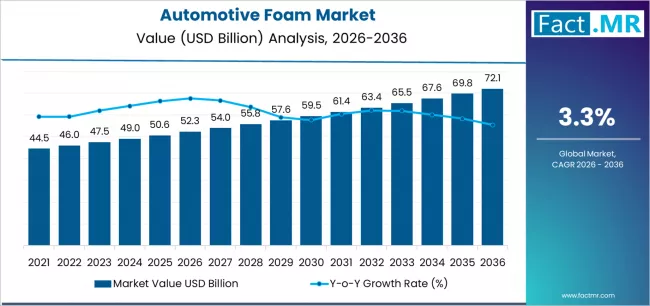
Rising automotive production in Asia Pacific nations, coupled with expanding lightweighting initiatives through advanced foam technologies and modern material engineering infrastructure, further accelerate market penetration across diverse vehicle segments. The growing global emphasis on vehicle comfort and acoustic performance, particularly in premium automotive applications and electric vehicle platforms, generates sustained requirements for high-performance foam materials and specialized cushioning solutions.
Technical advancements in polyurethane foam formulations demonstrating measurable improvements in durability, comfort characteristics, and weight reduction reinforce manufacturer confidence in automotive foam economics, while electric vehicle trends toward enhanced interior comfort and reduced cabin noise expand addressable market opportunities beyond traditional internal combustion engine vehicles into battery electric platforms.
Automotive Foam Market
| Metric | Value |
|---|---|
| Market Value (2026) | USD 52.3 billion |
| Market Forecast Value (2036) | USD 72.1 billion |
| Forecast CAGR (2026-2036) | 3.3% |
Category
| Category | Segments |
|---|---|
| Product Type | Polyurethane Foam; Polyolefin Foam; Others |
| Application | Interior Applications (Seating; Instrument Panels; Headliners; Door Panels and Water Shields; Seals, Gaskets and NVH; Others); Exterior Applications (Bumper Systems; Others) |
| Vehicle Type | Passenger Cars; Light Commercial Vehicles; Heavy Commercial Vehicles |
| End-Use | OEM; Aftermarket |
| Region | North America; Europe; Asia Pacific; Latin America; Middle East & Africa |
Segmental Analysis
What Makes Polyurethane Foam the Dominant Product Type in the Automotive Foam Market?
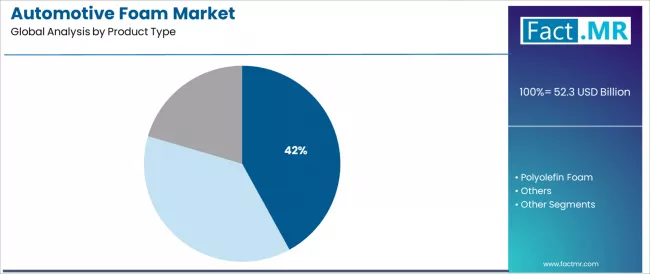
The polyurethane foam segment represents the dominant force in the automotive foam market, capturing approximately 42.0% of total market share in 2026. This established product category encompasses solutions featuring critical cushioning functionality for seating systems, headliners, and door panel applications, including flexible polyurethane formulations that enable superior comfort characteristics, excellent durability properties, and versatile processing capabilities across all automotive interior applications.
Key advantages driving the polyurethane foam segment include:
- Established manufacturing infrastructure with proven molding processes that reduce production complexity and ensure consistent component quality
- Superior comfort characteristics allowing optimal seating performance across different vehicle platforms without significant cost premiums
Which Application Category Leads Market Consumption in the Automotive Foam Market?
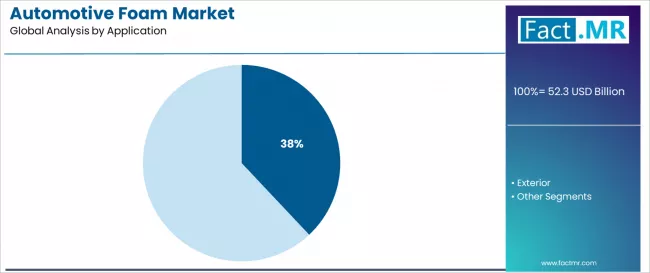
The seating segment represents the dominant application category in the automotive foam market, capturing approximately 38.0% of total market share in 2026. This leading application encompasses seat cushions, seat backs, and integrated headrest assemblies requiring comfortable support materials for driver and passenger accommodation across all vehicle types.
Which Vehicle Type Category Dominates in the Automotive Foam Market?
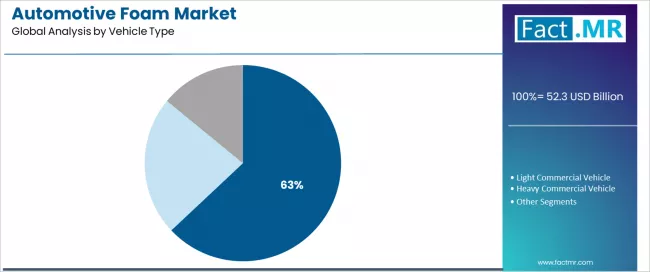
The passenger cars segment represents the dominant vehicle type in the automotive foam market, capturing approximately 63.0% of total market share in 2026. This leading vehicle category encompasses sedans, hatchbacks, SUVs, and crossover vehicles requiring comprehensive foam content for seating systems, interior trim, and acoustic management across global automotive production.
Which End-use Category Leads Market Consumption in the Automotive Foam Market?
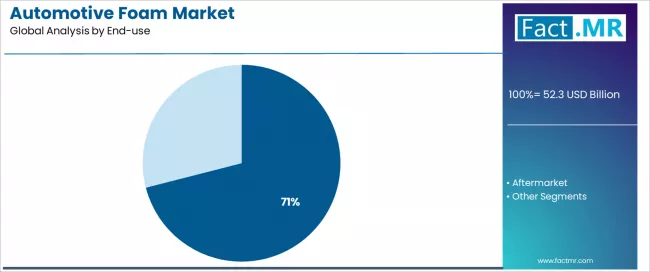
The OEM segment represents the dominant end-use category in the automotive foam market, capturing approximately 71.0% of total market share in 2026. This leading end-use encompasses original equipment manufacturing supply chains serving vehicle assembly operations through tier-one component suppliers and direct material providers for new vehicle production programs.
What are the Drivers, Restraints, and Key Trends of the Automotive Foam Market?
The automotive foam market is driven by rising global vehicle production, expanding manufacturing capacity, and increasing demand for interior comfort solutions. Growing electric vehicle adoption and interior design innovation are further increasing foam usage, particularly for seating, acoustic insulation, and vibration control. Advances in foam formulation chemistry and processing technologies are also enabling lightweighting solutions that reduce vehicle mass while maintaining durability and comfort performance.
Market restraints include volatile petrochemical raw material prices, particularly for isocyanates and polyols, which challenge stable pricing and production planning. Environmental regulations related to VOC emissions and end-of-life recycling add compliance costs and may require product reformulation. Competition from alternative materials such as advanced textiles and lightweight composites further pressures foam adoption, requiring continuous performance and cost validation.
Key trends include growing adoption of bio-based foam formulations in developed markets, driven by sustainability mandates. Manufacturers are also integrating automated dispensing, real-time density control, and quality monitoring systems to reduce waste and improve consistency. However, emerging seating technologies and alternative interior concepts could disrupt long-term demand.
Analysis of the Automotive Foam Market by Key Countries
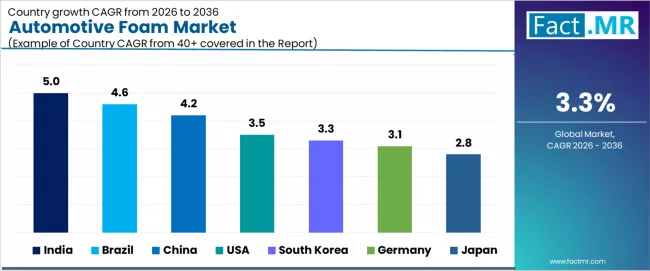
| Country | CAGR (2026-2036) |
|---|---|
| India | 5.0% |
| Brazil | 4.6% |
| China | 4.2% |
| USA | 3.5% |
| South Korea | 3.3% |
| Germany | 3.1% |
| Japan | 2.8% |
Why is India Leading Automotive Foam Demand through Manufacturing Expansion and Policy Support?
India records the highest growth rate at 5.0% CAGR through 2036, supported by rapid expansion in vehicle production and component manufacturing. Automotive hubs such as Chennai, Pune, Gujarat, and Haryana continue to attract OEM investments, strengthening foam consumption across passenger vehicles and commercial platforms. Demand is reinforced by a mature tier-one supplier ecosystem and deeper OEM-supplier integration.
Government initiatives under Make in India further support domestic component manufacturing, improving supply chain depth and technology adoption. Modern foam molding equipment and quality systems are increasingly standard across production facilities, aligning comfort, cost, and scale requirements.
How Is Brazil’s Automotive Foam Market Recovering Through Production Revival and Quality Upgrades?
Brazil is emerging as a recovery-driven market, growing at a 4.6% CAGR through 2036. Automotive activity is strengthening across São Paulo, Minas Gerais, and Rio Grande do Sul as vehicle output and domestic sales improve. Automakers are adopting foam materials to balance comfort expectations with cost-efficient manufacturing.
Industry restructuring has increased reliance on dependable component supply, while partnerships between international foam suppliers and domestic manufacturers are improving material quality and testing capabilities. As production volumes stabilize, foam adoption is increasingly tied to quality assurance and competitive positioning.
Why Does China Maintain Automotive Foam Growth Through Scale and Electric Vehicle Expansion?
China’s automotive foam market grows at a 4.2% CAGR, anchored in large-scale vehicle production and accelerating electric vehicle development. Manufacturing clusters in Shanghai, Guangzhou, and Changchun drive sustained material demand, particularly for interior comfort and acoustic performance.
EV platforms are increasing the need for lightweight and advanced foam solutions. While cost pressures remain, expanding production volumes and supply chain integration support steady adoption. Sustainability considerations and recyclable foam formulations are also gaining traction as regulatory and environmental expectations evolve.
How Is the USA Driving Automotive Foam Adoption Through Electric Vehicles and Lightweighting?
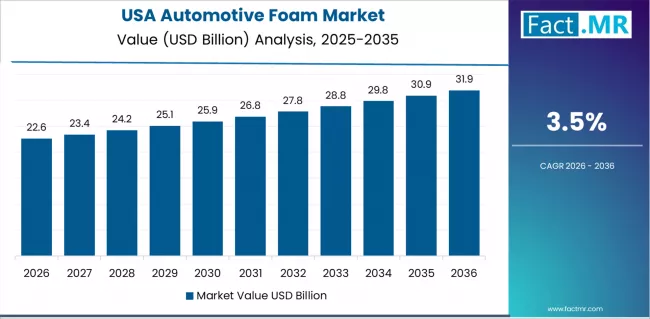
The US market expands at a 3.5% CAGR, shaped by strong electric vehicle programs and lightweighting priorities. Production centers in Michigan, Texas, Tennessee, and Kentucky are adopting advanced foam formulations to improve efficiency and comfort, particularly in EV platforms. Established tier-one supplier networks enable rapid material deployment aligned with OEM specifications. Collaboration between automotive engineers and material developers supports innovation in performance and sustainability, including recycled and low-emission foam systems.
Why Does South Korea’s Automotive Foam Market Benefit From Export-Led Manufacturing Strength?
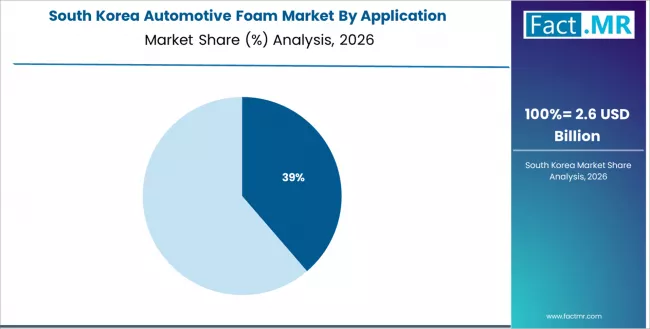
South Korea grows at a 3.3% CAGR, supported by export-oriented vehicle production in Ulsan, Seoul, and Gwangju. Automakers emphasize consistent foam quality to meet international certification and performance standards. Foam adoption is closely linked to comfort enhancement and manufacturing efficiency, both critical for global competitiveness. Long-standing relationships between Korean OEMs and global material suppliers strengthen technical support and process reliability. Cost control and quality assurance remain central to material selection strategies.
How Does Germany Sustain Automotive Foam Demand Through Premium Engineering and Comfort Focus?
Germany’s market expands at a 3.1% CAGR, driven by premium vehicle manufacturing and advanced engineering practices. Automotive regions such as Bavaria and Baden-Württemberg lead adoption of high-performance foam materials that support comfort, durability, and brand positioning. OEMs prioritize precision molding and rigorous testing, often developed through close collaboration with international material suppliers. Sustainability and regulatory compliance increasingly influence material choices, particularly in European supply chains.
Why Does Japan Emphasize Automotive Foam Quality Through Precision Manufacturing Systems?
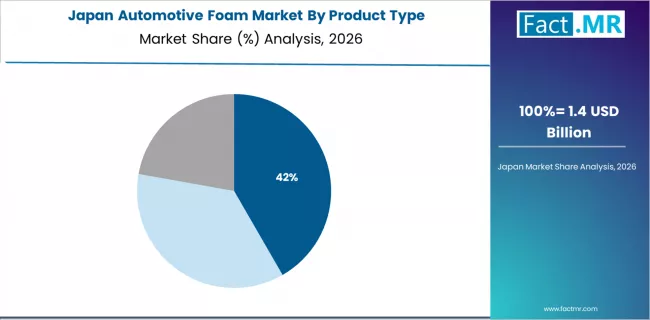
Japan records a 2.8% CAGR, reflecting stable demand rooted in quality-focused automotive production. Manufacturing centers such as Toyota City and Hiroshima integrate precision foam processes within highly controlled production environments. Automakers prioritize material consistency, reliability, and long-term performance, supported by strong partnerships with domestic foam suppliers. Continuous improvement practices and stringent inspection protocols reinforce steady foam adoption aligned with Japan’s manufacturing standards.
Competitive Landscape of the Automotive Foam Market
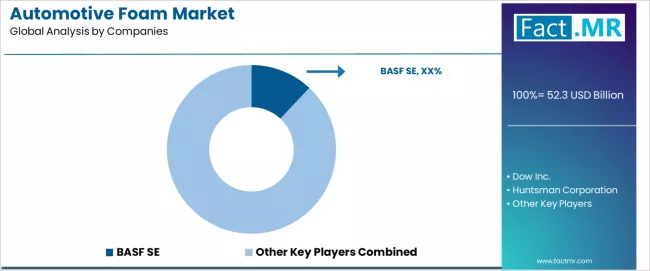
The automotive foam market comprises roughly 40–60 meaningful participants and shows moderate concentration, with leading producers controlling a significant share of global capacity through established OEM and tier-one supplier relationships. Market leaders such as BASF SE, Dow Inc., and Huntsman Corporation benefit from broad automotive foam portfolios, global manufacturing footprints, and long-standing expertise in polyurethane chemistry and foam processing. These strengths support stable customer relationships and ongoing expansion into electric vehicle and sustainability-focused applications.
Challenger companies including Recticel NV, Woodbridge Foam Corporation, and Covestro AG compete through specialized product offerings and strong regional positions in major automotive manufacturing hubs. Specialty suppliers such as Armacell, JSP Corporation, and Rogers Corporation focus on niche applications, including acoustic performance, advanced polymer formulations, and application-specific technical support. Saint-Gobain maintains competitiveness through diversified materials expertise and integrated automotive solutions.
Regional and emerging producers intensify competition, particularly in China and India, where localized production improves logistics efficiency and customer responsiveness. Competitive positioning increasingly depends on formulation innovation, quality management systems, and investments aligned with sustainability and regulatory requirements.
Key Players in the Automotive Foam Market
- BASF SE
- Dow Inc.
- Huntsman Corporation
- Recticel NV
- Woodbridge Foam Corporation
- Armacell
- JSP Corporation
- Rogers Corporation
- Saint-Gobain
- Covestro AG
Scope of the Report
| Items | Values |
|---|---|
| Quantitative Units | USD 52.3 Billion |
| Product Type | Polyurethane Foam, Polyolefin Foam, Others |
| Application | Interior (Seating, Instrument Panels, Headliners, Door Panels & Water Shields, Seals & Gaskets & NVH, Others), Exterior (Bumper System, Others) |
| Vehicle Type | Passenger Cars, Light Commercial Vehicle, Heavy Commercial Vehicle |
| End-use | OEM, Aftermarket |
| Regions Covered | North America, Europe, Asia Pacific, Latin America, MEA |
| Country Covered | India, Brazil, China, USA, South Korea, Germany, Japan, and 40+ countries |
| Key Companies Profiled | BASF SE, Dow Inc., Huntsman Corporation, Recticel NV, Woodbridge Foam Corporation, Armacell, JSP Corporation, Rogers Corporation, Saint-Gobain, Covestro AG |
| Additional Attributes | Dollar sales by product type, application, vehicle type, and end-use categories, regional production trends across Asia Pacific, Europe, and North America, competitive landscape with chemical producers and foam manufacturers, material specifications and performance requirements, integration with automotive assembly operations and component manufacturing systems. |
Automotive Foam Market by Segments
-
Product Type :
- Polyurethane Foam
- Polyolefin Foam
- Others
-
Application :
- Interior
- Seating
- Instrument Panels
- Headliners
- Door Panels & Water Shields
- Seals & Gaskets & NVH
- Others
- Exterior
- Bumper System
- Others
- Interior
-
Vehicle Type :
- Passenger Cars
- Light Commercial Vehicle
- Heavy Commercial Vehicle
-
End-use :
- OEM
- Aftermarket
-
Region :
- North America
- USA
- Canada
- Mexico
- Europe
- Germany
- France
- UK
- Spain
- Italy
- Rest of Europe
- Asia Pacific
- China
- India
- Japan
- South Korea
- Australia & New Zealand
- ASEAN
- Rest of Asia Pacific
- Latin America
- Brazil
- Rest of Latin America
- MEA
- Saudi Arabia
- Other GCC Countries
- Turkey
- South Africa
- Rest of MEA
- North America
Table of Content
- Executive Summary
- Global Market Outlook
- Demand to side Trends
- Supply to side Trends
- Technology Roadmap Analysis
- Analysis and Recommendations
- Market Overview
- Market Coverage / Taxonomy
- Market Definition / Scope / Limitations
- Market Background
- Market Dynamics
- Drivers
- Restraints
- Opportunity
- Trends
- Scenario Forecast
- Demand in Optimistic Scenario
- Demand in Likely Scenario
- Demand in Conservative Scenario
- Opportunity Map Analysis
- Product Life Cycle Analysis
- Supply Chain Analysis
- Investment Feasibility Matrix
- Value Chain Analysis
- PESTLE and Porter’s Analysis
- Regulatory Landscape
- Regional Parent Market Outlook
- Production and Consumption Statistics
- Import and Export Statistics
- Market Dynamics
- Global Market Analysis 2021 to 2025 and Forecast, 2026 to 2036
- Historical Market Size Value (USD Million) Analysis, 2021 to 2025
- Current and Future Market Size Value (USD Million) Projections, 2026 to 2036
- Y to o to Y Growth Trend Analysis
- Absolute $ Opportunity Analysis
- Global Market Pricing Analysis 2021 to 2025 and Forecast 2026 to 2036
- Global Market Analysis 2021 to 2025 and Forecast 2026 to 2036, By Product Type
- Introduction / Key Findings
- Historical Market Size Value (USD Million) Analysis By Product Type, 2021 to 2025
- Current and Future Market Size Value (USD Million) Analysis and Forecast By Product Type, 2026 to 2036
- Polyurethane Foam
- Polyolefin Foam
- Others
- Y to o to Y Growth Trend Analysis By Product Type, 2021 to 2025
- Absolute $ Opportunity Analysis By Product Type, 2026 to 2036
- Global Market Analysis 2021 to 2025 and Forecast 2026 to 2036, By Application
- Introduction / Key Findings
- Historical Market Size Value (USD Million) Analysis By Application, 2021 to 2025
- Current and Future Market Size Value (USD Million) Analysis and Forecast By Application, 2026 to 2036
- Interior (Seating)
- Exterior
- Y to o to Y Growth Trend Analysis By Application, 2021 to 2025
- Absolute $ Opportunity Analysis By Application, 2026 to 2036
- Global Market Analysis 2021 to 2025 and Forecast 2026 to 2036, By Vehicle Type
- Introduction / Key Findings
- Historical Market Size Value (USD Million) Analysis By Vehicle Type, 2021 to 2025
- Current and Future Market Size Value (USD Million) Analysis and Forecast By Vehicle Type, 2026 to 2036
- Passenger Cars
- Light Commercial Vehicle
- Heavy Commercial Vehicle
- Y to o to Y Growth Trend Analysis By Vehicle Type, 2021 to 2025
- Absolute $ Opportunity Analysis By Vehicle Type, 2026 to 2036
- Global Market Analysis 2021 to 2025 and Forecast 2026 to 2036, By End-use
- Introduction / Key Findings
- Historical Market Size Value (USD Million) Analysis By End-use, 2021 to 2025
- Current and Future Market Size Value (USD Million) Analysis and Forecast By End-use, 2026 to 2036
- OEM
- Aftermarket
- Y to o to Y Growth Trend Analysis By End-use, 2021 to 2025
- Absolute $ Opportunity Analysis By End-use, 2026 to 2036
- Global Market Analysis 2021 to 2025 and Forecast 2026 to 2036, By Region
- Introduction
- Historical Market Size Value (USD Million) Analysis By Region, 2021 to 2025
- Current Market Size Value (USD Million) Analysis and Forecast By Region, 2026 to 2036
- North America
- Latin America
- Western Europe
- Eastern Europe
- East Asia
- South Asia and Pacific
- Middle East & Africa
- Market Attractiveness Analysis By Region
- North America Market Analysis 2021 to 2025 and Forecast 2026 to 2036, By Country
- Historical Market Size Value (USD Million) Trend Analysis By Market Taxonomy, 2021 to 2025
- Market Size Value (USD Million) Forecast By Market Taxonomy, 2026 to 2036
- By Country
- USA
- Canada
- Mexico
- By Product Type
- By Application
- By Vehicle Type
- By End-use
- By Country
- Market Attractiveness Analysis
- By Country
- By Product Type
- By Application
- By Vehicle Type
- By End-use
- Key Takeaways
- Latin America Market Analysis 2021 to 2025 and Forecast 2026 to 2036, By Country
- Historical Market Size Value (USD Million) Trend Analysis By Market Taxonomy, 2021 to 2025
- Market Size Value (USD Million) Forecast By Market Taxonomy, 2026 to 2036
- By Country
- Brazil
- Chile
- Rest of Latin America
- By Product Type
- By Application
- By Vehicle Type
- By End-use
- By Country
- Market Attractiveness Analysis
- By Country
- By Product Type
- By Application
- By Vehicle Type
- By End-use
- Key Takeaways
- Western Europe Market Analysis 2021 to 2025 and Forecast 2026 to 2036, By Country
- Historical Market Size Value (USD Million) Trend Analysis By Market Taxonomy, 2021 to 2025
- Market Size Value (USD Million) Forecast By Market Taxonomy, 2026 to 2036
- By Country
- Germany
- UK
- Italy
- Spain
- France
- Nordic
- BENELUX
- Rest of Western Europe
- By Product Type
- By Application
- By Vehicle Type
- By End-use
- By Country
- Market Attractiveness Analysis
- By Country
- By Product Type
- By Application
- By Vehicle Type
- By End-use
- Key Takeaways
- Eastern Europe Market Analysis 2021 to 2025 and Forecast 2026 to 2036, By Country
- Historical Market Size Value (USD Million) Trend Analysis By Market Taxonomy, 2021 to 2025
- Market Size Value (USD Million) Forecast By Market Taxonomy, 2026 to 2036
- By Country
- Russia
- Poland
- Hungary
- Balkan & Baltic
- Rest of Eastern Europe
- By Product Type
- By Application
- By Vehicle Type
- By End-use
- By Country
- Market Attractiveness Analysis
- By Country
- By Product Type
- By Application
- By Vehicle Type
- By End-use
- Key Takeaways
- East Asia Market Analysis 2021 to 2025 and Forecast 2026 to 2036, By Country
- Historical Market Size Value (USD Million) Trend Analysis By Market Taxonomy, 2021 to 2025
- Market Size Value (USD Million) Forecast By Market Taxonomy, 2026 to 2036
- By Country
- China
- Japan
- South Korea
- By Product Type
- By Application
- By Vehicle Type
- By End-use
- By Country
- Market Attractiveness Analysis
- By Country
- By Product Type
- By Application
- By Vehicle Type
- By End-use
- Key Takeaways
- South Asia and Pacific Market Analysis 2021 to 2025 and Forecast 2026 to 2036, By Country
- Historical Market Size Value (USD Million) Trend Analysis By Market Taxonomy, 2021 to 2025
- Market Size Value (USD Million) Forecast By Market Taxonomy, 2026 to 2036
- By Country
- India
- ASEAN
- Australia & New Zealand
- Rest of South Asia and Pacific
- By Product Type
- By Application
- By Vehicle Type
- By End-use
- By Country
- Market Attractiveness Analysis
- By Country
- By Product Type
- By Application
- By Vehicle Type
- By End-use
- Key Takeaways
- Middle East & Africa Market Analysis 2021 to 2025 and Forecast 2026 to 2036, By Country
- Historical Market Size Value (USD Million) Trend Analysis By Market Taxonomy, 2021 to 2025
- Market Size Value (USD Million) Forecast By Market Taxonomy, 2026 to 2036
- By Country
- Kingdom of Saudi Arabia
- Other GCC Countries
- Turkiye
- South Africa
- Other African Union
- Rest of Middle East & Africa
- By Product Type
- By Application
- By Vehicle Type
- By End-use
- By Country
- Market Attractiveness Analysis
- By Country
- By Product Type
- By Application
- By Vehicle Type
- By End-use
- Key Takeaways
- Key Countries Market Analysis
- USA
- Pricing Analysis
- Market Share Analysis, 2025
- By Product Type
- By Application
- By Vehicle Type
- By End-use
- Canada
- Pricing Analysis
- Market Share Analysis, 2025
- By Product Type
- By Application
- By Vehicle Type
- By End-use
- Mexico
- Pricing Analysis
- Market Share Analysis, 2025
- By Product Type
- By Application
- By Vehicle Type
- By End-use
- Brazil
- Pricing Analysis
- Market Share Analysis, 2025
- By Product Type
- By Application
- By Vehicle Type
- By End-use
- Chile
- Pricing Analysis
- Market Share Analysis, 2025
- By Product Type
- By Application
- By Vehicle Type
- By End-use
- Germany
- Pricing Analysis
- Market Share Analysis, 2025
- By Product Type
- By Application
- By Vehicle Type
- By End-use
- UK
- Pricing Analysis
- Market Share Analysis, 2025
- By Product Type
- By Application
- By Vehicle Type
- By End-use
- Italy
- Pricing Analysis
- Market Share Analysis, 2025
- By Product Type
- By Application
- By Vehicle Type
- By End-use
- Spain
- Pricing Analysis
- Market Share Analysis, 2025
- By Product Type
- By Application
- By Vehicle Type
- By End-use
- France
- Pricing Analysis
- Market Share Analysis, 2025
- By Product Type
- By Application
- By Vehicle Type
- By End-use
- India
- Pricing Analysis
- Market Share Analysis, 2025
- By Product Type
- By Application
- By Vehicle Type
- By End-use
- ASEAN
- Pricing Analysis
- Market Share Analysis, 2025
- By Product Type
- By Application
- By Vehicle Type
- By End-use
- Australia & New Zealand
- Pricing Analysis
- Market Share Analysis, 2025
- By Product Type
- By Application
- By Vehicle Type
- By End-use
- China
- Pricing Analysis
- Market Share Analysis, 2025
- By Product Type
- By Application
- By Vehicle Type
- By End-use
- Japan
- Pricing Analysis
- Market Share Analysis, 2025
- By Product Type
- By Application
- By Vehicle Type
- By End-use
- South Korea
- Pricing Analysis
- Market Share Analysis, 2025
- By Product Type
- By Application
- By Vehicle Type
- By End-use
- Russia
- Pricing Analysis
- Market Share Analysis, 2025
- By Product Type
- By Application
- By Vehicle Type
- By End-use
- Poland
- Pricing Analysis
- Market Share Analysis, 2025
- By Product Type
- By Application
- By Vehicle Type
- By End-use
- Hungary
- Pricing Analysis
- Market Share Analysis, 2025
- By Product Type
- By Application
- By Vehicle Type
- By End-use
- Kingdom of Saudi Arabia
- Pricing Analysis
- Market Share Analysis, 2025
- By Product Type
- By Application
- By Vehicle Type
- By End-use
- Turkiye
- Pricing Analysis
- Market Share Analysis, 2025
- By Product Type
- By Application
- By Vehicle Type
- By End-use
- South Africa
- Pricing Analysis
- Market Share Analysis, 2025
- By Product Type
- By Application
- By Vehicle Type
- By End-use
- USA
- Market Structure Analysis
- Competition Dashboard
- Competition Benchmarking
- Market Share Analysis of Top Players
- By Regional
- By Product Type
- By Application
- By Vehicle Type
- By End-use
- Competition Analysis
- Competition Deep Dive
- BASF SE
- Overview
- Product Portfolio
- Profitability by Market Segments (Product/Age /Sales Channel/Region)
- Sales Footprint
- Strategy Overview
- Marketing Strategy
- Product Strategy
- Channel Strategy
- Dow Inc.
- Huntsman Corporation
- Recticel NV
- Woodbridge Foam Corporation
- Armacell
- JSP Corporation
- Rogers Corporation
- Saint-Gobain
- Covestro AG
- BASF SE
- Competition Deep Dive
- Assumptions & Acronyms Used
- Research Methodology
List Of Table
- Table 1: Global Market Value (USD Million) Forecast by Region, 2021 to 2036
- Table 2: Global Market Value (USD Million) Forecast by Product Type, 2021 to 2036
- Table 3: Global Market Value (USD Million) Forecast by Application, 2021 to 2036
- Table 4: Global Market Value (USD Million) Forecast by Vehicle Type, 2021 to 2036
- Table 5: Global Market Value (USD Million) Forecast by End-use, 2021 to 2036
- Table 6: North America Market Value (USD Million) Forecast by Country, 2021 to 2036
- Table 7: North America Market Value (USD Million) Forecast by Product Type, 2021 to 2036
- Table 8: North America Market Value (USD Million) Forecast by Application, 2021 to 2036
- Table 9: North America Market Value (USD Million) Forecast by Vehicle Type, 2021 to 2036
- Table 10: North America Market Value (USD Million) Forecast by End-use, 2021 to 2036
- Table 11: Latin America Market Value (USD Million) Forecast by Country, 2021 to 2036
- Table 12: Latin America Market Value (USD Million) Forecast by Product Type, 2021 to 2036
- Table 13: Latin America Market Value (USD Million) Forecast by Application, 2021 to 2036
- Table 14: Latin America Market Value (USD Million) Forecast by Vehicle Type, 2021 to 2036
- Table 15: Latin America Market Value (USD Million) Forecast by End-use, 2021 to 2036
- Table 16: Western Europe Market Value (USD Million) Forecast by Country, 2021 to 2036
- Table 17: Western Europe Market Value (USD Million) Forecast by Product Type, 2021 to 2036
- Table 18: Western Europe Market Value (USD Million) Forecast by Application, 2021 to 2036
- Table 19: Western Europe Market Value (USD Million) Forecast by Vehicle Type, 2021 to 2036
- Table 20: Western Europe Market Value (USD Million) Forecast by End-use, 2021 to 2036
- Table 21: Eastern Europe Market Value (USD Million) Forecast by Country, 2021 to 2036
- Table 22: Eastern Europe Market Value (USD Million) Forecast by Product Type, 2021 to 2036
- Table 23: Eastern Europe Market Value (USD Million) Forecast by Application, 2021 to 2036
- Table 24: Eastern Europe Market Value (USD Million) Forecast by Vehicle Type, 2021 to 2036
- Table 25: Eastern Europe Market Value (USD Million) Forecast by End-use, 2021 to 2036
- Table 26: East Asia Market Value (USD Million) Forecast by Country, 2021 to 2036
- Table 27: East Asia Market Value (USD Million) Forecast by Product Type, 2021 to 2036
- Table 28: East Asia Market Value (USD Million) Forecast by Application, 2021 to 2036
- Table 29: East Asia Market Value (USD Million) Forecast by Vehicle Type, 2021 to 2036
- Table 30: East Asia Market Value (USD Million) Forecast by End-use, 2021 to 2036
- Table 31: South Asia and Pacific Market Value (USD Million) Forecast by Country, 2021 to 2036
- Table 32: South Asia and Pacific Market Value (USD Million) Forecast by Product Type, 2021 to 2036
- Table 33: South Asia and Pacific Market Value (USD Million) Forecast by Application, 2021 to 2036
- Table 34: South Asia and Pacific Market Value (USD Million) Forecast by Vehicle Type, 2021 to 2036
- Table 35: South Asia and Pacific Market Value (USD Million) Forecast by End-use, 2021 to 2036
- Table 36: Middle East & Africa Market Value (USD Million) Forecast by Country, 2021 to 2036
- Table 37: Middle East & Africa Market Value (USD Million) Forecast by Product Type, 2021 to 2036
- Table 38: Middle East & Africa Market Value (USD Million) Forecast by Application, 2021 to 2036
- Table 39: Middle East & Africa Market Value (USD Million) Forecast by Vehicle Type, 2021 to 2036
- Table 40: Middle East & Africa Market Value (USD Million) Forecast by End-use, 2021 to 2036
List Of Figures
- Figure 1: Global Market Pricing Analysis
- Figure 2: Global Market Value (USD Million) Forecast 2021 to 2036
- Figure 3: Global Market Value Share and BPS Analysis by Product Type, 2026 and 2036
- Figure 4: Global Market Y to o to Y Growth Comparison by Product Type, 2026 to 2036
- Figure 5: Global Market Attractiveness Analysis by Product Type
- Figure 6: Global Market Value Share and BPS Analysis by Application, 2026 and 2036
- Figure 7: Global Market Y to o to Y Growth Comparison by Application, 2026 to 2036
- Figure 8: Global Market Attractiveness Analysis by Application
- Figure 9: Global Market Value Share and BPS Analysis by Vehicle Type, 2026 and 2036
- Figure 10: Global Market Y to o to Y Growth Comparison by Vehicle Type, 2026 to 2036
- Figure 11: Global Market Attractiveness Analysis by Vehicle Type
- Figure 12: Global Market Value Share and BPS Analysis by End-use, 2026 and 2036
- Figure 13: Global Market Y to o to Y Growth Comparison by End-use, 2026 to 2036
- Figure 14: Global Market Attractiveness Analysis by End-use
- Figure 15: Global Market Value (USD Million) Share and BPS Analysis by Region, 2026 and 2036
- Figure 16: Global Market Y to o to Y Growth Comparison by Region, 2026 to 2036
- Figure 17: Global Market Attractiveness Analysis by Region
- Figure 18: North America Market Incremental Dollar Opportunity, 2026 to 2036
- Figure 19: Latin America Market Incremental Dollar Opportunity, 2026 to 2036
- Figure 20: Western Europe Market Incremental Dollar Opportunity, 2026 to 2036
- Figure 21: Eastern Europe Market Incremental Dollar Opportunity, 2026 to 2036
- Figure 22: East Asia Market Incremental Dollar Opportunity, 2026 to 2036
- Figure 23: South Asia and Pacific Market Incremental Dollar Opportunity, 2026 to 2036
- Figure 24: Middle East & Africa Market Incremental Dollar Opportunity, 2026 to 2036
- Figure 25: North America Market Value Share and BPS Analysis by Country, 2026 and 2036
- Figure 26: North America Market Value Share and BPS Analysis by Product Type, 2026 and 2036
- Figure 27: North America Market Y to o to Y Growth Comparison by Product Type, 2026 to 2036
- Figure 28: North America Market Attractiveness Analysis by Product Type
- Figure 29: North America Market Value Share and BPS Analysis by Application, 2026 and 2036
- Figure 30: North America Market Y to o to Y Growth Comparison by Application, 2026 to 2036
- Figure 31: North America Market Attractiveness Analysis by Application
- Figure 32: North America Market Value Share and BPS Analysis by Vehicle Type, 2026 and 2036
- Figure 33: North America Market Y to o to Y Growth Comparison by Vehicle Type, 2026 to 2036
- Figure 34: North America Market Attractiveness Analysis by Vehicle Type
- Figure 35: North America Market Value Share and BPS Analysis by End-use, 2026 and 2036
- Figure 36: North America Market Y to o to Y Growth Comparison by End-use, 2026 to 2036
- Figure 37: North America Market Attractiveness Analysis by End-use
- Figure 38: Latin America Market Value Share and BPS Analysis by Country, 2026 and 2036
- Figure 39: Latin America Market Value Share and BPS Analysis by Product Type, 2026 and 2036
- Figure 40: Latin America Market Y to o to Y Growth Comparison by Product Type, 2026 to 2036
- Figure 41: Latin America Market Attractiveness Analysis by Product Type
- Figure 42: Latin America Market Value Share and BPS Analysis by Application, 2026 and 2036
- Figure 43: Latin America Market Y to o to Y Growth Comparison by Application, 2026 to 2036
- Figure 44: Latin America Market Attractiveness Analysis by Application
- Figure 45: Latin America Market Value Share and BPS Analysis by Vehicle Type, 2026 and 2036
- Figure 46: Latin America Market Y to o to Y Growth Comparison by Vehicle Type, 2026 to 2036
- Figure 47: Latin America Market Attractiveness Analysis by Vehicle Type
- Figure 48: Latin America Market Value Share and BPS Analysis by End-use, 2026 and 2036
- Figure 49: Latin America Market Y to o to Y Growth Comparison by End-use, 2026 to 2036
- Figure 50: Latin America Market Attractiveness Analysis by End-use
- Figure 51: Western Europe Market Value Share and BPS Analysis by Country, 2026 and 2036
- Figure 52: Western Europe Market Value Share and BPS Analysis by Product Type, 2026 and 2036
- Figure 53: Western Europe Market Y to o to Y Growth Comparison by Product Type, 2026 to 2036
- Figure 54: Western Europe Market Attractiveness Analysis by Product Type
- Figure 55: Western Europe Market Value Share and BPS Analysis by Application, 2026 and 2036
- Figure 56: Western Europe Market Y to o to Y Growth Comparison by Application, 2026 to 2036
- Figure 57: Western Europe Market Attractiveness Analysis by Application
- Figure 58: Western Europe Market Value Share and BPS Analysis by Vehicle Type, 2026 and 2036
- Figure 59: Western Europe Market Y to o to Y Growth Comparison by Vehicle Type, 2026 to 2036
- Figure 60: Western Europe Market Attractiveness Analysis by Vehicle Type
- Figure 61: Western Europe Market Value Share and BPS Analysis by End-use, 2026 and 2036
- Figure 62: Western Europe Market Y to o to Y Growth Comparison by End-use, 2026 to 2036
- Figure 63: Western Europe Market Attractiveness Analysis by End-use
- Figure 64: Eastern Europe Market Value Share and BPS Analysis by Country, 2026 and 2036
- Figure 65: Eastern Europe Market Value Share and BPS Analysis by Product Type, 2026 and 2036
- Figure 66: Eastern Europe Market Y to o to Y Growth Comparison by Product Type, 2026 to 2036
- Figure 67: Eastern Europe Market Attractiveness Analysis by Product Type
- Figure 68: Eastern Europe Market Value Share and BPS Analysis by Application, 2026 and 2036
- Figure 69: Eastern Europe Market Y to o to Y Growth Comparison by Application, 2026 to 2036
- Figure 70: Eastern Europe Market Attractiveness Analysis by Application
- Figure 71: Eastern Europe Market Value Share and BPS Analysis by Vehicle Type, 2026 and 2036
- Figure 72: Eastern Europe Market Y to o to Y Growth Comparison by Vehicle Type, 2026 to 2036
- Figure 73: Eastern Europe Market Attractiveness Analysis by Vehicle Type
- Figure 74: Eastern Europe Market Value Share and BPS Analysis by End-use, 2026 and 2036
- Figure 75: Eastern Europe Market Y to o to Y Growth Comparison by End-use, 2026 to 2036
- Figure 76: Eastern Europe Market Attractiveness Analysis by End-use
- Figure 77: East Asia Market Value Share and BPS Analysis by Country, 2026 and 2036
- Figure 78: East Asia Market Value Share and BPS Analysis by Product Type, 2026 and 2036
- Figure 79: East Asia Market Y to o to Y Growth Comparison by Product Type, 2026 to 2036
- Figure 80: East Asia Market Attractiveness Analysis by Product Type
- Figure 81: East Asia Market Value Share and BPS Analysis by Application, 2026 and 2036
- Figure 82: East Asia Market Y to o to Y Growth Comparison by Application, 2026 to 2036
- Figure 83: East Asia Market Attractiveness Analysis by Application
- Figure 84: East Asia Market Value Share and BPS Analysis by Vehicle Type, 2026 and 2036
- Figure 85: East Asia Market Y to o to Y Growth Comparison by Vehicle Type, 2026 to 2036
- Figure 86: East Asia Market Attractiveness Analysis by Vehicle Type
- Figure 87: East Asia Market Value Share and BPS Analysis by End-use, 2026 and 2036
- Figure 88: East Asia Market Y to o to Y Growth Comparison by End-use, 2026 to 2036
- Figure 89: East Asia Market Attractiveness Analysis by End-use
- Figure 90: South Asia and Pacific Market Value Share and BPS Analysis by Country, 2026 and 2036
- Figure 91: South Asia and Pacific Market Value Share and BPS Analysis by Product Type, 2026 and 2036
- Figure 92: South Asia and Pacific Market Y to o to Y Growth Comparison by Product Type, 2026 to 2036
- Figure 93: South Asia and Pacific Market Attractiveness Analysis by Product Type
- Figure 94: South Asia and Pacific Market Value Share and BPS Analysis by Application, 2026 and 2036
- Figure 95: South Asia and Pacific Market Y to o to Y Growth Comparison by Application, 2026 to 2036
- Figure 96: South Asia and Pacific Market Attractiveness Analysis by Application
- Figure 97: South Asia and Pacific Market Value Share and BPS Analysis by Vehicle Type, 2026 and 2036
- Figure 98: South Asia and Pacific Market Y to o to Y Growth Comparison by Vehicle Type, 2026 to 2036
- Figure 99: South Asia and Pacific Market Attractiveness Analysis by Vehicle Type
- Figure 100: South Asia and Pacific Market Value Share and BPS Analysis by End-use, 2026 and 2036
- Figure 101: South Asia and Pacific Market Y to o to Y Growth Comparison by End-use, 2026 to 2036
- Figure 102: South Asia and Pacific Market Attractiveness Analysis by End-use
- Figure 103: Middle East & Africa Market Value Share and BPS Analysis by Country, 2026 and 2036
- Figure 104: Middle East & Africa Market Value Share and BPS Analysis by Product Type, 2026 and 2036
- Figure 105: Middle East & Africa Market Y to o to Y Growth Comparison by Product Type, 2026 to 2036
- Figure 106: Middle East & Africa Market Attractiveness Analysis by Product Type
- Figure 107: Middle East & Africa Market Value Share and BPS Analysis by Application, 2026 and 2036
- Figure 108: Middle East & Africa Market Y to o to Y Growth Comparison by Application, 2026 to 2036
- Figure 109: Middle East & Africa Market Attractiveness Analysis by Application
- Figure 110: Middle East & Africa Market Value Share and BPS Analysis by Vehicle Type, 2026 and 2036
- Figure 111: Middle East & Africa Market Y to o to Y Growth Comparison by Vehicle Type, 2026 to 2036
- Figure 112: Middle East & Africa Market Attractiveness Analysis by Vehicle Type
- Figure 113: Middle East & Africa Market Value Share and BPS Analysis by End-use, 2026 and 2036
- Figure 114: Middle East & Africa Market Y to o to Y Growth Comparison by End-use, 2026 to 2036
- Figure 115: Middle East & Africa Market Attractiveness Analysis by End-use
- Figure 116: Global Market - Tier Structure Analysis
- Figure 117: Global Market - Company Share Analysis
- FAQs -
How big is the automotive foam market in 2026?
The global automotive foam market is estimated to be valued at USD 52.3 billion in 2026.
What will be the size of automotive foam market in 2036?
The market size for the automotive foam market is projected to reach USD 72.1 billion by 2036.
How much will be the automotive foam market growth between 2026 and 2036?
The automotive foam market is expected to grow at a 3.3% CAGR between 2026 and 2036.
What are the key product types in the automotive foam market?
The key product types in automotive foam market are polyurethane foam, polyolefin foam and others.
Which application segment to contribute significant share in the automotive foam market in 2026?
In terms of application, interior (seating) segment to command 38.0% share in the automotive foam market in 2026.