- Base Value(2025): 32.4 Bn
- Estimated Value(2025): 32.4 Bn
- Forecast Value (2035): 55.8 Bn
- CAGR (2025 - 2035): 5.6%
Automotive Alternator & Starter Motor Market Forecast and Outlook 2025 to 2035
The global automotive alternator & starter motor market is projected to reach USD 55.8 billion by 2035, recording an absolute increase of USD 23.5 billion over the forecast period. The market is valued at USD 32.4 billion in 2025 and is set to rise at a CAGR of 5.6% during the assessment period.
Demand for automotive alternators & starter motors is expected to grow by 1.7 times during the same period, supported by increasing global vehicle production volumes and expanding aftermarket replacement demand across both passenger and commercial vehicle segments.
Growing adoption of start-stop technology systems, expanding electrical content requirements in modern vehicles, and advancing electrification trends in conventional powertrains creates expanding opportunities for enhanced alternator capabilities and durable starter motor innovations.
Quick Stats for Automotive Alternator & Starter Motor Market
- Automotive Alternator & Starter Motor Market Value (2025): USD 32.4 billion
- Automotive Alternator & Starter Motor Market Forecast Value (2035): USD 55.8 billion
- Automotive Alternator & Starter Motor Market Forecast CAGR: 5.6%
- Leading Product Segment in Automotive Alternator & Starter Motor Market: Starter Motors (55.0%)
- Key Growth Regions in Automotive Alternator & Starter Motor Market: Asia Pacific, North America, and Europe
- Top Players in Automotive Alternator & Starter Motor Market: Denso Corporation, Valeo Group, Bosch Mobility (Robert Bosch GmbH), Mitsubishi Electric Corporation, Hitachi Astemo Ltd., Prestolite Electric (Broad-Ocean), SEG Automotive, Delco Remy (BorgWarner Inc.), MAHLE Group, Lucas TVS Ltd.
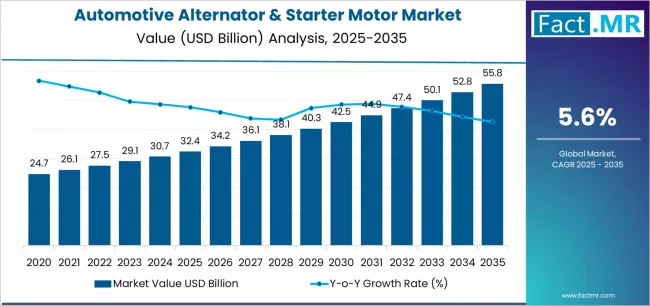
Automotive Alternator & Starter Motor Market Market Value Analysis | Source: Fact.MR
Rising vehicle parc expansion globally, coupled with increasing automotive manufacturing capacity through modern assembly facilities and integrated component supply chains, further accelerate market penetration across diverse vehicle categories. The growing automotive industry demand for reliable electrical power generation, particularly in feature-rich passenger vehicles and heavy-duty commercial applications, generates requirements for high-output alternators and robust starting systems.
Technical advancements in alternator efficiency technologies demonstrating measurable improvements in power density, thermal management, and fuel economy contribution reinforce manufacturer confidence in electrical system economics, while vehicle electrification trends toward mild hybrid architectures expand addressable market opportunities beyond traditional 12-volt systems into higher voltage platforms and integrated starter-generator configurations.
Vehicle manufacturers and aftermarket service providers increasingly incorporate advanced alternators and starter motors into vehicle specifications, replacement programs, and performance upgrade offerings, creating mainstream adoption channels that extend beyond original equipment applications into comprehensive aftermarket distribution networks.
However, accelerating electric vehicle adoption and increasing hybrid powertrain penetration may pose challenges to long-term market expansion. Supply chain complexity for copper windings and permanent magnet materials in certain regions also influences production economics, requiring manufacturers to develop optimized sourcing strategies catering to specific operational requirements across different geographical markets.
Technology transition complexity during mild hybrid integration and the component requirements for regenerative braking compatibility and voltage stability management may create adaptation challenges for traditional alternator and starter motor suppliers in developing regions with limited infrastructure for advanced electrical system development and validation capabilities.
Automotive Alternator & Starter Motor Market Year-over-Year Forecast 2025 to 2035
Between 2025 and 2030, the automotive alternator & starter motor market is projected to expand from USD 32.4 billion to USD 42.2 billion, resulting in a value increase of USD 9.9 billion, which represents 42.0% of the total forecast growth for the decade. This phase of development will be shaped by rising demand for aftermarket replacement components and vehicle feature content expansion, product innovation in high-efficiency alternator designs and durable starter motor technologies, as well as expanding integration with start-stop system requirements and increasing electrical load management capabilities. Companies are establishing competitive positions through investment in power density enhancement development, thermal performance optimization, and strategic market expansion across original equipment manufacturer partnerships, aftermarket distribution networks, and remanufacturing operations.
From 2030 to 2035, the market is forecast to grow from USD 42.2 billion to USD 55.8 billion, adding another USD 13.6 billion, which constitutes 58.0% of the overall ten-year expansion. This period is expected to be characterized by the expansion of specialized electrical system solutions, including integrated starter-generator systems and intelligent voltage control technologies tailored for specific vehicle applications, strategic collaborations between component suppliers and vehicle manufacturers, and an enhanced focus on efficiency optimization and extended service life capabilities. The growing emphasis on fuel economy improvement and electrical system reliability will drive demand for advanced alternator and starter motor solutions across diverse automotive applications.
Automotive Alternator & Starter Motor Market Key Takeaways
| Metric | Value |
|---|---|
| Market Value (2025) | USD 32.4 billion |
| Market Forecast Value (2035) | USD 55.8 billion |
| Forecast CAGR (2025-2035) | 5.6% |
Source: Fact.MR analysis. Updated Dec 8, 2025
Why is the Automotive Alternator & Starter Motor Market Experiencing Steady Growth?
The automotive alternator & starter motor market grows by enabling vehicle manufacturers, automotive service providers, and fleet operators to access reliable electrical system components that support vehicle functionality while meeting automotive industry demand for dependable power generation and engine starting capabilities.
Automotive engineers and maintenance professionals face mounting pressure to specify high-performance electrical components with proven durability and operational characteristics, with alternator and starter motor systems typically providing 100,000+ mile service life and consistent performance across extreme temperature conditions, making these components essential for vehicle reliability positioning in passenger car, commercial vehicle, and off-road equipment categories.
The automotive industry's need for electrical power sufficiency and starting system reliability creates demand for diverse component configurations that can provide superior power output, maintain predictable performance across different operating conditions, and ensure quality consistency without compromising vehicle economics or operational specifications.
Vehicle complexity trends promoting increased electrical content and advanced feature adoption drive requirements in new vehicle production, aftermarket replacement channels, and fleet maintenance programs, where component selection has a direct impact on vehicle uptime outcomes and total cost of ownership.
The automotive aftermarket's growing focus on aging vehicle populations and extended ownership periods further expands market opportunities, with service data demonstrating measurable replacement demand from alternator and starter motor failures, including wear-related issues and electrical system degradation.
Component sourcing complexity during copper and rare earth material procurement and the technical requirements for quality manufacturing and testing validation may limit production flexibility among smaller component manufacturers and developing regions with limited infrastructure for advanced automotive electrical component production and certification systems.
Segmental Analysis
The market is segmented by product, sales channel, vehicle type, and region. By product, the market is divided into starter motors and alternators. By sales channel, the market is divided into OEMs and aftermarket.
By vehicle type, the market is divided into passenger vehicles, commercial vehicles, and off-road vehicles. Regionally, the market is divided into Asia Pacific, North America, Europe, Latin America, and Middle East & Africa.
Which is the Dominant Product Type in the Automotive Alternator & Starter Motor Market?
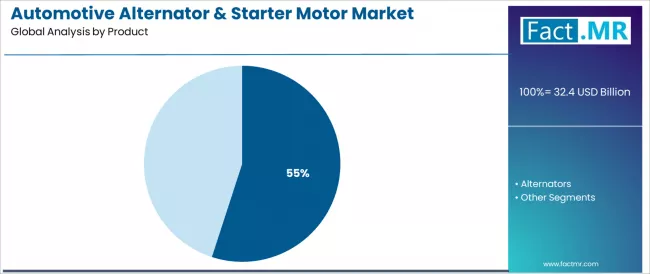
Automotive Alternator & Starter Motor Market Analysis By Product | Source: Fact.MR
The starter motors segment represents the dominant force in the automotive alternator & starter motor market, capturing 55.0% of the total market share in 2025. This established product category encompasses solutions featuring electric motor functionality for internal combustion engine cranking, gear reduction mechanisms for torque multiplication, and solenoid engagement systems, including conventional inertia-type starters and reduction gear starters that enable reliable engine starting, compact packaging, and proven durability across all automotive applications.
The starter motors segment's market leadership stems from its essential role in every conventionally powered vehicle, with these components capable of meeting diverse starting requirements while maintaining cost-effective production and replacement economics across all vehicle manufacturing environments. Within the starter motors segment, passenger vehicle applications account for the largest consumption share, driven by high production volumes and universal fitment requirements across global automotive manufacturing operations. The segment is valued at USD 17.8 billion in 2025 and grows at 5.6% CAGR through 2035.
The alternators segment maintains a substantial 45.0% market share, serving vehicle manufacturers who require electrical power generation for battery charging, accessory operation, and vehicle electrical system supply. These applications offer essential product solutions for continuous power delivery, voltage regulation capabilities, and charging system functionality while providing sufficient operational flexibility to meet power demands and electrical load requirements. The segment is valued at USD 14.6 billion in 2025 and demonstrates accelerated growth at 5.9% CAGR through 2035.
Key advantages driving the starter motors segment include:
- Established manufacturing infrastructure with integrated automotive component production facilities that reduce supply complexity and ensure consistent product availability
- Critical engine starting functionality allowing reliable vehicle operation across different powertrain configurations without alternative technology options
- Proven application compatibility, delivering dependable cranking performance while maintaining competitiveness across diverse vehicle segments
- Broad automotive adoption enabling straightforward component specification and replacement standards across multiple vehicle categories
How does OEM Sales Channel Lead Market Distribution?
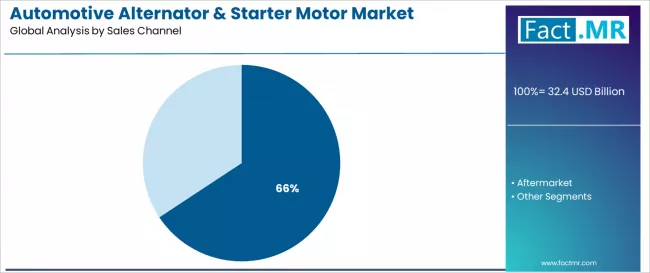
Automotive Alternator & Starter Motor Market Analysis By Sales Channel | Source: Fact.MR
The OEM sales channel segment demonstrates commanding market leadership with a 65.7% share in 2025, driven by direct integration into new vehicle production and comprehensive supplier relationships with automotive manufacturers. This channel category encompasses component supply for vehicle assembly lines, original equipment specifications, and factory installation applications that prioritize quality assurance, warranty compliance, and production consistency.
The OEM segment's market dominance reflects automotive manufacturing volumes and new vehicle sales patterns, with component suppliers maintaining long-term partnerships with vehicle manufacturers to achieve design validation and production integration across vehicle platforms. The segment is valued at USD 21.3 billion in 2025 and grows at 5.5% CAGR through 2035.
The aftermarket sales channel retains 34.3% market share, serving replacement applications where vehicle owners, repair facilities, and fleet operators require service parts for component failures, preventive maintenance programs, and vehicle restoration projects. The aftermarket segment grows at an accelerated 6.1% CAGR through 2035, valued at USD 11.1 billion in 2025.
Key factors supporting OEM channel dominance include:
- New vehicle production volumes driving continuous component demand through established automotive manufacturing cycles
- Quality specification requirements enabling stringent performance standards through original equipment validation processes
- Supplier integration advantages supporting long-term business relationships through engineering collaboration and production coordination
- Technology development partnerships maintaining competitive positioning through joint innovation programs and platform adaptation
Which is the Primary Vehicle Type Category in the Automotive Alternator & Starter Motor Market?
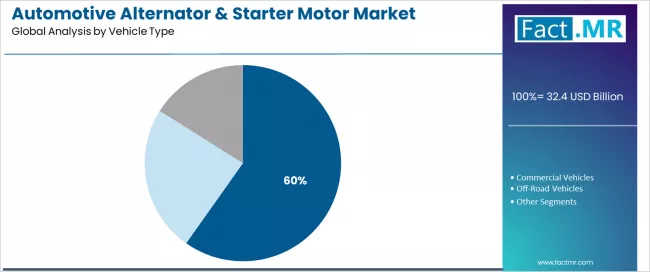
Automotive Alternator & Starter Motor Market Analysis By Vehicle Type | Source: Fact.MR
Passenger vehicles account for 59.8% of automotive alternator & starter motor market share in 2025, reflecting the segment's substantial global production volumes and diverse model range requirements across automotive manufacturing operations.
This vehicle category encompasses sedans, hatchbacks, sport utility vehicles, and crossover vehicles that require reliable electrical systems for engine starting, battery charging, and accessory power supply, creating consistent demand for proven alternator and starter motor technologies that ensure vehicle functionality while meeting consumer reliability expectations.
The passenger vehicles segment's market leadership stems from annual production volumes exceeding 70 million units globally and comprehensive replacement demand driven by vehicle age and component wear patterns. The segment is valued at USD 19.4 billion in 2025 and grows at 5.6% CAGR through 2035.
The commercial vehicles segment accounts for 30.0% market share, serving trucks, buses, and delivery vehicles that require heavy-duty electrical components capable of handling higher duty cycles, larger engine displacements, and extended operational requirements, valued at USD 9.7 billion in 2025 and growing at 6.5% CAGR through 2035.
The off-road vehicles segment represents 10.2% market share, addressing construction equipment, agricultural machinery, and specialty vehicles, valued at USD 3.3 billion in 2025 with 5.2% CAGR through 2035.
What are the Drivers, Restraints, and Key Trends of the Automotive Alternator & Starter Motor Market?
The market is driven by three concrete demand factors tied to vehicle production and replacement cycles. First, increasing global vehicle parc and aging fleet demographics creates growing demand for aftermarket replacement components, with global light vehicle population exceeding 1.4 billion units and average vehicle age increasing in major markets worldwide, requiring comprehensive parts distribution infrastructure. Second, expanding vehicle electrical content and feature proliferation drives increased power generation requirements, with many vehicle manufacturers implementing higher capacity alternators and advanced electrical architectures to support infotainment systems, advanced driver assistance features, and comfort technologies by 2030. Third, technological advancements in start-stop system adoption and micro-hybrid integration enable more efficient fuel consumption that increases starter motor duty cycles while requiring enhanced component durability and thermal management capabilities.
Market restraints include accelerating electric vehicle adoption that eliminates traditional starter motors and reduces alternator requirements, potentially causing market displacement as battery electric vehicles gain market share across passenger and commercial segments. Increasing hybrid powertrain penetration poses another significant challenge, as full hybrid and plug-in hybrid architectures often integrate starter and generator functions into electric motor systems, reducing demand for conventional alternator and starter motor components. Raw material price volatility for copper windings and steel laminations creates additional market challenges for cost management, demanding ongoing investment in procurement strategies and value engineering initiatives.
Key trends indicate accelerated development of high-efficiency alternator designs with improved rectification systems, enhanced cooling capabilities, and intelligent voltage control that optimize fuel economy contribution while maintaining reliable battery charging. Technology integration trends toward integrated starter-generator systems for mild hybrid applications, regenerative braking capabilities, and 48-volt electrical architectures enable advanced powertrain approaches that bridge conventional and electrified vehicle technologies. However, the market thesis could face disruption if electric vehicle adoption accelerates beyond current projections or major technological breakthroughs in alternative power generation systems reduce reliance on traditional alternator configurations.
Analysis of the Automotive Alternator & Starter Motor Market by Key Countries
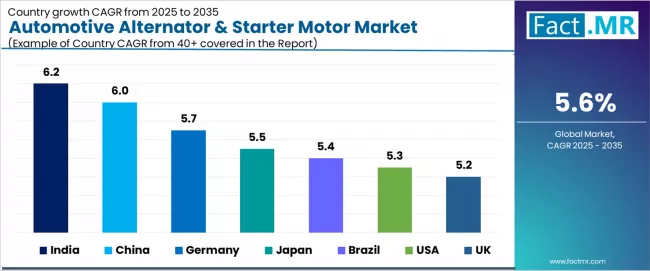
Automotive Alternator & Starter Motor Market Cagr Analysis By Country | Source: Fact.MR
| Country | CAGR (2025 to 2035) |
|---|---|
| India | 6.2% |
| China | 6.0% |
| Germany | 5.7% |
| Japan | 5.5% |
| Brazil | 5.4% |
| USA | 5.3% |
| UK | 5.2% |
Source: Fact.MR analysis. Updated Dec 8, 2025
The automotive alternator & starter motor market is expanding steadily, with India leading at a 6.2% CAGR through 2035, driven by rising passenger vehicle demand, expanding commercial vehicle production, and growing aftermarket service infrastructure. China follows at 6.0%, supported by largest global automotive production capacity, substantial domestic vehicle sales, and integrated component manufacturing networks. Germany records 5.7%, reflecting leading European original equipment manufacturer presence alongside advanced start-stop technology adoption.
Japan posts 5.5%, anchored by established automotive industry infrastructure and advancing hybrid vehicle technology integration. Brazil grows at 5.4%, with expanding commercial vehicle segment and growing automotive sales volumes. USA advances at 5.3%, emphasizing high vehicle ownership rates and substantial aftermarket replacement demand, while UK grows steadily at 5.2%, focusing on aging vehicle fleet replacement cycles and ongoing fleet modernization programs.
India leads Global Market Expansion
India demonstrates the strongest growth potential in the automotive alternator & starter motor market with a CAGR of 6.2% through 2035. The country's leadership position stems from rapid passenger vehicle market expansion, substantial commercial vehicle manufacturing growth, and increasing automotive component localization enabling mainstream market development.
Growth is concentrated in major automotive manufacturing regions, including Haryana, Maharashtra, Tamil Nadu, and Gujarat, where vehicle production clusters and expanding automotive infrastructure are implementing comprehensive component supply chains for domestic vehicle assembly and export markets.
Distribution channels through integrated supplier networks, aftermarket distribution partnerships, and service center relationships expand deployment across vehicle manufacturers and replacement parts retailers. The country's growing automotive sector provides policy support for component manufacturing development, including investment incentives for automotive parts production facilities and local sourcing initiatives.
Key market factors:
- Automotive demand concentrated in passenger vehicle segments and commercial vehicle applications with comprehensive manufacturing ecosystems
- Infrastructure development through automotive cluster expansion and component supply chain improvements
- Comprehensive manufacturing ecosystem, including established vehicle assembly operations with proven production capabilities
- Component localization featuring domestic alternator and starter motor production, quality improvement programs, and cost optimization initiatives
China Emerges as Production Powerhouse
In major automotive manufacturing provinces including Jilin, Shanghai, Guangdong, and Hubei, the production and consumption of automotive alternators and starter motors is accelerating across vehicle assembly operations and aftermarket distribution segments, driven by integrated supply chains and massive production capacity.
The market demonstrates strong growth momentum with a CAGR of 6.0% through 2035, linked to government automotive industry policies, integrated manufacturing infrastructure, and sustained domestic vehicle demand. Chinese manufacturers are implementing advanced component production technologies and quality management systems to enhance product reliability while meeting growing demand in expanding passenger vehicle sectors and commercial vehicle industries. The country's automotive industry development initiatives create persistent demand for electrical components, while increasing vehicle parc expansion drives adoption of aftermarket replacement parts distribution systems.
Key development areas:
- Passenger vehicle and commercial vehicle segments leading component consumption with comprehensive production programs
- Integrated supply chains providing efficient component flow with extensive logistics infrastructure
- Technology partnerships between Chinese manufacturers and international automotive suppliers are expanding market reach
- Integration of advanced manufacturing automation and comprehensive quality control protocols
Germany Demonstrates Automotive Technology Leadership
The German market leads in advanced automotive electrical system applications based on integration with premium vehicle engineering and sophisticated start-stop technology implementation for enhanced fuel efficiency. The country shows strong potential with a CAGR of 5.7% through 2035, driven by world-class automotive industry presence, strong engineering capabilities, and the expansion of specialized electrical system development in major automotive centers, including Baden-Württemberg, Bavaria, North Rhine-Westphalia, and Lower Saxony.
German manufacturers are adopting advanced alternator technologies for premium vehicle applications and efficiency optimization, particularly in regions with sophisticated engineering requirements and specialized applications demanding comprehensive performance standards. Technology deployment channels through established automotive original equipment manufacturers and tier-one suppliers expand coverage across premium vehicle production and advanced powertrain development.
Leading market segments:
- Premium passenger vehicle manufacturing operations in major automotive centers implementing comprehensive electrical system integration
- Strategic partnerships with component suppliers, achieving stringent efficiency specifications and quality standards
- Collaborative research between automotive engineering institutes and commercial operations are expanding innovation capabilities
- Focus on start-stop system development initiatives and advanced energy management methodologies
Japan emphasizes Technology Excellence
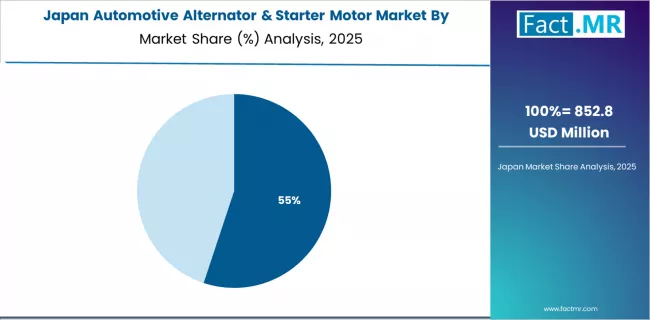
Automotive Alternator & Starter Motor Market Japan Market Share Analysis By Product | Source: Fact.MR
In major automotive manufacturing regions including Aichi, Kanagawa, and Hiroshima, vehicle manufacturers and component suppliers are implementing comprehensive electrical system development strategies to optimize existing vehicle platforms and improve fuel efficiency outcomes, with documented case studies showing significant efficiency improvements through advanced alternator technologies and intelligent control system integration. The market shows steady growth potential with a CAGR of 5.5% through 2035, linked to established automotive industry infrastructure, advanced engineering capabilities, and ongoing hybrid vehicle technology development in major regions.
Japanese producers are adopting innovative alternator and starter motor technologies and precision manufacturing protocols to enhance vehicle efficiency while maintaining performance standards demanded by automotive engineering specifications and fuel economy requirements. The country's advanced automotive infrastructure creates persistent demand for technology innovation and quality optimization solutions that integrate with hybrid powertrain systems.
Market development factors:
- Automotive manufacturers and component suppliers leading electrical system innovation across Japan
- Hybrid vehicle technology development and domestic production capacity providing support for advanced component integration
- Strategic relationships between Japanese automotive companies and global vehicle manufacturers are expanding technology capabilities
- Emphasis on quality excellence and engineering precision across automotive electrical component applications
Brazil shows Commercial Vehicle Focus
Brazil's automotive alternator & starter motor market demonstrates growth positioning focused on commercial vehicle expansion and automotive sales recovery, with documented adoption of durable component systems in truck and bus operations, achieving improved reliability through quality replacement parts in São Paulo and Minas Gerais automotive regions.
The country maintains steady growth momentum with a CAGR of 5.4% through 2035, driven by expanding commercial vehicle production, growing automotive sales volumes, and strategic positioning for South American automotive market supply.
Major automotive manufacturing facilities, including operations in São Paulo and Paraná, showcase deployment of electrical components where commercial vehicle applications support operational reliability improvements and comprehensive vehicle performance programs.
Key market characteristics:
- Commercial vehicle industry and passenger vehicle production driving component adoption with emphasis on durability and replacement availability
- Regional manufacturing partnerships enabling cost-effective production approaches with comprehensive supply chain programs
- Component sourcing collaboration between Brazilian automotive manufacturers and international suppliers is expanding market capabilities
- Emphasis on aftermarket distribution development and service network enhancement methodologies
USA emphasizes Aftermarket Strength
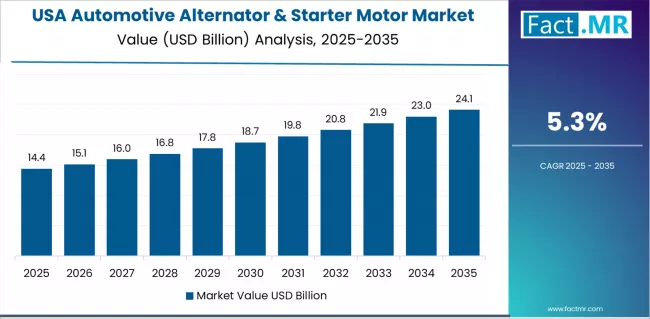
Automotive Alternator & Starter Motor Market Country Value Analysis | Source: Fact.MR
In major metropolitan regions including Detroit, Houston, Los Angeles, and Atlanta, vehicle owners and service facilities are implementing comprehensive replacement strategies for aging vehicle fleets, achieving extended vehicle service life through quality aftermarket components and preventive maintenance programs. The market shows steady growth potential with a CAGR of 5.3% through 2035, linked to high vehicle ownership rates, established aftermarket distribution infrastructure, and ongoing vehicle aging trends driving replacement demand.
American consumers and fleet operators are adopting reliable replacement components and professional installation services to maintain vehicle functionality while managing total cost of vehicle ownership demanded by extended ownership periods and economic considerations. The country's mature automotive market creates persistent demand for aftermarket component supply and distribution solutions that integrate with diverse vehicle populations.
Market development factors:
- Aging vehicle fleet and aftermarket replacement demand leading component consumption across USA
- Distribution network strength and parts availability providing comprehensive market coverage through retail and wholesale channels
- Strategic relationships between aftermarket distributors and service facility networks are expanding parts accessibility
- Emphasis on component quality and warranty support across replacement applications
UK Shows Fleet Replacement Dynamics
The UK automotive alternator & starter motor market demonstrates mature landscape, characterized by aging vehicle populations and expanding replacement cycles across passenger and commercial vehicle segments. The country shows steady growth momentum with a CAGR of 5.2% through 2035, driven by established vehicle parc, increasing average vehicle age, and strategic emphasis on maintaining existing vehicle functionality through quality replacement components.
The UK's focus on vehicle maintenance standards and roadworthiness requirements creates requirements for reliable electrical component replacements that support comprehensive vehicle testing compliance and operational safety programs. The market benefits from strong distribution networks between component suppliers and aftermarket retailers, creating comprehensive supply ecosystems that prioritize parts availability and technical support services.
Key market characteristics:
- Aftermarket replacement and fleet maintenance operations driving component demand with emphasis on availability and quality assurance
- Distribution partnerships enabling comprehensive parts coverage with established wholesale and retail networks
- Component sourcing collaboration between UK distributors and international manufacturers is expanding supply capabilities
- Emphasis on vehicle maintenance standards and component reliability methodologies
Europe Market Split by Country
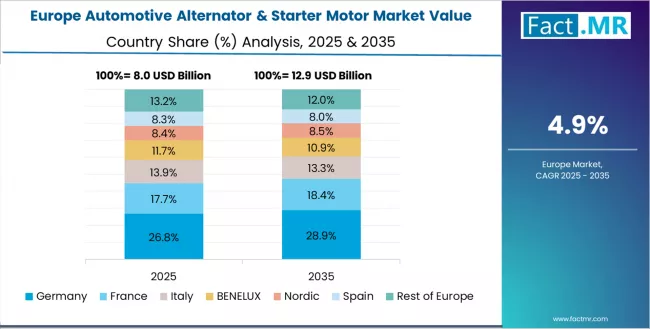
Automotive Alternator & Starter Motor Market Europe Country Market Share Analysis, 2025 & 2035 | Source: Fact.MR
The automotive alternator & starter motor market in Europe is projected to grow from USD 7.9 billion in 2025 to USD 13.4 billion by 2035, registering a CAGR of 5.7% over the forecast period. Germany is expected to maintain its leadership position with a 32.4% market share in 2025, supported by its advanced automotive manufacturing infrastructure, comprehensive original equipment manufacturer presence, and strong component engineering capabilities across major automotive centers.
France follows with a 23.6% share in 2025, driven by established automotive production operations and integrated component manufacturing sectors. UK holds a 18.7% share in 2025 through its substantial vehicle parc and mature aftermarket distribution infrastructure. Italy commands a 14.8% share, while Rest of Europe accounts for 10.5% in 2025.
By 2035, Germany is projected to hold 32.1% share, France 23.8%, UK 18.9%, Italy 14.7%, and Rest of Europe 10.5%, reflecting sustained growth momentum across all major European markets and increasing component adoption in diversified vehicle applications implementing advanced electrical system programs.
Competitive Landscape of the Automotive Alternator & Starter Motor Market
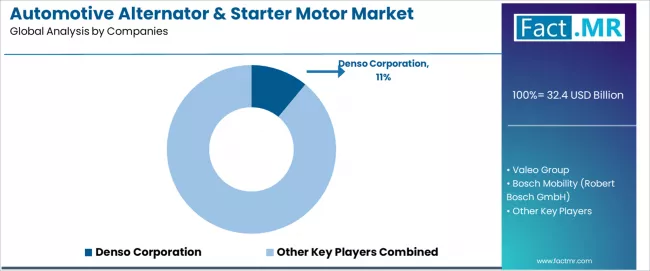
Automotive Alternator & Starter Motor Market Analysis By Company | Source: Fact.MR
The automotive alternator & starter motor market features approximately 30-40 meaningful players with moderate concentration, where the top three companies control roughly 28-33% of global production capacity through established manufacturing operations and extensive customer relationships across original equipment manufacturers and aftermarket distributors.
Market leaders include Denso Corporation, Valeo Group, and Bosch Mobility (Robert Bosch GmbH), which maintain competitive advantages through comprehensive electrical component product portfolios, global manufacturing networks, and deep expertise in the automotive electrical systems and power management sectors, creating strong customer relationships among vehicle manufacturers and aftermarket service providers.
These companies leverage established production facilities and ongoing technology development initiatives to defend market positions while expanding into adjacent mild hybrid applications and integrated starter-generator markets. Denso Corporation commands an 11.0% market share through diversified automotive component operations and strategic positioning in global automotive markets.
Challengers encompass Mitsubishi Electric Corporation, Hitachi Astemo Ltd., and SEG Automotive, which compete through specialized component offerings and strong regional presence in key automotive manufacturing markets. Specialty producers, including Prestolite Electric (Broad-Ocean), Delco Remy (BorgWarner Inc.), and Lucas TVS Ltd., focus on specific vehicle segments or distribution channels, offering differentiated capabilities in heavy-duty applications, remanufactured components, and regional market expertise.
Regional players and emerging manufacturers create competitive pressure through cost-advantaged production capabilities and strategic market positioning, particularly in high-growth markets including China and India, where local presence provides advantages in component supply and automotive manufacturer proximity.
Market dynamics favor companies that combine advanced manufacturing technologies with comprehensive quality management systems that address the complete value chain from component design through production validation and aftermarket support. Strategic investments in efficiency optimization and mild hybrid integration capabilities enable technology differentiation and competitive advantage across electrical component operations.
Global Automotive Alternator & Starter Motor Market - Stakeholder Contribution Framework
Automotive alternator and starter motor products represent critical electrical system components that enable vehicle manufacturers, service providers, and fleet operators to achieve reliable vehicle operation and electrical power generation without compromise to starting reliability, typically providing essential engine cranking functionality and continuous charging capabilities while supporting diverse vehicle applications.
With the market projected to grow from USD 32.4 billion in 2025 to USD 55.8 billion by 2035 at a 5.6% CAGR, these products offer compelling advantages - proven reliability, established manufacturing infrastructure, and comprehensive aftermarket support - making them essential for passenger vehicle production (largest segment), commercial vehicle manufacturing (growing applications), and diverse automotive applications seeking dependable electrical system components. Scaling production capacity and market development requires coordinated action across automotive policy, industry standards, component manufacturers, vehicle producers, and aftermarket distributors.
How Governments Could Spur Local Production and Adoption?
- Automotive Manufacturing Support Programs: Include electrical component production capabilities in national automotive strategies, providing targeted funding for component manufacturing facilities in regions with automotive industry clusters and supporting local suppliers through investment incentives and development support.
- Quality Standards & Testing Requirements: Implement comprehensive component performance standards that ensure reliability benchmarks, provide regulatory frameworks for aftermarket parts quality, and establish testing protocols that support consumer protection and product safety.
- Trade Policy & Market Access: Create balanced import-export frameworks across automotive components and replacement parts, establish fair trade practices for electrical system products, and develop international cooperation protocols that facilitate component supply chain development.
- Skills Development & Training: Fund technical education programs for automotive technicians, component engineers, and quality specialists. Invest in technology transfer initiatives that bridge research institutions with commercial component production and vehicle integration operations.
How Industry Bodies Could Support Market Development?
- Quality Standards & Certification: Define standardized performance specifications for automotive alternators and starter motors across passenger vehicle, commercial vehicle, and off-road applications, establish universal testing protocols and durability metrics, and create certification programs for aftermarket quality that service providers can implement.
- Market Education & Best Practices: Lead communication initiatives that demonstrate component maintenance importance, emphasizing preventive replacement benefits, quality component advantages, and proper installation procedures compared to deferred maintenance and low-quality alternatives.
- Remanufacturing Standards: Develop quality guidelines for remanufactured components, comprehensive testing requirements, and warranty program standards, ensuring reliable aftermarket options across different service channels and customer segments.
How Manufacturers and Technology Players Could Strengthen the Ecosystem?
- Component Technology Development: Develop next-generation alternator and starter motor designs with enhanced efficiency capabilities, improved thermal management, and application-specific features that enhance vehicle performance while improving fuel economy contribution and service life durability.
- Technical Support Platforms: Provide comprehensive application engineering support that integrates component selection assistance, installation guidance, diagnostic training, and troubleshooting resources, enabling service providers to maximize component reliability and customer satisfaction.
- Distribution Network Optimization: Offer flexible supply arrangements for vehicle manufacturers and aftermarket distributors, including inventory management support, logistics optimization, and warranty administration programs that keep component availability consistent with market demand patterns.
Key Players in the Automotive Alternator & Starter Motor Market
- Denso Corporation
- Valeo Group
- Bosch Mobility (Robert Bosch GmbH)
- Mitsubishi Electric Corporation
- Hitachi Astemo, Ltd.
- Prestolite Electric (Broad-Ocean)
- SEG Automotive
- Delco Remy (BorgWarner Inc.)
- MAHLE Group
- Lucas TVS Ltd.
Segmentation
Scope of the Report
| Items | Values |
|---|---|
| Quantitative Units | USD 32.4 Billion |
| Product | Starter Motors, Alternators |
| Sales Channel | OEMs, Aftermarket |
| Vehicle Type | Passenger Vehicles, Commercial Vehicles, Off-Road Vehicles |
| Regions Covered | Asia Pacific, North America, Europe, Latin America, Middle East & Africa |
| Country Covered | India, China, Germany, Japan, Brazil, USA, UK, and 40+ countries |
| Key Companies Profiled | Denso Corporation, Valeo Group, Bosch Mobility (Robert Bosch GmbH), Mitsubishi Electric Corporation, Hitachi Astemo Ltd., Prestolite Electric (Broad-Ocean), SEG Automotive, Delco Remy (BorgWarner Inc.), MAHLE Group, Lucas TVS Ltd. |
| Additional Attributes | Dollar sales by product categories, sales channel analysis across OEM and aftermarket segments, vehicle type segmentation trends across passenger and commercial applications, regional production developments across Asia Pacific, North America, and Europe, competitive landscape with electrical component manufacturers and automotive suppliers, performance specifications and quality requirements, integration with vehicle manufacturing facilities and aftermarket distribution operations. |
Source: Fact.MR analysis. Updated Dec 8, 2025
Automotive Alternator & Starter Motor Market by Segments
-
Product :
- Starter Motors
- Alternators
-
Sales Channel :
- OEMs
- Aftermarket
-
Vehicle Type :
- Passenger Vehicles
- Commercial Vehicles
- Off-Road Vehicles
-
Region :
- Asia Pacific
- China
- Japan
- South Korea
- India
- Australia & New Zealand
- ASEAN
- Rest of Asia Pacific
- North America
- USA
- Canada
- Mexico
- Europe
- Germany
- France
- UK
- Italy
- Rest of Europe
- Latin America
- Brazil
- Rest of Latin America
- Middle East & Africa
- Kingdom of Saudi Arabia
- Other GCC Countries
- Turkey
- South Africa
- Rest of Middle East & Africa
- Asia Pacific
Frequently Asked Questions
How big is the automotive alternator & starter motor market in 2025?
What will be the size of automotive alternator & starter motor market in 2035?
How much will be the automotive alternator & starter motor market growth between 2025 and 2035?
What are the key product types in the automotive alternator & starter motor market?
Which sales channel segment to contribute significant share in the automotive alternator & starter motor market in 2025?
Who worked on this report


Preview the report firsthand - request a free sample
Free SampleGet the brochure for pricing and purchase details
Download PDF