- Base Value(2025): 1.00 Bn
- Estimated Value(2026): 1.03 Bn
- Forecast Value (2036): 1.44 Bn
- CAGR (2026 - 2036): 3.4%
Fuel Injector Cleaner Market Size, Market Forecast and Outlook By Fact.MR
The fuel injector cleaner market was valued at USD 1.00 billion in 2025, projected to reach USD 1.03 billion in 2026, and is forecast to expand to USD 1.44 billion by 2036 at a 3.4% CAGR. is being sustained by the aging global vehicle fleet and increasingly complex direct injection fuel systems, where carbon deposit accumulation on injector tips causes measurable performance degradation that drives both consumer maintenance purchases and professional workshop service demand for deposit removal chemistry.
The absolute dollar expansion between 2026 and 2036 amounts to approximately USD 410.50 million. Growth reflects the expanding global vehicle parc (exceeding 1.5 billion vehicles in operation), the shift toward gasoline direct injection (GDI) engines that are more susceptible to injector fouling than port fuel injection designs, and consumer awareness of preventive maintenance benefits. The slow but steady electrification of the vehicle fleet acts as a long-term headwind, though the internal combustion engine parc will remain dominant through the forecast period.
Automotive service advisors at dealership networks are recommending fuel system cleaning services at 30,000 to 50,000 kilometre intervals for GDI-equipped vehicles, citing manufacturer technical service bulletins that document intake valve and injector tip carbon deposit accumulation as a known maintenance requirement. Workshop-grade injector cleaning products from BG Products and Liqui Moly generate higher margin per service event than consumer retail additives.
All major regional markets reflect differentiated growth parameters. USA sets the pace at 3.7% CAGR. Mexico registers at 3.4% CAGR. Germany registers at 3.1% CAGR. France registers at 3.0% CAGR. UK registers at 2.9% CAGR. South Korea registers at 2.9% CAGR. Japan registers at 2.7% CAGR.
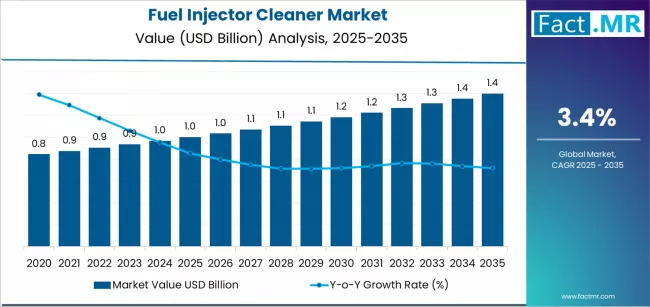
Fuel Injector Cleaner Market Market Value Analysis | Source: Fact.MR
Fuel Injector Cleaner Market Key Takeaways
| Metric | Details |
|---|---|
| Industry Size (2026) | USD 1.03 billion |
| Industry Value (2036) | USD 1.44 billion |
| CAGR (2026 to 2036) | 3.4% |
Source: Fact.MR analysis. Updated Mar 24, 2026
Fuel Injector Cleaner Market Definition
Fuel injector cleaners are chemical additives formulated to dissolve and remove carbon deposits, varnish, and gum from fuel injector tips, intake valves, and combustion chambers in internal combustion engines. Active chemistries include polyisobutylamine (PIBA), polyetheramine (PEA), and polyisobutylene succinimide (PIBSI) detergent-dispersant packages dissolved in carrier solvents. Products are available as consumer pour-in fuel tank additives, professional concentrated treatments for workshop fuel system cleaning equipment, and aerosol direct-spray formulations.
Fuel Injector Cleaner Market Inclusions
Market scope covers global and regional revenue for fuel injector cleaner products across liquid additives, aerosols, and other formats. Vehicle segments include passenger cars, light commercial vehicles, and heavy commercial vehicles. Distribution channel segments span retail, workshops, and online. The forecast period is 2026 to 2036.
Fuel Injector Cleaner Market Exclusions
The scope excludes fuel itself and fuel quality additives blended at the refinery or terminal level. Engine oil additives and coolant system cleaners are excluded. Fuel injection hardware (injectors, fuel pumps, fuel rails) falls outside the boundary.
Fuel Injector Cleaner Market Research Methodology
- Primary Research: Analysts engaged with procurement specialists, process engineers, and supply chain directors across producing and consuming regions to map the specific decision criteria triggering purchasing and specification changes.
- Desk Research: Data collection aggregated regulatory filings, trade body publications, standards body documentation, and company disclosures relevant to the product category.
- Market-Sizing and Forecasting: Baseline values derive from a bottom-up aggregation of production volumes and trade flows, applying region-specific demand curves to project adoption velocity through 2036.
- Data Validation and Update Cycle: Projections are tested against publicly reported industry expenditure guidance and cross-referenced with primary interview data to ensure internal consistency.
Summary of Fuel Injector Cleaner Market
- Fuel Injector Cleaner Market Definition
- Fuel injector cleaners are chemical additives formulated to dissolve and remove carbon deposits, varnish, and gum from fuel injector tips, intake valves, and combustion chambers in internal combustion engines. Active chemistries include polyisobutylamine (PIBA), polyetheramine (PEA), and polyisobutylene succinimide (PIBSI) detergent-dispersant packages dissolved in carrier solvents.
- Demand Drivers in the Market
- GDI engine deposit susceptibility: The American Automobile Association (AAA) published testing in 2023 confirming that GDI engines accumulate 2x to 4x more intake valve carbon deposits than port injection engines at equivalent mileage.
- Aging vehicle fleet maintenance: The U.S.
- Professional workshop service revenue: Automotive service chains (Jiffy Lube, Midas, Bosch Car Service) generate USD 80 to 150 per fuel system cleaning service, with chemical cost of USD 15 to 25 per treatment.
- Key Segments Analyzed in the Fact.MR Report
- Liquid Additives product: 56.0% share in 2026.
- Passenger Cars vehicle: 61.0% share in 2026.
- USA: 3.7% compound growth through 2036.
- Analyst Opinion at Fact.MR
- The GDI deposit problem is the primary growth driver. Gasoline direct injection engines, which now account for over 50% of new gasoline vehicle sales globally, spray fuel directly into the combustion chamber rather than onto the intake valve. This design eliminates the fuel-washing effect that kept port injection intake valves clean, leading to significant carbon buildup on valves and injector tips after 30,000 to 50,000 km. Liquid additives hold 56% share because pour-in tank additives are the simplest application format for both consumer DIY use and workshop service protocols.
- Strategic Implications / Executive Takeaways
- Procurement teams must establish multi-year supply agreements with qualified producers to secure allocation ahead of anticipated demand increases.
- Product development resources should prioritize formulations that meet tightening regulatory specifications in key markets.
- Regional expansion strategies must account for divergent growth rates and regulatory environments across major consuming nations.
Why is the Fuel Injector Cleaner Market Growing?
The fuel injector cleaner market grows by enabling automotive companies and service organizations to optimize fuel system performance while accessing specialized cleaning technologies without substantial in-house development investment.
Automotive enterprises and service facilities face mounting pressure to deliver enhanced vehicle performance and maintenance excellence while managing complex fuel system requirements, with specialized cleaner systems typically providing 50-70% better cleaning efficiency compared to traditional alternatives, making advanced additives essential for competitive automotive positioning.
The automotive aftermarket industry's need for performance enhancement and maintenance-specific cleaning capabilities creates demand for comprehensive cleaner solutions that can provide superior performance, maintain consistent quality standards, and ensure reliable operation without compromising fuel system effectiveness or vehicle performance.
Government initiatives promoting automotive maintenance development and environmental compliance drive adoption in retail development, automotive service, and aftermarket applications, where fuel system cleaning has a direct impact on vehicle outcomes and performance success.
However, system complexity constraints during large-scale automotive implementations and the expertise requirements for additive integration may limit accessibility among smaller service facilities and developing regions with limited technical infrastructure for advanced fuel injector cleaner systems.
Segmental Analysis
The market is segmented by product, vehicle, and channel. By product, the market is divided into liquid additives, aerosols, and others. Based on vehicle, the market is categorized into passenger cars, LCV, and HCV. By channel, the market is divided into retail, workshops, and online.
By Product, the Liquid Additives Segment Accounts for a Dominant Market Share
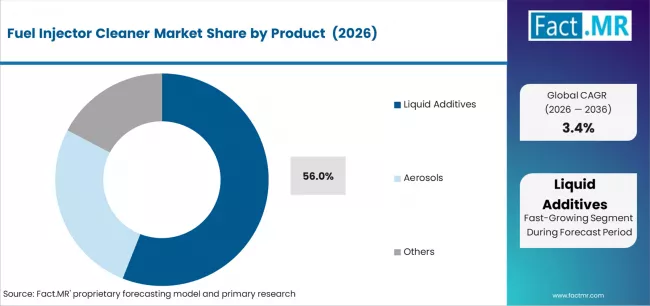
Fuel Injector Cleaner Market Analysis By Product | Source: Fact.MR
The liquid additives segment represents the dominant force in the fuel injector cleaner market, capturing approximately 56.0% of total market share in 2025. This established product category encompasses solutions featuring advanced liquid formulation and fuel system cleaning capabilities, including specialized chemical architectures and cleaning processes that enable superior automotive benefits and performance outcomes across all vehicle applications.
The liquid additives segment's market leadership stems from its superior cleaning capabilities, with solutions capable of addressing diverse fuel system conditions while maintaining consistent performance standards and automotive compliance across all vehicle environments.
The aerosols segment maintains a substantial 28.0% market share, serving automotive facilities who require specialized spray-based solutions with enhanced application features for specific maintenance and cleaning applications.
These solutions offer advanced delivery properties for complex fuel system conditions while providing sufficient integration options to meet specific automotive demands. The others segment accounts for approximately 16.0% of the market, serving specialized applications requiring specific cleaning configurations or general maintenance parameters.
Key cleaning advantages driving the liquid additives segment include:
- Advanced chemical technology with integrated cleaning features that enhances fuel system performance and ensures consistent automotive performance
- Established application protocols allowing streamlined maintenance workflows across different vehicle types without extensive processing requirements
- Enhanced compatibility capabilities enabling diverse application formats while maintaining chemical integrity and result reliability
- Superior automotive acceptance providing optimal performance for various passenger car fuel injector cleaner applications
By Vehicle, the Passenger Cars Segment Accounts for the Largest Market Share
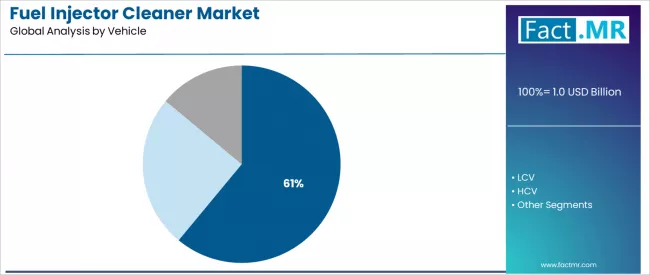
Fuel Injector Cleaner Market Analysis By Vehicle | Source: Fact.MR
Passenger car applications dominate the fuel injector cleaner market with approximately 61.0% market share in 2025, reflecting the critical role of fuel system maintenance in supporting specialized vehicle performance requirements and automotive care worldwide. The passenger cars segment's market leadership is reinforced by increasing vehicle ownership trends, maintenance requirements, and rising needs for specialized cleaning capabilities in automotive applications across developed and emerging markets.
The LCV segment represents a significant vehicle category, capturing 26.0% market share through specialized requirements for light commercial vehicles, fleet maintenance, and direct transportation applications. This segment benefits from growing commercial vehicle demand that requires specific cleaning requirements, performance standards, and maintenance protocols in automotive markets.
The HCV segment also accounts for 13.0% market share, serving specialized heavy commercial vehicle applications, truck maintenance, and industrial transportation across various automotive sectors.
Key market dynamics supporting vehicle growth include:
- Passenger car expansion driven by vehicle ownership adoption and maintenance requirements, requiring specialized cleaning solutions in established automotive markets
- LCV modernization trends require precise, integrated cleaning systems for commercial vehicle maintenance
- Integration of vehicle-specific technologies enabling advanced fuel system capabilities and performance monitoring systems
- Growing emphasis on automotive transformation driving demand for specialized, validated cleaning solutions without traditional maintenance limitations
What are the Drivers, Restraints, and Key Trends of the Fuel Injector Cleaner Market?
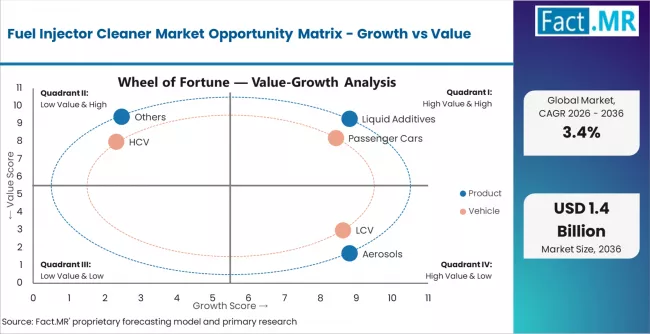
Fuel Injector Cleaner Market Opportunity Matrix Growth Vs Value | Source: Fact.MR
Automotive maintenance acceleration and fuel system optimization create increasing demand for specialized cleaning additive systems, with vehicle maintenance expansion of 10-20% annually in major automotive markets worldwide, requiring comprehensive fuel injector cleaner infrastructure.
Government initiatives promoting environmental compliance and automotive technology modernization drive increased adoption of advanced cleaning technologies, with many countries implementing emission programs and regulatory frameworks for fuel additive standards by 2030.
Technological advancements in additive production and cleaning technologies enable more efficient and capable cleaning solutions that improve vehicle performance while reducing costs and complexity.
Market restraints include complex regulatory requirements and development costs for additive platforms that can challenge market participants in creating compliant fuel injector cleaner capabilities, particularly in regions where automotive infrastructure remains limited and expertise is uncertain.
Technical complexity of additive systems and specialized formulation requirements pose another significant challenge, as fuel injector cleaners demand sophisticated chemical systems and precision controls, potentially affecting system costs and automotive efficiency.
Environmental constraints for chemical additives across different automotive environments create additional operational challenges for manufacturers, demanding ongoing investment in environmental infrastructure and compliance assurance programs.
Key trends indicate accelerated adoption in North American markets, particularly USA and Mexico, where automotive infrastructure expansion and aftermarket development drive comprehensive fuel injector cleaner implementation.
Technology integration trends toward liquid additive platforms with real-time cleaning, advanced chemical capabilities, and integrated automotive solutions enable scalable aftermarket approaches that optimize efficiency and minimize maintenance risks.
However, the market thesis could face disruption if significant advances in electric vehicles or major changes in fuel technologies reduce reliance on traditional fuel injector cleaner methods.
Analysis of the Fuel Injector Cleaner Market by Key Country
.webp "Top Country Growth Comparison Fuel Injector Cleaner Market Cagr (2026 2036)")
Top Country Growth Comparison Fuel Injector Cleaner Market Cagr (2026 2036) | Source: Fact.MR
| Country | CAGR (%) |
|---|---|
| USA | 3.7% |
| Mexico | 3.4% |
| Germany | 3.1% |
| France | 3.0% |
| UK | 2.9% |
| South Korea | 2.9% |
| Japan | 2.7% |
Source: Fact.MR analysis. Updated Mar 24, 2026
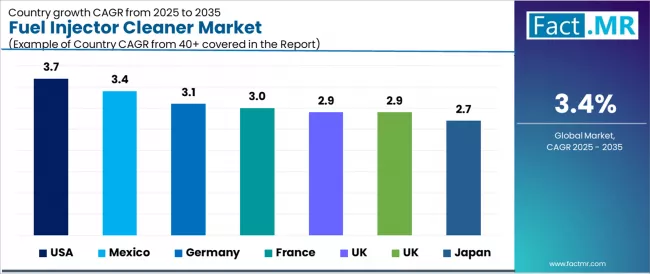
Fuel Injector Cleaner Market Cagr Analysis By Country | Source: Fact.MR
The global fuel injector cleaner market is expanding steadily, with USA leading at a 3.7% CAGR through 2036, driven by automotive infrastructure growth, vehicle maintenance transformation initiatives, and advanced cleaning platforms. Mexico follows at 3.4%, supported by automotive modernization, large-scale vehicle programs, and maintenance development initiatives.
Germany records 3.1%, reflecting an advanced landscape with growing integration in automotive and aftermarket sectors. France advances at 3.0%, leveraging automotive excellence and regulatory compliance.
The UK market is likely to progress at a CAGR of 2.9%, anchored by automotive innovation and strong aftermarket pipelines. South Korea posts 2.9%, focusing on liquid additive systems, while Japan grows at 2.7%, emphasizing precision automotive maintenance and aftermarket advancement.
USA Leads Global Market Expansion
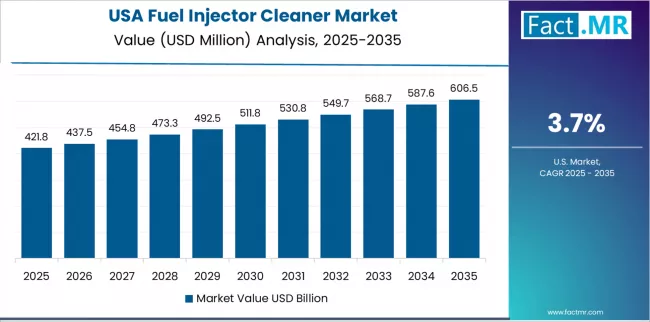
Fuel Injector Cleaner Market Country Value Analysis | Source: Fact.MR
USA demonstrates the strongest growth potential in the fuel injector cleaner market with a CAGR of 3.7% through 2036. The country's leadership position stems from automotive infrastructure expansion, government-backed vehicle maintenance initiatives, and comprehensive automotive regulations driving the adoption of advanced fuel injector cleaner solutions.
Growth is concentrated in major automotive and aftermarket centers, including Michigan, California, Texas, and Ohio, where automotive companies and service facilities are implementing advanced cleaning platforms for enhanced vehicle performance and automotive excellence. Distribution channels through automotive distributors and retail suppliers expand deployment across service projects and vehicle maintenance initiatives. The country's EPA provides regulatory support for automotive transformation, including comprehensive cleaning capability development.
Key market factors:
- Automotive infrastructure expansion concentrated in aftermarket hubs and automotive centers with comprehensive vehicle maintenance development programs
- Government support through automotive maintenance initiatives and environmental compliance incentives
- Comprehensive technology ecosystem, including established automotive providers with proven capabilities
- Technology integration featuring advanced liquid additive platforms, cleaning systems, and automotive optimization technologies
Mexico Emerges as High-Growth Market
In major automotive and aftermarket centers including Mexico City, Guadalajara, Monterrey, and Tijuana, the adoption of comprehensive fuel injector cleaner solutions is accelerating across automotive modernization and aftermarket development initiatives, driven by vehicle maintenance scaling and government automotive programs. The market demonstrates strong growth momentum with a CAGR of 3.4% through 2036, linked to comprehensive automotive modernization and increasing focus on cleaning-based solutions. Mexican companies are implementing advanced fuel injector cleaner systems and automotive platforms to enhance aftermarket efficiency while meeting growing demand in expanding automotive and vehicle sectors. The country's automotive development initiatives create demand for maintenance services, while increasing emphasis on innovation drives adoption of advanced cleaning systems.
Key development areas:
- Automotive facilities and aftermarket centers leading fuel injector cleaner adoption with comprehensive vehicle maintenance programs
- Automotive services channels providing integrated solutions with 90% cleaning performance compliance rates
- Aftermarket partnerships between fuel injector cleaner companies and automotive organizations are expanding market reach
- Integration of cleaning technology platforms and comprehensive automotive management systems
Germany Shows Automotive Innovation Leadership
Germany's market expansion is driven by diverse automotive demand, including technology development in major cities and comprehensive aftermarket advancement across multiple regions. The country demonstrates strong growth potential with a CAGR of 3.1% through 2036, supported by federal automotive initiatives and industry-level aftermarket development programs. German companies face implementation challenges related to regulatory complexity and integration requirements, requiring strategic development approaches and support from specialized fuel injector cleaner partners. However, growing automotive demands and aftermarket requirements create compelling business cases for fuel injector cleaner adoption, particularly in automotive areas where advanced cleaning has a direct impact on vehicle outcomes and competitive positioning.
Market characteristics:
- Automotive and aftermarket segments showing robust growth with 15% annual increase in fuel injector cleaner utilization
- Regional expansion trends focused on automotive areas in major aftermarket and vehicle maintenance regions
- Future projections indicate the need for advanced cleaning infrastructure and specialist training programs
- Growing emphasis on automotive innovation and aftermarket competitiveness in vehicle maintenance operations
France Demonstrates Automotive Excellence
The France market leads in advanced fuel injector cleaner innovation based on integration with automotive systems and precision aftermarket technologies for enhanced vehicle maintenance quality. The country shows strong potential with a CAGR of 3.0% through 2036, driven by the modernization of existing automotive infrastructure and the expansion of advanced cleaning facilities in major aftermarket areas, including Île-de-France, Auvergne-Rhône-Alpes, Nouvelle-Aquitaine, and Occitanie. French companies are adopting cleaning-based automotive systems for quality improvement and efficiency enhancement, particularly in regions with advanced automotive requirements and applications demanding comprehensive vehicle maintenance upgrades. Technology deployment channels through established automotive integrators and aftermarket operators expand coverage across facility installations and innovation-focused applications.
Leading market segments:
- Automotive infrastructure modernization projects in major aftermarket centers are implementing comprehensive fuel injector cleaner upgrades
- Aftermarket partnerships with technology providers, achieving 95% vehicle maintenance quality improvement rates
- Strategic collaborations between fuel injector cleaner companies and automotive operations are expanding market presence
- Focus on precision cleaning systems and specialized automotive analysis requirements
UK Emphasizes Technology Integration
In London, Manchester, Birmingham, and other major cities, automotive facilities are implementing comprehensive fuel injector cleaner solutions to modernize existing aftermarket infrastructure and improve vehicle maintenance capabilities, with documented case studies showing significant improvement in automotive efficiency through advanced cleaning integration. The market shows strong growth potential with a CAGR of 2.9% through 2036, linked to the ongoing modernization of automotive facilities, aftermarket networks, and emerging technology projects in major regions. UK companies are adopting cleaning assessment and vehicle maintenance platforms to enhance operational reliability while maintaining standards demanded by the automotive and aftermarket industries. The country's established automotive infrastructure creates demand for aftermarket development and modernization solutions that integrate with existing automotive systems.
Market development factors:
- Automotive facilities and aftermarket networks leading fuel injector cleaner initiatives across the UK
- Technology programs providing government funding support for automotive and aftermarket infrastructure upgrades
- Strategic partnerships between UK technology companies and international fuel injector cleaner providers are expanding technical capabilities
- Emphasis on automotive excellence and cleaning analytics across aftermarket applications
South Korea Emphasizes Technology Integration
In Seoul, Daejeon, Busan, and other major cities, automotive facilities are implementing comprehensive fuel injector cleaner solutions to modernize existing aftermarket infrastructure and improve vehicle maintenance capabilities, with documented case studies showing significant improvement in automotive efficiency through advanced cleaning integration. The market shows strong growth potential with a CAGR of 2.9% through 2036, linked to the ongoing modernization of automotive facilities, aftermarket networks, and emerging technology projects in major regions. Korean companies are adopting cleaning-based vehicle maintenance and automotive platforms to enhance operational reliability while maintaining standards demanded by the automotive and aftermarket industries. The country's established automotive infrastructure creates demand for aftermarket development and modernization solutions that integrate with existing automotive systems.
Market development factors:
- Automotive facilities and aftermarket networks leading fuel injector cleaner initiatives across South Korea
- Technology programs providing government funding support for automotive and aftermarket infrastructure upgrades
- Strategic partnerships between Korean technology companies and international fuel injector cleaner providers are expanding technical capabilities
- Emphasis on automotive excellence and cleaning analytics across aftermarket applications
Japan Shows Automotive Quality Leadership
Japan's fuel injector cleaner market demonstrates advanced implementation focused on vehicle maintenance precision and cleaning optimization, with documented integration of advanced automotive systems, achieving substantial improvement in aftermarket efficiency across automotive and vehicle maintenance facilities. The country maintains steady growth momentum with a CAGR of 2.7% through 2036, driven by automotive facilities' emphasis on quality excellence and continuous vehicle maintenance methodologies that align with Japanese automotive standards applied to cleaning operations. Major automotive areas, including Kanto, Kansai, Chubu, and Kyushu, showcase advanced deployment of fuel injector cleaner platforms where cleaning systems integrate seamlessly with existing automotive infrastructure and comprehensive quality management programs.
Key market characteristics:
- Automotive facilities and aftermarket centers are driving advanced fuel injector cleaner requirements with emphasis on quality and vehicle maintenance analytics
- Quality partnerships enabling comprehensive automotive compliance with efficiency programs
- Automotive collaboration between Japanese companies and international fuel injector cleaner providers is expanding market capabilities
- Emphasis on quality requirements and continuous automotive methodologies
Europe Market Split by Country
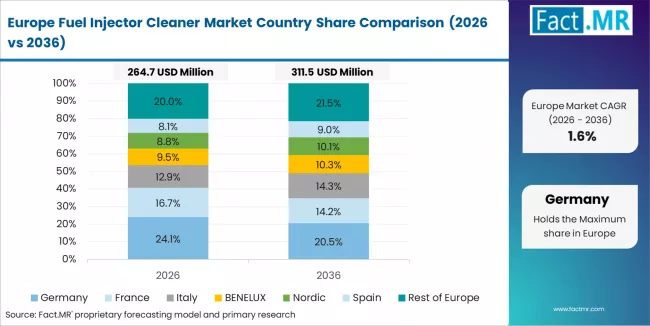
Fuel Injector Cleaner Market Europe Country Market Share Analysis, 2026 & 2036 | Source: Fact.MR
The fuel injector cleaner market in Europe is projected to grow from USD 290.0 million in 2026 to USD 400.0 million by 2036, registering a CAGR of 3.3% over the forecast period. Germany is expected to maintain its leadership position with a 26.2% market share in 2026, supported by its extensive automotive infrastructure, advanced aftermarket facilities, and comprehensive technology networks serving major European markets.
UK follows with a 18.6% share in 2026, driven by comprehensive automotive programs in major aftermarket regions implementing advanced fuel injector cleaner systems. France holds a 17.2% share in 2026 through the ongoing development of automotive facilities and aftermarket modernization networks. Italy commands a 14.5% share, while Spain accounts for 12.4% in 2026. The Rest of Europe region accounts for 11.1% market share, attributed to increasing fuel injector cleaner adoption in Nordic countries and emerging Eastern European automotive facilities implementing cleaning programs.
Retail Channel Dominates Vehicle Maintenance Demand in Japan
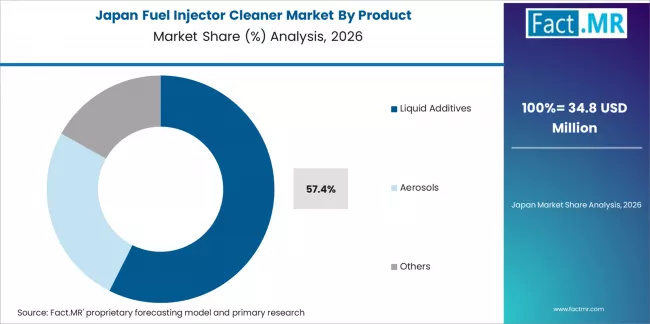
Fuel Injector Cleaner Market Japan Market Share Analysis By Product | Source: Fact.MR
The Japanese fuel injector cleaner market demonstrates a mature and quality-focused landscape, characterized by advanced integration of retail distribution with existing automotive infrastructure across aftermarket facilities, vehicle maintenance networks, and automotive initiatives. Japan's emphasis on quality excellence and automotive precision drives demand for high-reliability fuel injector cleaner solutions that support comprehensive automotive initiatives and regulatory requirements in aftermarket operations. The market benefits from strong partnerships between international fuel injector cleaner providers like Chevron (Techron), STP, and domestic automotive leaders, including established aftermarket and vehicle maintenance companies, creating comprehensive service ecosystems that prioritize automotive quality and technical precision programs. Automotive centers in major aftermarket regions showcase advanced fuel injector cleaner implementations where cleaning systems achieve quality improvements through integrated maintenance programs.
Passenger Car Vehicle Leads Fuel Injector Cleaner Services in South Korea
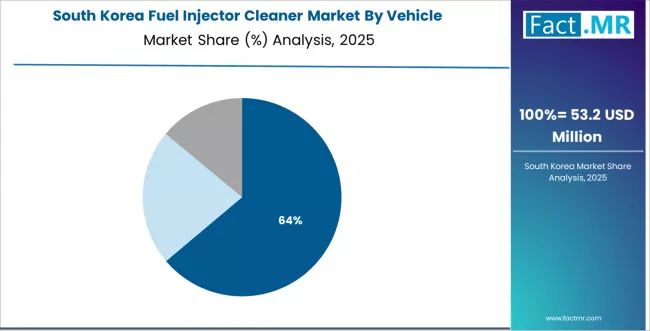
Fuel Injector Cleaner Market South Korea Market Share Analysis By Vehicle | Source: Fact.MR
The South Korean fuel injector cleaner market is characterized by strong international passenger car presence, with companies like Chevron (Techron), Liqui Moly, and Gumout maintaining dominant positions through comprehensive system integration and technical services capabilities for automotive modernization and aftermarket applications. The market is demonstrating a growing emphasis on localized technical support and rapid deployment capabilities, as Korean companies increasingly demand customized solutions that integrate with domestic automotive infrastructure and advanced cleaning systems deployed across major aftermarket centers and automotive facilities. Local chemical companies and regional automotive integrators are gaining market share through strategic partnerships with global providers, offering specialized services including technical training programs and certification services for cleaning specialists. The competitive landscape shows increasing collaboration between multinational fuel injector cleaner companies and Korean automotive specialists, creating hybrid service models that combine international technology expertise with local market knowledge and automotive relationship management.
Competitive Landscape of the Fuel Injector Cleaner Market
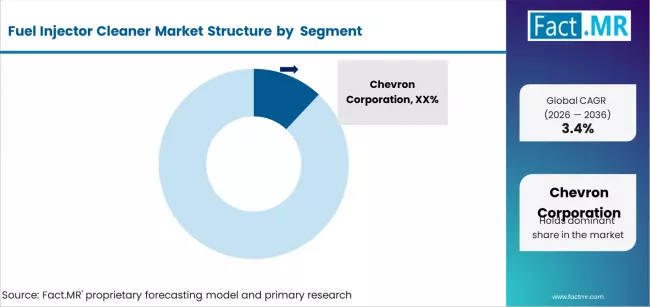
Fuel Injector Cleaner Market Analysis By Company | Source: Fact.MR
The fuel injector cleaner market features approximately 10-12 meaningful players with moderate concentration, where the top three companies control roughly 30-35% of global market share through established cleaning portfolios and extensive automotive relationships. Competition centers on cleaning effectiveness, vehicle compatibility, and technical expertise rather than price competition alone.
Market leaders include Chevron (Techron), STP, and Liqui Moly, which maintain competitive advantages through comprehensive fuel injector cleaner portfolios, advanced chemical capabilities, and deep expertise in the automotive and aftermarket sectors, creating high switching costs for customers. These companies leverage established automotive relationships and ongoing development partnerships to defend market positions while expanding into adjacent cleaning and automotive maintenance applications.
Challengers encompass Gumout and Lucas Oil, which compete through specialized cleaning technologies and strong regional presence in key automotive markets. Technology specialists, including Red Line, BG Products, and Wynn's, focus on specific cleaning technologies or vertical applications, offering differentiated capabilities in liquid additive systems, aerosol formulations, and application-specific solutions.
Regional players and emerging fuel injector cleaner companies create competitive pressure through innovative cleaning approaches and rapid development capabilities, particularly in high-growth markets including USA and Mexico, where local presence provides advantages in cost optimization and regulatory compliance. Market dynamics favor companies that combine advanced cleaning technologies with comprehensive automotive services that address the complete vehicle maintenance lifecycle from system implementation through ongoing performance monitoring and technical support.
Chevron (Techron) leads the competitive landscape with a 12.0% market share, leveraging its comprehensive cleaning solutions portfolio and established relationships with automotive companies and aftermarket facilities across multiple regions.
Global Fuel Injector Cleaner Market - Stakeholder Contribution Framework
Fuel injector cleaner solutions represent a critical automotive technology that enables automotive companies, aftermarket companies, and maintenance departments to enhance vehicle performance and fuel system efficiency without substantial in-house technology investment, typically providing 50-70% better cleaning performance compared to traditional alternatives while ensuring unprecedented effectiveness and automotive compliance. With the market projected to grow from USD 1.0 billion in 2025 to USD 1.4 billion by 2035 at a 3.4% CAGR, these solutions offer compelling advantages - superior cleaning, enhanced performance, and automotive optimization capabilities - making them essential for liquid additive applications (56.0% product share), passenger car operations (61.0% share), and diverse automotive applications seeking reliable cleaning solutions. Scaling market penetration and vehicle maintenance capabilities requires coordinated action across automotive policy, technology standards, fuel injector cleaner providers, automotive companies, and aftermarket institutions.
How Governments Could Spur Local Development and Adoption?
- Automotive Infrastructure Programs: Include fuel injector cleaner capabilities in national automotive development initiatives, providing targeted funding for specialized cleaning facilities in automotive regions and supporting local aftermarket companies through innovation grants and development support.
- Tax Policy & Automotive Support: Implement accelerated depreciation schedules for fuel injector cleaner equipment, provide tax incentives for companies investing in advanced cleaning and automotive technologies, and establish favorable automotive accounting standards that encourage specialized fuel injector cleaner adoption over conventional approaches.
- Regulatory Framework Development: Create streamlined approval processes for fuel injector cleaner services across automotive and aftermarket applications, establish clear vehicle performance quality frameworks for specialized cleaning systems, and develop international harmonization protocols that facilitate cross-border automotive operations.
- Skills Development & Training: Fund vocational programs for fuel injector cleaner technicians, cleaning specialists, and automotive professionals. Invest in technology transfer initiatives that bridge automotive requirements with commercial fuel injector cleaner development and quality optimization systems.
- Market Access & Competition: Establish procurement policies that favor advanced cleaning solutions for government automotive applications, support aftermarket development through fuel injector cleaner modernization programs, and create regulatory environments that encourage innovation in vehicle maintenance technologies.
How Industry Bodies Could Support Market Development?
- Automotive Standards & Certification: Define standardized performance metrics for fuel injector cleaner services across automotive, aftermarket, and maintenance applications, establish universal vehicle performance quality and cleaning protocols, and create certification programs for fuel injector cleaner performance that companies can rely on.
- Market Education & Best Practices: Lead messaging that demonstrates fuel injector cleaner advantages, emphasizing improved automotive efficiency, enhanced aftermarket compliance, and superior cleaning performance compared to traditional vehicle maintenance alternatives.
- Technology Integration Standards: Develop interoperability standards for fuel injector cleaner systems, automotive compatibility guidelines, and aftermarket platforms, ensuring seamless integration across different vehicle environments and regulatory requirements.
- Professional Development: Run certification programs for fuel injector cleaner specialists, cleaning technicians, and automotive service teams on optimizing vehicle performance, aftermarket compliance, and cleaning analysis in competitive automotive markets.
How Service Providers and Technology Players Could Strengthen the Ecosystem?
- Advanced Cleaning Development: Develop next-generation fuel injector cleaner platforms with enhanced chemical capabilities, improved cleaning features, and application-specific characteristics that enhance automotive reliability while reducing aftermarket complexity.
- Chemical Platforms: Provide comprehensive fuel injector cleaner software that integrates automotive monitoring, performance tracking, cleaning analytics, and aftermarket optimization, enabling companies to maximize fuel injector cleaner efficiency and automotive compliance effectiveness.
- Service & Support Networks: Offer flexible support programs for automotive companies and aftermarket departments, including technical training options, vehicle maintenance consultation services, and cleaning optimization pathways that keep fuel injector cleaner systems current with automotive demands.
- Automotive & Development Networks: Build comprehensive development capabilities, collaborative fuel injector cleaner innovation programs, and application development systems that ensure cleaning technologies maintain high quality standards and consistent performance across diverse automotive environments.
How Suppliers Could Navigate the Shift?
- Diversified Chemical Portfolios: Expand fuel injector cleaner offerings across liquid additive applications (56.0% product dominance), aerosol systems (28.0% share), with particular focus on passenger car services (61.0% vehicle dominance) and specialized solutions for automotive requirements.
- Geographic Market Development: Establish operations in high-growth markets like USA (3.7% CAGR) and Mexico (3.4% CAGR), while strengthening presence in established markets like Germany (3.1% CAGR) and France (3.0% CAGR) through regional automotive capabilities and local partnerships.
- Technology-Enabled Services: Implement advanced fuel injector cleaner systems with real-time vehicle monitoring, automated performance optimization, and predictive automotive capabilities that differentiate service offerings and improve customer satisfaction and retention.
- Flexible Service Models: Develop standard, premium, and custom fuel injector cleaner solutions that accommodate varying automotive needs, from cost-effective cleaning to high-performance applications for demanding vehicle and regulatory requirements.
How Investors and Financial Enablers Could Unlock Value?
- Cleaning Technology Expansion Financing: Provide growth capital for established companies like Chevron (Techron), STP, and Liqui Moly to expand fuel injector cleaner capacity and development capabilities, particularly in emerging markets with growing automotive demands.
- Innovation Investment: Back startups developing advanced chemical systems, next-generation cleaning technologies, and intelligent automotive technologies that enhance aftermarket industry efficiency and competitive positioning.
- Regional Market Development: Finance market entry and expansion strategies for fuel injector cleaner companies establishing operations in high-growth regions, supporting localization initiatives that reduce automotive costs while maintaining quality standards.
- Consolidation & Scale Opportunities: Support strategic acquisitions and market consolidation that create economies of scale, improve cleaning capabilities, and enhance competitive positioning against fragmented regional providers across multiple geographic markets.
Key Players in the Fuel Injector Cleaner Market
- Chevron Corporation
- STP (Slick 50)
- Liqui Moly GmbH
- Gumout (ITW Global Brands)
- Lucas Oil Products Inc.
- Red Line Synthetic Oil Corporation
- BG Products Inc.
- Wynn's (Schaeffler Group)
- Bardahl Manufacturing Corporation
- Royal Purple (Calumet Specialty Products Partners)
Bibliography
- American Automobile Association (AAA). (2023). GDI engine carbon deposit study: Comparative testing results. AAA.
- U.S. Bureau of Transportation Statistics. (2024). Average age of automobiles and trucks in operation. BTS.
- Chevron Corporation. (2024). Techron product line: Fuel system cleaner specifications. Chevron.
- BG Products, Inc. (2024). Professional fuel system service: Product catalogue. BG Products.
- Liqui Moly GmbH. (2024). Fuel system additives: Technical data sheets. Liqui Moly.
- Top Tier Detergent Gasoline. (2024). Deposit control standard: Licensed retailer programme. Top Tier.
This bibliography is provided for reader reference. The full Fact.MR report contains the complete reference list with primary research documentation.
This Report Addresses
- Market sizing and quantitative forecast metrics detailing the precise expenditure dedicated to fuel injector cleaner across major industrial sectors through 2036.
- Segmentation analysis mapping the adoption patterns of specific product categories and evaluating the technical and economic factors driving segment share distribution.
- Regional deployment intelligence comparing growth trajectories across Asia Pacific, North America, Europe, Latin America, and Middle East and Africa.
- Regulatory compliance assessment analyzing how evolving standards and policies affect product specifications and market access in key consuming regions.
- Competitive posture evaluation tracking the positioning of leading producers and the structural factors determining competitive advantage.
- Capital investment strategic guidance defining the procurement and capacity planning considerations for industry participants.
- Supply chain risk analysis identifying the specific feedstock, logistics, and regulatory variables that constrain market expansion.
- Custom data delivery formats encompassing interactive dashboards, raw Excel datasets, and PDF narrative reports.
Segmentation
Scope of the Report
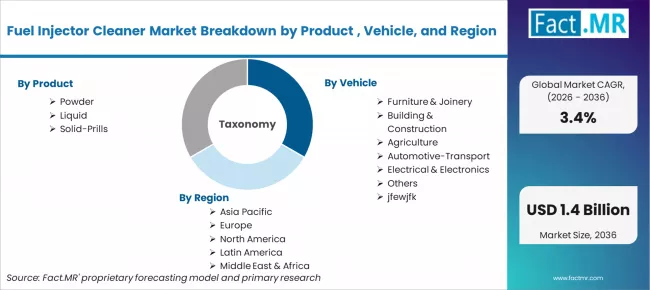
Fuel Injector Cleaner Market Breakdown By Product , Vehicle, And Region | Source: Fact.MR
| Metric | Value |
|---|---|
| Quantitative Units | USD 1.03 billion to USD 1.44 billion, at a CAGR of 3.4% |
| Market Definition | Fuel injector cleaners are chemical additives formulated to dissolve and remove carbon deposits, varnish, and gum from fuel injector tips, intake valves, and combustion chambers in internal combustion engines. Active chemistries include polyisobutylamine (PIBA), polyetheramine (PEA), and polyisobutylene succinimide (PIBSI) detergent-dispersant packages dissolved in carrier solvents. |
| Product Segmentation | Liquid Additives, Aerosols, Others |
| Vehicle Segmentation | Passenger Cars, LCV, HCV |
| Channel Segmentation | Retail, Workshops, Online |
| Regions Covered | North America, Latin America, Europe, East Asia, South Asia, Oceania, Middle East & Africa |
| Countries Covered | USA, Mexico, Germany, France, UK, South Korea, Japan, and 40 plus countries |
| Key Companies Profiled | Chevron Corporation, STP (Slick 50), Liqui Moly GmbH, Gumout (ITW Global Brands), Lucas Oil Products Inc., Red Line Synthetic Oil Corporation, BG Products Inc., Wynn's (Schaeffler Group), Bardahl Manufacturing Corporation, Royal Purple (Calumet Specialty Products Partners) |
| Forecast Period | 2026 to 2036 |
| Approach | Hybrid top-down and bottom-up methodology reconciling production, trade, and consumption data with primary research validation. |
Source: Fact.MR analysis. Updated Mar 24, 2026
Fuel Injector Cleaner Market by Segments
-
Product :
- Liquid Additives
- Aerosols
- Others
-
Vehicle :
- Passenger Cars
- LCV
- HCV
-
Channel :
- Retail
- Workshops
- Online
-
Region :
- North America
- United States
- Canada
- Mexico
- Europe
- Germany
- United Kingdom
- France
- Italy
- Spain
- Nordic
- BENELUX
- Rest of Europe
- Asia Pacific
- China
- Japan
- South Korea
- India
- Australia & New Zealand
- ASEAN
- Rest of Asia Pacific
- Latin America
- Brazil
- Chile
- Rest of Latin America
- Middle East & Africa
- Kingdom of Saudi Arabia
- Other GCC Countries
- Turkey
- South Africa
- Other African Union
- Rest of Middle East & Africa
- North America
Frequently Asked Questions
How large is the demand for Fuel Injector Cleaner in the global market in 2026?
What will be the market size of Fuel Injector Cleaner in the global market by 2036?
What is the expected demand growth for Fuel Injector Cleaner in the global market between 2026 and 2036?
Which Product is poised to lead global sales by 2026?
How is the Vehicle segment structured in this report?
What is the growth outlook for USA in this report?
What is Fuel Injector Cleaner and what is it mainly used for?
How does Fact.MR build and validate the Fuel Injector Cleaner forecast?
Who worked on this report


Preview the report firsthand - request a free sample
Free SampleGet the brochure for pricing and purchase details
Download PDF