Airport Catering Trucks Market (2026 - 2036)

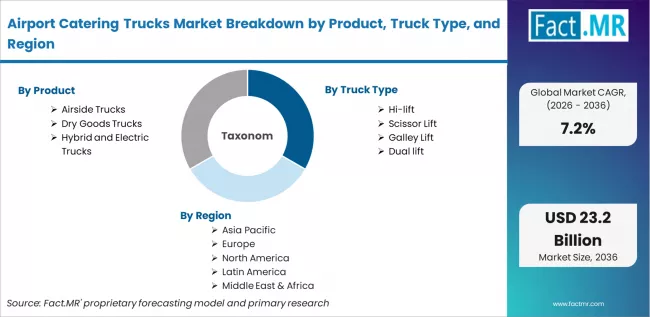
Airport Catering Trucks Market is segmented by Product (Airside Trucks, Dry Goods Trucks, Hybrid and Electric Trucks), Truck Type (Hi-lift, Scissor Lift, Galley Lift, Dual Lift), Application (Commercial Aircraft, Military Aircraft, Business Jets), Fuel Type (Diesel, Electric, Hybrid), and Region. Forecast for 2026 to 2036.

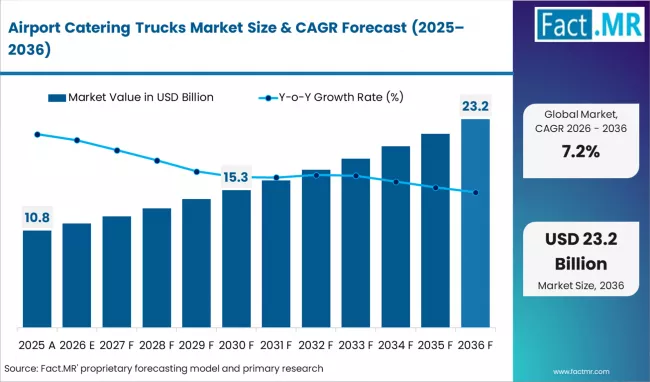
Fact.MR opines the airport catering trucks market was valued at usd 10.80 billion in 2025. sales are expected to reach usd 11.58 billion in 2026 and usd 23.20 billion by 2036. airside trucks is poised to lead by product with 44.0% share in 2026 and hi-lift is estimated to command by truck type in 2026.

Airport Catering Trucks Market Definition

The airport catering trucks market was valued at USD 10.80 billion in 2025, projected to reach USD 11.58 billion in 2026, and is forecast to expand to USD 23.20 billion by 2036 at a 7.20% CAGR. Accelerating global air passenger traffic recovery and fleet expansion at major hub airports are generating sustained replacement and fleet expansion cycles for specialized ground support catering vehicles. Airport authorities implementing airside emission reduction targets are mandating the phase-in of electric and hybrid catering truck configurations, creating a parallel procurement stream alongside conventional diesel fleet renewals.

The absolute dollar opportunity between 2026 and 2036 amounts to approximately USD 11.62 billion. Growth is anchored by airport terminal expansion programmes in the Middle East, Asia Pacific, and North America that require proportional ground support equipment fleet scaling. Diesel-powered trucks continue to dominate the installed base, but electrification mandates at major European and North American airports are compressing the replacement cycle for aging diesel fleets. Fact.MR analysts observe that the transition toward electric ground support equipment is constrained by charging infrastructure investment timelines and the weight penalty of battery packs on vehicles that must maintain precise hydraulic lift performance under full catering load conditions.

China leads with a 9.7% CAGR, followed by India at 9.2% as both nations commission new airport terminals with expanded gate capacity. South Korea registers 6.5%. USA operations advance at 6.3%, supported by FAA airside emission reduction guidance. Japan maintains a 6.0% trajectory. Germany registers 5.8%, and UK networks track at 5.5%.

Airport catering trucks are specialized ground support vehicles designed to transport prepared meals, beverages, and galley equipment from flight kitchens to aircraft parked at terminal gates or remote stands. These vehicles feature hydraulic lift platforms that elevate the enclosed cargo compartment to aircraft door height, enabling direct transfer of catering carts and trolleys into the galley service areas of commercial, military, and business jet aircraft.
Airport Catering Trucks Market Market Value Analysis

Airport Catering Trucks Market Key Takeaways

Metric Details
Industry Size (2026) USD 11.58 billion
Industry Value (2036) USD 23.20 billion
CAGR (2026 to 2036) 7.20% 

Airport Catering Trucks Market Inclusions

The report covers airside catering trucks, dry goods transport trucks, and hybrid/electric catering vehicles. Coverage includes hi-lift, scissor lift, galley lift, and dual lift truck types across commercial aircraft, military aircraft, and business jet applications. Fuel type segmentation spans diesel, electric, and hybrid configurations for the 2026 to 2036 forecast period.

Airport Catering Trucks Market Exclusions

Standard cargo loader vehicles without enclosed catering compartments, baggage handling equipment, fuel tanker trucks, and lavatory service vehicles are excluded. Airport terminal food court operations, airline catering menu planning services, and galley interior refurbishment programmes fall outside the analytical boundary.

Airport Catering Trucks Market Research Methodology

  • Primary Research: Analysts engaged with procurement directors, product engineers, and operations leads across the airport catering trucks value chain to map adoption triggers and specification thresholds.
  • Desk Research: Data collection aggregated regulatory filings, standards ratification records, trade body publications, and corporate annual reports from allowed source categories.
  • Market-Sizing and Forecasting: Baseline values derive from a hybrid top-down and bottom-up aggregation, applying region-specific adoption curves to project demand velocity through 2036.
  • Data Validation and Update Cycle: Projections undergo cross-validation against publicly reported financial guidance, regulatory compliance databases, and independent industry association benchmarks.

Summary of Airport Catering Trucks Market

  • Airport Catering Trucks Market Definition
    • Airport catering trucks are hydraulic-lift ground support vehicles that transport and elevate prepared food service loads from flight kitchens to aircraft galley door height for direct trolley transfer during turnaround operations.
  • Demand Drivers in the Market
    • Post-pandemic recovery in global commercial air traffic volumes compels airport operators and ground handling companies to expand catering truck fleets to match increased aircraft turnaround frequency at hub and secondary airports.
    • New terminal construction projects across the Middle East, India, and Southeast Asia mandate proportional ground support equipment procurement, with catering trucks specified as part of the baseline airside vehicle fleet for each new gate position.
    • Airport authority emission reduction mandates in Europe and North America are accelerating the procurement of electric and hybrid catering trucks, creating a replacement demand layer on top of standard fleet renewal cycles.
  • Key Segments Analyzed in the Fact.MR Report
    • Airside Trucks: 44.0% share in 2026, reflecting the dominant configuration within the product category across global markets.
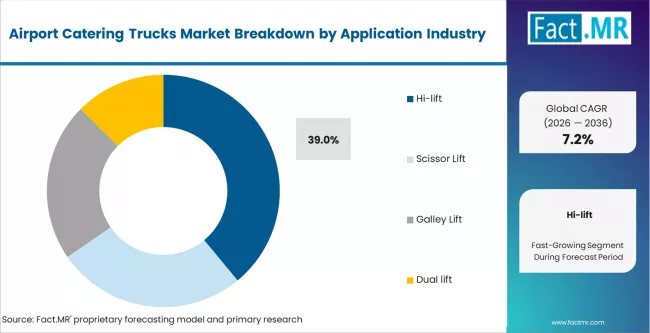
    • Hi-lift: 39.0% share in 2026, as the leading sub-segment within truck type segmentation.
    • China: 9.7% compound growth, representing the fastest-expanding national market within the forecast period.
  • Analyst Opinion at Fact.MR
    • The airport catering truck market is shaped by two converging procurement cycles: fleet expansion driven by new terminal gate capacity and fleet replacement driven by airside electrification mandates. Ground handling companies that delay electric truck adoption risk non-compliance with tightening airport emission regulations, particularly at Schiphol, Heathrow, and major Scandinavian hubs that have set binding zero-emission airside vehicle deadlines. The hi-lift configuration retains dominance because commercial aircraft door sill heights require vertical reach that simpler scissor lift designs cannot consistently achieve across all aircraft types in a mixed-fleet gate environment. Procurement directors must manage the trade-off between battery weight penalties and hydraulic lift performance specifications when evaluating electric catering truck bids against diesel incumbents.
  • Strategic Implications / Executive Takeaways
    • Ground handling fleet managers must develop phased electrification roadmaps aligned with airport-specific zero-emission airside vehicle deadlines to prevent contractual non-compliance with airport authority operating licences.
    • Manufacturers should prioritize hi-lift electric truck development that meets full catering load hydraulic performance specifications without compromising battery cycle life under intensive turnaround scheduling.
    • Airport expansion project directors commissioning new terminals in Asia Pacific and the Middle East must specify catering truck charging infrastructure in gate design blueprints to avoid costly retrofit requirements after terminal opening.

What are the regional trends of airport catering truck market?

The airport catering truck market in North America remains mature due to established flight operations and ongoing investments into airport infrastructure with green ground service equipment. North American airport authorities dedicate their effort to implementing electric catering vehicles as well as eco-friendly catering trucks according to their sustainability agendas.

Key countries within Europe work toward the same direction by giving priority to airport logistic standards that include technological development alongside regulatory enforcement and emissions control mechanisms. The rising aviation sector requires the implementation of technologically advanced catering trucks throughout this region.

Rapid airline expansion together with world-class airport facilities creates the Middle East into one of the main aviation hubs in the world. The expansion of airline passenger services in Latin America and Africa progresses slowly because limited budgets and infrastructure challenges exist.

What are the challenges and restraining factors of airport catering truck market?

Multiple market challenges exist which threaten to limit the airport catering truck market growth in the forecasting years. Advanced catering trucks involving high capital investment and operational costs become a financial burden for smaller airports along with their service providers specifically when it comes to electric or hybrid models.

Air traffic cycles demonstrate cyclical nature among aviation industries which results in periodic decrease of air traffic that negatively impact catering services. The implementation of food safety, emission standards and operational regulations elevates the difficulty and expenses involved in updating vehicle fleets.

The implementation of modern catering trucks is blocked by inadequate infrastructure within developing regions. Operations of sophisticated vehicles suffer from technical personnel shortages as well as insufficient expertise for their maintenance and operation.

The deployment of systems suffers additional delays because of supply chain disruptions that specifically affects essential components such as electric drivetrains or refrigeration units. The combined challenges prompt sustained development of this market to require both strategic public spending and supportive legislation.

Shifts in the Airport Catering Truck Market from (2021 to 2025) and Future Trends (2026 to 2036)

When international travel recovered the market demand returned with force especially in airports with high passenger volumes across Asia Pacific, North America and Europe. The market expansion occurred because airlines improved their services while modernizing ground equipment and international tourism operations began to recuperate.

The market will expand consistently from 2021 to 2036 because of declining carbon emissions in aviation and increasing aircraft fleets worldwide while smart electric vehicles and autonomous systems receive increased funding. Changes in airport emission regulations and IoT adoption for fleet observation will influence technological developments in this market sector.

Market Shift 2021 to 2026
Regulatory Landscape Ground equipment standards were loosely enforced, with a growing interest in safety compliance and low emissions.
Technological Advancements Introduction of basic electric catering trucks in developed markets; improvements in hydraulic lift systems.
Industry-Specific Demand Recovery from pandemic-induced decline; growth tied to long-haul and short-haul flight resumption.
Sustainability & Circular Economy Limited to pilot projects for electric trucks; recycling initiatives in major airport hubs.
Production & Supply Chain Faced delays due to global component shortages and supply chain fragmentation.
Market Growth Drivers Recovery of air travel upgrades in airport ground infrastructure, and airline competition in passenger experience.
Market Shift 2021 to 2036
Regulatory Landscape Tighter environmental mandates from aviation authorities (e.g., ICAO, FAA, EASA), requiring adoption of electric and hybrid catering trucks at major airports.
Technological Advancements Widespread adoption of AI-driven fleet management, autonomous guidance systems, modular chassis design, and full electrification of airport ground support fleets.
Industry-Specific Demand Increasing airline food service diversification, rising flight frequency in Asia and the Middle East, and expansion of low-cost carriers creating demand for high-throughput catering logistics.
Sustainability & Circular Economy Focus on net-zero ground operations, full transition to electric vehicles, and lifecycle analysis for catering truck components to reduce carbon footprint.
Production & Supply Chain Shift toward localized manufacturing in strategic aviation markets; vertical integration of truck manufacturing with fleet service providers.
Market Growth Drivers Electrification mandates, rise in premium in-flight services, expansion of airport infrastructure in developing countries, and smart airport initiatives.

Safran gained selection from emerging economies to construct new airports along with designing expansion plans for airport capacity development. The combination of smart diagnostic tools and zero-emission drivetrains and real-time inventory tracking systems will create unprecedented levels of fleet efficiency. The union of sustainability guidelines together with airport digital modernization will force OEMs and operators to redesign their service and product ranges.

Country-Wise Outlook

Top Country Growth Comparison Airport Catering Trucks Market Cagr (2026 2036)

Country CAGR (2026 to 2036)
United States 5.0%
China 8.6%
Japan 6.3%

United States (U.S.)

Current market trends indicate that the United States airport catering truck industry maintains a positive growth pattern with the resurgence of domestic along with international air travel activities. Airline companies purchase contemporary electric catering vehicles as a way to satisfy sustainability requirements and combat ground emissions at airports. The market benefits from FAA safety norms as well as rising customer demand for better in-flight food service methods.

Food delivery services become smoother through the collaborations that catering service providers establish with logistics technology companies. The market is growing primarily through two key segments where international carriers need big customizable trucks for premium airline service needs.

Market growth mechanisms stem from increasing interest in electric and hybrid car adoption, which federal green transport incentives help to promote. The U.S. market for transportation will experience a steady CAGR growth from 2026 through 2036 because of continuous updates in infrastructure and fleets and airlines concentrating on delivering exceptional services.

China

China’s airport catering truck market is highly competitive as the nation continuously develops its airport infrastructure and domestic aviation grows at an alarming rate. Passenger traffic is growing across tier-1 and tier-2 cities, causing a rise in demand for high-efficiency ground support equipment, which includes catering trucks.

Green aviation and low-emission airport vehicle support from governments electric and hybrid adoption of catering trucks. Like their western counterparts, Chinese manufacturers are also responding with state of the art automated and smart loading systems on request of regional airline customers.

New opportunities for equipment suppliers are opening through strategic investments in new airport hubs like Beijing Daxing and Chengdu Tianfu. The increase in high-end airline services and demand for diversified meal options during flight is further driving the demand for state-of-the-art temperature-controlled catering trucks.

Local production capabilities, cost competitiveness and state-supported R&D, give Chinese companies an advantage in both domestic and export markets. Between 2026 and 2036, the sector will experience high CAGR growth, fueled by modernization and sustainability policies of aviation.

Japan
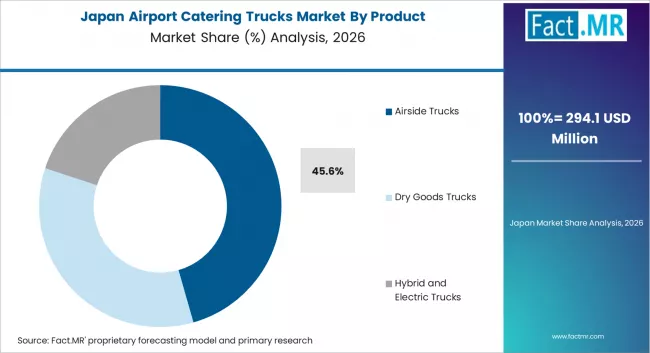
Airport Catering Trucks Market Japan Market Share Analysis By Product

The airport catering truck market in Japan functions under conditions which demand technological precision combined with compact design standards coupled with stringent food handling principles. Japanese airlines and airports use their service quality investment to buy next-generation catering trucks that integrate automation and eco-friendly powertrain systems and advanced safety controls for operational efficiency.

The market receives substantial demand from international carriers based in major transport hubs such as Tokyo Haneda and Kansai International Airport. The government’s dedication to sustainability and electric vehicle standard aims to propel Japan toward electric vehicle transformation in airport delivery fleets.

The market is increasing the number of robotic and remote operation technologies because they help to solve staffing problems and improve safety conditions at airports. Japanese manufacturers are designing modular units which use minimal space in order to fit within constrained airport areas.

Positive market conditions results from two factors increasing international traffic and aging fleet and green airport initiatives backed by government policies. The analysis predicts that the market will experience a steady CAGR between 2026 and 2036 because of established modernization efforts.

Category-Wise Analysis

Dry Goods Truck - By Product
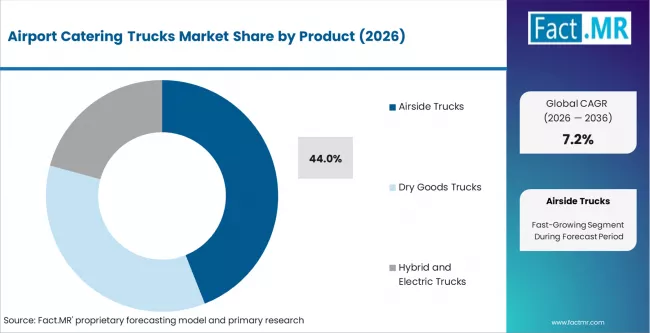
Airport Catering Trucks Market Analysis By Product

The airport catering truck market comprises dry goods trucks as its fundamental segment because they transport packaged food and beverages and non-perishable items to aircraft. Dry goods trucks provide critical service for rapid but hygienic delivery of catering supplies in particular to commercial flights that need substantial food inventory.

The storage systems within these trucks keep goods intact through temperature-controlled multi-compartment setups. Dry goods fleet at North American and European airports receive ongoing upgrades because both food safety standards and hygiene requirements from regulators keep increasing.

The segment operates under present-day challenges because fleet operators need to replace their vehicles with electric models to achieve carbon emission targets. The pursuit of airport sustainability involves the upgrading of dry goods truck with electric or hybrid drivetrains which is required in regions like California and parts of the EU.

Hi-Lift - By Truck Type
Airport Catering Trucks Market Analysis By Truck Type

Hi-lift trucks represent fundamental assets in airport catering logistics because their technologically advanced designs allow perfect elevation of catering containers toward aircraft door height. Engineering designs of these trucks incorporate a hydraulic system and a scissor mechanism to adapt their height according to narrow-body through wide-body aircraft.

The hi-lift system both optimizes operations and decreases manual labor so food and beverage carts can be safely loaded with intact quality alongside presentation standards. The segment experiences robust demand from busy airports handling numerous commercial aircraft particularly in Middle Eastern and Asia-Pacific regions because their airlines rapidly build up their fleet sizes.

Safety regulations and labor-saving automation also drive adoption. Development markets might not adopt hydraulic systems because they need significant initial expenses as well as high maintenance costs.

Commercial Aircraft - By Applications
Airport Catering Trucks Market Analysis By Application

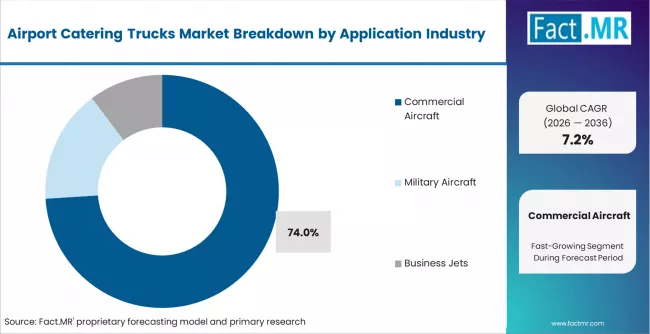
Commercial aircraft function as the primary application segment for airport catering trucks because they require extensive food services which correspond to their numerous daily flights. Air service providers running flights between short and long-distance destinations depend on dependable meal delivery services for distributing various food items including meals and snacks and beverages during their international services.

The segment continues to grow because low-cost carriers join expanding fleets of full-service airlines after the pandemic's conclusion. The increasing number of air passengers especially in Asia and Latin America requires the implementation of rapid and efficient catering logistics operations.

Airports with substantial commercial activity are enhancing their investments in automated and sustainable food delivery vehicles because these systems help to control fast intervals and ensure food quality requirements. The advancement of commercial airline catering toward premium meals and dietary customization requires ground services to enhance their vehicle capabilities. Food service providers face stringent regulations concerning food safety standards as well as employee safety and emission regulations where green airport policies exist.

Competitive Analysis
Airport Catering Trucks Market Analysis By Company

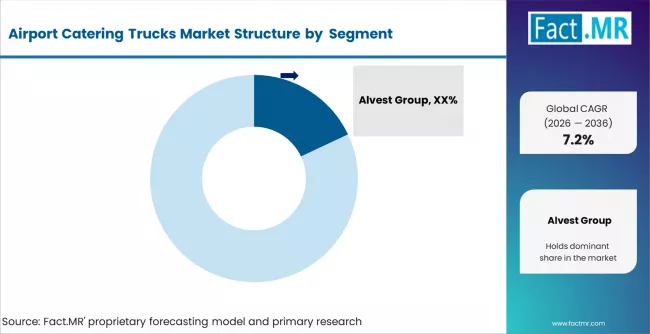
Market competition in airport catering trucks remains high due to increased air passenger numbers and requirements for effective ground operational support. Companies battle one another by creating innovative vehicles along with maximizing efficiency while delivering greater payload capacities and satisfying environmental standards and aviation requirements.

The market now differentiate itself through electrification and automation solutions because operators select environmental friendly products that need minimal maintenance. Local suppliers create difficulties for international brands through their affordable products which adapt to specific area infrastructure.

The purchasing preferences of customers are shaped by their ability to get post-purchase support and the capability to customize their products and integrate them with smart airport logistics solutions. The rising demand for modernized ground support equipment creates an intensified market competition because stakeholders invest in advanced fleet solutions to boost operational reliability and reduce airport turnaround times throughout the world.

Key players are Alvest Group, Global Ground Support Equipment LLC, Mallaghan Engineering Ltd, DOLL Fahrzeugbau GmbH, Eagle Industries DWC-LLC, Jiangsu Tianyi Airport Special Equipment Co., Cartoo GSE, WEIHAI GUANGTAI Airport Equipment Co., Ltd, Sovan, Rucker Equip. Industrials Ltda. and other players.

Market Share Analysis by Company

Company Name Estimated Market Share (%), 2024
Top 5 Players ~45-55%
Tier II Players ~15-30%
Other Players ~15-40%

Bibliography

  • International Air Transport Association. (2024). IATA Airport Handling Manual (AHM), 43rd edition: Ground support equipment specifications. IATA.
  • Airports Council International. (2024). ACI World airport traffic report 2024: Global passenger and cargo statistics. ACI.
  • International Civil Aviation Organization. (2024). Annex 14: Aerodromes, Volume I, aerodrome design and operations, 9th edition. ICAO.
  • European Union Aviation Safety Agency. (2024). Certification specifications and acceptable means of compliance for aerodrome design (CS-ADR-DSN). EASA.
  • Federal Aviation Administration. (2024). Advisory Circular 150/5220-10E: Guide specification for aircraft rescue and fire fighting vehicles. FAA.
  • Airport Cooperative Research Program. (2024). ACRP Report 233: Best practices for airport ground support equipment fleet electrification. TRB.

This bibliography is provided for reader reference. The full Fact.MR report contains the complete reference list with primary research documentation.

This Report Addresses

  • Market sizing and quantitative forecast metrics detailing global and regional expenditure on airport catering trucks through 2036.
  • Segmentation analysis evaluating adoption patterns across product, truck type, application, fuel type categories and their respective sub-segments.
  • Regional deployment intelligence comparing growth trajectories, regulatory environments, and competitive dynamics across North America, Europe, Asia Pacific, Latin America, and the Middle East & Africa.
  • Regulatory compliance assessment analyzing how safety, environmental, or performance standards shape procurement specifications and product development priorities.
  • Competitive landscape evaluation tracking market structure, supplier positioning, and integration strategies among leading industry participants.
  • Strategic investment guidance defining the procurement specifications, technology transitions, and capacity allocation decisions required for market positioning through the forecast period.
  • Supply chain risk analysis identifying material sourcing constraints, manufacturing concentration vulnerabilities, and logistics dependencies affecting market participants.
  • Custom data delivery formats encompassing interactive dashboards, raw Excel datasets, and comprehensive PDF narrative reports.

Scope of the Report

Airport Catering Trucks Market Breakdown By Product, Truck Type, And Region

Metric Value
Quantitative Units USD 11.58 billion to USD 23.20 billion, at a CAGR of 7.20%
Market Definition Airport catering trucks are hydraulic-lift ground support vehicles that transport and elevate prepared food service loads from flight kitchens to aircraft galley door height for direct trolley transfer during turnaround operations.
Product Segmentation Airside Trucks, Dry Goods Trucks, Hybrid and Electric Trucks
Truck Type Segmentation Hi-lift, Scissor Lift, Galley Lift, Dual Lift
Application Segmentation Commercial Aircraft, Military Aircraft, Business Jets
Fuel Type Segmentation Diesel, Electric, Hybrid
Regions Covered North America, Latin America, Europe, East Asia, South Asia, Oceania, Middle East & Africa
Countries Covered India, China, USA, Canada, UK, Germany, Japan, and 40 plus countries
Key Companies Profiled Alvest Group, Mallaghan Engineering Ltd, Global Ground Support Equipment LLC, DOLL Fahrzeugbau GmbH, Jiangsu Tianyi Airport Special Equipment Co., Eagle Industries DWC-LLC, Rucker Equip. Industrials Ltd.
Forecast Period 2026 to 2036
Approach Forecasting models apply a hybrid top-down and bottom-up methodology, cross-validated against primary research and public industry filings.

Segmentation of Airport catering truck market

  • By Product :

    • Dry Goods Trucks
    • Airside Trucks
    • Hybrid and Electric Trucks
  • By Truck Type :

    • Hi-lift
    • Scissor Lift
    • Galley Lift
    • Dual lift
  • By Application :

    • Commercial Aircraft
    • Military Aircraft
    • Business Jets
  • By Fuel Type :

    • Diesel
    • Electric
    • Hybrid
  • By Region :

    • North America
    • Latin America
    • Western Europe
    • Eastern Europe
    • East Asia
    • South Asia Pacific
    • Middle East & Africa

Table of Content

  1. Executive Summary
    • Global Market Outlook
    • Demand to side Trends
    • Supply to side Trends
    • Technology Roadmap Analysis
    • Analysis and Recommendations
  2. Market Overview
    • Market Coverage / Taxonomy
    • Market Definition / Scope / Limitations
  3. Research Methodology
    • Chapter Orientation
    • Analytical Lens and Working Hypotheses
      • Market Structure, Signals, and Trend Drivers
      • Benchmarking and Cross-market Comparability
      • Market Sizing, Forecasting, and Opportunity Mapping
    • Research Design and Evidence Framework
      • Desk Research Programme (Secondary Evidence)
        • Company Annual and Sustainability Reports
        • Peer-reviewed Journals and Academic Literature
        • Corporate Websites, Product Literature, and Technical Notes
        • Earnings Decks and Investor Briefings
        • Statutory Filings and Regulatory Disclosures
        • Technical White Papers and Standards Notes
        • Trade Journals, Industry Magazines, and Analyst Briefs
        • Conference Proceedings, Webinars, and Seminar Materials
        • Government Statistics Portals and Public Data Releases
        • Press Releases and Reputable Media Coverage
        • Specialist Newsletters and Curated Briefings
        • Sector Databases and Reference Repositories
        • Fact.MR Internal Proprietary Databases and Historical Market Datasets
        • Subscription Datasets and Paid Sources
        • Social Channels, Communities, and Digital Listening Inputs
        • Additional Desk Sources
      • Expert Input and Fieldwork (Primary Evidence)
        • Primary Modes
          • Qualitative Interviews and Expert Elicitation
          • Quantitative Surveys and Structured Data Capture
          • Blended Approach
        • Why Primary Evidence is Used
        • Field Techniques
          • Interviews
          • Surveys
          • Focus Groups
          • Observational and In-context Research
          • Social and Community Interactions
        • Stakeholder Universe Engaged
          • C-suite Leaders
          • Board Members
          • Presidents and Vice Presidents
          • R&D and Innovation Heads
          • Technical Specialists
          • Domain Subject-matter Experts
          • Scientists
          • Physicians and Other Healthcare Professionals
        • Governance, Ethics, and Data Stewardship
          • Research Ethics
          • Data Integrity and Handling
      • Tooling, Models, and Reference Databases
    • Data Engineering and Model Build
      • Data Acquisition and Ingestion
      • Cleaning, Normalisation, and Verification
      • Synthesis, Triangulation, and Analysis
    • Quality Assurance and Audit Trail
  4. Market Background
    • Market Dynamics
      • Drivers
      • Restraints
      • Opportunity
      • Trends
    • Scenario Forecast
      • Demand in Optimistic Scenario
      • Demand in Likely Scenario
      • Demand in Conservative Scenario
    • Opportunity Map Analysis
    • Product Life Cycle Analysis
    • Supply Chain Analysis
    • Investment Feasibility Matrix
    • Value Chain Analysis
    • PESTLE and Porter’s Analysis
    • Regulatory Landscape
    • Regional Parent Market Outlook
    • Production and Consumption Statistics
    • Import and Export Statistics
  5. Global Market Analysis 2021 to 2025 and Forecast, 2026 to 2036
    • Historical Market Size Value (USD Million) Analysis, 2021 to 2025
    • Current and Future Market Size Value (USD Million) Projections, 2026 to 2036
      • Y to o to Y Growth Trend Analysis
      • Absolute $ Opportunity Analysis
  6. Global Market Pricing Analysis 2021 to 2025 and Forecast 2026 to 2036
  7. Global Market Analysis 2021 to 2025 and Forecast 2026 to 2036, By Product
    • Introduction / Key Findings
    • Historical Market Size Value (USD Million) Analysis By Product , 2021 to 2025
    • Current and Future Market Size Value (USD Million) Analysis and Forecast By Product , 2026 to 2036
      • Airside Trucks
      • Dry Goods Trucks
      • Hybrid and Electric Trucks
    • Y to o to Y Growth Trend Analysis By Product , 2021 to 2025
    • Absolute $ Opportunity Analysis By Product , 2026 to 2036
  8. Global Market Analysis 2021 to 2025 and Forecast 2026 to 2036, By Truck Type
    • Introduction / Key Findings
    • Historical Market Size Value (USD Million) Analysis By Truck Type, 2021 to 2025
    • Current and Future Market Size Value (USD Million) Analysis and Forecast By Truck Type, 2026 to 2036
      • Hi-lift
      • Scissor Lift
      • Galley Lift
      • Dual lift
    • Y to o to Y Growth Trend Analysis By Truck Type, 2021 to 2025
    • Absolute $ Opportunity Analysis By Truck Type, 2026 to 2036
  9. Global Market Analysis 2021 to 2025 and Forecast 2026 to 2036, By Application
    • Introduction / Key Findings
    • Historical Market Size Value (USD Million) Analysis By Application, 2021 to 2025
    • Current and Future Market Size Value (USD Million) Analysis and Forecast By Application, 2026 to 2036
      • Commercial Aircraft
      • Military Aircraft
      • Business Jets
    • Y to o to Y Growth Trend Analysis By Application, 2021 to 2025
    • Absolute $ Opportunity Analysis By Application, 2026 to 2036
  10. Global Market Analysis 2021 to 2025 and Forecast 2026 to 2036, By Fuel Type
    • Introduction / Key Findings
    • Historical Market Size Value (USD Million) Analysis By Fuel Type, 2021 to 2025
    • Current and Future Market Size Value (USD Million) Analysis and Forecast By Fuel Type, 2026 to 2036
      • Diesel
      • Electric
      • Hybrid
    • Y to o to Y Growth Trend Analysis By Fuel Type, 2021 to 2025
    • Absolute $ Opportunity Analysis By Fuel Type, 2026 to 2036
  11. Global Market Analysis 2021 to 2025 and Forecast 2026 to 2036, By Region
    • Introduction
    • Historical Market Size Value (USD Million) Analysis By Region, 2021 to 2025
    • Current Market Size Value (USD Million) Analysis and Forecast By Region, 2026 to 2036
      • North America
      • Latin America
      • Western Europe
      • Eastern Europe
      • East Asia
      • South Asia and Pacific
      • Middle East & Africa
    • Market Attractiveness Analysis By Region
  12. North America Market Analysis 2021 to 2025 and Forecast 2026 to 2036, By Country
    • Historical Market Size Value (USD Million) Trend Analysis By Market Taxonomy, 2021 to 2025
    • Market Size Value (USD Million) Forecast By Market Taxonomy, 2026 to 2036
      • By Country
        • USA
        • Canada
        • Mexico
      • By Product
      • By Truck Type
      • By Application
      • By Fuel Type
    • Market Attractiveness Analysis
      • By Country
      • By Product
      • By Truck Type
      • By Application
      • By Fuel Type
    • Key Takeaways
  13. Latin America Market Analysis 2021 to 2025 and Forecast 2026 to 2036, By Country
    • Historical Market Size Value (USD Million) Trend Analysis By Market Taxonomy, 2021 to 2025
    • Market Size Value (USD Million) Forecast By Market Taxonomy, 2026 to 2036
      • By Country
        • Brazil
        • Chile
        • Rest of Latin America
      • By Product
      • By Truck Type
      • By Application
      • By Fuel Type
    • Market Attractiveness Analysis
      • By Country
      • By Product
      • By Truck Type
      • By Application
      • By Fuel Type
    • Key Takeaways
  14. Western Europe Market Analysis 2021 to 2025 and Forecast 2026 to 2036, By Country
    • Historical Market Size Value (USD Million) Trend Analysis By Market Taxonomy, 2021 to 2025
    • Market Size Value (USD Million) Forecast By Market Taxonomy, 2026 to 2036
      • By Country
        • Germany
        • UK
        • Italy
        • Spain
        • France
        • Nordic
        • BENELUX
        • Rest of Western Europe
      • By Product
      • By Truck Type
      • By Application
      • By Fuel Type
    • Market Attractiveness Analysis
      • By Country
      • By Product
      • By Truck Type
      • By Application
      • By Fuel Type
    • Key Takeaways
  15. Eastern Europe Market Analysis 2021 to 2025 and Forecast 2026 to 2036, By Country
    • Historical Market Size Value (USD Million) Trend Analysis By Market Taxonomy, 2021 to 2025
    • Market Size Value (USD Million) Forecast By Market Taxonomy, 2026 to 2036
      • By Country
        • Russia
        • Poland
        • Hungary
        • Balkan & Baltic
        • Rest of Eastern Europe
      • By Product
      • By Truck Type
      • By Application
      • By Fuel Type
    • Market Attractiveness Analysis
      • By Country
      • By Product
      • By Truck Type
      • By Application
      • By Fuel Type
    • Key Takeaways
  16. East Asia Market Analysis 2021 to 2025 and Forecast 2026 to 2036, By Country
    • Historical Market Size Value (USD Million) Trend Analysis By Market Taxonomy, 2021 to 2025
    • Market Size Value (USD Million) Forecast By Market Taxonomy, 2026 to 2036
      • By Country
        • China
        • Japan
        • South Korea
      • By Product
      • By Truck Type
      • By Application
      • By Fuel Type
    • Market Attractiveness Analysis
      • By Country
      • By Product
      • By Truck Type
      • By Application
      • By Fuel Type
    • Key Takeaways
  17. South Asia and Pacific Market Analysis 2021 to 2025 and Forecast 2026 to 2036, By Country
    • Historical Market Size Value (USD Million) Trend Analysis By Market Taxonomy, 2021 to 2025
    • Market Size Value (USD Million) Forecast By Market Taxonomy, 2026 to 2036
      • By Country
        • India
        • ASEAN
        • Australia & New Zealand
        • Rest of South Asia and Pacific
      • By Product
      • By Truck Type
      • By Application
      • By Fuel Type
    • Market Attractiveness Analysis
      • By Country
      • By Product
      • By Truck Type
      • By Application
      • By Fuel Type
    • Key Takeaways
  18. Middle East & Africa Market Analysis 2021 to 2025 and Forecast 2026 to 2036, By Country
    • Historical Market Size Value (USD Million) Trend Analysis By Market Taxonomy, 2021 to 2025
    • Market Size Value (USD Million) Forecast By Market Taxonomy, 2026 to 2036
      • By Country
        • Kingdom of Saudi Arabia
        • Other GCC Countries
        • Turkiye
        • South Africa
        • Other African Union
        • Rest of Middle East & Africa
      • By Product
      • By Truck Type
      • By Application
      • By Fuel Type
    • Market Attractiveness Analysis
      • By Country
      • By Product
      • By Truck Type
      • By Application
      • By Fuel Type
    • Key Takeaways
  19. Key Countries Market Analysis
    • USA
      • Pricing Analysis
      • Market Share Analysis, 2025
        • By Product
        • By Truck Type
        • By Application
        • By Fuel Type
    • Canada
      • Pricing Analysis
      • Market Share Analysis, 2025
        • By Product
        • By Truck Type
        • By Application
        • By Fuel Type
    • Mexico
      • Pricing Analysis
      • Market Share Analysis, 2025
        • By Product
        • By Truck Type
        • By Application
        • By Fuel Type
    • Brazil
      • Pricing Analysis
      • Market Share Analysis, 2025
        • By Product
        • By Truck Type
        • By Application
        • By Fuel Type
    • Chile
      • Pricing Analysis
      • Market Share Analysis, 2025
        • By Product
        • By Truck Type
        • By Application
        • By Fuel Type
    • Germany
      • Pricing Analysis
      • Market Share Analysis, 2025
        • By Product
        • By Truck Type
        • By Application
        • By Fuel Type
    • UK
      • Pricing Analysis
      • Market Share Analysis, 2025
        • By Product
        • By Truck Type
        • By Application
        • By Fuel Type
    • Italy
      • Pricing Analysis
      • Market Share Analysis, 2025
        • By Product
        • By Truck Type
        • By Application
        • By Fuel Type
    • Spain
      • Pricing Analysis
      • Market Share Analysis, 2025
        • By Product
        • By Truck Type
        • By Application
        • By Fuel Type
    • France
      • Pricing Analysis
      • Market Share Analysis, 2025
        • By Product
        • By Truck Type
        • By Application
        • By Fuel Type
    • India
      • Pricing Analysis
      • Market Share Analysis, 2025
        • By Product
        • By Truck Type
        • By Application
        • By Fuel Type
    • ASEAN
      • Pricing Analysis
      • Market Share Analysis, 2025
        • By Product
        • By Truck Type
        • By Application
        • By Fuel Type
    • Australia & New Zealand
      • Pricing Analysis
      • Market Share Analysis, 2025
        • By Product
        • By Truck Type
        • By Application
        • By Fuel Type
    • China
      • Pricing Analysis
      • Market Share Analysis, 2025
        • By Product
        • By Truck Type
        • By Application
        • By Fuel Type
    • Japan
      • Pricing Analysis
      • Market Share Analysis, 2025
        • By Product
        • By Truck Type
        • By Application
        • By Fuel Type
    • South Korea
      • Pricing Analysis
      • Market Share Analysis, 2025
        • By Product
        • By Truck Type
        • By Application
        • By Fuel Type
    • Russia
      • Pricing Analysis
      • Market Share Analysis, 2025
        • By Product
        • By Truck Type
        • By Application
        • By Fuel Type
    • Poland
      • Pricing Analysis
      • Market Share Analysis, 2025
        • By Product
        • By Truck Type
        • By Application
        • By Fuel Type
    • Hungary
      • Pricing Analysis
      • Market Share Analysis, 2025
        • By Product
        • By Truck Type
        • By Application
        • By Fuel Type
    • Kingdom of Saudi Arabia
      • Pricing Analysis
      • Market Share Analysis, 2025
        • By Product
        • By Truck Type
        • By Application
        • By Fuel Type
    • Turkiye
      • Pricing Analysis
      • Market Share Analysis, 2025
        • By Product
        • By Truck Type
        • By Application
        • By Fuel Type
    • South Africa
      • Pricing Analysis
      • Market Share Analysis, 2025
        • By Product
        • By Truck Type
        • By Application
        • By Fuel Type
  20. Market Structure Analysis
    • Competition Dashboard
    • Competition Benchmarking
    • Market Share Analysis of Top Players
      • By Regional
      • By Product
      • By Truck Type
      • By Application
      • By Fuel Type
  21. Competition Analysis
    • Competition Deep Dive
      • Alvest Group
        • Overview
        • Product Portfolio
        • Profitability by Market Segments (Product/Age /Sales Channel/Region)
        • Sales Footprint
        • Strategy Overview
          • Marketing Strategy
          • Product Strategy
          • Channel Strategy
      • Mallaghan Engineering Ltd
      • Global Ground Support Equipment LLC
      • DOLL Fahrzeugbau GmbH
      • Jiangsu Tianyi Airport Special Equipment Co.
      • Eagle Industries DWC-LLC
      • Rucker Equip. Industrials Ltd.
  22. Assumptions & Acronyms Used

List Of Table

  • Table 1: Global Market Value (USD Million) Forecast by Region, 2021 to 2036
  • Table 2: Global Market Value (USD Million) Forecast by Product, 2021 to 2036
  • Table 3: Global Market Value (USD Million) Forecast by Truck Type, 2021 to 2036
  • Table 4: Global Market Value (USD Million) Forecast by Application, 2021 to 2036
  • Table 5: Global Market Value (USD Million) Forecast by Fuel Type, 2021 to 2036
  • Table 6: North America Market Value (USD Million) Forecast by Country, 2021 to 2036
  • Table 7: North America Market Value (USD Million) Forecast by Product, 2021 to 2036
  • Table 8: North America Market Value (USD Million) Forecast by Truck Type, 2021 to 2036
  • Table 9: North America Market Value (USD Million) Forecast by Application, 2021 to 2036
  • Table 10: North America Market Value (USD Million) Forecast by Fuel Type, 2021 to 2036
  • Table 11: Latin America Market Value (USD Million) Forecast by Country, 2021 to 2036
  • Table 12: Latin America Market Value (USD Million) Forecast by Product, 2021 to 2036
  • Table 13: Latin America Market Value (USD Million) Forecast by Truck Type, 2021 to 2036
  • Table 14: Latin America Market Value (USD Million) Forecast by Application, 2021 to 2036
  • Table 15: Latin America Market Value (USD Million) Forecast by Fuel Type, 2021 to 2036
  • Table 16: Western Europe Market Value (USD Million) Forecast by Country, 2021 to 2036
  • Table 17: Western Europe Market Value (USD Million) Forecast by Product, 2021 to 2036
  • Table 18: Western Europe Market Value (USD Million) Forecast by Truck Type, 2021 to 2036
  • Table 19: Western Europe Market Value (USD Million) Forecast by Application, 2021 to 2036
  • Table 20: Western Europe Market Value (USD Million) Forecast by Fuel Type, 2021 to 2036
  • Table 21: Eastern Europe Market Value (USD Million) Forecast by Country, 2021 to 2036
  • Table 22: Eastern Europe Market Value (USD Million) Forecast by Product, 2021 to 2036
  • Table 23: Eastern Europe Market Value (USD Million) Forecast by Truck Type, 2021 to 2036
  • Table 24: Eastern Europe Market Value (USD Million) Forecast by Application, 2021 to 2036
  • Table 25: Eastern Europe Market Value (USD Million) Forecast by Fuel Type, 2021 to 2036
  • Table 26: East Asia Market Value (USD Million) Forecast by Country, 2021 to 2036
  • Table 27: East Asia Market Value (USD Million) Forecast by Product, 2021 to 2036
  • Table 28: East Asia Market Value (USD Million) Forecast by Truck Type, 2021 to 2036
  • Table 29: East Asia Market Value (USD Million) Forecast by Application, 2021 to 2036
  • Table 30: East Asia Market Value (USD Million) Forecast by Fuel Type, 2021 to 2036
  • Table 31: South Asia and Pacific Market Value (USD Million) Forecast by Country, 2021 to 2036
  • Table 32: South Asia and Pacific Market Value (USD Million) Forecast by Product, 2021 to 2036
  • Table 33: South Asia and Pacific Market Value (USD Million) Forecast by Truck Type, 2021 to 2036
  • Table 34: South Asia and Pacific Market Value (USD Million) Forecast by Application, 2021 to 2036
  • Table 35: South Asia and Pacific Market Value (USD Million) Forecast by Fuel Type, 2021 to 2036
  • Table 36: Middle East & Africa Market Value (USD Million) Forecast by Country, 2021 to 2036
  • Table 37: Middle East & Africa Market Value (USD Million) Forecast by Product, 2021 to 2036
  • Table 38: Middle East & Africa Market Value (USD Million) Forecast by Truck Type, 2021 to 2036
  • Table 39: Middle East & Africa Market Value (USD Million) Forecast by Application, 2021 to 2036
  • Table 40: Middle East & Africa Market Value (USD Million) Forecast by Fuel Type, 2021 to 2036

List Of Figures

  • Figure 1: Global Market Pricing Analysis
  • Figure 2: Global Market Value (USD Million) Forecast 2021-2036
  • Figure 3: Global Market Value Share and BPS Analysis by Product, 2026 and 2036
  • Figure 4: Global Market Y-o-Y Growth Comparison by Product, 2026 to 2036
  • Figure 5: Global Market Attractiveness Analysis by Product
  • Figure 6: Global Market Value Share and BPS Analysis by Truck Type, 2026 and 2036
  • Figure 7: Global Market Y-o-Y Growth Comparison by Truck Type, 2026 to 2036
  • Figure 8: Global Market Attractiveness Analysis by Truck Type
  • Figure 9: Global Market Value Share and BPS Analysis by Application, 2026 and 2036
  • Figure 10: Global Market Y-o-Y Growth Comparison by Application, 2026 to 2036
  • Figure 11: Global Market Attractiveness Analysis by Application
  • Figure 12: Global Market Value Share and BPS Analysis by Fuel Type, 2026 and 2036
  • Figure 13: Global Market Y-o-Y Growth Comparison by Fuel Type, 2026 to 2036
  • Figure 14: Global Market Attractiveness Analysis by Fuel Type
  • Figure 15: Global Market Value (USD Million) Share and BPS Analysis by Region, 2026 and 2036
  • Figure 16: Global Market Y-o-Y Growth Comparison by Region, 2026 to 2036
  • Figure 17: Global Market Attractiveness Analysis by Region
  • Figure 18: North America Market Incremental Dollar Opportunity, 2026 to 2036
  • Figure 19: Latin America Market Incremental Dollar Opportunity, 2026 to 2036
  • Figure 20: Western Europe Market Incremental Dollar Opportunity, 2026 to 2036
  • Figure 21: Eastern Europe Market Incremental Dollar Opportunity, 2026 to 2036
  • Figure 22: East Asia Market Incremental Dollar Opportunity, 2026 to 2036
  • Figure 23: South Asia and Pacific Market Incremental Dollar Opportunity, 2026 to 2036
  • Figure 24: Middle East & Africa Market Incremental Dollar Opportunity, 2026 to 2036
  • Figure 25: North America Market Value Share and BPS Analysis by Country, 2026 and 2036
  • Figure 26: North America Market Value Share and BPS Analysis by Product, 2026 and 2036
  • Figure 27: North America Market Y-o-Y Growth Comparison by Product, 2026 to 2036
  • Figure 28: North America Market Attractiveness Analysis by Product
  • Figure 29: North America Market Value Share and BPS Analysis by Truck Type, 2026 and 2036
  • Figure 30: North America Market Y-o-Y Growth Comparison by Truck Type, 2026 to 2036
  • Figure 31: North America Market Attractiveness Analysis by Truck Type
  • Figure 32: North America Market Value Share and BPS Analysis by Application, 2026 and 2036
  • Figure 33: North America Market Y-o-Y Growth Comparison by Application, 2026 to 2036
  • Figure 34: North America Market Attractiveness Analysis by Application
  • Figure 35: North America Market Value Share and BPS Analysis by Fuel Type, 2026 and 2036
  • Figure 36: North America Market Y-o-Y Growth Comparison by Fuel Type, 2026 to 2036
  • Figure 37: North America Market Attractiveness Analysis by Fuel Type
  • Figure 38: Latin America Market Value Share and BPS Analysis by Country, 2026 and 2036
  • Figure 39: Latin America Market Value Share and BPS Analysis by Product, 2026 and 2036
  • Figure 40: Latin America Market Y-o-Y Growth Comparison by Product, 2026 to 2036
  • Figure 41: Latin America Market Attractiveness Analysis by Product
  • Figure 42: Latin America Market Value Share and BPS Analysis by Truck Type, 2026 and 2036
  • Figure 43: Latin America Market Y-o-Y Growth Comparison by Truck Type, 2026 to 2036
  • Figure 44: Latin America Market Attractiveness Analysis by Truck Type
  • Figure 45: Latin America Market Value Share and BPS Analysis by Application, 2026 and 2036
  • Figure 46: Latin America Market Y-o-Y Growth Comparison by Application, 2026 to 2036
  • Figure 47: Latin America Market Attractiveness Analysis by Application
  • Figure 48: Latin America Market Value Share and BPS Analysis by Fuel Type, 2026 and 2036
  • Figure 49: Latin America Market Y-o-Y Growth Comparison by Fuel Type, 2026 to 2036
  • Figure 50: Latin America Market Attractiveness Analysis by Fuel Type
  • Figure 51: Western Europe Market Value Share and BPS Analysis by Country, 2026 and 2036
  • Figure 52: Western Europe Market Value Share and BPS Analysis by Product, 2026 and 2036
  • Figure 53: Western Europe Market Y-o-Y Growth Comparison by Product, 2026 to 2036
  • Figure 54: Western Europe Market Attractiveness Analysis by Product
  • Figure 55: Western Europe Market Value Share and BPS Analysis by Truck Type, 2026 and 2036
  • Figure 56: Western Europe Market Y-o-Y Growth Comparison by Truck Type, 2026 to 2036
  • Figure 57: Western Europe Market Attractiveness Analysis by Truck Type
  • Figure 58: Western Europe Market Value Share and BPS Analysis by Application, 2026 and 2036
  • Figure 59: Western Europe Market Y-o-Y Growth Comparison by Application, 2026 to 2036
  • Figure 60: Western Europe Market Attractiveness Analysis by Application
  • Figure 61: Western Europe Market Value Share and BPS Analysis by Fuel Type, 2026 and 2036
  • Figure 62: Western Europe Market Y-o-Y Growth Comparison by Fuel Type, 2026 to 2036
  • Figure 63: Western Europe Market Attractiveness Analysis by Fuel Type
  • Figure 64: Eastern Europe Market Value Share and BPS Analysis by Country, 2026 and 2036
  • Figure 65: Eastern Europe Market Value Share and BPS Analysis by Product, 2026 and 2036
  • Figure 66: Eastern Europe Market Y-o-Y Growth Comparison by Product, 2026 to 2036
  • Figure 67: Eastern Europe Market Attractiveness Analysis by Product
  • Figure 68: Eastern Europe Market Value Share and BPS Analysis by Truck Type, 2026 and 2036
  • Figure 69: Eastern Europe Market Y-o-Y Growth Comparison by Truck Type, 2026 to 2036
  • Figure 70: Eastern Europe Market Attractiveness Analysis by Truck Type
  • Figure 71: Eastern Europe Market Value Share and BPS Analysis by Application, 2026 and 2036
  • Figure 72: Eastern Europe Market Y-o-Y Growth Comparison by Application, 2026 to 2036
  • Figure 73: Eastern Europe Market Attractiveness Analysis by Application
  • Figure 74: Eastern Europe Market Value Share and BPS Analysis by Fuel Type, 2026 and 2036
  • Figure 75: Eastern Europe Market Y-o-Y Growth Comparison by Fuel Type, 2026 to 2036
  • Figure 76: Eastern Europe Market Attractiveness Analysis by Fuel Type
  • Figure 77: East Asia Market Value Share and BPS Analysis by Country, 2026 and 2036
  • Figure 78: East Asia Market Value Share and BPS Analysis by Product, 2026 and 2036
  • Figure 79: East Asia Market Y-o-Y Growth Comparison by Product, 2026 to 2036
  • Figure 80: East Asia Market Attractiveness Analysis by Product
  • Figure 81: East Asia Market Value Share and BPS Analysis by Truck Type, 2026 and 2036
  • Figure 82: East Asia Market Y-o-Y Growth Comparison by Truck Type, 2026 to 2036
  • Figure 83: East Asia Market Attractiveness Analysis by Truck Type
  • Figure 84: East Asia Market Value Share and BPS Analysis by Application, 2026 and 2036
  • Figure 85: East Asia Market Y-o-Y Growth Comparison by Application, 2026 to 2036
  • Figure 86: East Asia Market Attractiveness Analysis by Application
  • Figure 87: East Asia Market Value Share and BPS Analysis by Fuel Type, 2026 and 2036
  • Figure 88: East Asia Market Y-o-Y Growth Comparison by Fuel Type, 2026 to 2036
  • Figure 89: East Asia Market Attractiveness Analysis by Fuel Type
  • Figure 90: South Asia and Pacific Market Value Share and BPS Analysis by Country, 2026 and 2036
  • Figure 91: South Asia and Pacific Market Value Share and BPS Analysis by Product, 2026 and 2036
  • Figure 92: South Asia and Pacific Market Y-o-Y Growth Comparison by Product, 2026 to 2036
  • Figure 93: South Asia and Pacific Market Attractiveness Analysis by Product
  • Figure 94: South Asia and Pacific Market Value Share and BPS Analysis by Truck Type, 2026 and 2036
  • Figure 95: South Asia and Pacific Market Y-o-Y Growth Comparison by Truck Type, 2026 to 2036
  • Figure 96: South Asia and Pacific Market Attractiveness Analysis by Truck Type
  • Figure 97: South Asia and Pacific Market Value Share and BPS Analysis by Application, 2026 and 2036
  • Figure 98: South Asia and Pacific Market Y-o-Y Growth Comparison by Application, 2026 to 2036
  • Figure 99: South Asia and Pacific Market Attractiveness Analysis by Application
  • Figure 100: South Asia and Pacific Market Value Share and BPS Analysis by Fuel Type, 2026 and 2036
  • Figure 101: South Asia and Pacific Market Y-o-Y Growth Comparison by Fuel Type, 2026 to 2036
  • Figure 102: South Asia and Pacific Market Attractiveness Analysis by Fuel Type
  • Figure 103: Middle East & Africa Market Value Share and BPS Analysis by Country, 2026 and 2036
  • Figure 104: Middle East & Africa Market Value Share and BPS Analysis by Product, 2026 and 2036
  • Figure 105: Middle East & Africa Market Y-o-Y Growth Comparison by Product, 2026 to 2036
  • Figure 106: Middle East & Africa Market Attractiveness Analysis by Product
  • Figure 107: Middle East & Africa Market Value Share and BPS Analysis by Truck Type, 2026 and 2036
  • Figure 108: Middle East & Africa Market Y-o-Y Growth Comparison by Truck Type, 2026 to 2036
  • Figure 109: Middle East & Africa Market Attractiveness Analysis by Truck Type
  • Figure 110: Middle East & Africa Market Value Share and BPS Analysis by Application, 2026 and 2036
  • Figure 111: Middle East & Africa Market Y-o-Y Growth Comparison by Application, 2026 to 2036
  • Figure 112: Middle East & Africa Market Attractiveness Analysis by Application
  • Figure 113: Middle East & Africa Market Value Share and BPS Analysis by Fuel Type, 2026 and 2036
  • Figure 114: Middle East & Africa Market Y-o-Y Growth Comparison by Fuel Type, 2026 to 2036
  • Figure 115: Middle East & Africa Market Attractiveness Analysis by Fuel Type
  • Figure 116: Global Market - Tier Structure Analysis
  • Figure 117: Global Market - Company Share Analysis

- Frequently Asked Questions -

How large is the airport catering trucks market in 2026?

The airport catering trucks market is estimated to be valued at USD 11.58 billion in 2026.

What will the airport catering trucks market size be by 2036?

The airport catering trucks market is projected to reach USD 23.20 billion by 2036.

What is the expected CAGR for the airport catering trucks market between 2026 and 2036?

The airport catering trucks market is expected to grow at a CAGR of 7.20% between 2026 and 2036.

Which product segment is poised to lead in 2026?

Airside Trucks accounts for 44.0% of product share in 2026, making it the leading sub-segment within this category.

Which country is the fastest-growing market?

China is projected to grow at a CAGR of 9.7% during 2026 to 2036, representing the fastest compound expansion among countries analyzed.

What is the scope of this airport catering trucks market report?

The report covers market sizing, segmentation by product, truck type, application, fuel type, regional analysis across 40 plus countries, competitive landscape evaluation, and regulatory impact assessment for 2026 to 2036.

What methodology does Fact.MR use for this forecast?

Fact.MR applies a hybrid top-down and bottom-up methodology, cross-validated against primary research interviews, public financial disclosures, and independent industry association data.

Which companies are profiled in this report?

Companies profiled include Alvest Group, Mallaghan Engineering Ltd, Global Ground Support Equipment LLC, DOLL Fahrzeugbau GmbH, Jiangsu Tianyi Airport Special Equipment Co., and others. The full list is available in the scope of the report section.

Airport Catering Trucks Market