
- Market Value (2025): USD 166.5 Mn
- Estimated Value (2026): USD 180.0 Mn
- Forecast Value (2036): USD 392.2 Mn
- CAGR (2026-2036): 8.1%
Abrasion-Resistant Coating Resins Market Forecast and Outlook 2026 to 2036
The abrasion-resistant coating resins market reached a derived estimate of USD 166.5 million in 2025. The market is anticipated to grow from USD 180.0 million in 2026 to USD 392.2 million by 2036, expanding at a CAGR of 8.1% during the forecast period.
Longer-lasting surfaces are becoming a priority in flooring, automotive interiors, industrial equipment and packaging, where repeated friction can damage appearance and performance. Resin manufacturers are refining formulations that balance film hardness with flexibility and faster curing. A relevant example came in March 2025, when Arkema showcased its Orgasol and Rilsan additives at European Coatings Show 2025, highlighting improvements in abrasion resistance across water-based, solvent-based and UV-curable coatings. This focus on durable finishes is creating fresh opportunities for specialty coating resins.
Key Takeaways from the Abrasion-Resistant Coating Resins Market
- Sales of abrasion-resistant coating resins stood at USD 166.5 million in 2025
- Abrasion-Resistant Coating Resins Market Value (2026): USD 180.0 million
- Abrasion-Resistant Coating Resins Market Forecast Value (2036): USD 392.2 million
- Abrasion-Resistant Coating Resins Market Forecast CAGR (2026-2036): 8.1%
- Leading Product Type: Hybrid wear-resistant resin (26.1%)
- Key Market Participants: Covestro, BASF, Allnex, Evonik, Arkema, Dow
- Key Growth Regions: United Kingdom, Italy, United States, Germany, France
In October 2026, Dow reported third-quarter Materials & Coatings net sales of USD 2.25 billion, up 8%, with local price up 5% and volume up 3%. Demand for abrasion-resistant coating resins is growing as coating raw material markets recover in both price and volume. Suppliers of abrasion-resistant coating resins are using the upturn to launch waterborne and high-solids grades. Similar recovery is projected to support sales of abrasion-resistant coating resins across Europe and the United States.
Abrasion-Resistant Coating Resins Market
| Metric | Value |
|---|---|
| Estimated Value (2025) | USD 166.5 million |
| Market Value (2026) | USD 180.0 million |
| Forecast Value (2036) | USD 392.2 million |
| Forecast CAGR (2026 to 2036) | 8.1% |
Source: Fact.MR analysis. Updated Nov 25, 2026
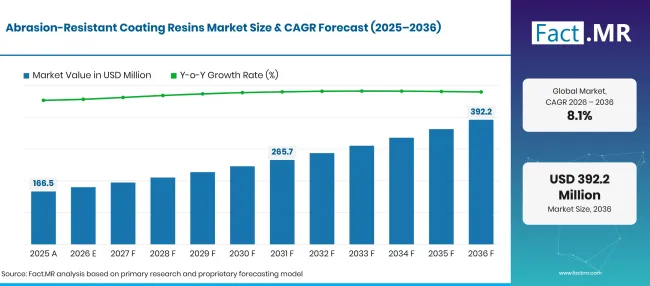
Abrasion Resistant Coating Resins Forecast Global | Source: Fact.MR
Category
| Category | Segments |
|---|---|
| Product Type | Hybrid wear-resistant resin, Acrylic abrasion resin, Epoxy coating resin, PU coating resin, Siloxane-modified resin |
| Material Form | Custom formulated, Liquid and dispersion, Paste and gel, Film and sheet, Pellet and powder |
| Performance Requirement | Chemical durability, Mechanical strength, Sustainability, Heat resistance, Electrical and thermal |
| End Use | Packaging and other, Industrial machinery, Electronics, Construction, Automotive |
| Region | United Kingdom; Italy; United States; Germany; France |
Source: Fact.MR analysis. Updated Nov 25, 2026
Segmental Analysis
Why do hybrid wear-resistant resins lead product demand in the Abrasion-Resistant Coating Resins Market?
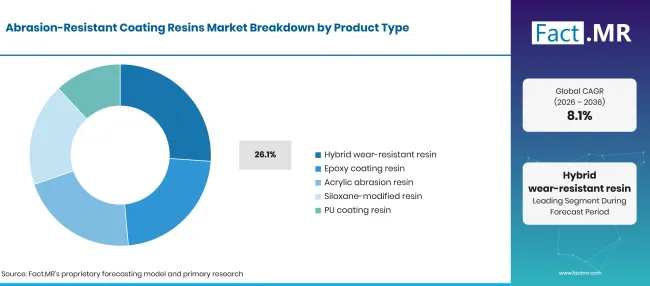
Abrasion Resistant Coating Resins Breakdown Product Type | Source: Fact.MR
Hybrid resins capture 26.1% of the market in 2026, equivalent to USD 47.0 million. Their appeal lies in combining polymer flexibility with inorganic hardness, making them suitable for plastic components, flooring and metal surfaces. Pure acrylic and polyurethane systems also find wider use where flexibility and application cost matter more than extreme surface hardness. Research published in Progress in Organic Coatings in July 2026 highlighted a siloxane-modified epoxy-acrylic hybrid with improved surface hardness and anti-smudge properties.
How is custom formulation leading form demand in the Abrasion-Resistant Coating Resins Market?
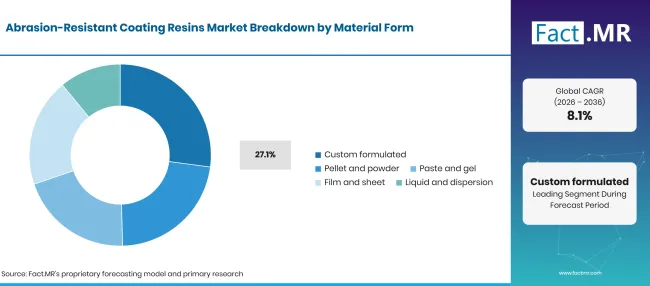
Abrasion Resistant Coating Resins Breakdown Material Form | Source: Fact.MR
Custom-formulated resins capture 27.1% of the market in 2026, worth USD 48.8 million. Coating manufacturers increasingly require formulations matched to substrate chemistry, curing conditions and abrasion-testing requirements. Standard formulations are also gaining traction among high-volume users seeking consistent results and simpler production processes. The need for application-specific performance is particularly visible in packaging, where ACTEGA's January 2026 ULTRASHEEN UV-8901BF technical sheet specifies scuff resistance, flexibility and adhesion across different paper-based packaging applications.
Why does chemical durability lead performance demand in the Abrasion-Resistant Coating Resins Market?
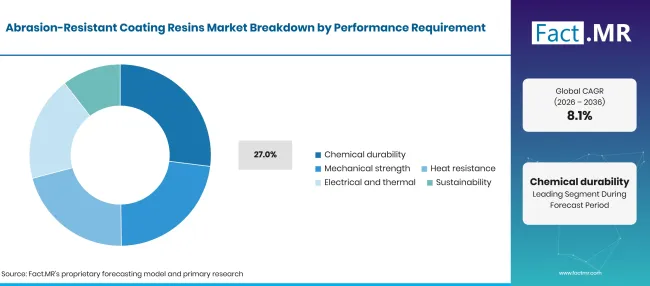
Abrasion Resistant Coating Resins Breakdown Performance Requirement | Source: Fact.MR
Chemical durability captures 27.0% of market revenue in 2026, reaching USD 48.6 million. Industrial floors, machinery and coated equipment face repeated contact with cleaning agents, oils and processing chemicals, making resistance to surface deterioration important. Scratch resistance and impact protection are also gaining attention in automotive components and consumer electronics. In 2026, Carboline's Plasite 7122 VAR product specifications highlighted combined chemical and abrasion resistance in epoxy-phenolic tank linings, illustrating the importance of protection against multiple forms of surface damage.
How do packaging and other end uses lead demand in the Abrasion-Resistant Coating Resins Market?
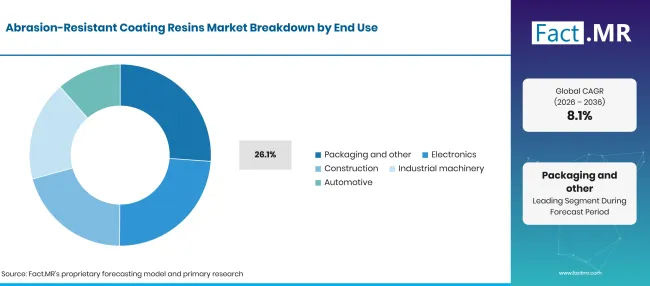
Abrasion Resistant Coating Resins Breakdown End Use | Source: Fact.MR
Packaging and other applications capture 26.1% of market revenue in 2026, equivalent to USD 47.0 million. Printed cartons, labels and flexible packs require protective finishes that prevent scuffing during handling, stacking and transportation. Automotive coatings and industrial flooring are also gaining traction as manufacturers seek longer-lasting surfaces. A January 2026 ACTEGA technical sheet for ULTRASHEEN UV-8901BF specifies scuff resistance, good adhesion and flexibility for folded boxes, commercial publications and transport packaging, highlighting the continued importance of protective coatings in packaging operations.
Abrasion-Resistant Coating Resins Market-Drivers, Restraints & Trends
Drivers
Packaging Regulations Increase Demand for Protective Coatings: Packaging converters are looking for thinner protective finishes that prevent scuffing without making recycling more difficult. This creates room for abrasion-resistant resins in recyclable paperboard, labels and flexible packaging. The European Union's Packaging and Packaging Waste Regulation began applying on 12 August 2026, introducing recyclability requirements for packaging placed on its market. Coatings that preserve surface durability while supporting recyclable pack designs are likely to attract greater interest.
Restraints
High Formulation Costs and Performance Trade-offs: Specialty resins often require costly additives, precise curing conditions and extensive testing. Raw material price swings can further squeeze margins, while premium formulations remain difficult to justify for budget flooring and furniture finishes. Smaller coaters also face equipment and process adjustments when switching to advanced UV-cured or hybrid systems.
Trends
UV and Electron-Beam Curing Create New Formulation Opportunities: Coating manufacturers are moving towards radiation-cured systems that shorten production cycles and reduce reliance on conventional solvent-based processing. Electron-beam curing is also gaining research attention for tougher polymer networks. A January 2026 study published in ACS Applied Materials & Interfaces demonstrated scratch resistance of up to 2.5 N in electron-beam-fabricated nanocomposite coatings. Further opportunities lie in developing abrasion-resistant formulations for high-speed industrial coating lines.
Trends
Recycled and Bio-Based Resin Feedstocks Open New Opportunities: Coating formulators are exploring renewable monomers and recyclable resin chemistries without compromising surface protection. In May 2026, research published in Progress in Organic Coatings demonstrated bio-based coatings with UV-blocking, self-healing and recyclability properties. This creates opportunities for resin developers to combine abrasion resistance with lower fossil-feedstock dependence. Future progress will depend on affordable bio-based inputs, consistent coating performance and compatibility with existing manufacturing processes.
Abrasion-Resistant Coating Resins Market by Analysis by Key Country
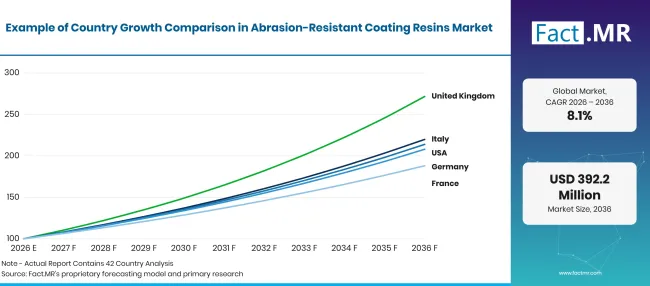
Abrasion Resistant Coating Resins Growth Index | Source: Fact.MR
| Country | CAGR (2026-2036) |
|---|---|
| United Kingdom | 10.5% |
| Italy | 8.2% |
| United States | 7.9% |
| Germany | 7.6% |
| France | 6.5% |
Source: Fact.MR analysis. Updated Nov 25, 2026
What is driving abrasion-resistant coating resins demand in the United Kingdom?
Electric vehicle manufacturing and premium automotive production are creating fresh opportunities for abrasion-resistant coating resins in the UK.
Interior trims, exterior components and battery-related surfaces require finishes that withstand repeated contact and handling. In September 2026, the UK government announced more than £1 billion in automotive investments within seven days, involving Bentley, McLaren and Nissan. Expanding vehicle manufacturing and advanced materials development are strengthening the market's growth prospects.
How is machinery export growth supporting abrasion-resistant coating resins sales in Italy?
Italy's established furniture, automotive and machinery industries offer several application areas for abrasion-resistant finishes.
Furniture surfaces and industrial components require coatings that retain their appearance despite frequent handling and friction. Istat reported a 1.2% monthly increase in Italian industrial production in September 2026, with capital goods output rising 1.3%. Activity across machinery and intermediate goods is creating opportunities for specialty resin formulations.
What is shaping abrasion-resistant coating resins demand in the United States?
A broad manufacturing base spanning automotive, aerospace, chemicals and packaging is keeping interest in high-performance surface protection strong across the United States.
In June 2026, the U.S. Bureau of Economic Analysis reported USD 121.8 billion in foreign direct investment expenditures in manufacturing during 2025. Expansion of production facilities and investment in industrial equipment are creating opportunities for coatings that withstand abrasion, chemical exposure and repeated cleaning.
How is the chemicals recovery shaping abrasion-resistant coating resins sales in Germany?
Germany's automotive engineering, machinery and industrial equipment sectors require durable coatings for components exposed to friction, handling and demanding operating conditions.
The country's Packaging Implementation Act, adopted in July 2026, adds another regulatory consideration for coating formulators working on recyclable packaging. Although automotive manufacturing faces employment pressures, the shift towards durable components and recyclable surface finishes is creating opportunities for advanced resin technologies.
Why is growth slower for abrasion-resistant coating resins in France?
France offers opportunities through its aerospace, automotive, packaging and industrial manufacturing industries.
Aircraft interiors, vehicle components and factory equipment require protective finishes that retain surface quality during prolonged use. In July 2026, INSEE reported that French manufacturing generated EUR 981 billion in production value during 2025, with manufacturing value added increasing 1.2%. Continued activity across industrial supply chains is creating scope for specialty abrasion-resistant coating formulations.
Competitive Landscape for Abrasion-Resistant Coating Resins Market
Competition in the abrasion-resistant coating resins market is shaped by manufacturers expanding their resin portfolios for demanding surface applications. Covestro offers Bayhydrol polyurethane and polyacrylate dispersions, while allnex markets EBECRYL® 1365 for abrasion-resistant UV and electron-beam coatings. BASF focuses on waterborne dispersions, acrylic resins and coating additives. Dow competes through specialty coating materials, while Evonik supplies surface-modifying additives and specialty silica. Arkema strengthens its position through Sartomer UV-curable resins and additives.
Recent product development highlights this shift: allnex showcased new waterborne and radiation-curable technologies at ACS 2026, including resins for industrial wood, packaging and protective finishes. Buyers increasingly compare scratch resistance, chemical durability, flexibility, curing speed and formulation cost when selecting suppliers.
Recent Developments
- On July 2, 2026, Covestro completed the acquisition of former Vencorex production sites in Thailand and the United States, expanding its HDI derivatives capacity for coatings and adhesives applications.
- On May 13, 2026, BASF launched Efka® PX 4720, a dispersing agent for solvent-free UV coatings that helps achieve ultra-matte finishes and stable formulations for industrial, furniture and flooring applications.
- On November 10, 2025, Allnex signed a strategic cooperation agreement with Nippon Paint to develop sustainable industrial coating solutions, including bio-based resins, with collaboration extending into coil, marine and engineering machinery coatings.
- On March 12, 2026, Evonik expanded its distribution partnership with IMCD into the United States, making its VISIOMER® specialty methacrylates portfolio more widely available for coatings, adhesives and construction applications.
- On September 17, 2025, Arkema announced a strategic partnership with Catalyxx to develop lower-carbon bio-based acrylic monomers and resins using renewable bio-alcohol feedstocks for coatings and other industrial applications.
- On September 17, 2026, Dow and Amcor launched a strategic collaboration to accelerate low-carbon packaging solutions by combining Dow's low-carbon polyethylene materials with Amcor's packaging technologies.
Key Players in Abrasion-Resistant Coating Resins Market
Key companies operating in the market include Covestro, BASF, Allnex, Evonik, Arkema, and Dow.
- Covestro
- BASF
- Allnex
- Evonik
- Arkema
- Dow
Bibliography
- Arkema. (2025). European Coatings Show 2025: Focus on Arkema's main product ranges for coating applications.
- ACTEGA. (2026). ULTRASHEEN® UV-8901BF: Technical data sheet.
- BASF. (2026, May 13). American Coatings Show 2026: BASF debuts Efka® PX 4720 to power ultra-matte UV coatings with CFRP technology.
- Bureau of Economic Analysis. (2026). New foreign direct investment in the United States, 2025. U.S. Department of Commerce.
- Carboline. (n.d.). Plasite® 7122 VAR: Product details.
- European Commission. (n.d.). Packaging waste.
- Frison, T., Verkerk, C.-F. J. B., van Ierssel, J., Tian, M., Totev, D. I., Tuinier, R., & Esteves, A. C. C. (2026). Electron beam fabrication of all-organic interpenetrating nanocomposite coatings. ACS Applied Materials & Interfaces, 18(2), 4302–4313.
- Istituto Nazionale di Statistica. (2026, November 11). Industrial production: September 2026.
- Institut national de la statistique et des études économiques. (2026, July 21). Indicateurs macroéconomiques de l'industrie: Données annuelles de 2010 à 2025.
- Liu, F., Yi, Q., Xi, A., Zhang, N., & Zeng, Y. (2026). Multifunctional bio-based coatings with UV-blocking, antioxidant, UV-induced self-healing, and recycling properties via solvent-free “click” chemistry. Progress in Organic Coatings.
- United Kingdom Department for Business, Innovation and Trade. (2026, September 24). Bentley announcement sees £1bn invested in UK automotive sector in just 7 days. GOV.UK.
- United States Department of Commerce. (2026). Dow reports third quarter 2026 results. Dow Investor Relations.
- Zhang, Y., Shi, H., Wen, X., Xu, S., & Pi, P. (2026). A perfluorosiloxane modified epoxy-acrylic hybrid resin with excellent anti-graffiti and anti-smudge performance. Progress in Organic Coatings.
Segmentation
Scope of Report
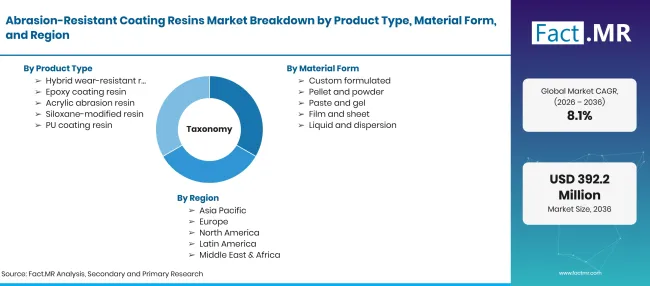
Abrasion Resistant Coating Resins Taxonomy | Source: Fact.MR
| Items | Values |
|---|---|
| Quantitative Units (2026) | USD 180.0 Million |
| Product Type | Hybrid wear-resistant resin, Acrylic abrasion resin, Epoxy coating resin, PU coating resin, Siloxane-modified resin |
| Material Form | Custom formulated, Liquid and dispersion, Paste and gel, Film and sheet, Pellet and powder |
| Performance Requirement | Chemical durability, Mechanical strength, Sustainability, Heat resistance, Electrical and thermal |
| End Use | Packaging and other, Industrial machinery, Electronics, Construction, Automotive |
| Regions Covered | North America, Latin America, Europe, East Asia, South Asia and Pacific, Middle East & Africa |
| Countries Covered | United Kingdom, Italy, United States, Germany, France, and other countries |
| Key Companies Profiled | Covestro, BASF, Allnex, Evonik, Arkema, Dow |
| Additional Attributes | Dollar revenue in the Abrasion-Resistant Coating Resins Market is segmented by product type (hybrid wear-resistant, acrylic, epoxy, PU, siloxane-modified resin), material form, performance requirement, end use and region. |
Source: Fact.MR analysis. Updated Nov 25, 2026
Abrasion-Resistant Coating Resins Market by Segments
-
Product Type
- Hybrid wear-resistant resin
- Acrylic abrasion resin
- Epoxy coating resin
- PU coating resin
- Siloxane-modified resin
-
Material Form
- Custom formulated
- Liquid and dispersion
- Paste and gel
- Film and sheet
- Pellet and powder
-
Performance Requirement
- Chemical durability
- Mechanical strength
- Sustainability
- Heat resistance
- Electrical and thermal
-
End Use
- Packaging and other
- Industrial machinery
- Electronics
- Construction
- Automotive
-
Region:
- North America
- United States
- Canada
- Mexico
- Europe
- Germany
- United Kingdom
- France
- Italy
- Spain
- Rest of Europe
- Asia Pacific
- China
- India
- Japan
- South Korea
- Australia
- Rest of Asia Pacific
- Latin America
- Brazil
- Mexico
- Argentina
- Rest of Latin America
- Middle East & Africa
- GCC Countries
- South Africa
- Rest of Middle East & Africa
- North America
Table of Contents
Key Takeaways
- Market Size and CAGR
- Top Growth Driver
- Fastest Growing Segment
- Leading Region
- Key Companies
- Emerging Opportunities

