- Market Value (2025): USD 318.9 Mn
- Estimated Value (2026): USD 340.0 Mn
- Forecast Value (2036): USD 644.2 Mn
- CAGR (2026-2036): 6.6%
UV-Curable Electronics Adhesives Market Forecast and Outlook 2026 to 2036
The UV-curable electronics adhesives market is expected to grow from USD 340.0 million in 2026 to USD 644.2 million by 2036. Demand for UV-curable electronics adhesives is likely to grow at a CAGR of 6.6% over the forecast period.
Orders for UV-curable electronics adhesives are increasing as makers of sensors, camera modules, displays, connectors and power electronics need bonds and encapsulants that cure in seconds under light, without ovens, so that lines run faster and heat-sensitive parts are not damaged. Specialist producers are offering acrylic, epoxy and dual-cure chemistries tuned for LED lamps, low outgassing and precise dispensing. For example, in October 2026, Henkel reported that its Adhesive Technologies unit grew 7.9% organically in the third quarter, with strength in electronics tied to semiconductor and AI demand.
Market figures and highlights for the UV-Curable Electronics Adhesives Market
- Sales of UV-curable electronics adhesives stood at USD 318.9 million in 2025
- UV-Curable Electronics Adhesives Market Value (2026): USD 340.0 million
- UV-Curable Electronics Adhesives Market Forecast Value (2036): USD 644.2 million
- UV-Curable Electronics Adhesives Market Forecast CAGR (2026-2036): 6.6%
- Leading Product Type: UV encapsulant adhesive (23.2%)
- Companies profiled: Henkel, DELO, Dymax, H.B. Fuller, ThreeBond, Panacol-Elosol
- Countries covered by growth analysis: United Kingdom, Belgium, Germany, Italy, Japan
In November 2026, Resonac raised its full-year profit forecast after back-end semiconductor materials sales grew 56%, driven by AI chip packaging. More businesses are purchasing UV-curable electronics adhesives as advanced packaging and optical modules multiply the number of small, precisely aligned joints per device. Specialist producers are developing grades for active alignment and fine-pitch encapsulation.
UV-Curable Electronics Adhesives Market
| Metric | Value |
|---|---|
| Estimated Value in (2026) | USD 340.0 million |
| Forecast Value in (2036) | USD 644.2 million |
| Forecast CAGR (2026 to 2036) | 6.6% |
Source: Fact.MR analysis. Updated Nov 23, 2026
Source: Fact.MR analysis.
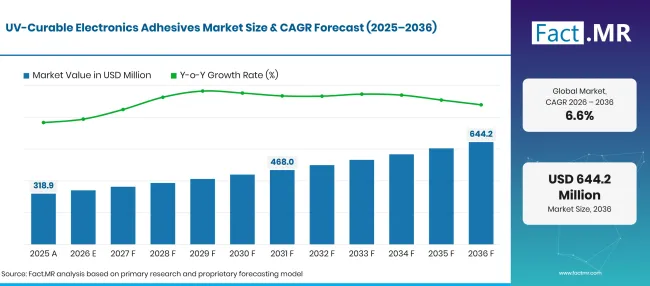
Uv Curable Electronics Adhesives Forecast Global | Source: Fact.MR
Category
| Category | Segments |
|---|---|
| Product Type | UV encapsulant adhesive, UV acrylic adhesive, UV pressure-sensitive, Dual-cure UV and moisture, UV epoxy adhesive |
| Performance Requirement | Chemical durability, Sustainability, Mechanical strength, Heat resistance, Electrical and thermal |
| Region | United Kingdom; Belgium; Germany; Italy; Japan |
Source: Fact.MR analysis. Updated Nov 23, 2026
Segmental Analysis
Why do UV encapsulant adhesives lead product demand in the UV-Curable Electronics Adhesives Market?
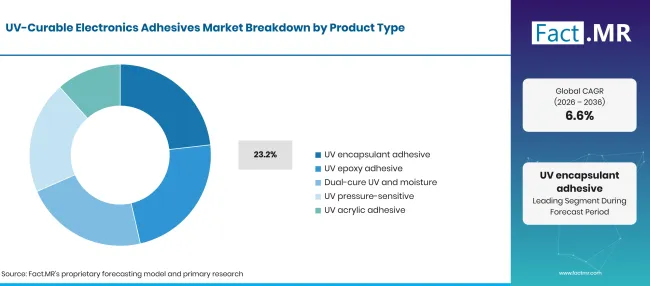
Uv Curable Electronics Adhesives Breakdown Product Type | Source: Fact.MR
UV encapsulant adhesives hold 23.2% of the UV-curable electronics adhesives market in 2026, valued at USD 78.9 million, because glob-top, dam-and-fill and conformal encapsulants protect chips, wire bonds and solder joints from moisture and shock. In February 2026, Henkel introduced Loctite Stycast UV 7998, a UV-curable conformal coating designed to protect electronic boards against moisture and harsh chemicals. Light curing supports faster production. Material suppliers are improving moisture protection and reducing shrinkage to meet electronics assembly requirements.
Why does chemical durability lead performance demand in the UV-Curable Electronics Adhesives Market?
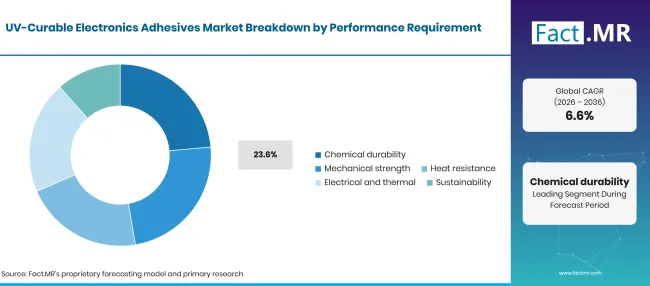
Uv Curable Electronics Adhesives Breakdown Performance Requirement | Source: Fact.MR
Chemical durability represents 23.6% of UV-curable electronics adhesives revenue in 2026, equivalent to USD 80.2 million, as bonded electronics must withstand cleaning solvents, coolants, oils and humid conditions. In April 2025, Henkel introduced Loctite AA 5885, a UV-curable sealing material developed to protect automotive electronic units against high temperatures and harsh conditions. Automotive and industrial applications require reliable material performance. Manufacturers are improving resistance to chemicals and moisture. Sales will depend on curing performance, substrate compatibility and production efficiency.
How is industrial machinery leading end-use demand in the UV-Curable Electronics Adhesives Market?
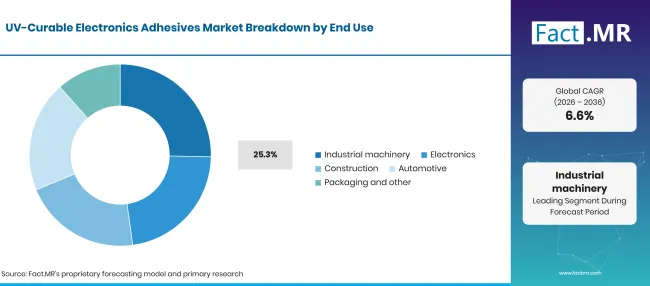
Uv Curable Electronics Adhesives Breakdown End Use | Source: Fact.MR
Industrial machinery holds 25.3% of UV-curable electronics adhesives revenue in 2026, worth USD 86.0 million, because drives, sensors, robots and controllers use bonded and protected electronic assemblies. In September 2026, Dymax introduced BlueWave FX Line Emitters for automated UV curing, supporting faster and more consistent production. Light curing suits industrial assembly lines. Adhesive suppliers are serving automation equipment manufacturers, including those operating in the 3D machine vision market.
UV-Curable Electronics Adhesives Market-Drivers, Restraints & Trends
Drivers
Orders for UV-curable electronics adhesives are increasing as semiconductor and electronics investment expands. For example, Henkel raised its 2026 organic growth outlook for Adhesive Technologies to between 4.5% and 5.5% in October 2026, citing strong electronics demand, and imec inaugurated the EUR 2.5 billion NanoIC pilot line in Leuven in February 2026. Specialist producers are supplying packaging and assembly lines.
Restraints
Demand for UV-curable electronics adhesives is constrained by shadowed areas that light cannot reach and by raw material price increases. For example, Henkel reported that third-quarter 2026 adhesives growth came mostly from price, up 7.2%, with volume up only 0.7%. New orders will follow approved bonding and encapsulation processes rather than electronics sales alone.
Trend
LED Curing and Dual-Cure Systems Demand for adhesives tuned to 365 nm and 405 nm LED lamps is rising because LEDs save energy and run cooler than mercury lamps. Suppliers are adding moisture or heat secondary cure for shadowed joints. Resonac reported strong AI packaging demand in November 2026. Similar process changes are projected to drive sales of UV-curable electronics adhesives, alongside thermal conductive adhesives.
Trend
Lower-Carbon Adhesive Raw Materials Demand for adhesives with bio-based or recycled content is rising as electronics brands set carbon targets. Suppliers are introducing bio-based acrylate monomers. Henkel said in October 2026 that all adhesive business areas contributed to its third-quarter growth. Similar targets are projected to support sales of UV-curable electronics adhesives.
UV-Curable Electronics Adhesives Market by Analysis by Key Country
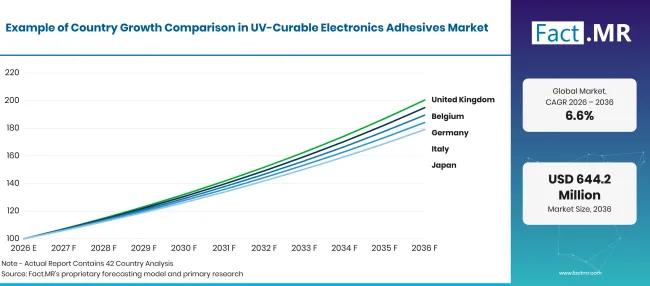
Uv Curable Electronics Adhesives Growth Index | Source: Fact.MR
| Country | CAGR (2026-2036) |
|---|---|
| United Kingdom | 7.2% |
| Belgium | 6.9% |
| Germany | 6.6% |
| Italy | 6.3% |
| Japan | 6.0% |
Source: Fact.MR analysis. Updated Nov 23, 2026
Source: Fact.MR analysis.
What is driving UV-curable electronics adhesives demand in the United Kingdom?
In the third quarter of 2026, the UK National Wealth Fund backed battery materials company Nexeon in a GBP 100 million funding round, while Agratas progressed its GBP 4 billion, 40 GWh gigafactory in Somerset.
Demand for UV-curable electronics adhesives in the United Kingdom is projected to grow at a 7.2% CAGR, the fastest among the five key countries, as battery, sensor and photonics production expands. Material suppliers are serving UK electronics assemblers.
How is chip research supporting UV-curable electronics adhesives sales in Belgium?
Sales of UV-curable electronics adhesives in Belgium are projected to grow at a 6.9% CAGR as semiconductor research expands.
On 9 February 2026, imec inaugurated its NanoIC pilot line and a 2,000 square metre cleanroom extension in Leuven, supported by EUR 2.5 billion in public and private investment. The expansion will support advanced semiconductor research and create opportunities for materials used in electronics assembly and packaging.
What is shaping UV-curable electronics adhesives demand in Germany?
Demand for UV-curable electronics adhesives in Germany is projected to grow at a 6.6% CAGR as automotive electronics and data centre investment continue.
Germany set targets in March 2026 to at least double data centre capacity by 2030. Suppliers of UV-curable electronics adhesives, including Henkel, DELO and Panacol-Elosol, are serving German sensor, camera and power module makers.
How is machinery export demand shaping UV-curable electronics adhesives sales in Italy?
Sales of UV-curable electronics adhesives in Italy are projected to grow at a 6.3% CAGR as machinery builders add more electronics.
UCIMU reported that Italy's machine tool order index rose 10.5% in the third quarter of 2026, with foreign orders up 24.7%. Material suppliers are serving Italian automation, appliance and automotive electronics producers.
Why is growth slower for UV-curable electronics adhesives in Japan?
Demand for UV-curable electronics adhesives in Japan is projected to grow at a 6.0% CAGR, the slowest among the five countries, as Japan is a mature market with established local suppliers such as ThreeBond.
Chip investment continues, with the government planning a further JPY 400 billion for Rapidus, though reports in November 2026 pointed to delays in its 2-nanometer schedule. Specialist producers are focusing on camera and packaging uses.
Competitive Analysis for UV-Curable Electronics Adhesives Market
Electronics adhesive manufacturers are competing through faster curing, precise application and reliable bonding performance. Henkel offers Loctite adhesives for semiconductor packaging and electronic assembly, while DELO specializes in high-precision light-curing materials. Dymax combines UV-curable adhesives with curing equipment, and H.B. Fuller provides bonding solutions for electronic components. ThreeBond and Panacol-Elosol strengthen the competitive field through specialized adhesives for industrial and electronic applications. Product selection depends on curing speed, adhesion strength, dispensing accuracy and long-term reliability.
Advances in semiconductor packaging and LED curing are influencing product development across the industry. In October 2026, Henkel reported 7.9% organic sales growth in its Adhesive Technologies business for the third quarter and raised its full-year outlook. Earlier, in February 2026, imec inaugurated its NanoIC pilot line in Belgium to support advanced semiconductor technologies.
Recent Developments
- In April 2025, Henkel launched LOCTITE AA 5885, a UV-curable gasketing sealant for automotive electronic units, offering rapid curing and protection against high temperatures and harsh operating conditions while reducing manufacturing energy requirements.
- In September 2026, Dymax launched 9208-W and 9209-W light-curable materials for wearable electronics, combining UV and visible-light curing with secondary moisture curing to protect components in areas hidden from direct light exposure.
- In July 2025, Panacol introduced Vitralit UD 8060 F, a dual-curing adhesive for electronics and sensor assembly, combining rapid UV curing with moisture curing to protect components in areas hidden from light.
Key Players in UV-Curable Electronics Adhesives Market
Key companies operating in the market include Henkel, DELO, Dymax, H.B. Fuller, ThreeBond, and Panacol-Elosol.
- Henkel
- DELO
- Dymax
- H.B. Fuller
- ThreeBond
- Panacol-Elosol
Bibliography
- ASML Holding N.V. (2026, February 25). 2025 annual report.
- Dymax. (2026, September 30). Dymax expands light-curable product portfolio for consumer wearable assembly.
- Department for Business, Innovation, Science and Trade. (2026, October 9). Industrial Strategy quarterly update: July to September 2026. GOV.UK.
- European Commission. (2026, February 9). EU invests €700 million in newly opened NanoIC, Europe’s largest Chips Act pilot line.
- Henkel. (2025, April 3). Henkel expands rapid cure gasketing sealant range with Loctite AA 5885, optimized for automotive electronics applications. Official press release
- Henkel AG & Co. KGaA. (2026, November 10). Q3 2026 statement.
- imec. (2026, February 9). Imec inaugurates NanoIC pilot line, accelerating innovation in sub-2nm systems-on-chip.
- imec. (2026, March 2). NanoIC opens access to first-ever fine-pitch RDL and D2W hybrid bonding interconnect PDKs.
- Infineon Technologies AG. (2026, July 2). An impulse for Germany, Europe and the world: Infineon opens the world’s largest fab for power semiconductors and analog/mixed-signal technologies in Dresden.
- Panacol-Elosol GmbH. (2025, July 7). New UV/moisture potting material for electronics and sensor assembly [Press release].
- SEMI. (2026, April 7). SEMI reports global semiconductor equipment billings reached $135 billion in 2025, up 15% year-on-year.
- SEMI. (2026, September 3). Global semiconductor equipment billings increased 23% year-over-year in Q2 2026, SEMI reports.
- UCIMU-SISTEMI PER PRODURRE. (2026, October 13). UCIMU: Order index in the third quarter of 2026 on the rise (+10.5%); foreign orders (+24.7%); domestic orders (-7.1%).
Segmentation
Scope of Report
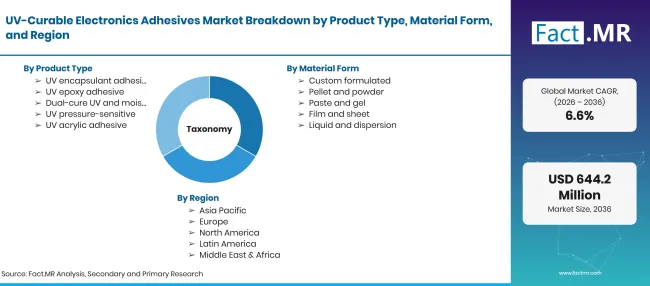
Uv Curable Electronics Adhesives Taxonomy | Source: Fact.MR
| Items | Values |
|---|---|
| Quantitative Units (2026) | USD 340.0 Million |
| Product Type | UV encapsulant adhesive, UV acrylic adhesive, UV pressure-sensitive, Dual-cure UV and moisture, UV epoxy adhesive |
| Performance Requirement | Chemical durability, Sustainability, Mechanical strength, Heat resistance, Electrical and thermal |
| Regions Covered | North America, Latin America, Europe, East Asia, South Asia and Pacific, Middle East & Africa |
| Countries Covered | United Kingdom, Belgium, Germany, Italy, Japan, and other countries |
| Key Companies Profiled | Henkel, DELO, Dymax, H.B. Fuller, ThreeBond, Panacol-Elosol |
| Additional Attributes | Dollar revenue in the UV-Curable Electronics Adhesives Market is segmented by product type (UV encapsulant, UV acrylic, UV pressure-sensitive, dual-cure, UV epoxy), performance requirement, and region. |
Source: Fact.MR analysis. Updated Nov 23, 2026
UV-Curable Electronics Adhesives Market by Segments
-
Product Type
- UV encapsulant adhesive
- UV acrylic adhesive
- UV pressure-sensitive
- Dual-cure UV and moisture
- UV epoxy adhesive
-
Performance Requirement
- Chemical durability
- Sustainability
- Mechanical strength
- Heat resistance
- Electrical and thermal
-
Region:
- North America
- United States
- Canada
- Mexico
- Europe
- Germany
- United Kingdom
- France
- Italy
- Spain
- Rest of Europe
- Asia Pacific
- China
- India
- Japan
- South Korea
- Australia
- Rest of Asia Pacific
- Latin America
- Brazil
- Mexico
- Argentina
- Rest of Latin America
- Middle East & Africa
- GCC Countries
- South Africa
- Rest of Middle East & Africa
- North America
Frequently Asked Questions
How big is the global UV-Curable Electronics Adhesives Market in 2026?
What will be the size of the UV-Curable Electronics Adhesives Market by 2036?
How fast will the UV-Curable Electronics Adhesives Market grow during the forecast period?
Which product type segment holds the largest share of the UV-Curable Electronics Adhesives Market?
Who worked on this report


Preview the report firsthand - request a free sample
Free SampleGet the brochure for pricing and purchase details
Download PDF